In this paper, the concepts of algebraic L-closure system and algebraic L-closure operators are introduced from the fuzzy point of view. It is shown that the category of algebraic L-closure spaces is isomorphic to the category of algebraic L-closure system spaces. It is also proved that the category of algebraic L-closure system spaces is dual to the category algebraic L-lattices.
Closure operators and closure systems play significant roles in several areas of classical mathematics, e.g., topology, algebra, lattice theory, logic, data mining, knowledge representation, and so on. In the classical order theory, they are particularly related to theoretical computer science and have a close relation with Galois connections [6, 7]. Since in any closure system as a complete lattice, join is usually not given by union, algebraic closure systems and algebraic closure operators emerge as the times require. In any algebraic closure system as an algebraic lattice, the join of any directed family is exactly given by set union. This solves the above problem in part.
On the other hand, since the partial order is an important mathematical structure and is useful in many areas, the generalization of the crisp partial order has been studied from the fuzzy point of view. In 1971, the fuzzy orderings was originally introduced by Zadeh [20]. Then, in order to fuzzify the fundamental theorem of concept lattices, the L-ordered set was introduced by Blohlvek [2]. Recently, in order to study quantitative domain theory via fuzzy sets, a kind of L-orders was redefined and studied by Yao [17], where L is a complete residuated lattice. Indeed, it is routine to show that an L-order, in the sense of Blohlvek and that in the sense of Yao are equivalent to each other.
On a set X and for a complete residuated lattice L, a mapping subX : LX × LX ⟶ L is defined by
Then subX is an L-order on LX, called the subsethood operator on X and (LX, subX) is a complete L-lattice. In the complete L-lattice (LX, subX), for any , and , which are the generalization of set intersection and set union in crisp case.
On this special L-ordered set (LX, subX), L-closure operators and L-closure systems were introduced and studied by Blohlvek [1], which are the fuzzification of the corresponding notions on classical powersets. Moreover, the one-to-one correspondence between L-closure systems and L-closure operators was established. Since in the fuzzy setting, the monotony condition of L-closure operators may take several particular forms, Blohlvek [4] proposed a new notion of L*- closure operator which satisfies more general monotony condition than that in [1]. In addition, Georgescu and Popescu [8] presented analogous results in the non-commutative fuzzy framework. In another direction, fuzzy closure systems and fuzzy closure L-systems on general L-ordered sets were introduced [9], which can be viewed as the fuzzification of the corresponding notions on classical partially ordered sets and can also be seen as the generalization of the corresponding notions in [1]. Go on this work, fuzzy interior operators and fuzzy interior systems were investigated [3, 18]. It was also shown that the correspondence between fuzzy interior operators and fuzzy interior systems can be established analogously. Recently, Guo, Li and Zhang [10] proposed a new notion of L∗-closure L-system which can be viewed as an alternative of L∗-closure systems introduced by Blohlvek [4], and Blohlvek and Konecny [5] presented a decomposition theorem for a general L-closure operator and utilize it for computing generators and bases of the L-closure system.
From the previous works, easily discerned is the problem that the join of L-subset of any L-closure system when performed as a L-complete lattice is not the generalization of set union in crisp case. Then, can establishing a special kind of L-closure system similar to classical partially ordered sets solve the aforementioned problem?
The aim of this paper is to propose a special kind of L-closure operators--algebraic L-closure operators, and a special kind of L-closure system--algebraic L-closure system. Moreover, from category view, discuss the relationship between the category of algebraic L-closure operator spaces and algebraic L-closure system spaces. Additionally, establish the L-subset family representation for algebraic L-lattices by algebraic L-closure systems.
The contents are arranged as follows. Section 2 presents some preliminary concepts and properties. Section 3 propose the concepts of algebraic L-closure systems and algebraic L-closure operators. It is shown that there is a bijective correspondence between algebraic L-closure operators and algebraic L-closure systems and the categories of algebraic L-closure operator spaces and algebraic L-closure system spaces are isomorphic. Section 4, from L-order view, focuses on the relationship between algebraic L-closure systems and algebraic L-lattices. Finally, some conclusions are presented in Section 5.
Preliminaries
For the convenience of the reader, in this section, some basic concepts are reviewed. Because of the outstanding properties of the complete Heyting algebra, throughout this paper, it were used as the structures of truth values.
Definition 2.1. [2, 21] An L-ordered set is a pair (X, e) such that X is a set and e : X × X ⟶ L is a mapping, called an L-order, that satisfies for any x, y, z ∈ X,
e (x, x) =1 (reflexivity);
e (x, y) ∧ e (y, z) ≤ e (x, z) (transitivity);
e (x, y) = e (y, x) =1 implies x = y (antisymmetry).
Given two L-ordered sets (X, eX) and (Y, eY), a mapping f : X ⟶ Y is said to be an L-order preserving mapping if eX (x, y) ≤ eY (f (x) , f (y)) for any x, y ∈ X.
Proposition 2.2.[2, 21] Let (X, e) be an L-ordered set. Then
x0 = ⊔ A iff e (x0, y) = ⋀ x∈XA (x) → e (x, y) for any y ∈ X;
x0 = ⊓ A iff e (y, x0) = ⋀ x∈XA (x) → e (y, x) for any y ∈ X.
x ∈ X is called the minimal (maximal) element of A ∈ LX if A (x) =1 and for any y ∈ X, A (y) ≤ e (x, y) (A (y) ≤ e (y, x)).
Let (X, e) be an L-ordered set and x ∈ X. ↓x ∈ LX and ↑x ∈ LX are defined as follows: ↓x (y) = e (y, x) , ↑ x (y) = e (x, y) for every y ∈ X. Moreover, define Al, Au ∈ Ł X as follows: Al (x) = ⋀ y∈XA (y) → e (x, y) , Au (x) = ⋀ y∈XA (y) → A (y, x) for any x ∈ X.
Definition 2.3. [11, 17] Let (X, e) be an L-ordered set. If an L-subset D of X satisfies
⋁x∈XD (x) =1;
for any x, y ∈ X, D (x) ∧ D (y) ≤ ⋁ z∈XD (z) ∧ e (x, z) ∧ e (y, z),
then it is called a directed L-subset in X. In this case, if it is a lower L-subset, then it is called an L-ideal in X. The set of all directed L-ordered subsets in X is denoted by and the set of all L-ideals in X is denoted by .
An L-ordered set (X, e) is called a directed complete L-ordered set if ⊔D exists for any . And it is called a complete L-lattice if for any A ∈ LX, ⊔A exists.
Definition 2.4. [17] Let (X, eX), (Y, eY) be directed complete L-ordered sets. A mapping f : X ⟶ Y is called an L-Scott continuous mapping if it satisfies f (⊔ D) = ⊔ f→ (D) for any .
It is noteworthy that every L-Scott continuous mapping is L-order preserving.
Definition 2.5. [11, 17] Let (X, e) be a directed complete L-ordered set. For x, y ∈ X, define ⇓x ∈ LX as
Let (X, e) be a directed complete L-ordered set and x ∈ X, if ⇓x (x) =1 (or equivalently, I (x) = e (x, ⊔ I) for any ), then we call x a compact element in X, and we denote the set of all compact elements in X by .
Definition 2.6. [14] Let (X, e) be a directed complete L-ordered set and x ∈ X, define K (x) ∈ LX as
If for any x ∈ X, and x = ⊔ K (x), then (X, e) is called a algebraic directed complete L-ordered set. If, in addition, (X, e) is a complete L-lattice, then (X, e) is called an algebraic L-lattice.
Remark 2.7. It is noteworthy that an algebra of directed complete L-ordered sets defined in Definition 2.6 is equivalent to the algebra of Ω-categories given by Yao [19], that is, a directed complete L-ordered set (X, e) is algebraic iff for any x ∈ X, and ⊔kx = x, where , for any .
Let (X, eX), (Y, eY) be L-ordered sets and f : X ⟶ Y be an ordinary mapping. One can define the forward fuzzy powerset operators f→, f← : LX ⟶ LY as follows:
for any A ∈ LX, B ∈ LY and any y ∈ Y, x ∈ X.
Definition 2.8. [11, 16] Let (X, eX) , (Y, eY) be two L-ordered sets and f : (X, eX) → (Y, eY) , g : (Y, eY) → (X, eX) two L-order preserving mappings. The pair (f, g) is called an L-adjunction between X and Y provided that
for all x ∈ X and all y ∈ Y, where f is called the left L-adjoint of g and dually g the right L-adjoint of f.
Definition 2.9. [12, 13] Let (X, e) be an L-ordered set. Then
(X, e) is tensored in the sense that for any a ∈ L, x ∈ X, there is an element a ⊗ x ∈ X, called the tensor of a with x, such that for any y ∈ X, e (a ⊗ x, y) = a → e (x, y);
(X, e) is cotensored in the sense that for any a ∈ L, x ∈ X, there is an element arightarrowtailx ∈ X, called the cotensor of a with x, such that for any y ∈ X, e (y, arightarrowtailx) = a → e (y, x).
Proposition 2.10.[12, 13] Let (X, e) be a complete L-lattice, then for an L-subset A ∈ LX, ⊔A = ⋁ x∈XA (x) ⊗ x and ⊓A = ⋀ x∈XA (x) rightarrowtailx.
Definition 2.11. [1] An L-closure operator on a set X is a mapping C : LX ⟶ LX satisfying
A ≤ C (A) for any A ∈ LX;
subX (A, B) ≤ subX (C (A) , C (B)) for any A, B ∈ LX;
C (A) = C (C (A)) for any A ∈ LX.
Definition 2.12. [1] Let X be a set. A system is called an L-closure system on X if for each A ∈ LX,
Remark 2.13. (1) Let X be a set, , then is an L-ordered set. Moreover, from the view of L-order, is an L-closure system on X is equivalent to that for any , , where is a include mapping, i.e., for any .
(2) From the definition of the L-closure system, it is easy to check that for any L-closure system , .
Algebraic L-closure operators and algebraic L-closure systems
As referred to in the introduction, for any L-closure system as a complete L-lattice, the join of any L-subset of it is not the generalization of set union in crisp case. Therefore, in this section, we introduce the algebraic L-closure operators and the algebraic L-closure systems from L-order view.
Definition 3.1. Let X be a set, be an L-closure system on X. Then is said to be an algebraic L-closure system on X, if for any , .
Remark 3.2. For a set X, it is easy to check that
an algebraic L-closure system is also an algebraic closure fuzzy set system given in [15], that is, it is closed under (point-wise) joins of upward directed families of members of , i.e., for any upward directed families , ;
an L-closure system is algebraic iff for any , .
By definition of algebraic L-closure system, we have that join of any directed L-subset of algebraic L-closure systems is exact the generalization of set union in crisp setting. This partially addresses the question raised in Introduction.
Example 3.4. (1) Given an L-ordered set (X, e), then the set of all L-ideals is an algebraic L-closure system on X.
(2) The set of all fuzzy equivalence relations on a non-empty set X is an algebraic L-closure system on X × X. A fuzzy equivalence θ on X if and only if θ (x, x) =1, θ (x, y) = θ (y, x) , θ (x, y) ∧ θ (y, Z) ≤ θ (x, z) for all x, y, z ∈ X.
(3) Let (X, e) be an L-ordered set, then the set of all L-Frink ideals, denoted , is an algebraic L-closure system on X. An L-subset J ∈ LX is a Frink L-ideal if for any F ∈ K (LX), subX (F, J) = subX (Ful, J). The detailed proof is as follows:
Proof. Since for any ,
and for any ,
which implies that and thus subX) is a complete L-lattice. Moreover, it is easy to check that for any and any , and , which implies that by the completeness of . Therefore, is an algebraic L-closure system.
Note that for any x ∈ X, (↓ x) ul = ↓ x, i.e., . Then we have the following embedding theorem.
Theorem 3.5.Let (X, e) be an L-ordered set and define as x ↦ ↓ x for any x ∈ X. Then is a completion of X via the mapping ↓.
The above theorems tell us that every L-ordered set can be embedded into an algebraic L-closure system by the Yoneda embedding.
Next, we introduce the definition of algebraic L-closure operator.
Definition 3.6. Let C be an L-closure operator on a set X. Then C is called an algebraic L-closure operator, if for any , holds.
Remark 3.7. (1) It is easy to check that C is an algebraic L-closure operator iff for any , holds.
(2) If an L-closure operator C is algebraic, then C (A) = ⋁ B∈LXsubX (B, A) ∧ C (B) for any A ∈ LX.
Example 3.8. For an L-ordered set (X, e), an operator ↓ : LX ⟶ LX defines as follows: for any A ∈ LX, ↓A (x) = ⋁ y∈XA (y) ∧ e (x, y) , ∀ x ∈ X, we can easy check that the operator ↓ is an algebraic L-closure operator.
Theorem 3.9.Let C be an algebraic L-closure operator on X and be an algebraic L-closure system on X. Then is an algebraic L-closure system on X and is an algebraic L-closure operator on X. Moreover, and .
Proof. We only need to show that is algebraic and is algebraic by Theorem 3.4 in [1]. Since for any and any x ∈ X, we have and
is algebraic by Remark 3.7 (1). Next, we show that is algebraic, i.e., for any , . In fact,
which implies that . As for the reverse, we first show that . Define by for any A ∈ LX. Then, we have and so . As and thus , i.e., . Moreover, since
we have
Next, two categories are introduced, called the category of algebraic L-closure spaces and the category of algebraic L-closure systems paces, respectively. An algebraic L-closure space is a pair (X, C) consisting of a set X and an algebraic L-closure closure C on X. A mapping f : X ⟶ Y is called an L-continuous mapping between algebraic L-closure spaces (X, CX) and (Y, CY) if f→ (CX (A)) ≤ CY (f→ (A)). Alternatively, one may introduce algebraic L-closure system spaces as pairs where is an L-closure system on X. A mapping f : X ⟶ Y is called an L-continuous mapping between algebraic L-closure system spaces and if for any . Then we can obtain the following conclusions.
Proposition 3.10. (1) Algebraic L-closure spaces together with L-continuous mappings as morphisms form a category AL - CSP.
(2) Algebraic L-closure system spaces together with L-continuous mappings as morphisms form a category AL - CSSP.
Proof. (1) Let f ∈ HomAL-CSP (X, Y) , g ∈ HomAL-CSP (Y, Z), and IdX : X ⟶ X is an identity mapping. Then, for any A ∈ LX and x ∈ X,
which implies g ∘ f ∈ HomL-CSP (X, Z) and
(2) Let f ∈ HomAL-CSSP (X, Y) , g ∈ HomAL-CSSP (Y, Z), and IdX : X ⟶ X is an identity mapping. Then, for any , by (g ∘ f) ← (B) = f← (g← (B)) and the L-continuity of f, g, we have , which implies g ∘ f ∈ HomAL-CSSP (X, Z). Moreover, for any and x ∈ X, we have .
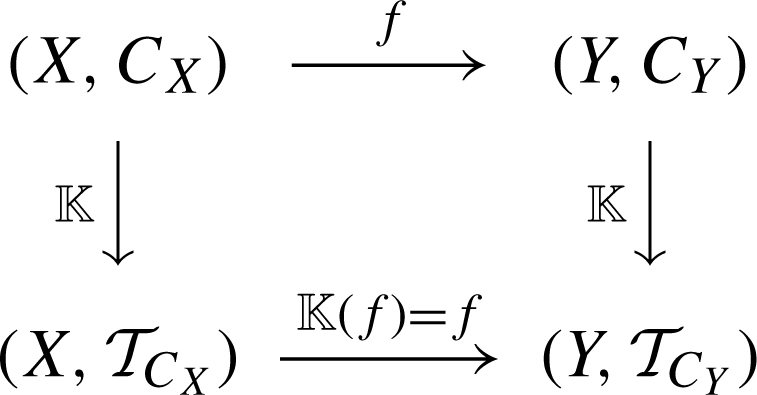
Proposition 3.11. (1) For all (X, CX) , (Y, CY) ∈ ob (AL - CSP) and f ∈ HomAL-CSP (X, Y), let and . Then is a functor from the category AL - CSP to the category AL - CSSP, i.e., the following diagram.
(2) For all and f ∈ HomAL-CSSP (X, Y), let and . Then is a functor from the category AL - CSSP to the category AL - CSP, i.e., the following diagram.
Proof. (1) By Theorem 3.9 and Proposition 3.10, we have that and preserves the composite of morphisms and the identity. Let and y ∈ Y, then
and so
Therefore, we have f← (B) = CX (f← (B)), i.e., which implies that .
(2) Similar to (1), we only need to show that for any f ∈ HomAL-CSSP, . In fact, for any A ∈ LX and y ∈ Y,
and so
By Theorem 3.9 and Proposition 3.11, we obtain the following result.
Theorem 3.12.The categories AL - CSP and AL - CSSP are isomorphic.
It is noteworthy that is a adjoint functor, and so there is a Galois correspondence between the category of algebraic L-closure spaces and that of algebraic L-closure system spaces.
The relationship between the category of algebraic L-closure system spaces and that of
algebraic L-lattices
In order to go to develop the notions of algebraic L-closure system and algebraic L-closure operator and investigate the relationship between the category of algebraic L-closure system spaces and that of algebraic L-lattices, we propose the following lemma.
Lemma 4.1.Let X be a set. Then
for any ;
, where 0X (x) =0 for any x ∈ X;
∀x ∈ X, , where 1x ∈ LX is defi- ned by 1x (y) =1 if y = x, and otherwise, 1x (y) =0;
(LX, subX) is an algebraic L-lattice.
Proof. (1) We only need to show that for any . In fact,
(2) Indeed, for any , we have that
(3) In fact, for any , we have that
(4) Firstly, we show that for any B ∈ LX, . In fact,
and by (1), we have, for any B1, B2 ∈ K (LX),
Second, we show that ⊔K (B) = B. Indeed, for any x ∈ X,
and on the other hand,
Theorem 4.2.Let C be an L-closure operator on a set X. Then the following are equivalent:
C is an algebraic L-closure operator;
for any A ∈ LX and any x ∈ X, C (A) (x) = ⋁ B∈LXK (A) (B) ∧ C (B) (x).
Proof. (1)⇒(2): For any A ∈ LX, and ⊔K (A) = A by the algebra of (LX, subX). Then, for any x ∈ X,
(2)⇒(1): Let , then it follows that
which implies that . For the reverse inequality, we have that for any x ∈ X,
Lemma 4.3.Let C be an algebraic L-closure operator on a set X and let be the associated algebraic L-closure system. Then is algebraic L-lattice in which an element A is compact if and only if A = C (B) for some compact element B in (LX, subX).
Proof. As is a complete L-lattice, we only need to verify that is algebraic. We first show that A is compact in if and only if A = C (B) for some compact element B in (LX, subX). Let B is a compact element in (LX, subX) and let A = C (B). For any ,
which implies that A is compact element in .
Conversely, assume that is a compact element. Certainly,
which implies that there exists such that C (B) = A.
Next, we show that is algebraic. Indeed, for any ,
Therefore, . Moreover, by the algebra of (LX, subX), we have, for any ,
and K (A) (B) ≤ subX (B, A). Hence, we have ⊔K (A) = A.
Theorem 4.4.(1) Let be an algebraic L-closure system on a set X. Then is an algebraic L-lattice.
(2) Let (X, e) be an algebraic L-lattice and , then is an algebraic L-closure system and .
Proof. Part (1) follows from the preceding lemma. For the part (2), we first show that is an L-closure system. In fact, let and let for any x ∈ X, then A ∈ LX and ⊓A exists by the completeness of (X, e). Moreover, for any ,
Next, we prove that the map f : x ↦ kx is an isomorphism of (X, e) onto and that is algebraic. Because (X, e) is algebraic, . Therefore, f is an L-isomorphism.
Let and let , then . We claim that and so belongs to . Indeed, for any , it holds that
Next, we illustrate the theorem by Example 3.3.
By Example 3.3, we have is an algebraic L-closure system on X and is a complete L-lattice, so we only need to check that is algebraic. In fact, by and
we can easy calculate that and thus K (φi) (φj) = subX (φj, φi) for any , which implies that for any , and φi = ⊔ K (φi). On the other hand, we define e : X × X ⟶ L as follows:
By definition one can easily see that (X, e) be a complete L-lattice and . Then, we have ⇓1 (1) = (e (1, ⊔ φ2) → φ2 (1)) ∧ (e (1, ⊔ φ5) → φ5 (1)) ∧ (e (1, ⊔ φ8) → φ8 (1)) = (e (1, 1) →1) ∧ (e (1, 2) →1) ∧ (e (1, 3) →1) =1, which implies and thus it is easy to check that (X, e) is algebraic. Now, let then all L-subsets of are as follows: Φ1 = (0, 0, 0), Φ2 = (1, 0, 0), Φ3 = (0, 1, 0), Φ4 = (0, 0, 1), Φ5 = (1, 1, 0), Φ6 = (1, 0, 1), Φ7 = (0, 1, 1), Φ8 = (1, 1, 1). It is easy to check that , and , , , which implies that is an algebraic L-closure system on X and .
Let L - ALGDOMG denote the category of algebraic L-lattices with L-Scott continuous mappings which having left L-adjoint.
Lemma 4.5.Let g be an L-Scott continuous mapping between algebraic L-lattices (X, eX) and (Y, eY), f be the left L-adjoint of g. Then
f maps compact elements of (Y, eY) to compact elements of (X, eX), that is, ;
has the property that for any , .
Proof. (1) First of all, we observe that for any y ∈ Y and ,
Then we have
which implies that for any , , i.e., .
(2) Let , we claim that is an L-ideal of . Note that for any , I (x) = eX (x, ⊔ I), then for any , it holds that , as (1) and g is the right L-adjoint of f. Thus, H (g) ← (I) = kg(⊔I) is an L-ideal of by the algebra of (Y, eY).
Proposition 4.6.(1) For all (X, eX) , (Y, eY) ∈ ob (L - ALGDOMG) and g ∈ HomL-ALGDOMG (X, Y), let and , where and f is the left L-adjoint of g. Then is a functor from the category L - ALGDOMG to the category AL - CSSPop.
(2) For all and f ∈ HomAL-CSSP (X, Y), let and . Then is a functor from the category AL - CSSP to the category L - ALGDOMGop.
Proof. (1) By Theorems 3.9, 4.4 and Proposition 3.10, we have that and preserves the composite of morphisms and the identity. Moreover, for any x ∈ X, by Lemma 4.5, it holds that , which implies that for any x ∈ X, .
(2) Similar to (1), we only need to show that for any f ∈ HomAL-CSSP (X, Y), . Firstly, for any and x ∈ X,
Then, for any and any x ∈ X,
Therefore, by Theorem 3.5 in [16] and the completeness of , we have .
The above proposition can be shown in following diagrams:
Theorem 4.7.Let is natural isomorphism.
Proof. For any algebraic L-lattice (X, eX), it is obvious that is an isomorphic mapping. Moreover, suppose that (X, eX) , (Y, eY) are algebraic L-lattices and g ∈ HomL-ALGDOMGop (X, Y) with the left adjoint f, then the diagram below is commutative.
In fact, for any x ∈ X, it is easy to check that
i.e.,
Theorem 4.8.L - ALGDOMG is dual to AL - CSSP.
Proof. The proof can be accomplished in two steps by Proposition 4.6 and Theorem 4.7.
Step 1. We show that the functor ⟶AL - CSSP is faithful. Suppose that (X, eX) and (Y, eY) are all algebraic L-lattice, g1 ≠ g2 ∈ HomL-ALGDOMG (X, Y), and f1, f2 are the left adjoint of them, respectively. we have that . Otherwise, , then for all x ∈ X, , i.e., , and so kg1(x) = kg2(x), which implies g1 = g2 by the algebra of (Y, eY). This is contradiction with g1 ≠ g2.
Step 2. We show that the functor is full, i.e., for any HomL-ALGDOMG (X, Y), is surjective from HomL-ALGDOMG (X, Y) to . Suppose that f ∈ HomAL-CSSP, then f is L-order preserving, since eY (y1, y2) = f← (f (y2)) (y2) ∧eY (y1, y2) ≤ f← (f (y2)) (y1) = eX (f (y1) , f (y2)) for any . Let g (x) = ⊔ i→ (f← (kx)), then for any ,
Next, we show that g is an L-Scott continuous mapping between algebraic L-lattices (X, eX) and (Y, eY). In fact, for any y ∈ Y,
Therefore, for any ,
Therefore, g is L-order preserving and thus is an L-adjunction between and . Finally, let h (y) = ming← (↑ y) for any y ∈ Y. Then h is the left L-adjoint of g by Theorem 3.4 in [16]. In order to complete the proof, we still show that h (y) = f (y) when . In fact, for any , eX (f (y) , ⊓ g← (↑ y))) ≥ g← (↑ y) (f (y)) = eY (y, g ∘ f (y)) ≥ eY (y, y) =1 which implies that ⊓g← (↑ y) ≥ f (y). For the converse inequality, for any x ∈ X,
which implies that ⊓g← (↑ y) ≤ f (y). Therefore, by Theorem 2.6 in [16], it obtains that f (y) = ming← (↑ y) and thus h (y) = f (y) for any .
Conclusions
Taking the complete Heyting algebra as the structure of truth value, we proposed the notions of the algebraic L-closure system and the algebraic L-closure operator, which generalize the corresponding notions on crisp setting. From L-order view, the algebraic L-closure system has the property that the join of directed L-subset of it is the generalization of set union in crisp case. This partly solves the problem mentioned in Introduction. Moreover, in order to exploit the relationship between the algebraic L-closure systems and the algebraic L-closure operators, we showed that there is a one-to-one correspondence between these two structures and obtained that the category of algebraic L-closure spaces is isomorphic to the category of algebraic L-closure system spaces. As a result of our study, it followed that the category L - ALGDOMG is dual to AL - CSSP.
Acknowledgments
This work is partially supported by the National Natural Science Foundation of China (Nos. 11371130 and 11561002), the National Basic Research Program of China (No. 2011CB311808), the National Social Science Foundation of China (No. 12BJY122), and the Science Foundation of Education Committee of Jiangxi (No. GJJ14481).
References
1.
BělohlávekR., Fuzzy closure operators, Journal of Mathematical Analysis and Applications262 (2001), 473–489.
2.
BělohlávekR., Concept lattices and order in fuzzy logic, Annals of Pure and Applied Logic128 (2004), 277–298.
3.
BělohlávekR. and FuniokováT., Fuzzy interioroperators, International Journal of General Systems33(2004), 315–330.
4.
BělohlávekR., FuniokováT. and VychodilV., Fuzzyclosure operators with truth stressers, Logic Journal of theIGPL13 (2005), 503–513.
5.
BělohlávekR. and KonecnyJ., Bases of closure systemsover residuated lattices, Journal of Computer and SystemSciences82 (2016), 357–365.
6.
DaveyB.A. and PriestleyH.A., Introduction to Lattices and Order, second ed., Cambridge University Press, Cambridge, 2002, p. 8.
7.
GierzG., HofmannK.H., KeimelK., LawsonJ.D., MisloveM. and ScottD.S., Continuous Lattices and Domains, CambridgeUniversity Press, 2003.
8.
GeorgescuG. and PopescuA., Closure operators and concept equations in non-commutative fuzzy logic, TatraMountains Mathematical Publications27 (2003), 67–90.
9.
GuoL.K., ZhangG.Q. and LiQ.G., Fuzzy closure systems on Lordered sets, Mathematical Logic Quarterly57 (2011), 281–291.
10.
GuoL.K., ZhangG.Q. and LiQ.G., A note on L-fuzzy closure systems, International Journal of Fuzzy Systems18 (2016), 110–118.
11.
LaiH.L. and ZhangD.X., Complete and directed complete --categories, Theoretical Computer Science388 (2007), 1–24.
12.
StubbeI., Categorical structures enriched in a quantaloid: Categories, distributors and functors, Theoryand Applications of Categories14 (2005), 1–45.
13.
StubbeI., Categorical structures enriched in a quantaloid: Tensored and cotensored categories, Theory and Applications of Categories16 (2006), 283–306.
14.
SuS.H. and LiQ.G., Algebraic fuzzy directed-complete posets, Neural Computing and Applications21(2012), 255–265.
15.
SwamyU.M. and Viswanadha RajuD., Algebraic fuzzy systems, Fuzzy Sets and Systems41 (1991), 187–194.
16.
YaoW. and LuL.X., Fuzzy Galois connections on fuzzy posets, Mathematical Logic Quarterly55(2009), 84–91.
17.
YaoW. and ShiF.G., Quantitative domains via fuzzy Scott sets: Part II: Fuzzy topology on fuzzy directedcomplete posets, Fuzzy Sets and Systems161 (2011), 1–21.
18.
YaoW. and ZhaoB., Kernel systems on L-ordered sets, Fuzzy Sets and Systems182 (2011), 101–109.
19.
YaoW., A duality between --categories and algebraic --categories, Electronic Notes in Theoretical ComputerScience301 (2014), 153–168.
20.
ZadehL.A., Similarity relations and fuzzy orderings, Information Sciences3 (1971), 177–200.
21.
ZhangQ.Y., XieW.X. and FanL., Fuzzy complete lattices, Fuzzy Sets and Systems160 (2009), 2275–2291.