



Abstract
This paper proposes a mathematical programming approach to construct an appropriate membership function extending our previous studies. It is important to set a membership function with both subjectivity and objectivity to obtain a reasonable optimal solution based on decision maker’s feelings in real-world decision making. In order to ensure objectivity of obtained membership function as well as subjectivity, an entropy-based approach based on mathematical programming is integrated into interval estimation considered by the decision maker. As a general entropy with fuzziness, fuzzy Harvda-Charvat entropy is introduced, which is a natural extension of fuzzy Shannon entropy. In addition, qualitative and subjective evaluations based on the pairwise comparison are introduced to represent the differences between two membership values. The main step of our revised approach is to solve the proposed mathematical programming problem strictly using nonlinear programming. In this paper, the given membership function is assumed to be a piecewise linear membership function as approximation of nonlinear functions, and each intermediate value of partial linear function is optimally obtained.
Introduction
In the real-world, it is most important to do appropriate decision making. The optimal solution derived from a mathematical programming problem with constant parameter values is often not appropriate for the decision maker, because there are many uncertainties in the real-world. Uncertainty is generally represented as a random variable using statistics in the case the decision maker receives numerical data, and it is better to deal with stochastic programming approaches to obtain the optimal solution. On the other hand, it is also important to mathematically formulate other uncertainty derived from human sentiment, utility, and subjectivity. One standard approach to represent the uncertainty mathematically is Fuzzy theory. The most important element is to set a membership function (MF). Many approaches to develop the MFs for fuzzy sets have been shown in some surveys (for instance, Gottwald [8]). In previous standard approaches, a specific MF such as Trapezoidal and Gaussian functions is initially assumed. However, it is difficult to select the appropriate MF and to set the membership values statistically. One of the revised approaches is heuristic method. If a decision maker defines the MF using some heuristic methods subjectively, she/he may obtain the optimal solution close to decision maker’s feeling. However, the objectivity of optimal decision is not mathematically and statistically guaranteed, and hence, it is difficult to evaluate whether this optimal decision is good for other people in the society with the decision maker or not.
In order to overcome this disadvantage, more rigorous approaches have been proposed in terms of objectivity and statistics. For instance, some researchers adopted transformation from a probability distribution to a possibility distribution (for instance, Bharathi and Sarma [3]). As an important approach, Civanlar and Trussell [7] proposed a mathematical programming approach to define the MF for a certain group of fuzzy sets by minimizing fuzziness based on the probability density function (PDF) derived from real-world data. This approach has been extended by some researchers (for instance, Cheng and Cheng [6] and Nieradka and Butkiewicz [17]). Particularly, some researchers extended Civarnlar and Trussell’s study using a fuzzy entropy. Cheng and Cheng [5] proposed an automatic determination approach of the MF based on the maximum entropy principle. We [11] also proposed a constructing approach using fuzzy Shannon entropy to obtain optimal parameters of S-curve MF. The advantage of fuzzy entropy-based approaches is that the decision maker can objectively obtain the MF, because almost all parameters are automatically determined by solving the mathematical programming problem. However, human cognitive behavior and subjectivity may not be sufficiently reflected in the obtained MF. Therefore, it is important to develop a constructing approach to integrate subjective and objective approaches.
On the other hand, in terms of appropriateness of heuristic approaches, Chameau and Santamarina [4] compared four heuristic approaches to construct MFs and concluded that the interval estimation approach to set intervals with membership values 0 and 1 is better than the others. Yoshikawa [20] also proposed an interactive identification method on the form of MFs. His proposed approach is also based on the interval estimation and questionnaires related to the degree of membership. In real-world decision making, a decision maker can confidently set two intervals with membership values 0 and 1, because he/she can subjectively and objectively explain how to set these intervals. Thus, the interval estimation method has some advantages in terms of practical application of heuristic approaches. However, it is hard to set the appropriate MF from membership values 0 to 1 using the only heuristic method. Furthermore, it is not natural to introduce a specific MF. In [9], we introduced a piecewise linear MF as a general nonlinear MF and developed a constructing approach based on Civarnlar and Trussell’s model and fuzzy entropy. We [10] also constructed an interactive approach to set lower and upper membership values with respect to some elements except for intervals with respect to membership values 0 and 1.
However, our previous approach could not prove the relation between Civarnlar and Trussell’s approach and entropy-based approaches mathematically. Therefore, in order to improve our previous approaches, we introduce Harvda-Charvat entropy [12]. Harvda-Charvat entropy and very similar entropies [15, 19] are natural extension of Shannon entropy, and have been also extended to fuzzy entropy [2, 16]. We mathematically prove the relation between Civarnlar and Trussell’s approach and entropy-based approaches by using fuzzy Harvda-Charvat entropy.
In addition, our previous approached did not consider introducing effective information of piecewise comparison by the decision maker. In the case of noise, the decision maker can easily evaluate “Noise level i is higher than level j.” Analytic hierarchy process (AHP) is one of standard methodologies for decision making using the pairwise comparison [4], but we cannot obtain the detailed MF. As a mathematical programming approach, Lagreze and Siskos [13] proposed UTA method to assess additive utility functions which aggregate multiple criteria in a composite criterion. This approach is based on an ordinal regression method using linear programming to estimate the parameters of the utility function. Most recently, Yoshizumi [21] proposed a mathematical programming-based approach to obtain the objective functions from qualitative and subjective comparisons. Using these approaches, we proposed an extend approach to maximize fuzzy Harvda-Charvat entropy under the regression method using linear programming to estimate the parameters of MF based on piecewise comparison.
Consequently, the originality of this paper is as follows: The MF can be constructed without assuming a PDF and a specific MF such as triangle and Gaussian MFs. The MF can be both objectively and subjectively obtained by solving the mathematical programming as well as introducing the pairwise comparison. The optimal membership values can be straightforwardly obtained by applying our proposed efficient algorithm.
This paper is organized as follows. In Section 2, we introduce fuzzy Shannon entropy and fuzzy Harvda-Charvat entropy based on the standard entropy in information theory. We also introduce a piecewise linear function to apply our constructing approach. In addition, we introduce regression method using linear programming, particularly Yoshizumi’s qualitative and subjective comparisons. In Section 3, we formulate a mathematical programming problem maximizing the fuzzy Harvda-Charvat entropy under constraints of the total average membership value derived from the given PDF and regression method derived from piecewise comparison. We obtain the optimal membership values under KKT condition. Furthermore, we also develop an interactive approach for the appropriate MF. Finally, in Section 4, we conclude this paper and discuss future researches.
Mathematical definition for appropriate membership function
We introduce mathematical definitions to develop a mathematical programming approach to construct an appropriate MF integrating the decision maker’s interval estimation with a given PDF. The main step of our proposed approach is to solve Civarnlar and Trussell’s model maximizing fuzzy Harvda-Charvat entropy of a piecewise linear MF from membership values 0 to 1 under information of piecewise comparison. In the next subsections, we introduce each mathematical definition.
Civarnlar and Trussell’s model
As a mathematical approach to obtain a membership function objectively, Civanlar and Trussell [7] considered minimizing fuzziness of MF based on the PDF derived from real-world data. The continuous MF μ (x) is obtained by solving the following mathematical programming problem under given PDF p (x):
The objective function is to minimize fuzziness of μ (x), that is, it means that the size of a fuzzy set is as small as possible [7]. As an important constraint in problem (1), the total expected membership value
Various definitions of fuzzy entropy have been proposed (for instance, Al-sharhan and Karray [1], Nieradka and Butkiewicz [17], Pal and Bezdek [18]). For instance, Shannon entropy for random events is one of the most standard entropies in information theory, and formulated as
On the other hand, as a natural extension of Shannon entropy, Harvda and Charvat [12] defined the following entropy:
If we consider q → 1, (3) is equivalently transformed into Shannon entropy
In addition, we consider maximizing simple fuzzy Harvda and Charvat entropy (4), and can equivalently transform the following form in the case q = 2:
Therefore, Civarnlar and Trussell’s model is the same as the Harvda and Charvat entropy-based model under q = 2.
In real-world decision making, it is often subjective to determine a specific MF such as trapezoidal and Gaussian functions, and hence, it is not appropriate to apply the optimal solution straightforwardly. In statistics and machine learning, a piecewise linear function is introduced as a general nonlinear function, because almost all nonlinear functions are approximately formulated as a corresponding piecewise linear function. Therefore, it is natural to introduce a piecewise linear membership function as a general MF. In order to formulate a piecewise linear function, we divide received data into n groups and set
In I
k
, we introduce the following piecewise linear function:
In the case that the MF is determined by using this linear membership function, parameters ck-1 and c
k
are replaced as membership values
In this paper, we assume that PDF p (x) is a histogram, i.e., ∫x∈I
k
p (x) dx = p
k
, ∀ x ∈ I
k
. Of course, our proposed approach can be apply to any PDFs, but we focus on the histogram which can be constructed from only received data without assuming the specific PDF. In this case, it is also natural to divide intervals including all data into same width, that is, a
k
- ak-1 = T, ∀ k ∈ { 1, 2, …, n } holds. Furthermore, from this assumption, we can consider optimizing each intermediate value μ
k
based on
Subjective and objective evaluation of utility function based on mathematical programming
Yoshizumi [21] proposed a method to objectively determine a utility function from the decision maker’s qualitative and subjective evaluations. The idea is to use a scale for measuring such as the Likert scale based on paired differences of two feasible solutions, and to formulate these differences as constraints in mathematical programming.
We assume that the utility function consists of K metrics which is represented as
However, this formulation cannot represent the difference between “better than” and “far better than” strictly. Therefore, Yoshizumi [21] introduced the following definition each boundary. A decision maker evaluates that solution i is “similar to” solution j. A decision maker evaluates that solution i is “better than” solution j. A decision maker evaluates that solution i is “far better than” solution j.
This situation represents 3 point satisfaction of Likert scale. Of course, it is easy to define 5 or 7 point satisfaction in the same manner. We define R0 = R≈, R1 = R> and R2 = R>> in the above-mentioned 3 point satisfaction.
From these definitions, the decision maker’s pairwise comparison of n alternative solutions is mathematically represented as the following constraints:
Under these constraints, the optimal weight in the decision maker’s utility function is obtained to solve the following problem [21]:
This problem is a linear programming problem of
In this section, we extend our previous approach to construct the appropriate MF. Particularly, to simplify the following discussion, we focus on a monotonous increasing MF to connect two intervals with membership values 0 and 1 set by the decision maker shown in Fig. 1. We can also easily apply the extended approach in this section to various MFs such as L-R fuzzy number.
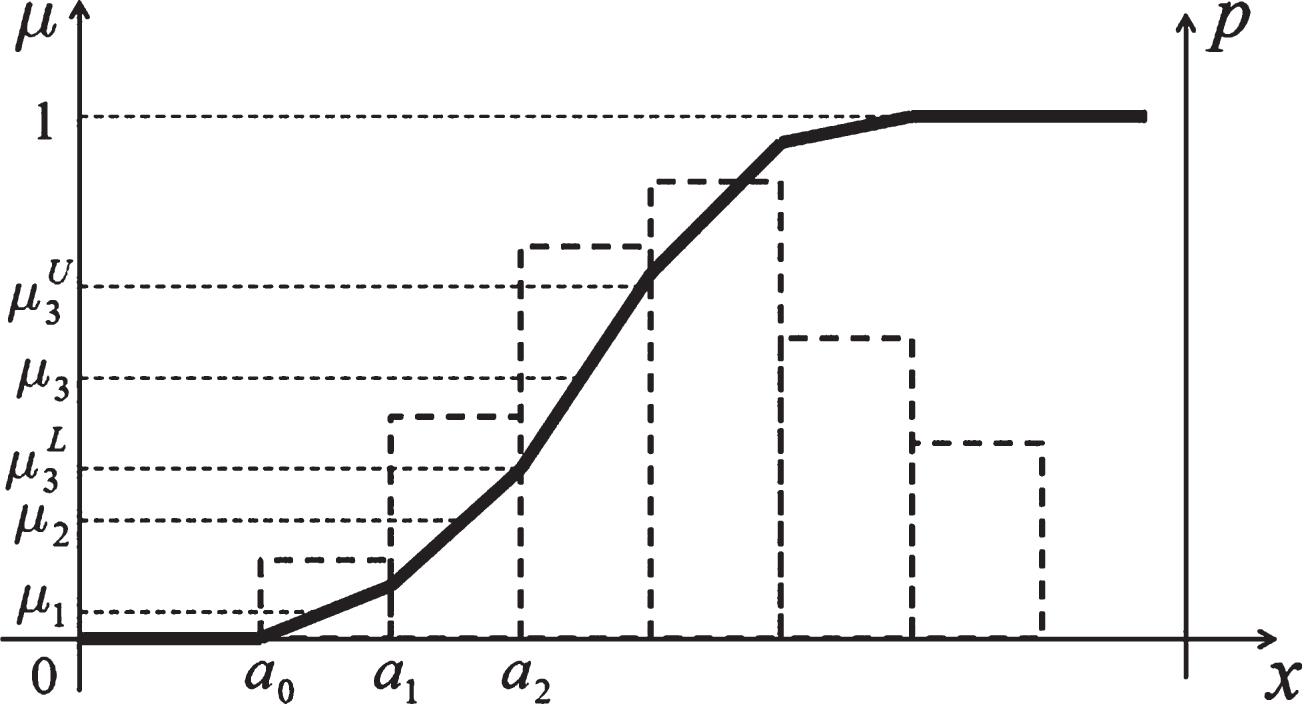
Outline of MF (solid line) under histogram-based PDF (dotted line).
We assume that each endpoint of two intervals is initially set by the decision maker.
The main objective function of our approach is to maximize the fuzzy Harvda-Charvat entropy. The available data is histogram-based PDF p
k
corresponding to I
k
derived from real-world data and information of pairwise comparison by the decision maker. Constraints are based on Civanlar and Trussell study [6]. In addition, from the pairwise comparison using the interview or questionnaire to the decision maker such as Likert scale, membership values at the intermediate value
From the received pairwise comparison by decision maker, the appropriate MF is obtained as the optimal solution of the following problem to integrate problem (2) with formulas (4) and (9):
In this subsection, we divide problem (11) into two problem: (i) linear programming problem based on problem (9) to obtain the baseline membership value, and (ii) convex programming problem which is a simplification of problem (11). The first problem (i) is formulated as follows:
The decision variables are μ
i
and ɛ
ij
, and this problem is a linear programming problem. Therefore, we can efficiently obtain the optimal value of problem (12). In this subsection, the optimal value is represented as
Next, we focus on the second problem (11). In order to obtain the explicit optimal membership value, we propose the following problem introducing adjustment values
In problem (13), without loss of optimality, we substitute
This problem is a simple extension of Civanlar and Trussell problem (2) considering the balance from baseline membership values. The Lagrange function is also obtained as follows:
With respect to first Equation in (16), there are three patterns of optimal membership values
To simplify the following discussion, we consider that
The optimal value
We assign the optimal value
The membership value
Therefore, the optimal membership function
If we find parameter ramda
From these discussions and interactive setting based on the decision maker’s pairwise comparison, the following interactive constructing approach to obtain the strict membership value is developed.
In Step 4, if the decision maker considers that the that the difference between
Using the proposed approach, all parameters are straightforwardly calculated. Furthermore, in terms of fuzzy entropy, fuzzy Harvda and Charvat entropy includes fuzzy Shannon entropy as a special case. Therefore, our proposed approach is also more efficient and more versatile than previous approaches.
In order to show the obtained membership function, we provide a simple numerical example based on a histogram-based PDF according to proposed approach shown in subsection 3.2.
In Step 1 of the proposed approach, the decision maker sets histogram-based PDF p (x) and the intervals with membership values 0 and 1. This example considers a comfortable temperature. A decision maker receives each interval I
k
= [ak-1, a
k
] and the corresponding probability ∫x∈I
k
p (x) dx = p
k
derived from the histogram-based PDF p (x) in subsection 2.4 as shown in Table 1 and Fig. 2. The decision maker also sets two intervals x ≤ 14 with μ (x) = 0 and x ≥ 14 with μ (x) = 1, that is,
Numerical date of interval I
k
and corresponding probability p
k
Numerical date of interval I k and corresponding probability p k
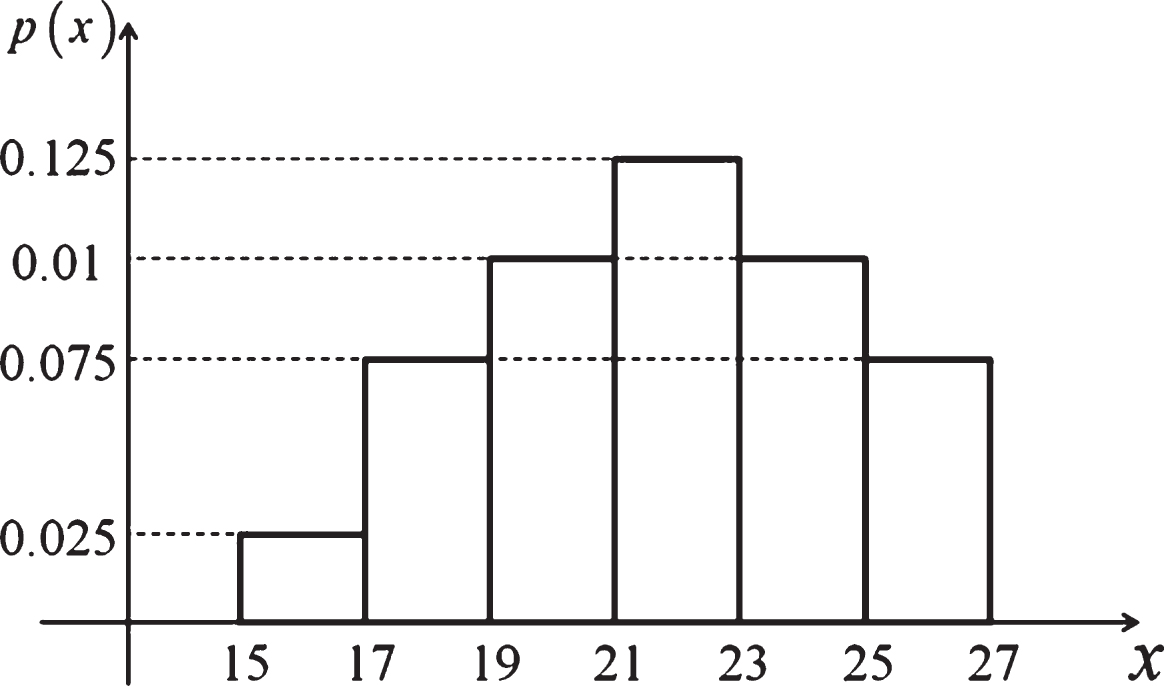
Histogram-based PDF p (x) derived from numerical data in Table 1.
In addition, in Step 1 of the proposed approach, the decision maker does the pairwise comparison. In this numerical example, the decision maker performs the following 5 point satisfaction in subsection 3.1 to two intermediate values of I k as shown in Table 2.
Data of 5 point satisfaction and the corresponding two intervals
(u): R u based on 5 point satisfaction in subsection 2.4 (u = 0, 1, 2, 3, 4). -: the decision maker does not compare two intermediate values.
Corresponding to 5 point satisfaction, parameters b u , (u = 0, 1, 2, 3, 4) are set as 0.1, 0.3, 0.5, 0.7 and 0.9, respectively. q in the Harvda-Charvat entropy is also initially set as q = 3.
From these input data, we solve problem (12) at Step 2 of the proposed approach, and obtain each baseline membership value
Optimal membership values
Next, we solve problem (13) according to Step 3 of the proposed approach, and obtain the optimal membership value
In Step 4, the decision maker compares current optimal membership value
In general, the obtained membership function derived from Civanlar and Trussell’s model (2) is strongly dependent on the given PDF. This numerical example provides the histogram-based PDF, and hence, the only histogram-based membership function is obtained from Civanlar and Trussell’s approach [7]. On the other hand, as shown in Fig. 3, the proposed approach can be obtained various membership functions considering the decision makers feeling from subjective and objective evaluations not restricted to the given PDF. Therefore, the proposed approach is more flexible than previous approaches.
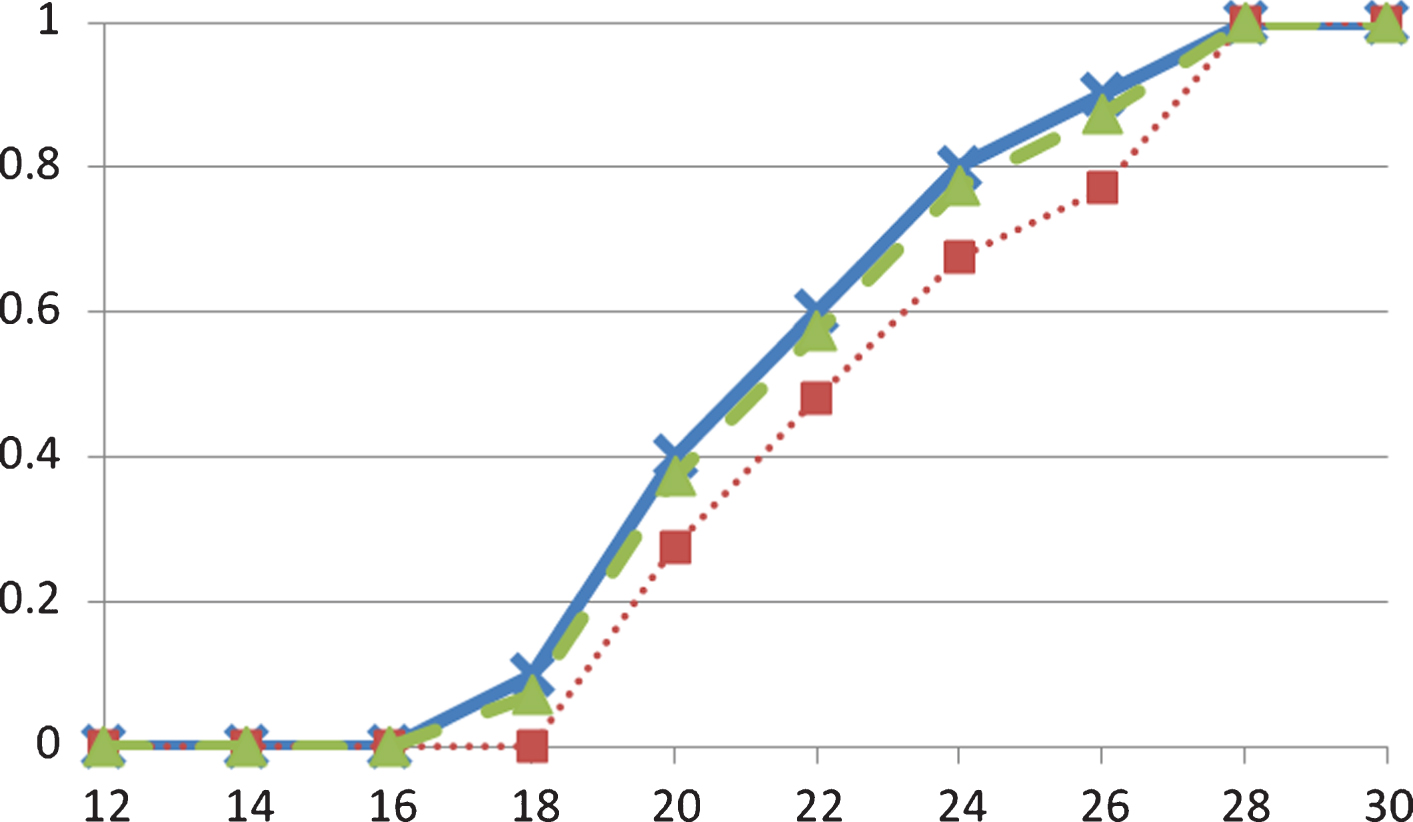
The obtained membership functions
In this paper, we have improved our previous constructing approach to obtain an appropriate and objective membership function using fuzzy Harvda and Charvat entropy under the given probability density function and information of piecewise comparison. The proposed approach has been formulated as a mathematical programming problem based on Civanlar and Trussell’s model, and we have solved it efficiently using linear programming and strict algorithm with the parametric approach. This paper’s approach is more versatile than previous approaches in terms of both theory and application, because we introduce some effective information of pairwise comparison, and do not assume a specific membership function. Therefore, the obtained membership function will be useful in many social problems dependent on human feelings.
As a future work, we need to develop some objective evaluation methods whether our approach is more appropriate comparing with previous approaches. The decision maker can obtain the membership function using our constructing approach, but it is not easy task to evaluate the fitness between the obtained function and the real function to exist in decision maker’s mind. Particularly, in the real-world decision making, it is important whether current decision is best or not.