



Abstract
In order to improve the recognition rate and the recognition time of the low resolution image, the face recognition technology based on matching degree and local phase quantization is studied. In face recognition, the dynamic time warping strategy is applied to the fast extraction of face contour, and a parallel matching local phase quantization algorithm is proposed to realize the face recognition, which can be expressed by a number of 2D curves extracted from the surface. The experimental results verify the feasibility and effectiveness of the proposed algorithm on the face database of ORL, Yale B and AR, and show it can obtain better recognition results especially in real time and robustness.
Introduction
With the rapid development of the construction of smart city, a variety of security equipment and technical means can be seen everywhere, especially the face recognition technology is developing rapidly. In today’s information society, the application of personal identity authentication technology is ubiquitous, which is based on fingerprint, iris, face and other human biometric identification technology in a number of areas there is a huge market demand [1]. Face recognition is an important biometric identification methods, has the advantages of less interference to users and features only, intuitive and easy to conceal, interactive and convenient, and has a broad application prospect in many fields, such as authentication, security surveillance, human-computer interaction, system security and visual communication [2]. How to get the effective expression of human face features and design a strong classifier to become the key to face recognition, while the actual environment is not controllable factors increase the difficulty of obtaining [3]. For the face, the main way to improve the recognition rate is to reduce the data dimension and extract the discriminate features efficiently. Face recognition technology will effectively promote economic and social development, and bring good market economicbenefits.
In the current development trend of cloud computing, big data, and Internet, the development of face recognition by the impact and contradictions embodied in the three aspects of data security, data control, data standards. The development of face recognition is affected by three aspects of data security, data control and data standards. Face recognition technology consists of three parts: face detection, face tracking, and face alignment. Face detection is to determine whether there is a face image in a dynamic scene and a complex background, and to separate the image from the image. Face tracking is the dynamic object tracking of the detected face, which is based on the combination of motion and model. A face alignment is a target search for an identity that is detected as an identity or in a face image database. The key technology of this method is to compare the sampled surface image with the face image, and find the best matching object. Therefore, the description of the face image determines the specific method and the performance of the recognition. This method mainly uses the feature vector and faces template two description methods. Face recognition technology is the core of the actual local human characteristics analysis, this algorithm is the use of human facial organs and characteristic parts of the method, the general requirements to determine the time of less than 1 second. Face recognition has been an active research field of computer vision and biometrics over the last two decades with numerous proposed systems. Figure 1 shows the disguised face images from the sameperson.
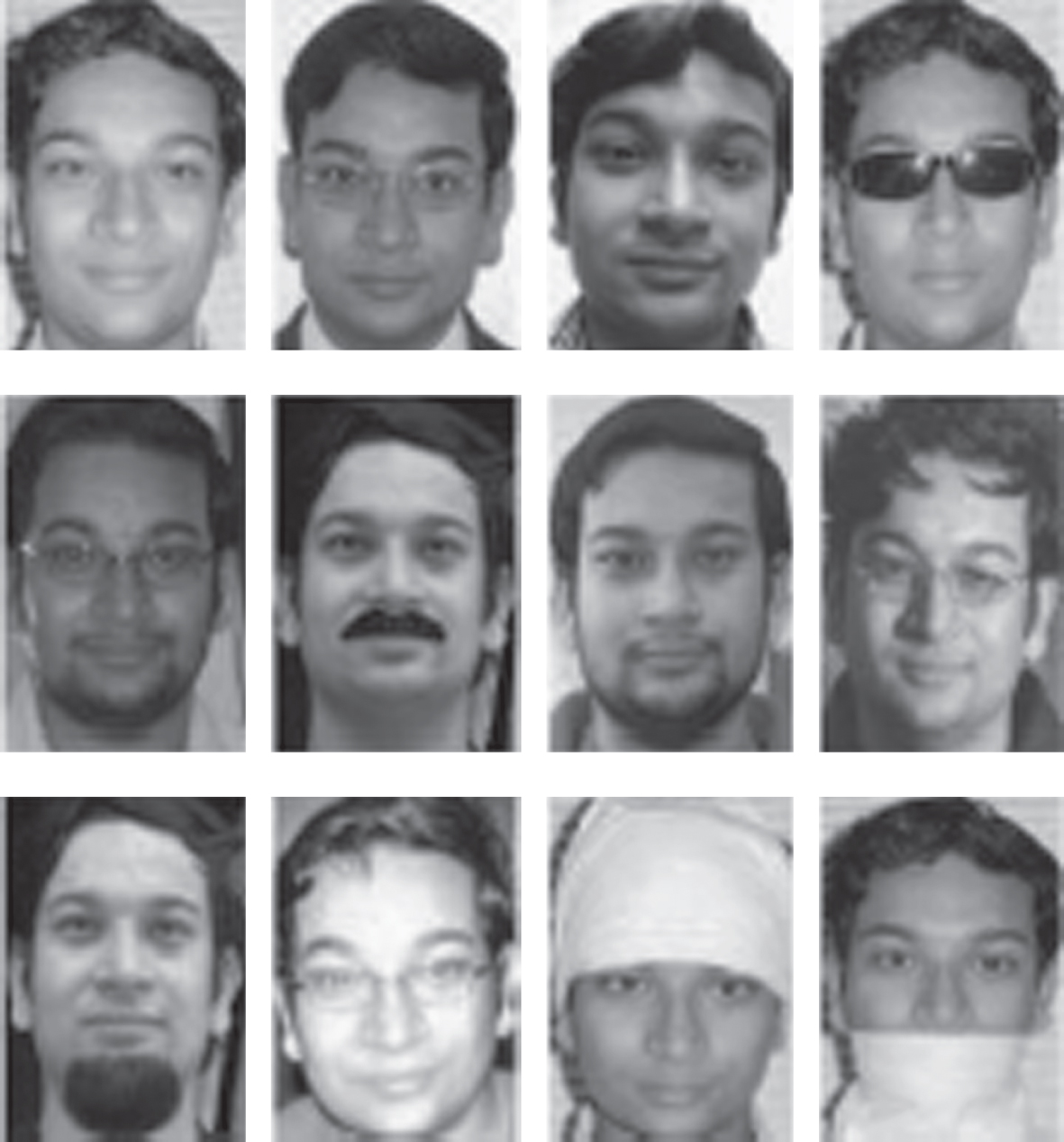
Disguised face images from the same person.
In a specific constraint environment, if the face image of high resolution and image quality is good, then the face recognition rate will be relatively high. But in practical applications, due to light, shooting conditions, facial expressions, gestures and other factors caused by low image resolution, image quality is poor, resulting in the rate of face recognition is not particularly ideal [4]. Therefore, it has more practical significance for face recognition based on low resolution images, and the research of low resolution face recognition has gradually become a new hot spot in the field of face recognition. In face recognition, feature extraction is one of the most critical aspects [5]. In general, most of the features are extracted from an object, and remain stable under certain conditions. Its essence can be regarded as an object of information compression or other transformation processing [6]. To extract the feature of human face is to represent the human face. At the same time, a good feature should have the characteristics of high recognition rate and short recognition time.
The main objective of this paper is to improve the traditional local binary pattern (LBP) algorithm and improve the accuracy and efficiency of face recognition. In this paper, an effective face recognition algorithm based on parallel local phase quantization and matching degree, called PMLPQ, is studied for face recognition. PMLPQ can be expressed by a number of 2D curves extracted from the surface. From the point of view of object recognition, the outline contains a lot of information. If the outline is clear, a large number of objects can be basically accurate identification. The experimental results verify the feasibility and effectiveness of the proposed algorithm on the face database of ORL, Yale B and AR, and show it can obtain better recognition results especially in real time and robustness.
The rest of this paper is organized as follows: A brief overview of the related works is presented in Section 2. Section 3 discusses the system optimization model, and the parallel matching local phase quantization algorithm is proposed in Section 4. The simulation results and performance analysis is presented in Section 5. Finally, Section 6 concludes the paper.
Face recognition is one of the most important research topics in pattern recognition and artificial intelligence. Due to difficulties of overcoming illumination, resolution, expression, pose, age and disguised variations, it has remained a hot research direction. The research of face recognition technology can be traced back to 1960s. Through the unremitting efforts of the researchers, the two-dimensional face recognition technology based on image is becoming more and more mature. Under certain constraints related research has been made good recognition results, and produced some excellent recognition algorithm, its main focus in the research of 2D face recognition, often using principal component analysis (PCA), linear discriminate analysis (LDA) and local binary matching LBP algorithm.
In recent years, Local Discriminate Embedding (LDE) and Markov Random Field (MRF) for non frontal face reconstruction and positive virtual face recognition has obvious effect. Although they can overcome the influence of illumination and pose changes to a certain extent, they have single information, which is difficult to cope with the face recognition in complex environment. The goal of PCA is to find the largest data set, divergence of the projection axis, and the goal of LDA is the divergence between the maximum and minimum within class scatter to find discriminate subspace. However, LDA often deal with small sample problems when dealing with high dimensional data.
In recent years, sparse representation in compressed sensing is a new research filed and hot topic in signal processing. The method of face recognition based on LBP [7] has attracted more and more attention. By extracting the texture features of human face, it has the characteristics of simple calculation, monotonic gray level, and translation invariant and so on. Ojala T, et al. also proposed Uniform pattern of LBP, greatly reducing the image feature dimension, reducing the amount of computation, but also lost a lot of information. At the same time, he proposed the rotation invariant LBP, which makes the image rotation invariant.
Most recognition algorithms have high recognition rate for face images with similar pose and facial expression. However, the recognition rate of most algorithms will be greatly decreased when the facial expression or pose changes. In order to preserve the integrity of the texture information, Guo et al. proposed a Complete Local Binary Pattern (CLBP) based on the LBP, which used the mean curvature and Gauss curvature to classify the concave and convex shape of the face, and then apply it to texture classification. Experimental results showed that the proposed method is robust to illumination and noise [8].
In the face image, more curve information is facial contour, facial features and so on. The curve singularity affects many wavelet coefficients, which cannot be the optimal representation of the human face. For the human face, the main way to improve the recognition rate is to reduce the data dimension and extract the discriminate features efficiently. Ahonen et al. described the characteristics of the fuzzy face image based on Local Phase Quantization (LPQ), and then face recognition, and finally achieved a good recognition effect [9].
Three dimensional data is an irregular, disordered, and even disordered point set, which is much more difficult to deal with the 3D data. Chua et al. proposed a face recognition method based on Signature Point (PS) [10], which was used to characterize the shape of the point in the shape of a curve in the neighborhood of a point on the face surface. Wang et al. proposed a deformation model called GCD (constraints deformation guidance-based) model, which considers the plastic deformation caused by the facial expression from 2 angles. Lee et al. proposed a weighted Hausdorff distance based on the depth value, which essence is to give different importance to the points in different regions of the face, and to extract the important feature points and edges of the face with the curvature. The weighted Hausdorff distance is weighted by the depth of the corresponding feature region.
The first and well-known Gabor wavelets based system is elastic bunch graph matching [11] where face images are represented as labeled graphs, which are generated by utilizing a special data structure called bunch graph to collect information from Gabor jets. Dr. Lee Y.H. et al. [12] introduced augmented Gabor feature vector and used enhanced fisher linear discriminates model to form Gabor- Fisher- classifier (GFC) method. J.A. Russell et al. [13] proposed a multi-scale block LBP (MB-LBP) algorithm where the LBP computation is operated on mean values of pixels’ sub-region instead of the pixel itself. MB-LBP is claimed to capture both micro-structures and macro-structures from image patterns and therefore it could yield higher performance.
System models
Assume that X = [x1, x2, …, x n ] is data matrix, which contains all training samples set {x i |x i ∈ R n , i = 1, …, n}, and n denotes dimensions. The purpose of linear dimension reduction is to transform the data of high dimensional space to the low dimension space, that is to say y = W T x ∈ R d (d << n).
With the increase of time, facial contour and facial texture will be a certain change. Face feature extraction is to say that a good feature should have a high recognition rate and recognition time is short. In this paper, we use the nearest neighbor classification algorithm to classify the face of the test samples, and then calculate the rate of face recognition. The recognition rate can be defined as follows:
In which, TT
right
is the number of correctly identified, TT
test
is the number of test samples. Face recognition algorithm is determined by the recognition rate, the practicality of the algorithm is measured by the recognition time.
In which, n i is the number of the class i samples, m i is mean vector of the class i samples, m is the mean vector of whole samples, denotes the jth sample of class i.
In digital image processing, blur effects can be modeled by a discrete linear relationship defined by a convolution between the image intensity and a point spread function. Assuming that the feature points at around the neighborhood δ is the feature points set G, and the number of feature points of the neighborhood δ is k. The credibility assessment vector of feature points r
i
is V
i
= {v1, v2, …, v
k
, …, v
m
} at the time t, and the credibility assessment vector of feature points r
i
is at the time t + Δt. Then, the matching degree of feature points r
i
can been given as:
In which, n denotes the scale of confidence level, m is the types of feature attributes, . We can know from the above definition: 0 ≤ Match _ Feat (i) ≤1. The value is close to 1, which indicates that the matching degree of feature points is similar to that of the feature points.
As the training image is close to the recognition time, the feature change is smaller, so the time is close to the feature matching degree value is higher. In this paper, the attenuation function is introduced att _ Trust (i, t). The attenuation function att _ Trust (i, t) of the feature points r
i
over time can been given as:
In which, t is the current time, t ij is the last modified time.
Facial expressions are important for human interaction both in the context of interpersonal communication and man-machine interfaces. There are a number of difficulties in facial expression recognition due to the variation of facial expressions across environmental change. Feature credibility is defined as follows:
Local Phase Quantization algorithms
In 2008, a local phase quantization (LPQ) algorithm was proposed by Ojansivu et al. which is a kind of texture feature descriptor with fuzzy invariance [14, 15]. The recognition effect of LPQ algorithm in face image texture feature description is better.
For image f (x), the field of M × M labeled as N
x
adopts discrete short-term Fourier transformation, specific formulas can be given as follows:
The phase information of local phase quantization can be extracted using the two dimensional windowed Fourier transform [16]. Local Fourier coefficient is calculated by four frequency points u1 = [a, 0]
T
, u2 = [a, 0]
T
, u3 = [a, a]
T
, and u4 = [a, - a]
T
. a represents a very small area, . For each pixel location, the vector is denoted as follows:
Fourier coefficient phase can be expressed by each part of the real and imaginary symbol:
In which, g
j
is the jth part of vector G (x), and G (x) is defined as following:
Then, g
j
execute binary coding for it, and the corresponding LPQ value of this point can be calculated by the following formula:
As a result, we get the LPQ value which is a 256 dimensional vector used for classification. In other words, the range of LPQ is an integer between 0–255.
Because the LPQ algorithm is the premise of uniform illumination and image acquisition, image acquisition is actually the environmental brightness differences caused by describing the texture of the image LPQ algorithm is not accurate enough, resulting in distortion of the local details of face image.
In order to improve the recognition accuracy, we will define the feature domain, feature matching degree and feature credibility in this section. When the feature of the feature set is consistent, the feature points can be obtained by comparing the features of the image and the training image, and the multiple training images can be obtained. Then, we can know the credibility of the feature points by means of calculating the similarity.
Image in the face recognition system is divided into the acquisition of images and training images. The collected image is a face image captured by the image acquisition device, and the training image is the image that has been preserved for feature contrast. By using the feature points of the training image to find the optimal matching results in the image acquisition, the position and the matching degree of each feature point are obtained. The matching degree of all feature points is sorted, and the initial populations P with high to low order is formed, P = {X1, X2, …, X N }. N is the total number of feature points. By N feature point to form m populations and each population has n feature point, N = mn. The m feature points with the highest matching degree are assigned to different populations, and the optimal solution X best of the feature points with the highest matching degree is the highest matching degree in each point set.
When the position of the corresponding feature points of the optimal solutions of all populations are no longer changed, the features are considered to be successful, then the q feature points of the population and their corresponding feature points are the feature points.
In the feature space R n , set A is assumed to include all the samples which belong to class A. And if there are any two samples x and y in set A, there must be a set B for any τ > 0:
If the feature points satisfy the condition of the neighborhood feature group δ, then the feature points agree successfully, and only the other feature points of the population are adjusted in the next evolution. In the adjustment process, if the population is better than the optimal matching degree solution of a feature point in the population, in the sorting process by the feature points of the solution instead of the optimal solution, and the formation of the new population, and enter into the next evolution. After the success of the recognition, the feature value of the collected image is compared with the feature value of the existing training feature list. If the matching degree of the feature value of the collected image is larger, then the feature value of the training feature list is replaced by the feature of the image acquisition image, and the reliability is calculated. Finally, the proposed algorithm achieves the best coverage of the target with all the feature points. Figure 2 shows the PMLPQ algorithm operators, include horizontal, vertical and symmetric pair.
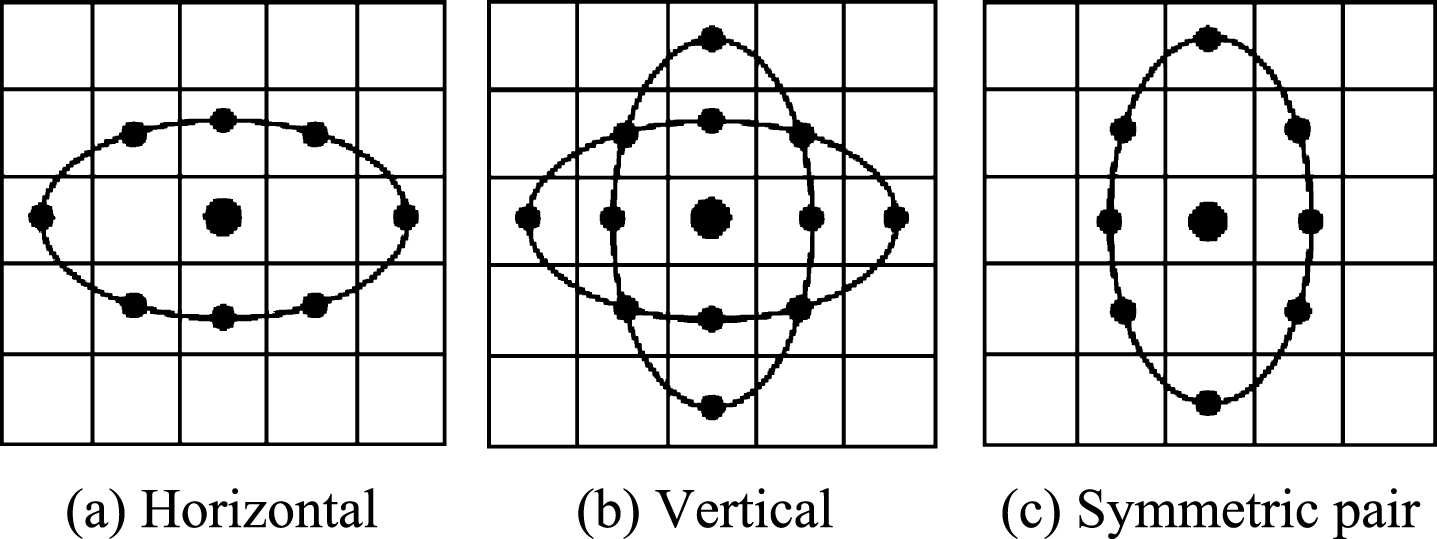
PMLPQ algorithm operators.
This paper carries on the simulation data analysis using MATLAB 2015 based on Aoliweidi research laboratory (ORL) face database, Yale B face database and Aleix-Robert (AR) face database. ORL face database is a common face database, and the resolution of each image is 112×92 after cutting and other pre processing [17]. In order to facilitate the test, this paper randomly selected 20 people from the library and each people samples 10 pieces as the test object. Yale B face database is a standard library of variable illumination, which contains all the range of illumination space. The Yale B database contains 2414 front face images of 38 people [18]. Each person has about 64 face images under different illumination conditions. These images are taken under different poses, illumination and expression. This paper randomly selected 10 people from the Yale B library, and each people samples 20 pieces as the experimental data, which the resolution of each image is 192×168 after cutting to retain part of the image of the face. AR face database is a widely accepted evaluation library. AR database contains 4000 individuals of 126 face images. Each person has 26 images, the 26 images were taken at two different times (two weeks apart). Each shot includes face images of different expression, illumination and occlusion.
The number of samples per person and the resolution of the human face image on each database are different, which is mainly to verify the adaptability of the algorithm. ORL face database in the face images have more expression, posture and other changes. In the ORL face database, each people randomly selected 5 face images as a training sample, and the remaining 5 face images as a test sample. In the Yale B face database, each people randomly selected 10 face images as a training sample, and the remaining 10 face images as a test sample. AR face database not only contains more images than the Yale B face database, and the facial expression, pose, and illumination condition of the face images in the database are much larger than that of the Yale B database.
In order to test the validity and practicability of the algorithm, this paper compares the recognition rate of PMLPQ algorithm with LPQ and MFA algorithms under different decomposition stages. Table 1 shows the matching degree of the same person in different posture, and Table 2 shows the matching degree of different person in the same posture. The matching degree is the average value of each test group, which tests 20 times.
The matching degree of the same person in different posture
The matching degree of the same person in different posture
The matching degree of the different person in same posture
The experimental results can be seen from Tables 1 and 2 that the matching degree of PMLPQ algorithm is the highest under the condition of the same person in different posture. The matching degree of PMLPQ algorithm is the lowest under the condition of the different person in the same posture, thus effectively improve the division. The experimental results show that the proposed PMLPQ algorithm can effectively improve the accuracy of face recognition, which shows the effectiveness of the proposed PMLPQ algorithm.
Face recognizing in unconstrained environment causing in different perturbations and changes to face appearance is very challenging for an automated system. Figure 3 shows the comparison of the recognition rate of ORL samples at different resolutions ration. Figure 4 shows the comparison of the recognition rate of Yale samples at different resolutions ration. Figure 5 shows the comparison of the recognition rate of AR samples at different resolutions ration.
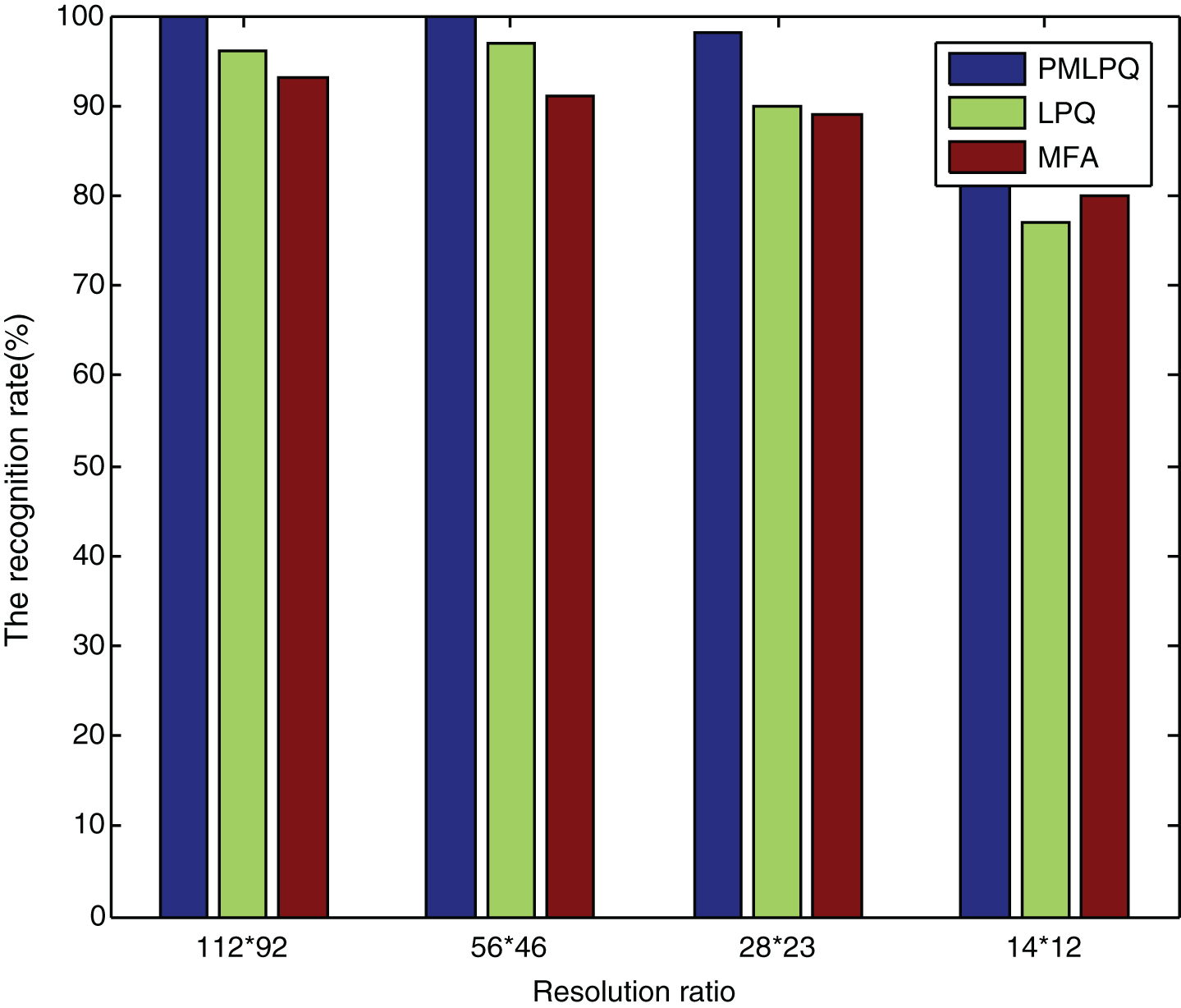
The recognition rate of three algorithms with different resolution ratio for ORL samples.
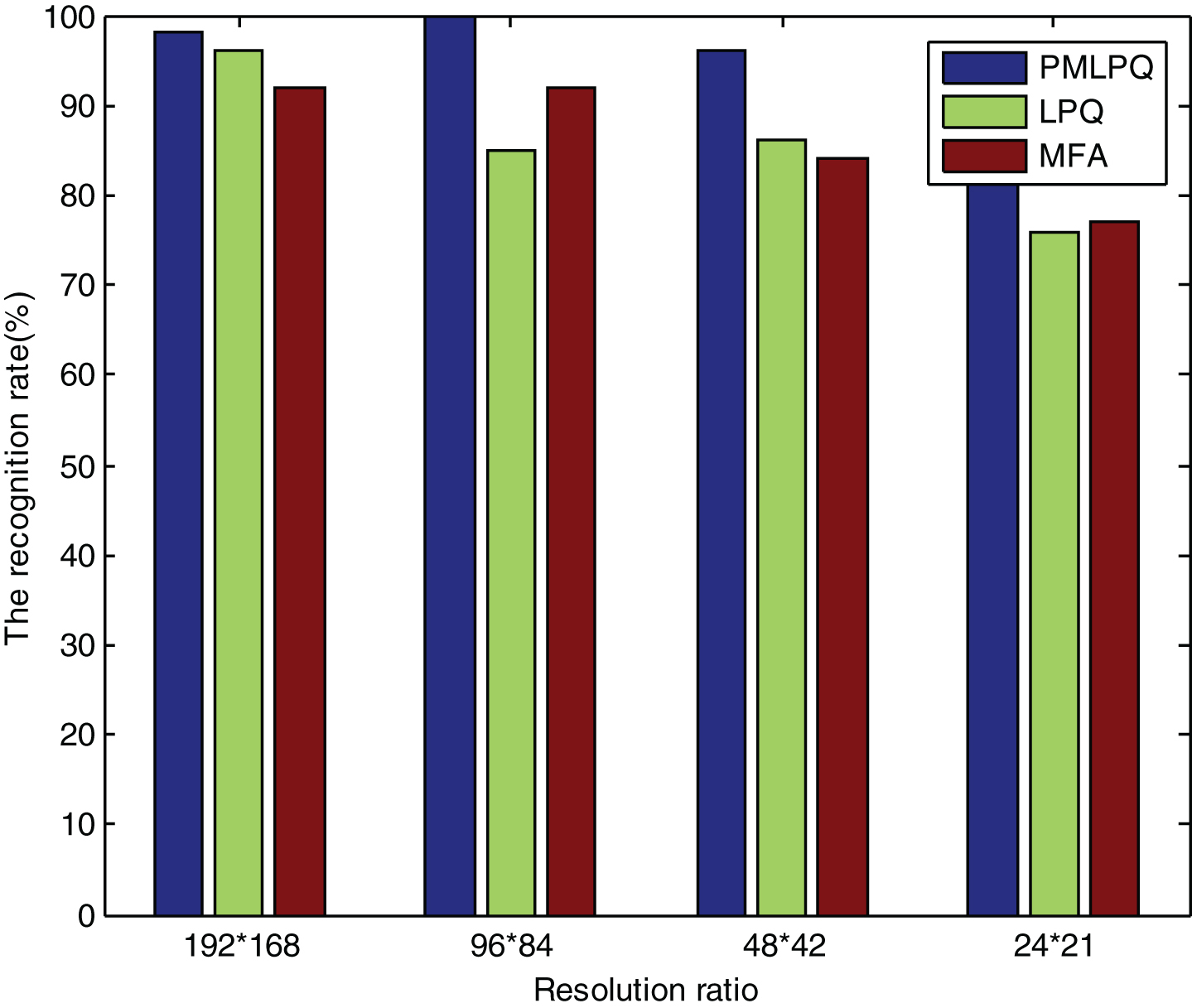
The recognition rate of three algorithms with different resolution ratio for Yale B samples.
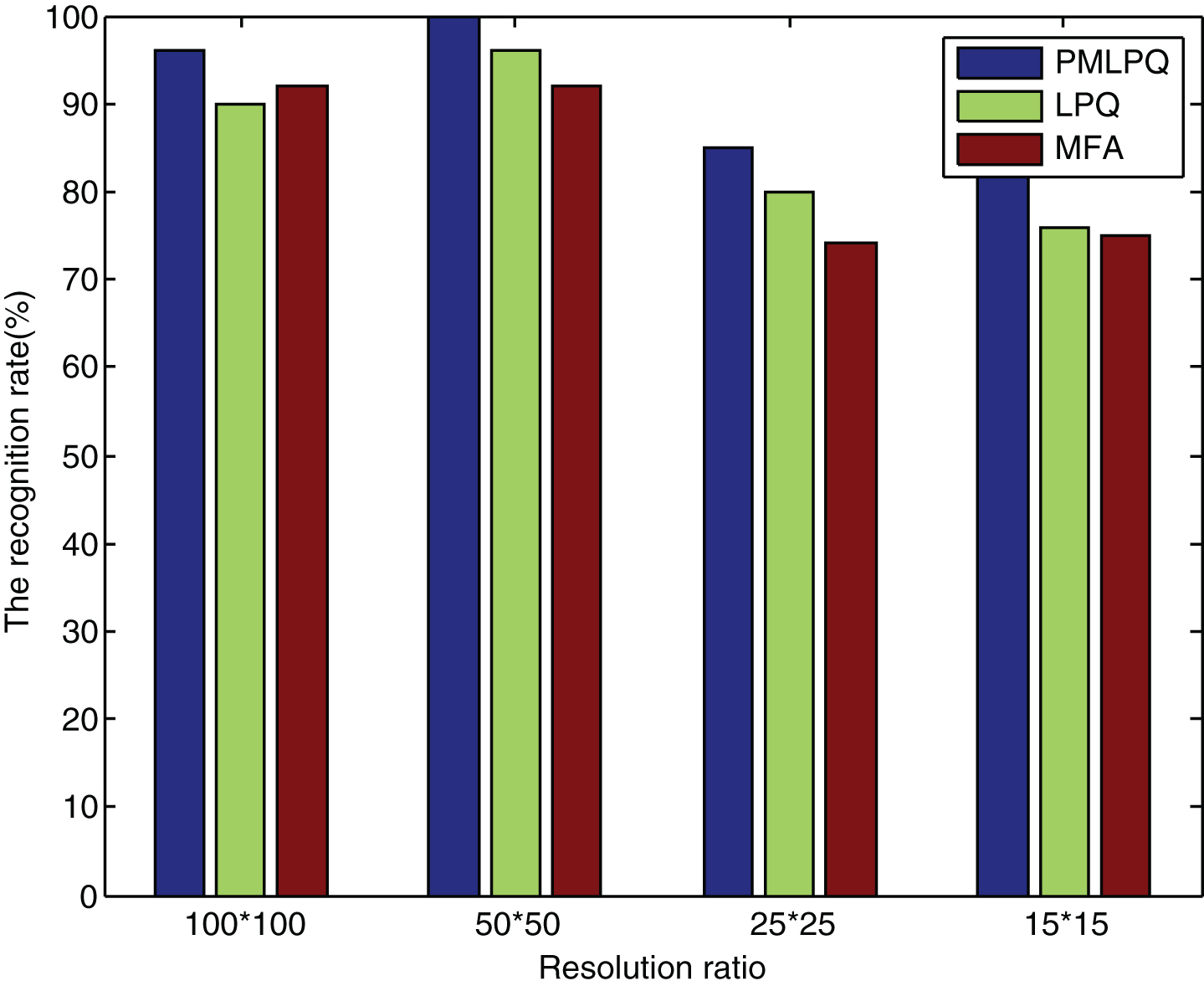
The recognition rate of three algorithms with different resolution ratio for AR samples.
Experimental results show that the performance of the three algorithms is not large in the case of high resolution. However, the recognition rate of the three algorithms is reduced when the resolution is gradually reduced. But with the increase of dimension, the average recognition rate of PMLPQ decreased, and the performance of LPQ and MFA was not stable. When the number of training samples increases, the average recognition rate of the PMLPQ algorithm is improved, which indicates that the training set should involve more human face changes.
Figure 6 shows the recognition rate of three algorithms with different degrees of occlusions to facial expressions. As can be seen from Fig. 6, PMLPQ algorithm gets very higher performance compared with LPQ and MFA. Generally, the recognition rates will be worse while the rations of the occlusion parts of the image become larger. When testing images corrupted by 10%, 20%, 30%, 40%, 50% respectively, recognition rates of PMLPQ algorithm are 65.2%, 50.8%, 38.1%, 24.8%, and 20.7%. But when the testing images are damaged more than 20%, the other methods recognition rates are less than 35%.
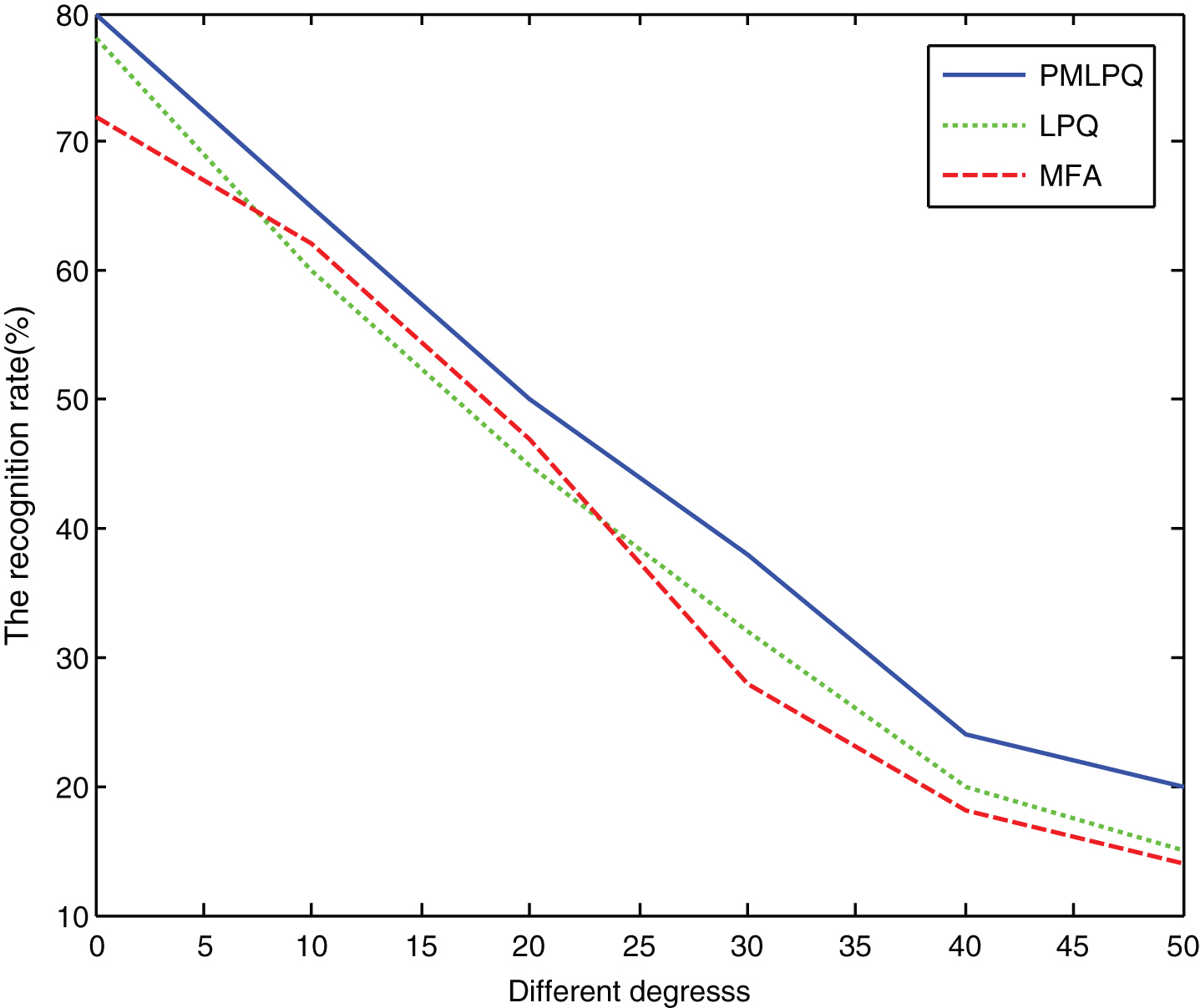
The recognition rate of three algorithms with different degrees of occlusions to facial expressions.
Figure 7 shows the recognition rate of three algorithms on different expressions. Figure 8 shows the recognition time of three algorithms with different degrees of occlusions to facial expressions. It can be seen from Fig. 7 that the recognition rate of PMLPQ is much higher than the LPQ and MFA for most facial expressions, especially in facial expression 2 (happy) the proposed PMLPQ approach get a recognition rate as high as 100%.
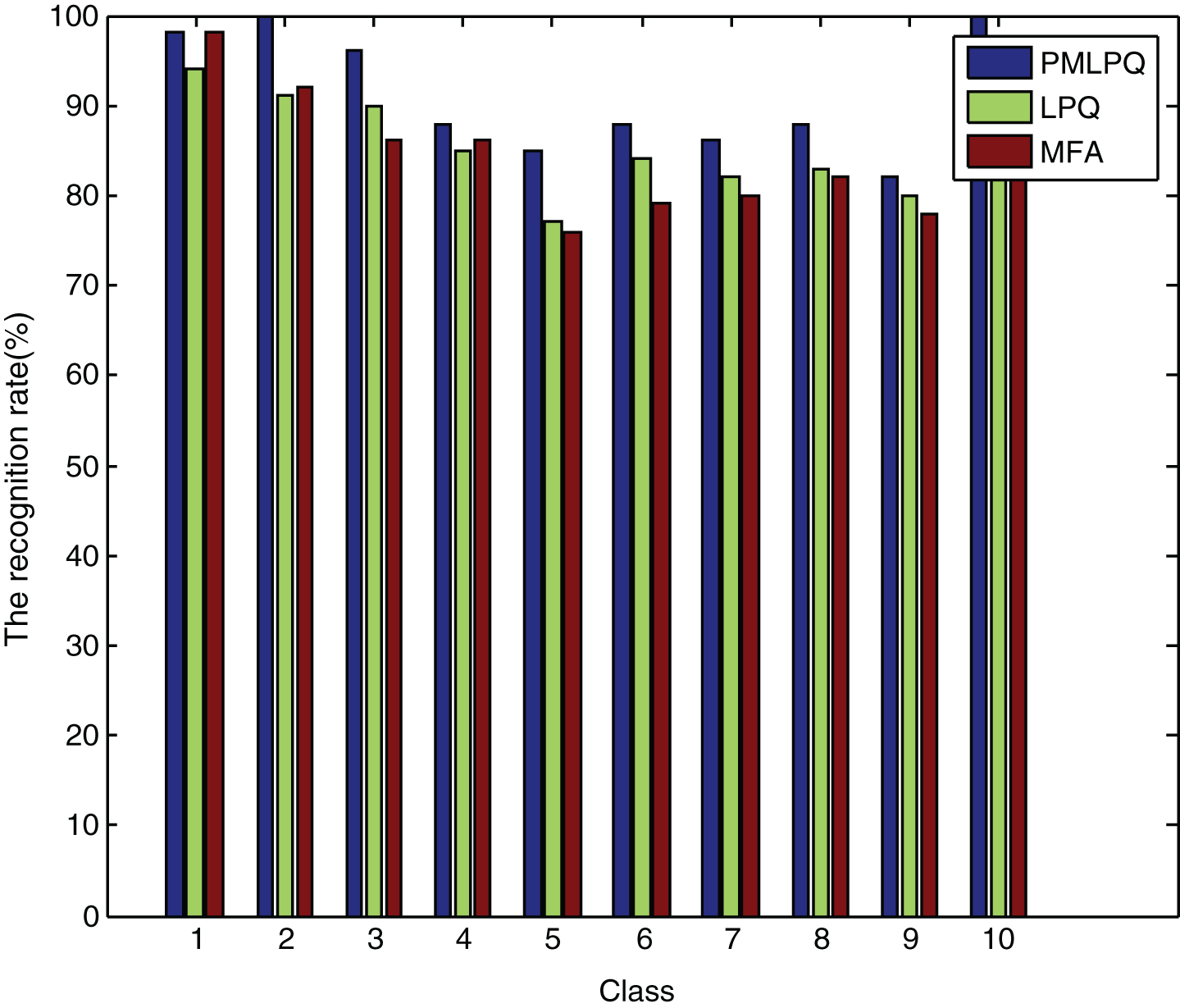
The recognition rate of three algorithms on different expressions.
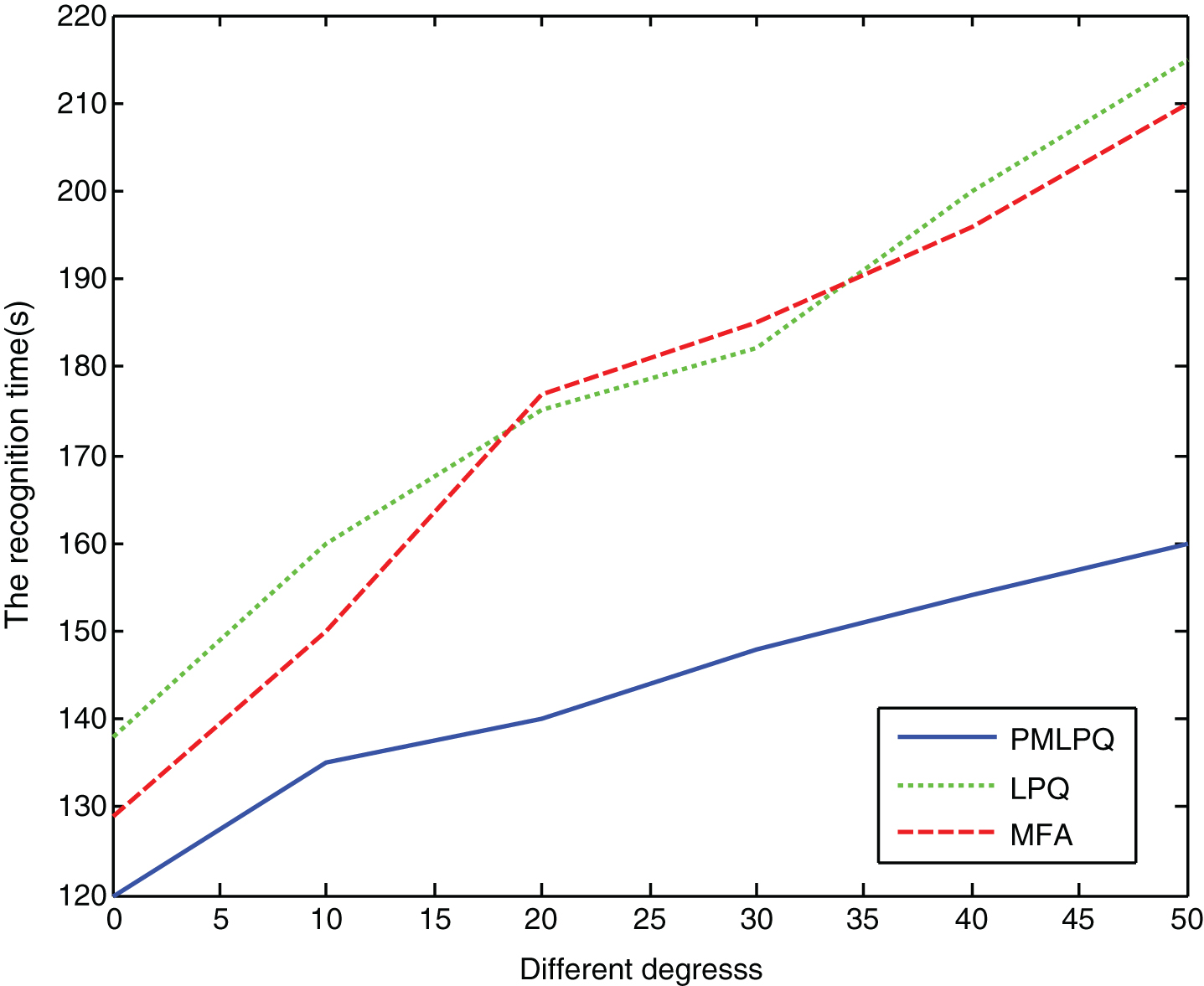
The recognition time of three algorithms with different degrees of occlusions to facial expressions.
Through the above experimental results, it can be observed that PMLPQ can effectively meet the requirements of face recognition, and it can obtain better recognition results especially in real time and robustness. This is due to LPQ operator has a significant impact on the robustness of PMLPQ approach as well. While PMLPQ is based on binary threshold of each pixel from an accumulated gradient image with its neighbor, LPQ is based on quantization of STFT phase responses and it extracts the local phase patterns from gradient images. LPQ was proved to be strong against blurred faces [19], as a result its presence in PMLPQ equips our approach with blur invariant property. On the other hand, PMLPQ is also strong to uniform illumination, an attribute derived from LPQ [20].
Facial expressions are important for human interaction both in the context of interpersonal communication and man machine interfaces. Face has the unique characteristics, convenient and easy to use, and has a wide range of applications in many fields such as authentication, security system, and visual communication and so on. In the future, we will deeply discuss the optimal expression of facial features in order to better achieve the robustness of face recognition system. The specific work includes the following aspects: (1) Human faces detection and recognition under the condition of weak light; (2) Face recognition in different poses, especially in the case of radial rotation.
Footnotes
Acknowledgments
We wish to thank the anonymous reviewers who helped to improve the quality of the paper. The authors gratefully acknowledge the helpful comments and suggestions of the reviewers, which have improved the presentation.