



Abstract
In practical application, the parameters of RBF neural network are difficult to determine. In general, we need to test several times according to experience and prior knowledge, which is lack of a strict design procedure on theoretical basis. And we also don’t know whether the RBF neural network is convergent. This paper proposes a genetic algorithm to optimize the centers and the widths of hidden nodes and the connection weights between hidden layer and output layer of RBF neural network globally. In contrast to optimizing RBF neural network by genetic algorithm partially, each generation group contains the whole parameters of RBF neural network. The fitness value of each individual is calculated by the adaptive function. The optimal individual is obtained by selecting, crossover and mutation by genetic algorithm. The optimal parameters are chosen as initial value of RBF neural network. According to the characteristics of wood dyeing, a predictive model of pigment formula for wood dyeing based on RBF neural network is proposed. The average relative error of the original RBF neural network is 1.55% in 158 epochs. However, the average relative error of the RBF neural network which is optimized globally by genetic algorithm is only 0.87% in 20 generations. Therefore, the convergence rate and approximation precision of the RBF neural network are improved significantly.
Introduction
Computer color matching is a common method in the process of wood dyeing [1]. The computer color matching technology can greatly improve the accuracy and efficiency of wood dyeing and save costs to adapt to industrial production. The topology of RBF neural network is simple. The generalization ability of RBF neural network is strong [2]. And RBF neural network shows good classification performance and approximation performance in application. So RBF neural network have been applied and evaluated in computer color matching [3, 4]. However, it is difficult to determine the parameters of RBF neural network in practical application. We need to test several times according to the experience and prior knowledge, which is lack of a strict design procedure on theoretical basis.
In regard to limitations of the traditional RBF neutral network, RBF neural network optimized globally by genetic algorithm has been proposed [5]. However, existing methodologies are to optimize RBF neural network by genetic algorithm partially, which means optimizing the centers and the widths of hidden nodes or the connection weights between hidden layer and output layer of RBF neural network respectively. Such methods cannot rebuild a complete RBF neutral network by optimization results [6, 7]. Non-optimized parameters need to be determined by other assistant techniques, which makes the optimization inefficient and inaccurate [8].
This paper proposes a genetic algorithm to optimize the centers and the widths of hidden nodes and the connection weights between hidden layer and output layer of RBF neural network globally. Each generation group contains the whole parameters of RBF neural network. The fitness value of each individual is calculated by the adaptive function. The optimal individual is obtained by selecting, crossover and mutation by genetic algorithm. The optimal parameters are chosen as initial value of RBF neural network, which can improve the convergence rate and approximation precision of the RBF neural network significantly.
Principles of the RBF neural network
RBF neural network is a kind of feed-forward neural network, whose basic topology contains three layers: input layer, hidden layer and output layer [9]. Figure 1 depicts this topology for a RBF neural network. The training of RBF neural network is accomplished through the estimation of three kinds of parameters, namely the centers and the widths of the radial basis function and the neuron connection weights.
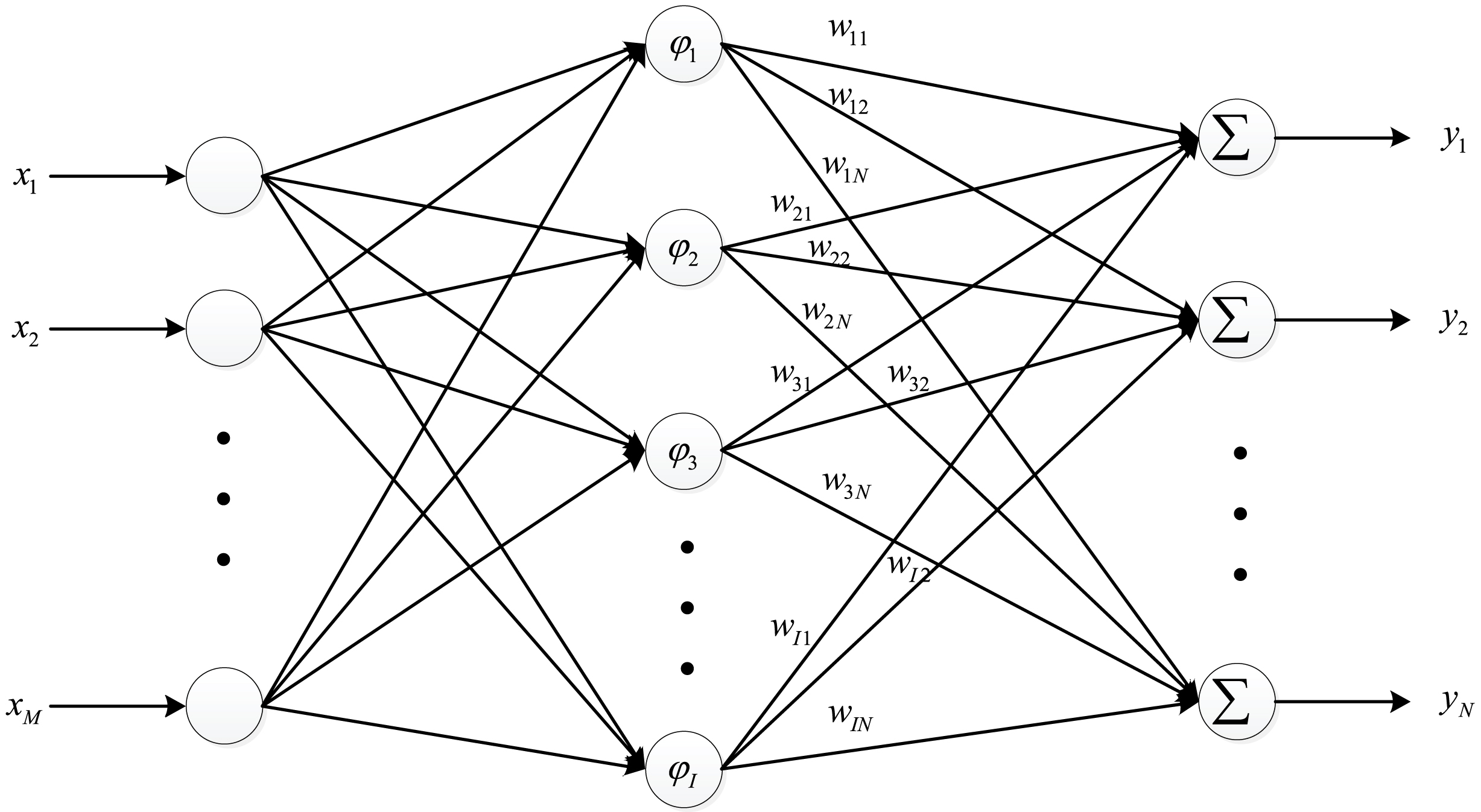
Basic topology of RBF neural network.
When the radial basis function is Gauss function, the following relationship can be derived [10].
Where φ (X, t i ) is the radial basis function; t i = [ti1, ti2, L, t im , L, t im ] is the center of the Gauss function; σ i is the width.
The estimated output of the network utilizes the following linear regression functional:
Where w in (i = 1, 2, L, I, n = 1, 2, L, N) is the connection weight.
In this paper, the elementary theory and methods of RBF neural network optimization and genetic algorithm is introduced [11]. The centers and the widths of hidden nodes and the connection weights between hidden layer and output layer of RBF neural network are optimized globally. Each generation group contains the whole parameters of RBF neural network.
In order to accelerate the solving speed of genetic algorithm and improve convergence performance, the encoding of genetic algorithm is significant [12]. The operands of genetic algorithm are genetic codes rather than the parameters themselves.
The procedures of the design of the RBF neural network optimized globally by genetic algorithm are as follows:
Step 1: Normalize the sample data. The input data of RBF neural network should be between zero and one [13]. The formulae of normalization is shown as
Where x min represents the minimum value of samples; x max represents the maximum value of samples.
Step 2: Encoding the chromosomes. There are two encoding styles of genetic algorithm: binary coding and natural number coding. Natural number coding has characteristic of large scope search, fast convergence and high precision, which can be applied to genetic encoding. The length of a chromosome can be calculated according to
Where l represents the length of a chromosome; M represents the length of genetic encoding of the center of the Gauss function; 1 represents the length of genetic encoding of the width of the Gauss function; I represents the number of nodes in the hidden layer; N represents the length of genetic encoding of the connection weights between hidden layer and output layer of RBF neural network.
Figure 2 depicts this topology for a chromosome.

Basic topology of a chromosome.
Step 3: Initialing the generation group. Initialize the parameters including the size of generation group, the hereditary algebra, the crossover probability and the mutation probability.
Step 4: Constructing the adaptive function. In genetic algorithm, each individual is inherited according to the fitness value calculated by the adaptive function. The adaptive function has a great impact on the genetic algorithm. The adaptive function can be derived by
Where N represents the number of neurons between hidden layer and output layer of RBF neural network; d n represents the ideal output of the n th output nodes; y n represents the actual output of the n th output nodes.
Step 5: Genetic operations. Genetic operations included selection, crossover and variation. The optimal individual is obtained by selecting, crossover and mutation by genetic algorithm. The optimal parameters are chosen as initial value of RBF neural network, which can improve the convergence rate and approximation precision of the RBF neural network significantly. Select operation
Select operation is a method to obtain the superior individual and obsolete the bad individual. Generally, roulette is the way to select optimal individual. In this way, each individual is selected according the selection probability. The selection probability has a major influence on the generation group. The selection probability can be derived by
Where F
k
represents the fitness value of each individual; L represents the size of generation group. Crossover operation
Genetic recombination means the crossover of chromosome, which has a big influence on biological evolution. Crossover is the key operator in the genetic algorithms, and it is impetus for evolution. Figure 3 depicts this crossover strategy for two chromosomes [14].

Crossover strategy for two chromosomes.
After crossover operation, the gene can be derived by
Where P
c
represents the probability of crossover operation. Mutation operation
Mutation operation is a method to change the chromosome randomly. Normally, mutation is deadly bad for individuals. However, mutation is the main mean for biological evolution. The genetic algorithm is improved by mutation operation. New chromosome takes place of the original chromosome, which accelerate the speed of biological evolution. What’s important at this operation is the uncontrollability of the mutation.
Where P m represents the probability of mutation operation; x k represents the value of chromosome.
Full-automatic spectrophotometer is used to measure the chromatic aberration before and after dyeing. The dyestuffs used in tests are reactive brilliant red X-3B, reactive yellow X-R, and reactive blueX-R. The inputs of the predictive model of pigment formula for wood dyeing are the chromatic aberration and the outputs are the concentration values of the dyestuffs. The topology of the predictive model of pigment formula for wood dyeing is shown inFig. 4.

The topology of the predictive model of pigment formula for wood dyeing.
We simulate the predictive model of pigment formula for wood dyeing. The threshold is used as a criterion for judging the training. When the actual error is less than the tolerance, it is considered as having accomplished the training. Comparing the simulation results between RBF neural network before and after optimized globally by genetic algorithm, the fitting curves of the neural network are shown in Figs. 5 and 6. The error curves are shown in Figs. 7 and 8, and the simulation results are shown in Tables 1 and 2.

The fitting curve of the RBF neural network.
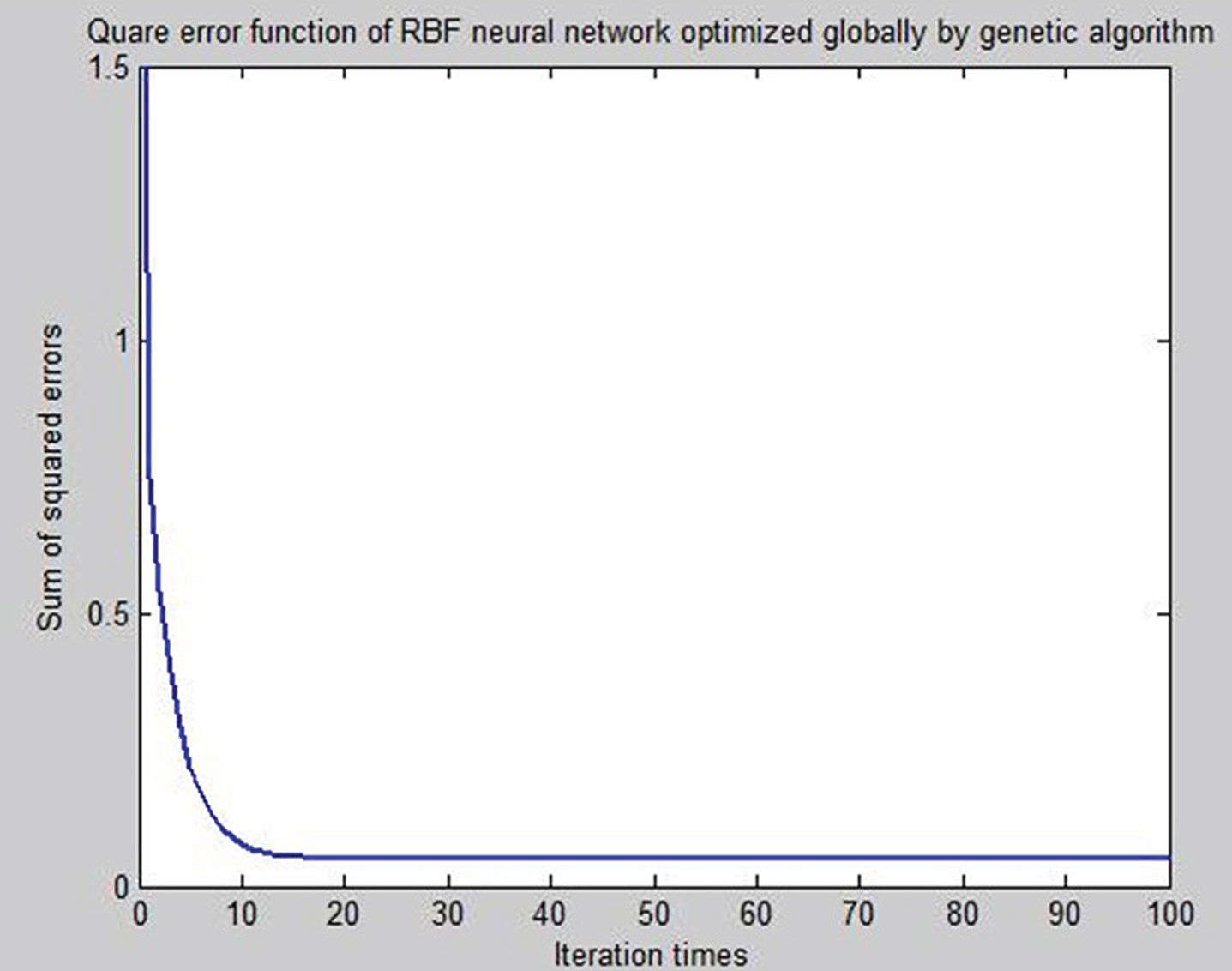
The square error function of RBF neural network optimized globally by genetic algorithm.

The error curve of the RBF neural network.

The error curve of the RBF neural network optimized globally by genetic algorithm.
The simulation result of the RBF neural network
The simulation result of the RBF neural network optimized globally by genetic algorithm
According to the simulation results above, we can safely come to the conclusion that the average relative error of the original RBF neural network is 1.55% in 158 epochs. However, the average relative error of the RBF neural network which is optimized globally by genetic algorithm is only 0.87% after 20 generations. Therefore, the convergence rate and approximation precision of the RBF neural network are improved significantly. The output of the RBF neural network i optimized globally by genetic algorithm can match well with the sample data of wood dyeing. So the RBF neural network optimized globally by genetic algorithm has good application value in intelligent color matching of wood dyeing.
Before we establish the predictive model of pigment formula for wood dyeing with the RBF neural network we should determine the topology of network and the algorithm of training. This paper proposes a genetic algorithm to optimize the centers and the widths of hidden nodes and the connection weights between hidden layer and output layer of RBF neural network globally. In contrast to optimizing RBF neural network by genetic algorithm partially, each generation group contains the whole parameters of RBF neural network. The results prove that the convergence rate and precision of the RBF neural network are improved significantly. However, the research on the generalization ability–the ability of the machine’s learning algorithm adapting to fresh samples–of neural networks in intelligent color matching of wood dyeing has never stopped. The application of neural network needs to be further improved and perfected.
Footnotes
Acknowledgements
This work is sponsored by the Research Funds for the Innovative Talents of Science and Technology of Harbin (2013RFQXJ138) and the Fundamental Research Funds for the Central Universities (2572015CB11).