



Abstract
Aiming at the problem of low accuracy of the current English interpretation teaching quality evaluation, a teaching quality evaluation method based on a genetic algorithm (GA) optimized RBF neural network is proposed. First, the principal component analysis is used to select the teaching quality evaluation index, and then design The RBF neural network teaching evaluation model is used, and GA is used to optimize the initial weights of the RBF neural network. Experimental results show that this method can effectively evaluate the quality of English interpretation teaching, and has high accuracy and real-time performance.
Keywords
Introduction
Teaching quality evaluation of college teachers is an important way to improve the level of teaching management and teachers’ teaching ability [1, 2]. Using teaching quality evaluation, students can give feedback on teachers’ teaching conditions, teachers can reflect on teaching results, and schools can effectively implement teaching management improvements. Teachers are trained in a targeted manner. English interpretation teaching is an important part of college education, and the process of evaluating English interpretation teaching quality is relatively complicated. Therefore, building an objective and scientific English interpretation teaching quality evaluation model is a hot research direction [3, 4].
In response to the problem of teaching quality evaluation in colleges and universities, researchers have proposed a variety of evaluation methods, such as the grey relational analysis method [5], analytic hierarchy process [6], fuzzy comprehensive evaluation method [7], etc. But these methods are suitable for linear models and are difficult to It is adapted to the non-linear teaching quality evaluation problem, which has subjective and random defects, and cannot achieve the teaching quality evaluation well. For this reason, literature [8] constructed a distance teaching quality evaluation model, and based on a support vector machine Realize the teaching quality evaluation, and achieved good evaluation results. Literature [9] proposed a teaching quality evaluation method based on intelligent algorithms, using genetic algorithms to improve the BP neural network to evaluate teaching quality, which has a faster convergence speed and evaluation accuracy.
This paper studies the evaluation of English interpretation teaching quality in colleges and universities and proposes a teaching quality evaluation method based on a genetic algorithm to improve the RBF neural network. This method uses an RBF neural network to evaluate English interpretation teaching quality.
The genetic algorithm is used to optimize the initial weights and radial basis parameters of the RBF neural network and the evaluation indicators are screened by the principal component analysis method. The test results verify the effectiveness and superiority of the method.
The genetic algorithm optimizes the RBF neural network
RBF neural network
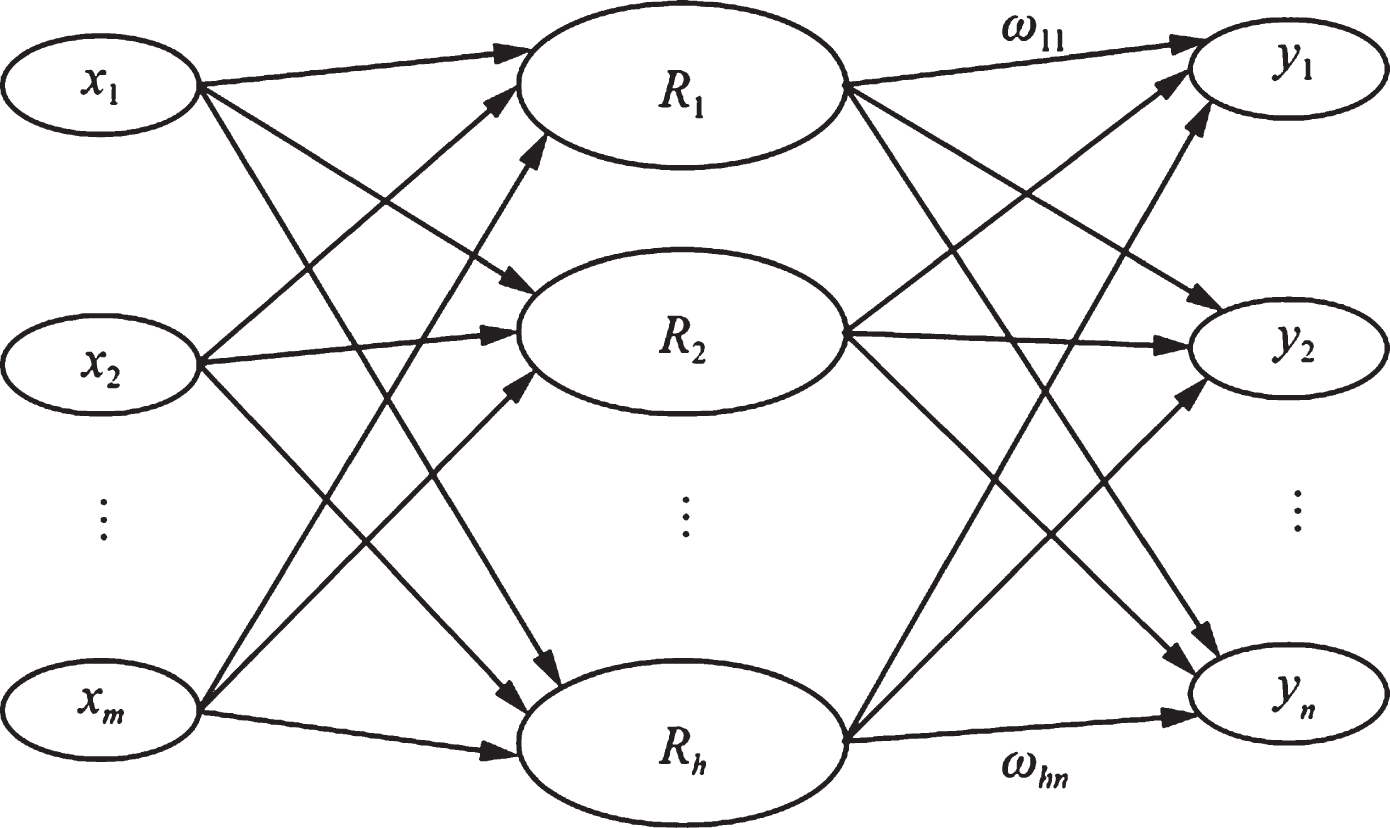
The basis of the RBF neural network is the function approximation theory. It is a feedforward neural network with strong global optimization capabilities. It has a very wide range of applications in the fields of signal processing, image processing, and pattern recognition [10]. RBF neural networks are usually It is composed of an input layer, an output layer, and a hidden layer. The common structure is shown in Fig. 1.
RBF neural network structure.
In the RBF neural network, the three-layer neural network has a total of 2 weight vectors, in which the weights of the input layer and the hidden layer are static (fixed to 1), and the output layer and the hidden layer are dynamic weights, and The activation function of the hidden layer is the radial basis function. Therefore, the output of the output layer is the weighted summation of the input data after passing through the activation function of the hidden layer. The radial basis function and dynamic weight are the keys to the RBF neural network. The expression of the basis function is:
In the formula (1), XP-Ci represents the norm, X
P
-C
i
represents the sample data input by the input layer, and c and I represent the center and width of the radial basis function respectively. After the network weights and radial basis function parameters are determined, RBF the output of the neural network can be expressed as:
In the formula, I,j represents the weight of the hidden layer and the output. According to the solution process of the RBF neural network, the network optimization process is to continuously update the dynamic weight, the center and width of the radial basis function according to the training data, until the entire neural network the nonlinear function approximation required for network realization.
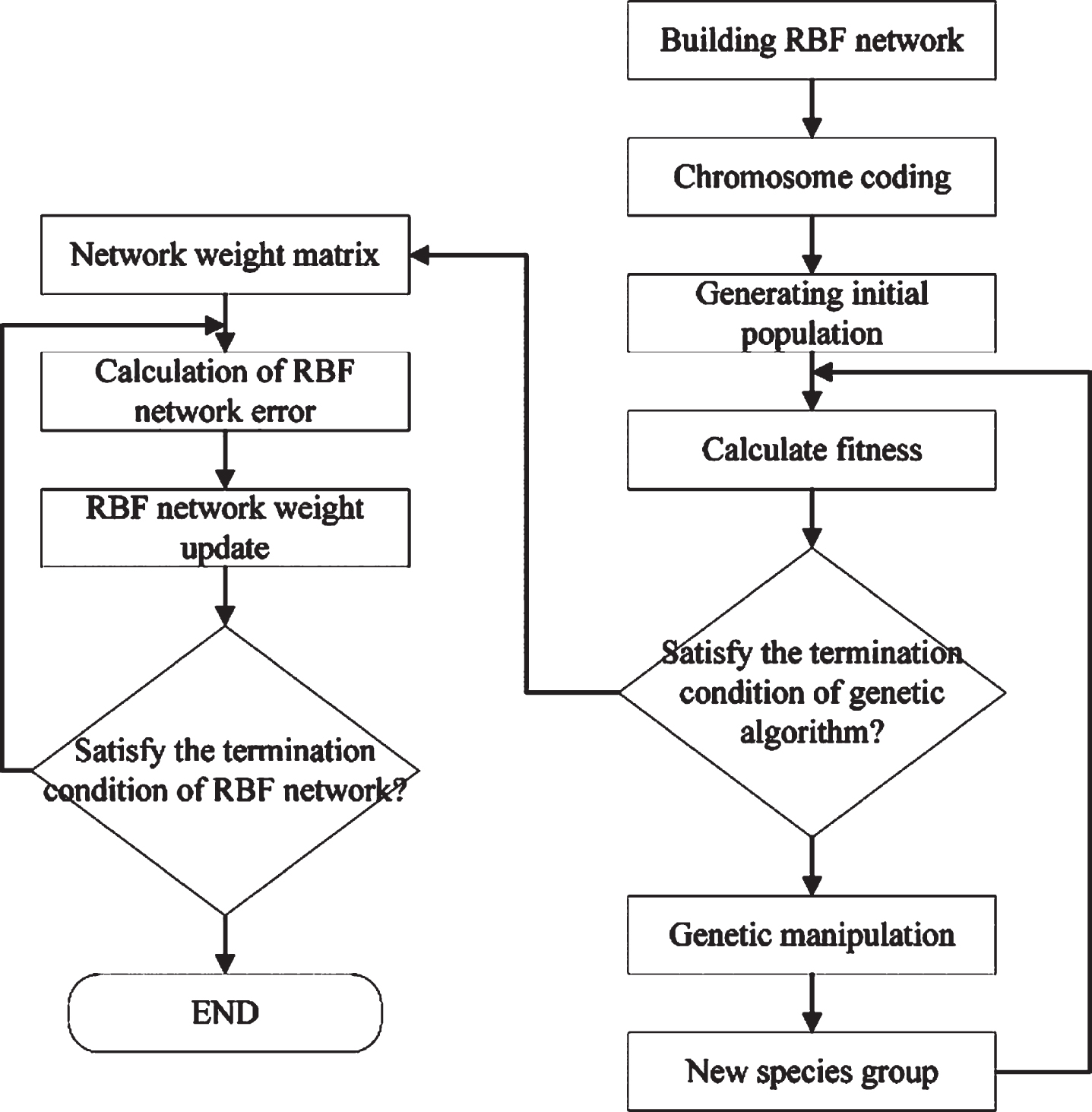
The application of the RBF neural network to realize English interpretation teaching quality evaluation requires pre-setting the initial weights and radial basis function parameters of the network. The initial parameter setting has a greater impact on network performance. To improve the accuracy and calculation of the RBF neural network English interpretation teaching quality evaluation Efficiency, the genetic algorithm is used to optimize the parameters of the RBF neural network.
Before training, the English interpretation teaching quality evaluation model based on RBF neural network uses a genetic algorithm to determine the optimal network initial parameters. The genetic algorithm generates multiple starting points at random for parallel optimization and uses fitness function to determine the optimization direction. Crossover and mutation operations realize high-dimensional space adaptive fast parameter optimization.
(1) Chromosome coding
The parameter optimization of the RBF neural network is a continuous parameter optimization process. To improve the accuracy of parameter optimization, floating-point number encoding is used. Floating-point number encoding can avoid encoding and decoding during subsequent selection, crossover, and mutation, and improve convergence efficiency, it can also break through the limitation of the traditional binary codeword length and obtain higher parameter optimization accuracy. If the topological deconstruction of the constructed RBF neural network is 4-7-3, there are a total of 21 weights from the hidden layer to the output layer. The hidden layer needs to set the centers and widths of 6 radial basis functions, so the chromosome code length of the genetic algorithm is 33.
(2) Fitness function
Aiming at the problem of RBF neural network parameter optimization, the smaller the difference between the network output value and the expected value, the better the corresponding chromosome. For this reason, the expected output and the reciprocal of the mean square error of all individuals in the population are used as the fitness function of the evolution operation of the genetic algorithm, The specific calculation method is as follows:
In the formula, N represents the number of chromosomes in the population, Y represents the actual output value of the model, and T represents the expected output value of the model.
(3) Genetic operator
The selection operation adopts the classic proportional selection method (roulette method), first calculate the individual fitness function value of each chromosome, sort the chromosomes according to the size of the fitness function value, and specify that the larger the fitness function value, the corresponding chromosome The higher the probability of being selected. For chromosome bi, assuming the fitness function value is E
bi
, the probability of being selected is:
Among them, E represents the overall fitness function value of all chromosomes in the population.
From Equation (4), it can be seen that the degree of chromosome fitness determines the probability of the chromosome being selected. However, to increase the diversity of the population and avoid falling into the local optimal solution, it is also necessary to select a part of the inherited chromosomes from the less adaptive chromosomes. The next-generation is population.
Crossover operation refers to the evolution process of genetic algorithm, to increase the diversity of the population, the coding of two chromosomes is exchanged according to certain rules, and finally, two new chromosomes are evolved. In genetic algorithm optimization In the process, most of the new chromosomes are derived from crossover operations. Crossover operations are the core of genetic optimization. In the early stages of genetic evolution, the fitness function value of individual chromosomes is small, and it is necessary to perform crossover operations on chromosomes with high probability. Improve the global optimization capability of the genetic algorithm. In the later stage of genetic evolution, multiple selections of crossover mutation operations have made the fitness function value of the individual chromosomes larger. At this time, the crossover operation should be performed with a smaller probability to improve the local optimization of the algorithm Ability. To this end, the crossover probability in genetic evolution in the article is set as:
In the formula, Emax represents the maximum fitness function value of the two chromosomes to be crossed in the parent population, E mean represents the average fitness function of the chromosomes in the parent population, iter represents the current iteration number of genetic evolution, and itermax represents the maximum iteration number of genetic evolution, Pcmax is the preset maximum cross probability value.
Mutation operation refers to the process of mutation of certain chromosomes in the process of biological evolution, which is interfered with and generates new chromosome individuals. During the evolution of genetic algorithms, the mutation is also important for renewing chromosome individuals and increasing the ability of genetic optimization Link. The mutation probability setting is the key to genetic mutation operation. When the mutation probability is large, it is helpful for the genetic algorithm to expand the optimization search range and obtain the global searchability, but it is not conducive to maintaining the high fitness chromosome individuals obtained by selection and crossover; mutation probability Smaller can effectively save good chromosome individuals. The mutation probability of traditional genetic algorithms is set to a fixed value, usually between 0.001 and 0.1, which is not conducive to obtaining excellent chromosomes. For this reason, refer to the crossover probability setting method to carry out the mutation probability the adaptive setting of the mutation probability setting method is:
Among them, E represents the value of the chromosome fitness function to be mutated in the parent population, and iter and Ener max represent the current number of iterations and the maximum number of iterations, respectively. Equation (6) shows that when the chromosome fitness function value in the early evolutionary stage is lower than the mean value, the mutation probability is set to be small, which can retain good chromosome individuals. With the continuous progress of genetic evolution, when the fitness function value of the chromosome is higher than the average value, the mutation probability can be increased and the local optimization ability of the genetic algorithm can be increased.
The genetic algorithm can optimize the dynamic weight of the RBF neural network, the center, and the width of the radial basis function. Aiming at the problem of English interpretation teaching quality evaluation, the structure of the RBF neural network optimized based on genetic algorithm is shown in Fig. 2.
Genetic algorithm optimizes the RBF neural network.
At present, there are many indicators used for the evaluation of English interpretation teaching quality. If these indicators are directly inputting into the RBF neural network without choice, indicators that are weakly correlated or redundant with the evaluation of teaching quality will affect the accuracy and evaluation of the final evaluation results efficiency. To this end, this section uses the principal component analysis method to screen the English interpretation teaching quality evaluation indicators to simplify the evaluation indicators and improve the accuracy and real-time quality of English interpretation teaching quality evaluation.
Principal component analysis can comprehensively analyze the existing English interpretation teaching quality evaluation indicators, remove redundant components in the indicators, and generate new teaching evaluation indicators [11]. The new indicators greatly reduce the amount of data but can include the absolute value of the original indicators most of the information. The reduction in the number of indicators can not only improve the efficiency of teaching quality evaluation but also reduce the complexity of the RBF neural network. The specific process of teaching quality evaluation based on principal component analysis is as follows.
Suppose the original English interpretation teaching quality evaluation index set is:
Among them, p is the number of teaching evaluation indicators. The data difference between the English interpretation teaching quality evaluation indicators is large. To reduce the impact of big data on small data, the collected data needs to be standardized. The standardized processing formula is:
Where
After the teaching quality evaluation index is standardized, the correlation coefficient matrix of the evaluation index is calculated:
Among them, r
ij
represents the correlation coefficient between the ith teaching quality evaluation sample and the jth index, and the calculation method is:
Construct the characteristic equation u = Ru, and calculate the characteristic value and characteristic vector of the characteristic equation:
Calculate the contribution of the main components of the English interpretation teaching quality evaluation index to the cumulative variance:
In the formula, I represent the contribution of the i-th main component in the teaching quality evaluation index. To select the main index (that is, the principal component) that best represents all the index information from the teaching quality evaluation index, if the cumulative contribution of the first m main components More than 85%, it can be determined that these m main costs can represent all the evaluation indicators of English interpretation teaching quality. The indicators selected based on principal component analysis are used as the new feature vector for evaluating the quality of English interpretation teaching, which can maintain the performance of teaching quality evaluation. At the same time, it effectively reduces the dimension of features and improves evaluation efficiency.
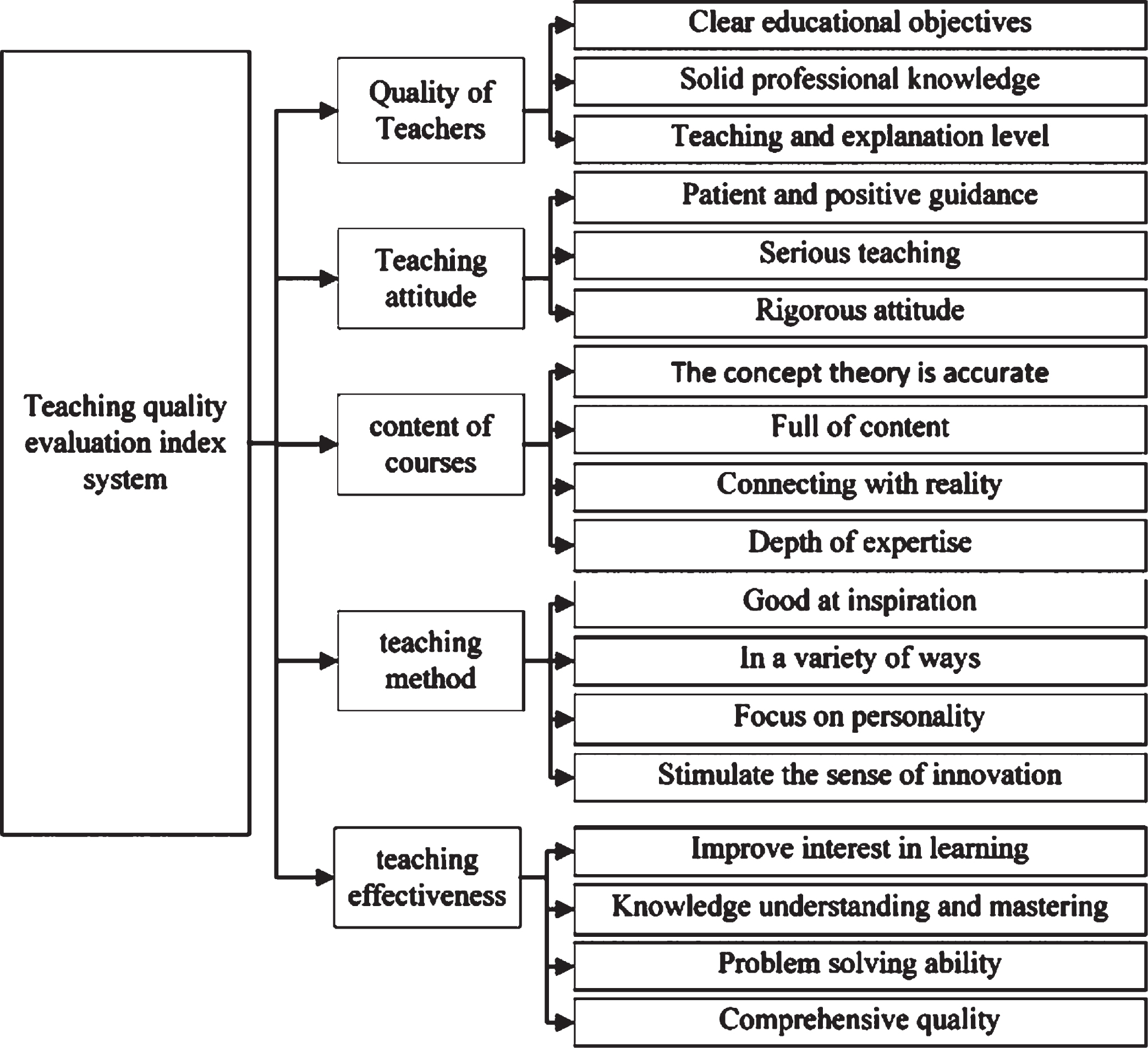
The evaluation index system is the basis for the evaluation of English interpretation teaching quality, and a scientific and reasonable index system is a powerful guarantee to ensure the evaluation performance of teaching quality. At present, the index system for evaluating teaching quality has many principles, such as the construction of indicators based on teaching content, based on student performance for the evaluation of English interpretation teaching quality, this paper constructs a specific evaluation index system, the structure is shown in Fig. 3.
Teaching quality evaluation index.
The English interpretation teaching quality evaluation process based on RBF neural network proposed in this paper is as follows: Construct an evaluation index system and collect relevant data for teaching quality evaluation; Data standardization processing, generating evaluation index correlation coefficient matrix; Select English interpretation teaching quality evaluation indicators based on principal component analysis removes redundant indicators, and achieve feature dimensionality reduction; Use the RBF neural network improved by genetic algorithm to evaluate the teaching quality and output the evaluation results.
To test the effectiveness of the RBF neural network English interpretation teaching quality evaluation method based on genetic algorithm optimization proposed in this article, this section uses the collected college English teacher teaching quality evaluation data to test its performance. According to the English interpretation teaching quality constructed in the previous section Evaluation index model, a total of 400 groups of English quality evaluation data were collected, of which 360 groups were used as training data, and the remaining 40 groups were used as test data. In the table, x1∼x18 corresponds to the teaching quality in Fig. 3 evaluation indicators.
Principal component analysis to select evaluation indicators
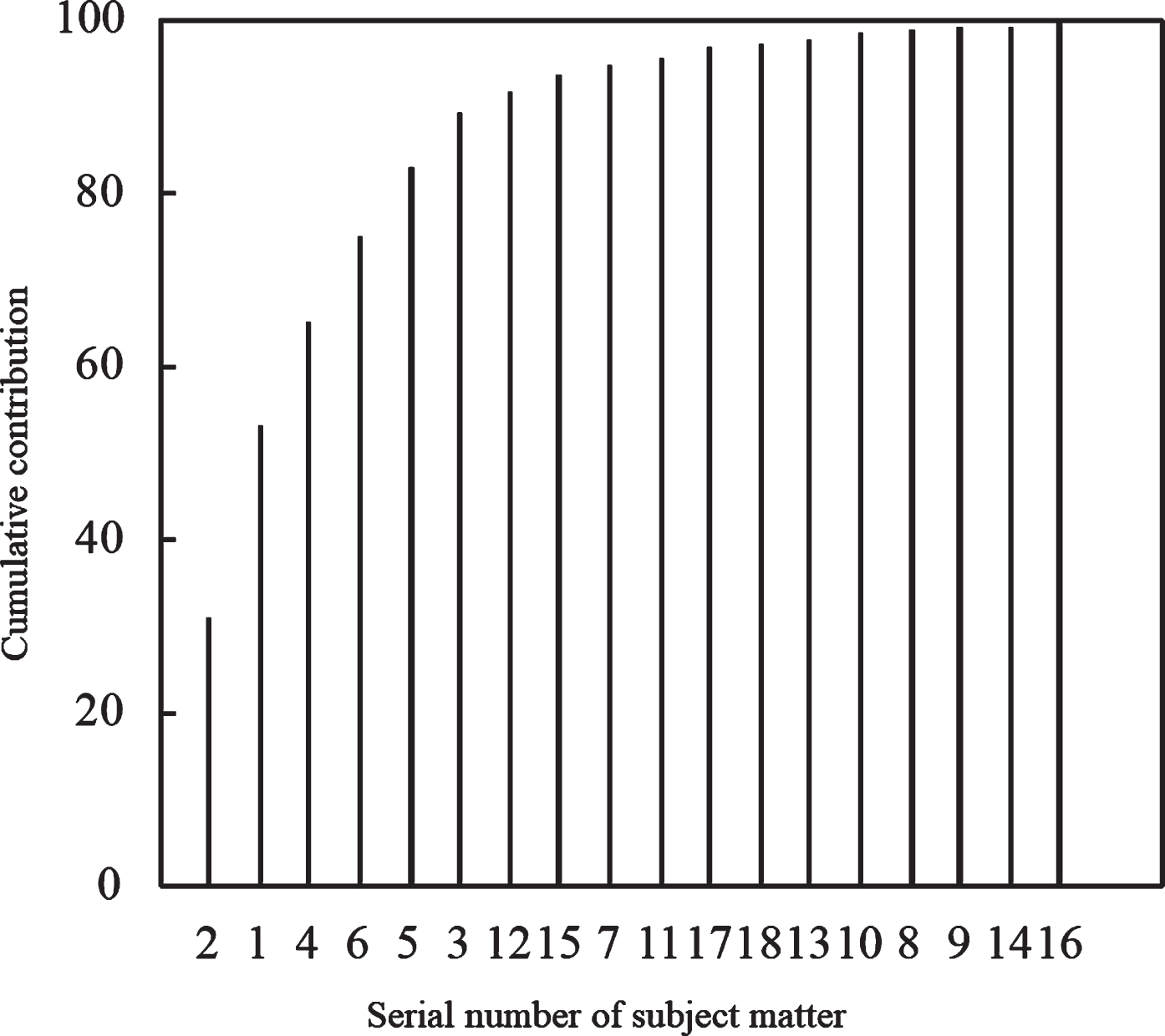
Using the proposed principal component analysis method of English evaluation indicators to analyze the English interpretation teaching quality evaluation indicators in Table 1, and screen out the indicators that contribute the most to the evaluation of teaching quality, the results of the principal component analysis are shown in Fig. 4.
Comparison results of evaluation performance
Comparison results of evaluation performance
The results in Fig. 3 show that the cumulative contribution rate of the first 8 principal component indicators to the evaluation of English interpretation teaching quality has reached 94.3%, which exceeds the set cumulative contribution rate threshold. This shows that the first 8 indicators can effectively represent all the indicators included. Important information, these 8 indicators will be used to evaluate the quality of English interpretation teaching in the future.
Using the genetic algorithm constructed in this paper to optimize the RBF neural network model to evaluate the English interpretation teaching quality, the mean square error curve during the model training is shown in Fig. 5, and the teaching quality evaluation accuracy of the test group data is shown in Fig. 6. Figure 5 shows, the original RBF neural network reached convergence after about 45 iterations, but only about 30 times after genetic algorithm optimization. This shows that a genetic algorithm can effectively improve the convergence speed of the RBF neural network and reduce model training time. And, the military error of the RBF neural network optimized by the genetic algorithm is always lower than that of the original RBF neural network, indicating that the genetic algorithm can improve the prediction accuracy of the model.
Principal component analysis processing results of evaluation indicators.
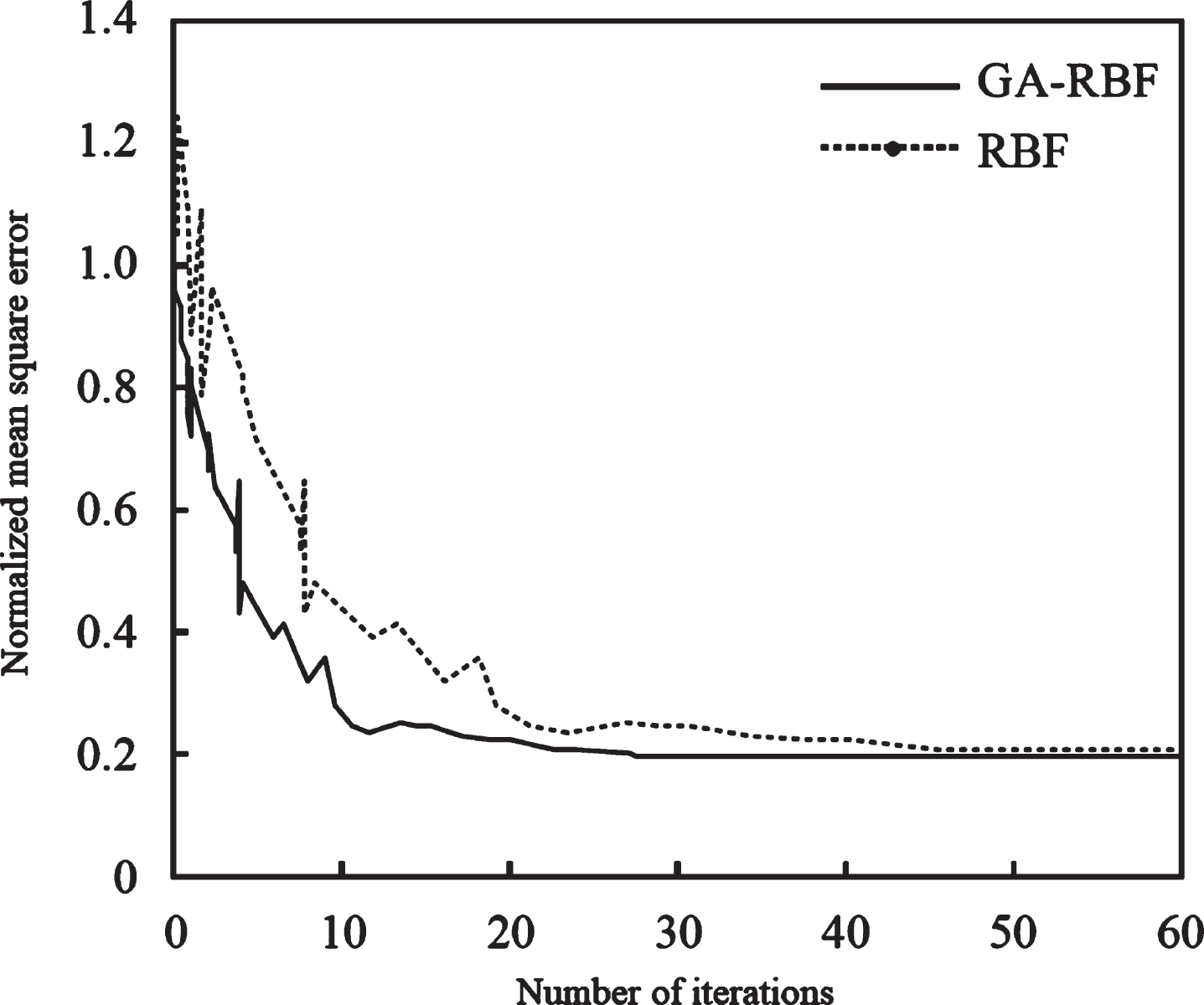
Model mean square error curve.

Model evaluation accuracy curve.
Figure 6 shows that the original RBF neural network has a higher evaluation accuracy of English interpretation teaching quality, which is higher than 81%, but the evaluation accuracy of the genetic algorithm optimized RBF neural network is better than the original RBF neural network. The statistical results show that in 40 groups of test samples, The genetic algorithm optimized RBF neural network model has an evaluation accuracy of greater than 90% for 36 groups, and the evaluation accuracy of 30 groups is greater than 93%, indicating that the model has a high approximation accuracy.
To further test the English interpretation teaching quality evaluation performance of the optimized RBF neural network based on genetic algorithm constructed in this paper, it is compared with the GA-BPNN evaluation model proposed in [9] and the evaluation model based on support vector machine (SVM) proposed in [8] Perform performance comparison tests. The simulation data remains unchanged, and the English interpretation teaching quality evaluation performance comparison is shown in Table 1. The experimental results show that the genetic algorithm optimized RBF neural network model constructed in this paper has high evaluation accuracy and computing efficiency. This is because The BP neural network in the GA-BPNN evaluation model of literature [9] has an overfitting phenomenon, which affects the accuracy of the evaluation. In the SVM evaluation model of literature [8], there are too many evaluation indicators, and the indicators interfere with each other, which affects the accuracy of the evaluation. It also increases the computational cost.
Conclusions
The evaluation of college English interpretation teaching quality is an important measure to improve teaching quality. This paper constructs an English interpretation teaching quality evaluation model based on a genetic algorithm to optimize the RBF neural network. This model uses principal component analysis to screen evaluation indicators and uses a genetic algorithm to determine the RBF network weight the parameters are optimized to achieve a high-accuracy evaluation of the quality of English interpretation teaching. The test results verify that the method has high evaluation accuracy and high computational efficiency. The research content provides a new method for college teaching quality evaluation.
This work is supported by the Humanities and Social Sciences Research Foundation for the Youth Scholars of Ministry of Education of China (No. 18YJC740059): A Study on the Re-contextualization of Interpreting Teaching —From the “Computer-assisted-interpreter-training” Perspective. We would like to thank all the participating teachers and school districts for their contribution.