



Abstract
With the development of cloud computing technology, a heavy workload and the considerable amount of energy consumed create significant pressure on the cloud service providers. However, in the open sharing mobile Internet, many devices are idle in the network, and a large amount of resource is wasted. This study proposes a new model based on the idea of crowdfunding, which can be a supplement to the traditional resource supply mode. With this model, users can contribute their spare resource to cloud service providers to perform cloud tasks and receive preferential pricing when they require resource. A reward and punishment mechanism is designed based on the repeated game to encourage users to contribute their spare resource and to monitor the cloud service provider to ensure that supporters can receive a preferential price in return. MATLAB simulation results show that the new model reduces the overall energy consumption, and the incentive mechanism is available to motivate supporters to actively perform cloud tasks.
Keywords
Introduction
In the traditional cloud service mode, data centers provide resources for cloud users. However, with the exponential growth of cloud users, a considerable amount of energy is used in data centers, which not only increases operating costs but also releases a large amount of carbon that influences the ecosystem and hastens global warming. Thus, green cloud computing is receiving increasing attention.
This study proposes a new resource-providing model based on the idea of crowdfunding inspired by Di [1], in which the cloud providers expand their resources by introducing the users’ idle resources that are distributed in the network to reduce the cost of energy and achieve the goal of green cloud computing. In the proposed model, users are not only the resource consumer but also the resource provider. Users who contribute resources (hereinafter supporters) receive a discount price if they require resources. However, only providing a reward is insufficient; supporters will use resources at the least price but not contribute sustainable resources if constraint is ineffective. Therefore, a punishment mechanism is designed based on the idea of repeated game to punish supporters who do not comply with the crowdfunding agreement and urge them to contribute stably and sustainably. The main contributions of the study are summarized as follows: A new resource-providing model is presented to solve the problem of resource bottlenecks and decrease the energy consumption in data centers. In the model, cloud provider introduces the idle resource of supporters into the network to expand resource capacity and the resource supporters receive a reward in return. A cloud resource crowdfunding algorithm is designed to encourage users to contribute their idle resources continuously and punish supporters who do not follow the crowdfunding agreement. A new resource pricing method based on the repeated game is proposed to answer the question of how much discounts supporters should receive.
The remainder of this paper is organized as follows: In Section 2, we introduce works related to improving the resource utilization and reducing energy consumption in cloud computing, edge computing and fog computing. In Section 3, a resource crowdfunding framework is described. In Section 4, a cloud resource crowdfunding algorithm is presented, and related definitions and the detailed steps of the algorithm are explained. A resource pricing method are proposed and analyzed mathematically in Section 5. In Section 6, performance evaluation results are presented. Finally, Section 7 concludes the paper.
Related works
In green cloud computing technology, the effective use of resource and the reduction of energy consumption are critical issues. Several studies have been conducted to resolve the above problems. These studies are summarized as follows:
Xiao et al. [2] introduce the concept of “skewness.” By minimizing skewness, the overall utilization of server resources is improved enhancing the ability of the cloud data centers to provide resources to serve users. They also developed a set of heuristics that effectively prevent system overload and conserve energy. Beloglazov et al. [3] investigate the issue of virtual machine consolidation in heterogeneous data centers and presented an energy-efficient virtual machine deployment algorithm called MBFD. The algorithm selects the physical machine that increases the energy consumption of the system the least after placing a virtual machine as the destination host where a virtual machine should be placed. The algorithm plays an energy-saving role. Lee et al. [4] generate two heuristic algorithms for task integration ECTCC and MaxUtil. The goal of these heuristic algorithms is to reduce the energy consumption of data centers by turning on as few physical machines as possible. Hsu et al. [5] propose an energy-aware task consolidation technique. This technique minimizes energy consumption by consolidating tasks among virtual clusters and by limiting the CPU usage below a specified peak threshold. In addition, they design an energy cost model considering the problem of the delay in the process of virtual machine migration. Gao et al. [6] investigate the deployment of virtual machines under a homogeneous data center, regarding it as a multi-objective optimization problem. System resource utilization and energy consumption were optimized, and a multi-objective ant colony algorithm was presented. Dong et al. [7] design a hierarchical heuristic algorithm that considers the communication between virtual machines when analyzing the virtual machine deployment problem. The energy consumption of physical and network resource is optimized. Wu et al. [8] present a green energy-efficient scheduling algorithm that efficiently assigns proper resource in the cloud data center to users according to the users’ requirements. Their algorithm increases resource utilization by meeting the minimum resource requirements of a task and prevents the excessive use of resources. Zhang et al. [9] formulate the multiple virtual machines resource scheduling for cloud computing into an integer programming problem. According to the utility optimization theory, they propose a global regulation algorithm. Tian et al. [10] propose an integrated and dynamic resource scheduling algorithm for cloud datacenters. When scheduling resource, this algorithm considers the utilization of memory and CPU of physical machines and virtual machines. In addition, they desigh a scheme to balance the level of each physical server and the cloud datacenter. In [11], Papagianni et al. propose a uniform resource allocation framework in cloud computing. The optimization of the network cloud is mapped into a mixed integer programming problem. Then they use a heuristic methodology to address the problem of the efficient mapping between tasks and various resources. In order to schedule resource to meet the requirement of the user, Yang et al. [12] propose a cost-based resource scheduling scheme using market theory. This scheme assigns the resource with the most favorable price to users according to the market price and current resource availability of suppliers. Xu et al. [13] establish a multi-objective optimization model for the problem of energy-aware resource management considering load balance in cloud computing. Then, a novel algorithm named greedy-based load balance (GBLB) algorithm is proposed. This algorithm can achieve a better load balancing level.
In addition, some researchers have enabled the resource management and application scheduling policies across edge and cloud resource under different scenarios and conditions such as mobile cloud computing, edge computing and fog computing. Cloud Services are extended to the edge of the network to decrease the network congestion and latency [14]. Guo et al. [15] propose a resource allocation scheme in edge computing system. They build two computation-efficient models. Then, they appropriately allocate communication and computation resource to solve the overall weighted sum energy consumption minimization problem under each model. For the problem of cooperative resource management in mobile cloud computing, the authors in [16, 17] present some fair revenue share schemes among the cooperators. They use the method of Shapley value from cooperative game theory to maximize the benefit of the mobile cloud service providers cooperating and sharing the resources in the resource pool. Wang et al. [18] propose an efficient resource management scheme based on multi-leader multi-follower two-stage Stackelberg game model. This scheme can obtain a good balance performance between mobile terminals and cloud servers by maximizing the utility function of mobile cloud computing networks. Based on the service-oriented utility functions in the mobile cloud, the authors in [19] present a mathematical unified framework for heterogeneous resource sharing. These heterogeneous resources such as latency, power and bandwidth are equivalently mapped to ‘time’ resource. Their scheme not only reduces service latency effectively but also achieves high energy efficiency. In [20], the authors propose a resource dynamic allocation model based on semi-Markov decision process in mobile cloud computing. They have found an optimal scheme in allocating resource of the cloudlet and the bandwidth in order to satisfy the needs of quality of service of mobile users. For the cloudlet in the mobile cloud computing system, Liu et al. [21] propose a new multi-resource allocation scheme. The problem of resource allocation is considered as a semi-Markov decision process. They use linear programming technology to solve the optimization problem.
Some researchers have studied the interaction and cooperation between the cloud and the fog to avoid resource and energy wastage. In [22], Deng et al. present a systematic framework to study the tradeoff between transmission delay and energy consumption in the fog-cloud computing system. They allocate tasks between fog and cloud to minimize energy consumption under the constrained service delay. They use an approximation to solve the workload allocation problem by decomposing the primal problem into three corresponding subproblems. Then these subproblems can be solved separately. In [23], the authors present a resource allocation scheme based on the collaboration between cloud computing and fog computing. The scheme is decision rules of linearized decision tree based on completion time, services size and the capacity of VMs to improve resource allocation and balance workload efficiently. Li et al. [24] study the cooperation and interplay between the core and the edge of the network. They present a three-tier system architecture including things tier, the fog tier and the cloud tier. Then they mathematically characterize each tier considering latency and energy consumption. Aazam et al. [25, 26] present a resource management model based on fog computing. Their model considers resource prediction and allocation as well as user type and characteristics realistically and dynamically, thus enabling the adaptation to different telecom operators according to requirements. However, their resource management model neglects heterogeneous services, service quality and device movement.
Although the above works ensured that the resource can be used more effectively, the problems of resource bottleneck and energy consumption in data centers still is not resolved. In addition, the resource providers of fog computing and edge computing are always the small local devices on the edge of the network. However, for crowdfunding, all kinds of resource owners in the network (even a data center) could be considered as the participator of our system if only it has idle resources. According to [27], the idea is that the more decentralized the system is, the less energy is consumed. The high energy consumption concentrated in large data servers of a cloud data center is converted to the low energy consumption of the relatively small devices of users who are widely distributed in the network. The waste of resource is reduced on the client side while saving overall system energy. This study proposes a new resource-providing model based on the crowdfunding idea.
The description of resource crowdfunding framework
There are many devices exhibiting considerable computing capability around us. These distributed devices possess tremendous idle resources. These idle resources can be used for providing cloud services and share the pressure of the cloud data center. The resource within these devices may be insignificant unless these devices can create meaningful information and services simultaneously. The resource quantity of these devices is usually too limited to provide services for certain resource-intensive tasks. Therefore, it is necessary to create a seamless intelligent integration [28].
Considering the limited resource capacities in a single device, we propose a new resource-providing framework referred to as ‘crowdfunding’. In this framework, devices with spare resources distributed in a network and the cloud service provider can realize the cooperation by forming crowdfunding resource pool under the supervision and intermediary of the crowdfunding platform. The proposed cloud resource crowdfunding framework is shown in the following Fig. 1, and the framework consists of three parts: The sponsor is a medium or small centralized cloud service provider. It has the ability to provide services to address the resource needs of users. However, the computing and storage services that they provide are limited because of financial, technical, and other external factors. The sponsor is eager to improve its ability to provide service using crowdfunding resource. When the cloud service provider needing some resource support, it will send a request to the crowdfunding platform, and then the crowdfunding platform will contacts the supporters to provide resource support. The sponsor will give supporters some financial incentives to motivate them to contribute resource. In this manner, it can transfer its energy costs to these resource supporters. Supporters are users who are willing to contribute their own idle resources or devices to the network, which can be expressed by {s1, s2, …, s
i
, si+1, …, s
n
}. These devices include fixed terminals, such as desktop computers, or mobile terminals, such as mobile phones, tablet personal computers, and other mobile devices. Although the amount of resources in a single device might be limited, it would be considerable if many devices can cooperate with each other and form a resource pool. When the users want to contribute their idle resources, they will send a request to the crowdfunding platform, and then the crowdfunding platform will notice the sponsor. In the proposed crowdfunding model, the supporters can achieve some revenues according to their contributions by supporting cloud service. The crowdfunding platform is a trusted third-party platform that connects the sponsor and supporters, including a credit system and monitor system. The credit system that legally audits the information of the sponsor and supporters is supposed to be licensed and monitored by the government to prevent bias, with certificates accompanying the legal crowdfunding platform. It has the ability to create the awareness in order to bring out the public audits in the crowdfunding framework [29]. According to [29], the credit system can be trusted and is impartial for both the sponsor and supporters. Supporters report and open their idle resource to the crowdfunding platform, and the sponsor demonstrates reward measures to supporters through the platform. The acts of both the sponsor and supporters have been constrained under the supervision of the monitor system.
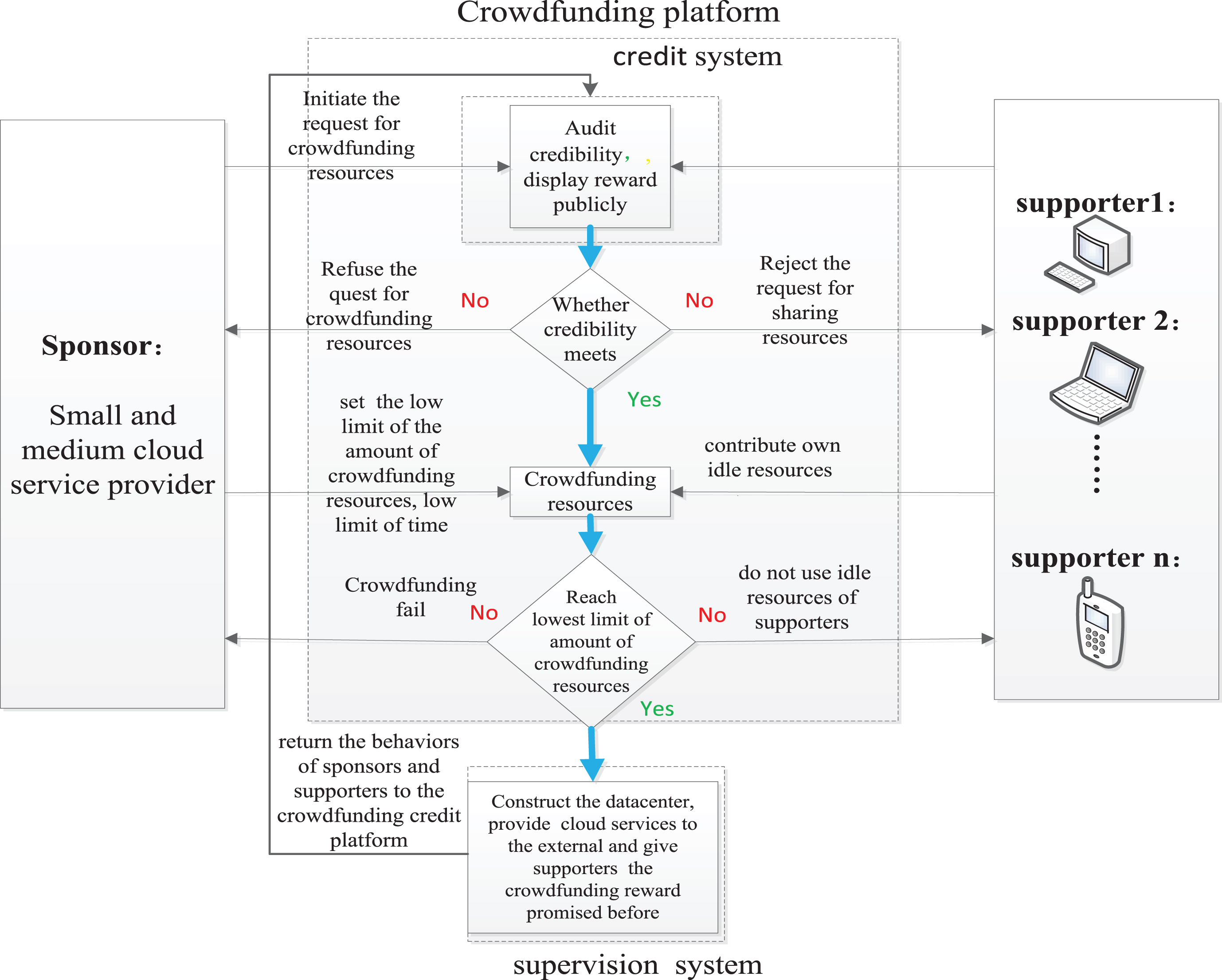
Cloud resource crowdfunding framework.
According to this crowdfunding framework, a reward and punishment mechanism for users is established to provide incentives to users and to supervise the continuous contribution of their own resource. This method ensures that the resource price is in line with the demands of consumers and market rules. This mechanism is composed of a resource crowdfunding algorithm and resource pricing.
A cloud resource crowdfunding algorithm is designed to provide incentives for a large number of network users to actively contribute their own idle resources. In this section, we first introduce the realted definitions for crowdfunding algorithm. Then, we describe in detail the specific flow of the algorithm.
Related definitions
The algorithm requires several definitions, as follows:
Each time supporter i completes a task assigned through the crowdfunding platform, the credit platform evaluates the degree of satisfaction, which is denoted as f
l
. We let f1 represent the first degree of satisfaction. Assuming m evaluations for node i on the reputation sheet of the credit platform, the reputation model that does not consider time decay is expressed as follows:
However, to calculate the reputation of the nodes accurately, the trust model must distinguish the fact for reputation calculation at different stages, that is, a closer evaluation implies a higher weight of the value. Therefore, the final trust model considering the time decay is expressed as follows:
Where
Con is an index quantifying the degree of supporters’ contribution and is described using the following equation:
In general, the units of different contribution metrics are nonuniform. To eliminate the measured units’ differences in different metrics, the metrics must be normalized.
The normalization of t and d is in accordance with the previously presented formula.
If ∀m, t, d = 0, then Con = 0. We assume that m ∈ [0, 1000]. Usually, 1000 is the maximum number of resources the server has. Moreover, t ∈ [0, 5] and d ∈ [0, 10].
P is the market price that users leasing the resource in a cloud data center per unit time must pay. Currently, existing billings for cloud services generally charge for the time and storage space used.
The discounted price is what cloud providers charge for crowdfunding users based on the average market price of the actual resource. Rational cloud providers want to minimize the price.
If the users participate in crowdfunding, then their own benefits are affected. The degree of influence on a user can be represented as e.
The losses users incurred when they actively execute tasks include energy costs and risk costs unit time. When users fully use their resources to perform a task, they improve their own resource utilization. According to [30, 31], system utilization and power increase linearly, which indicates that the increase in system utilization leads to high energy costs. Even if a user has a number of idle resources at the present time, these resources may be used at another time. The users’ own resource requests may suddenly increase sharply at some point. Therefore, contributing their idle resources may reduce their own task execution efficiency and may even cause the task to fail. In this article, the actual negative effects of supporters have a linear relationship with their contributions, which we refer to as Con * e.
When sponsors do not give supporters a prescriptive discount price or supporters cannot contribute resources sustainably, cooperation between them can be considered pseudo-cooperation.
The crowd funding algorithm involves the following steps:
After the cloud providers crowdfund resource successfully, services will be provided to the users. When a user i requests services from the cloud data center, he provides information on the required resource and the degree of contribution. We use the vector [t i , con i ] to denote this request, where t i is the time user i plans to use the resource services. Con i represents the degree of contribution of user i, and Con i = 0 indicates that the user did not participate in crowdfunding (or black users). After the crowdfunding platform receives the job request from users, it will schedule resource according to the task request information vector [t i , con i ] to perform and assign tasks. According to the principles that we have set, the crowdfunding platform will preferentially respond to the task requests of users with a high degree of contribution (i.e., higher con i ). When a user submits a task, the task will be divided into several sub-tasks based on the actual requirements of the user and the actual situation of the crowdfunding sources. Since the crowdfunding sources that perform the tasks are often heterogeneous and controlled by different individuals with highly fluctuating behaviors in providing resource [26], the characteristics of the crowdfunding sources performing the tasks should be considered when allocating the sub-tasks to each supporter in cloud computing. For example, we can assign the sub-tasks according to the power and CPU performance of supporters. In terms of financing, users participating in crowdfunding will pay less than η unit time compared with users not involved in crowdfunding resource.
However, building a resource pool through crowdfunding is unstable because supporters are likely to violate the agreement, that is, they do not contribute sufficient resource and time. We designed a supervision strategy to monitor the supporters contributing idle resource and cloud providers fulfilling their commitment of giving discounted price to crowdfunding users when they use resources in the resilient resource pool. The algorithm proceeds to Step 4.
Resource pricing based on repeated game
We use game theory to model and analyze the most suitable value of η for the cloud provider and users. The sponsor and supporters are two players who can select the strategy. The definitions particularly needed in this game are described as follows:
Payoff functions of the sponsor and supporters are denoted by f and u, respectively. They represent the cost of providing service or using service.
If the strategy combination It is the Nash equilibrium of the original game. It can constitute the Nash equilibrium in any sub-game.
Assuming that they are rational individuals, the sponsor would want to minimize the cost of providing services and supporters would want to minimize the cost of using the service. The ultimate goal of the supporter and the sponsor is to minimize their costs, that is, Min f|u. The sponsor and users do not know at what stage the task will end. Therefore, this process is equal to an infinitely repeated game without the final stage.
Thereafter, we analyze a single stage of the game that the cloud data center providing services and the user using services run only once.
According to the crowdfunding algorithm in 4.1, the sponsor must provide the supporters a discount price represented as η*. Therefore, the cost for the sponsor in unit time can be described as follows:
However, if the sponsor does not follow the crowdfunding agreement and does not give the discount price to users, then the cost for the sponsor in unit time can be described as follows:
If the supporter follows the agreement and cooperates with the cloud provider positively, then the price of using resources can be described as follows:
If the supporter takes pseudo-cooperation and cannot contribute the resource sustainably, then the price of using resources can be described as follows:
If the supporter does not participate in crowdfunding, then the price of using the resource can be described as follows:
Through the previously presented analysis, the sponsor’s strategy combination is a function from {η|η≥ 0 } that provides supporters the price lease resource unit time and the crowdfunding users’ strategy combination is a function from {η|η≥ 0 } to {maintain contributed resource, false cooperation}, which is an infinite dynamic game strategy. In this strategy, maintaining contributing the resource or pseudo-cooperation is the response of supporters to the favorableness of the price that the sponsor has given. The sponsors and the supporter are rational individuals who are eager to pursue their own maximum utility, which indicates minimizing costs for providing services or using services. We assume that the cloud provider has already given supporters η* price preferential according to the agreement. Because contributing their own resources continuously will bring additional costs of energy and risk and no punitive measures, users must select pseudo-cooperation after they have finished using the resource at preferential price, and the cost of the sponsor is
Therefore, if a task only executes one stage, then the dynamic resource pool constituted by supporters is unstable. Reaching Nash equilibrium is not ideal.
Obviously, Nash equilibrium at the stage game G is unfavorable for the sponsor and supporters. Thus, we are ready to prove whether a strategy combination that can make both parties obtain high effectiveness in repeated games exists. If such strategy combination exists, then both sides of the game can implement this strategy combination. When someone deviates from this strategy combination, the other players will return to execute the Nash equilibrium strategy in stage game G as a penalty. The players in the game do not know when the mission will end. Therefore, returning to the original Nash equilibrium will lead deviations to the loss of subsequent utility. As long as this loss is sufficiently large, deviant behaviors can be prevented and cooperative strategy combination can be maintained.
However, the sponsor does not know when a supporter will no longer use the service. Supporters do not guarantee that they will no longer use the cloud provider’s service again in the future. Thus, the game between the sponsor and the supporter cannot be a one-stage game and is an infinitely repeated game. In this article, we consider the game to be a repeated game with complete information, which indicates that each player (the sponsors or the supporters) can decide its subsequent strategy according to the decision of the opposing player. kt-1 ={ ft-1, ut-1 } represents the action combinations of the sponsors and the supporters. mem
t
={ k1, k2, ⋯ , kt-1 } represents the memory for each player at the first t – 1 stages, which is called “the memory of Stage t.” Therefore, each player can decide its strategy according to “the memory of Stage t.” To achieve effective restraint on both sides, we designed the following trigger strategy T: Sponsor: The sponsor will give the supporters discount price η* when they use the resource for the first time. In addition, if the supporter executes the task always at the state of K {m, t}, then the discount price will always be η*. An opposite scenario indicates that the supporter selects pseudo-cooperation, and the pseudo-cooperative behaviors are recorded in the credit platform. Moreover, the user’s reputation will be reduced to 0. With reputation recorded as 0, the contribution of the degree is equal to 0 according to Definition 2, that is, the user is no longer regarded as a supporter, and the subsequent use of the resource will not come with any concessions. The sponsor will not give any discount. Supporter: When resources are leased, if the sponsor keeps his promise to provide the supporters a favorable usage price, then the supporters will keep contributing resources, as stated in the original report prepared in accordance with K {m, t}. If the first (t - 1) stage deals are always η*, then the first phase t retains K {m, t}; otherwise, the user does not fulfill the original crowdfunding convention if it no longer contributes idle resources.
If no one deviates from the trigger strategy T, that is, the cloud provider can give the user a continuous discount price η* and the users can contribute resources steadily, then the payoff function of the cloud provider in the process of the repeated game can be described as follows:
In addition, the payoff function of the supporter contributing the resource steadily can be described as follows:
If the sponsor does not give any discount price, then the sponsor’s revenue function can be described as follows:
Moreover, if supporters select pseudo-cooperation, then their profit function can be described as follows:
In ensuring that the aforementioned triggering policy is credible, the strategy combination of the sponsor and supporters must constitute a sub-game perfect Nash equilibrium, which means fulfilling conditions (1) and (2) stated in Definition 9. First, we prove condition (1):
To ensure that the game achieves a stable state, the following formulas should be met:
In addition, the contribution degree should be considered. Thus, we can express the formula as follows:
Therefore, when Second, we prove condition (2):
The sub-game of the repeated game includes the beginning sub-game between two crowdfunding periods T and the starting sub-game in which supporters execute tasks after sponsors have given them η rewards.
The beginning sub-game between two crowdfunding periods T has the same structure as that of the originally repeated game and is an infinitely repeated game. Therefore, when condition (1) is fulfilled, the triggering strategy is also the Nash equilibrium in the sub-game.
If the stages before the beginning sub-game when supporters respond to the task are all in Nash equilibrium, then the cloud provider will still give supporters η* discounted price at this stage. Therefore, the best strategy of crowdfunding users is still to perform positive tasks. In addition, users must complete the sub-task successfully because of active implementation. In the subsequent phase, the cloud provider will continue to provide discount price η* and remain with the trigger strategy. The trigger strategy combination in the sub-game is also a Nash equilibrium.
Therefore, this strategy combination is a sub-game perfect Nash equilibrium, indicating that the trigger mechanism is credible and plays not only an incentive role but also a regulatory role for cloud service providers and users. This strategy combination makes the game players waive immediate interests, maintaining cooperation. Through the previously presented analysis, we determine that η* is the most suitable price for sponsors and supporters.
Simulation scenario
To evaluate the new crowdfunding platform proposed in this study, we established a new experimental scenario based on Hadoop platform, which composed of two server nodes and four PC nodes. One of server nodes acts as the sponsor, the other represents crowdfunding platform. The four PCs are the supporters who contribute the resource. The computing capabilities of the supporters and the sponsor were generated randomly within the ranges of [40, 100] and [500, 1000], respectively. In addition, w1 = 0.5, w2 = 0.4, and w3 = 0.1.
In the crowdfunding system, some related important configuration parameters used in the simulation are described in Table 1. In addition, some parameters used for the crowdfunding algorithm are described in Table 2. Furthermore, we used Ganglia system to monitor the status of these nodes to obtain the experiment results.
The configuration parameters of performing simulation
The configuration parameters of performing simulation
The related parameters of crowdfunding algorithm
Under different loads ranging from 10% to 100%, ten experiments were designed randomly to evaluate the power consumption of two scenarios. One scenario can be described as “without crowdfunding”, which means that the sponsor performs the task independently. Another scenario can be described as “with crowdfunding”, which means the sponsor requests resource supporting from crowdfunding platform to perform the task.
As shown in Fig. 2, the power consumption with crowdfunding is always significantly less than that without crowdfunding because the more decentralized the system is, the less energy is consumed.
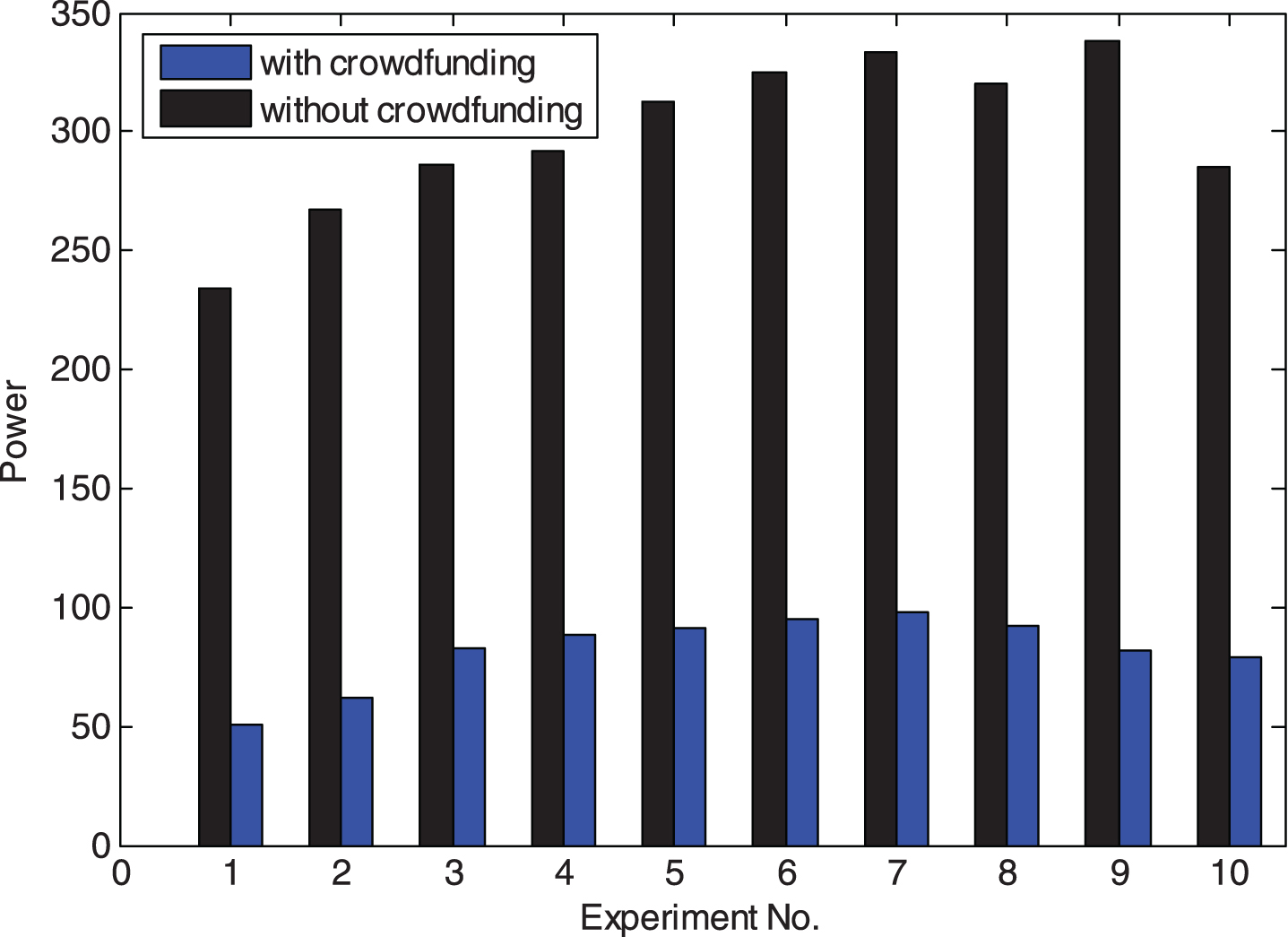
Comparison of power consumption.
However, the crowdfunding is meaningless if we reduce the power consumption by sacrificing performance. Therefore, we compare the performance of crowdfunding and not crowdfunding to measure whether our proposed scheme is useful or not. We consider some different “PageRank” tasks as the application request, which are shown in Table 3. The experiments are based on different scales of input data, which required different longest tolerance time. Task processing time is an important indicator of performance. We defined ‘satisfaction rate’ as the probability that tasks can be completed within the longest tolerance time. From Figs. 2 and 3, we can conclude that using crowdfunding scheme, the energy consumption of crowdfunding dramatically is reduced, while the satisfaction rate is not declined. So our scheme not only reduces the power consumption but also ensures the performance.
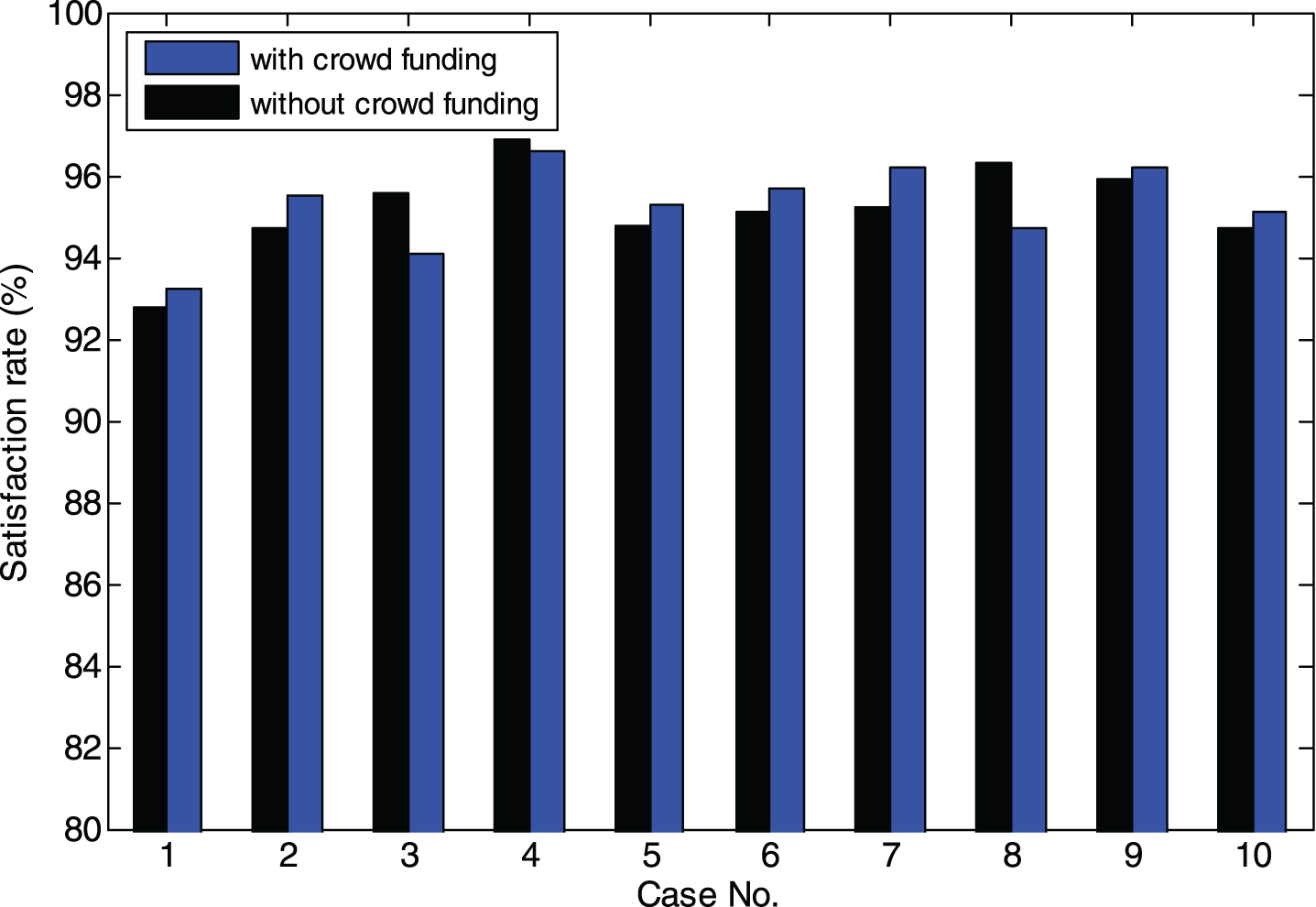
Comparison of satisfaction rate.
Description of tasks
The scheme is designed with a rational pricing mechanism. The reputation values of different supporters are described in Table 4. In this section, we evaluate the discounted price for supporters. Figure 4 shows that the discounted prices will increase with the supporters’ contributed resource quantity. We also find that the discounted prices will increase if the time of contribution is prolonged, as shown in Fig. 5. In addition, the supporter with higher reputation will receives a greater discounted price.
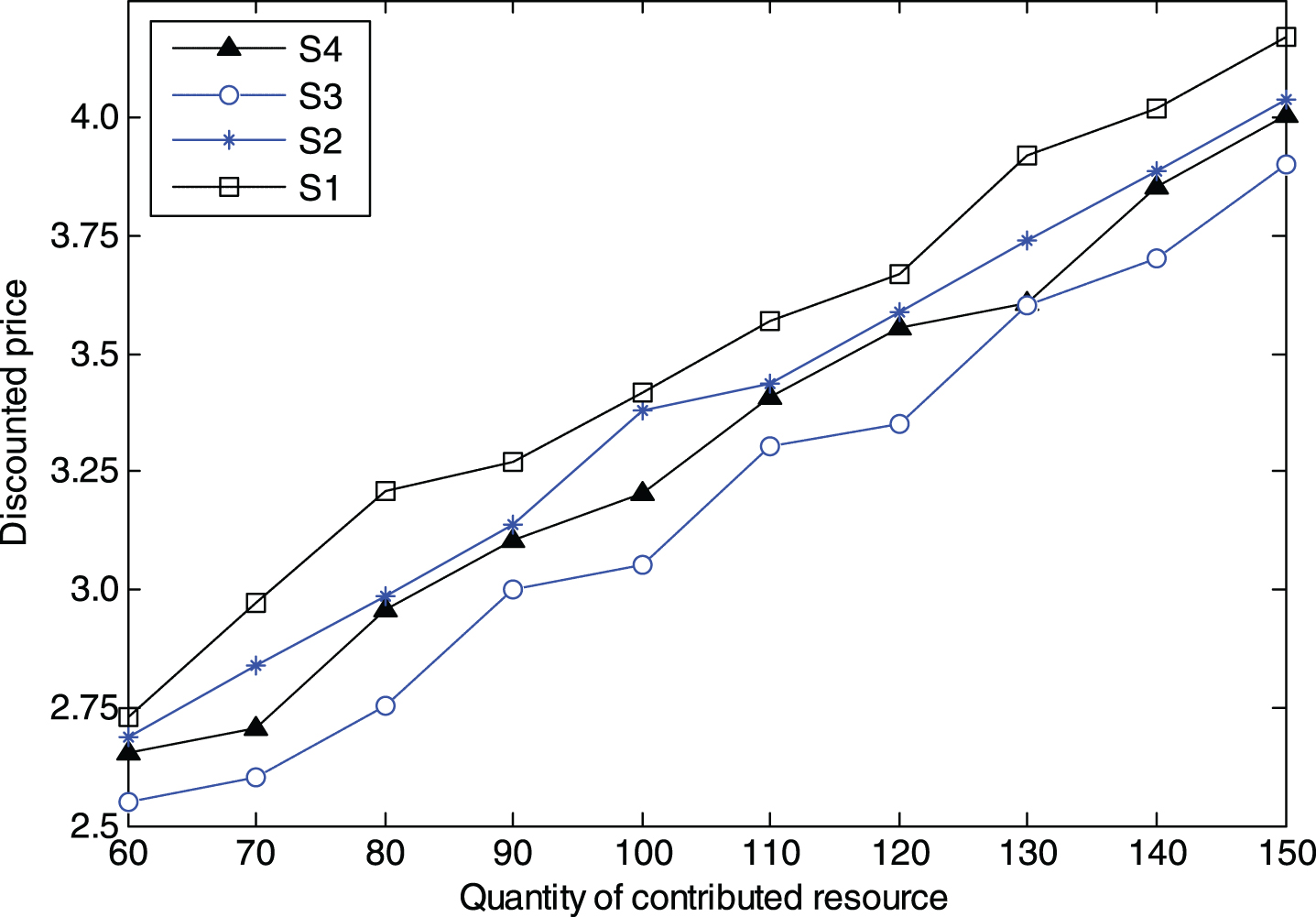
Discounted price on different quantities of contributed resource.
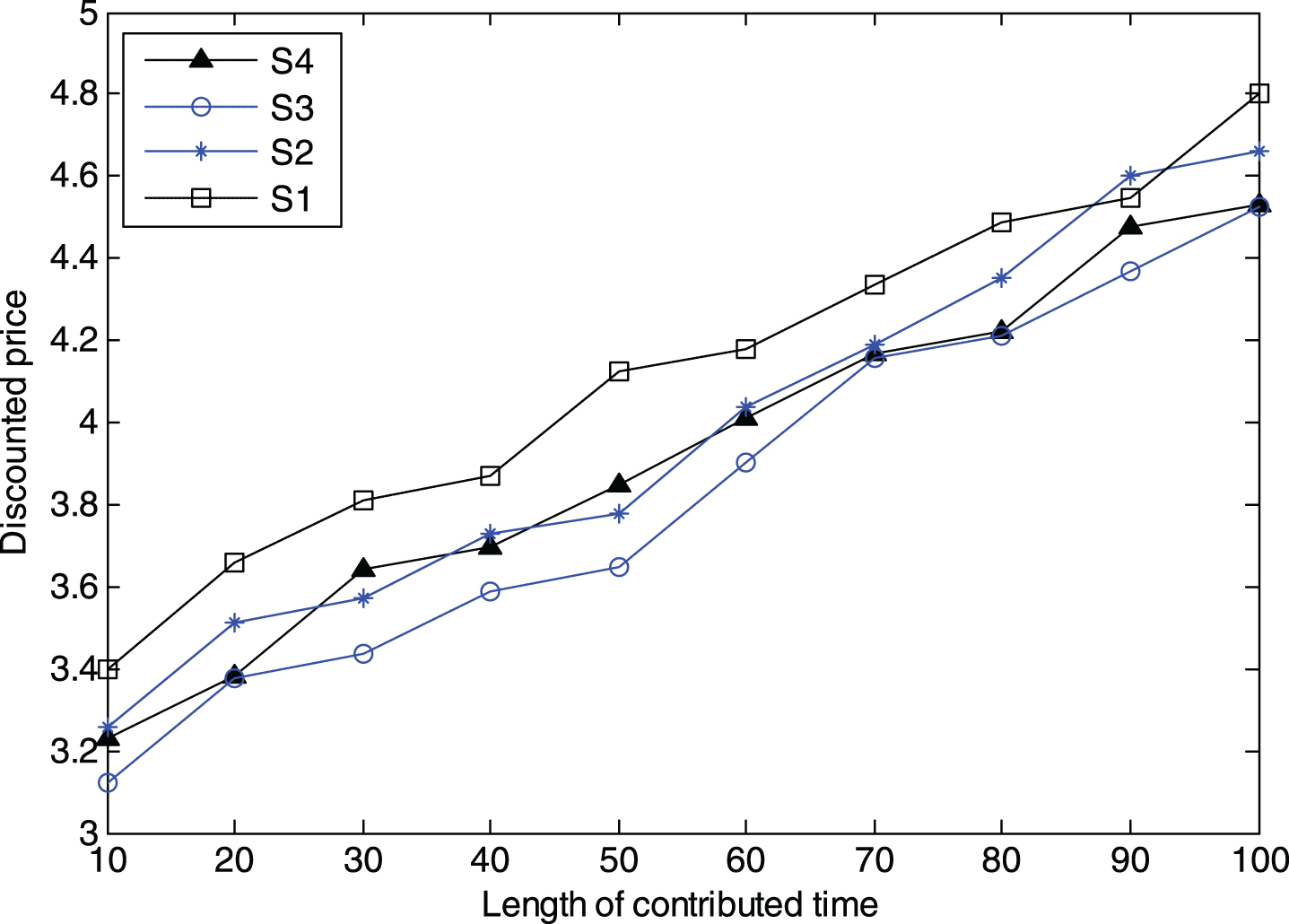
Discounted price on different lengths of contributed time(s).
Reputation of supporters
In this paper, we determine that the users who contribute their own idle resources are priced favorably. Through a trusted third-party crowdfunding platform, we supervise the conduct of the parties. Our proposed crowdfunding scheme can effectively reduce the overall energy consumption and increase the resource utilization of the system. Regarding future work in this area, we plan to elaborate on the reward and punishment mechanisms considering the quality of services offered by supporters while further optimizing energy efficiency in a cloud data center.