



Abstract
This paper develops a dual-objective vendor-managed inventory model with a single supplier and multiple retailers in a supply chain in which the retailer’s demand is assumed as a fuzzy random variable and the supplier incurs a constant deterioration rate. The model is optimized to simultaneously minimize the total cost and maximize the service level under capital budget and storage constraints, in which ordering cost, holding cost, deterioration cost and transportation cost are considered in the total cost of the vendor. To solve the proposed model in an imprecise environment, the expected value and pessimistic value are used to change the fuzzy random model into a determined model. Three fuzzy random simulations are presented to obtain the optimal replenishment quantities of the expectation model and the pessimistic model. A numerical study with a single vendor and three retailers in the supply chain is provided to demonstrate the efficiency of the models and algorithms, which gives the optimal results for the expectation model and pessimistic model. Furthermore, recommendations for the replenishment policy for different types of decision makers in the pessimistic model are provided based on the analysis of inventory costs with different parameter values.
Introduction
In the 21st century, competition is no longer among individual enterprises, it is among supply chains. As a vital part of supply chain management, effective inventory management and stock control have attracted increasing attention. Vendor-managed inventory (VMI) is an efficient method which makes the inventories of the supplier and retailer integrally managed through information sharing and cooperation. The retailers share sale data and inventory information using an information system such as Electronic Data Interchange and Internet-based XML protocols. The supplier undertakes the responsibility of replenishment, inventory management and distribution of retailers based on the information. VMI system is a complicated business entity and has a high degree of uncertainty. There are three different sources of uncertainty, including supplying, process and demand uncertainty. This article considers the demand uncertainty in modeling which aims to reduce the impact of fluctuations on suppliers and whole supply chain and find an optimal stock strategy in a VMI system with a single vendor and multi-retailer.
Most scholars studied stock control problem considering the retailer’s demand as a random variable [1–3]. Kiesmuller [4] developed a two-echelon inventory system for a single supplier and a single retailer. The demand of the retailer was assumed as a random variable, and the aim was to obtain the minimum total cost of supply chain with an economic order quantity. Lan [5] had a deep research in stock control problem of deteriorating products in the VMI model with multiple retailers and considered the stochastic demand. A bi-level programming model was established with minimal cost and delivery time.
With the development of uncertainty theory, the fuzzy variable was used to study the inventory model for the VMI problem. Tong [6] proposed a VMI model consisted of a single factory and a single customer with a triangular fuzzy demand and obtained the maximum profit of the supply chain. Sadeghi [7] constructed an economic production quantity VMI model in multi-retailer single-supplier supply chain management under storage capacity, replenishment quantity and average stock capacity limitations. Sadeghi [8] developed a bi-objective model where the demand was a fuzzy variable and the supplier managed the retailer’s inventory in a middle stockroom. The optimal result was to determine the replenishment frequency, minimizing stock cost and storage area of the retailer. In a study by Nia [9], the retailers’ demand, supplier’s storage capacity and ordering quantity were considered fuzzy, and the proposed model was intended to obtain the minimal total cost of the supply chain.
The uncertain random theory was introduced in inventory management and stock control considering the fuzzy and random features of demand. In a study by Li [10], there were optimistic, pessimistic and risk-neutral decision indexes when making replenishment decision. And retalier’s demand was recognized as a fuzzy random variable in a supply chain coordinated by a buyback contract. Zhang [11] conducted a model based on the study [10], and the cost of backorder was added to the profit model. A realistic case was introduced to demonstrate the efficiency of supply chain coordination and the effect of mixed imprecise and uncertain demand. Hu [12] studied a two-stage supply chain system including a single customer and a single vendor for deteriorating items where the demand was considered a triangular fuzzy variable. Expectation theory and signed distance were applied to change the fuzzy random model into a deterministic model, which maximized the total profit with the optimal initial order quantity. Nagar [13] established a multi-objective two-echelon stochastic programming supply chain model with uncertain producing rate, imprecise vendor productivity and fuzzy random demand. The maximum return, maximum customer service level, and minimum decision risk were determined at the end of the paper. Chakraborty [14] considered the following factors to be fuzzy random and bifuzzy: the price of product, holding cost, procurement cost, transportation cost, storage area and capital budget. A model with stock deterioration for a multi-item supply chain was optimized to determine the credit periods and total time of the supply chain cycle with limited storage space and budget.
Table 1 summarizes the related literatures for the supply chain modeled in an imprecise environment. As is shown in Table 1, many domestic and international scholars only considered random demand or fuzzy demand when it came to the VMI problem in an imprecise environment; Only a few literatures established the multi-objective model and considered deterioration in modeling. In this article, a dual-objective VMI model is developed where retailers demand is assumed as a fuzzy random demand and the deterioration is considered in the calculation process of stock status and costs related to inventory. The proposed model is optimized to obtain the appropriate replenishment quantity which intends to get the minimum total cost and the maximum service ability.
Summary of related literature for the supply chain model in an imprecise environment
Summary of related literature for the supply chain model in an imprecise environment
IE: Imprecise Environment; IP: Imprecise Parameter; O: Objective; V/R: Vendor/Retailer; C: Constraint; D: Deterioration; ST: Shortage; T: Transportation; S: Single; M: Multi.
The rest of the article is structured as following five parts. Section 2 represents the definitions and theorems in the developed model. The problem description and principal assumptions are provided in Section 3. Section 4 illustrates the dual-objective VMI model in detail, and three fuzzy random simulation algorithms are proposed in Section 5. Section 6 includes a numerical study for the expectation model and pessimistic model, and the optimal result is presented. Finally, the conclusion and future research are discussed at the end of this paper.
In the paper, a dual-objective VMI model with fuzzy random demand is proposed and uncertainty theory developed by Liu is applied to the process of model constructing and solving. The definitions and theorems needed in this paper are as followings.
Problem definition and assumptions
The vendor-managed inventory system with a single supplier and multi-retailer is proposed in Fig. 1. The supply chain includes a single supplier and multiple retailers who face multiple sale seasons. The vendor provides a single product to all customers according to their orders and undertakes the responsibility of replenishment, stock management and distributions. The model only considers the process of procurement, storage and distribution; the manufacturing procedure is neglected.
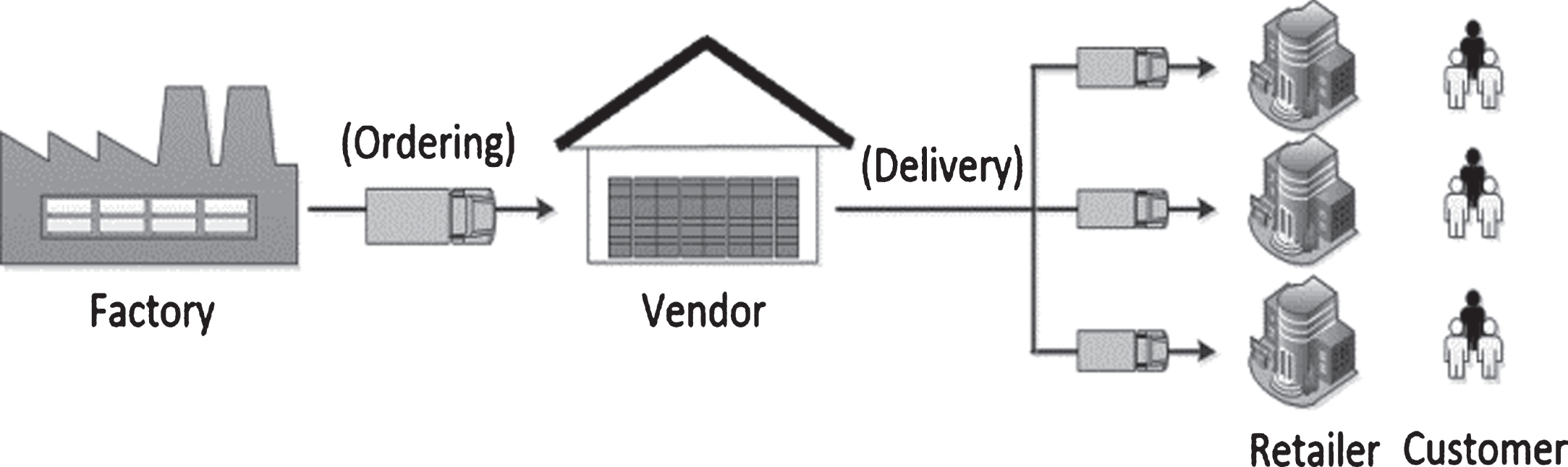
An illustration of a supply chain.
The amounts of vendor’s inventory and retailer’s inventory are presented in Fig. 2, where the retailer’s demand is considered fuzzy random and the supplier’s stock deteriorates at a fixed rate. The supplier’s demand is equal to the accumulation of all retailer demand in the supply chain in a replenishment interval, and the supplier satisfies m replenishment cycles of retailers with the initial ordering quantity.
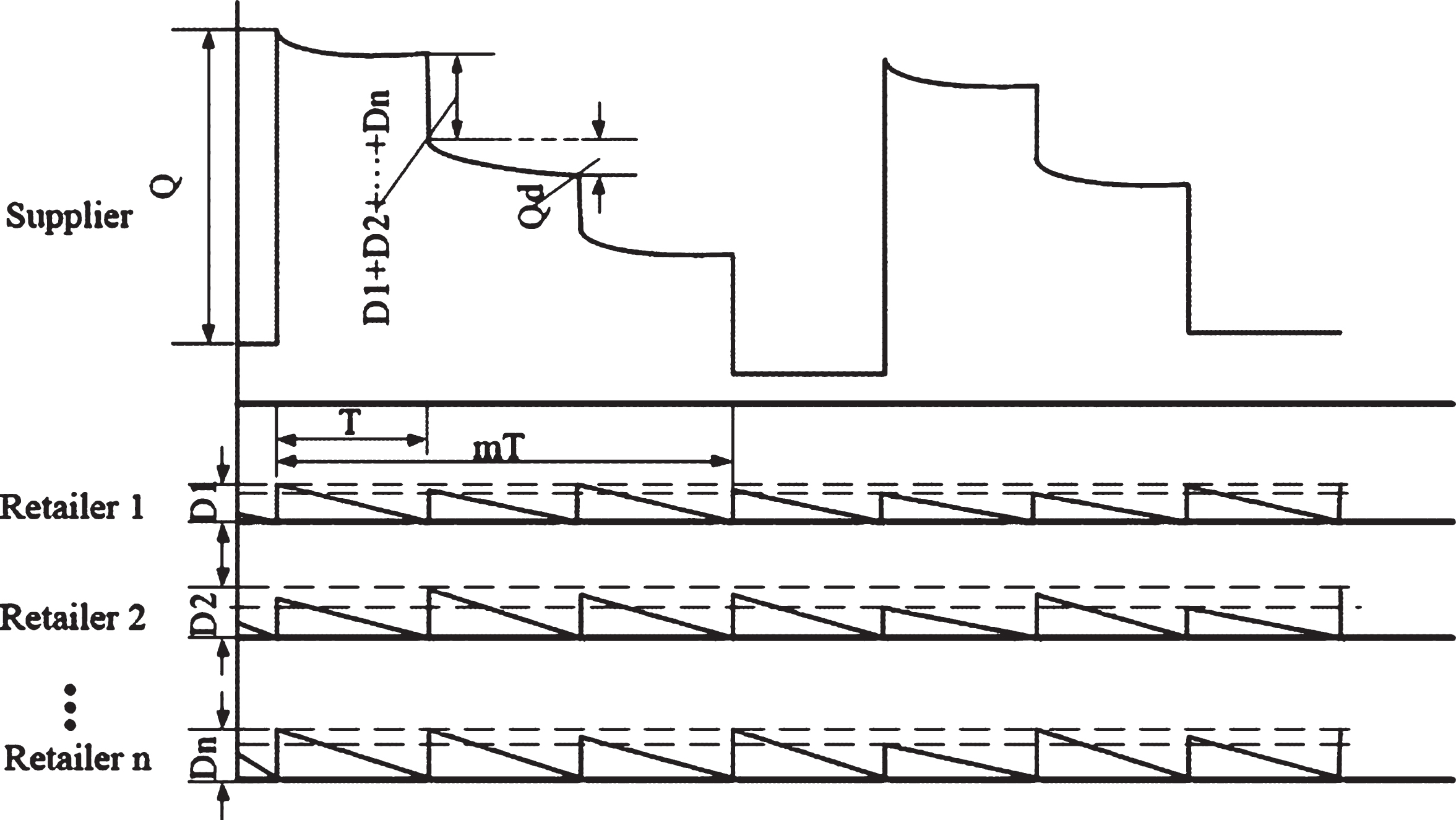
Inventory levels with single vendor and multiple retailers.
The principal assumptions which the proposed VMI model with the fuzzy random demand considered is based on are as follows:
There is a supply chain, which consists of a single supplier and multi-retailer, and the supplier only provides a single item for all retailers. The retailer’s demands are independent, and the supplier replenishes retailers at the same time. All products are owned by the supplier until the delivery is completed, and all retailers have no inventory. The storage time of the retailer is notably short, and holding cost can be neglected. The vendor is responsible for the deterioration of products in the process of procurement, storage and distribution. The ordering quantity of the supplier should satisfy multiple replenishments of retailers and the reorder point is zero. Shortages are only permitted in the last replenishment cycle, which corresponds to the supplement period of the vendor. The price of the product, fixed cost of ordering and shipment, variable cost of shipment, holding cost per unit, existing inventory, deteriorated rate, capital budget and storage space are constant.
Notations and demand descriptions
Notations involved in this paper are shown as followings.
C
O
replenishment cost of the vendor R
cost
maximum amount of financial resources R
space
maximum amount of spatial resources Q ordering quantity per time of the vendor I
e
existing inventory of the vendor h holding cost per unit during one period θ deterioration rate of the item c price of commodity per unit c
o
fixed cost per order of vendor c
f
fixed cost per shipment c
v
transportation cost per unit n number of retailers in supply chain m replenishment cycles for retailers
The retailer’s demand fluctuates in practical situations and it’s always not completely consistent with supplier’s prediction. Because of the lead time of production, there are many cases when the supplier cannot satisfy the actual demands of the retailers. The demands might be less, equal or more than expected, and the probability of these cases can be obtained from historical data. However, there are little or no available data to support decision and two reasons are accountable for this phenomenon. For one thing, the environment always changes in the supply chain. for another, the existing data cannot accurately estimate the probability distribution of the retailer actual need in the supply chain [18]. Hence, the demand described with a single random variable or a single fuzzy variable is not suited. To solve the uncertainties of the retailer’s demand and quickly respond to the diverse demand, a fuzzy random variable is applied to the proposed model and it is much more accurate to reflect environment changes in this complicated situation.
The fuzzy random demand of retailer i is denoted by
The supplier undertakes the costs of management and deterioration in the process of procurement, storage and distribution in the proposed model. The vendor may lose sale opportunities and even customers when a shortage is incurred. Therefore, a dual-objective VMI model is composed according to the assumptions and derivations in Section 3. The objectives are as follows: (1) minimization of the total cost of the supplier; (2) maximization of the service ability for the retailers. The model aims to obtain the optimal replenishment quantity under the budget and space constraints.
The inventory level with deterioration can be described by Equation (2) according to [5] when the demand is zero.
The amount of inventory of the vendor at time t in the replenishment cycle j of retailers is shown in Equation (3).
The stock status and deteriorated quantities at the end of the replenishment periods of retailers are expressed in the following segmented Equations (4 and 5), respectively. Then, j < m,
The expectation model of uncertain random variable proposed by Liu [19] is applied to obtain the optimal solutions of the proposed VMI model. Since the objectives are conflicting, there are no optimal solution which simultaneously minimizes the total cost and shortage. With the increment of replenishment quantity, the shortage will decrease. However, the total cost of the vendor will increase. To obtain the optimal result, the second objective is converted into a constraint of the first objective; then, λQ expresses the allowable shortage of the supplier, and λ ∈ [0, 1]. The minimum expected total cost for the VMI problem under the budget and space constraints is expressed in Equation (14).∥
The chance constraint model with the minimum pessimism value of the fuzzy random variable, which was proposed by Liu, is used to get the optimal solutions of the VMI problem [16]. The original model is converted to achieve the minimum pessimistic value of the total cost, where the second objective of shortage becomes a chance constraint at the allowable shortage quantity; λQ is the allowable shortage quantity of the supplier, and λ ∈ [0, 1]. The pessimistic model under the chance constraint is expressed in Equation (17). This model aims to determine the minimum total cost under budget and space constraints, where the chance of shortage is less than the permitted value which is greater than σ.∥∥
To solve the proposed models, three algorithms are developed:
Fuzzy random simulation for the expected value Fuzzy random simulation for the pessimistic value Fuzzy random simulation for the α - chance value
Set e = 0; Randomly generate fuzzy variables f
j
(ω
i
) with membership degrees μ
j
, j = 1, 2 ⋯ N; Calculate the minimum and maximum values
Uniformly generate r from the range [a, b]; If r ≥ 0 set
If r < 0
Repeat (4) and (5) N times; the expected value is
Algorithm 2 Fuzzy random simulation for the pessimistic value
Initialize ɛ, which is a small positive number; Randomly generate the fuzzy vectors
Let the fuzzy variable be
Repeat (2) and (3) N times; Calculate the minimum and maximum values:
Set r = (a + b)/2; Calculate the credibility
If L (r) ≥ δ, set b = r; otherwise, set a = r; If b - a ≥ ɛ, go to step (6); and Return r as the δ pessimistic value of variable F (ω
i
).
Algorithm 3 Fuzzy random simulation for the α - chance value
Set j = 1; Randomly generate the fuzzy vectors j = j + 1; if j ≤ N, go to step (2); otherwise, go to step (4); and Calculate and return β
i
; then
Numerical Study
To illustrate the application of the proposed model and algorithms and investigate its performances, a supply chain with a single supplier and three retailers is assumed. The cost of different procedures and resource constraints are shown in Table 2 and demands of retailers are shown in Table 3. Model_1 is solved by Algorithm 1, and Model_2 is solved by Algorithm 2 and Algorithm 3. All the solutions are obtained by thesoftwareMATLAB2012a on a personal computer.
Input data in a fuzzy random environment
Input data in a fuzzy random environment
Note: The unit of all kinds of cost is yuan (RMB).
Demands of retailers in a fuzzy random environment
The optimal result of Model_1 is shown in Fig. 3. The expected total cost is an increasing function of replenishment quantity, whereas the expected shortage is a decreasing function of the initial order quantity. The expected quantity of shortage is zero if the replenishment quantity is greater than 21,263 units. The ordering quantity of the supplier is optimal if the shortage quantity is equal to the allowance. The allowable quantity of shortage is decided by decision maker. In the case of λ = 0.1, the optimal replenishment quantity is 19,241 units at the intersection point of the left vertical line and the x-axis, and the expected shortage is 1,924 units. Additionally, the minimum expected total cost is 144,751 yuan. Similarly, the optimum initial quantity occurs at the intersection point of the right vertical line and the x-axis in the case of λ = 0.05, and the optimum order quantity, minimum expected total cost and expected shortage of products are 20,202 units, 154,780 yuan and 1,009 units, respectively. The optimal result is shown in Table 4.

Optimal result of model_1.
Optimal result of Model_1
Note: The unit of total cost is yuan (RMB).
The optimal result of Model_2 is shown in Fig. 4 for γ = 0.8, δ = 0.8, α = 0.8 and λ = 0.1. With the increase in initial ordering quantity, the total cost increases nearly linearly, whereas the chance value first increases and gradually remains stable. The intersection point of the vertical line and total cost curve represents the minimum cost of the supplier when σ is equal to 0.8. The optimal replenishment quantity is 20,470 units, the minimum total cost of the supplier is 184,211 yuan. Similarly, the supplier’s total cost curve and the chance value curve with the shortage constraint when λ = 0.05 is shown in Fig. 5, where the optimum ordering quantity and total cost of σ = 0.8 are 21,500 units and 195,964 yuan, respectively. The optimal result of Model_2 for various values of parameters λ and σ is shown in Table 5.

Optimal result of model_2 (λ = 0.1).
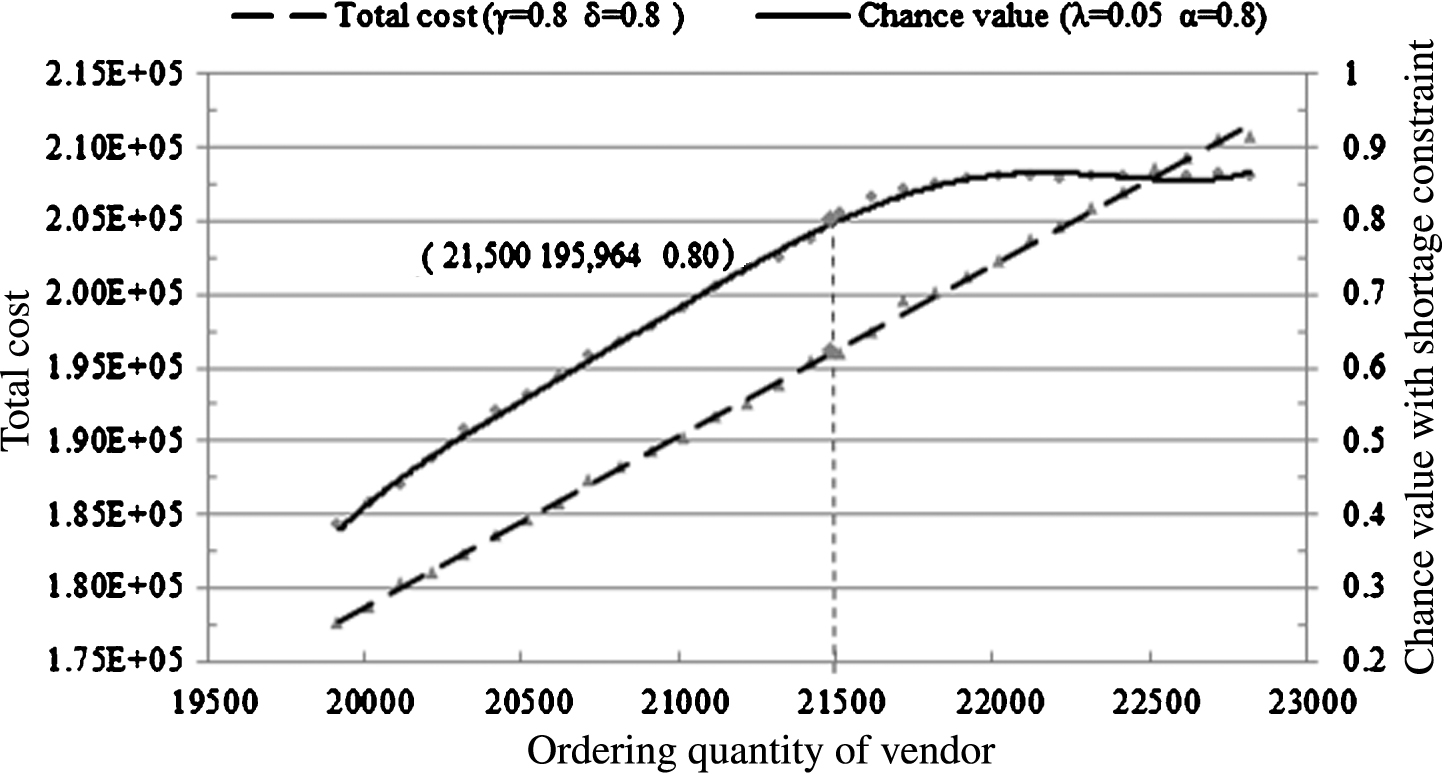
Optimal result of model_2 (λ = 0.05).
Optimal result of Model_2
Note: The unit of total cost is yuan (RMB).
The result of Model_2 when γ = 0.8, δ = 0.8 and α = 0.8 is more reliable than the other model with smaller parameter values. There is a slight possibility that the shortage is greater than the permitted value with the optimal replenishment quantity, but the total cost is relatively higher. As a result, it is suitable for risk-averse entrepreneurs. The values of parameters γ and δ can decrease to reduce the total cost for a risk-preference decision maker. As is shown in Figs. 6 and 7, the total cost decreases when the values of parameters γ and δ are reduced. The functions of the total cost with various values of δ are shown in Fig. 6, where γ is equal to 0.8. Similarly, the functions of the total cost with various values of γ are shown in Fig. 7, where δ is equal to 0.8. With the decrease in α, the optimal replenishment quantity and total cost decrease because of the increase in α - chance. The optimal results of the α - chance value with the shortage constraint for various α values are shown in Figs. 8 and 9. Although the optimal ordering quantity and total cost decrease with smaller values of parameters γ, δ and α for Model_2, the credibility of the model is undermined, and the shortage risk increases.
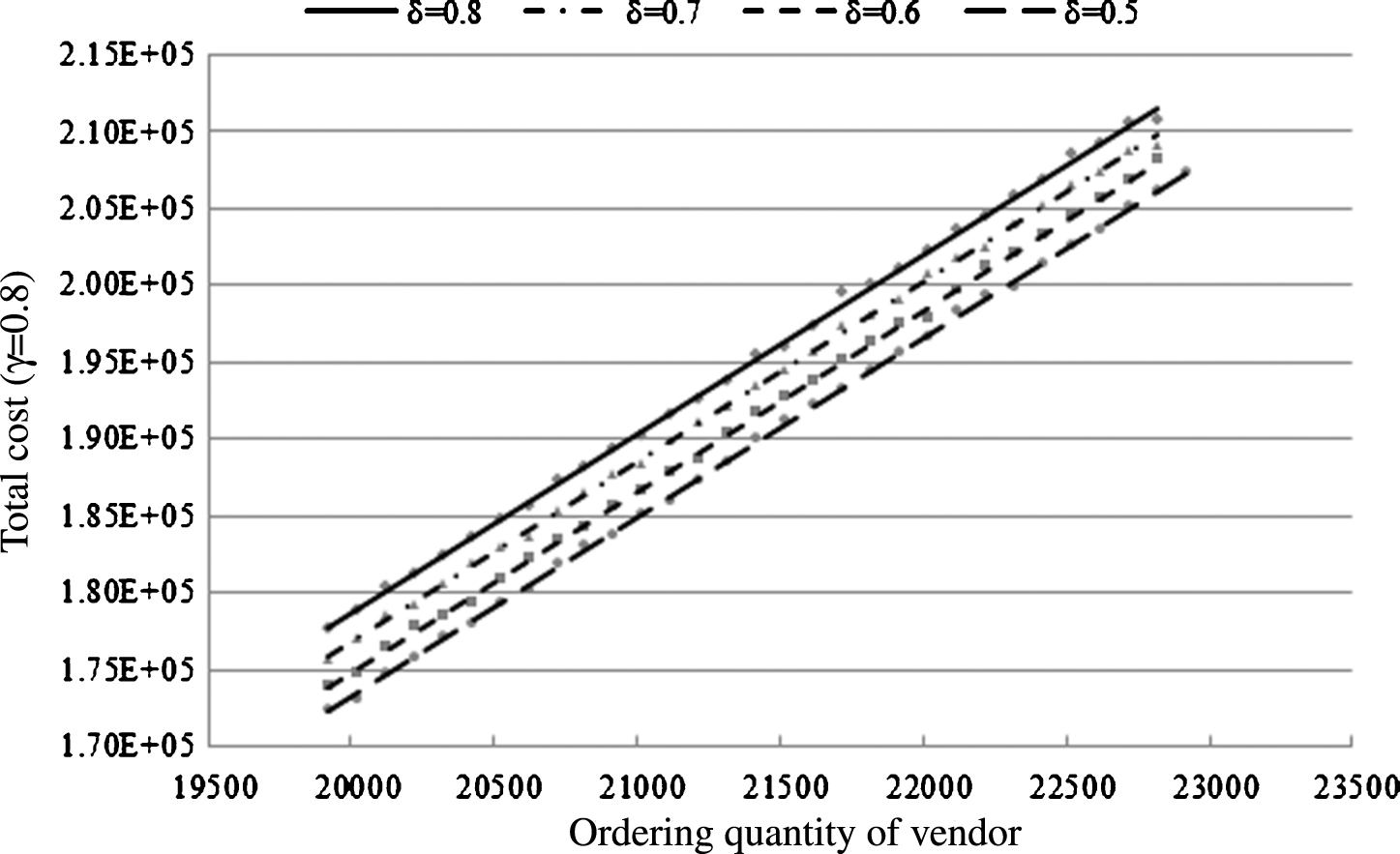
Pessimistic value of the total cost (γ = 0.8).
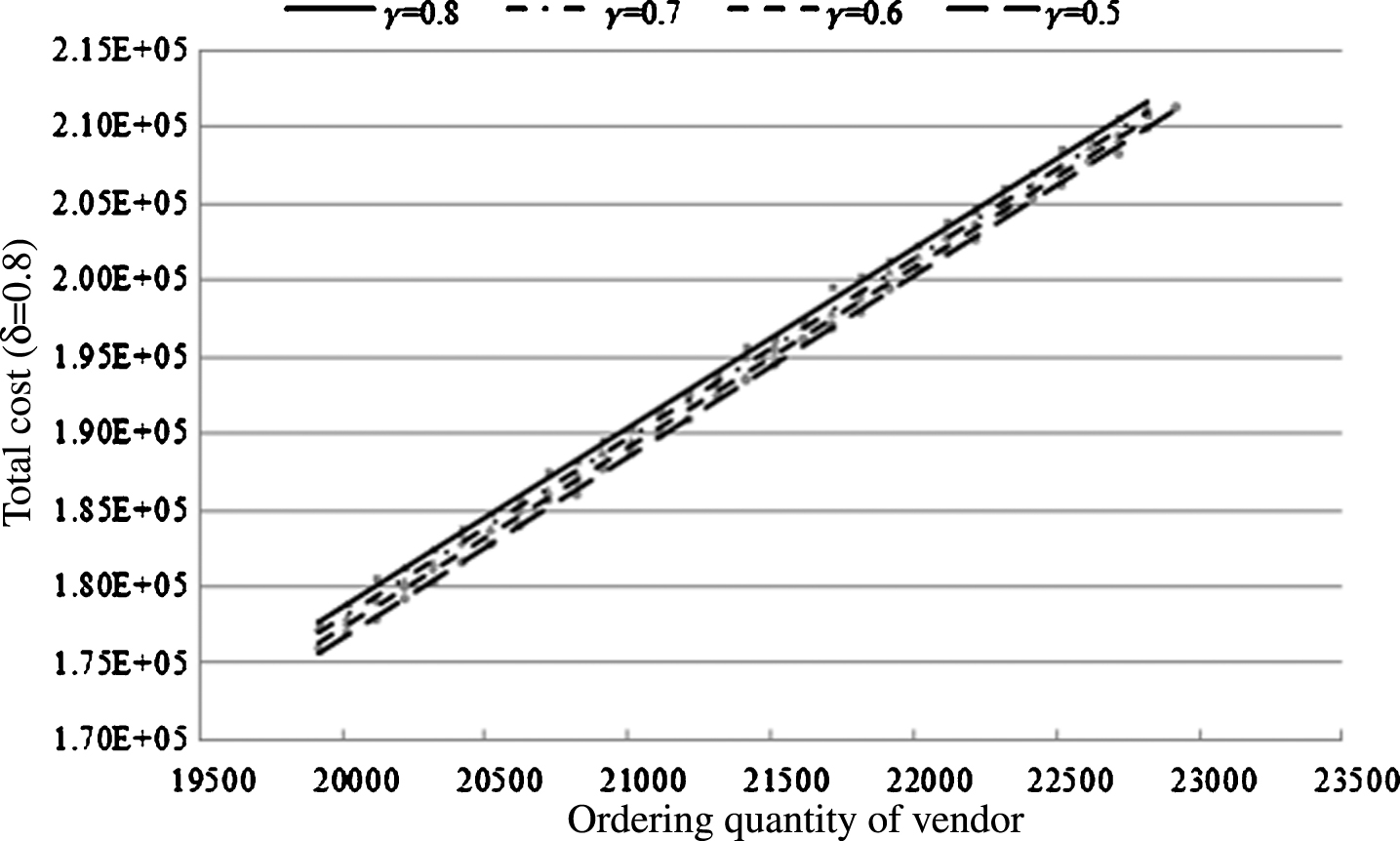
Pessimistic value of the total cost (δ = 0.8).

Chance value with shortage constraint (λ = 0.1).

Chance value with shortage constraint (λ = 0.05).
In this paper, a vendor-managed inventory model for a single supplier and multiple retailers with fuzzy random demand is proposed. The proposed model aims to obtain the minimal total cost and maximal degree of service under budget and space constraints. The expectation model and pessimistic model are used to obtain the optimal solutions. The fuzzy random model for the VMI problem is transformed into a deterministic model with expectation in which the replenishment quantity of the supplier is determined by the historical sale data of retailers and realistic environment. Therefore, the simulation results are more suitable for the practical situation. The pessimism model provides the optimal replenishment quantity and minimal pessimistic value of the total cost in terms of the retailer’s demand under budget, space and shortage constraints in case of credibility δ and probability γ. Some features of this model are as follows: (1) It is a dual-objective VMI model with total cost minimization and service ability maximization for multiple retailers under multiple constraints. (2) The retailer’s demand, which is described with the fuzzy random variable, exactly reflects real life. (3) The stock deterioration and delivery process are considered in this model, meanwhile the deterioration cost and distribution cost are included in the total cost. The present model can be extended to a multi-supplier and multi-retailer model with multiple items in future studies, and the deterioration rate can be considered a variable value.