



Abstract
Faced with the problems of low production efficiency and unreasonable industrial organization exist in the development of agriculture, this paper studied the multi-objective optimization of sustainable agricultural industrial structure based on genetic algorithm in order to optimize the allocation of agricultural industrial structure. First of all, this paper expounded the current agricultural development background, and then put forward the research status of multi-objective optimization algorithm, based on which points out the advantages of genetic algorithm. Then, establish the model system that is based on the optimal allocation of industrial structure. Use the improved genetic algorithm to solve the problem, and modify the operator design to obtain the optimal algorithm for the sustainable agricultural optimization sequence. The results of the algorithm evaluation show that the optimized industrial structure benefit value and sustainability both have been improved.
Keywords
Introduction
Sustainable agriculture refers to the idea of applying the concept of sustainable development to agriculture, including the rational use of agricultural resources, the improvement of industrial output, and the development of resources and so on. China’s sustainable agriculture has begun to pay attention to the protection of the environment, while ecological agriculture can promote the virtuous cycle of ecology, and promote the improvement of the quality of life [1]. In the development of sustainable agricultural industry, the adjustment of industrial structure is the key issue. Many scholars have used various methods to adjust the industrial structure. The current industrial structure model includes dynamic model, econometric model, mathematical model and so on, and generally choose the appropriate model according to actual situation [2]. The input-output model mainly analyzes the relationship between the various departments and Eng, the establishment of mathematical models, the use of economic analysis and calculation, and the analysis of economy and industry organization. In the system dynamics analysis, the differential equation is used to solve the nonlinear problem, and it is widely used in the field of industrial structure adjustment [3]. This paper mainly discusses the analysis, nonlinear and multi-objective optimization model of sustainable agricultural development which is a very complicated system, but not a simple linear function that can be expressed easily. And the existence of nonlinear programming model was calculated by using the genetic algorithm in the study. Considering the economic efficiency and ecological efficiency, it also realized multi objective optimization.
State of the art
The multi-objective optimization algorithm in mathematical programming model is developed, involving multiple objective problems, and conflicts in the calculation will inevitably encounter various problems. All other goals may lead to deterioration after improving an index. Therefore, it is necessary to find the optimal solution. The multi object optimization in traditional methods, including three kinds of optimization method, regards a target as the main target, and the other as a constraint condition, which will transform the multi-objective problem into single objective optimization. Rating method and hierarchical sequence method belong to optimization method [4]. The goal programming rule is to solve the deviation according to the target set value as the design variable. This algorithm transforms the multi objective linear function into the single target algorithm. Evaluation function method is to constructs evaluation function, which will transfer multiple target problems into a single objective problem, solving the problem. The common evaluation function methods include linear weighting method, distance function method, and minimax method and so on [5]. The traditional algorithm can only obtain an effective solution of the target, and the actual decision needs different design options, thus it may not get satisfactory results [6]. By using genetic algorithm in this study, the genetic algorithm is a search optimization algorithm in the last century that was put forward in 70 s without finding any information by asking questions. And it doesn’t affect by continuous problem of the optimal solution of the search space, and is used more frequently in the current nonlinear and multi-dimensional space problems.
Methodology
There are some differences in different regions in the multi-objective optimization of sustainable agricultural structure [7]. Picture 1 is sustainable agriculture planning map. The research and analysis, whose research object is a province of agriculture in our country, covering agricultural planting, animal husbandry and fishery, focus on the rational allocation of animal husbandry and farming, forestry and animal husbandry and optimization analysis of relationship, whose aim is to achieve the harmonious development of the agricultural industry structure to, Fig. 1.

Sustainable agriculture planning map.
Genetic algorithm (GA) has a group operation algorithm of generating and detecting, which operates with individuals as objects. Selection, crossover and mutation constitute genetic operations. Therefore, genetic algorithm has the characteristics that other algorithms don’t have; Fig. 2 is a genetic algorithm that often uses a toolbox. In the genetic algorithm, the basic elements include fitness function, parameter coding, genetic design, etc. [8]. The main steps of the genetic algorithm are to determine the objective function and the decision variables. The fitness function is determined, the population is initialized, the fitness of the population is calculated, and the excellent individuals are inherited to the next generation. Cross operation in individual pairing, perform mutation operation, and then get the next generation group.
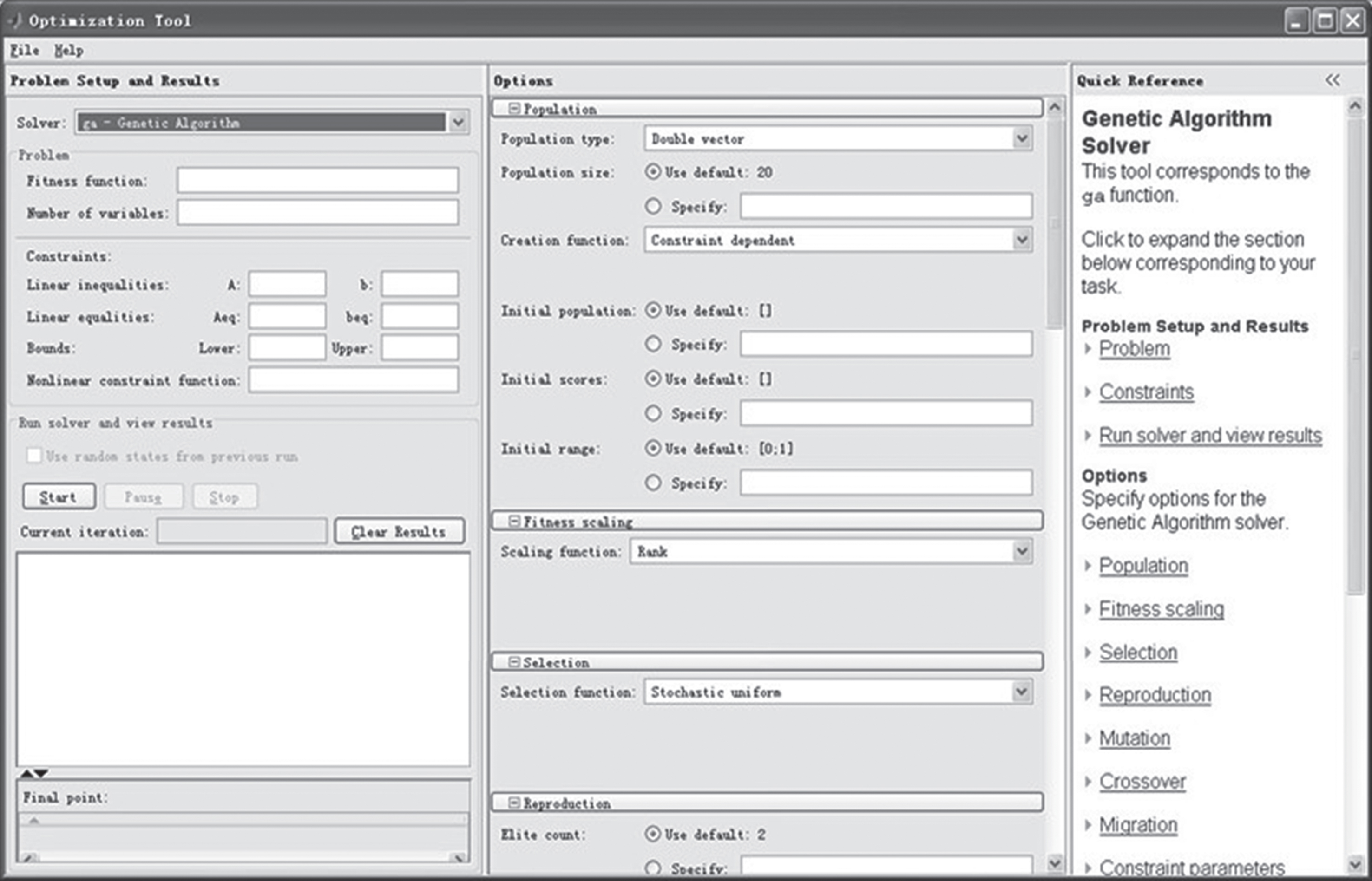
Is a genetic algorithm that often uses a toolbox.
The genetic algorithm cannot process the data in space directly, so it needs coding. There are three encoding methods currently used among which the binary encoding is the most common one. It has simple operation and low search efficiency. However, there is mapping error [9]. The solution of multiobjective problem is to obtain the set of non-inferior solutions. Symbol coding refers to the determination of symbol set according to the individual chromosome code, while the numerical coding is to determine the real number according to individual gene. With variable X assumptions, variables are expressed by Y, using decimal encoding algorithm to determine the interval, the interval is divided into M parts, encoding form can be expressed as the chromosome or individual, in the range of [0,1], the random selection of real numbers, expressed by Y, gene into variable formula using formula to achieve:
In the Y variable, by accuracy, M is the number of continuous variables.
In the genetic operation, many individuals form groups, and in the process of carding, population determination is the next step. In order to ensure the feasibility, it is necessary to test the rationality, remove the unreasonable individuals, retain the original individuals, and then retest until all the individuals meet the requirements.
In genetic algorithm, fitness function is an important function to measure the individual. It needs to be designed according to the specific problem, and according to certain conversion rules, the objective function is transformed into fitness function. All the individuals form a sequence according to the function value, and the fitness formula is calculated:
In the formula, Y denotes the individual, R denotes the ordinal number, D denotes the fitness, and K is a constant. The fitness of the population can be obtained from this formula.
According to individual fitness, genetic operation is carried out to further optimize and approximate the optimal solution. The selection operator optimizes the individual to the next generation, and adopts the comparative selection method, and the selected individuals are inherited to the next generation. It is difficult to measure the advantages and disadvantages of multi-level wooden handle in solving your problem. Then is considered as a multi-objective programming problem, and the function is maximized. In the implementation, we choose the optimal preservation strategy, save the solution of the first generation evolution, and then compare, gradually eliminate the bad solution, optimize the population, and calculate the best feasible solution of the end of the trip.
In the multi objective system of sustainable agricultural industrial structure, the determination of function is one of the key problems. The indicators covered in the construction of multi objective system should include decision variables, objective functions, constraints and so on [10]. The biggest purpose of industrial structure adjustment is to obtain the highest economic value with the least resources:
In the formula, X represents decision variables, f represents economic goals, and G represents constraints. We choose the production projects on the basis of the characteristics of each industry sector, including food crops, economic crops, livestock, aquatic products, forestry and so on. The meaning of each decision variable is shown in Table 1.
Meaning of each decision variable of model
In the adjustment of industrial institutions, it is necessary to take into account multiple objectives, while examining economic value, ecological benefits and social benefits. According to the local development plan, the objective function is set up in three, and the objective function of agricultural economy is as follows:
In the formula, X represents the decision variable, and C denotes the average output value. The formula of total industrial income function can be expressed as:
S represents unit income in the industry sector, I means industry sector, and j stands for the first j. The objective function of total output of agricultural products can be expressed as:
F3, F4 and F5 represent the total grain output, the economic output as a yield and livestock production, and the yield per unit area of D gem. The total objective function of ecological benefit can be expressed as
E represents contribution rate, f means ecological benefit generation, and the unit is yuan. The benefit objective function of water resources utilization can be expressed as:
V represents the total yield per unit area, X means planting area, and ET means water consumption.
After the objective function is determined, ensure the constraint condition. In the optimization of industrial structure, the constraints are the most important factors. In the aspect of natural resources constraint, the constraints of total area of cultivated land are as follows:
X means the planting area, and P means planting index. The constraint function of irrigation water consumption can be expressed as
M means total irrigation, X means optimal planting area, and Q represents the total amount of irrigation available. In woodland, it is required to meet the constraints:
M2 represents the total area of woodland in the year, and the unit is 10000 hm2. In aquaculture, the constraint function is required:
M3 represents the total area of aquaculture. In the adjustment of industrial structure, it is necessary to meet the requirements of social demand and to meet the restriction of total grain output:
M4 represents total grain demand, and DL represents yield. In the same way, we can get the constraint function of the total amount of livestock and the demand of aquatic products. In the aspect of ecological constraint function, green coverage is required:
M0 represents the total area of the design, and theta represents coverage. Organic fertilizer is the necessary material for agricultural production, thus it should satisfy the following function:
F1 represents the amount of fertilizer used per unit of crop, F3 represents the demand for forest land, F- represents natural loss, and organic fertilizer provided by other means of F+gem. The same method is used to determine the area constraint function of soil erosion. In terms of production condition constraint function, it is necessary to satisfy the constraint function and decision variable function of labor resource. The mechanical total power and decision variable function is:
P means labor force (total power).
Using genetic algorithm to solve multi-objective optimization problem. In the determination of objective function weight, the method of random weighting is used to determine the response of different decision-makers to the target. Experts are required to determine the weight of the objective function, and Table 2 is the weight of each index function.
Weights of experts for each index function
Weights of experts for each index function
After obtaining the weight value, the probability and cumulative probability of the statistical weight will be calculated, following the normal distribution of the weights. Table 3 is the weight and cumulative frequency of the objective function.
Weight and cumulative frequency of each index function
According to the optimization value of decision variables, the advantageous industries should be developed vigorously in the process of sustainable agriculture industrial structure adjustment, such as wheat, corn, vegetables and other industries, and ensure food security as well as the development of feed and economic crops, and ensure sustained economic development. After much iteration, the set is obtained, and the variables and functions are analyzed, and obtain the effective solution. The results of model calculation are shown in Table 4.
Industrial structure optimization calculation results test statistics
In the optimization, the wheat planting proportion in 13.6%, corn planting proportion 45.2%, potato planting proportion in 1.9%, the proportion of planting oil in 8.5%, 5.9% in the proportion of planting beans, vegetables planting proportion in 5.2% while silage maize planting proportion in 19.7%. The proportion of the optimized planting after the genetic algorithm is shown in Fig. 3. The proportion of millet, potato, beans, vegetables and silage corn has increased, and the proportion of other crops has declined.
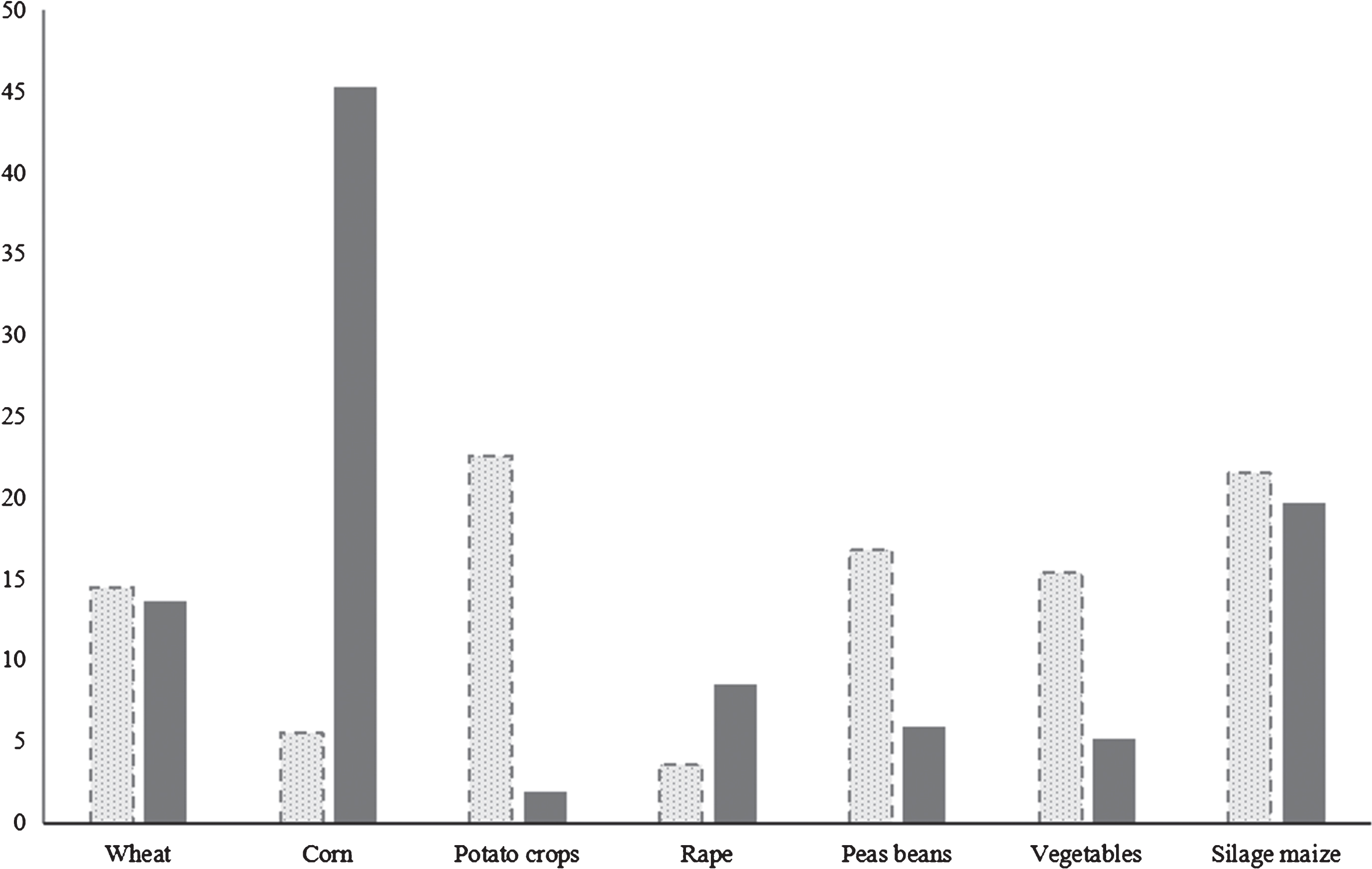
Planting proportion optimized by genetic algorithm.
Multi objective optimization of sustainable agricultural structure has become one of the key issues of agricultural structure optimization, and this paper studies the adoption of international goal optimization algorithm in Xi Xi, which also considers economic, social and ecological efficiency; in the structural optimization, genetic algorithm is used to solve the problem. To ensure SGA rapid improvement of the global search ability of genetic algorithm to avoid blind cable, realizing the diversity of the population. The multidimensional grey model is used to determine the coordination coefficient of the index, and the weight of the index is obtained as well, whose results show that after the optimization of industrial structure, the coordination of agricultural industrial structure has been greatly improved, and the economic benefits are improved significantly, while the ecological and social benefits have been improved, the proportion of the planting area has been adjusted, the agricultural planting structure more reasonable, aquaculture area and forest area increased. There are some shortcomings in the study, like the data is less, the index considered is not comprehensive, or there’s no quantitative analysis. In the solution of the model, the genetic algorithm is not optimized, and the speed and accuracy of the genetic algorithm need to be further improved.
Footnotes
Acknowledgments
The study was supported by: (1) Fund of Aeronautics Science, The Multistage Supply Chain Inventory Optimization and Coordination of Aviation Weapons Manufacturing under FRSD Environment, (2016ZG55019). (2) Project of Youth Backbone Teachers of Colleges in Henan Province, The Study of Multistage Supply Chain Inventory Model and Control Policy of Aircraft Manufacturing under Fuzzy Random Supply and Demand Environment, (2015GGJS-179). (3) Science and Technology Program of Henan Province in 2018, The Study on Inventory Model and Control Policy of Food Cold-chain Logistics under the FRSD Environment (2018KJGG0292).