In this paper, we highlight an intelligent system to properly construct a function between a pair of generalized-fractal spaces: the d-cube [0, 1] d endowed with its natural fractal structure, and the closed unit interval endowed with a natural-like fractal structure. Such a function allows the definition of space-filling curves by levels as well as the calculation of the box dimension of higher dimensional subsets through the box dimension of subsets on the real line.
There are several results in the mathematical literature allowing the calculation of the box dimension of subsets of by means of the box dimension of 1-dimensional subsets. Among them, we can quote Theorem 4.1 in [9], based on the existence of a δ-uniform curve from [0, 1] to the d-cube as well as Theorem 1 in [13], which lies on the existence of a quasi-inverse function from [0, 1] d to the closed unit interval for some space-filling curves including the Peano, Hilbert, and Sierpinśki ones.
Recently, a result in this line has been provided in the context of fractal structures, a kind of uniform spaces (c.f. Definition 2.1). In this case, such a theorem depends on a function α which allows linking the elements of the natural fractal structure on [0, 1] d (c.f. Definition 2.2), Δ, with the elements of a certain fractal structure defined on [0, 1] under the assumption that Δ = α (Γ) (c.f. either Theorem 2.4 or Corollary 2.5). Given this, along this paper we shall highlight an intelligent procedure to properly construct such a curve α, see [6] for more details.
As such, the structure of this work remains as follows. Section 2 contains the mathematical framework Theorem 3.3 is based on. The main result in this paper appears in Section 3. Finally, Section 4 illustrates some applications of Theorem 2.4 to curve filling.
Mathematical framework
Firstly, recall that a covering of a set X is a collection of subsets, Γ, such that X = ∪ {A : A ∈ Γ}. Next, we provide the powerful concept of a fractal structure.
Definition 2.1. (c.f., e.g., Definition 2.1 in [8]) Let be a countable family of coverings of X. We shall understand that Γ is a fractal structure provided that the two following statements hold:
for each A ∈ Γn+1, there exists B ∈ Γn such that A ⊆ B.
B = ∪ {A ∈ Γn+1 : A ⊆ B} for all B ∈ Γn.
If Γ is a fractal structure on X, we say that the pair (X, ef) is a generalized-fractal space (GF-space, for short).
Below, the natural fractal structure on each Euclidean space , which stands as a particular case from Definition 3.1 in [7], is described.
Definition 2.2. The natural fractal structure on the is the countable family of coverings, , with levels given by
It is worth pointing out that the natural fractal structure just provided in Definition 2.2 can be induced on the d-cube [0, 1] d as follows.
Remark 2.3. The natural fractal structure on [0, 1] d is the family of coverings whose levels are defined as
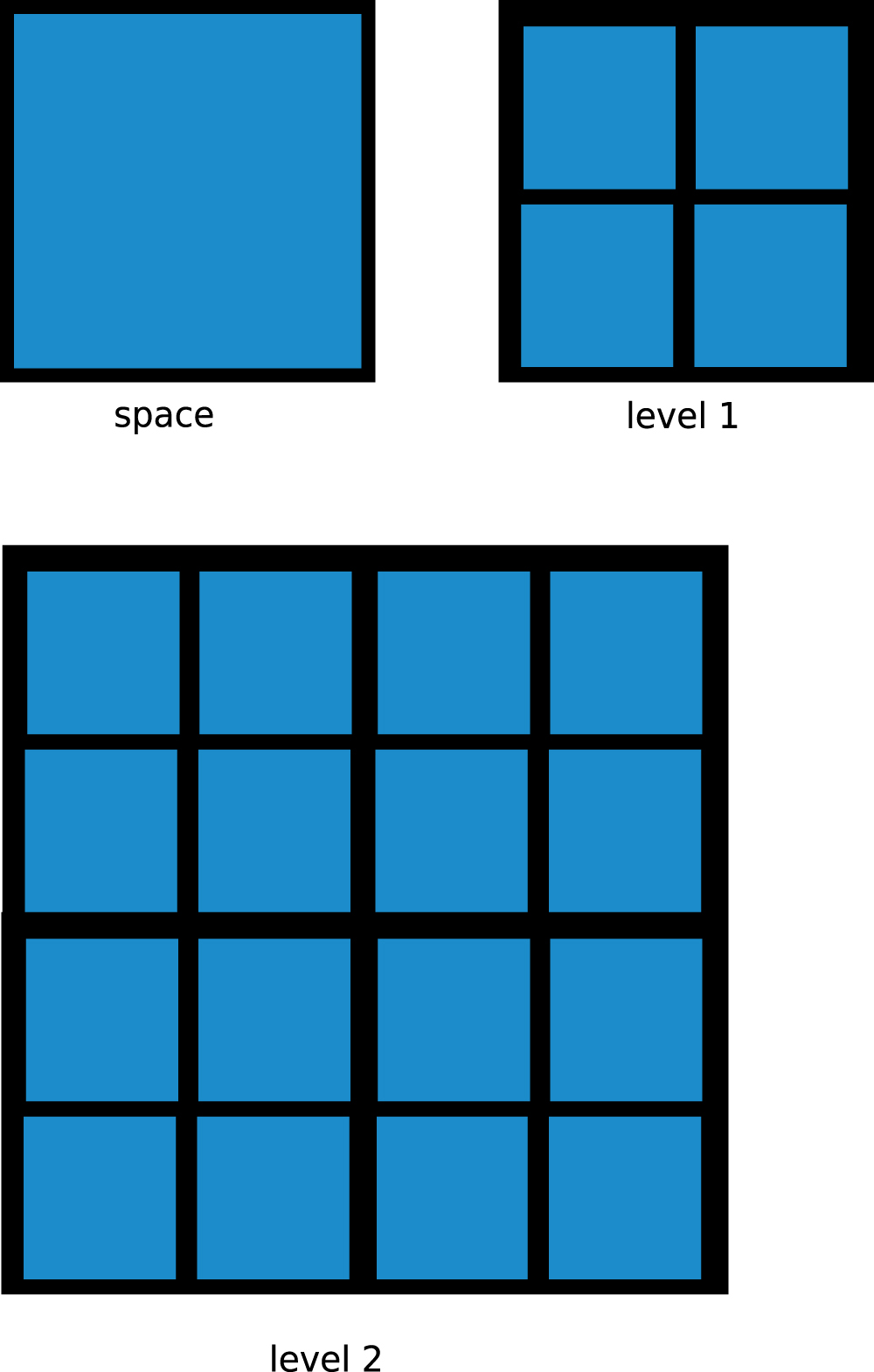
for all (c.f. Fig. 1).
The figure above illustrates the first two levels in the natural fractal structure on [0, 1] × [0, 1]. Observe that the first level consists of four squares with sides equal to, Γ2 contains 42 squares with sides equal to , and in general, level n consists of 4n squares with sides equal to .
Interestingly, the following approach becomes especially appropriate to deal with the effective calculation of the box dimension of Euclidean subsets, since it allows applying the already existing procedures to calculate the box dimension of 1-dimensional subsets.
Theorem 2.4.(c.f. Theorem 2.8 in [5]) Let Δ be the natural fractal structure on [0, 1] d, and assume that [0, 1] is endowed with the fractal structure Γ whose levels are. Moreover, let F be a subset of [0, 1] d, and α : [0, 1] → [0, 1] d a function such that Δ = α (Γ). Then the (lower/upper) box dimension of F equals the (lower/upper) box dimension of α-1 (F) ⊆ [0, 1] up to a factor, namely, the embedding dimension, d. In particular, if dimB(F) exists, then dimB(α-1 (F)) also exists (and reciprocally), and it holds that
Alternatively, a more operational version of previous Theorem 2.4 can be stated in the following terms.
Corollary 2.5.(c.f. both Theorem 4.1 and Remark 4.4 in [5]) Let Δ be the natural fractal structure on [0, 1] d, and assume that [0, 1] is endowed with the fractal structure Γ with levels for all . In addition, let F be a subset of [0, 1] d, and α : [0, 1] → [0, 1] d a function such that Δ = α (Γ). Then the lower and upper box dimensions of F can be calculated throughout the following expressions, respectively:
In particular, if the box dimension of F exists, then
where is the number of δ-cubes that intersect α-1 (F) ⊆ [0, 1], and a δ-cube in is a set of the form .
As such, the previous results involve a fractal structure Δ on [0, 1] d (i.e., the natural one), another fractal structure Γ on the closed unit interval, and a function α : [0, 1] → [0, 1] d such that Δ = α (Γ) to guarantee both Equations (1) and (2). Though there are no restrictions regarding that the α apart from the condition Δ = α (Γ), along upcoming Section 3 we shall highlight an intelligent construction based on a sequence of stages to properly apply Theorem 2.4 (resp. Corollary 2.5) to calculate the box dimension in higher dimensional spaces.
The theorem
In this section, we state the key result in this paper. First, we would like to mention that the concept of a starbase fractal structure plays a key role to construct that function α.
Definition 3.1. ([1], Section 2.2) Let Γ be a fractal structure on X. We say that Γ is starbase if is a neighborhood base of x for all x ∈ X, where St (x, Γn) = ∪ {A ∈ Γn : x ∈ A}.
A sequence is said to be decreasing provided that An+1 ⊆ An for all .
Definition 3.2. ([2], Definition 3.1.1) Let be a fractal structure on X. We say that Γ is Cantor complete if for each decreasing sequence with An ∈ Γn, it holds that .
Following the concepts above, we have the following
Theorem 3.3.([4], Theorem 3.6) Let be a starbase fractal structure on a metric space X, a Cantor complete starbase fractal structure on a complete metric space Y, and a collection of functions. Consider the following list of statements:
if A∩ B ≠ ∅ with A, B ∈ Γn for some , then αn (A)∩ αn (B) ≠ ∅.
If A ⊆ B with A ∈ Γn+1 and B ∈ Γn for some , then αn+1 (A) ⊆ αn (B).
αn is onto.
αn (A) = ∪ {αn+1 (B) : B ∈ Γn+1, B ⊆ A} for all A ∈ Γn,
The two following hold for all A ∈ Γn and:
If both conditions (i) and (ii) stand, there exists a unique continuous function α : X → Y such that α (A) ⊆ αn (A).
If Γ is Cantor complete and conditions (i)–(iv) stand, then α is also onto and we have α (A) = αn (A).
Proof. Firstly, we shall define the function α : X → Y. For each x ∈ X, there exists a decreasing sequence such that An ∈ Γn for all with . Thus, is also decreasing with αn (An) ∈ Δn for all . Moreover, it holds that ∩nαn (An) is a single point, since Δ is starbase and Cantor complete. Therefore, we shall define . As such, we affirm that α is well-defined. In fact, let x ∈ X and assume that there exist a pair of decreasing sequences of subsets of X, and , such that for all with and , as well. Suppose, in addition, that and with y ≠ z. Then there exists a natural number n such that St (y, Δn)∩ St (z, Δn) = ∅, since Δ is starbase. Hence, . However, on the other hand, we have that for all . Thus, by condition (i), a contradiction. Accordingly, y = z.
Under both conditions (i) and (ii), the following statements hold:
α (A) ⊆ αn (A) for all A ∈ Γn and . This is clear from the definition of α.
α is continuous. Let and x ∈ X. Assume that y ∈ St (x, Γn). Then there exists A ∈ Γn such that x, y ∈ A. Thus, α (x), α (y) ∈ α (A) ⊆ αn (A) by condition (3). Hence, α (y) ∈ St (α (x), Δn).
α is unique. Let β : X → Y be a continuous function such that β (A) ⊆ αn (A) for all A ∈ Γn and . Let x ∈ X. Then there exists a decreasing sequence of subsets of X, , such that An ∈ Γn for all with , since Γ is starbase and Cantor complete. Hence, , so β (x) = α (x) for all x ∈ X.
In addition, assume that Γ is Cantor complete and also that all conditions (i)–(iv) stand. We shall prove that αn (A) ⊆ α (A) for all A ∈ Γn and , since it implies that α is onto. In fact, let , and y ∈ αn (A). Let also Bn = αn (A) and An = A. Then by condition (iv), there exists An+1 ∈ Γn+1 such that An+1 ⊆ An with y ∈ αn+1 (An+1) ⊆ αn (An). Let Bn+1 = αn+1 (An+1). As such, we can iteratively construct sequences {Bk : k ≥ n} and {Ak : k ≥ n} such that Ak ∈ Γk, αk (Ak) = Bk ∈ Δk, y ∈ Bk for k ≥ n, An = A, and Bn = αn (A), as well. Since Γ is starbase and Cantor complete, it holds that ∩k≥nAk = {x} for some x ∈ X. Hence, the construction of such sequences leads to y = f (x) with x ∈ A, so y ∈ α (A). □
Applications to curve filling
The main goal in this section is to show how Theorem 3.3 allows the construction of space-filling curves with a different nature. As such, while Subsection 4.1 deals with the definition of the Hilbert’s curve by levels, Subsection 4.2 tackles with the construction of a curve filling an attractor. These functions allow defining appropriate connections among the elements in each level of both fractal structures, Γ and gf, and hence, enable the application of Theorem 2.4 (resp., Corollary 2.5) to calculate the box dimension of subsets of by means of the box dimension of 1-dimensional subsets.
A curve filling the Hilbert’s curve
First, let us show how the classical Hilbert’s plane-filling curve (c.f. [10]) can be iteratively described by levels.
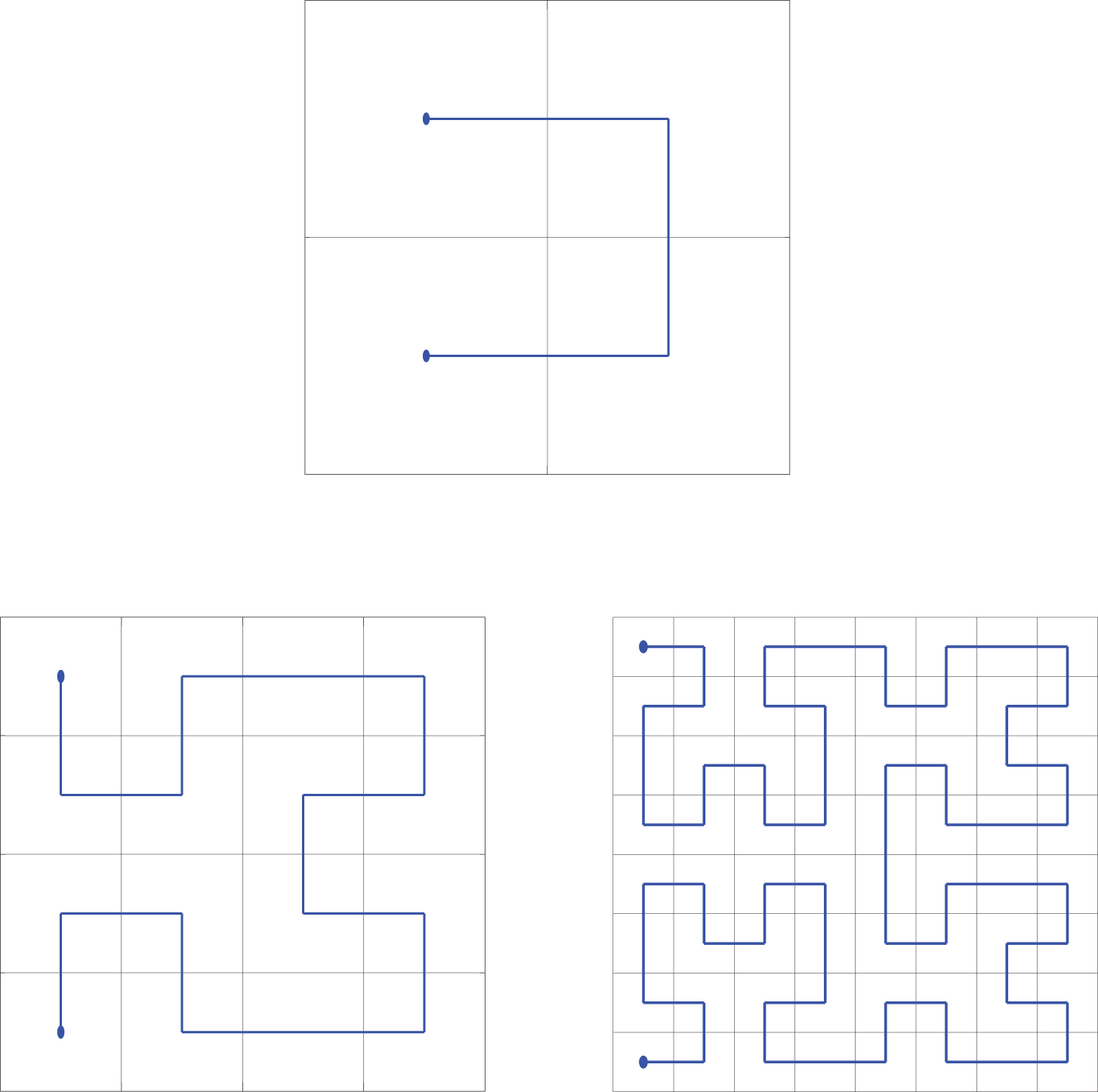
Example 4.1. (c.f. Example 1 in [4]) Let (Y, Δ) be a GF-space with Y = [0, 1] × [0, 1] and Δ being the natural fractal structure on [0, 1] × [0, 1] as a Euclidean subset, i.e., , where for each . In addition, let (X, ef) be another GF-space where X = [0, 1] and with . It is worth pointing out that each level n of Γ (resp., of Δ) contains 22n elements. Next, we explain how to construct a function α : X → Y such that Δ = α (Γ). To deal with, we shall define the image of each element in level n of Γ through a function αn : Γn → Δn. For instance, let , and , as well (c.f. Fig. 2). Thus, the whole level Δ1 = α (Γ1) = {α (A) : A ∈ Γ1} has been defined. It is worth mentioning that this approach provides additional information regarding α as deeper levels of both Γ and Δ are reached via αn under the two following conditions (c.f. Theorem 3.3):
If A∩ B ≠ ∅ with A, B ∈ Γn for some , then αn (A)∩ αn (B) ≠ ∅.
If A ⊆ B with A ∈ Γn+1 and B ∈ Γn for some , then αn+1 (A) ⊆ αn (B).
For instance, if A ∈ Γn, then we can calculate its image via αn, αn (A). Going beyond, let B ∈ Γn+1 be so that B ⊆ A. Then αn+1 (B) ⊆ αn (A) refines the definition of αn (A), and so on. This allows us to think of the Hilbert’s curve as the limit of the maps αn (c.f. Fig. 3). This example illustrates how Theorem 3.3 allows the construction of (continuous) functions and in particular, space-filling curves.
The two plots above arrange how each element in level n of Γ is sent to some element in level n of Δ via αn for n = 2, 3.
First three levels in the construction of the Hilbert’s curve according to Theorem 3.3.
A curve filling the Sierpinśki gasket
Let k ≥ 2. By an iterated function system, we shall understand a finite collection of similitudes on , , where each self-map satisfies the following identity:
where d denotes the Euclidean distante and ci ∈ (0, 1) is the similarity ratio associated with each fi. Under the previous assumptions, there always exists a unique (nonempty) compact subset such that
The previous equality is usually known as Hutchinson’s equation (c.f. [11]) and is named the attractor (also the self-similar set) generated by .
Next, we define the natural fractal structure that each attractor can be always endowed with.
Definition 4.2. (c.f. [3], Definition 4.4) Let be an IFS whose attractor is . The natural fractal structure on as a self-similar set is given by the countable family of coverings , where , and Γn+1 = {fi (A) : A ∈ Γn, i = 1, …, k} for each .
It is worth mentioning that such a fractal structure is starbase (c.f. [3, Theorem 4.7]).
Interestingly, it holds that Theorem 3.3 also allows the construction of maps filling a whole attractor. Next, we shall illustrate it by generating a curve that crosses (once) each element of the natural fractal structure which the Sierpiński gasket (c.f. [12]) can be endowed with as a self-similar set (c.f. Definition 4.2).
Example 4.3. (c.f. Example 4 in [4]) Let I = [0, 1] endowed with the fractal structure with levels given by for each . In addition, let be the Sierpiński triangle contained in the equilateral triangle with set of vertices given by . Let be endowed with its natural fractal structure as a self-similar set, namely, let with and Δn+1 = {fi (A) : A ∈ Δn, i ∈ I} for all , where I = {1, 2, 3} and the three similitudes leading to are defined as follows:
for all . Thus, the Sierpiński gasket is fully determined as the unique non-empty compact subset satisfying the Hutchinson’s equation . Observe that each piece is a self-similar copy of the whole Sierpiński triangle. Similarly to Example 4.1, next we construct a map γ such that Δ = γ (Γ). Let . Next, we shall provide further refinements of γ by defining the image of each element A ∈ Γn via γn : Γn → Δn. Thus, we can define as the equilateral triangle whose set of vertices is , as the equilateral triangle with set of vertices , and is the equilateral triangle with set of vertices , as well. This allows to define Δ1 = γ (Γ1) = {γ (A) : A ∈ Γ1}. Similarly, the next levels of Δ can be defined. Fig. 4 illustrates such a construction. It is worth mentioning that the polygonal line shows the path followed to cross (once) all the elements in each level of the natural fractal structure in . Thus, with γ being equal to the limit of the maps γn as n→ ∞.
First two levels in the construction of a curve filling the whole Sierpiński gasket.
Conflict of Interests
The authors declare that there is no conflict of interests regarding the publication of this paper.
Footnotes
Acknowledgments
We thank the reviewers for their constructive comments to improve the quality of this paper. We would like also to thank Prof. M.A. Sánchez-Granero for his insightful remarks concerning this study. He also enabled us the use of both Figs. 1 and .
References
1.
ArenasF.G. and Sánchez-GraneroM.A., Directed GF-spaces, Applied General Topology2(2) (2001), 191–204.
2.
ArenasF.G. and Sánchez-GraneroM.A., Completeness in GFspaces, Far East Journal of Mathematical Sciences (FJMS)3(10) (2003), 331–351.
3.
ArenasF.G. and Sánchez-GraneroM.A., A characterization of self-similar symbolic spaces, Mediterranean Journal of Mathematics9(4) (2012), 709–728.
4.
Fernández-MartínezM. and Sánchez-GraneroM.A., A new fractal dimension for curves based on frl structures, Topology and its Applications203 (2016), 108–124.
5.
Fernández-MartínezM. and Sánchez-GraneroM.A., Calculating the fractal dimension in higher dimensional spaces, preprint.
6.
Fernández-MartínezM., A survey on frl dimension for fractal structures, Applied Mathematics and Nonlinear Sciences1(2) (2016), 437–472.
7.
Fernández-MartínezM. and Sánchez-GraneroM.A., Frl dimension for fractal structures, Topology and its Applications163 (2014), 93–111.
8.
Fernández-MartínezM. and Sánchez-GraneroM.A., How to calculate the Hausdorff dimension using fractal structures, Applied Mathematics and Computation264 (2015), 116–131.
9.
GarcíaG., MoraG. and RedtwitzD.A., Box-counting dimension computed by α–dense curves, Fractals25(5) (2017), 1750039 [11 pages].
10.
HilbertD., Über die stetige Abbildung einer Linie auf ein Flächenstück, Math Ann38 (1891), 459–460.
11.
HutchinsonJ.E., Fractals and self-similarity, Indiana University Mathematics Journal30(5) (1981), 713–747.
12.
SierpińskiW., Sur une courbe dont tout point est un point de ramification, C R Math Acad Sci Paris160 (1915), 302–305.
13.
Skubalska-RafajłowiczE., A new method of estimation of the box-counting dimension of multivariate objects using spacefilling curves, Nonlinear Analysis: Theory, Methods & Applications63(5–7) (2005), e1281–e1287.






 .
.