



Abstract
In this paper, we explore the fractal dimension of Cone Beam Computed Tomography images to analyze the trabecular bone structure of healthy subjects. That quantity, computed throughout three distinct approaches, provided us accurate values of normality concerning the radiographic density of this kind of bones and will allow us to establish comparisons with respect to the fractal dimension from patients with different pathologies that may affect the density of trabecular bones.
Keywords
Introduction
Since Dr. Frederic Otto Walkhoff first took a dental radiography in 1896, the radiological field has widely evolved, not only from the viewpoint of the apparatus but also due to the exposure times and the radiation doses. At the same time, William Herbert Rollins built the first dental X-ray unit. However, it was William J. Morton who really used this device, who also contributed to the scientific basis regarding the use of X-rays in the field of dentistry. Several years later, the intraoral radiographic film was used by Dr. Frank Van Woert. In 1913, William D. Coolidge created the first X-ray tube with tungsten filament, a revolution. In 1980, Fred M. Medwedeff, throughout the technique of collimation, managed to reduce exposure significantly. The devices have been improved over the years until the Cone Beam Computed Tomography (CBCT, hereafter) was introduced in 1996 in the European market. Such a method considerably reduces the dose of radiation and exposure and provides high resolution images, as well. In this paper, we have developed a detailed study from high quality CBCT images based on the analysis of their fractal dimensions. Unlike other approaches used in the literature, we have tested a novel approach, completely different from the standard methods usually applied to estimate the fractal dimension in the medical field. We should mention here that the so-called box-counting dimension constitutes the par excellence method to explore fractal patterns in radiographic projections (c.f. [8–19]).
Next, we highlight two relevant novelties to what has been written so far regarding the present work:
We used CBCT as a unique radiographic study method. We applied a novel procedure for fractal dimension estimation purposes, supported bytheoretical results, to accurately calculate the box dimension of CBCT images. Interestingly, it throws more accurate results than those obtained by the standard implementation of the box-counting approach. As such, we can specify to what is really happening inside the analyzed bone (c.f. [1]).
It is worth pointing out that the devices we used offered us the possibility of capturing high quality images. This facilitated the application of novel fractal dimension based methods of analysis so sensitive that the results became extremely accurate. In this way, the analyzed CBCT images were captured by the same Planmeca team, Planmeca ProMax 3-D Max (Planmeca Oy, Helsinki, Finland) duly calibrated. Radiographs were taken with the subjects in prone position, adjusting the position of their heads by using the laser guidance system of the device. The beam emission parameters were kV = 96, mA = 8, exposure time of ≃12s, and an image size equal to 501 × 501 × 466 voxels (with each voxel being equivalent to 200 μm). The evaluation software was the Romexis 2.5.1.R (Planmeca Oy, Helsinki, Finland), which allowed observation of the image in a multiple window where the axial, coronal, and sagittal planes can be visualized in 0.2mm intervals, together with a 3D vision. All the subjects taking part in our study were in general and oral health good conditions. They did not present any kind of dental or systemic pathology. They did not take any type of medication that could affect their bone density nor had they taken it in the past. The mean age of the subjects in the sample was 45 years and the same section of the bone, located according to the mental hole in the jaw bone, was analyses in all the cases.
Following the above, the structure of this article is as follows. First, Section 1 provides all the mathematical tools we applied to carry out the present study. More specifically, it contains the basics on the box-counting dimension (box dimension, hereafter) and describes the concept of fractal structure (which our theoretical results are based on). In particular, we define the natural fractal structure on the Euclidean plane. Since we are interested in the calculation of the box dimension for plane CBCT images, all our theoretical development lies in the context of subsets of R2. However, it is worth mentioning all of them can be extended to any Euclidean space, if needed. We also provide some theoretical results allowing the calculation of the box dimension of CBCT images in terms of the box dimension of 1-dimensional subsets via a certain function α. Interestingly, a constructive approach to define that function is also contributed at the end of that section. Next, Section 1 is devoted to comment on our computational results. In fact, we explain how the calculations regarding the box dimension of CBCT images have been carried out via three different approaches, namely, the standard box dimension algorithm and two novel approaches based on our theorems, as well. Finally, we provide several remarks to conclude the paper (c.f. Section 1).
Mathematical framework
Along this section, we shall provide all the mathematical content we applied to properly study the box dimension of CBCT images. As such, the structure of this section is as follows. In Subsection 2.1, we recall the basics on the box dimension model. Subsection 2.2 contains the foundations on fractal structures and provides the definition of the so-called natural fractal structure which any Euclidean subset can be always endowed with. Subsection 2.3 is devoted to theoretically tackle with the calculation of the box dimension of plane subsets. It is worth pointing out that a pair of results we contribute, namely, Theorem 2.5 and Corollary 2.6, allow the calculation of such a fractal dimension from the box dimension of a 1-dimensional subset. Since such a subset of [0, 1] depends on a function α : [0, 1] → [0, 1] × [0, 1] which relates a fractal structure
The box dimension
Next, we recall the concept of box dimension. Its origins go back to the thrities when Pontrjagin and Schnirelman first provided its standard definition (c.f. [7]).
Let δ > 0. By a (plane) δ-cube we shall undertand a set of the form
The versatility of box dimension lies in the fact that it can be computed with easiness in the context of empirical applications (mainly on Euclidean spaces) involving fractal dimension. In fact, it can be estimated as the slope of the regression line of a graph comparing log δ vs.
First of all, we recall that a covering of a set X is a collection of subsets, say Γ, such that X = ∪ {A : A ∈ Γ}. The main concept we shall apply along this article for fractal dimension calculation purposes is defined next.
for each A ∈ Γn+1, there exists B ∈ Γ
n
such that A ⊆ B. B = ∪ {A ∈ Γn+1 : A ⊆ B} for all B ∈ Γ
n
.
It is worth mentioning that covering Γ
n
of
Next, we define what it is understand by the natural fractal structure on the Euclidean plane. It is worth mentioning that such a concept stands as a particular case from Definition 3.1 in [4] or [3] for moredetails.
We would like to highlight that the natural fractal structure just defined on R2 can be induced on the unit square as follows.
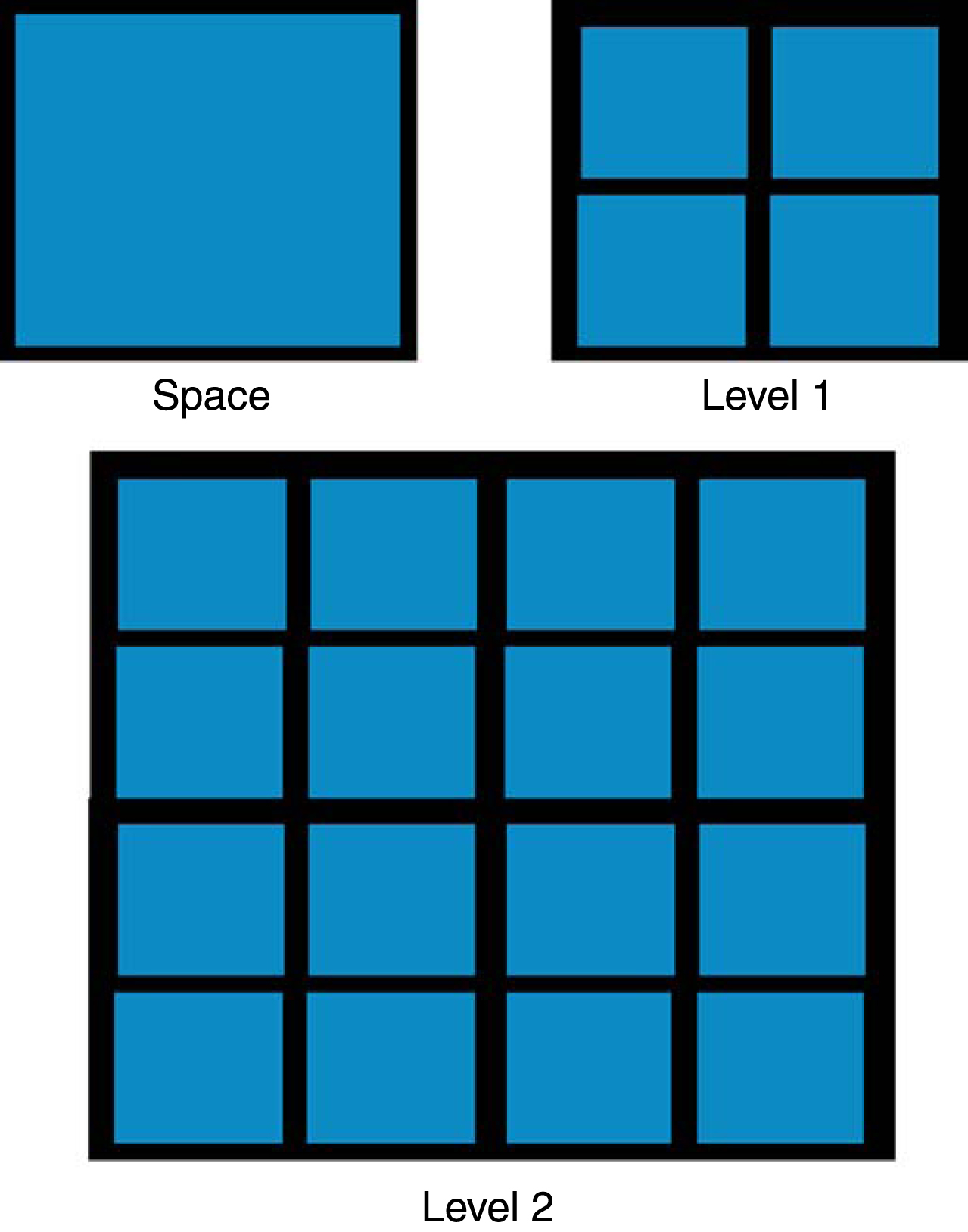
The figure above graphically displays the first two levels in the natural fractal structure on the unit square, [0, 1] × [0, 1]. Observe that the first level consists of four squares with sides equal to, whereas Γ2 contains 42 squares with sides equal to
The key theoretical result, which supports all the computational calculations carried out along this paper regarding the box dimension of CBCT images (c.f. Section 3), is stated next.
Interestingly, as a consequence of Equation (2), we have that the box dimension of each plane subset F (in particular, of each CBCT image we analyzed un upcoming Section 3) equals (up to a constant, namely, the embedding dimension) the box dimension of α−1 (F), a subset of the closed unit interval. It is also worth pointing out that there are no further restrictions regarding the function α : [0, 1] → [0, 1] × [0, 1] apart from the condition
Next, we state a more operational version of Theorem 2.5 to deal with the effective calculation of the box dimension of plane subsets. As such, we shall highlight that it suffices with calculating the number of δ-cubes that intersect α−1 (F) ⊆ [0, 1] for (lower/upper) bca (F) estimation purposes.
Though Theorem 2.5 gives that the box dimension of F ⊆ [0, 1] × [0, 1] is proportional to the fractal dimension of α−1 (F) ⊆ [0, 1] with α : [0, 1] → [0, 1] × [0, 1] being a function between the GF-spaces ([0, 1],
if A∩ B ≠ ∅ with A, B ∈ Γ
n
for some n ∈ N, then α
n
(A)∩ α
n
(B) ≠ ∅. If A ⊆ B, where A ∈ Γn+1 and B ∈ Γ
n
for some n ∈ N, then αn+1 (A) ⊆ α
n
(B). α
n
is onto. α
n
(A) = ∪ {αn+1 (B) : B ∈ Γn+1, B ⊆ A} for all A ∈ Γ
n
. if α
n
satisfies both conditions (i) and (ii), there exists a unique continuous function α : [0, 1] → [0, 1] × [0, 1] so that α (A) ⊆ α
n
(A) for each A ∈ Γ
n
and all n ∈ N. Moreover, if (iii)-(iv) also stand for all n ∈ N, then α is onto with α (A) = α
n
(A) for all A ∈ Γ
n
and each natural number n.
The two following hold:
Let us illustrate how previous Theorem 2.7 can be applied to deal with the construction of our function α : [0, 1] → [0, 1] × [0, 1].

The two plots above arrange how each element in level n of the fractal structure
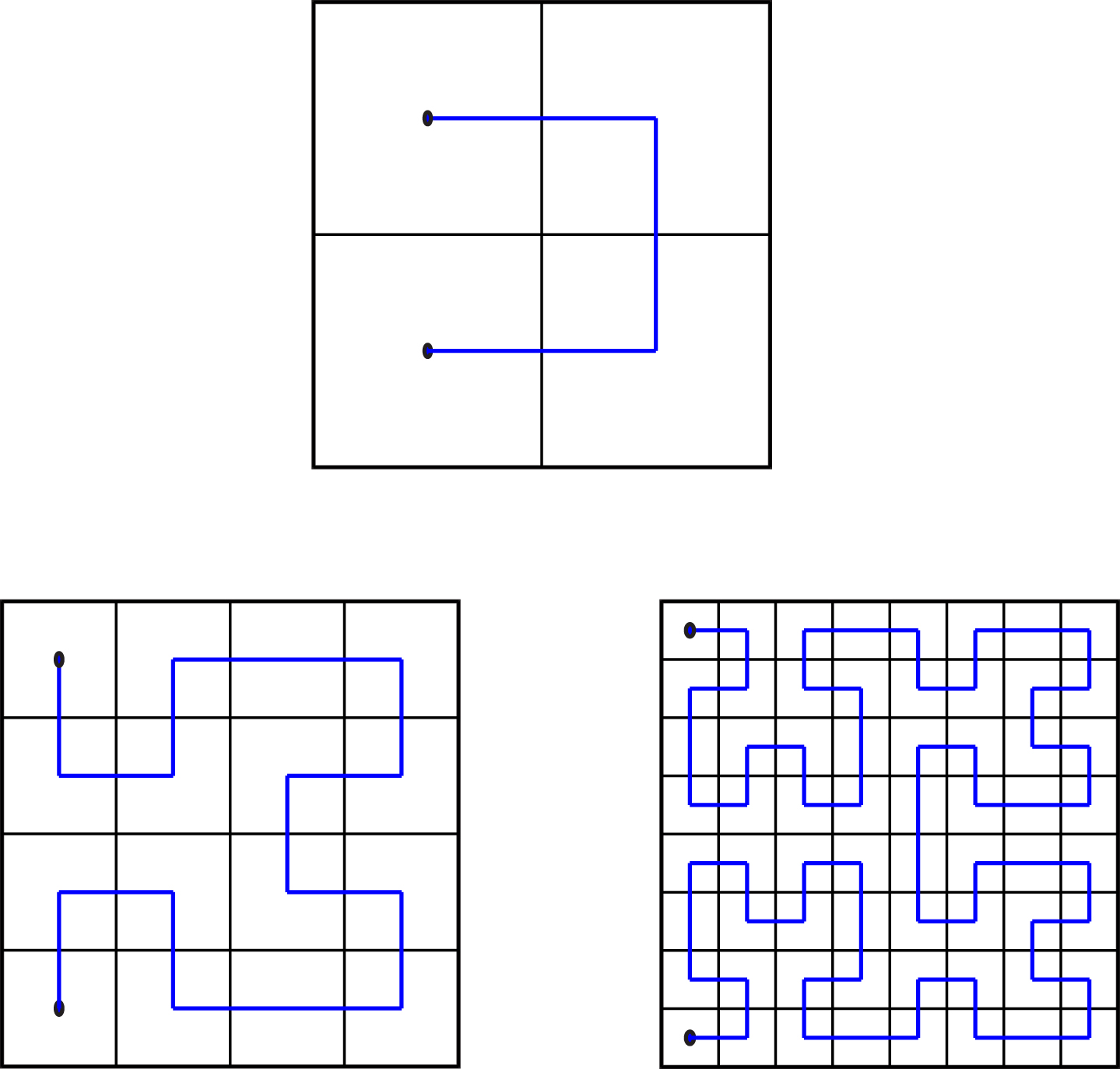
The figure above displays the first three levels in the construction of the Hilbert’s plane-filling curve according to Theorem 2.7.
Along this section, we shall carry out some computational experiments regarding the calculation of the box dimension of CBCT images. First of all, we would like to highlight that three different approaches have been applied for box dimension estimation purposes. The first one basically consists of a standard implementation of the box dimension mainly used in computational applications involving fractal dimension. We shall denote it as “Standard box-counting” (SBC, hereafter) approach. It is worth pointing out that the functioning of such a procedure is based on the following expression (c.f. Eq. 1):
The second procedure tested along this paper deals with the calculation of
Finally, the third algorithm applied herein consists of a slight modification of BC1. It contains several instructions with the aim to improve the calculation of
The next remark becomes necessary to deal with computational applications regarding the calculation of box dimension.
Following the above, and for each of the 19 subjects in our sample, we computed the box dimension (by means of each of the three approaches described above) of a pair of CBCT images captured via Romexis 2.5.1.R software: both a 513 × 513 pixel image (low resolution) and a 4364 × 2464 pixel image (original resolution). Fig. 4 has been provided for illustration purposes. It is worth pointing out that all the 19 CBCT images in both resolutions displayed self-similarity patterns in the whole range of 1 - 8 levels analyzed. In fact, all of them displayed linear correlation coefficients quite close to 1 when comparing each scale δ with respect to its corresponding quantity
The obtained results were as follows. For low resolution images, the mean of the box dimensions of all the subjects was found to be equal to 1.55512 according to SBC with a standard deviation of 0.0578431 (a variance equal to 0.00334583). Regarding BC1, the mean box dimension was equal to 1.95578 and the standard deviation was found to be equal to 0.00627091 (a variance equal to 0.0000393243). On the other hand, BC2 procedure threw the following result: a mean box dimension of 1.9628 and a standard deviation equal to 0.0144581 (a variance equal to 0.000209037). As such, we obtained that both BC1 and BC2 approaches provided similar results in terms of the mean fractal dimension they provided with slight deviations. However, the SBC displayed a different value of the mean box dimension together with a larger deviation than the other methods. Regarding original resolution images, SBC provided a mean box dimension equal to 1.38447 and a standard deviation equal to 0.0758612 (a variance of 0.00575492). On the other hand, BC1 threw a mean fractal dimension equal to 1.98088 with a standard deviation of 0.004269 (a variance equal to 0.0000182244). Similarly, BC2 approach provided a mean box dimension of 1.86931 together with a standard deviation equal to 0.013183 (a variance of 0.000173792). It is worth noting that in this occasion, BC1 and BC2 procedures displayed mean box dimensions not so close among them as in the low resolution case though both of them provided slight deviations with respect to the mean. Again, SBC provided a lower mean box dimension with a larger deviation than the other approaches. It is also worth pointing out that BC2 became more computationally expensive than both SBC and BC1.

The plot above displays a representative CBCT image from a subject of the sample (left figure) as well as an enlargement of a region of the same capture containing a piece of trabecular bone.
Next, we shall highlight some concluding remarks concerning the study we carried out along this paper.
A priori, each CBCT image possesses a box dimension d with 1 ≤ d ≤ 2. In fact, each picture contains parts of trabecular bone (assumed to display a self-similar structure), so the geometry of such figures lies halfway between a smooth curve (with embedding dimension = 1) and a plane subset (embedding dimension = 2). Regarding the estimation of the box dimension of such CBCT images, it holds that both approaches BC1 and BC2 behave similarly. However, the results they provided became distinct from those thrown by SBC algorithm. The functioning of both BC1 and BC2 methods is based on Theorem 2.5 (resp., Corollary 2.6), and in particular, on Eq. (1). In particular, BC2 implements certain instructions to optimise the calculation of The fractal dimension values obtained via both BC1 and BC2 approaches are refined as higher resolution CBCT images are analyzed. However, the computation time increases, especially in the case of BC2 procedure. Given this, an option may consist of using the low resolution CBCT images to carry out a preliminary analysis regarding the existence of fractal patterns at a first stage. Afterwards, a more accurate study may be performed throughout the high resolution images, if necessary. Even though the fractal dimensions may vary after exploring the high resolution pictures, it is worth noting that they remain uniform along the whole sample with a slight deviation from the mean box dimension. All the (low and high resolution) CBCT images from the 19 patient sample displayed fractal patterns in the whole range of scales we explored (1 - 8 levels). In fact, in all the cases, a correlation coefficient quite close to 1 was found when comparing δ vs. It is worth pointing out that for both low and high resolution CBCT images, BC1 provided the lowest deviations from the mean fractal dimension. In this way, we would like to highlight the robustness of both novel algorithms, BC1 and BC2 for box dimension estimation.
Footnotes
Conflict of Interests
The authors declare that there is no conflict of interests regarding the publication of this paper.
Acknowledgments
We thank the reviewers for their constructive comments to improve the quality of this paper. We would like also to thank Prof. M.A. Sánchez-Granero for his insightful remarks concerning this study. He also enabled us the use of bothFigs. 1 and  .
.