



Abstract
The traditional algorithm does not take account of the authentication problem of terminal and server. It has poor security, heavy computation of encryption or decryption, and low efficiency. To address these problems, a new intelligent encryption algorithm for network communication parallel data of information release terminal is proposed in this paper. After users’ registration, the registered ID, user password, and two random numbers are entered. The first authentication data is obtained by calculating and then transferred through a secure channel to the server for the first authentication. After the success of the identity authentication in the information release terminal and the server, the user of the information release terminal obtains the release authority. Self-inverse key matrix is generated with MapReduce parallel mechanism. Source release information data file is divided into blocks in the communication process, and each block is encrypted with key matrix. After dividing the plaintext matrix and the key matrix, the plaintext is encrypted according to the Hill encryption principle. After obtaining the ciphertext and key matrix, the plaintext is decrypted according to the principle of Hill decryption principle. Experimental results show that the proposed algorithm has high security and efficiency.
Introduction
In the era of big data, people share their own information through information release terminal network. Massive heterogeneous data is stored in the cloud. Users download the data from the cloud for local use [1]. The way of sharing resources in such an open environment brings great convenience to people, but it also facilitates hackers at the same time. Hackers can easily acquire many valuable data that need to break through all kinds of firewall barriers before, which make the network communication data in the open environment face huge security risks [2]. How to ensure the safety of terminal network communication data while giving full play to data value is a major challenge for the era of big data and also one of the hot topics [3].
In the literature [4], a security protection scheme is designed and implemented for the terminal. The AES algorithm is used to encrypt the data file of the network communication. Although the algorithm ensures data security, AES algorithm has large computation time and high complexity in the process of encryption and decryption, which will cause great impact on the efficiency of the encryption and decryption of terminal data file.
Considering the technical features of the terminal and combining the operation habits of the terminal users, a web-based encryption algorithm for terminal communication data file based on is proposed and designed in the literature [5]. The algorithm can effectively implement file encryption, but it does not take into account the authentication problem of the terminal and server, and the security of data file in the process of transmission and storage.
In the literature [6], the integrity and confidentiality of the terminal communication data file is guaranteed by the RSA asymmetric encryption algorithm and hash function. Two RSA encryption algorithms and one message digest algorithm are carried out on the data file at the terminal. The confidentiality of data files is ensured by using the security of the RSA algorithm. Message digest algorithm is used to guarantee the integrity of data files. Meanwhile, by introducing credible third party audit institution to verify the integrity of data, and executing DES encryption algorithm for data files, the safety of data files is ensured. Although the algorithm greatly improves the security of data files, many times of the encryption and decryption with RSA algorithm results in low efficiency for the terminal with limited computingpower.
In the literature [7], symmetric encryption is carried out by using CPU. OpenGL is used to implement AFS on the previous generation of CPU. Due to the limitation of the programming model capability, including the limitations of performance improvement and hardware programmable ability, the pipeline with fixed function is used. In the output gathering phase, the hardware is used to complete XOR. A complete AFS execution needs to pass through multiple pipelining, which has a significant impact on efficiency.
In the literature [8], the NvidiaUcForcc 8800 graphics card is used to speed up the AFS encryption algorithm at the terminal. 024 bytes are a plaintext block and each plaintext block is encrypted by a thread block. The size of the thread block is 256. Multiple threads are responsible for the calculation of a plaintext packet (16 bytes). Threads of a thread block need synchronization and communication. The shared memory is used as the mode of communication. The execution of thread synchronization is required in each round of AES encryption. It is obvious that the conflict of shared memory and thread synchronization have a bad effect on the performance. In addition, the capacity of the memory restricts the size of one parallel encrypted plaintext. As the amount of data increases, communications will form a bottleneck.
Parallel computing is the application of computers or multiprocessors for solving problems, which is much faster than using one computer. Parallel computing provides an opportunity to solve large-scale problem. Solving these large-scale problems often require heavy computation and larger storage capacity, which are owned by a multi-computer or multiprocessor system. In this way, an intelligent encryption algorithm for network communication parallel data of information release terminal is proposed in this paper. The proposed algorithm includes two parts of identity authentication and intelligent encryption of communication data. Experimental results show that the proposed algorithm has high safety and efficiency.
Material and methods
Network communication data encryption of information release terminal mainly is realized from two aspects: identity authentication and communication data intelligent encryption.
Identity authentication of information release terminal
The identity authentication method is mainly used in the early warning of the network communication security of the information release terminal. It needs to follow the following principles.
Try to select the cryptographic algorithm with simple computation and high security to reduce the amount of computation.
Try to use the short message to reduce the number of authentication information and save network resources.
Although the client and server are authenticated using a secret key, it is not allowed to send secret key in the network.
It is not allowed to send the identity identification in the network.
Figure 1 shows the user registration process of one-time password identity authentication in information release terminal. In the process of user registration, user enters the ID, password PW, and two random numbers N1 and R1. The above data is calculated to obtain first authentication data, and then transmitted to the server through a secure channel for storage in the server for the first time authentication.
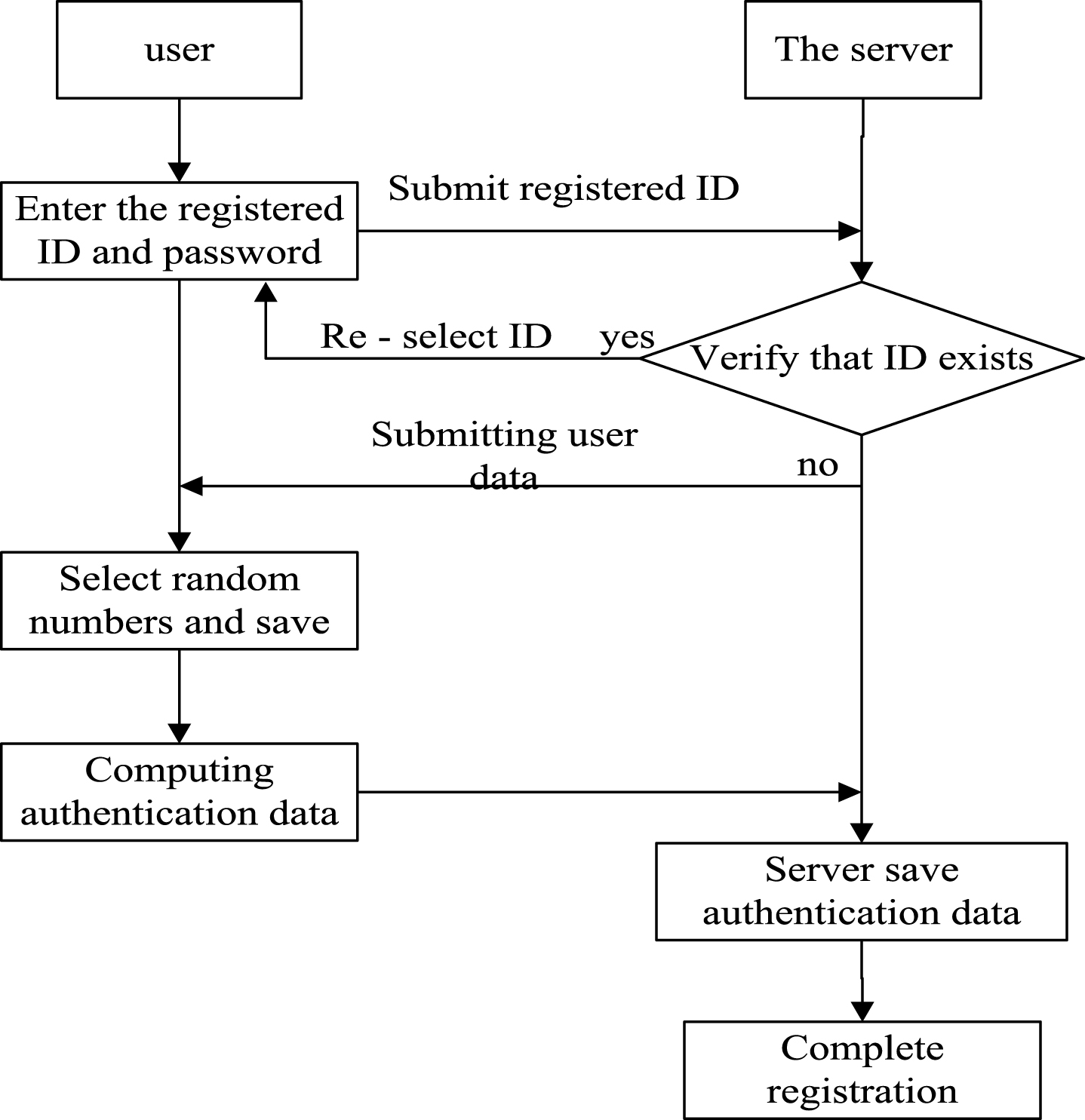
Flow chart of user registration.
The detailed process of user registration is as follows.
The user enters a newly registered user ID and user password PW in the client, and transmits the user ID to the server.
After obtaining the user’s newly registered ID, the server validates the ID to determine whether it has been registered or not. If the ID has been registered, the command is sent to the user to reregister ID. Otherwise, the next step will be continued to allow the user to transmit the registered data.
Two random numbers N1 and R1 will be generated in the client. Through calculation of the entered ID, password PW, and the random numbers, C1 and H (R1) is obtained. C1 is given by
The ID, PW, and the random numbers N1 and R1 are saved in the client.
The authentication data of C1, ID, and H (R1) is sent to the server through a secure channel by the client.
After obtaining the authentication data, the authentication data is stored in the authentication database by the server to achieve the new user registration.
The generation of one-time password is the basis and guarantee of the network communication of the information release terminal [9, 10]. The result of key generation is considered as a one-time password. The generation of the key is as follows.
A public big prime number p is obtained by filtering big prime numbers.
Calculate constantly to form the big prime number of secrecy q.
n = pq and Euler function are obtained.
Randomly select an integer e and take it as an encryption key, which needs to satisfy
The decryption key d is generated by using
Delete p, q, and φ (n) to generate the key as the one-time password.
The network communication process of the information release terminal is shown in Fig. 2.
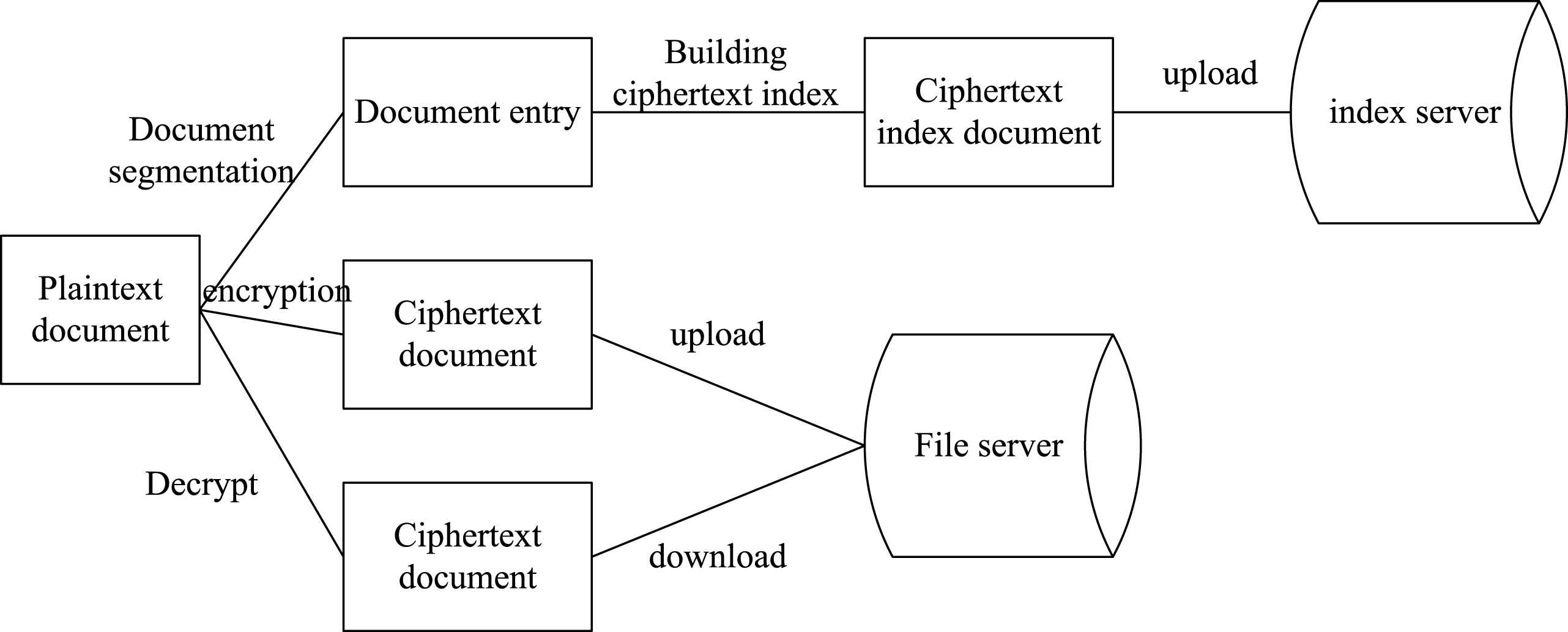
Network communication process of the information release terminal.
After the success identity authentication of the information release terminal and the server, the user of information release terminal can obtain the release authority [11, 12]. When the user releases information, the information release terminal generates a corresponding encryption key. The result will be used as the key index for the current uploaded file and saved to the terminal. Then the release information is encrypted with the obtained encryption key, and the obtained ciphertext document and key index are uploaded to the server in the specified format. In order to facilitate the future retrieval, when the information is released, segmentation processing is carried out for plaintext information and the entry is obtained. Then the ciphertext index is built with the entry, and the ciphertext index is uploaded to the indexserver.
The Hill encryption scheme selected in this section is based on MapReduce. The core algorithm of Hill encryption is matrix multiplication. The parallel algorithm of matrix multiplication in this section is based on the block matrix multiplication.
Before generating the self-inverse key matrix, the self-inverse matrix is generated. The self-inverse matrix is defined as follows. For the matrix B, if B = B-1 is established, then B is a self-inverse matrix.
The generation of self-inverse matrix is as follows. Assume
m is an even number, s is the seed for the generation of random number, p is a modulus and a prime number, r is the multiplier, l is the scale constant.
All operations in this section are done under the modulus p and the steps are as follows.
By using the seed s, generate the (m/2) * (m/2) matrix B11, which is given by
Generate B22. Let B22 = B11, then
Generate B12. Let B12 = l (I - B11), then
Generate B21. Let B21 = 1/l (I + B11), then
Combine the block matrixes to form the matrix B.
For the analysis of the composition of the self-inverse matrix, in the step (1), the seed s is used to generate B11. The elements of B11 have strong correlation and regularity. The inherent regularity between elements can be found through discrete elements, which results in encryption to be easy to crack [13]. If this relationship is eliminated, then the self-inverse matrix is more encrypted and harder to decipher. Based on this idea, a new matrix element is generated based on chaos theory to form a new self-inverse key matrix [14]. The steps are as follows.
Generate dynamic random block matrix B11. Logistic mapping is used to generate chaotic sequence. The chaotic sequence {x
i
} is generated based on Logistic iterative equation xn+1 = λx
n
(1 - x
n
). According to the element x
i
in the sequence, the elements are quantized and coded according to the following logic. IF x
i
≥ 0.5, then c
i
= 1, else c
i
= 0(i = 1, 2, ⋯, 8). A bit c
i
is obtained. λ is the control parameter of chaotic iterative equation. An appropriate combination of bits can form an arbitrary range of the integer. If the self-inverse matrix is used to encrypt information data, the size of the matrix element should be between [0, 255]. So the Logistic system should generate 8 bits continuously to form an integer h1 = c7c6c5c4c3c2c1c0 as the element b11 of the matrix B11. The Logistic system continues to iterate to generate 8 bits, and combine them into the second integer h2 as the element b12 of the matrix B11. Other elements of B11 can be generated with the above method. Generate B22 = - B11 Generate B12 and let B12 = l (I - B11). Generate B21 and let B21 = (1/l) * (I + B11). Combine the block matrixes to form the chaotic key B.
The source release information data file in the communication process is segmented into blocks. Each block is encrypted independently with key matrix to ensure the parallelism of the communication encryption process. Assume the order of the key matrix is N, the dimension of the plaintext matrix is M × N. The ASC II code of the communication data file to be encrypted is read into the plaintext matrix and stored in a one-dimensional array. When the number of elements stored in a matrix is larger than the communication data file, the insufficient location is completed by using 0. Assume the plaintext matrix Q is segmented into m rows and k columns and the key matrix B is segmented into k rows and n columns. The detailed segmentation strategy is as follows. The plaintext matrix Q is segmented into m × k blocks and each block is denoted as Qi,q. The boundary of each block can be represented by 4 variables (ir, er, ic, ec), which are the number of initial rows, the number of end rows, the number of initial columns, and the number of end columns.
The plaintext matrix Q is given by
For the key matrix B it is segmented into k × n blocks and each block is denoted as
The block matrix multiplication can be used to carry out parallel Hill encryption after segmentation.
After segmentation of the plaintext matrix and key matrix, the plaintext is encrypted according to the Hill encryption principle [15]. The encryption algorithm is given by
Block matrix multiplication strategy is as follows. The matrix multiplication is taken on the block, and the blocks are summed and the final cipher block
The matrix addition operation is taken on the blocks with the same q value in
A complete ciphertext matrix can be obtained by combining the ciphertext blocks.
After the ciphertext and key matrix are obtained, the plaintext is decrypted according to the principle of Hill decryption. The decryption algorithm is given by
As the key matrix is symmetric matrix, that is, B = B-1, the plaintext matrix is given by
The ciphertext is segmented into blocks. Each block is encrypted independently with key matrix to ensure the parallelism of the communication encryption process. Assume the order of the key matrix is N, the dimension of the ciphertext matrix is M × N. The ASC II code of the ciphertext to be decrypted is read into the ciphertext matrix and stored in a one-dimensional array [16–19]. When the number of elements stored in a matrix is larger than the communication data file, the insufficient location is completed by using 0. Assume the ciphertext matrix Q is segmented into m rows and k columns and the key matrix B is segmented into k rows and n columns. The detailed segmentation strategy is as follows. The plaintext matrix Q is segmented into k × m blocks and each block is denoted as
For the key matrix B, it is segmented into k × n blocks and each block is denoted as
After segmentation, parallel Hill encryption can be used by block matrix multiplication. The block matrix multiplication strategy is as follows.
The matrix multiplication is taken on the block, and the blocks are summed and the final plaintext block
The matrix addition operation is taken on the blocks with the same q value in
A complete plaintext can be obtained by combining the plaintext blocks.
Test environment
The proposed algorithm is developed based on the DSF framework. It includes the client and the server. The client and server are deployed on different PCs. The software and hardware environment of the client and server is shown in Table 1.
Software and hardware environment
Software and hardware environment
Statistical analysis is one of the most commonly used attack methods in cryptanalysis. In order to intuitively observe and analyze the ability of the algorithm to resist statistical analysis, the distribution of the pixel value of the image is statistically analyzed with the image information as an example.
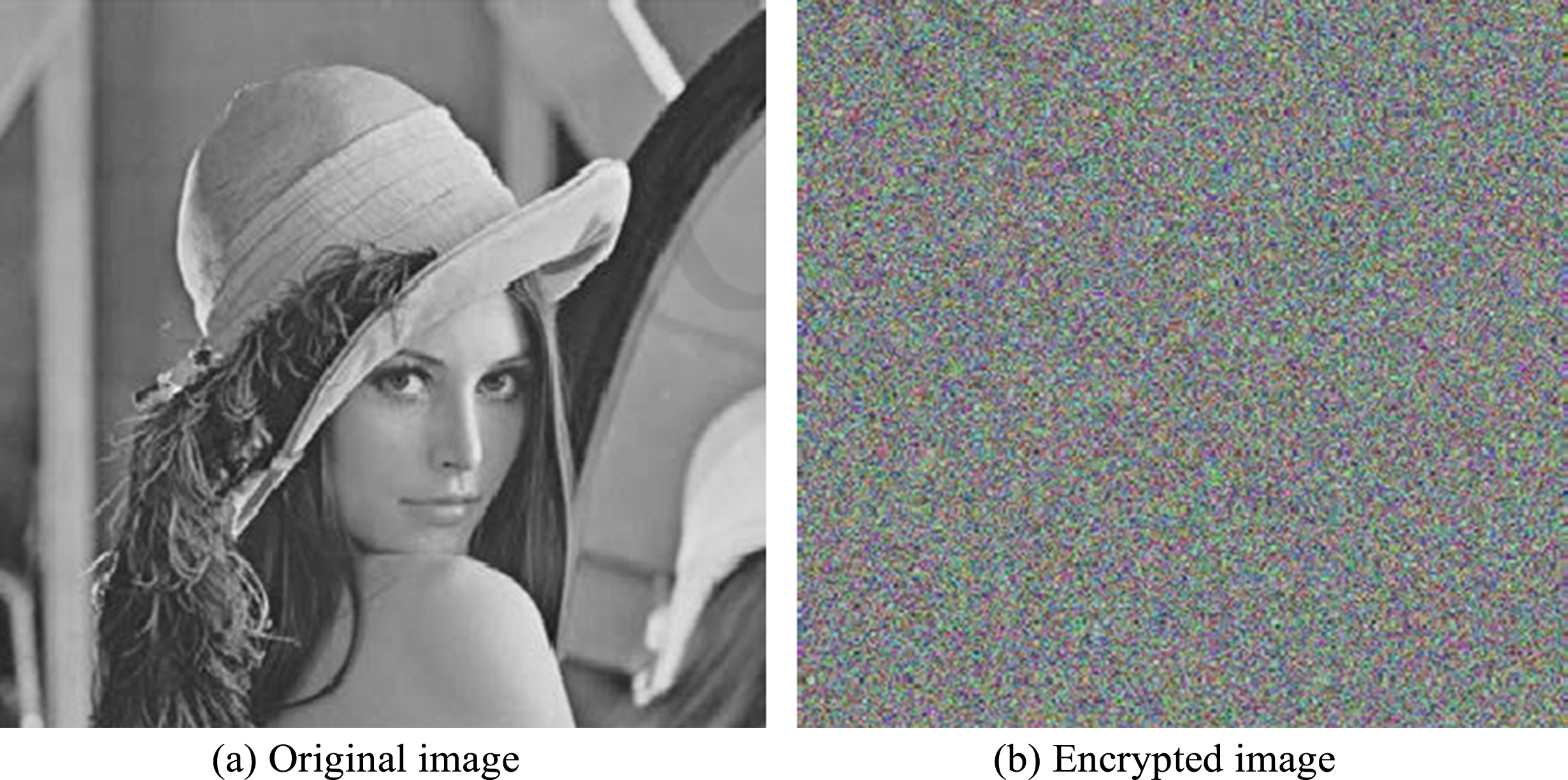
In the experiment, the 512×512 grayscale bitmap of “lena.bmp” with 8 bits is selected, and then this algorithm is applied for encryption. The images before and after encryption are as shown in Fig. 3.
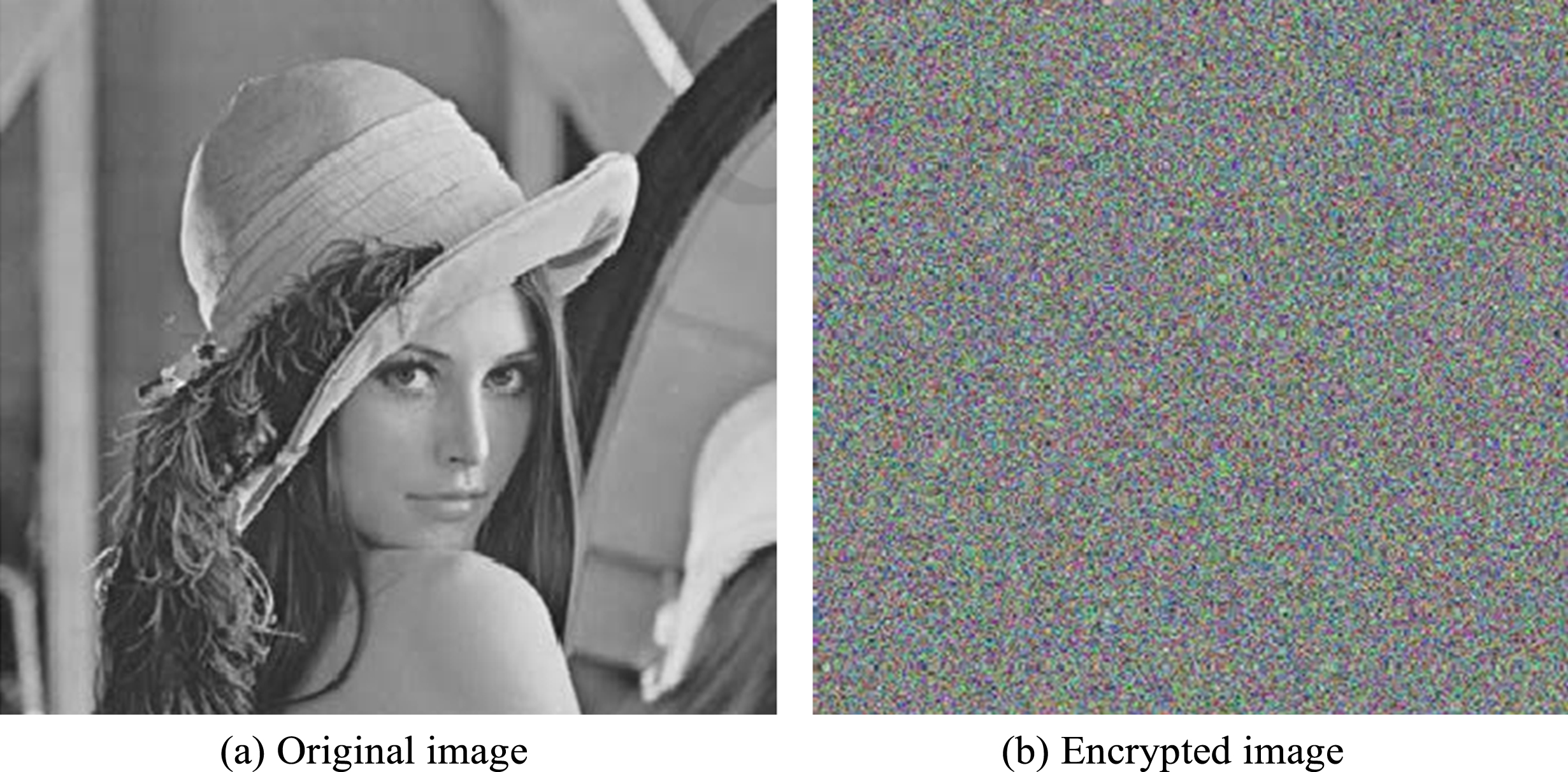
Comparison of bitmap “lena.bmp” before and after encryption.
From Fig. 3, it can be seen that, the encrypted image has completely failed to show any information of the original image, and has a good visual encryption effect. Next, the distribution of the pixel value of the image before and after the encryption is analyzed, as shown in Figs. 4 and 5. Figure 4 shows the histogram of the original image of “lena.bmp”. The gray distribution presents an uneven state and corresponds to the feature of the image. Figure 5 shows the histogram of the encrypted image. It can be seen that the gray distribution of the encrypted image is close to uniform, and the feature information of the original image is well hidden.
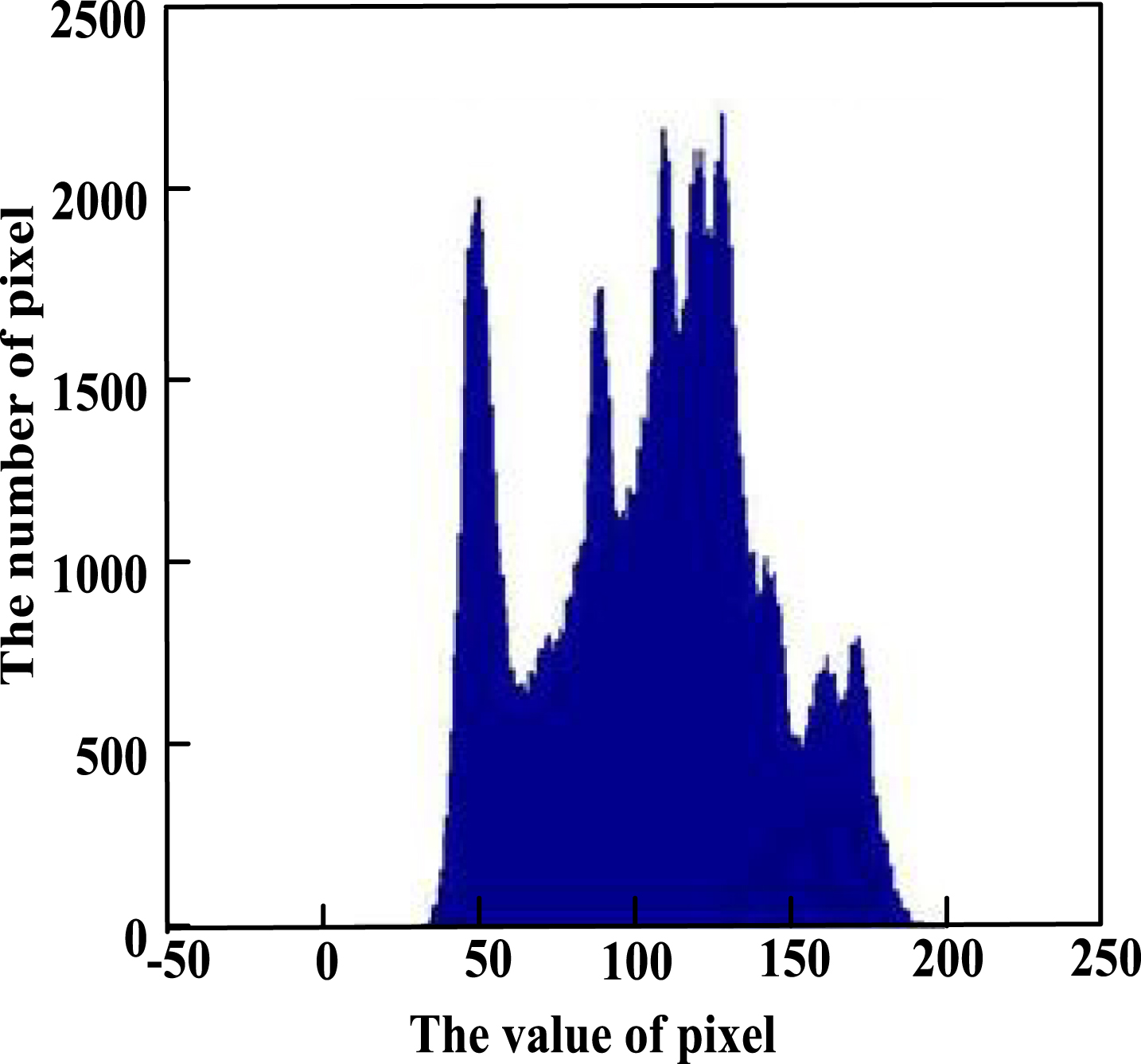
Histogram of gray distribution of the original image of “lena.bmp”.
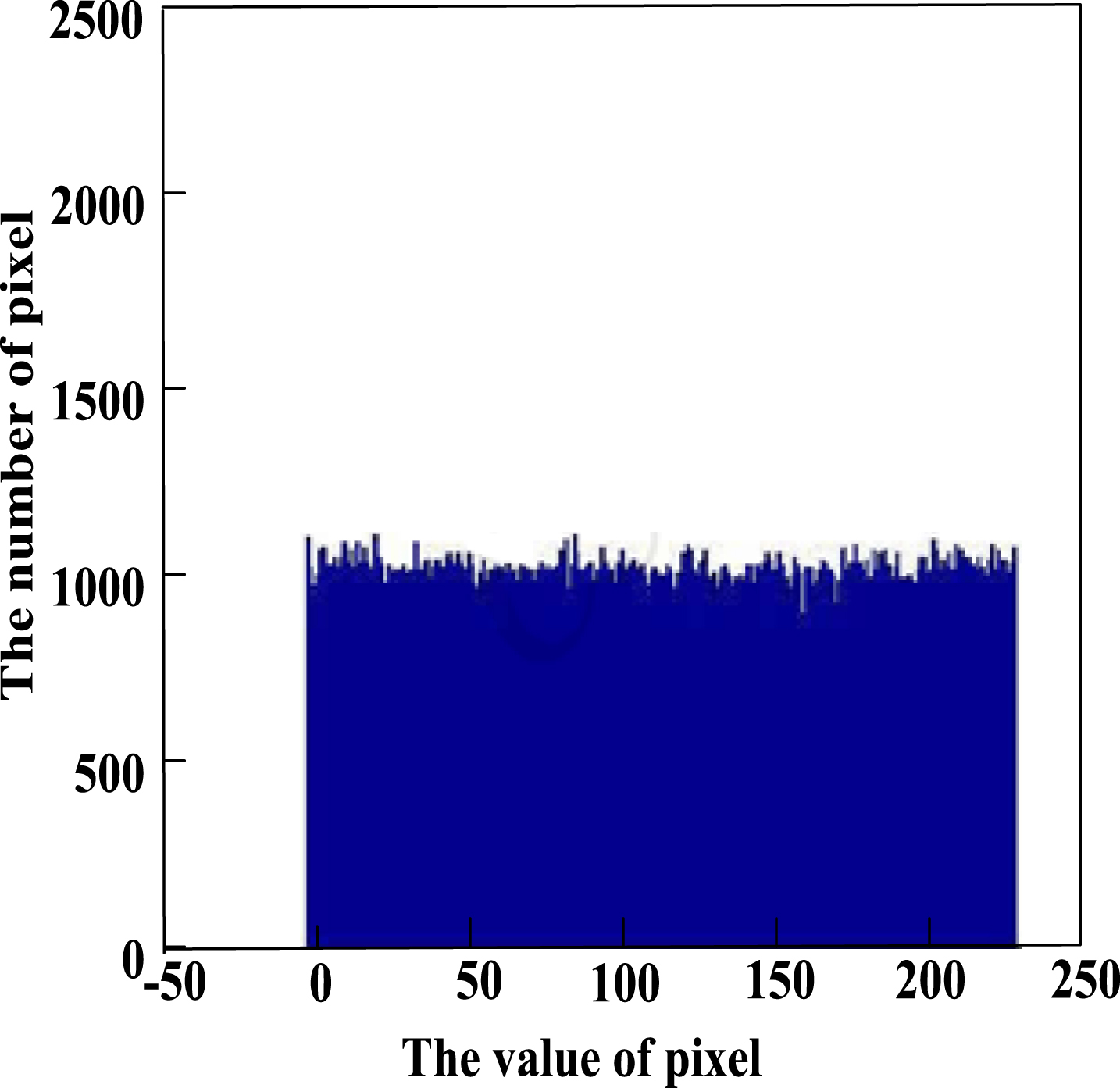
Histogram of gray distribution of the encrypted image of “lena.bmp”.
A large redundancy bitmap is used for encryption experiments, as shown in Fig. 6. Figure 6 (a) is a 720×450 depth bitmap “test.bmp” with 24 bits, and Fig. 6(b) is the encrypted image obtained with the proposed algorithm.
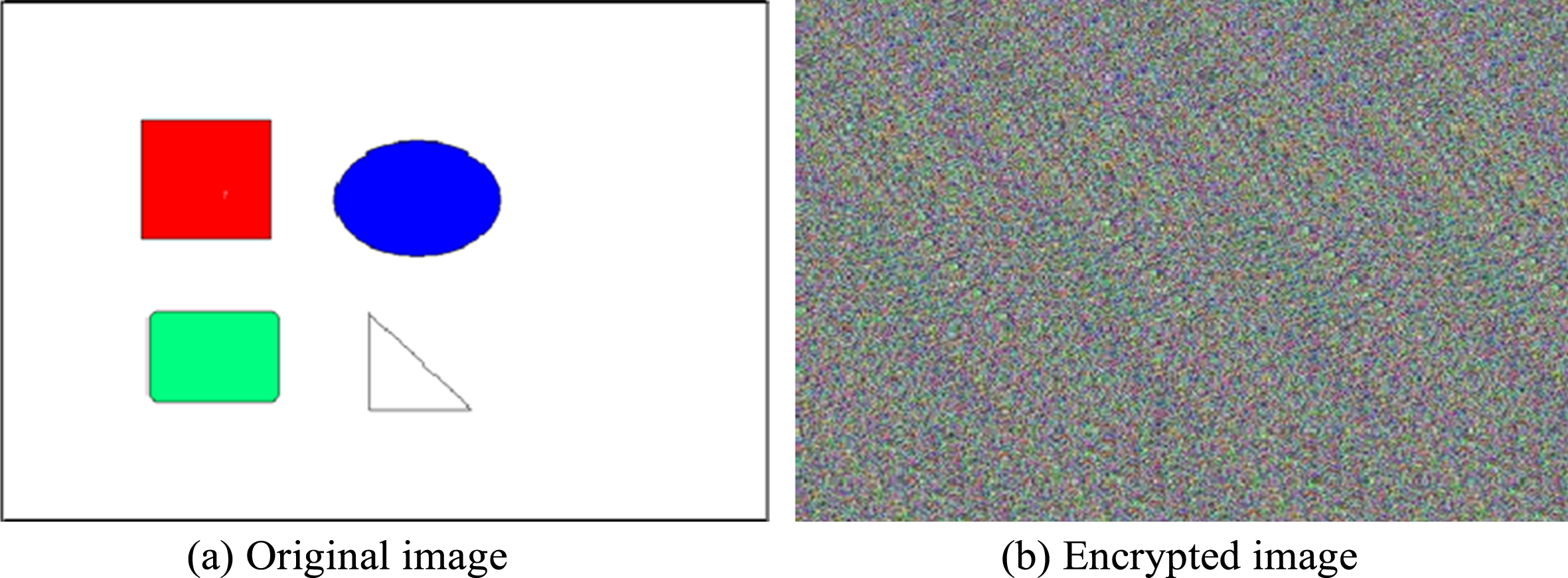
Comparison of bitmap “test.bmp” before and after encryption.
From Fig. 6, it can be seen that, “test.bmp” after encryption has been completely unable to see any information of the original image, and achieved very good encryption effect. Figure 7 shows the histogram of the encrypted image.
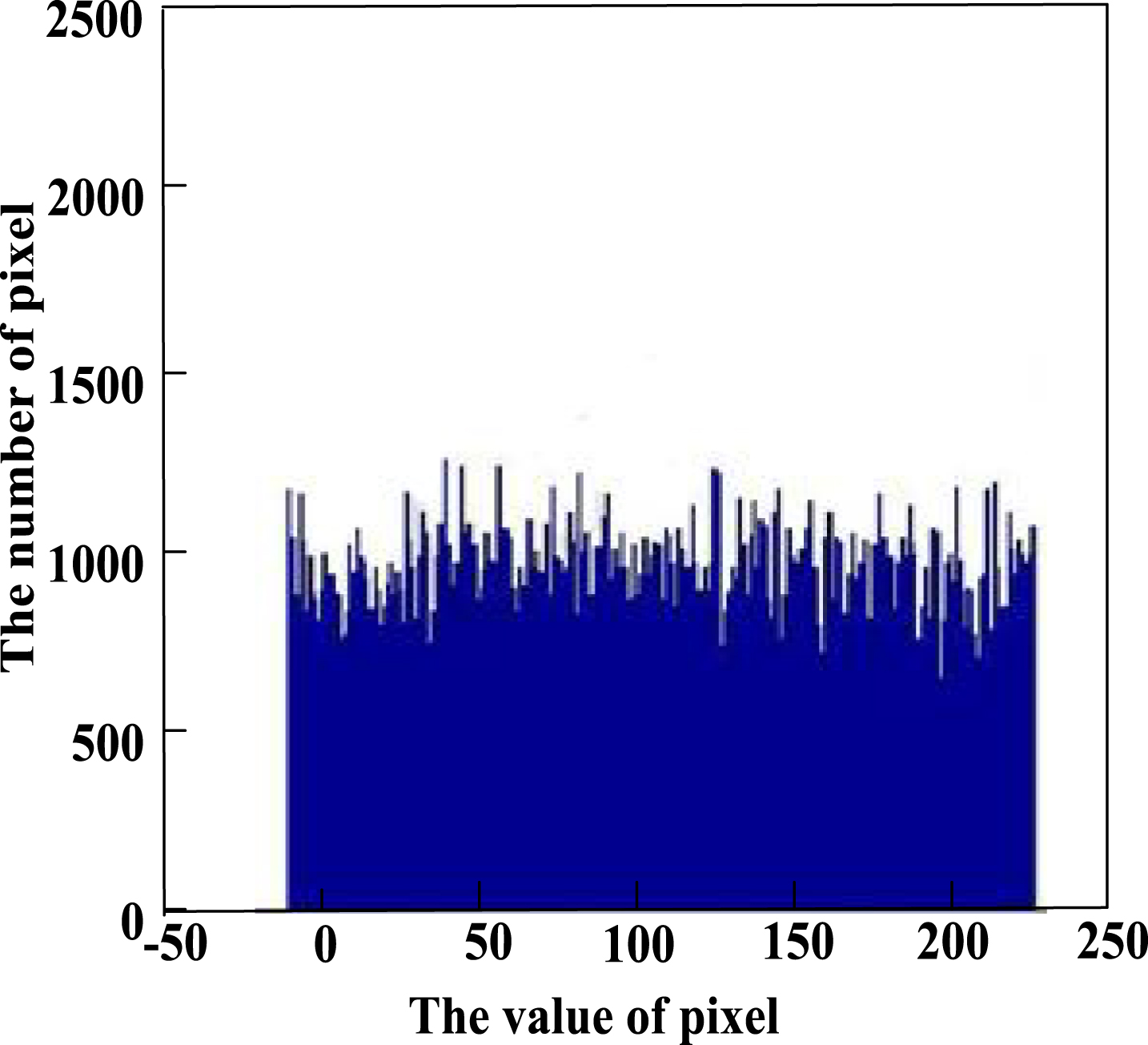
Histogram of gray distribution of the encrypted image of “test.bmp”.
From Fig. 7, after the encryption with segmentation linear chaos algorithm is, the pixel value distribution of the image is obviously homogenized, and the related information of the original image cannot be reflected.
A secure encryption algorithm must have a large enough key space, only in this way the algorithm can resist attack and other violent cracks. The proposed algorithm is based on the sensitivity of the chaotic system to the parameters and initial values of the system. So even small change of the initial value will inevitably lead to a huge change in the result. If exhaustive attack is used, it is bound to cost a great amount of calculation, and it is not decrypted within a short time.
To verify the extreme sensitivity of the algorithm to the key, the grayscale bitmap “lena.bmp” is selected as the original image. Encryption parameters: Initial iteration number n = 100, chaotic initial value x0 = 0.5. The images before and after encryption are shown in Fig. 8.
Comparison of images before and after encryption for the case of x0 = 0.5.
For decryption, the other parameters are unchanged, and the initial value is changed by 10–8 order of magnitude, that is,. The decryption of the encrypted image in Fig. 8 is shown in Fig. 9. Figure 9 (a) shows the decryption effect obtained with the initial value and Fig. 9(b) shows the decryption effect obtained with the initial value x0.
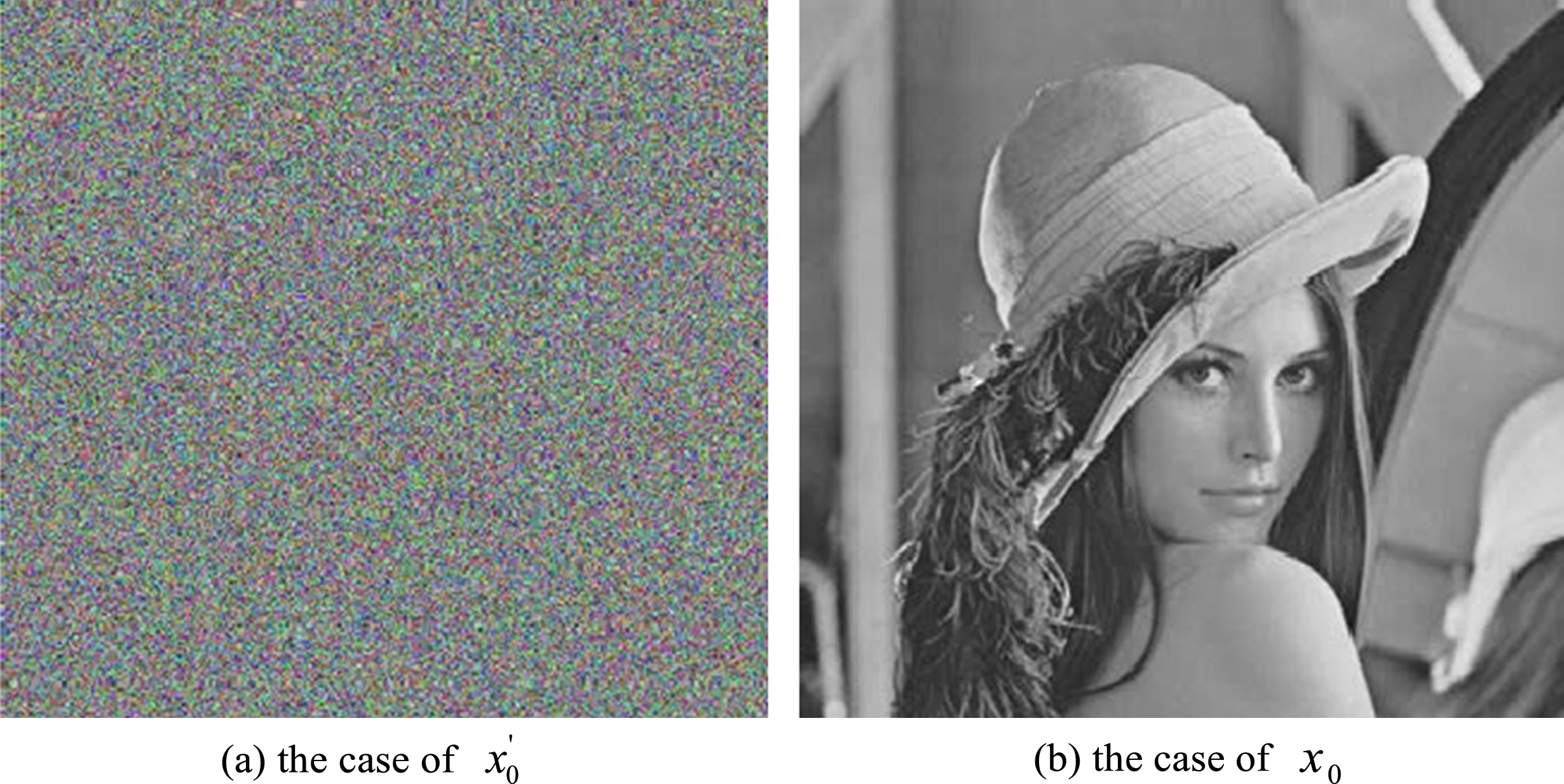
Decrypted images obtained with and x0.
From Fig. 9, the correct initial value can decrypt the original image, but if the initial value changes slightly, even if changes by only 10–8 order of magnitude, it cannot restore the image correctly. Figure 10 shows the gray distribution of the encrypted image obtained with. It can be seen that the pixel values are basically evenly distributed, and the original information of the relevant plaintext cannot be obtained.
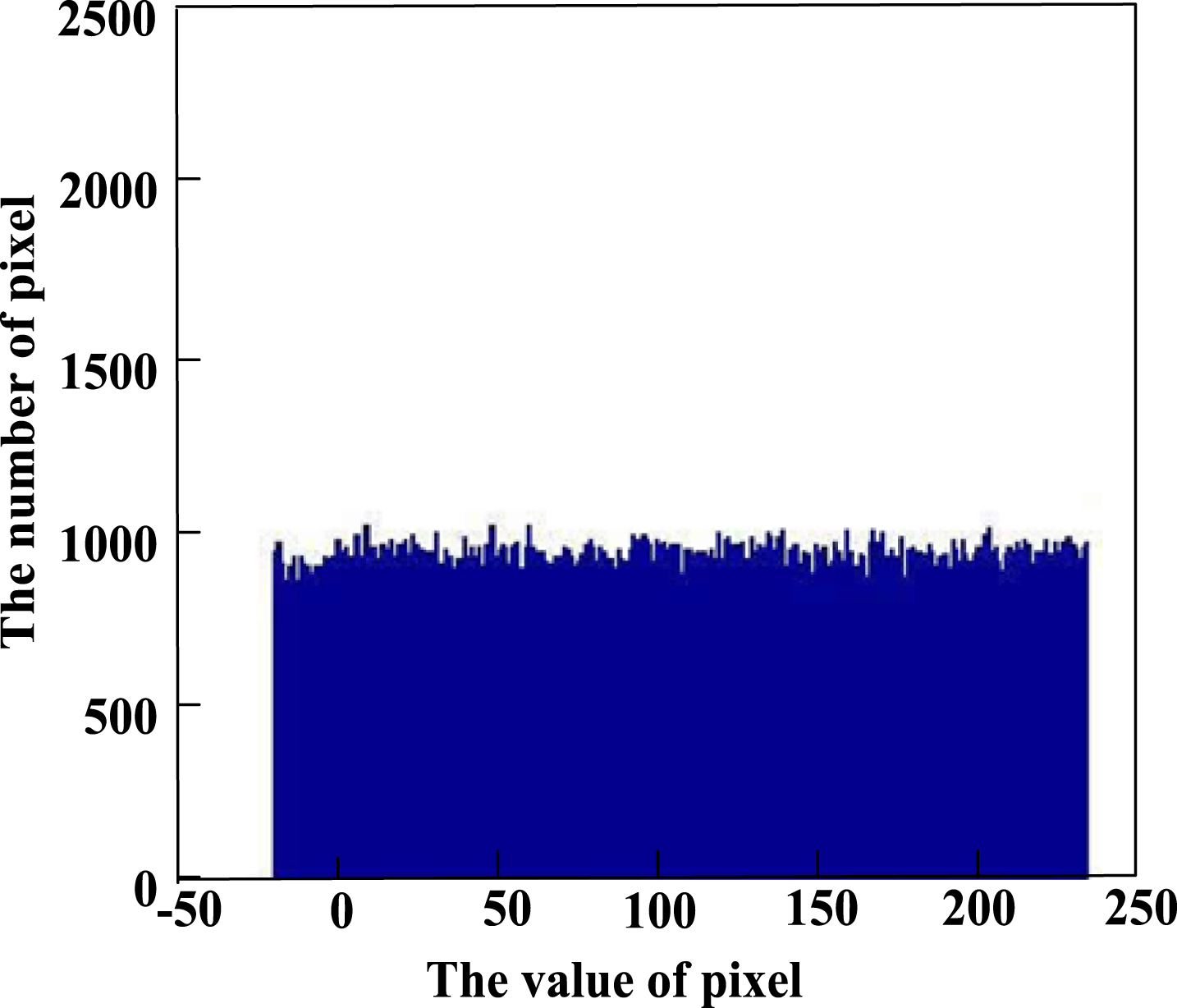
Histogram of gray distribution of the encrypted image obtained with.
The proposed algorithm is highly sensitive to key, even if the tiny differences are enlarged infinitely by the chaotic system, so as to ensure that the algorithm has enough large key space, and has good defense ability for violent attacks such as exhaustiveattack.
The performance of this parallel encryption algorithm will be analyzed from two aspects. One is the parallel acceleration ratio, and the two is the comparison of the encryption time. Acceleration ratio is the ratio of execution speed after parallel processing to execution speed before parallel processing.
A group of different sizes of information files is selected, which are 1000 kB, 2000 kB, and 4000 kB. The number of parallel processors is set to 4. Different sizes of plaintext are encrypted. The parallel acceleration ratio and encryption time of the proposed algorithm, the literature [5] algorithm, and the literature [6] algorithm are compared. The results are shown in Table 2.
Comparison of efficiency of three algorithms
Comparison of efficiency of three algorithms
From Table 2, it can be seen that, for exponential growth of computing task scale, the acceleration ratio of the proposed algorithm for relatively heavy task is slightly higher than light task. It is valuable to use the proposed parallel algorithm for processing the large amount of data computation [20–23]. Better parallel performance is achieved. For the other two algorithms, with the increase of the scale of the task, the acceleration ratio is decrease rapidly and the efficiency is low. In addition, the time cost of the literature [5] algorithm and the literature [6] algorithm is increase geometrically with the increase of the file size, while the time cost of the proposed algorithm increases slowly with the increase of the file size. This algorithm has an obvious advantage over other algorithms in the encryption time.
Cipher is the core technology of information security, and it is also one of the basic means to protect information security. For the information security of information release terminal, the theory of cryptography has been researched. A series of representative cryptographic schemes were proposed. But almost every cryptographic scheme is incomplete. The traditional encryption algorithms, DES and AES, do not take full account of the characteristics of multimedia information. AES and other traditional encryption algorithms cannot be satisfactory when encrypting some special multimedia data, especially for some redundant image, voice and other information. These traditional encryption algorithms are also difficult to meet the requirements of real-time and rapid encryption of multimedia information with large amounts of data.
From a lot of research results, it has found that there are a lot of similarities between chaos and cipher. Chaos injects new design idea into cipher. For the chaotic cryptography, it has fast encryption, is simple and easy to implement, and a slight change in plaintext or key will have a huge impact on ciphertext. Therefore, the terminal has high security. With the continuous improvement of chaos theory and the wide application in cryptography, chaotic cipher has become an important frontier in modern cryptographic research.
With the popularity and development of high-performance computer with multi-core processors, the application of parallel technology has been widely used. In cryptography, parallel encryption has been widely used. Combining chaos encryption with parallel technology has become a new trend in cryptography.
Conclusions
In this paper, the proposed encryption algorithm consists of two parts.
The attacker is prevented from impersonation attack through identity authentication. Access authorization is achieved to legitimate user of the information release terminal.
The parallel Hill encryption method is used to provide a parallel encryption for the encryption of communication data. By using the parallel computer system and combining with the Hill encryption method, the plaintext data is encrypted by the lightweight packet. By using the block matrix multiplication algorithm, the encryption of the communication data of the information release terminal network is finally realized.
Although some aspects of communication data encryption of the information release terminal net-work are researched in this paper, there are still some problems to be further researched and improv-ed. Although Hill encryption algorithm has been improved in this paper, lightweight block cipher algorithm has been proposed, and the performance of encryption and decryption processing on the information release terminal is improved, there is still a lack of key security management. In the future work, the key management should be researched to improve the key security.