



Abstract
When the current algorithm encrypts cloud computing user behavior data, it cannot effectively resist external attacks. When there are many feature data, the encryption performance is poor. To solve this problem, a secondary encryption algorithm for data based on coupled control game mechanism is proposed. The piecewise linear chaotic maps and Fibonacci sequence perturbations are utilized to obtain pseudo-random numbers and improve the key’s mapping space, and can effectively defend against threats and attacks. Based on the piecewise linear chaotic map encryption algorithm, the discrete chaotic integrated map encryption algorithm based on the coupled control game mechanism is adopted. After group-based encryption, the user behavior feature data is mapped into the encryption source-optimization evolution structure, and encrypted mapping is performed piecewisely. The encrypted data is used as the seed-derived set in the coupled control game mechanism, and the competition mechanism is adopted to perform the second discrete chaotic optimization on the encrypted data. The encrypted data ciphertext with the lowest chaotic discrete coefficient and the best game performance is selected as the output results of the coupled control game. Experimental results show that the proposed algorithm can effectively improve the encryption performance and improve the operation security of cloud computing network.
Introduction
The inevitable result of advances in information technology is the production of big data. The Internet has connected every computer in the world, making access to various information and data from the Internet the most basic way. It has also completely changed people’s lifestyle [1]. Cloud computing stores data scattered in personal computers and enterprise servers in the ‘cloud’, and users access the data by using a browser or a client to log in. Cloud storage provides access to storage space for big data and is a prerequisite and necessary condition for the generation of big data [2]. Another product of the advancement in information technology is the Internet of Things. Different sensors in the Internet of Things generate large amounts of data, which is one of the important sources of big data [3]. The rise of big data has ushered in another disruptive technological reform in the IT industry. Its potential commercial value has become the focus of the information industry.
With the rapid development of cloud computing, people enjoy the convenience of lowering operating costs and improving operational efficiency, while also facing more severe challenges of information security [4]. The huge amount of users’ important data in cloud computing is attractive to attackers. At the same time, cloud computing provides users with an open access interface so that cloud terminal users can directly use and operate the cloud service provider’s software, operating systems, and even the programming environment and network infrastructure, thus, the impact and disruption of cloud resources are much more serious than the current use of the Internet for resource sharing [5]. Researching security technologies for big data is to ensure that big data can be safely interacted and data is prevented from being intercepted, altered, copied, and disseminated by unauthorized persons. The commonly used method to process data is data sampling. Data sampling mainly relies on massive network data resources and data processing and statistical techniques, and valuable data and information are obtained through analysis of massive data. At present, research in the field of data security is still in its infancy. At this stage, due to the high requirements of data in terms of computational strength and storage methods, mature data encryption techniques and data processing methods are mostly unsuitable for data encryption in cloud computing. Therefore, an encryption method for cloud computing user behavior feature data is required [6].
Yi proposed a dual-chaotic mutual feedback encryption algorithm based on the characteristics of social networks [7]. The algorithm used the login user’s ID, creation time, and attention as initial values and parameters of the encryption function, and used Logistic mapping and Tent mapping to perform interactive operations on two chaotic systems to obtain the key sequence. Due to the particularity of the input parameters, the ciphertext has unpredictability. Experiments show that the algorithm achieves good encryption and decryption effects. At the same time, both encryption and decryption are in the order of milliseconds, which can achieve the user’s senseless operation. In addition, the algorithm has extremely sensitive initial conditions and large key space, but it has the problem of low encryption performance. Guo et al. reported a data privacy encryption protection method under big data environment based on improved protection order encryption algorithm [8]. Firstly, according to the theory of OPES+, the privacy data in the big data environment was converted into numerical values to be expressed, and the aligned position data was divided into buckets to make them evenly distributed, so that the number of points in each bucket was less than a given threshold. The protection order encryption algorithm encrypted the data in the bucket and kept the size of the encrypted data in order. The privacy encryption process was constrained to solve the encryption function. The encryption function was used as the core to transform the data privacy encryption protection problem into a linear optimization problem with constrained isomorphism. The simulation results show that the improved method is more robust, but the data encryption performance is poor due to the low security of data privacy encryption. Zhang group came up with the utilization of multi-valued and ambiguous schemes (MAS) to solve data security problems in cloud-assisted WBAN [9]. This algorithm can be used to solve cloud-assisted WBAN data security problems, but overall the encryption performance is still worse. Other than these, an encryption algorithm based on Hadoop big data platform and non-degenerate high-dimensional discrete hyperchaotic system was reported [10]. The algorithm used stream symmetric cryptography to read the large data stored in the Hadoop distributed file system (HDFS) on the Hadoop platform, and after fragmentation processing and MapReduce programming, the parallel encryption and decryption of data were realized using the Map function. The data was merged and stored in HDFS through the Reduce function. The algorithm has better execution efficiency. Compared with the low-dimensional chaotic system, the non-degenerate high-dimensional discrete hyperchaotic encryption algorithm can improve the system security performance. The Lipschitz exponent is positive and sufficient, and has better statistical characteristics. Through the strict TESTU01 test, the ciphertext generated with parallel encryption is very small. The large number of key parameters makes it more difficult to estimate or identify. Under the condition of ciphertext closed-loop feedback, it has the ability to defend against known plaintext attacks and selected plaintext attacks. Although it can effectively resist attacks, it still has the problem of poor encryption performance.
The overall structure: Primary encryption is performed using piecewise linear chaotic map data encryption algorithm; Discrete chaotic map encryption algorithm is used to couple the control game mechanism to re-encrypt the cloud computing user behavior feature data; The validity of the proposed algorithm is verified; The overall performance is summarized and optimization is proposed.
Material and methods
Piecewise linear chaotic map data encryption algorithm
An iterative mapping of user behavior data in cloud computing can be expressed as follows:
Among them, x n is an iterative term, n is the number of iterations, and it can also be understood as a function of time n, that is, continuous time change. p is the control parameter.
The definition of piecewise linear chaotic map is as follows:
Where x0 is the initial value of x n and x n ∈ [0, 1], p ∈ [0, 1].
Another definition of the piecewise linear chaotic map of user behavior feature data is as follows:
The piecewise linear chaotic map defined by Equations (2 and 3) has the following properties:
The chaotic system is chaotic in the mapping space, and the output value of the system shows a certain randomness, ergodicity, and sensitivity to initial values in continuous orbit [11];
The piecewise linear chaotic map has a uniform probability density function f (x) =1, x ∈ [0, 1);
Chaotic sequences have good autocorrelation and cross-correlation.
As shown in Fig. 1, the piecewise linear chaotic maps the distribution of chaotic orbits when the control parameter of the user behavior feature data is p = 0.31. The chaotic orbit is shown in Fig. 2.
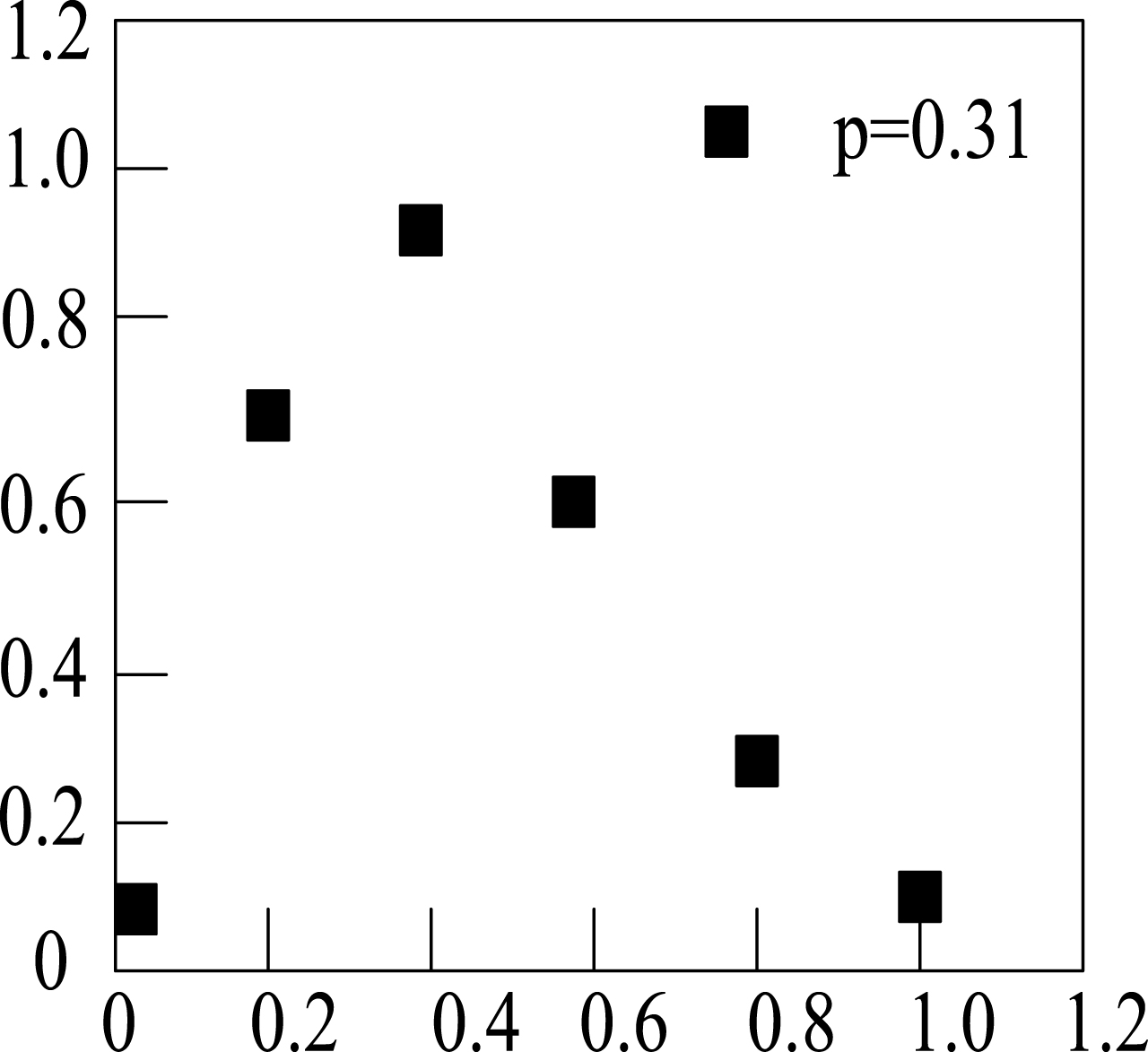
Piecewise linear chaotic map with the control parameter p = 0.31.
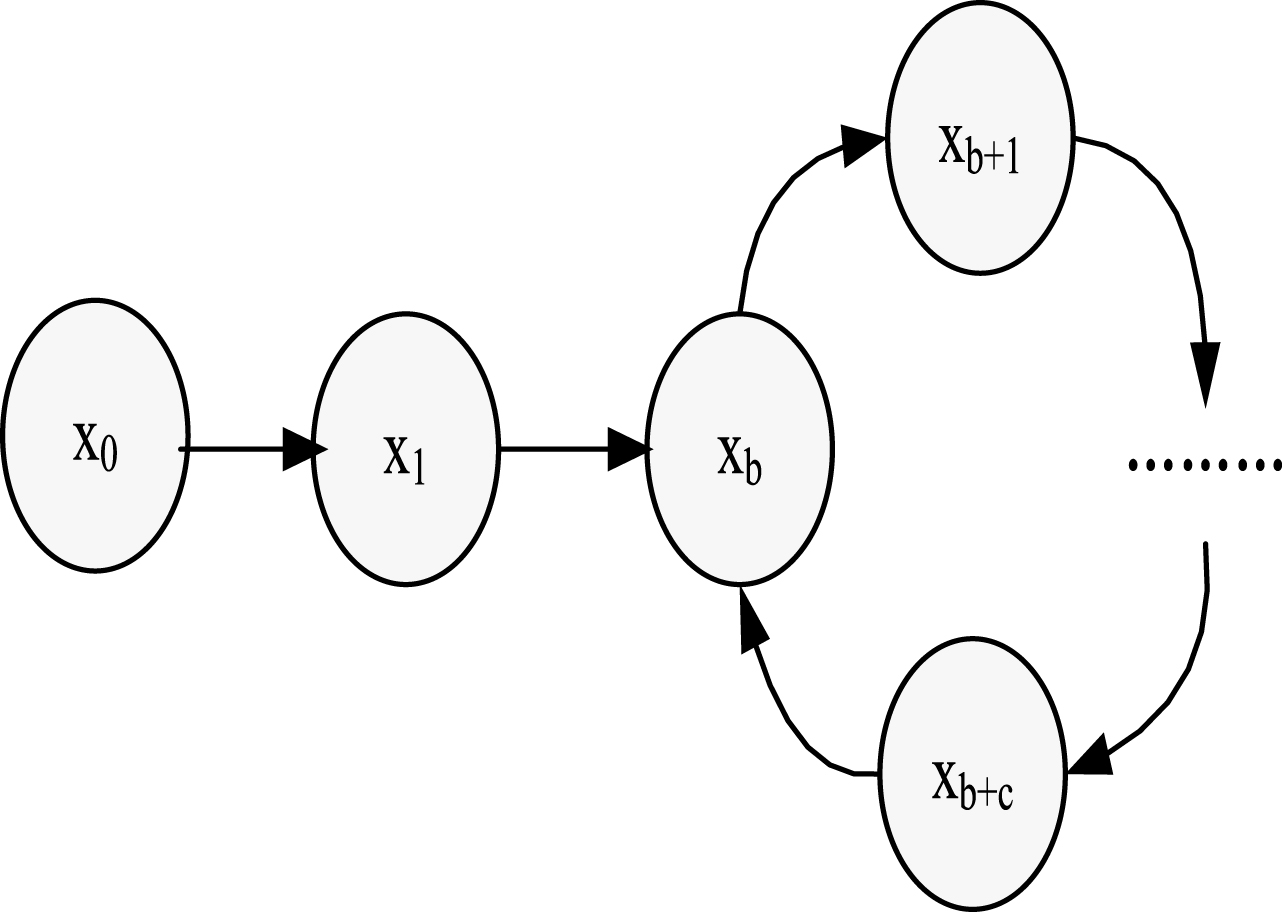
Orbit of the chaotic system.
The orbit of the chaotic system of the user behavior feature data can be expressed as: {x0, x1, …, x b , xb+1, …, xb+c}. Among them, from x0 to x b is the transition period, from xb+1 to xb+c is the cycle period [12]. This feature of chaotic orbit is particularly evident in the case of limited accuracy.
As shown in Fig. 3, under the limited accuracy of 4-bit, the parameter value of the user behavior feature data is set to p = 3/24, and the state of the orbit can be quantified as i/24. Therefore, the finite state distribution is 0/24, 1/24, ⋯ , 14/24, 15/24. As can be seen from Fig. 3, the distribution of piecewise linear chaotic map is not uniform and limited to a limited number of values.
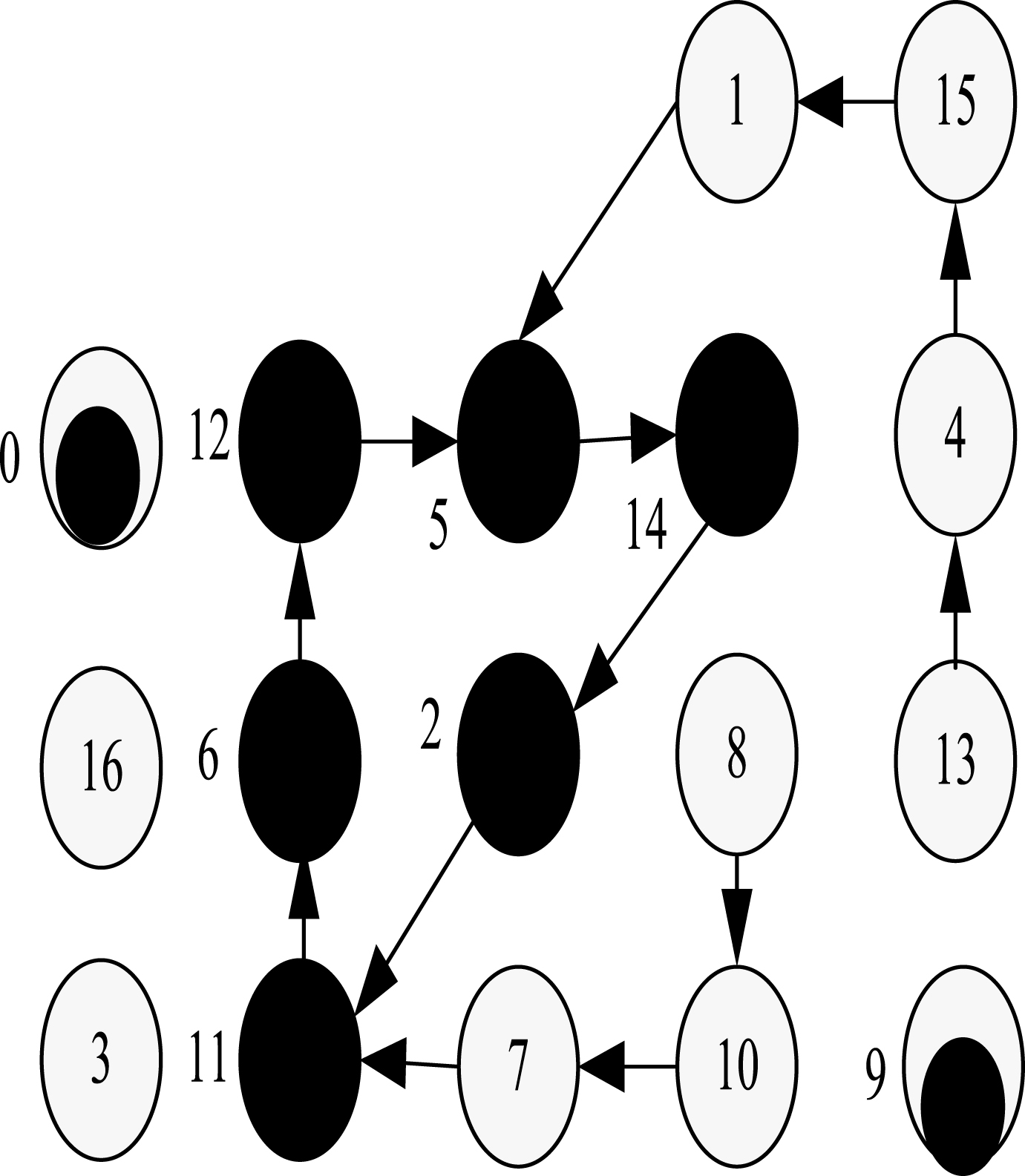
Chaotic orbit with limited accuracy.
Therefore, with limited accuracy, the chaotic characteristics degrade so severely that the use of such a system for cryptographic design is insufficient to defend against known attacks [12]. Therefore, the user behavior feature data function needs to be improved to meet the basic requirements of the design.
One way is to add perturbation mechanism. The method used is to add the Fibonacci sequence for perturbation.
The Fibonacci sequence can be defined as:
In Equation (4), Z represents a modulo.
The mixed map can be defined as:
The basic principle is to use the Fibonacci sequence to perturb the Logistic map to convert it to an integer sequence. The stochastic performance of this method satisfies the basic characteristics of chaos and can satisfy user behavior feature data encryption requirements [13].
The given key space is defined in the chaotic area, this design follows the proposed user behavior feature data key design and can be expressed as follows:
Where x n is the output of the piecewise linear chaotic map of Equations (2 and 3). fib n is the output term of the Fibonacci sequence of Equation (5). The result of the modulo 256 (binary) maps the current calculated value to byte space, ie to one byte.
Based on the above basic rules, the design method of adding disturbance and multi-parameter integration key is adopted.
The composition of the key contains a set:
In the equation,
An encryption system is a five-tuple that satisfies the following conditions;
Where P is a finite set of possible plaintexts; C is a finite set of possible ciphertext of user behavior feature data; K is a key space, and a finite set of possible keys; e k is an encryption rule; d k is a decrypted rule [14].
For each k ∈ K, there is an encryption rule k ∈ K and the corresponding decryption rule d k ∈ D. Each e k : P → C and d k : C → P is a function d k (e k (x)) = x for each plaintext x ∈ P. E and D represent all possible sets of encryption and decryption rules.
Combined with the piecewise linear chaotic map encryption algorithm to encrypt user behavior feature data in cloud computing, the data encryption algorithm based on coupled control game mechanism is used to perform secondary encryption for user behavior feature data in cloud computing.
Piecewise encryption of user behavior feature data based on attack source.
It is assumed that the original to-be-sent user behavior feature data space satisfies a complete set Ω = { a1, a2, ⋯ , a
n
} ∈ Rm×n, where a
i
denotes the atomic weight to be encrypted in the entire space, and m and n denote row dimension and column dimension of the space [15]. The signal space Ω′ = { b1, b2, ⋯ , b
n
} ∈ R
a
of attack source can be represented by a linear combination of a
i
:
Where B is the determinant corresponding to b n , and β is the minimum Euclidean distance between the signal space Ω′ of user behavior feature data attack source and the original data space to be sent. Obviously, the greater the distance β, the smaller the similarity between the user behavior feature data space and the signal space of attack source, and the better the encryption effect.
From the model (9) and (10), it can be seen that the attack source signal space is a linear space satisfying the Rm×n space matrix, and its maximum dimension is N = max{ m, n }, and the encrypted subspace vector X satisfies:
Where x
i
represents the encrypted data structure, X, Ω and Ω′ satisfy the orthogonal relationship:
According to the idea of orthogonal transformation, the model (12) and (13) can be written as follows:
Among them, F represents the user behavior feature data space set after encryption, B represents the matrix corresponding to the attack source signal space, A represents the matrix corresponding to the data source signal space, x i represents the encrypted data structure, α is the error factor, generally takes random number 0∼1.
Encryption with coupled game control. Since the encrypted data space set obtained by the model (14) is a linear space and the encrypted data satisfies the orthogonal relationship with both Ω and Ω′. But the model (14) and the attack source signal space Ω′ are in a non-orthogonal state. Therefore, it is still possible to restore the original space Ω of the user behavior feature data through the model (14). After a certain coupling processing is performed on the model (14), the model (14) needs to be further game-controlled based on the orthogonality idea, so as to realize the orthogonality between the encrypted data space F and the attack source signal space Ω′ [16].
The coupling factor Idex (F
m
, B
n
) is defined as follows:
Among them, F represents the user behavior feature data space set after encryption, B represents the matrix corresponding to the attack source signal space, F
m
and B
n
represent the corresponding column vectors in F and B, respectively. l, k, and h are column vectors that are orthogonal to each other, and their dimensions are the same as the dimensions of F, and α, β, and γ are normalization factors. The parameters of model (15) satisfy the following relationship:
After F and B in model (14) are subjected to the coupled game control shown in model (15), the corresponding column vector (F
m
, B
n
) is orthogonal to the column vector of the attack source signal, ie:
According to the model (14), it can be seen that the new encrypted user behavior feature data space set F′ satisfies:
Integration map of discrete chaos. The encrypted user behavior feature data space set obtained by the model (19) and the attack source signal space Ω′ have been in an orthogonal state, whereas F′ is at continuous state in the time domain, considering that F′ is at the same state as the original to-be-sent data space Ω. The mathematical expression of F′ is discretized and sampled, and can be mapped again through the orthogonal matrix, and the entire mapping process is invertible [17–20].
Let T be the sampling period of F′, after discretization sampling for T times, model (19) can be written as follows:
The parameters in model (20) are the same as those in model (19). ∥ ∥ T denotes the discretization sampling with sampling period T, and ∥F′ ∥ T denotes the collection of user behavior feature data space after discretization sampling for T times. At this point, ∥F′ ∥ T and F′ are orthogonal.
By taking X-1 as the mapping matrix of ∥F′ ∥
T
and overlapping the column vectors, we can get the final user behavior feature encrypted data space W:
W and the original data space Ω to be sent satisfy the following expression:
In model (22), X is an invertible matrix, W-1 is the invertible subspace of the encrypted data space W, and F′ and ∥F′ ∥ T are same to model (19) and (20).
Through the model (22), the finally obtained encrypted data space W is completely restored to plaintext. Figure 4 shows the flow of the encryption algorithm.
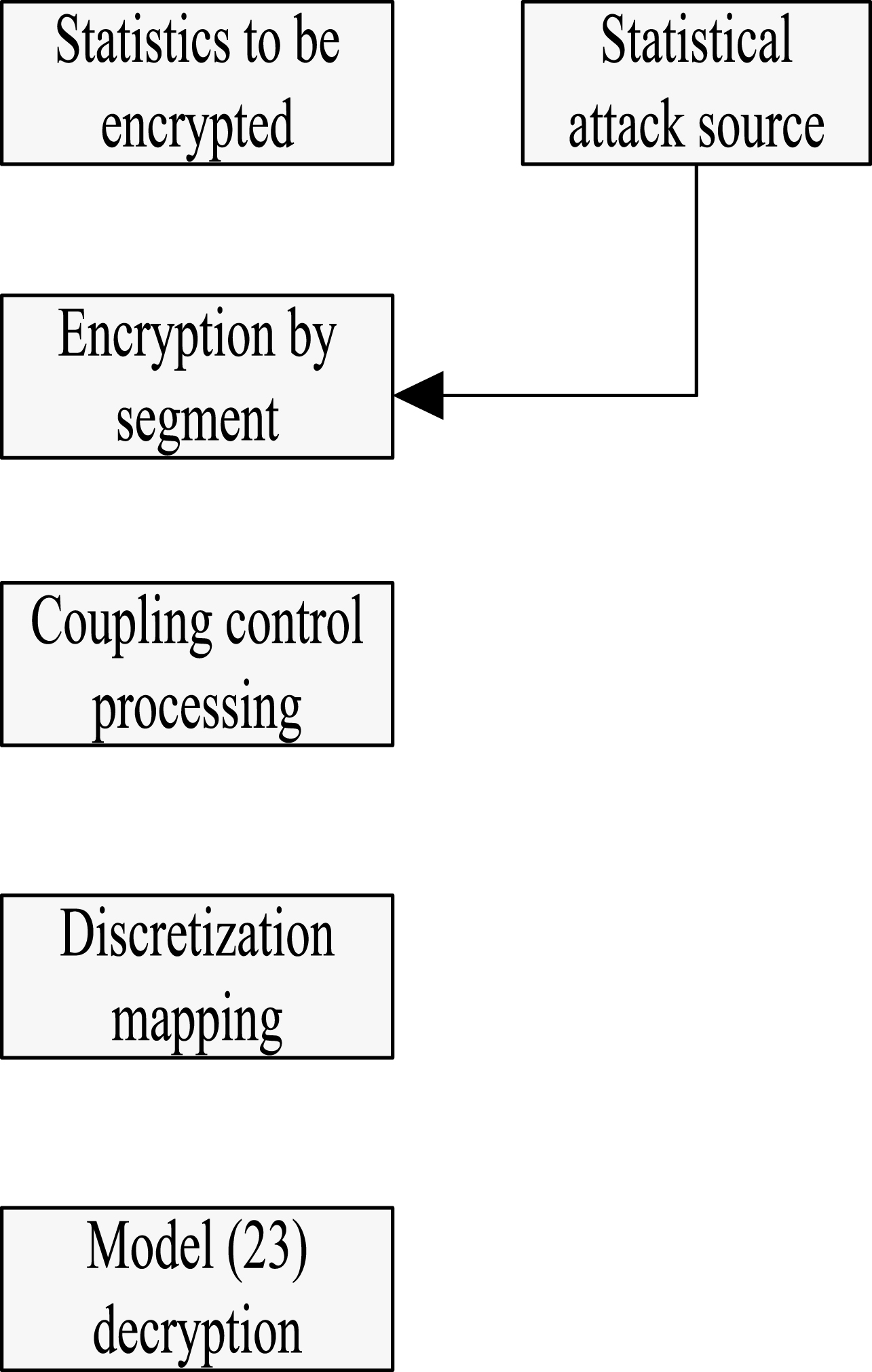
Encryption algorithm flow chart.
In summary, the process of encrypting cloud computing user behavior data using the piecewise linear chaotic map encryption algorithm is described, and the data encryption algorithm based on the coupled control game mechanism is used to perform secondary encryption on the user behavior data to encrypt the user behavior feature efficiently, thus, intelligent encryption of cloud computing user behavior data is completed.
In order to prove the validity of the proposed secondary encryption algorithm for data based on the coupled control game mechanism, an experiment is needed. PC configuration: Intel (R) Core (TM) i5-4200M, CPU is 2.5 GHz, memory is 4GB, window10, 32-bit operating system. The encryption algorithm is programmed in Matlab 2017. Total 50 sets of data are selected between 0 and 255 for experimentation.
Anti-attack analysis
Information entropy. According to Shannon’s theorem, entropy is used to describe the uncertainty of information and reflect the amount of information. The more complicated the data, the less information it contains and the greater the information entropy. The equation for calculating the informationentropy is:
Where P (m i ) is the probability of data m i ; n is the number of data. Table 1 shows the information entropy differences of Joseph’s ring algorithm, AES algorithm, and Logistic algorithm and encryption algorithm based on coupled control game mechanism. The information entropy of encryption algorithm based on coupled control game mechanism reaches millions, and the information entropy of the other three algorithms is within 1000, the encryption algorithm based on coupled control game mechanism is more resistant to attack.
Information entropy comparison
Data correlation. The correlation analysis between the encrypted data and the original data is performed. If the correlation between the encrypted data and the original data is greater, the encryption effect is worse; on the contrary, the better the encryption effect is. The equation for calculating the correlation coefficient is represented by Equation (24):
Where x, y represent the original data and encrypted data; K represents the number of bytes of data; E (x) represents the mathematical expectation of x; D (x) represents the variance of x; cov (x, y) represents the covariance of x, y; r xy represents the correlation coefficient of x, y. Table 2 compares the data correlation calculation results of four algorithms. The data correlation of AES is the lowest. The data correlation of encryption algorithm based on coupled control game mechanism is close to that of Joseph’s ring algorithm, and significantly lower than that of Logistic algorithm. And the anti-attack performance of encryption algorithm based on coupled control game mechanism is significantly improved.
Data-related minimum correlation comparison
According to the Kerckhoff criterion, a good encryption algorithm should have a large key space. The encryption algorithm based on coupled control game mechanism has n, m (infinity) and nb are decimal numbers, assuming that the computer precision is 10–15, then the key space is 3 × 1045 > 1045. The key space comparison of four algorithms is shown in Table 3. The encryption algorithm based on coupled control game mechanism has the largest key space, which is about 1015 times bigger than that of Joseph’s ring algorithm and can better resist attack.
Key space comparison
Key space comparison
The encryption algorithm based on coupled control game mechanism uses simple calculations to make each encrypted data iterate once in a random algorithm to ensure that the algorithm is as secure as possible and reduce the amount of encryption computation. Under the above-mentioned platform, four encryption algorithms are tested. Consecutive samplings of four algorithm are performed 50 times for each experiment to obtain four sets of samples. Table 4 compares the computational complexity of four algorithms. Encrypting the same data, the encryption time of four algorithms is quite different. According to the statistical average to analyze, the encryption algorithm based on coupled control game mechanism has the shortest time, which takes 21 ms; according to the standard deviation to analyze, the encryption algorithm based on coupled control game mechanism is the smallest; comparing to Logistic algorithm, Joseph’s ring algorithm and AES algorithm, the complexity of the encryption algorithm based on coupled control game mechanism is reduced by 67.2%, 62.5% and 96.8%, respectively. Therefore, the encryption algorithm based on coupled control game mechanism has the lowest computational complexity. Figure 5 shows the comparison of the encryption time of four algorithms. The time curve of the encryption algorithm based on coupled control game mechanism is lower than the other three encryption algorithms. It has the least time and low computational complexity and is more suitable for real-time security system.
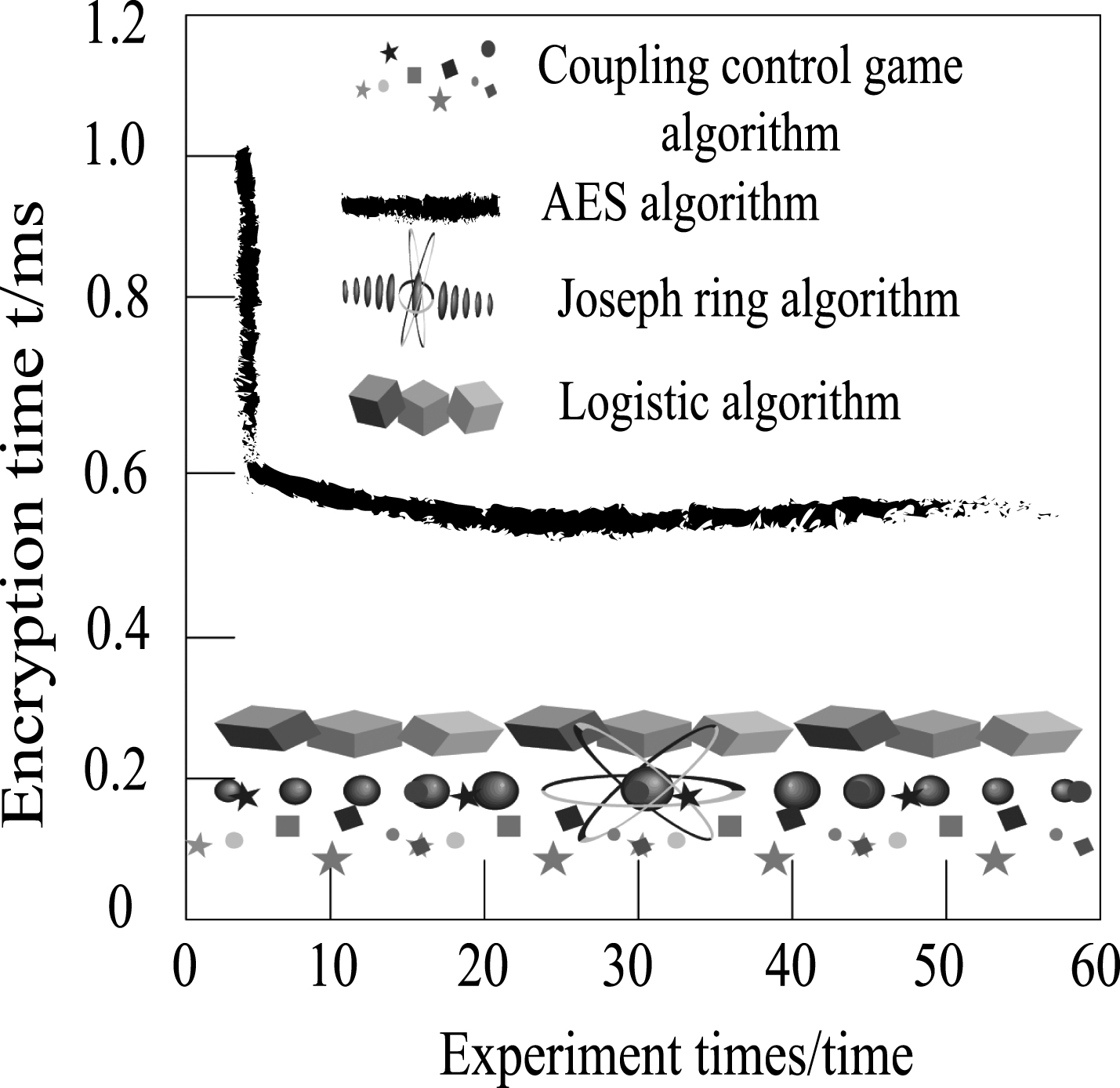
Comparison of encryption time of different algorithms.
Comparison of computational complexity
The improved Logistic algorithm mainly performs 3 large-scale operations on all data, which ensures the security of the algorithm and minimizes the memory consumption of the computer. Under the above-mentioned platform, four encryption algorithms are tested. For each experiment, the four algorithms are successively sampled 50 times, and 4 sets of experimental samples are obtained. Table 5 compares the memory consumption of four algorithms. Encrypting the same data, the memory consumption of four algorithms is quite different. According to the average to analyze, the encryption algorithm based on coupled control game mechanism has the least memory consumption and consumes 519 306 772. According to the analysis of standard deviation, the memory consumption of Logistic algorithm is constant. The encryption algorithm based on coupled control game mechanism fluctuates in the beginning and gradually tends to be constant; the memory consumption of encryption algorithm based on coupled control game mechanism relative to Logistic algorithm, Joseph’s ring algorithm and AES algorithm decreases by 21%, 24% and 31.7%, respectively, so the encryption algorithm based on coupled control game mechanism has the least memory consumption and effectively improves the encryption performance. Figure 6 shows the comparison of the memory consumption of four algorithms. The time curve of the encryption algorithm based on coupled control game mechanism is lower than the other three encryption algorithms and consumes the least memory.
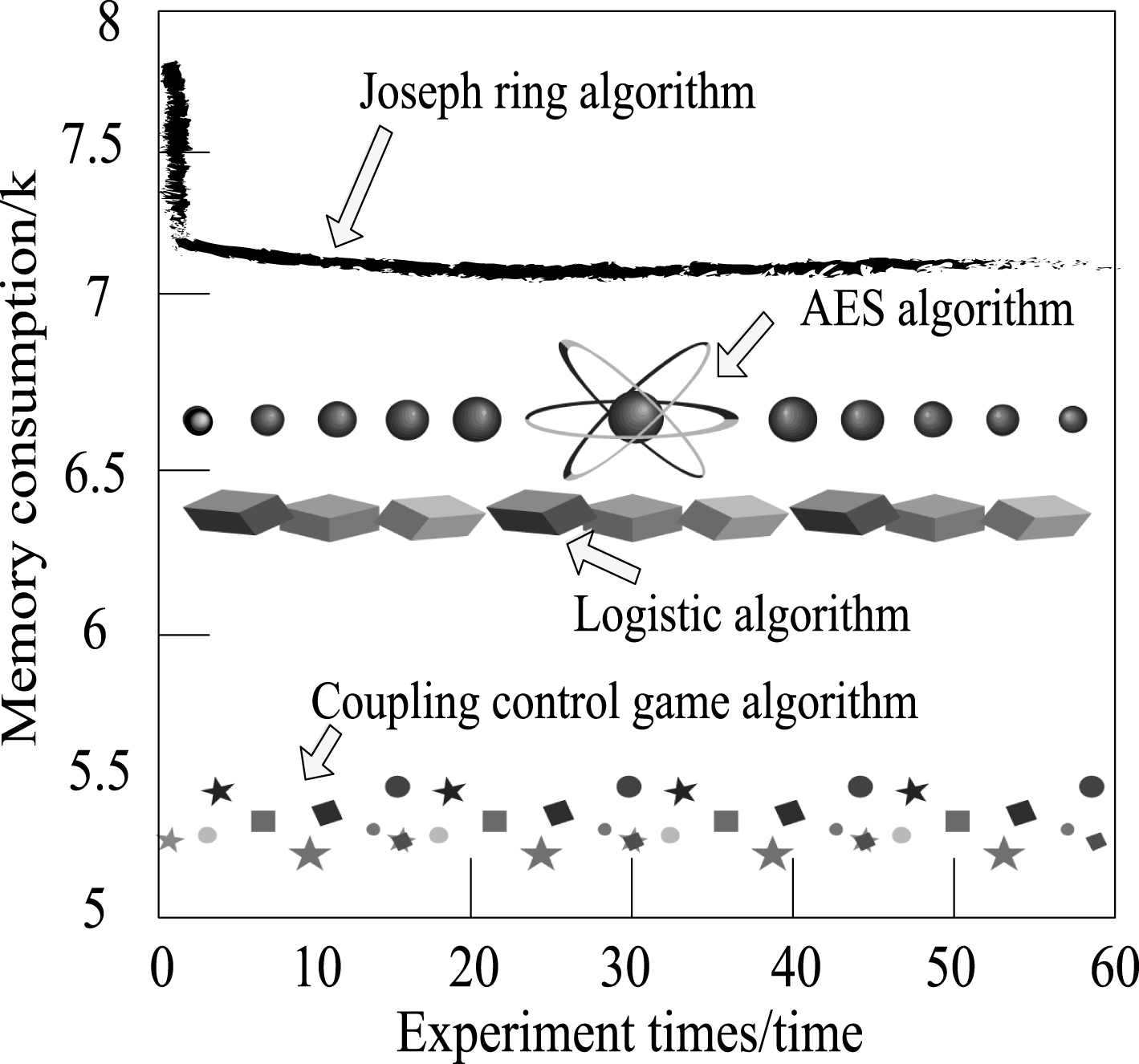
Memory consumption comparison.
Comparison of memory consumption
For the problem of poor encryption performance of cloud computing user behavior data, a secondary encryption algorithm for user behavior data based on coupled control game mechanism is proposed. The piecewise linear chaotic map data encryption algorithm is firstly utilized to encrypt the user behavior feature data to effectively resist external attacks. While considering the user behavior feature data, the data encryption algorithm based on the coupled control game mechanism is used to encrypt user behavior feature data again. The experimental results show that the data encryption algorithm based on the coupled control game mechanism can effectively encrypt the data, and encryption performance is better than other encryption algorithms, which embodies the superiority of the data encryption algorithm based on coupled control game mechanism.
The future plan is to: Conduct further research on the data encryption algorithm based on coupled control game mechanism; Update and improve cloud computing network data in a timely manner.