



Abstract
The cognitive radio network provides a pioneered solution to the spectrum scarcity problem and represents a new paradigm for designing intelligent wireless networks. Energy efficient cognitive radio system maintaining reliability holds great importance in the present scenario of wireless communications. In a cognitive radio network, relays are used to enhance energy efficiency as well as to maintain the sensing reliability. Most of the works in the area of cognitive radio network focused on optimization of energy consumed during data transmission only, while neglecting the energy consumed during spectrum sensing. In this paper, an energy efficient multi-relay cognitive radio network is designed, in which both sensing energy and data transmission energy are jointly optimized. Also, optimal values of system parameters like sensing time and amplifying gain of the relays are determined for the energy efficient system. The minimization of the energy consumed under constraints of target throughput and sensing requirements of cognitive radio network is considered as an optimization problem. Swarm intelligence based optimization techniques like particle swarm optimization (PSO), Particle Swarm Optimization with Aging Leader and Challengers (ALCPSO), Human behavior based Particle Swarm Optimization (HPSO) and Whale Optimization Algorithm (WOA) are used to optimize energy consumption in the network. The analysis reveals that the proposed scheme makes the cognitive radio network more energy efficient than conventional schemes.
Keywords
Introduction
In the present times, the numbers of wireless devices are increased tremendously, which causes scarcity in radio frequency spectrum. In a survey conducted by Federal Communication Commission (FCC), the underutilization of spectrum in static allocation policies is revealed [1]. To solve the problem, dynamic spectrum assignment (DSA) schemes are proposed. DSA can be done by implementing policy based intelligent networks known as cognitive radios [2]. These types of networks have been drawing great attention in the field of wireless communications, because of their great spectrum efficiency. In such networks, a secondary user can access the spectrum, if it is unoccupied by the primary user. The network performs spectrum sensing operation to sense the radio environment in order to find the available spectrum band that can be accessed by secondary users. Different types of spectrum sensing techniques have been proposed so far. Some of these techniques are [3]: Energy detector based sensing, Cyclostationarity-based sensing, Radio identification based sensing, Waveform-based sensing, etc. A secondary user can only transmit data when it is found that there is no active primary user present in the sensed spectrum. Liang et al. [4] derived the theoretical formula for the achievable throughput of secondary user and they also determine the optimal sensing time to maximize it under the constraint of minimum detection probability. Rashid et al. [5] presented a particle swarm optimization (PSO)-based scheme to address the tradeoff between sensing time and throughput of secondary users.
Design of energy efficient cognitive radio system maintaining the reliability of the network is an emerging area of research [6]. Relays are used in the network to enhance the spectrum sensing reliability and to increase the throughput of secondary users [7–12]. Huang et al. [8] proposed an optimal power allocation strategy for maximization of the throughput of secondary users under both sensing reliability and power constraints in cognitive relay networks. Song et al. [9] designed a cognitive relay system that jointly optimizes sensing time and signal-to-noise ratio to maximize energy efficiency. Huang et al. [10] presented an energy-efficient cooperative spectrum sensing with amplify and forward relaying scheme. Minimizations of energy consumption in the data transmission process of multi-relay cognitive radio network were done by Chatterjee et al. [11]. Huang et al. [12] analyzed the tradeoff between sensing performance and data transmission energy of amplify and forward relay scheme considering both the case of fixed and variable amplifying gain. Optimization of both sensing and data transmission times was done to minimize the average energy consumed in cognitive radio network without using relay by Wu et al. [13]. To consider the spectrum-efficiency and the energy efficiency jointly, a utility function was presented by Hu et al. [14]. It is shown in the paper that to maximize the utility function, there exist an optimal number of cooperating secondary users.
Most of the aforementioned works focus on energy consumed in cognitive radio networks during data transmission time only, while neglecting the energy consumed during sensing time. In this paper, an energy efficient multi-relay cognitive radio network is designed, in which both sensing energy and data transmission energy are jointly optimized. The main contributions of the paper are as follows. Firstly, an expression for energy consumption in the network during sensing and data transmission time is presented. Secondly, the existence of signals of primary users both in sensing and data transmission process is considered, which makes the system more relevant to practical scenarios. Thirdly, optimal values of system parameters like sensing time and amplifying gain of the relays are determined for the energy efficient system. The minimization of the energy under the constraint of target throughput and sensing requirements of the cognitive radio network is considered as an optimization problem. Fourthly, swarm intelligence based optimization techniques like PSO [15, 16], ALCPSO [17], HPSO [18] and WOA [19] are used to solve the optimization problem. These optimization techniques are used in this work, because they rely on rather simple concepts and are easy to implement; do not require gradient information and can bypass local optima [16–20].
The remainder of the paper is organized as follows. In section 2, the system model is proposed. The expression for energy consumption in the cognitive radio network in sensing and data transmission process is presented in section 3. In section 4, specifications of the system parameters for efficient transmission are given. In section 5, problem formulation is done. Results and discussions are presented in section 6 and the paper is concluded in section 7.
System model
The proposed system model is shown in Fig. 1, which consists of a primary network and an infrastructure less cognitive radio network. The primary network has a primary source (PU s ), a primary base station (PBS) and a primary destination (PU d ). The cognitive radio network has three components: a secondary source (SU s ), multiple amplify-and-forward (AF) relay nodes and a secondary destination (SU d ).
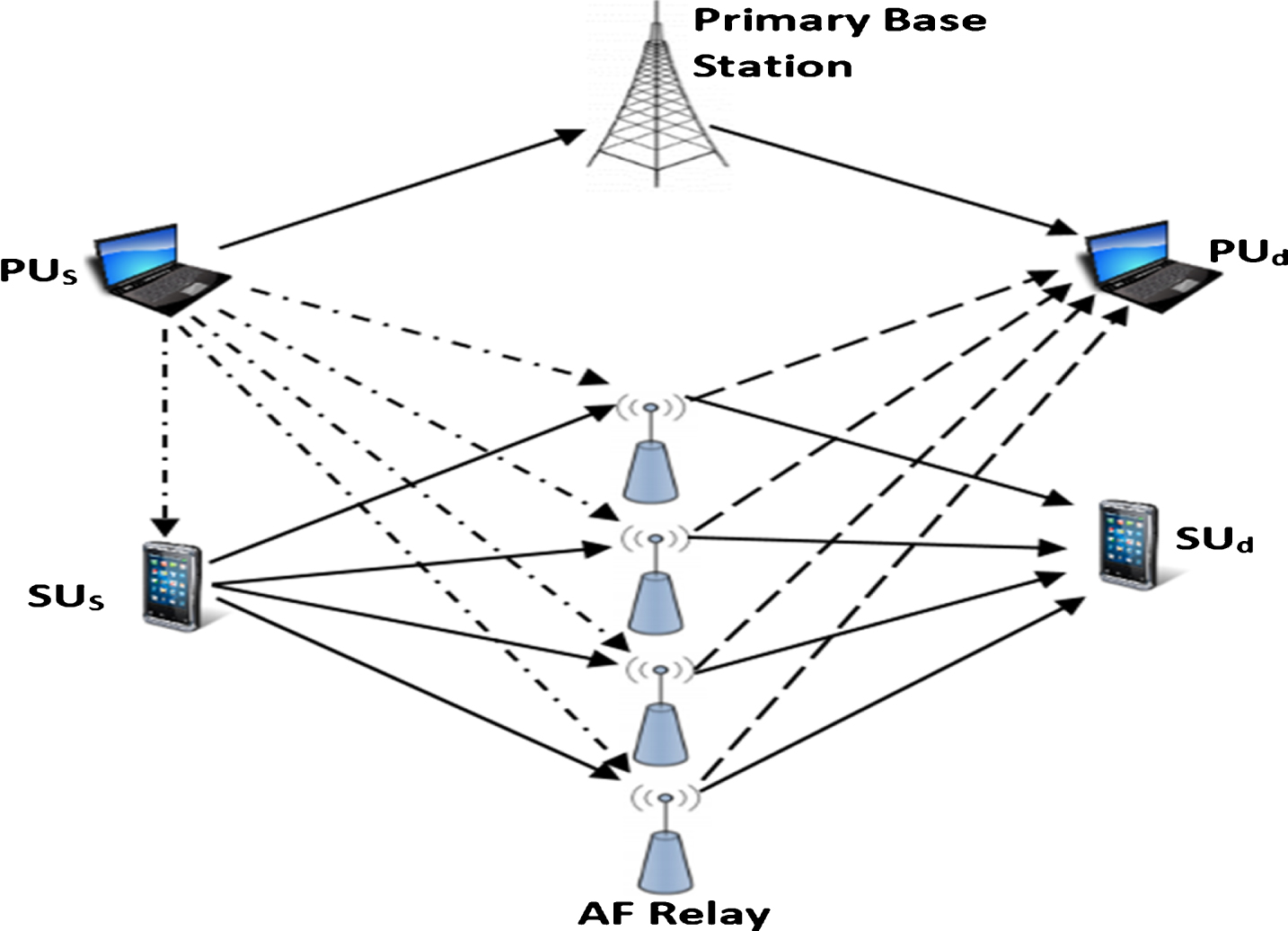
System model.
In the proposed system model, the existence of signals of PU s during data transmission is also considered. This assumption helps to make cognitive radio system aware about the probability of primary sources being active not only during sensing but also during the data transmission time and helps to adjust the values of system parameter of the network to increase the reliability of the system. Also, the transmission process of the cognitive radio network causes interference to PU d . To mitigate the problem, the amplification gains of the AF relays are kept within suitable ranges. In the Fig. 1, the continuous directed lines signify the data links and the dashed directed lines signify the interference links. The cognitive radio network performs on a frame-by-frame basis i.e., it occupies a channel for frame duration of T f . The time frame is shown in Fig. 2, which is divided into sensing time (T s ) and data transmission time (T d ). The data transmission time is again divided into two equal time slot T1 and T2. The sensing operation is executed during T s to find whether any signal from the primary source is present at the particular channel. The energy detection based spectrum sensing scheme [4] is used in this work. If there is no signal from primary sources present in the channel then SU s will transmit signals to SU d via AF relays. During T1, SU s transmits to all AF relays and during T2, the relays amplify and forward the received signals to SU d .
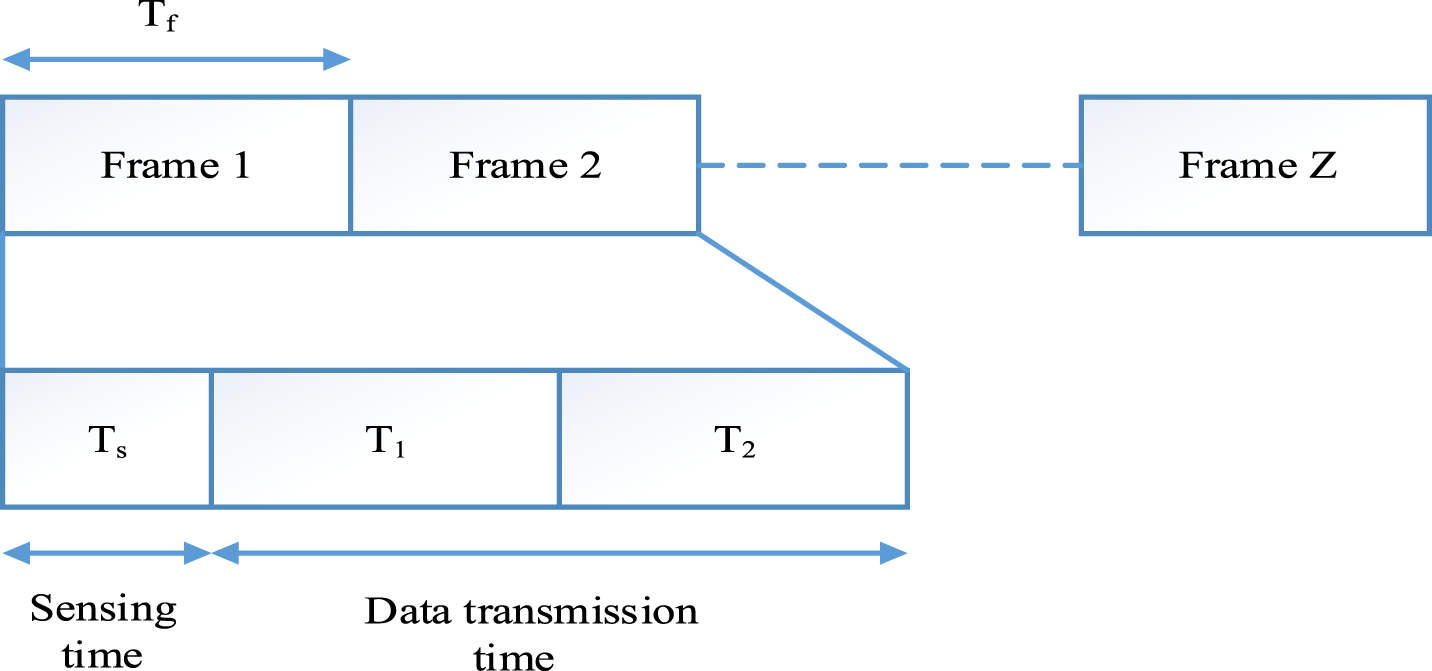
Time frame of the system.
In this section, the expression for energy consumed in the cognitive radio network during sensing and data transmission process is presented.
Energy consumption during data transmission time
Considering the time frame model as shown in Fig. 2, data transmission time is divided into two time slots: T1 and T2, the energy consumed in the cognitive radio network at each time of the slots is determined.
Energy consumed during T1
As discussed in section 2, SU s transmits signals to the relays during T1. But, there is a chance of arrival of the signals of PU s during time T1, which carries a chance of occurrence of misdetection. The misdetection causes interference from PU s to the cognitive radio network. Two scenarios can be assumed for the transmission process of SU s during T1 as follows.
Considering above scenarios the average power transmitted during T1 is given by
Average energy consumed during T1 is given by
As discussed in section 4.2, all relays amplify and forward the signals received in T1 to SU d . If the primary source PU s is active during T2 then it causes interference to the relays. In this case, the interference signals from PU s is also amplified and forwarded by the relays. It is considered that all relays have equal gain i.e., β1 = . . . = β i = . . . = β M = β. Two scenarios can be assumed for the transmission process of ith relay (CR i ) during T2 as follows.
Considering the above scenarios the average transmission power of SU s during T2 is given by
Therefore, the average energy consumed by all relays during T2 is given by
Total energy consumed during sensing and data transmission process is the sum of energy consumed during T
s
, T1 and T2 respectively.
The objective is to minimize the average energy consumed in the cognitive radio network for sensing and data transmission process satisfying the constraints of sensing and throughput. Also, maintaining the interference to the PU d below a predefined threshold value.
The objective of the paper is to optimize the average energy consumption in the cognitive radio network during sensing and data transmission process. While doing the optimization, the system parameters like the probability of detection, the probability of false alarm, sensing time and throughput are needed to be kept within acceptable ranges so that reliability of the system can be maintained. In this section, the acceptable ranges of some of the system parameter are presented.
Sensing time
The minimum number of sensing samples (N
min
) required to meet the target probability of detection and the target probability of false alarm is given as [5]
The average achievable throughput of the cognitive radio network can be expressed as [4]
The interference to the PU
d
is maintained below the threshold value
The minimum and maximum allowable limits for amplifying gain of the relays are given in (15) and (17) respectively.
The objective is to minimize the average energy consumption in cognitive radio network for sensing and data transmission process satisfying the constraints of sensing and throughput. Also, maintaining the interference to the PU d below a threshold value. Mathematically, the optimization problem can be formulated as
List of parameters for optimization
In this paper, analysis of energy consumption in cognitive radio network under different channel gain conditions is done. The transmission power of the primary sources (P p ) and the cognitive source (P c ) are considered to be 0 dBW. The power consumption during the sensing process is taken as –15 dBW. The frame duration and sampling time are considered as 224.25 ms and 1 ms respectively.
Variations of energy consumed with different parameters
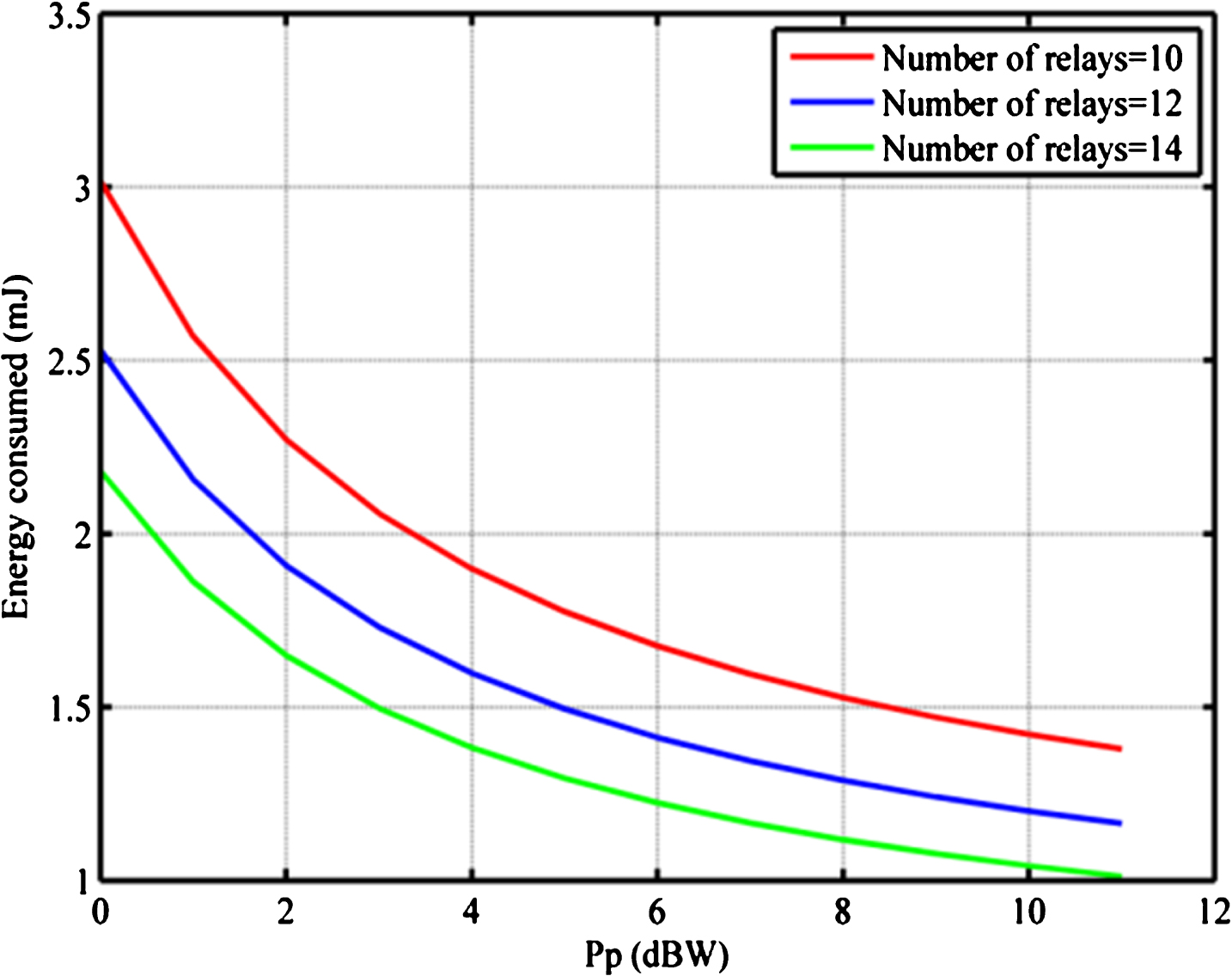
In Fig. 3, it is shown that energy consumption in cognitive radio network decreases with the increase of the transmission power of the primary source. This is due to the fact that the increase in transmission power of primary sources lowers the amplifying gain of the relays, which in turn decrease the energy consumption in the system. Also, it is noticed from Fig. 3, that the increase in number of relays makes the system more energy efficient. Energy consumed versus transmission power of PU
s
.
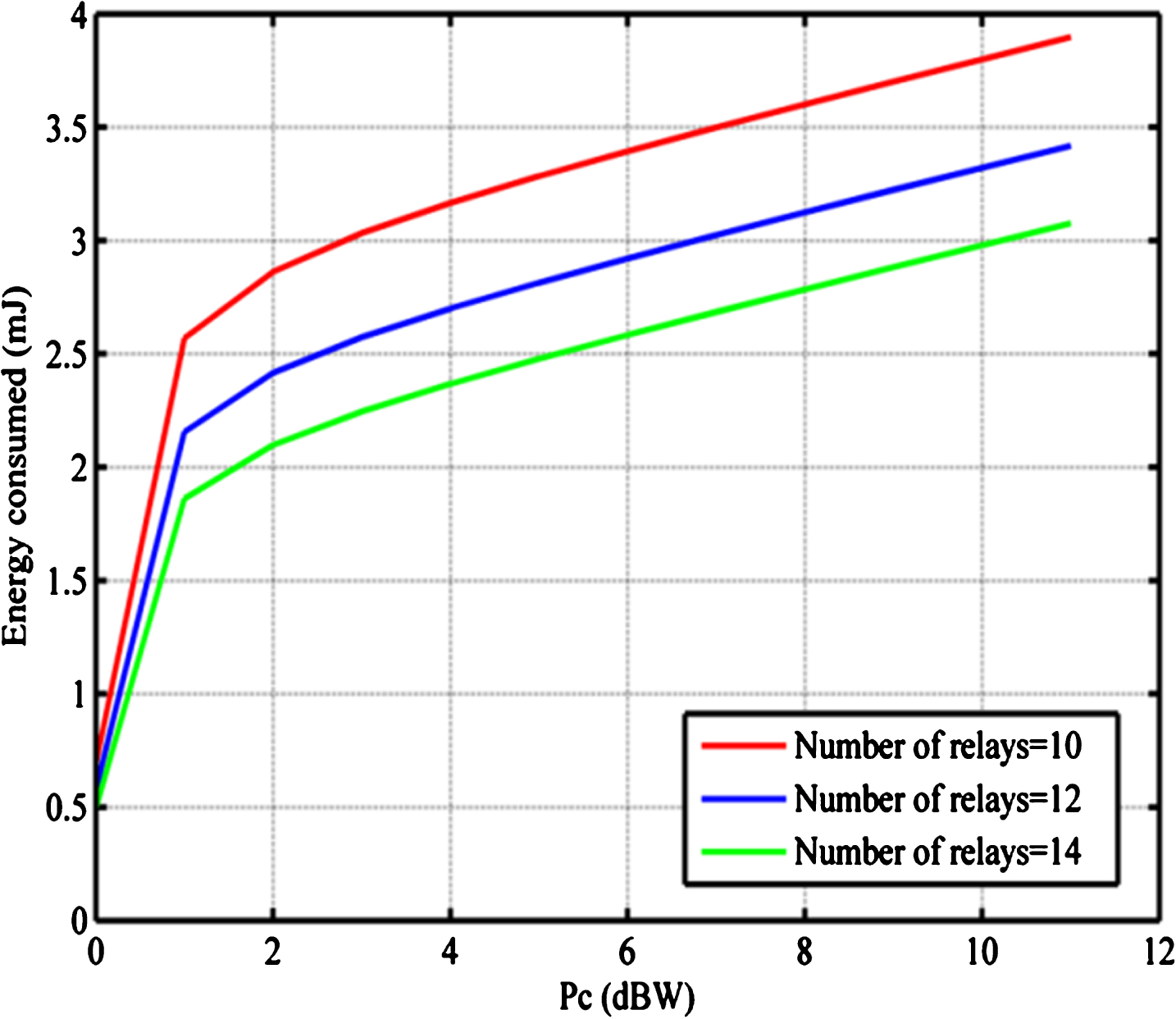
Energy consumed versus transmission power of SU s .
To fulfill the objective, swarm intelligence based algorithms like PSO, ALCPSO, HPSO and WOA are used. The implementation of swarm intelligence based algorithms in practical scenarios are involved the following steps.
Step 1: Dimension and population size of the swarm are initialized. Also, each particle’s position and velocity are initialized to independent random values.
Step 2: For each iteration k, the velocity and position of the ith particle in n dimension search space are updated as follows [10]
Computational time complexity of the algorithms
Step 3: The current fitness value of each particle is compared with its previous best value. If the current fitness value is better than the previous best value, then the current value is set as pbest. The gbest is set as the best of all pbest values.
Step 4: Update the position and velocity of each particle using (19) and (20) respectively till termination condition is satisfied.
Step 5: Evaluate the optimal solution, which is the best gbest value of all iterations.
The time complexity [21, 22] of swarm intelligence based algorithms is O (n × P + P × cof), where n is the dimension of the problem and P is the population size and cof is the cost of the objective function. The term cof varies according to the optimization process of the algorithms. In the analysis of the complexity, n × P signifies the computation of solutions for a population of size P with n dimensions. P × log 2P signifies the sorting of the best solution among P numbers of solutions. The computational time complexity of the algorithms to solve the optimization problem is given in Table 2, which reveals that PSO is better in terms of computational time complexity than the other algorithms.
The results of the optimization processes of energy consumption in the cognitive radio network are represented with the help of convergence plots of the aforementioned swarm intelligence based techniques. The comparison of convergence plots of all the algorithms at relatively low channel gain conditions, i.e., G pc = G pr i = G r i pd = -10 dB, G cr i = G r i d = -4 dB is shown in Fig. 5 and the obtained values of system parameters are given in Table 3. Similarly the comparative analysis of the energy consumption at relatively high channel gain conditions i.e., G pc = G pr i = G r i pd = 3 dB, G cr i = G r i d = 3 . 5dB is shown in Fig. 6 and the obtained values of system parameters are listed in Table 4. From the comparative analysis given in Figs. 5, 6, Tables 3 and 4, it can be concluded that the WOA has reported the best results for the concerned problem of minimum energy consumption in cognitive radio network satisfying the reliability constraints of the system both at low and high channel gain conditions.
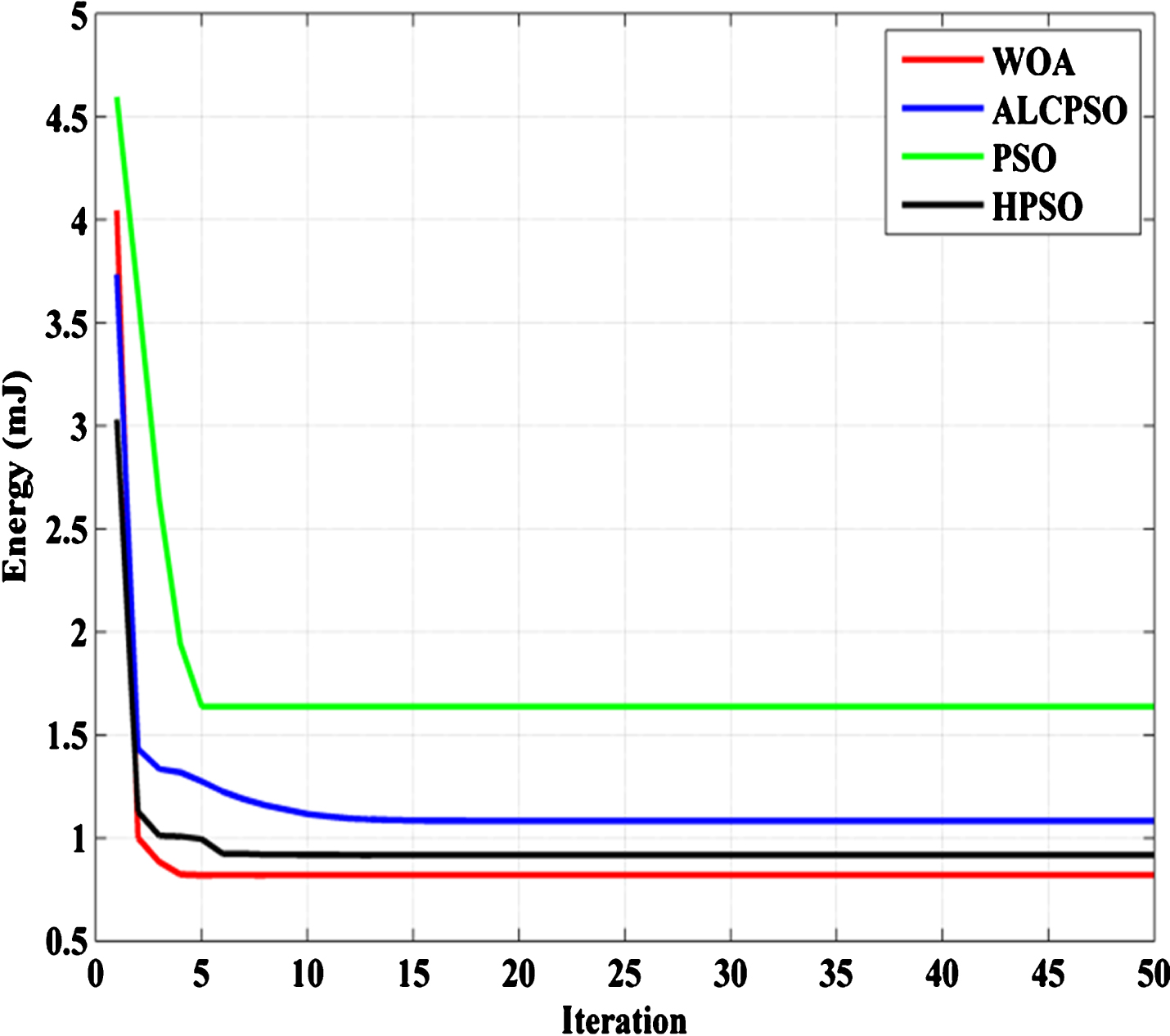
Convergence plots of the algorithms at low channel gains.
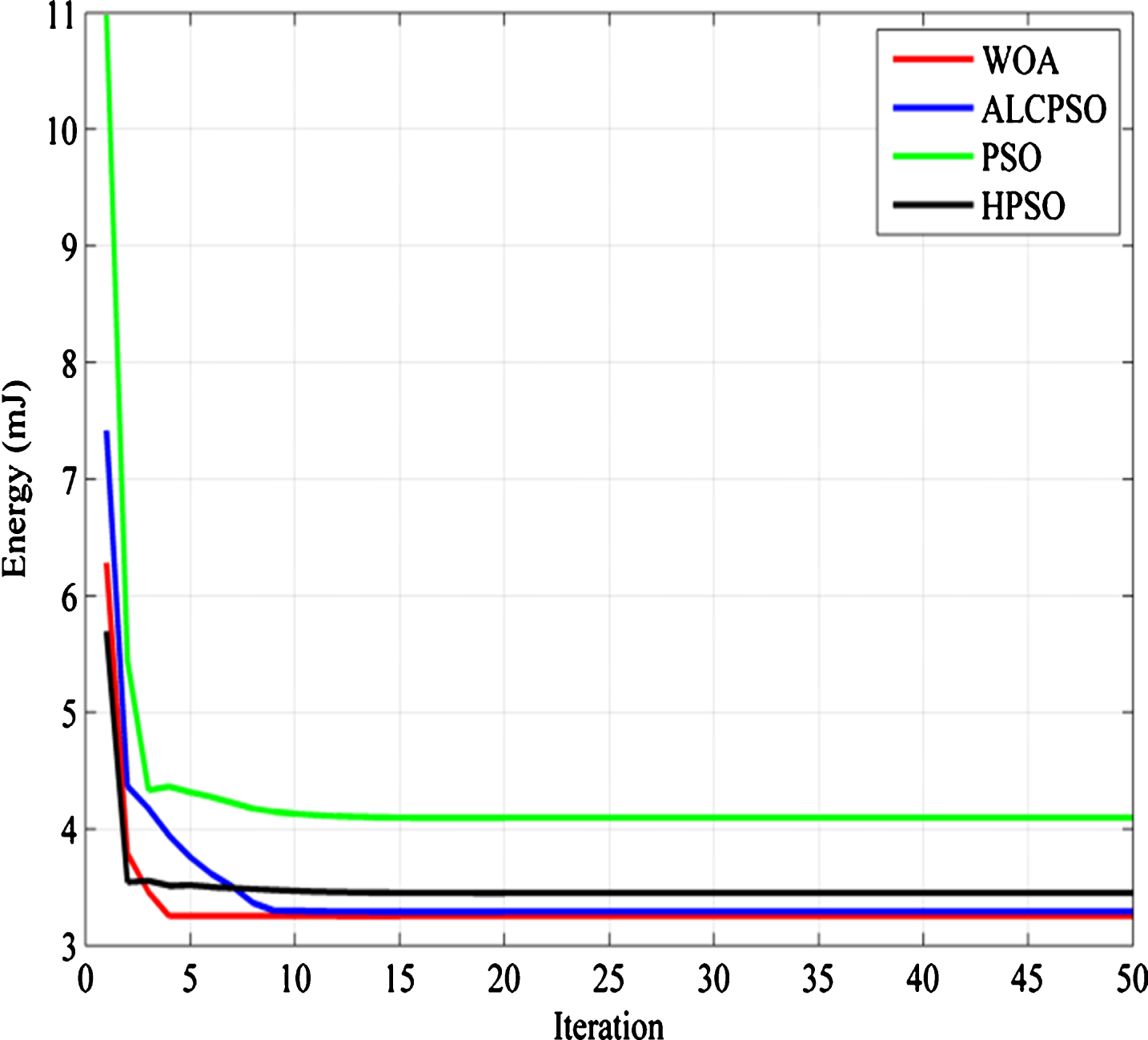
Convergence plots of the algorithms at high channel gains.
Results of optimization process at low channel gains
Results of optimization process at high channel gains
In Fig. 7, a three-dimensional plot of interference to PU d and system throughput under different values of the transmission power of the cognitive radio network is shown. From Fig. 7, it is revealed that with optimal values of parameters obtained from the optimization process of WOA, the values of interference and throughput lies within their acceptable limits as given in Table 1. Also, the analysis reveals that the WOA based optimization scheme makes the network more energy efficient than the schemes used in [10–12] as shown in Fig. 8.
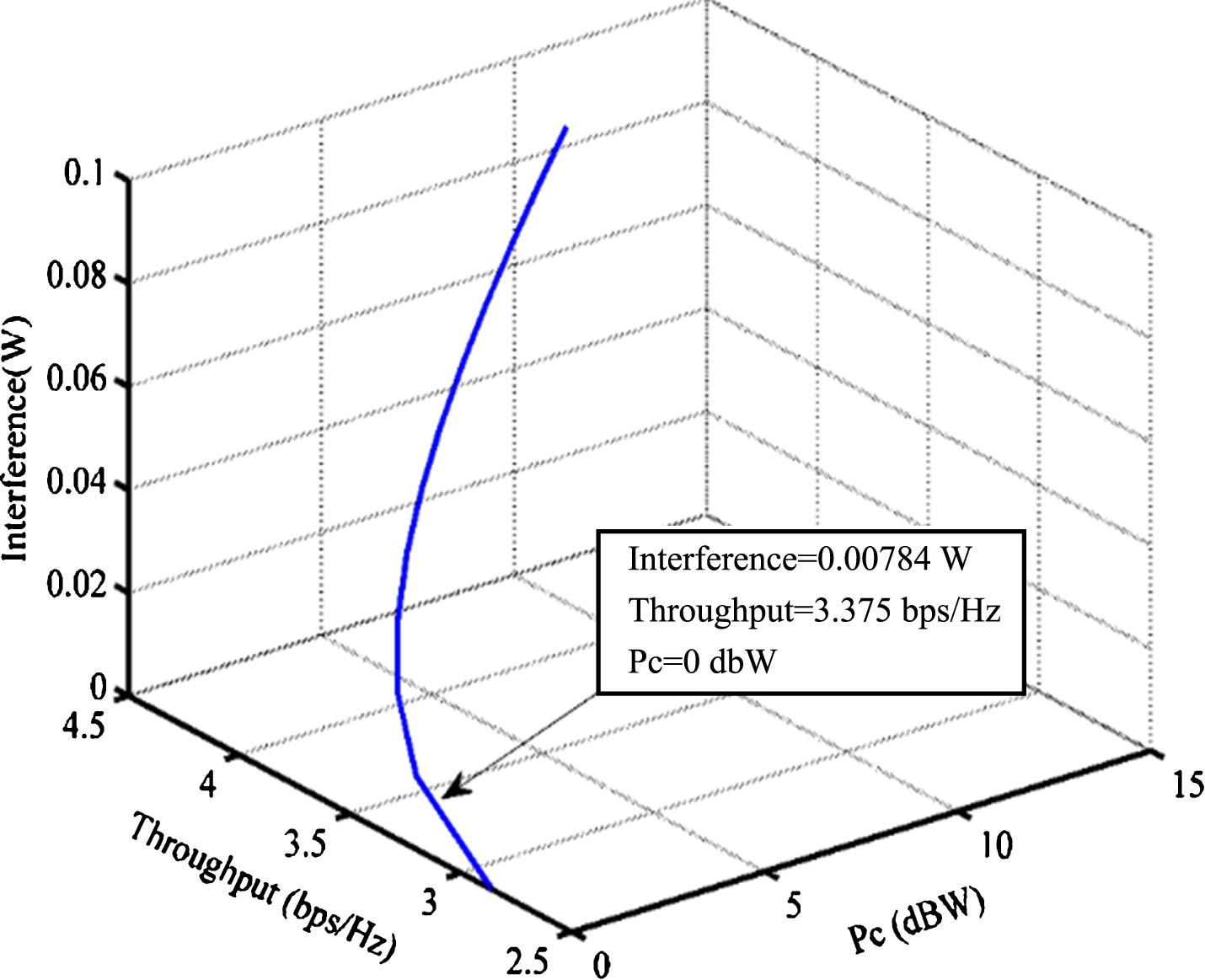
Three dimensional plot interference, throughput and transmission power.
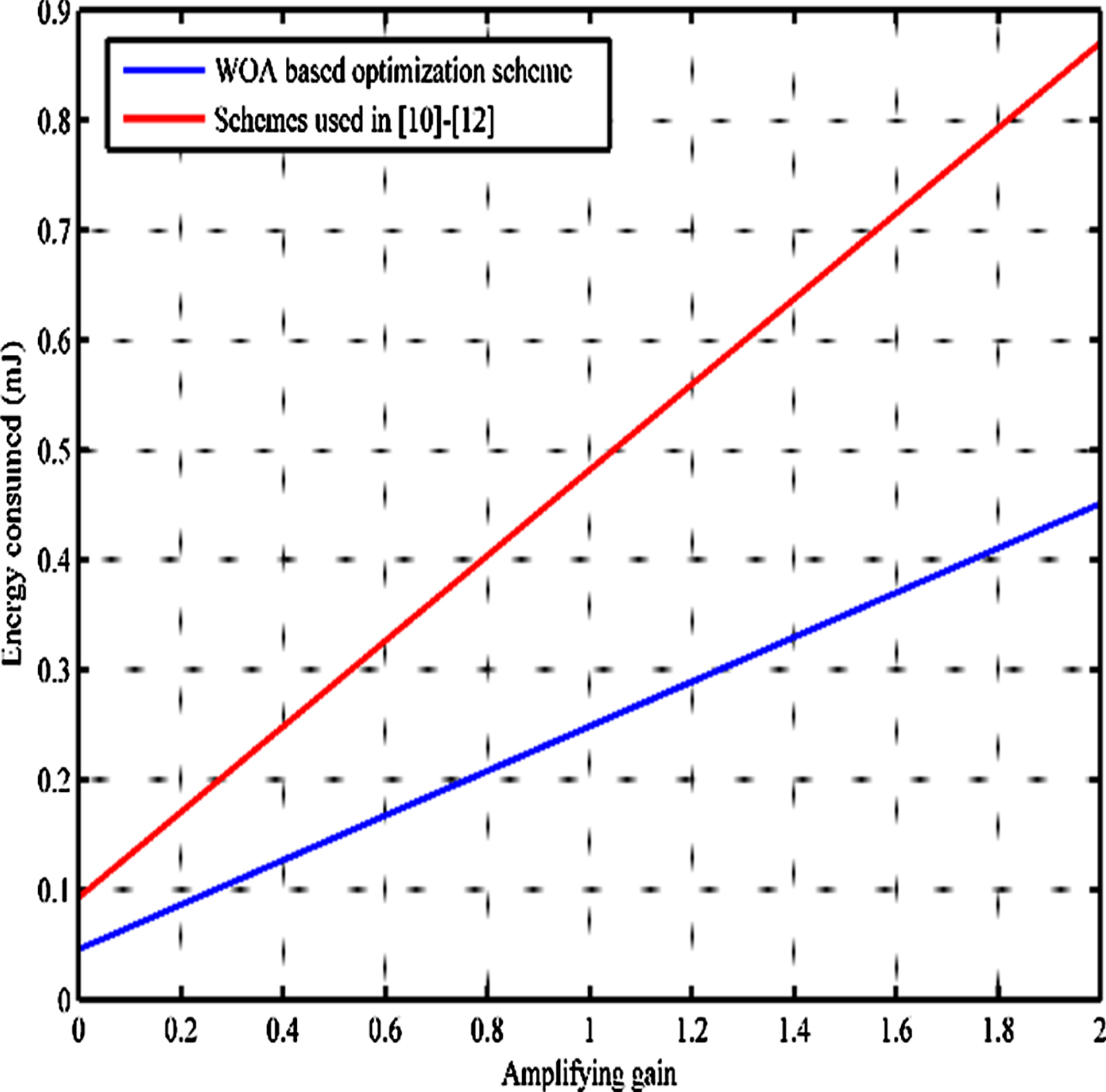
Comparison of energy consumption.
The performance comparison in terms of achievable throughput in the network of the proposed WOA based optimization scheme with schemes used in [10–12] is shown in Fig. 9. From Fig. 9, it is seen that the proposed WOA based scheme enables the cognitive radio network to achieve greater throughput than the other schemes.
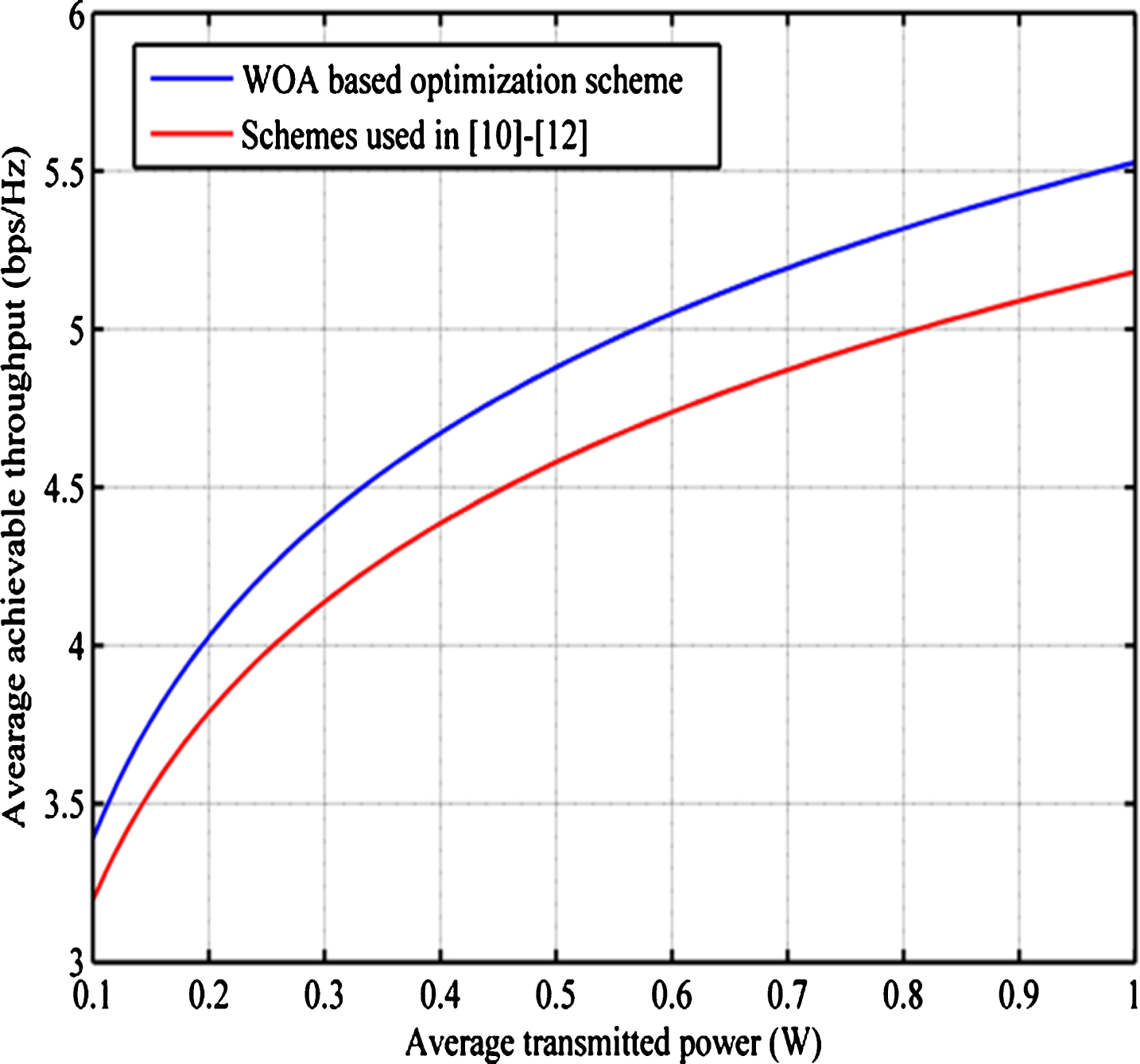
Average achievable throughput versus average transmitted power.
The cognitive radio network has capability to meet the demand of high spectrum utilization in 5 G communications. Because of the ability to adapt its parameters according to requirements of radio environment, the cognitive radio network can be used in military operations, health care services, disaster management services etc. In this paper, optimization of energy consumption in cognitive radio network in sensing and data transmission process is done using PSO, ALCPSO, HPSO and WOA. The optimization is done both in low and high channel gain conditions. Simulation results show that the system optimized with WOA is more efficient than that of the other algorithms in terms of energy consumption satisfying the system reliability. Also, it is shown that the WOA based optimization scheme makes the network more efficient in terms of energy consumption and throughput than the conventional schemes.