



Abstract
Investment project assessment is one of the most critical activities in the investment process, which requires a trade-off between multiple attributes exhibiting vagueness and imprecision with the involvement of a group of experts. The multiple attribute group decision-making (MAGDM) method based on trapezoidal interval type-2 fuzzy sets (IT2FSs) is suitable for the decision makers to deal with this problem. However, some shortcomings in the arithmetic operations of trapezoidal IT2FSs, and some of ranking methods in some cases are invalid. In this paper, the arithmetic operations of trapezoidal IT2FSs are redefined, which can overcome some shortcomings of the ones developed in existing literature. And then, a new ranking method of trapezoidal IT2FSs based on the incentre point of fuzzy sets is developed. In order to verify the proposed method, thirteen fuzzy sets are used in comparison with some of the existing methods, and the comparison results demonstrate the superiority of the proposed method. Finally, the proposed method is integrated into the technique for order preference by similarity to the ideal solution (TOPSIS) method and an illustrative example in investment project assessment is presented to evaluate the effectiveness of the proposed methods.
Keywords
Introduction
In the past decades, investment project assessment problem has greatly been considered by researchers in the literature and practice [1–4, 16, 20, 24]. The investment project assessment problems fall into the multiple attributes group decision-making (MAGDM) problems category, which include both qualitative and quantitative performance indicators [1]. Suder and Kahraman [1] proposed a fuzzy multi-criteria decision-making (MCDM) method to evaluate technological innovation investments based on the technique for order preference by similarity to the ideal solution (TOPSIS) approach. Amelia et al. [2] provided a methodology to assess the sustainability of investments in government bond funds, where the decision-making method of TOPSIS is used to rank a finite set of alternatives. A group of experts make a trade-off between these attributes based on their own’s backgrounds, and choose a best candidate from a set of alternatives by means of multiple attributes assessment method [3, 4, 8, 20]. Chuu [24] developed a group decision-making model using fuzzy multiple attributes analysis to evaluate the suitability of supply chain RFID technology, which is important for supply chains to make capital investment decisions. The intent of MAGDM methods is to improve the quality of decisions about investment projects involving multiple attribute by making choices more explicit, rational, and efficient [23].
In practice, most of the assessment information is not known precisely because decision-makers are not always certain of their given decision or preference information and often use a certain degree of uncertainty to express their subjective judgments [17, 18, 32, 33]. In such cases, the values of assessment are usually represented by fuzzy sets [10, 13, 16, 31] and several methods have been proposed for dealing with fuzzy decision-making problems [25–30, 37, 39]. As a special case of fuzzy sets, interval type-2 fuzzy sets (IT2FSs) have a better ability to address linguistic uncertainties by modeling the vagueness and unreliability of information [12, 23]. Therefore, IT2FSs have been applied productively in the decision-making field, and numerous fuzzy decision-making methods based on IT2FSs [21, 22, 25–28, 32]. Chen and Lee [25] proposed a method to handle fuzzy MAGDM problems based on the ranking values and the arithmetic operations of IT2FSs. Chen and Lee [26] also proposed a new method to handle MAGDM problems based on TOPSIS technique and applied it to the car evaluation problem. Chen et al. [27] presented a new ranking method of IT2FSs for MAGDM and applied it in uncertain purchase problem. Ghorabaee et al. [21] proposed a new ranking method of trapezoidal IT2FSs and applied it in supplier selection problems. Ghorabaee [22] developed an MCDM method for robot selection based on the ranking values and the arithmetic operations of trapezoidal IT2FSs. Chen [34] proposed a new likelihood-based MCDM method based on IT2FSs and validated it with the medical decision-making problem, the car evaluation problem, the manager selection problem and the car purchase problem. Chen [35] proposed a novel interval type-2 fuzzy TOPSIS method for MCDM problems and applied it in the landfill site selection problem, the supplier selection problem and the car evaluation problem. Hu et al. [11] proposed a new approach based on possibility degree to solve MCDM problems and applied it to assess the overseas minerals investment project. Celik et al. [6] provided a comprehensive review of MCDM approaches based on IT2FSs and discussed their real applications or empirical results and limitations. Wang et al. [14] presented a new approach for solving MAGDM problems based on new arithmetic operations and the ranking rules of trapezoidal IT2FSs, which is used to illustrate an investment company invest a sum of money in the best option.
However, as pointed out in [14], some shortcomings in the arithmetic operations of IT2FSs may lead to the loss of uncertainties in some complex situation. Moreover, some ranking methods proposed in the literature in some cases are invalid, which cannot distinguish the ranking order of IT2FSs. Therefore, although a considerable amount of research work has already been conducted by the researchers in previous studies on investment project assessment using different MAGDM methods, there is still a need to employ a simple and systematic mathematical approach for handling ambiguity and fuzziness in investment project assessment problems. In this paper, the arithmetic operations of trapezoidal IT2FSs are redefined to overcome the shortcomings of the ones developed in the existing literature. Based on the redefined arithmetic operations, a new trapezoidal IT2FSs ranking method based on the incentre point of fuzzy sets is developed. There are several strategies for ranking trapezoidal IT2FSs [11, 14, 25–27, 32], but the proposed method allows to get a more accurate ranking results as well as easy computation. Finally, the proposed method is integrated into the TOPSIS method to handle fuzzy MAGDM problems in a more flexible and smarter manner and the basis for developing investment project assessment models.
This paper is organized as follows. In section 2 the related concepts of IT2FSs are reviewed. In section 3 the arithmetic operations between trapezoidal IT2FSs are presented. In section 4 a new trapezoidal IT2FSs ranking method is proposed. In section 5 the ranking method is integrated into the TOPSIS approach, and an example in investment project assessment is presented to illustrate the application of the proposed method. At last, in section 6 a conclusion is presented.
Preliminaries
This section reviews some fundamental concepts of IT2FSs presented by Mendel et al. [12], Chen and Lee [25].
Note that the upper membership function (UMF) and the lower membership function (LMF) of an IT2FS are type-1 membership functions, respectively [12].
Let

A trapezoidal interval type-2 fuzzy set.
where,
where, k ∈ R+.
According to Definition 4, the arithmetic operations are shown as follows:
Note that some shortcomings of the arithmetic operations of trapezoidal IT2FSs in the literature have been reported in [14], and also the corresponding improvement has been made in [14]. In this section, inspired by the basic operations of triangular intuitionistic fuzzy sets given in [36, 38], we define the arithmetic operations of trapezoidal IT2FSs as follows:
According to the improved arithmetic operations, several drawbacks in Definition 4 can be addressed, as shown below:
(1)In the addition and subtraction operations, the influence of larger membership function is taken into consideration. Unlike in Definition 4, only pick up the minimum membership of upper and lower membership function respectively.
(2)The reciprocal influence of different trapezoidal IT2FSs is taken into consideration in the multiplication operation, and the elements of upper and lower membership function can take negative values.
Compare the results of example 1 with example 3, the calculation results of example 3 are more in accordance with the actual situation and more accurate. Similarly, the calculation results of example 2 and example 4 show that the improved multiplication operation can overcome the drawback of the elements of upper and lower membership function must larger than zero.
A new method for ranking trapezoidal IT2FSs
The concept of ranking trapezoidal IT2FSs is presented by Lee and Chen [19] and the ranking value of the trapezoidal IT2FS is defined by the UMF and LMF. The incentre point concept of trapezoidal type-1 fuzzy set is presented by Rouhparvar et al. [9] and applied to calculate the ranking value of trapezoidal type-1 fuzzy set. In this section, a new method of ranking trapezoidal IT2FSs is developed. The incentre point concept of trapezoidal type-1 fuzzy set is used in calculation method of possibility degree of the trapezoidal IT2FSs. Then the possibility degree is used to determine ranking value of trapezoidal IT2FSs.
If If
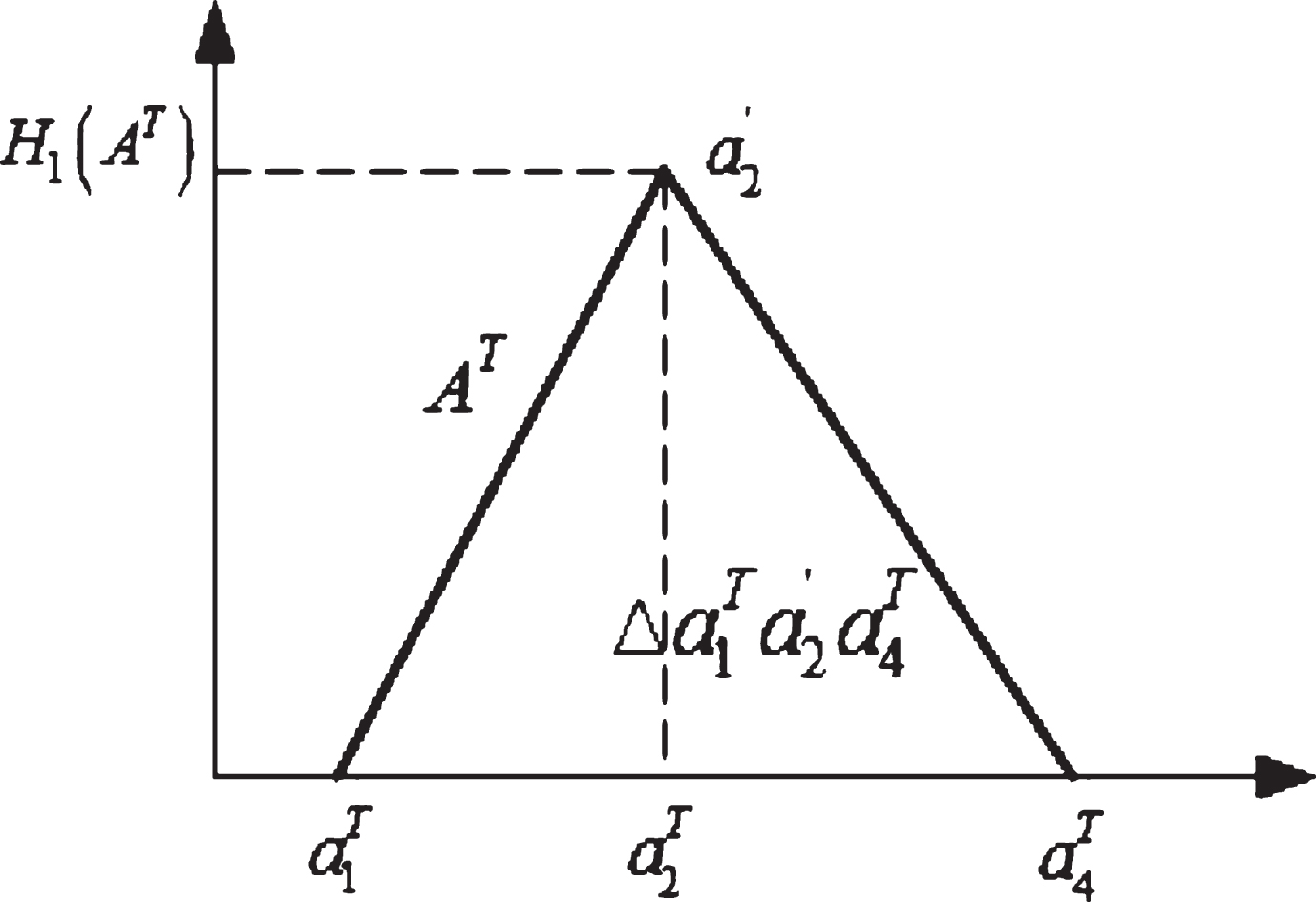
A triangular fuzzy set.
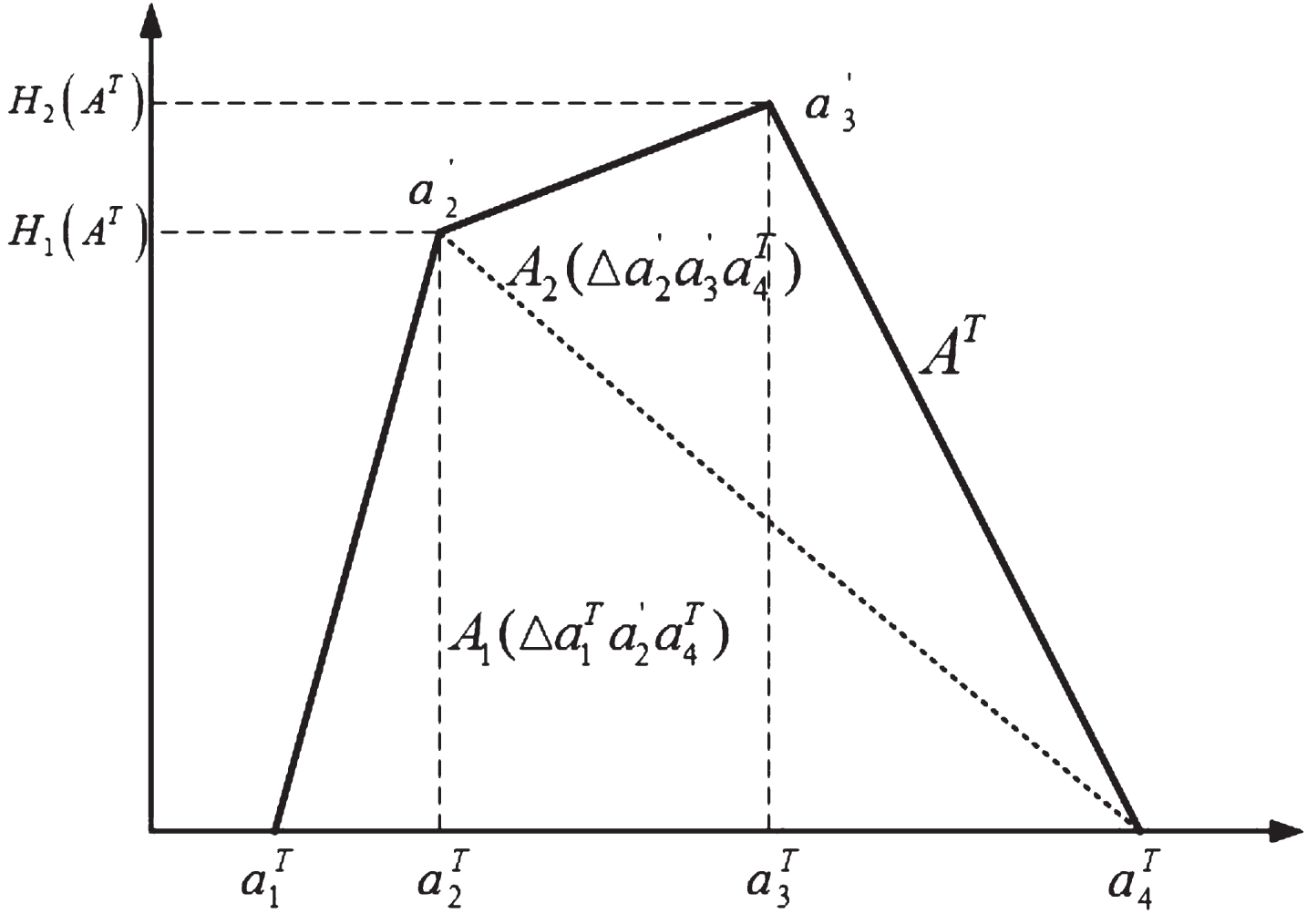
A trapezoidal fuzzy set.
Next, to verify the proposed method, thirteen fuzzy sets that were provided by Bortolan and Degani [7] are used for computing and comparing the ranking values. These fuzzy sets are shown in Table 1 and the comparison results are shown in Table 2.
Thirteen sets of fuzzy sets.
Thirteen sets of fuzzy sets.
According to Table 2, some drawbacks of the existing methods [5, 11, 15, 21, 25, 32] can be observed. The comparison results between these existing methods and the proposed one can be stated as follows:
According to Set 1 in Table 2, the method in [5] (in Uniform mode), [21, 25] and the proposed method get the same ranking order; According to Set 2 ~ 6, Set 8, Set 9 and Set 11 in the Table 2, the ranking order of proposed method is consistent with the methods proposed in [5, 11, 15, 21, 0050], and [32]; According to Set 7 in Table 2, only the method in [15] and the proposed method can distinguish between the fuzzy sets; According to Set 10, the result of the proposed method is consistent with that of [5, 15, 21, 25] and [32]; According to Set 12, the result of the proposed method is consistent with that of [11, 15] and [25], while in [5, 21] and [32] cannot distinguish between the fuzzy sets; According to Set 13 in Table 2, the result of the proposed method is consistent with that of [5, 21] and [32].
Based on the results in Table 2, the results obtained by the proposed method for λ = 0.85 are consistent with the others. What’s more, in some situations the proposed method can distinguish the fuzzy sets while the others cannot.
Comparison results of the thirteen fuzzy sets for different methods.
The time complexity and the space complexity are often used to evaluate the complexity of one algorithm. In this paper, the time complexity is considered and the number of times of multiplication is used as a criterion of appraisal. Assume that there are n IT2FSs to determine the ranking results. Compared the proposed ranking method with the approach in [5, 11, 15, 21, 25, 32], the following conclusions can be obtained:
In [5], to determine the ranking order, we need to count the total integral value of n IT2FSs; In [11], the number of times of multiplication is In [21], the number of times of multiplication is In [25], to count the likelihood In [5, 32] and the proposed ranking method, the number of times of multiplication is Kn (K ∈ N). Therefore, the complexity is O (n).
According to the result of complexity analysis, the proposed method is easier to implement than most other methods.
Trade-off factor analysis
In order to verify the influence of the value of λ on the ranking results, the comparison of the proposed method for different λ is carried out. In general, for sets
Denote
Comparison results of the thirteen fuzzy sets for the proposed method with different λ.
Comparison results of the thirteen fuzzy sets for the proposed method with different λ.
From the comparison results, it can be observed that the distinguish degree coefficient ρ λ achieves its maximum at λ = λ* = 0.6, that is to say, for the given thirteen sets the proposed method has the best distinguishing ability when λ = 0.6. However, from the Table 3, it can be observed that the proposed method made a wrong distinction between Set 8 for λ < 0.8, and between Set 13 for λ > 0.9. Therefore, a reasonable value of λ should be in (0.8,0.9), this is the reason why λ = 0.85 is used in the proposed method. The comparison result is consistent with the idea in literature [9]. Therefore, the proposed ranking method is valid.
Assessment of investments is a MADM problem with many conflicting tangible and intangible attributes [31]. And the TOPSIS method [37] is presented for handling MADM problems in many cases. In this section, the proposed ranking method is integrated into the TOPSIS method for handling fuzzy MAGDM problems.
Formulation of the MAGDM process
For an investment project assessment problem, assume that there is a set S of alternative investment projects and a set F of assessment attributes, where S = {s1, s2, ⋯, s n } and F = {f1, f2, ⋯, f m }. Assume that there are k decision-makers D1, D2, ⋯, D k . The proposed method for handling fuzzy MAGDM problems is now illustrated as follows:
F1 denotes the set of benefit attributes, F2 denotes the set of cost attributes, F1∩ F2 = ∅, F1 ∪ F2 = F and 1 ≤ i ≤ m.
The following example is used to demonstrate the efficiency of the proposed method, which is adapted from the one used in Chen and Lee [25].
Suppose an investment company wants to buy a number of special vehicles. There are three decision-makers D1, D2 and D3 to assess three alternative investment projects s1, s2, s3. Table 4 shows the linguistic terms “Very Low” (VL), “Low” (L), “Medium Low” (ML), “Medium” (M), “Medium High” (MH), “High” (H), “Very High” (VH) and their corresponding IT2FSs, respectively. There are four assessment attributes (i.e., “Safety”, “Price”, “Appearance”, “Performance”), as shown in Table 5. Let S be a set of alternatives, where S = {s1, s2, s3} and let F be a set of attributes, where F = {Safety, Price, Appearance, Performance}. In Table 5, three benefit attributes are considered, (i.e., “Safety” (denoted by f1), “Appearance” (denoted by f3) and “Performance” (denoted by f4)) and one cost attribute is considered, (i.e., “Price” (denoted by f2)). Assume that the three decision-makers D1, D2 and D3 use the linguistic terms shown in Table 4 to represent the weights of the four attributes, respectively, as shown in Table 6.
Linguistic terms and their corresponding IT2FSs [25].
Linguistic terms and their corresponding IT2FSs [25].
Evaluating values of alternatives of the decision-makers with respect to different attributes [25].
Based on Eq. (2), the average decision matrix
Weights of the attributes evaluated by the decision-makers [25].
Based on Eq. (3), the average weight matrix
where
The others can be obtained in the same way, where
It can be observed that the obtained result is the same as that in [25]. Therefore, the proposed method is valid and can be used to improve the assessment quality.
Compared the proposed method with the approaches in [11, 14, 25, 26], we find the difference between our proposed method and the approaches in [11, 14, 25, 26] as follows. The proposed method consider the impact of trapezoidal IT2FS’s membership in the arithmetic operations, and reserves fuzzy information as in [14] do. Therefore, the proposed method reserves more messages than in [11, 25, 26] due to its impact being not neglected in the first step. Moreover, the proposed method computation is more accurate as well as more easier than other methods in [11, 14, 25, 26] due to the new method for ranking trapezoidal IT2FSs. Obviously, there are the proposed method’s advantages in this paper.
In this paper, a new method of ranking trapezoidal IT2FSs based on incentre points of fuzzy sets was proposed, and MAGDM for investment assessment based on the proposed method was investigated. Trapezoidal IT2FS is the most widely used in modeling a word and can provide more flexibility when representing uncertainties. Thus trapezoidal IT2FSs were used to describe the attributes and their weights in the multiple attribute group decision-making problems. The comparison results reveal the superiority of the proposed method, and the applied instance showed the efficiency and effectiveness of the method. The study of ranking trapezoidal IT2FSs based on incentre points will promote its application in practical problems. With the increase of complexity, it is suitable to express the index system with a nature phrase and rank the assessment results with a relative correct method.
In future research, the proposed ranking method with other classical decision methods will be integrated, such as AHP, DEMATEL, VIKOR, and others. The study could be continued with an anticipation that the method could be found applicable to other similar decision problems, such as supplier selection problem. Additionally, with the help of IT2FS’s properties, other ranking methods of IT2FSs will be considered.
Footnotes
Acknowledgment
The work is supported by the State Key Program of National Natural Science of China (Grant No. 61632002), the National Natural Science of China (Grant Nos. 61472372, 61603348, 61775198), Science and Technology Innovation Talents Henan Province (Grant No. 174200510012), and the Science Foundation of for Doctorate Research of Zhengzhou University of Light Industry (Grant No. 2017BSJJ010).