



Abstract
In recent years, spectral clustering algorithm has been widely used in the field of pattern recognition and computer vision. How to construct an effective similarity matrix is the key issue of spectral clustering algorithm. In order to describe the uncertainty in the image and design the efficient similarity matrix for spectral clustering, an interval fuzzy spectral clustering ensemble algorithm for color image segmentation (IFSCE) is presented in this paper. Firstly, the color histogram is obtained by the just noticeable difference color threshold method. Then the interval fuzzy similarity measure based on color feature is constructed by utilizing the interval membership degree and the image are grouped by normalized cut criterion under the similarity matrix produced by interval fuzzy similarity measure. Finally, the segmentation results with different optimal fuzzy factors combination are integrated to get the final result. The experimental results on real images show that the proposed algorithm behaves well in the segmentation accuracy and visual segmentation result.
Keywords
Introduction
Image segmentation is a crucial research and has been used in image description and pattern recognition [2, 24]. There are many kinds of image segmentation algorithms, such as threshold based image segmentation methods, clustering based image segmentation methods and region-based segmentation methods. Clustering analysis is one of the most useful methods for knowledge acquisition, and is used to explore the potential clusters and interesting distribution pattern [8]. Therefore, clustering technique is important in diverse fields, for instance, data mining, machine learning and pattern recognition [32]. Clustering-based image segmentation method is a commonly method and has been widely used in various fields. As one traditional clustering method, fuzzy c-means clustering algorithm (FCM) is proposed based on traditional fuzzy set theory. As an extension of usual fuzzy clustering algorithms, the type-2 fuzzy set was initially introduced into FCM and interval type-2 fuzzy c-means clustering algorithms [5, 9, 29] were proposed. Hwang and Rhee constructed the interval membership degree with two different fuzzy index and proposed the Interval-valued type-2 fuzzy c-means clustering (IT2FCM) method [5]. However, similar to traditional FCM, IT2FCM is sensitive to the initial number of clusters, initial cluster centers, and fuzzy factors.
Comparing with these traditional clustering algorithms, spectral clustering algorithm [3, 12, 18, 28] is a more effective clustering method. It is suitable for any shape of sample space and can converge to global optimal solution. These methods transform the original dataset into a new one in a lower-dimensional eigenspace by utilizing eigenvalues and eigenvectors of a similarity matrix derived from the dataset. Then the traditional clustering algorithms can be performed on this new dataset to obtain the final clustering result. There are many typical spectral clustering algorithms, such as kernel subspace leaning of Nyström method [3], semi-supervised learning algorithm [7], SM algorithm proposed by Shi and Malik [13], bipartite graph partitioning algorithm [11], k-way partition of the NJW algorithm [20]. However, there are still some obvious problems in spectral clustering algorithms. First of all, the construction and eigendecomposition of the similarity matrix are very crucial for spectral clustering. The traditional spectral clustering algorithms usually use the Gaussian kernel function to construct the similarity relation among the samples. However, the clustering result is very sensitive to the scale parameter selection in the Gaussian kernel function. And the Gaussian kernel similarity measure based on Euclidean cannot fully reflect the spatial distribution of complex data sets [25]. Moreover, the spectral clustering algorithm requires much time and memory to compute the eigenvectors of the similarity matrix, especially applied to image segmentation. In order to choose the appropriate similarity measure, many researchers try to design the similarity measure model and improve the segmentation performance. Chapdle [26] proposed the similarity measure based on the shortest path among nodes. Zhao et al. [10] introduced the fuzzy membership function into the construction of similarity measure and proposed spectral clustering with fuzzy similarity measure. Chrysouli et al. [7] utilized a semi-supervised learning technique to improve the similarity measure model of spectral clustering. These above algorithms improve the performance of spectral clustering by changing the similarity measure. In addition, in order to reduce the computational requirements of grouping algorithms based on spectral partitioning, Fowlkes et al. [4] utilized Nyström method to approximately solve the eigenfunction problems and presented Spectral grouping using the Nystrom method. Nyström method has the appealing characteristic that for a given number of sample points, its complexity scales linearly with the data amount.
When spectral clustering algorithms are applied to image segmentation, the uncertainty of image properties is also easily influence their segmentation performance. The fuzzy set theory has the ability to describe this uncertainty. The fuzzy set theory [6, 8, 31, 35] describes the membership degree of the sample by the membership function, not only describes the partitioning characteristics of the sample, but also reflects the degree of correlation between the sample and the classification. Aimed at these problems of traditional spectral clustering algorithm, an interval fuzzy spectral clustering ensemble image segmentation method (IFSCE) is proposed in this paper. Firstly, in order to reduce the computation complexity of similarity among pixels, the color histogram of the image is constructed and the interval fuzzy membership based on this color histogram can be obtained. Because the different fuzzy exponents of the type-2 fuzzy clustering algorithm can produce different interval fuzzy membership, some effective fuzzy indices are used to select the optimal fuzzy exponents. Then the interval fuzzy membership under the optimal fuzzy exponents is utilized to construct an effective interval fuzzy similarity measure. Finally, clustering ensemble method is used to integrate some multiple clustering results and the final segmentation results are obtained.
The remainder of this paper is organized as follows. In Section 2, we introduce the traditional fuzzy c-mean and spectral clustering. In Section 3, the proposed method is verified by segmentation experiments on real images. Finally, some concluding remarks are given in Section 5.
Fuzzy c-means lustering and spectral clustering
Fuzzy c-means clustering
Let X = {x
1, x
2, ..., x
n
} denote an image with n pixels. Conventional FCM is an iterative algorithm which utilizes the fuzzy membership function to group data [34]. The objective function of FCM is given as follows:
The theoretical basis of spectral clustering is the theory of graphs, which regards the image as an undirected weighted graph G = (T, E) based on some similarity, where T is the set of vertices and E is the set of edges, W = {w ij } is the weights set of the edges. The theory of graphs involves the spectrum of the similarity matrix of the graph and the spectrum of the Laplace matrix of the graph, so constructing the adjacency matrix is a very critical step. When using spectral clustering to segment image, it is necessary to construct the similarity matrix between pixels in the image. Therefore, the storage and the effectiveness of the similarity matrix are critical to the final segmentation result. The SM algorithm proposed by Shi and Malik [13] and the NJW algorithm of k-way partition proposed by Ng et al. [11] are the typical spectral clustering methods. The main difference between these two algorithms is the spectral partition criteria function.
Here, we take the NJW algorithm as an example to introduce spectral clustering algorithm. The similarity matrix W is constructed according to the Gaussian kernel function with Euclidean distance. The similarity measure is given as follows:
Each row in Y is used as a point in the k-dimensional space and then is clustered by using the traditional clustering algorithm. The corresponding clustering result of new data is the result of the original data.
When applied to image segmentation, the storage and validity of similarity matrix in spectral clustering is a very critical problem. In addition, the scale parameter of similarity measure can influence its performance. Therefore, in order to solve these problems, an interval fuzzy spectral clustering ensemble image segmentation method is proposed in thispaper.
Just Noticeable Difference color histogram
Histogram presents an important global statistic of the digital image, which can be used for a number of analysis and processing algorithms [14]. For the color image, Just Noticeable Difference (JND) color histogram is an effective histogram [22]. According to the research of Bhurchandi et al. [15], a vision observer can respond to only 17000 colors at the maximum intensity without saturating the human eye. People’s eyes can distinguish between two colors, if they are at least one ‘just noticeable difference (JND)’ from each other. The similarity mechanism of color is based on the similarity threshold, and this similarity is obtained by comparing the Euclidean distance between two colors. The threshold Θ should satisfy 285.27 ≤ Θ ≤ 2567 [14]. The construction algorithm of JND color histogram is given asfollows:
Construction of interval fuzzy similarity measure
The construction of similarity measure is the key process in spectral clustering. After obtaining the color histogram, the similarity measure of color feature in JND histogram should be firstly constructed. Because of the effective performance of interval fuzzy set, interval valued fuzzy membership is utilized to design the similarity measure. Let t
j
denote the jth color feature in the color histogram and γ
j
is its corresponding frequency. Through minimize the following two objective functions:
The upper and lower fuzzy membership degrees
Finally, the fuzzy membership degree can be obtained by a type-reduction method:
Under certain fuzzy factors m
1 and m
2, the membership degree reflects the relative closeness of color feature with all the prototypes. Utilizing this membership matrix, the interval fuzzy similarity matrix for spectral clustering can be constructed by judging the relationship among color feature with the cluster prototypes. Let S
i
j
represent the similarity between ith and jth color feature, it is computed by
According to the interval-based fuzzy similarity measure, we can construct the weighted undirected graphs among color features. In this graph, the color feature is regarded as the vertex. The partition of vertexes should utilize some partition criteria [12, 17, 30]. Shi and Malik have proved that this minimization problem can solved by the eigenvalue problem for the normalized Laplacian matrix (
For interval valued fuzzy clustering, the different fuzzy factors m 1 and m 2 may produce different membership functions. Therefore, before constructing the similarity measure, selecting some effective fuzzy factors combination can have a positive impact. Compactness and separation are often considered to be major characteristics to validate the clusters. Therefore, these two cluster properties are chosen to be the selection validation of fuzzy factorscombination.
In particular, Xie-Beni index [33] and PBM index [21] are two popular fuzzy cluster validity indices and have been frequently used in recent research. Through introducing the color histogram, the modified Xie-Beni index (MXB) is defined as
The smaller the MXB index value indicate is, the smaller the difference within the same class is and the greater the separation between different classes is. Another modified PBM index (MPBM) is computed by
The maximum value of MPBM means that clusters become more compact and more separated. Utilizing these two validity indices, some effective fuzzy factors combinations can be obtained from the candidate fuzzy factors set.
Once spectral clustering with the interval fuzzy similarity measure under selected fuzzy factors combination are performed, a set of segmentations results will be obtained. Integrating some image segmentation results to form a final result is an effective image process. Clustering ensemble strategy can find a new data division by using the multiple clustering results to. This partition maximizes the clustering information of the data (or object) set of all the input clustering results. There are many clustering ensemble methods. Meta-Clustering Algorithm (MCLA) [32] is based on clustering cluster and yields object-wise confidence estimates of cluster membership. It first utilizes the amount of objects grouped in both to define the similarity between two clusters. Then the clusters and the similarity relations are used to construct the nodes and edges of a meta-graph. Finally, the meta-graph is then partitioned into k balanced meta-clusters using METIS [1]. In this paper, in order to obtain the final segmentation result, we use MCLA to integrate multiple segmentation results.
The main steps of the proposed method are given as follows:
Calculate the upper and lower membership degrees; Calculate the interval cluster center [v
L
, v
R
] and the interval fuzzy membership degree [μ
L
, μ
R
] by the MKM iteration algorithm. Obtain the fuzzy membership degree and clustering center by type-reduction. Utilize the MXB index and MPBM index to evaluate the fuzzy factor combination and obtain some effective fuzzy factor combinations.
Construct the similarity matrix Calculate the eigenvectors corresponding to the k largest eigenvalues of Treat each row of
Accuracy rate of different comparison methods
Accuracy rate of different comparison methods
Obtain the segmentation results of the image
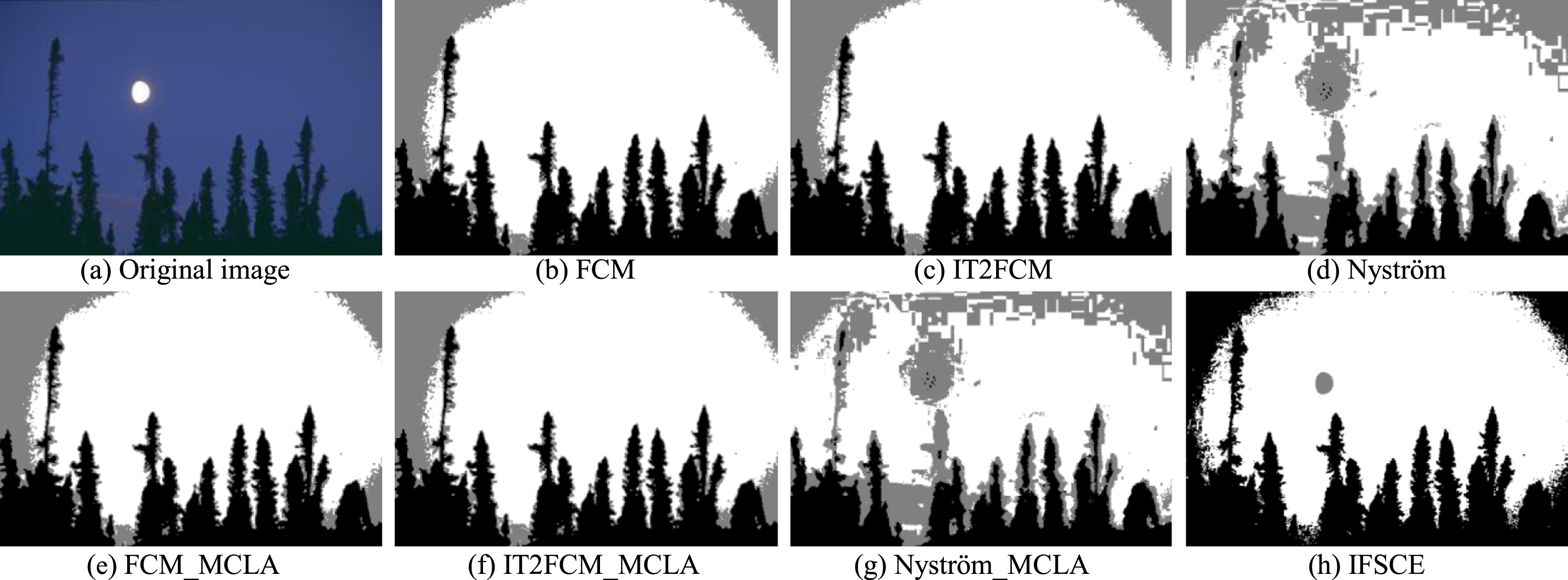
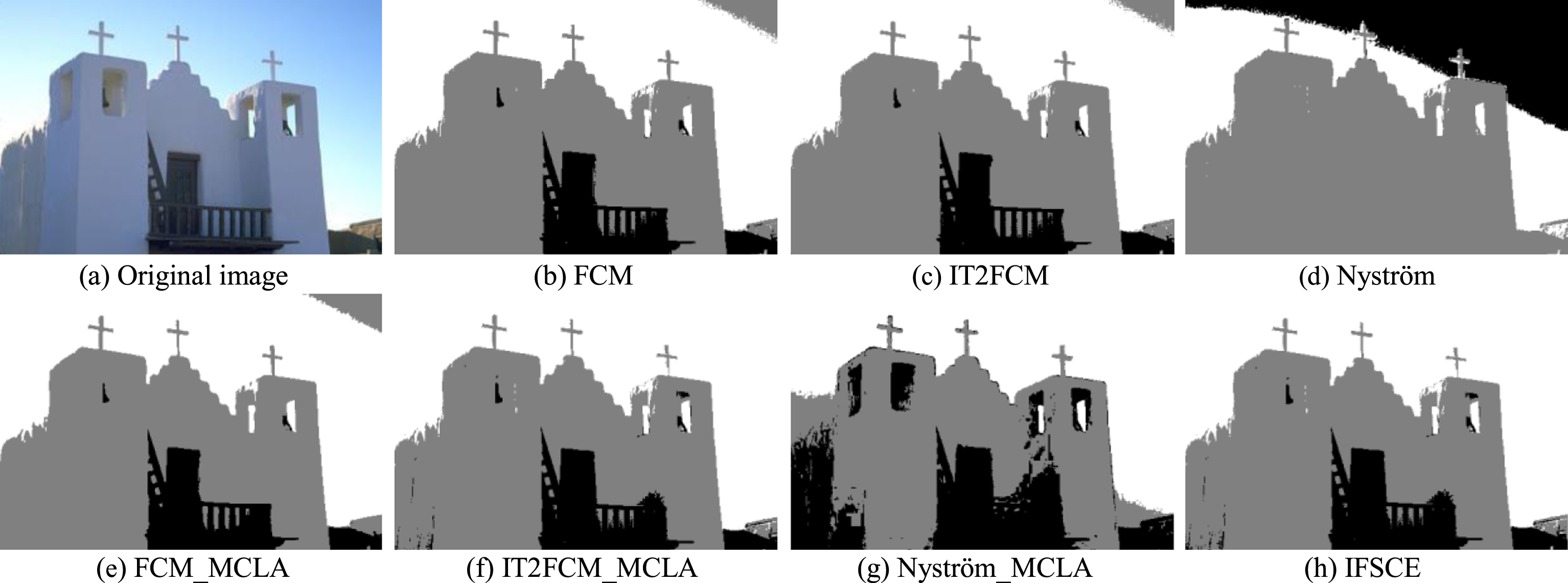
In order to verify the validity of IFSCE, seven images (#3096, #238011, #24063, #12003, #3063, #167062, #135069) are selected from the Berkeley Segmentation Dataset [27] for comparative experiments. The comparison methods include FCM algorithm, IT2FCM algorithm, Nyström algorithm, FCM ensemble algorithm (FCM_MCLA), IT2FCM ensemble algorithm (IT2FCM_MCLA), Nyström ensemble algorithm (Nyström_MCLA). In FCM ensemble algorithm, each segmentation result is obtained by FCM under different parameters and random initialization [19]. In Nyström ensemble algorithm, each segmentation result is achieved by Nyström algorithm under different scale parameters σ.
Figures 1–7 represent the image segmentation results of all comparison methods. It can be seen from the results of #3096 and #167062 that IFSCE, FCM and FCM_MCLA obtain the satisfying segmentation results. For #24063 and #167062, IFSCE and IT2FCM_MCLA obtain the satisfying results. For #238011, #3096, #12003 and #135069, there are some wrong classified pixels in the results of Nyström and Nyström_MCLA. It can be seen form #24063, FCM obtains wrong result and the roof is wrongly segmented. Due to the introduction of the interval fuzzy membership degree similarity measure, IFSCE can obtain the better segmentation results of the image. Moreover, the accuracy rate of all comparison methods are shown in Table 1. The results confirm that IFSCE is better than other comparison algorithms. Comparison of segmentation results of each algorithm on #3096 (k = 2). Comparison of segmentation results of each algorithm on #238011 (k = 3). Comparison of segmentation results of each algorithm on #24063 (k = 3). Comparison of segmentation results of each algorithm on #12003 (k = 2). Comparison of segmentation results of each algorithm on #3063 (k = 2). Comparison of segmentation results of each algorithm on #167062 (k = 3). Comparison of segmentation results of each algorithm on #135069 (k = 3).


This paper presents an interval fuzzy spectral clustering ensemble image segmentation method. Firstly, the color histogram of the input image should becalculated. Secondly, the effective fuzzy validity indices are adopted to obtain a set of the fuzzy factors combination and interval fuzzy similarity measure is constructed under each fuzzy factors combination. Thirdly, the eigenvector of the Laplacian matrix of the matrix constructed by the measure is clustered and the segmentation results under selected fuzzy factors are integrated to obtain the final segmentation results. The experimental results show that the proposed algorithm can improve the efficiency of image segmentation and obtain the ideal segmentation result. In our future work, we will concentrate on the construction of interval fuzzy graph and solution of interval fuzzy graph partition theory.
Footnotes
Acknowledgments
This work is supported by the National Natural Science Foundation of China (Grant Nos. 61571361, 61202153, 61671377, 41471280 and 61102095), the Science and Technology Plan in Shaanxi Province of China (Grant No. 2014KJXX-72), New Star Team of Xi’an University of Posts & Telecommunications (xyt2016-01).