



Abstract
The continuous improvement of performance in organizations requires the continuous and purposeful evaluation of organizations. One of the most vital sectors that significantly affects the economic growth of countries is transportation; in this regard, performance assessment plays an important role in this sector. Therefore, a novel hybrid algorithm based on Fuzzy Analytical Hierarchy Process (FAHP) and Data Envelopment Analysis (DEA) is proposed here to measure the efficiency of product transportation in road fleets of Iranian provinces. FAHP method is used to define the weights of input and output criteria, and the priority of criteria is implemented as a constraint in a DEA model. The efficiency of each province in this domain will be determined by means of the proposed DEA model. The results obtained from the application of the proposed approach to Iran Road Maintenance & Transportation Organization vindicated the effectiveness and efficiency of the proposed approach.
Introduction
Transportation is one of the basic needs of humans. The fast rate of global transformations and changes as well as the continuous progress of communities, the diversity of products and services in the world, the competitiveness of economic activities, division of labor, product production and service delivery based on regions’ competitive advantages, etc. have created the increasing significance of transportation for the fast transfer of goods and people. On the other hand, transportation is known as one of the main prerequisites of development, and the economic growth of developed countries is indebted to the expansion of their transportation and communication systems. The enjoyment of a tactical and strategic assessment system is an important factor in the better development of this industry. Therefore, this study proposes a strategic approach for the performance assessment of the product transportation fleet in road sector in different provinces of Iran.
There are a large number of studies that have used Multi-Criteria Decision Making (MCDM) tools in various fields of evaluation and priority, such as Mina et al. [1], Rao et al. [2], Bafrooei et al. [4], Cao et al. [7], Liu et al. [16], Wu et al. [24], Zhang and Guo [25] and Dong and Cooper [26]. However, when it comes to the field of vehicles fleet, a few studies have been carried out by using these tools. Gumus [8] proposed a hybrid model wherein FAHP and TOPSIS are combined for the assessment of hazardous material transportation companies. They have used such criteria as safety, service quality, compliance with standards, and servicing time and embarked on assessing and ranking five companies active in the transportation of hazardous materials. Yeh et al. [22] applied a multi criteria analysis approach for the performance assessment of urban bus companies under uncertainty conditions. They have used fuzzy TOPSIS method and such criteria as comfort, safety, and social duty to rank 10 bus companies.
Lee [11], Morisugi [13], and Quinet [15] have proposed models based on benefit-cost analysis to assess the transportation projects in the USA, Japan, and France, respectively.
Zak & Kruszynski [23] proposed an approach based on AHP and ELECTRE III/IV for the assessment of urban transportation projects. They applied the aforementioned approach for 18 projects where the results indicated the efficiency and user friendliness of their proposed approach.
Haghshenas et al. [9] assessed urban transportation projects with regard to sustainable development policies. They made use of system dynamics approach and assessed urban transportation projects from the perspective of sustainable development in Isfahan by using the data pertaining to the past four decades.
Shen et al. [17] proposed an applied approach for the assessment of metro infrastructure projects in China. They used such criteria as population of city, length of metro system, annual ridership of metro system, and Gross Domestic Product (GDP) to assess the metro system of 17 cities in China.
Baran & Zak [5] proposed an approach based on AHP for assessing the transportation performance of agribusiness companies. They used transportation cost, delivery time, fleet modernity, transportation reliability, transportation quality, safety, environmental friendliness, and fleet utilization as criteria for the assessment of companies.
In a review paper written by Macharis & Bernardini [12], different types of papers about transportation projects have been reviewed, and, then, the methods used in these papers have been identified, among which approaches based on ANP/AHP with the weight of 33% have been used more frequently than the other methods. In Table 1, some studies in the field of transportation assessment have been shown.
Comparison of the proposed approach with those of other studies
Comparison of the proposed approach with those of other studies
According to Table 1, a new hybrid approach based on FAHP and DEA is proposed to evaluate the relative efficiency of each province from the perspective of Road Maintenance and Transport Organization in Iran. In the proposed approach, the weights of the input and output criteria are calculated using the FAHP method, and the provinces are prioritized relative to each other in terms of road maintenance and transportation according to their weights. Then, the prioritization results are implemented as the constraints of the proposed DEA model. To the best of the authors’ knowledge, this is one of the first studies that puts its focus on the ranking of road transport areas by using a novel Decision Support System (DSS). The effectiveness and efficiency of the DSS represent its appropriate performance.
The next section of the paper is dealt with the description of the problem and the proposed approach. The third part is dedicated to the implementation of the proposed model in road Maintenance and Transport Organization of Iran. Finally, the conclusion of this paper will be presented in the fourth section.
All public and private organizations require a performance assessment system for development, growth, and sustainability so that they can measure the efficiency and effectiveness of their processes, organizational programs, and also human resources. Efficient organizations not only gather and analyze data and information, but also use such data and information to improve the organization, realize the missions, and implement the strategies. In other words, they put their main focus on performance management rather than performance assessment.
The management quality and effectiveness of the administrative system are crucial factors in the realization of development and welfare programs of countries. The high organizational costs, limited financial resources, and the low efficiency of these organizations have compelled governments to assign attention to the realization of these organizations’ goals. Considering the results and the realization of goals, the continuous quality improvement of services and products, and citizens’ satisfaction, it is required to focus on performance assessment and management.
Road transport area is not an exception and it requires an assessment and ranking system for the purpose of development, growth, and sustainability in the competitive environment in order to achieve such goals as the creation of an appropriate legal platform for privatization, cost reduction, economy of activities, increased productivity, qualitative development of human resources, improvement of service quality, enhancement of business and marketing activities, use of equipment and fleet with new technologies, reduction of environmental pollution and increase of safety, expansion of multi-modal, compound and container-based transport, and establishment of a trade-off in road transport.
According to the statistics released by Road Maintenance and Transport Organization of Iran, more than 90% of products are carried by road transport fleets. To this end, more than 4,200 companies are active in the field of road transportation in the country, around 90% of which belong to the private sector (http://www.rmto.ir). In the last three years, the annual rate of 385 million tons of products have been carried through road transportation by 423000 trucks and 464000 truck drivers on average.
Based on the above information, the field of road transportation has a vital role in goods delivery, lots of industries are benefited through this field, and a large number of jobs have been influenced either directly or indirectly by this area. Hence, the presentation of a performance assessment approach can have a significant impact on the improved performance of this domain.
The proposed approach
This article aims to propose a hybrid approach based on FAHP and DEA to measure and rank the performance of Iranian provinces in terms of their effectiveness in the field of road transportation. The proposed approach is illustrated in Fig. 1 and presented as follows:
This step determines the criteria for fleet performance evaluation to rank the performance of provinces. To the best of the authors’ knowledge, due to the absence of any criterion for performance assessment in the area of road transportation in the literature, the evaluation criteria were obtained based on the experts’ consensus and brainstorming method. These criteria are divided into two groups, namely input criteria and output criteria, as shown below:
Average freight cost per ton-kilometer based on the origin province (IC1) Number of public transportation vehicles (IC2) Number of transportation vehicle drivers (IC4) Number of active companies and organizations in load transportation area (IC4)
Quantity of imported goods into the province (OC1) Quantity of exported goods out of the province (OC2) Quantity of transported goods in the province (OC3) Average travelled distance in each travel based on the origin province (OC4) Number of inter-provincial travels by each loading truck (OC5) Number of out-of-province travels by each loading truck (OC6) Number of loading trucks entered to the province (OC7)
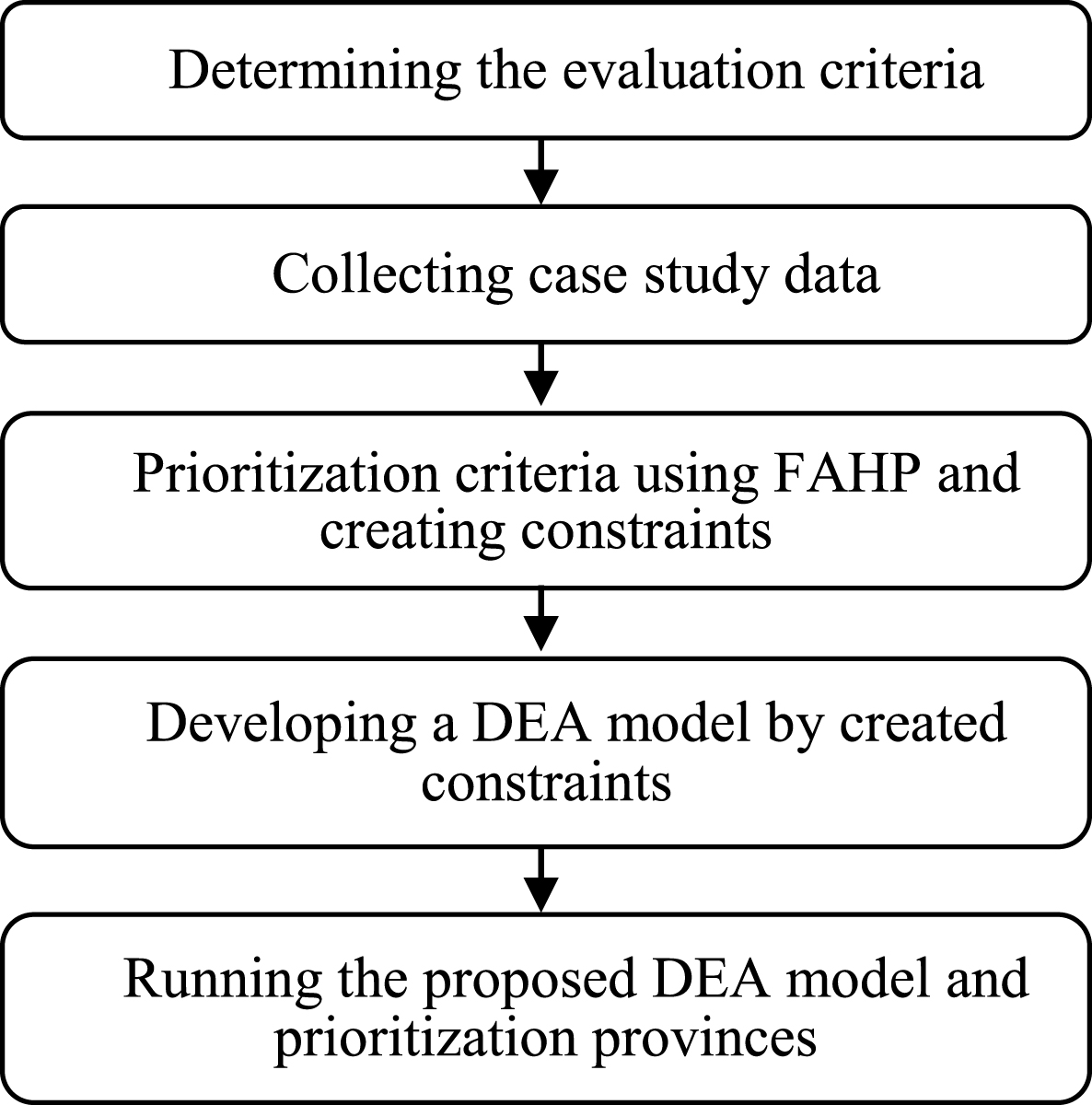
Procedure of proposed approach.
Data extraction is fulfilled by a performance assessment team in the Road Organization where these data are collected annually and are included on the website of the Road Organization (www.rmto.ir).
In this step, FAHP presented by Bozbura and Beskese [6], is used to weight the criteria so that the importance of each criterion is obtained. For this purpose, pairwise comparison questionnaires were sent to the experts and, they were asked to fill the questionnaires based on linguistic terms of Table (2). Then, the weight of each criterion is determined using Bozbura and Beskese’s [6] method and, thereafter, the constraints pertaining to the weight of each criterion will be recognized by applying data environment analysis. This process is presented as follows:
Linguistic scale for difficulty and importance [1]
Assume that
Where a, b and c represent the lower, middle and upper bounds of triangular fuzzy numbers, respectively. The following operation should be performed to obtain
Fuzzy synthetic extent (S
i
) is defined as below:
Then, the possibility degree must be determined. For example, the possibility degree of expression M2 ≥ M1 is defined as:
This possibility degree is calculated via the following formula:
Where d is the maximum height between μ M 1 and μ M 1 . Figure 2 illustrates this concept.

M1 and M2 intersection diagram.
The next stage defines the possibility degree for convex fuzzy numbers:
Thus, it is assumed that
Then, the weighting vector is represented as follows:
At this point, the obtained weight vector should be normalized:
Thereafter, it is possible to calculate the local weight of each criterion.
After determination of the weights, the criteria are prioritized. Then, the priority between the criteria is expressed in terms of mathematical constraints so that these constraints can be added to DEA model. For example, if there are n input criteria and m output criteria, then, n-1 constraints are added to the proposed DEA model for input criteria and m-1 constraints are added to it for output criteria.
In this step, the extended form of the model proposed by Azadeh et al. [3] is used to rank provinces in terms of their efficiency in the domain of road transport. For the development of DEA model, the constraints pertaining to the prioritization of criteria, which were determined in the second step, will be added to Azadeh et al.’s model [3]. The developed model has been presented below:
Objective Function
The objective function of the proposed model aims at minimizing deviation from efficiency.
Constraint (11) defines the value of the objective function as the greatest deviation from efficiency. In other words, the objective function embarks on minimizing the deviation from efficiency based on constraint (11). The total of efficiency and deviation from efficiency for each province should be equal to one where constraint (12) represents this formula.
Constraints (13) and (14) ensure that the weights obtained from input and output criteria should not be zero.
Based on the proposed model, the efficiency deviation of each province is calculated and is ranked according to the mentioned score.
Iranian road transport is of great importance due to such reasons as vast climate variation, expansion of road transport network, limited coverage of rail and air transportation, lack of navigable waterways, flexibility, economic nature, and potential usability of environmental and tourism attractions. This is highlighted by the fact that more than 90 percent of Iranian product transportations are done through roads.
Each year 1 , in Iranian road transport, 4299 active companies or organizations transport more than 380 million tons of goods in 27 million travels where more than 90 percent of these companies belong to the private sector.
The performance improvement of these companies depends on the assessment of their performance and efficiency so that this important goal (i.e., performance improvement) can be achieved through the reinforcement of the weaknesses and the consolidation of the strengths. The development of an evaluation approach requires the selection of an appropriate evaluation criteria and an effective and efficient model. For this purpose, a combined approach of DEA and FAHP was presented. In this section, the presented approach was implemented in Iranian Road Maintenance and Transportation Organization for its efficiency measurement and validation. The results are presented in following steps:
In this step, the evaluation criteria required for the evaluation of each province performance are identified. The data related to input and output criteria are presented in Tables (3) and (4), respectively.
Input criteria data for each province
Input criteria data for each province
Output criteria data for each province
In this step, the questionnaires are submitted to the experts and they are requested to make pairwise comparisons using linguistic terms of Table (2). Tables (5) and (6) present the obtained results of the questionnaires.
Pairwise comparison of input criteria
Pairwise comparison of output criteria
Now, the weight of each criterion is obtained using the method developed by Bozbura and Beskese [6]. As an example, the weighting process of input criteria is presented based on Table (5) below.
According to Equation (1), the sum of fuzzy numbers in each row is calculated:
As per Equation (2), the reverse of the sum of triangular fuzzy numbers is obtained for all rows and columns:
Then, the fuzzy synthetic extent is determined by Equation (3):
Then, the possibility degree is obtained using Equations (4), (5) and (6):
For each pairwise comparison, the minimum of the possibility degrees is obtained by Equation (7):
Thus, the non-normal weighting vector can be generated (see Equation (8)):
Via normalization, the importance weights of criteria are calculated as follows (see Equation (9)):
Therefore, the weights of all criteria are calculated. Table (7) presents the weights of all input and output criteria, which are calculated via FAHP.
Weights of criteria
Now, based on the results of Table (6), the constraints pertaining to weights of criteria are determined and are applied in the proposed DEA model. Based on the weights presented in Table (6) and the proposed DEA model, the following will be true:
In this step, the proposed DEA model and the resultant constraints from previous step (FAHP) are merged and, thereby, the mathematical model is developed as follows:
By running the model in GAMS24.1/BARON software, the efficiency deviation of each province is calculated. The province with the lowest level of deviation benefits form higher efficiency. The results of the model implementation are presented in Table (8):
Provinces’ efficiency and rank
As shown in Table (8), Hormozgan province with the relative efficiency of 1 and Kohkiluye and Boyerahmad with the relative efficiency of 0.09 are known as the most and the least efficient provinces in road transport in Iran, respectively.
Transportation, as an important activity in servicing sectors, has an undeniable role in the growth of industries. In recent years, transportation section has experienced a high added value which is constantly increasing. For any improvement in this section, the realization of the current weaknesses is required at first. Accordingly, a hybrid method based on FAHP and DEA was proposed in this study to measure the efficiency of transportation section in each province. The proposed method includes the importance of the criteria as an input and also considers expert opinion in the form of constraints in DEA model. In order to validate the model, we applied the proposed method in Road Maintenance and Transport Organization of Iran and the results proved its effectiveness.
