




Abstract
Quality function deployment (QFD) is a systematic approach by which to incorporate the needs of customers within the process of product development. Unfortunately, semantic ambiguity pertaining to “hesitation” tends to undermine the effectiveness of QFD (both the conventional as well as fuzzy versions). In this study, we developed a novel QFD evaluation model referred to as intuitive fuzzy QFD in which an intuitive fuzzy analytic hierarchy process is implemented in conjunction with data envelopment analysis with the aim of deriving a more objective presentation of human thought processes when dealing with multiple-attribute problems within the context of group decision-making. The proposed model also takes into consideration cost limitations and difficulties associated with implementation. The practicality of the proposed model is demonstrated in a case study involving the design of machines for printing touch panels. In practice, this model can help the industrial develop and urge the promotion of design quality.
Keywords
Introduction
Market competitiveness depends on the ability to respond swiftly to market demand in terms of product innovation. Chen and Weng [1], Fung et al. [2], Jia and Bai [3], Wang et al. [4], Li et al. [5] and Wang et al. [6] demonstrated the importance of collecting and analyzing market data and then applying it to the development of new products in accordance with market trends. Quality function deployment (QFD) was first proposed by Akao [7] and Akao and Mizuno [8] as a systematic quality planning tool (a chart) referred to as the House of Quality. Essentially, QFD is a method by which to establish a quality standard aimed at guiding product design in accordance with customer needs (CNs). Akao and Mizuno [8] described QFD as a means of transforming CNs (Whats) into know-how (Hows). In the short period since its inception, QFD has become one of the most widely-used instruments in product research and development (R&D). Numerous scholars and R&D engineers have successfully applied QFD to product development and process improvement aimed at gaining an advantage over competitors [1, 9–14].
Traditional QFD uses a value system (e.g., [1–9] or [1–9]) to illustrate the opinions of customers or experts within a relation matrix. Multi-level deductive analysis is used to assess CNs, establish a standardized system to guide product/service design, and facilitate management efforts in terms of quality control, production specifications, and spare parts deployment [15–17]. This method provides a simple yet effective method for calculating the weights of CNs and function requirements (FRs); however, many scholars see room for refinement and/or extension. For example, it would be helpful to consider the opinions of multiple customers and/or experts, considering that the design process has largely become a form of group decision-making (GDM). Some scholars have employed fuzzy sets to deal with issues pertaining to subjectivity, uncertainty, and semantic ambiguity [11, 18–20]. Other researchers have incorporated fuzzy theory in the prioritization of CNs and FRs (Vanegas and Labib, [21–24]. Still other researchers have applied fuzzy sets to QFD to create alternative fuzzy QFD methods, including the fuzzy analytic hierarchy process [10, 26], the fuzzy analytic network process [18, 27], fuzzy mathematical programming [24, 29], the fuzzy weighted average method [21–30], and the fuzzy expert system [32–36].
In the implementation of QFD, linguistic uncertainty can undermine one’s ability to maintain objectivity in the ranking of CNs and FRs. Fuzzy sets have proven effective in overcoming subjective interpretations; however, they are insufficient to overcome the difficulties involved in representing “hesitation”. Atanassove [37] sought to overcome this limitation in the depiction of human thought processes by applying intuitive fuzzy sets (IFS) to fuzzy membership grades for “hesitation” to produce proportional presentations encompassing “agreement”, “opposition”, and “hesitation”. Numerous researchers have applied IFS to multi-criteria decision-making [38–46] and product design [1, 47–50]; however, neither IFS nor IFS combined with the analytic hierarchy process (IFS-AHP) have been applied to QFD.
This study employed IFS in the development of a QFD evaluation model (IFS-QFD). The proposed model produces an objective representation of the thought processes of product testers/experts in order to facilitate the incorporation of CNs in the process of product design. We also employed data envelopment analysis (DEA) to expand the context of product design to include cost limitations and difficulties in execution. A case study on the manufacture of printing machines for touch panels is used to demonstrate the practicality of the proposed method. We believe that the proposed IFS-QFD model provides a valuable reference to advance the design of products and/or services.
Literature review
In the following, we outline previous work on intuitive fuzzy set theory, fuzzy QFD, and fuzzy AHP before describing the proposed IFS-QFD model.
Intuitive fuzzy sets (IFS)
Zadeh [51] developed fuzzy theory with the aim of resolving issues related to subjectivity and uncertainty in human thought processes; however, the issue of hesitation has remained a stumbling block. Atanassove [37] extended conventional fuzzy sets through the development of intuitive fuzzy sets (IFS) that incorporate information related to membership, non-membership, and indeterminacy. This approach provides linguistic expressions that more closely resemble human thought processes. Atanassove [37] and Gau and Buehrer [52] defined IFS as follows:
Let X be a universal set, in which A is an IFS and A = { x, 〈 t A (x) , f A (x) 〉 } , x ∈ X where t A (x): X → [0, 1] and f A (x):X → [0, 1] respectively represent the degree of agreement and opposition. Furthermore, t A (x) + f A (x) ≤ 1, such that 1 - t A (x) + f A (x) indicates the degree of hesitation. Figure 1 presents a graphical representation of this process.

Intuitive fuzzy sets.
Let A ={ x, 〈 t A (x) , f A (x) 〉 |x ∈ X } and B ={ x, 〈 t B (x) , f B (x) 〉 |x ∈ X } be IFSs in X, with their sum and product respectively expressed as follows:
In the discussion above, we sought to illustrate the means by which IFSs can be used to obtain a more objective expression of thought processes and expand expressive capacity when dealing with problems based on uncertain information and in multi-criteria decision-making. The use of QFD to elucidate the relationship between CNs and FRs and to prioritize FRs is also considered a multi-criteria decision-making problem. This has led many researchers to adopt IFS in the development of methods by which to clarify multi-criteria decision-making [38–46] and facilitate product design [1, 2]. However, no previous research has been conducted on the application of this approach to QFD. In the current study, we employed IFS in the creation of a relationship matrix of CNs and FRs in order to derive more accurate and reasonable results from QFD.
QFD originated in Japan in the 1970s as a customer-oriented quality control management system aimed at enhancing customer satisfaction. According to Mizuno and Akao [7], Akao and Mizuno [8], and Akao and Mazur [53], QFD facilitates teamwork by incorporating the voice of customers (VOC) into the design of products or services. The ultimate goal is to ensure that the functionality and quality of the resulting product match the expectations of the customers as closely as possible.
Figure 2 presents a typical QFD graph (House of Quality) template. The QFD design team should include the following information: (1) “what to do” (what): compiling CNs and analysing their relative importance; (2) “how to do” (how): formulate primary FRs aimed at satisfying CNs; (3) relationship between “what” and “how”: analyzing the correlation among FRs in the form of a correlation matrix; (4) relationships among “whats”: determining the means by which CNs and FRs are interrelated in the form of an interrelationship matrix. Finally, the FRs are rated in terms of importance based on the results obtained in Steps (1) and (4). Many previous researchers have used QFD in product development, process improvement, and in the enhancement of overall competitiveness[9–14].
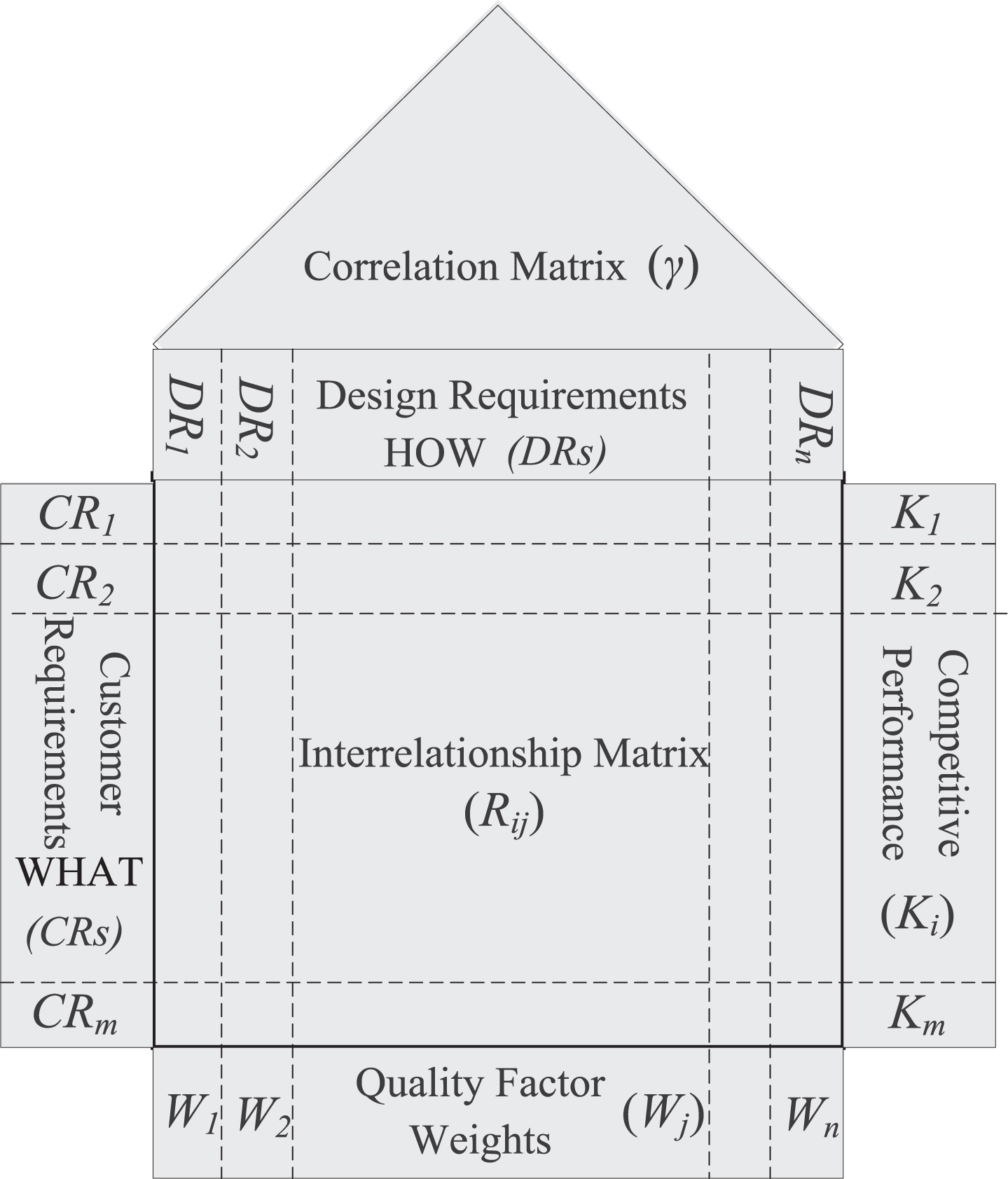
House of quality template.
According to Lyman [54], the strength of each CN in the interrelationship matrix can be quantified to indicate the strength of the relationships between FRs and CNs, as well as the importance of FRs to corresponding CNs. Thus, a normalization formula can be used to provide a better indication of the extent to which each FR contributes to CNs, as follows:
Lyman [54] and Wasserman [55] reported that the correlation between FRs should also be taken into consideration in weighting. We therefore revised the normalized formula used to determine relationship strength, as follows:
Still other researchers have applied fuzzy sets to QFD to create alternative fuzzy QFD methods, including the fuzzy analytic hierarchy process (Kwong and Bai, [10]; Das and Mukherjee, [25]; Kilincci and Onal [26]; Gong et al. [39]), the fuzzy analytic network process [18, 27], fuzzy mathematical programming [24, 29], the fuzzy weighted average method [21, 30–21], and the fuzzy expert system [32–36].
Nonetheless, this approach has proven ineffective in dealing with “hesitation” in human logic and thought processes. In fact, this issue is not even mentioned in any references relevant to fuzzy QFD. In this study, we referred to the intuitive fuzzy sets theory proposed by Atanassove [37] in the formulation of a novel IFS-QFD to deal with the membership grade for “hesitation”.
This study developed the intuitionistic fuzzy quality function deployment (IFS-QFD) model by combining the intuitionistic fuzzy AHP with QFD for the weighting of customer needs (CNs). We then identified the relative priority of function requirements (FRs) using defuzzification and determined the final ranking of priorities using data envelopment analysis (DEA). The research framework is presented in Fig. 3.

Intuitionistic fuzzy QFD.
Questionnaire surveys were used to collect data on CNs for the development or improvement of products. FRs were then obtained from internal company data related to technical requirements.
The survey results (opinions) from K experts in relevant industries are converted into intuitionistic fuzzy values and entered into the relationship matrix of the House of Quality. In this study, we employed the 9-point intuitionistic fuzzy semantic conversion scale proposed by Zhang and Liu [57] for scoring criteria, where t refers to “agreement”, f is “opposition”, π is “hesitation”, and 1-f is “agreement +hesitation ”, as shown in Table 1.
Intuitionistic fuzzy semantic scale
In accordance with the process described by Filev et al. (1998), OWA operators were used to obtain group (K) intuitionistic fuzzy preferences. We first defined a House of Quality (Fig. 2) with m number of CNs and n number of FRs, in which the intuitionistic fuzzy correlation values of CNs and FRs were R ij ={ x, (t R ij (x) , f R ij (x)) }, i = 1, 2, …, n ; j = 1, 2, …, m, where t R ij (x) and f R ij (x) respectively represent agreement with and opposition to CR i and TR j . We included the various intuitionistic fuzzy weights of the experts in the calculation of the group intuitionistic fuzzy preference using the OWA method, as follows:
We built on the process outlined by Abdullah et al. [58] by incorporating the intuitionistic fuzzy AHP into the intuitionistic fuzzy QFD to enable the calculation of relative weights for the CNs with greater objectivity. A step-by-step illustration of the process is presented in Fig. 4:
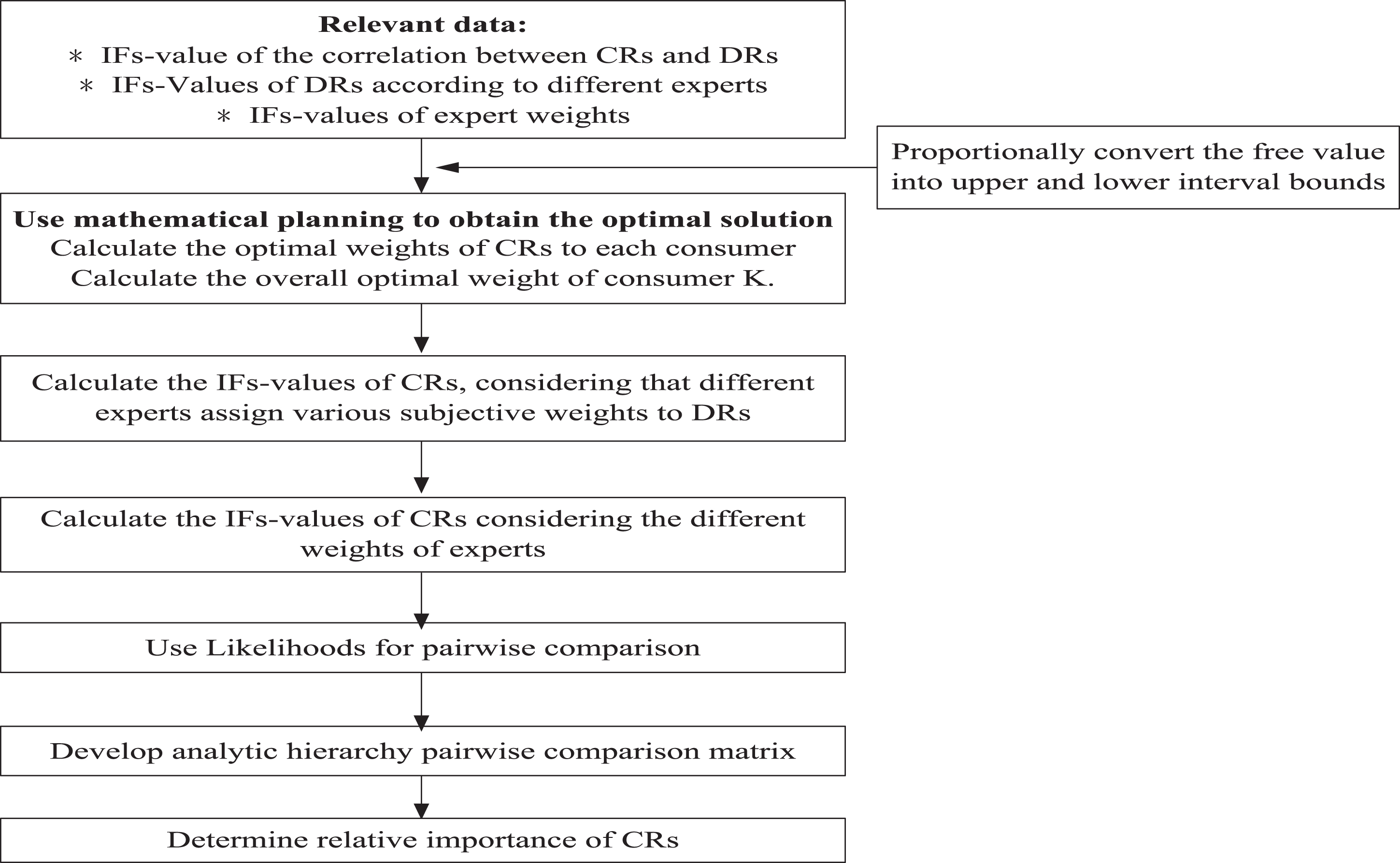
Using intuitionistic fuzzy AHP to obtain CN weights.
Step 3.1. Converting intuitionistic fuzzy values of CNs and FRs into interval values
The extent of agreement with/opposition to CNs compared to FRs are
When
Step 3.2. Converting intuitionistic fuzzy values of FR weights into interval values
Experts differ in their evaluations pertaining to the importance of each DR, which results in different opinions related to weights. We expanded on the concept proposed by Abdullah et al. [58] by processing the intuitionistic fuzzy weight of FRs
Step 3.3. Converting intuitionistic fuzzy weights of each expert
Differences in the experience and specialization of experts lead to variations in their assessment results. Again, we adopted the method outlined by Abdullah et al. [58] in assigning different intuitionistic fuzzy weights to each expert. Here, α
k
and β
k
respectively represent agreement with/opposition to the importance ranking of each expert, while 0 ≤ α
k
≤ 1, 0 ≤ β
k
≤ 1, 0 ≤ α
k
+ β
k
≤ 1 and the hesitation value γ
k
= 1 - α
k
- β
k
. Following the proportional allocation of a hesitation value, we determined that the importance of each expert fell within the range of
Step 3.4. Dissimilarities in weighting of CNs and obtaining an optimal solution mathematically
The fact that QFD is a group decision and experts differ in their opinions regarding the importance of CNs, led us to apply mathematical planning to obtain the optimal weight solution for FRs, as shown below:
The optimal weight was multiplied to calculate the intuitionistic fuzzy intervals of correlation between CNs and FRs:
Step 3.5. Taking into account the standing of each expert
To account for variations in the significance of assessment results, each of the experts was assigned a specific weight. The intuitionistic fuzzy interval from Step 3-3 was multiplied with that obtained in Step 3-4 in order to take into account variations in the weight of each expert in determining the correlation between CNs and FRs, as follows:
Step 3.6. Likelihood of using pairwise CN comparison
Step 3.7. Determining the optimal weight of each CN
This study used AHP to obtain the optimal weight of each CN, as follows:
Step 3.8. Obtaining a priority ranking from CN weights
The weights from Steps 3-7 are ranked in order of priority in order to determine the relative importance of each CN
The goal of QFD is to compare the importance of FRs and then apply the results to the next stage of product development. After ranking CNs in order of importance using the intuitionistic fuzzy AHP, Equations (2), (3) and (8) are used to calculate the intuitionistic fuzzy values related to the importance of FRs.
We extended the method proposed by Hung et al. [59] for the defuzzification of fuzzy values related to importance and then applied DEA to the intuitionistic fuzzy QFD, while taking into account constraints such as budgetary limitations and difficulties in implementation. This made it possible to obtain the relative importance ranking of FRs for use in product design.
Step 5.1. Defuzzification for computation of weights and rankings
To obtain the final weights pertaining to production requirements, we expanded the defuzzification method presented by Hung et al. [59], as follows:
In accordance with the previous DR priority rankings, defuzzification was used to determine the order of relative importance.
Step 5.2. Ordering FRs according to relative importance using DEA
We sought to minimize the number of input factors by taking into account the resources that companies have on hand, in order to enhance the relative efficiency of the decision-making unit (DMU). Using a CCR-DEA model, we set n number of FRs as DMUs and m number of output units as CNs. Survey results from a wide range of experts can then be used to identify costs and difficulties associated with implementation as two inputs. DEA-Solver Prp 6.0 software was used to compute the relative importance of the FRs.
This study emphasizes the discussion on whether the IFS-QFD model can be more closely applied to the real-life decision making than the previous related applications. However, the computation among intuitionistic fuzzy sets is not easier than the traditional QFD. Therefore, to facilitate the practical use and operation, this study uses software Matlab to build up an operation interface and demonstrates the relevant contents as well as interface in the case study.
In recent years, since the touch panel industry has gradually replaced the traditional semiconductor processing with the screen printing processing to cope with the technical development requirements of new-generation system modularity, this study uses the screen printing processing of a Taiwanese touch panel manufacturer as a case study to explain the application of this evaluation model.
Intuitionistic fuzzy AHP
Identifying CNs and FRs
This case-study company is a large-scale equipment manufacturer of touch-panel screen printing machines in central Taiwan whose clients are Foxconn (a subcontractor of iPhone cell phones), AU Optronics Corporation (a manufacturer of large-sized televisions), ASUS (a manufacturer of computers and cell phones), and so on. Therefore, Customer Needs (CNs) are based on these customers, and their feedback is sent to the QFD evaluation team. The technical department of the manufacturer in this study has compiled a list of possible FRs based on CNs and the technical standards established by management. We assembled a five-person project committee of experts with at least ten years of work experience, as follows: senior executive (A1), R&D manager (A2), customer service manager (A3), business manager (A4), and design team leader (A5). This committee was tasked with identifying key CNs from the House of Quality, based on their own experience and the requirements of upstream companies. This process resulted in 14 CNs and 14 FRs.
Customer needs include automatic line production (CN1), accurate positioning (CN2), full panel printing (CN3), high resolution (CN4), defect-free glass (CN5), low cost (CN6), properly configured images (CN7), short changeover time (CN8), safe and easy operation (CN9), easy to clean (CN10), steady operating speed (CN11), resistance to acid and dust (CN12), sturdy hardware (CN13) and stable printing speed (CN14). Technical requirements included automated design (FR1), accurate CCD+UVW positioning (FR2), tools design technology (FR3), image processing (FR4), scratch-resistant glass (FR5), centered design (FR6), operational modularization (FR7), human interface design (FR8), removable screen design (FR9), steady-pressure control printing (FR10), static cleaning design (FR11), panel correction design (FR12), local production of components (FR13) and anti-etching design (FR14). These data were entered into a Excel-integrated Matlab system (see Fig. 5) to assemble a House of Quality model.

Interface used with House of quality assessment system.
The senior executive assigned scores to each of the committee members based on their experience and expertise (Table 2). Conventional AHP was then used to test for homogeneity. As long as the scores were homogeneous, they were converted into intuitionistic fuzzy intervals using the sematic scale (Table 1).
Original expertise scores
Original expertise scores
The scores were shown to be homogeneous (C.I = 0.09 and C.R = 0.08); therefore, they were converted into intuitionistic fuzzy intervals (Table 3). We used the intuitionistic fuzzy AHP (Equations (12)–(16)) to obtain the relative weights of each expert, as follows: A1 = [0.195,0.272], A2 =[0.228,0.308], A3 = [0.175,0.248], A4 = [0.117,0.176], A5 = [0.124,0.188].
Intuitionistic fuzzy values and weights for each expert
The CN scores were tested for homogeneity using the same methods, which resulted in the following C.I and C.R values for each expert: A1: C.I=0.1, C.R=0.06; A2: C.I=0.09, C.R=0.06; A3: C.I=0.1, C.R=0.06; A4: C.I = 0.08, C.R = 0.05; A5: C.I = 0.07, C.R = 0.05. The CN scoring by the experts presented a high degree of homogeneity; therefore, the scores were converted into intuitionistic fuzzy intervals. Equations (17–20) were used to calculate the final intuitionistic fuzzy weights of group CNs from the weights computed using IFS-AHP (see Table 4).
Intuitionistic fuzzy CN values and group CN weights
Group DR weights
The five experts used the proposed system to rate the relationships (see Fig. 6) between the 14 CNs and 14 FRs (Table 5) and convert the scores into intuitionistic fuzzy intervals based on Table 1. After the IFS-House of Quality was completed by 5 experts (see Table 5), Formulas (1)-(3) and Formula (9) were used to calculate the importance of each expert to each FR. Considering different weights of each expert, the agreement value of the final group IFS interval weight was 0.017. Its calculation s on the basis of Formula (9), in which the final IFS interval values of FRs computed by these five experts’ IFS-House of Quality as well as each expert’s relative weight were multiplied and made up to receive FR3= 0.017. According to the weights of the experts (see Table 6), This made it possible to compute the group intuitionistic fuzzy weight of FRs, from which the three most important were FR3= [0.017,0.516], FR2= [0.017,0.510] and FR10= [0.014,0.442].

Interface 1 used with House of quality system.
Intuitionistic Fuzzy House of Quality
Intuitionistic fuzzy weights of FRs
To facilitate computation, the 14 FRs were designated as DMUs and the 14 CNs as outputs. The inputs included the cost and difficulty of implementation, as determined by the results of the questionnaire survey. The software package DEA-Solver Prp 6.0 was used for computation. The proposed system can be used to obtain the final ranking of FRs (Figs. 7 and 8).
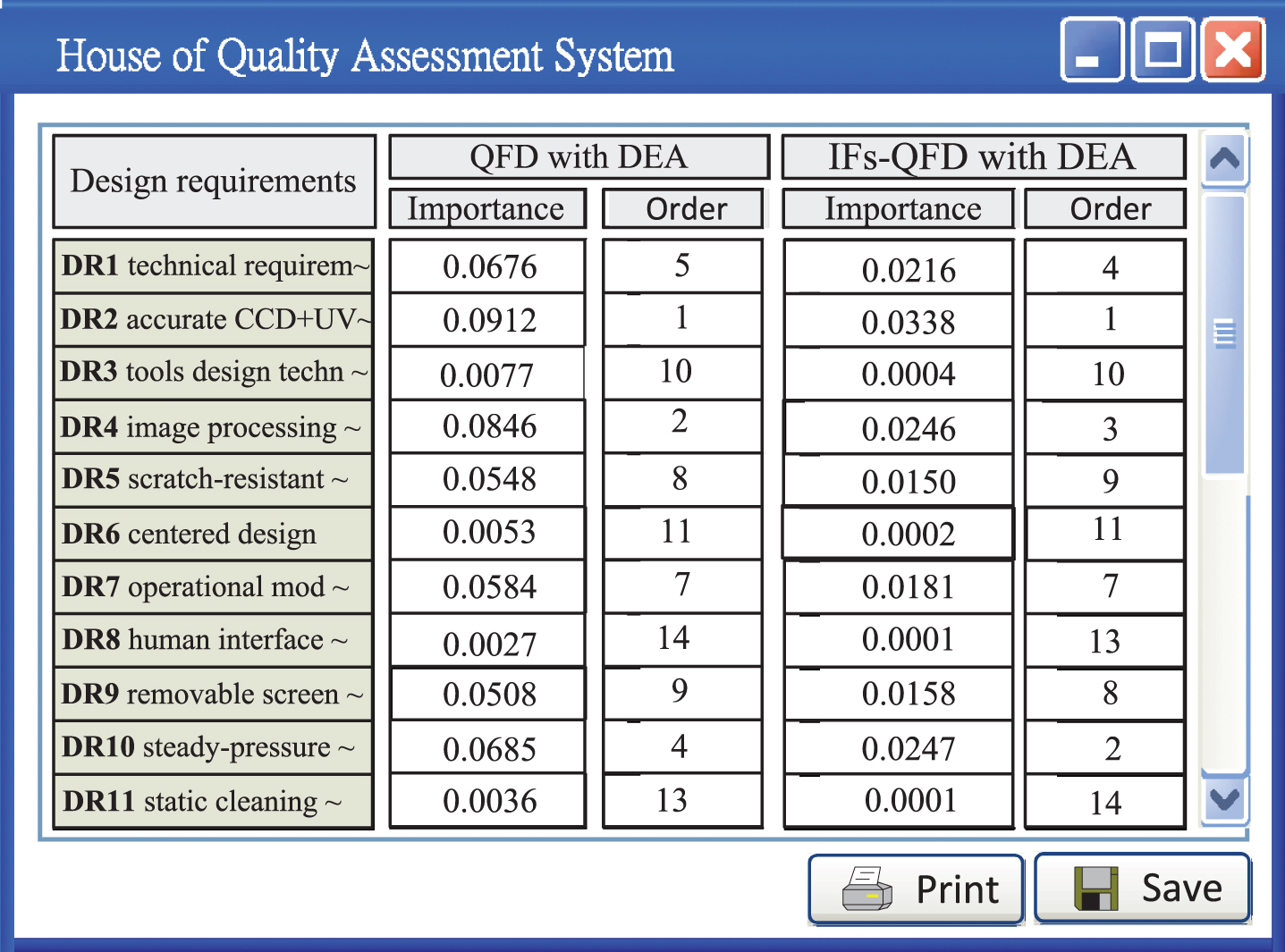
Interface 2, used with House of quality system.
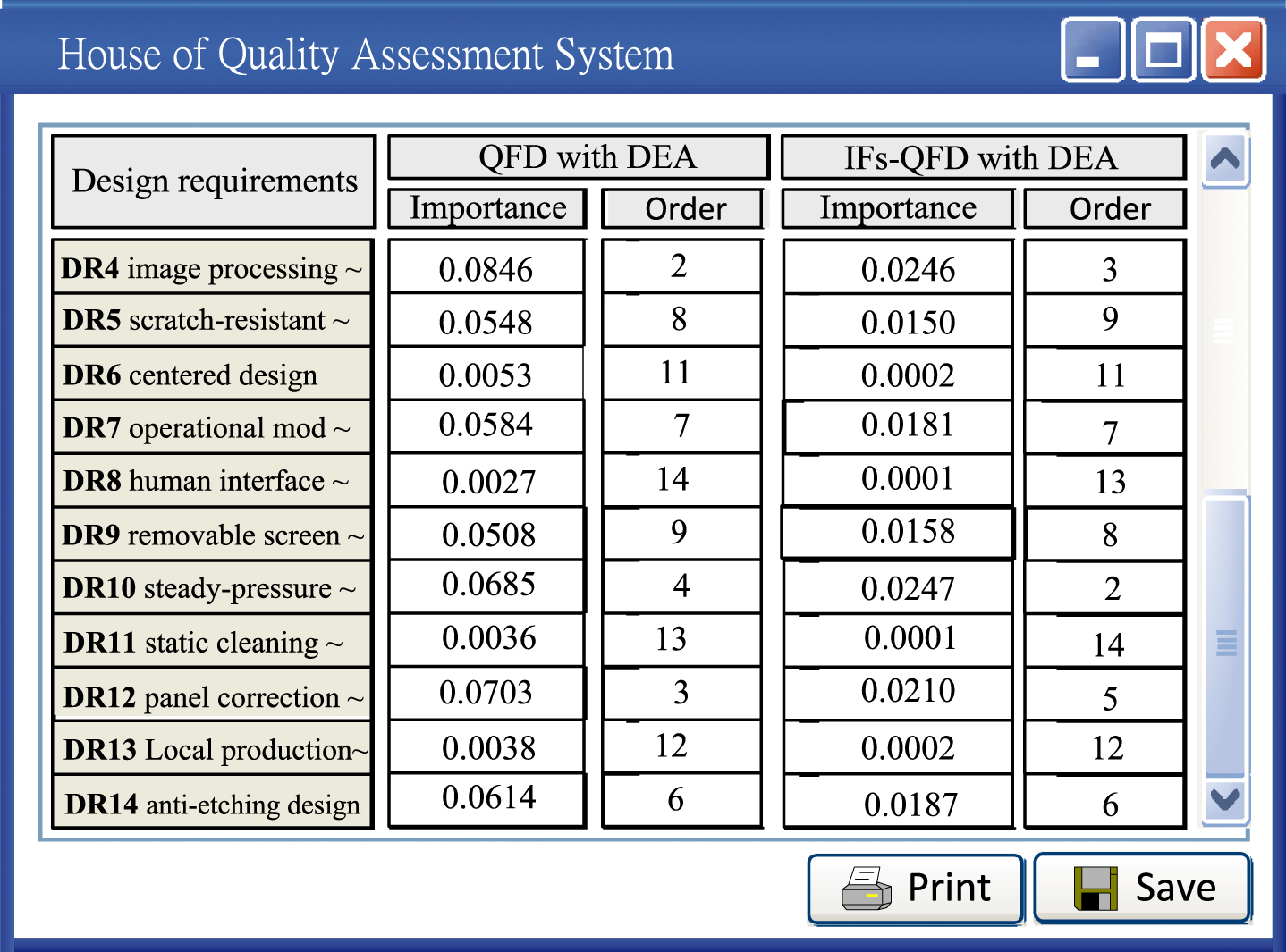
Interface 3, used with House of quality system.
This study respectively combined conventional QFD with the intuitionistic fuzzy QFD with DEA and then compared the rankings generated by the system. As shown in Figs. 7 and 8, the three most important FRs resulting from conventional QFD-DEA were FR2, FR4, and FR12. However, when the intuitionistic fuzzy QFD was combined with DEA, the three most highly ranked FRs were FR2, FR10 and FR4. Only six of the FRs (FR2, FR3, FR6, FR7, FR13 and FR14) obtained the same ranking from both systems. After this study discussed and confirmed the results with the case-study company, it was discovered that the ranking result did more objectively reflect the entire company’s situation in research, development and resources. This is a clear indication that intuitionistic fuzzy sets are more objective and accurate when processing problems involving multi-attribute and group decisions.
After the case manufacturer’s example is verified, the importance ranking received from the model of this study, the traditional QFD combined with DEA, and the current importance ranking of the company are analyzed and compared (see Table 7). Their differences are explained as follows:
Ranking results of three methods
Ranking results of three methods
(1) The ranking results received from the traditional QFD combined with DEA and the intuitive fuzzy QFD combined with DEA compare with the present company’s current ranking. The most important top three ranking results of the intuitive fuzzy QFD are exactly the same as the ones of the company’s current ranking, while the traditional QFD method only has the same ranking result in the top one item, and the rest of the items are subject to change. However, in terms of overall ordering, DR3, DR6, DR7, and DR14 are currently ranked 11th, 10th, 6th, and 7th in the company, while the results of both intuitive fuzzy QFD and traditional QFD are 10th, 11th, 7th, and 6th. The importance of DR3, DR6, DR7, and DR14 is interchangeable, which means that after the calculation of DEA method, the importance order will change with its quality characteristics.
(2) In addition, according to past scholars’ research [38–46], intuitive fuzzy sets have more objective and correct performance ability in dealing with multi-attribute decision-making and group decision-making. Besides, the process of quality function development is also a kind of group decision-making. Therefore, this study introduces intuitive fuzzy sets into QFD to improve the bias of traditional QFD sequencing, so that it can be more in line with the decision-making behavior in human real life. Next, the results of the intuitive fuzzy QFD combined with DEA will provide the company with the ability to accurately grasp customers’ needs and enable decision makers to develop the best product design.
QFD design does not easily accommodate the subjectivity inherent in the opinions of customers or preferences of experts. A number of scholars have applied fuzzy sets to mediate the uncertainties in semantic presentation of multi-attribute problems within the context of group decision-making. However, this approach has proven ineffective in dealing with the problem of “hesitation” in human thought processes. In this study, we referred to the intuitive fuzzy sets proposed by Atanassove (1986) in the development of a novel QFD model that incorporates fuzzy sets to guide product design. Our primary aim was the conversion of semantic concepts pertaining to “agreement”, “opposition”, and “hesitation” into intuitive fuzzy values. Our representation of hesitation makes it possible to objectively compute the relative importance of various design criteria.
This study adopted intuitive fuzzy AHP in conjunction with IFS-QFD to assist in evaluating differences in seniority, expertise, and work experience among experts and assign weights accordingly. We also incorporated DEA to improve the management of CNs within the context of cost limitations and difficulties in implementation. Finally, we conducted a case study on the manufacture of printing machines for touch panels to demonstrate the applicability of this model in product design. The proposed scheme not only provides engineers and designers with more comprehensive data and decision-making tools but also offers an effective evaluation method for key technology.