



Abstract
Task scheduling on heterogeneous data centers of cloud computing environment is a challenging problem. The efficiency of the cloud depends on the adopted task scheduling strategy. The task scheduling algorithm schedules the required task resources of application in the cloud platform. Even though many algorithms are presented for task scheduling; they consider only the minimum objectives for the trade-off of optimal scheduling. In this paper, a multi-objective task scheduling strategy is proposed for the task scheduling problem in the cloud network as an NP-hard optimization problem. In order to solve the scheduling problem, Fractional Grey wolf Multi-objective optimization-based Task Scheduling strategy (FGMTS) is newly proposed for scheduling tasks in the cloud. The proposed FGMTS algorithm is the combination of the existing fractional theory and Grey Wolf Optimizer algorithm. Also, the multi-objective function is newly formulated to solve the multi-objective scheduling problem. The fitness function for the proposed optimization considers the parameters, such as Execution time, Communication time, Execution cost, Communication cost, Energy, and Resource utilization for optimal scheduling. The experimentation of the proposed task scheduling strategy is carried out over two cloud setups. The performance of proposed system is validated over the existing techniques, such as PSO, GA, and GWO using the metrics considered in the multi-objective formulation function. The experimental results show that the proposed FGMTS-Task scheduling scheme allocates the resource for all incoming task requests while preserving the performance of the cloud with an increase in the profit.
Keywords
Introduction
Scheduling is the important activity in the cloud which schedules the resources for the tasks from the cloud center [6]. By proper scheduling, proper utilization of cloud resources and load management between the resources with minimum execution time of tasks, the workload efficiency can be improved with profit in the cloud. The influence of task scheduling on the system load and performance is more. And so the task scheduling is considered crucial in cloud computing [1–5]. Some of the traditional scheduling algorithms are round robin [29], FIFO [30], etc. On meeting the user requirement, the task scheduling must also improve the efficiency of the whole system [8]. Now a day, the numbers of the cloud centers are growing so that the efficiency, throughput and resource utilization of the cloud computing needs to be evolved [9]. The dynamic nature of the cloud environment has imperative action on scheduling [7]. The scheduling algorithm in the cloud is divided into two types; accurate algorithm and heuristic algorithm (rule based) [10]. Accurate algorithm intends to find the accurate solution for the task scheduling whereas the heuristic algorithms intends to achieve an acceptable solution but not the accurate solution. The parameters reflected for the task scheduling is significant. Most of the existing scheduling algorithm [11–18] considers various parameters like time, cost, makespan, speed, scheduling success rate, resource utilization and so on as objective function. Even though different objectives are considered, the trade-off verdict between the parameters for the effective cloud is tough [11].
Because of varying nature, the task scheduling in the cloud is considered as a multi-objective optimization problem which is a NP-hard problem. And also it is conferred as multi-objective optimization problem so that multiple parameters are indulged for the trade-off in order to attain proper task scheduling. To solve the multi-objective problem, many of the states of art research work based on optimization algorithm like probabilistic and uncertain global optimization problems [19] have been proposed. The most common meta-heuristic techniques applied to task scheduling problems in grid and cloud computing are Genetic Algorithm (GA) [1], Particle Swarm Optimization (PSO) [20], and Ant Colony Optimization (ACO) [21]. PSO converges faster and obtains better solution than GA and ACO due to its exploratory capability for finding optimal solutions [21]. However, the search space limitation in optimization algorithm may result in faulty resource allocation for subtask.
FGMTS Model structure
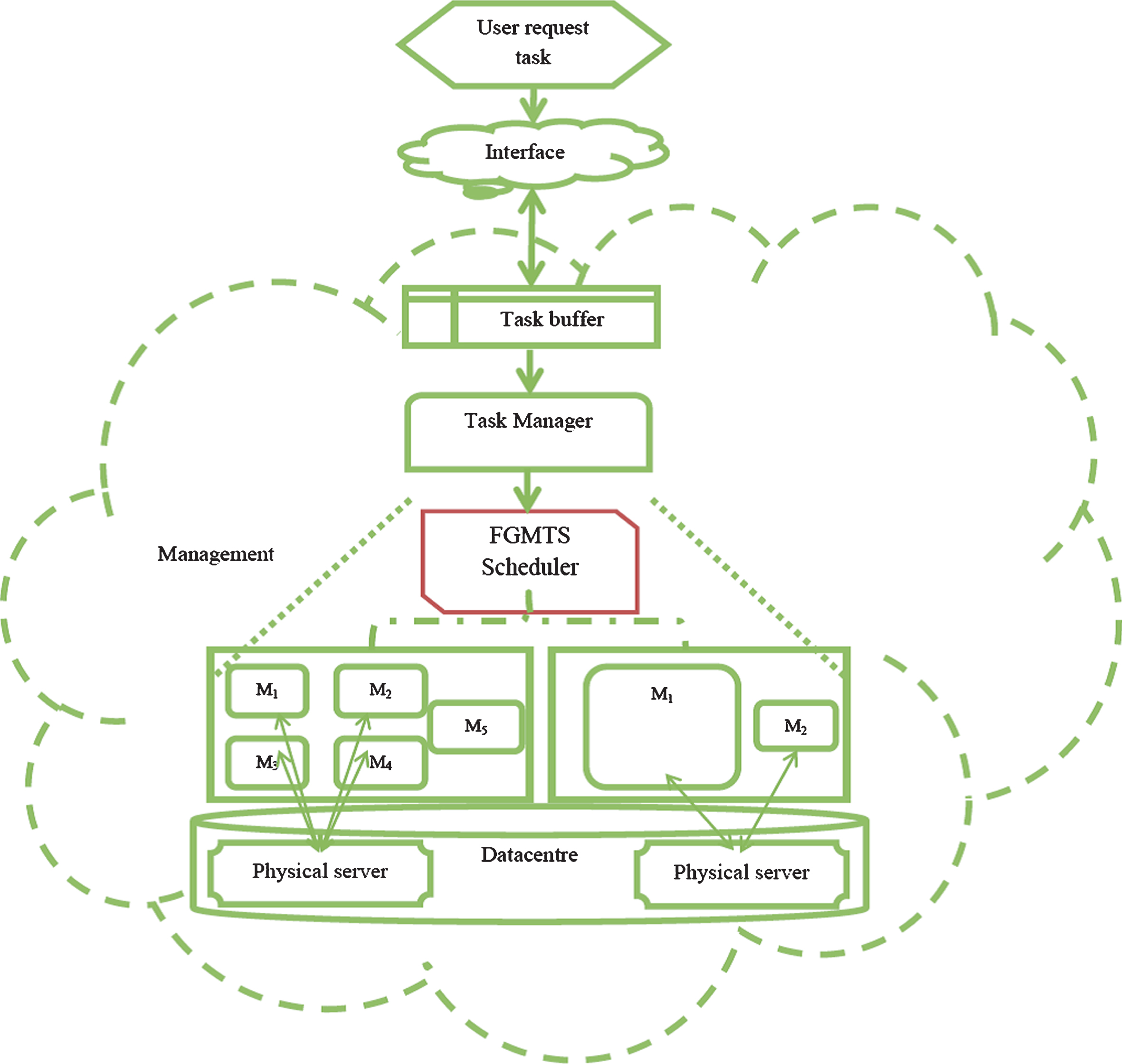
The proposed FGMTS model structure for task scheduling in the cloud computing environment is presented in this section. The system framework for the proposed model is shown in Fig. 1.
FGMTS model structure.
Here, the user submitted request tasks are sent to cloud environment via a user interface (internet). In the cloud, the submitted tasks are accepted by the task buffer and managed by task manager. The task manager monitors the condition of physical serves and manages to obtain their CPU and memory information. And the information of the local resources is fed to the scheduler; FGMTS Scheduler (Fractional Grey wolf Multi-objective task scheduler).
The FGMTS scheduler is the proposed scheduler for allocating resources for submitted tasks. The sole responsibility of FGMTS is to allocate resources using the optimization scheduling method. The scheduling algorithm comprises the integration of fraction theory and grey wolf optimization algorithm. Based on the collected information from the task manager, if the particular resource of the server meets the requirements of the task, the resource is allocated by the scheduler. The requirements of task are fulfilled in such a way by employing multi-objective functions improving the performance of the cloud. The resources are allocated for task execution with minimal execution time, communication time, energy consumption and better resource utilization with the quality of service constraints. The fractional grey wolf optimization algorithm is implemented in such a way scheduling the tasks only based on their objectives not based on their priorities.
In the proposed scheduling strategy, the task scheduling algorithm is performed with following scenario’s; i)Tasks from the user request is divided into subtasks, and the amount of subtasks derived from each task will be different, ii) data transmission between subtask is possible, iii) The physical servers are heterogeneous and distributed, iv) bandwidth between virtual resources is different and varies over time.
The cloud setup model is described in this section. The ultimate aim of the cloud is to allocate the resource for the execution of the user requested application task. The resources for the task execution are provided from the cloud data center. The cloud model is depicted in Fig. 2.

Cloud setup.
In the data center, multiple numbers of physical servers or resources are available. Using virtualization phenomena of cloud, resources are provided as the virtual resources from the physical resources. Each of the physical servers has a different number of virtual resources with different memory capacity, CPU, etc. In Fig. 2, S denotes the Physical server of the data center. The Physical server is represented by S ={ S1, S2, …… S h }. For each Server S, different numbers of virtual machines are available. For the Physical server S1, two virtual machines are available; similarly, for server S2, three virtual resources are available and so on. The virtual resource in the physical server is epitomized by M ={ m1, m2, … m j … m n }. Each of virtual machine M j has a processing capacity C j and a resource cost RC j . Based on processing capacity and resource cost, the input tasks of users are scheduled with virtual resources. If user task needs the virtual machine with more processing capacity, only M with maximal storage capacity is reflected for resource scheduling. The individual tasks are allocated with only one resource from the physical server.
The client request tasks to the cloud are represented by Task, T ={ t1, t2, t3, …… t
i
, …… t
m
}; m number of tasks. Each of the tasks is divided into a number of subtasks. The total number of subtask in the submitted request is given by;
Task setup model is shown in Fig. 3. Here, Task T is given by T ={ t1, t2, t3, … t
m
}. Each of tasks is divided into subtasks and is given by;

Task setup.
The bandwidth between two subtasks is given by
The relation between the task T and virtual machine M is uttered by making use of a distribution matrix V, and the value of V is given by;
The elemental value of distribution matrix depends on the ability of task and virtual resource. The value of v
ij
is 1 only if the task t
i
(subtask) is allocated with resources by m
j
. The term
Each of virtual resources has the cost of transmission of data per unit time, i.e., TC. Based on transmitting cost, resources will be selected centered on the user budget. If the user budget is hefty, the virtual resources with high transmitting cost are provided for the execution of application task, and if user budget is low, resource nodes with low transmitting cost are selected for execution.
The multi-objective formulation proposed for the FGMTS scheduling strategy is discussed in this section.
The motive for the consideration of multi-objective formulation approach is that instead of seeking an optimal solution based on single objective, multi-objective optimization approach aims to get the optimal solution based on multiple objectives [14]. However in multi-objective optimization approach solutions inherited with all objectives are difficult to attain. But the solution can be designated without worsening other objective in the multi-objectives considered, improving the performance of the cloud [23]. The proposed multi-objective model approach made a fine grain estimate of real infrastructure usage aiding in proper estimation of optimal schedule that would be consumed for each run of an application through the allocation of resources with minimal execution and communication cost and time, energy consumption, and resource utilization.
The multi-objective formulated for optimization includes the constraints related to the Quality of Service, Cost, System performance, energy consumption, completion time, etc. The main targets as the objectives in the proposed multi-objective optimization algorithm are execution time, communication time, execution cost, communication cost, energy consumption, and resource utilization. The utmost intention is to minimize the execution, communication time and cost, minimize energy consumption, and to maximize resource utilization. Consequently, six objectives are considered in the proposed multi-objective formulation approach. The objective regarding constraints of cost, time, energy consumption, resource utilization are reflected below:
Here, V
ij
is distribution matrix relating the virtual machine resource & task, P is processing capacity of the resource; T is a number of tasks and set
ij
is execution time of subtasks. Since the objective is to obtain the task run with minimum execution time, the objective function is given by;
The proposed FGMTS task scheduling strategy using optimization algorithm is discussed in this section.
The Task scheduling algorithm requires us to find the optimal solution from a large number of feasible solutions in search space. Many of heuristic algorithms are used for the task scheduling algorithm such as genetic algorithm (GA) [25], Ant Colony optimization algorithm (ACO) [12], Particle Swarm optimization algorithm (PSO) [11], etc. But in the existing optimization algorithms, local optima problem and handling of multi-objectives are difficult. In this paper, task scheduling in the cloud is performed using the proposed FGMTS algorithm. Optimization algorithm developed is the integration of fractional theory [28] and fractional grey wolf optimization algorithm [26].
a) Solution Encoding:
In proposed FGMTS algorithm, a possible solution is in the form of the grey wolf population. The encoding means to denote the possible solution of optimization.
b) Fitness Evaluation:
The fitness evaluation is an important step in proposed fractional multi-objective grey wolf optimization algorithm. The fitness value is used to evaluate the user experience. The grey wolf population with higher fitness value have a greater probability to be inherited as the optimal resource for task execution. In the user experience, the task execution should be done with minimal cost, time and energy, and maximal resource utilization. In this paper, we choose 6 of formulated Multi-objective as evaluation criteria to conduct the multi-objective optimization.
The solution vector of the FGMTS algorithm is converted into distribution matrix V
ij
which expresses the relation between task and virtual resource. Using the data length of task and processing capacity of virtual resource, the execution time of the task is also calculated. The value of V
ij
and set
ij
are calculated for computation of fitness value of concerned solution vector chosen as the optimal schedule. The fitness evaluation function is given by;
The result and discussion of experimentation of proposed task scheduling strategy using F-MOGWO algorithm are presented in this section.
A) Experimental set up:
The runtime environment of the proposed task scheduling algorithm is windows 10 with Intel i-3 core processor, 2 GB RAM, and the implementation of the proposed algorithm is performed using Cloudsim tool with Java. The experimentation of proposed FMTS strategy is performed over two cloud setups. The description of cloud setup considered for experimentation is given below;
Setup 1:
Cloud setup 1 consists of 5 physical servers, providing resources for task execution via 14 virtual machines. The user application request consists of 5 tasks which are subdivided into 17 subtasks.
Setup 2:
Cloud setup 2 consists of 10 physical servers with 24 virtual machines for providing resources for task execution. The user application requests with 10 tasks which are subdivided into 28 subtasks are considered in cloud setup 2.
B) Comparative Methods:
The performance of proposed task scheduling algorithm using FGMTS is validated over the existing task scheduling algorithms using PSO [11], GA [25], and conventional Grey Wolf optimizer.
C) Performance measures:
The performance evaluation of comparative methods is analyzed using the formulated objective functions regarding measures such as Execution Time, Communication Time, Execution Cost, Communication cost, Energy consumption and resource utilization.
Performance evaluation
The performance evaluation of proposed FGMTS task scheduling algorithm over the existing methods using formulated objective functions is presented in this section.
i) Analysis based on objective 1:
The analysis based on objective function 1 over experimentation of cloud setup 1 and cloud setup 2 is presented below. Objective function 1 resembles the minimal execution time value. The evaluation chart for analysis based on execution time is given in Fig. 4. The experimentation is performed for five iterations (t = 1, 2, 3, 4 and 5). Figure 4a represents execution time evaluation chart for cloud setup 1. At iteration t = 1, the minimal execution time value of 0.4484 is attained by proposed FGMTS method. But the value 0.715, 0.4861, and 0.4516 attained by existing PSO, GA and GWO methods respectively are larger than that of ET value attained by the proposed method. Similarly, for iteration t = 2, 3, 4, and 5, the ET value attained proposed FGMTS method is 0.4484 which is lower than values of existing methods. Figure 4b represents execution time evaluation chart for cloud setup 2. At t = 1, the execution time (ET) of existing PSO, GA and GWO method is 0.3125, 0.3125 and 0.286 respectively, whereas the proposed FGMTS method attained the ET of 0.2246 which is less than that of existing methods. Similarly, for t = 2, 3, 4 and 5, ET attained by proposed FGMTS is 0.1949, 0.2808, 0.1906, and 0.2221 respectively which is minimal than that of objective function 1 attained in the existing methods. The best case ET value of 0.1906 is attained by the proposed method at iteration t = 4 and the worst case ET value of 0.3125 is attained by PSO method for all iterations considered for experimentation.

Evaluation based on execution time.
ii) Analysis based on objective 2:
In this section, the performance validation of comparative methods based on objective function 2 is discussed. Objective function 2 resembles the minimal communication time. The evaluation chart based on communication time for setup 1 and setup 2 is depicted in Fig. 5a and b respectively. For cloud setup 1, at iteration t = 1, the communication time value attained by the existing methods PSO, GA, and GWO is 0.1814 respectively, whereas the proposed FGMTS method attained the CT value of 0.1814 which is same as that of value attained by existing methods. For consecutive iterations t = 2, 3, 4, and 5, the CT value attained by proposed and existing method remains same. The same CT value proves the fact that proposed FGMTS algorithm doesn’t degrade below the existing methods. For cloud setup 2, at iteration t = 1, the CT attained by the proposed FGMTS method is 0.1747, at the same time CT value attained by existing method PSO, GA and GWO is 0.1747 respectively. For entire iterations considered for experimentation, CT value attained by all comparative methods is equal. By totaling the communication time of existing method, the proposed FGMTS method proves the ability in task scheduling algorithm ofthe cloud.

Evaluation based on communication time.
iii) Analysis based on objective 3:
The evaluation based on objective function 3 is deliberated in this section. Objective function 3 resembles the minimal execution cost. Figure 6a and b represent the evaluation chart for analysis based on execution cost for cloud setup 1 and cloud setup 2 respectively. From Fig. 6a, it is evident that, at t = 1, the execution cost value attained by the proposed method is 0.0814 whereas the existing methods PSO, GA and GWO attained EC value of 0.0856, 0.0861, and 0.0854 respectively. The EC value of proposed FGMTS method is minimal compared to EC value of existing methods. For iteration t = 3, 4, and 5, the EC value attained by existing methods PSO, GA and GWO is 0.09, 0.0861, and 0.0854 respectively which is greater than value 0.0814 attained by proposed FGMTS. From 6b, it is clear that for cloud setup 2, at iteration t = 1, the execution cost value attained by the existing methods PSO, GA, and GWO is 0.0175, 0.0146, and 0.0187 respectively, whereas the proposed FGMTS method attained the execution cost of 0.0178. With the increase in the iteration, the EC values of existing PSO and GWO remains same. But the EC value of GA falls for consecutive iterations compared to PSO and GA. However, the EC value attained by the proposed FGMTS method for iterations t = 2, 3, 4, and 5 is lower than that of existing methods proving the efficacy of proposed scheduling algorithm.

Evaluation based on execution cost.
iv) Analysis based on objective 4:
In this section, the analysis based on objective function 4 is presented. Objective function resemblesminimal communication cost for task execution in the cloud. The evaluation chart for analysis based on communication cost is given in Fig. 7. For cloud setup 1 as shown in 7a, at t = 1, the CC value attained by proposed FGMTS method is 0.009 less than value attained by existing PSO and GA method and 0.0057 less than value attained by GWO method. Likewise, for iteration t = 2, the CC value attained by existing methods PSO, GA, and GWO is 0.109, 0.109, and 0.1057 respectively, whereas the proposed FGMTS method attained the CC value of 0.1 which is minimal than the value attained by existing methods. For consecutive iterations, the CC value of proposed methods seems minimal compared to the value of PSO, GA and GWO method. For cloud setup 2, as shown in Fig. 7b, at t = 1, the communication cost value attained by the proposed method is 0.087, whereas the existing method PSO, GA and GWO attained the CC value of 0.09, 0.0871 and 0.0871 respectively which are greater than the value achieved by the proposed method. Greater the communication cost, worse the performance of cloud. At iteration t = 2, 3, 4, and 5, the CC value remains the same as attained in iteration 1. The best case CC value of 0.087 is attained by proposed FGMTS method for all iterations, and the worst case CC value of 0.09 is attained by existing PSO method for all iterations.
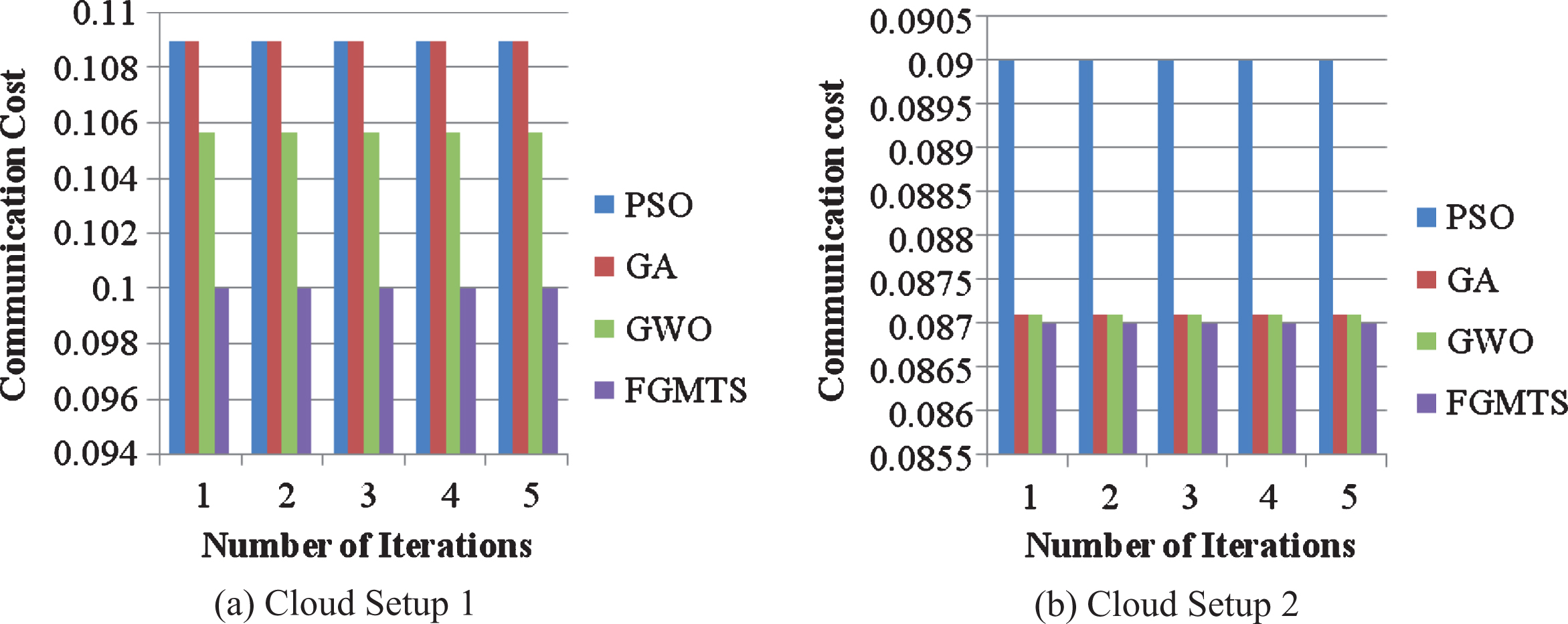
Evaluation based on communication cost.
Table 1 shows the comparative discussion of the proposed method with the existing methods for setup 1 and setup 2. For setup 1, the existing methods, such as PSO, GA, and GWO have the execution time of 0.4681, 0.4681, and 0.4516 respectively. On the other hand, the proposed FGMTS has the execution time of 0.4484. The existing methods, like PSO, GA, and GWO and the proposed method have the communication time of 0.1814. The proposed FGMTS has the execution cost of 0.0814 while the existing methods, PSO, GA, and GWO have the execution cost of 0.0768, 0.0861, and 0.0854.The proposed method has the minimum communication cost of 0.1 than the existing methods. The existing methods, such as GA, and GWO have the energy consumption of 0.0336 and 0.3145 but the proposed method has the minimum energy consumption of 0.3048. Similarly, the proposed method has the minimum resource utilization of 0.5674 than the existing methods, such as GA and GWO. Similarly, for setup 2, the proposed method has the better performance than the existing methods by obtaining the minimum execution time, execution cost, communication cost, energy consumption, and resource utilization.
Comparative Discussion of the proposed method with the existing methods
Comparative Discussion of the proposed method with the existing methods
In this paper, a novel multi-objective scheduling strategy, FGMTS was proposed. The proposed scheduling algorithm is the combination of the fractional theory and Grey Wolf optimization algorithm. The integration of the fractional theory and Grey Wolf optimization algorithm increased the convergence in attaining an optimal solution. The fitness function adopted in the proposed FGWO algorithm obtained the optimal solution with maximized resource utilization increasing the profit of the cloud provider and with minimized execution time, communication time, execution cost, communication cost and energy. Thereby, task scheduling was done with a proper trade-off between multiobjective parameters. The experimentation of the proposed FGWO-MT Strategy is performed over two cloud setups. The performance of the proposed task scheduling strategy is compared over the existing technique using the measures execution time, communication time, execution cost, communication cost, resource utilization rate, and energy. The experimental results show that FGWO based MTS algorithm is an effective scheduling algorithm, producing more stable and acceptable schedules for the user application task.