



Abstract
Objective image quality assessment plays an important role in various computer vision and image processing applications. The most widely used image quality measures are the classical mean squared error (MSE), computed by averaging the squared intensity differences of distorted and reference image pixels, and its related quantity of the peak signal-to-noise ratio (PSNR). Unfortunately, these measures are not very well matched to perceived visual quality. In this paper, we propose a measure based on the intuitionistic fuzzy set theory, whose performance would be more closely related to the human perception of visual quality. The proposed measure provides a flexible mathematical framework for modelling of imprecise or/and imperfect information often present in digital images. Furthermore, we show how the neighborhood-based intuitionistic fuzzy similarity measures can be combined with intuitionistic fuzzy inclusion measures for improving the perceptive behavior of intuitionistic fuzzy similarity measures. The performance of the proposed measure is evaluated on a set of real images with different distortion types and the obtained results demonstrate its advantages over the classical measures.
Keywords
Introduction
Image quality measurement aims to assess the perceptual quality of image and plays a major role in numerous image processing and computer vision applications. It is usually adopted to measure the visual distortion of compressed images/video so as to evaluate the performance of lossy image compression; it can also be utilized to quantify the visual quality refinement after image enhancement [1, 2]. Thus, a central problem in these applications is determining the distance between images. It can be classified into objective and subjective methods [3]. Subjective methods relies on human diligence and work without reference to evident criteria [4] an the efficiency of these methods is measured by the extent of reconstruction errors visibility. It seems to be meaningful since there are no satisfactory mathematical models serving this task. As a result, a quality measure that predict the human perceptual sensitivity to distortion of images is beneficial to the design and evaluation of image processing algorithms. On the other hand, objective methods are often referred to as being based on comparisons using explicit numerical criteria. That is, the main goal of objective image quality assessment research is to design computational models that can predict perceived image quality accurately and automatically.
To this end, several objective quality measures are proposed in the literature [5, 6]. Among all of them, the mean squared error (MSE) and its related measures like peak signal-to-noise ratio (PSNR) are the most widely used measurements in image fidelity due to their analytic simplicity. But, these measures do not accurately measure the perceived distortion and their performances are not satisfactory in many scenarios [7]. Therefore, several image quality measures have been introduced in the literature to solve the problem of image comparison [8–12].
Recently, there have been strenuous efforts to design an objective quality measures based on fuzzy similarity measures [2, 14]. One significant problem associated with these quality measures is the selection of applicable fuzzy similarity measures to images comparison. In [15], Weken et al. showed that several similarity measures used to compare fuzzy sets can also be applied successfully in image processing. However, the pixel-based similarity measures still have some flaws in the sense of image quality estimation [16]. To cope with this drawback, fuzzy similarity based on homogeneity have been used in the image quality evaluation procedure for better observation of image’s relevant structures [17].
The intuitionistic fuzzy set (IFS) theory [18] is utilized in measuring the similarity between images. Essentially, the similarities/distances between IFSs are the extensions of conventional similarity/distance functions [19]. Several similarity measures based on the IFSs are surveyed in [20]. For instance, Farhadinia [21] introduced a similarity measure based on a distance defined on an interval using convex combination of endpoints that considers the property of min and max operators. While, a set of intuitionistic fuzzy similarity measures based on min max operators as a generalization of some known measures is proposed in [22]. Another similarity measure with high capacity for discriminating IFSs is introduced in [23] based on the direct operation on the membership, non-membership and hesitation functions as well as the upper bound of two IFSs membership functions. Nguyen [24] introduced a similarity measure based on the concept of a knowledge measure of information conveyed by the IFS. It is shown that this measure overcomes the drawbacks of existing measures on the problem of pattern recognition. Motivated by the success of IFS-based similarity measure in a variety of applications, this paper presents a set of image quality measures which are based on a twofold usage of IFS-based similarity measures introduced in [20] and inclusion measures which can be applied to image’s histograms introduced in [25]. The performance of the proposed measures is tested on a set of natural images with different distortion types and we conduct a comparison between the IFS-based measures and the classical MSE/PSNR metrics.
The rest of this paper is organized as follows. Section 2 presents the necessary basic concepts and provides a brief introduction to intuitionistic fuzzy theory. While, the details of the proposed measures based on combining the IFS-based inclusion and IFS-based similarity measures are presented in Section 3. Section 4 presents the experiment results and the associated discussions. Finally, Section 5 concludes the paper.
Preliminaries
This section presents the necessary basic concepts that will be used in this paper. Also, it provides a brief introduction to intuitionistic fuzzy image processing.
Intuitionistic fuzzy sets
The values of μ
A
(x) and ν
A
(x) denote the belongingness and non-belongingness degrees of x in A, respectively. For an IFS A in X, the intuitionistic fuzzy index of an element x ∈ X in A is given by the following equation:
Clearly, a fuzzy set F can be represented by using the notation of IFS as follows
In what follows, IFS (X) refers to the family of all intuitionistic fuzzy sets on X. The following basic operations on IFSs will be needed in our paper.
A ⊆ B iff μ
A
(x) ≤ μ
B
(x) and ν
A
(x) ≥ ν
B
(x) for each x ∈ X. A = B iff A ⊆ B and B ⊆ A. thicksimA = {〈x, ν
A
(x) , μ
A
(x) 〉|x ∈ X}. A ∪ B = {〈 x, max { μ
A
(x), μ
B
(x) },min { ν
A
(x), ν
B
(x) } 〉 |x ∈ X}. A ∩ B = { 〈 x,min { μ
A
(x),μ
B
(x) },max { ν
A
(x),ν
B
(x)} 〉|x ∈ X}.
An image A of M × N size and L levels of grayness can be considered as M × N array of fuzzy singletons relating the intensity values of the image pixels. In order to represent the image A in intuitionistic fuzzy set (IFS) theory, many techniques are used. In 2007, Vlachos and Sergiadis [27] used gamma membership function to construct the membership values of the pixels of an image and used cross entropy to find the optimum threshold. Later on, a different approach used by Couto et al. [28] in the calculation of hesitation degree and used intuitionistic fuzzy entropy to find the optimum threshold. Several techniques introduced by T. Chaira can be found in [29–32]. In this paper, we construct the membership of IFS-image by setting the exponential fuzzifier F
e
= 2 and calculating the denominational fuzzifier F
d
from the following equation:
An M × N pixels image A of L gray level ranging between 0 and L - 1 is represented by the IFS as follows
An example for construction of IFS images from gray scale images using the above method is shown in Fig. 1.

Representation of the intuitionistic fuzzy images: (a) Original image, (b) Membership function image, and (c) Non-membership function image.
Histogram-based techniques are characterized by their simplicity and speed compared to their pixel-based counterparts. In [33, 34], Vlachos and Sergiadis proposed an automated approach for constructing the intuitionistic fuzzy histogram (IFS-based histogram) of a gray-scale and color images based on the notion of intuitionistic fuzzy numbers (i.e., IFS-based numbers). Where, the value of the histogram denoted by h A (g) of an image A in the gray value g is equal to the total number of pixels with the gray value g.
Figure 2 depicts fuzzy histogram and IFS-based histogram of “Cat” image shown in Fig. 1, where the lower and upper normalized IFS-based histogram are in red and blue lines in Fig. 2(b), respectively.
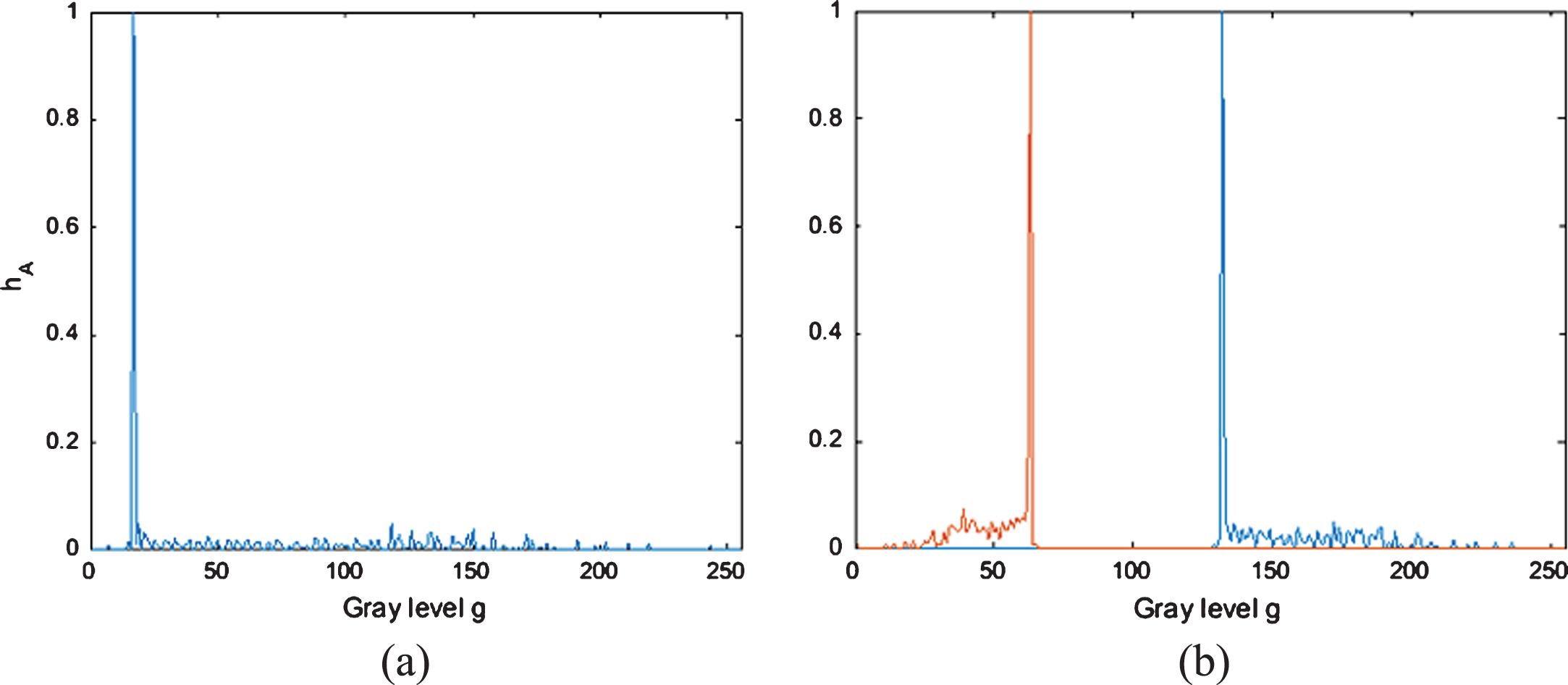
(a) Normalized crisp histogram for the original image of Fig. 1, (b) Corresponding lower (red line) and upper (blue line) normalized IFS-based histograms.
IFS-based inclusion measure is an important topic in IFS theory. It is a pairwise relation between two IFSs, which express the degree of the inclusion between two IFS. Xie et al. [25] redefined the IFS-based inclusion measure of [35, 36] and five IFS-inclusion measures are constructed by means of different operators. Moreover, they showed that the IFS-based similarity measures obtained from IFS-based inclusion measures hold the normal similarity measures’s properties.
if μ
A
(x) ≥ ν
A
(x) for all x ∈ X, then if A ⊆ B ⊆ C, then
The following IFS-based inclusion measures were defined in [25]:
IFS-based inclusion measures can be combined together by using a t-norm to construct a similarity measure. Suppose that
This relation based on the crisp expression
In our experiment, we will use the product t-norm
IFS-based similarity measures is a relation which can be seen as an intuitionistic fuzzification of crisp equivalence relation, and it is an important tool for determining the degree of similarity between two objects. Many different similarities between IFSs have been proposed in the literatures. Let S (A, B) be a similarity measure between two IFSs A, B ∈ IFS (X). Where, each set represents an IFS image of size M × N. The following IFS-based similarity measures were defined in [14, 38–42]:
To enhance the perceptive behavior of similarity measures, Hasaballah and Ghareeb [20] introduced a neighborhood-based similarity scheme by combining image’s homogeneity in the different neighborhoods. Firstly, the compared images A and B are divided into disjoint 4 × 4 parts and we measure the similarity between the asymmetric parts of these two images using pixel-based similarity measures. Suppose that each image is divided into P parts of size 4 × 4, and let the restricted similarity S (A
i
, B
i
) between two parts A
i
and B
i
of A and B, respectively; then the total similarity S
P
between A and B is the weighted average of the similarities in asymmetric disjoint image parts. That is,

Intuitionistic fuzzy model of an image: each pixel consists of membership and non-membership degree of intensity value.
Clearly, a pixel has a maximum intensity if it has a maximum degree of membership and minimum degree of non-membership, while it has a minimum intensity if it has a minimum degree of membership and maximum degree of non-membership. Moreover, the homogeneity of the image can be calculated as the similarity between the gray-values of the pixel with maximum intensity and the gray-values of the pixel with minimum intensity using the following resemblance relation
The weight w
p
is calculated using
It should be note that the weight w p is a similarity measure between the homogeneity of corresponding image parts, where the distance d in Equation (20) is L1-distance between the two values h A and h B .
Historically, image quality is known as the visibility of image’s distortion, like colour shifts, blurriness, blockiness and Gaussian noise. Therefore, the most used technique for modeling an image quality measure is by quantification of the visibility of these distortions. In this paper, we present a set of image quality measures which are rely on a twofold usage of ne-based similarity measures introduced in [20] and inclusion measures introduced in [25] which can be applied to image’s histograms. The proposed IFS-based image quality measures are simply given by combining the neighborhood-based similarity measures and the IFS-based similarity measures
Equation 23 represents the proposed mathematical universal image quality measures. The term “universal” means that the measurement independent of tested images, viewing conditions, or individual observers.
To test the efficiency of the proposed IFS-based image quality measures, a set of experiments is carried on “Monkey” image shown in Fig. 4. Five kinds of distortions are applied on the image and we compare the results with pixel-based, neighborhood-based similarity measures, MSE, and PSNR. The image is affected by the following types of distortions such that the distorted images have the same MSE and PSNR relative to original image: Implusive salt & pepper noise. Multiplicative speckle noise. Enlightening. Blurring. JPEG compression.
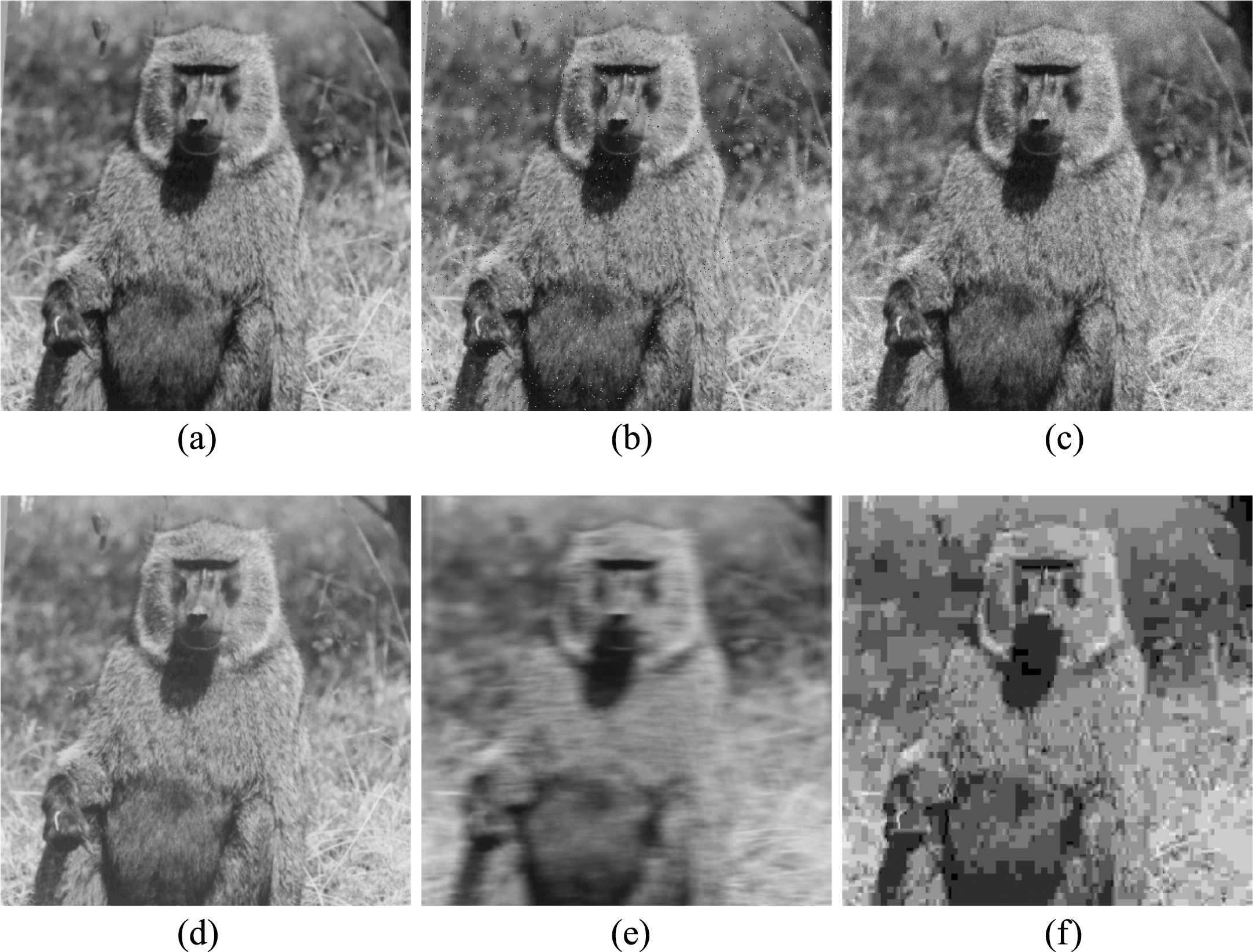
(a) The original ’Monkey’ image, (b) Impulsive salt & pepper noise. (c) Multiplicative speckle noise, (d) Enlightened, (e) Blurring, (f) JPEG compression.
Figure 4 displays the original and distorted images. Table 1 shows the poor performance of pixel-based similarity, MSE and PSNR measures compared to neighborhood-based similarity measures. While, the results of the proposed IFS-based image quality measures Qi,j where i = 1, …, 6 and j = 1, …, 4 compared to MSE and PSNR are displayed in Table 2.
Performance of pixel-based and neighborhood-based IFS-similarity measures compared to MSE/PSNR for ‘Monkey’ image
Performance of the new IFS-based image quality measures compared to MSE/PSNR for ’Monkey’ image
The results shows poorness of MSE and PSNR performance in the sense that images with nearly identical MSE and PSNR are drastically different in perceived quality. In contrast, the proposed IFS-based image quality measures yields significantly better results in comparison with MSE and PSNR. Furthermore, it can be note that incorporating the homogeneity make the similarity values are more reliable, where these values are decreased according to the noise type as reported in Table 2. Thus, the construction of neighborhood-based similarity scheme considering homogeneity of images seems to be very useful for computing reliably the similarity value, specifically for eliminating the effect of simple structured regions within compared images.
In this paper, we proposed new image quality measures based on a twofold usage of IFS-based similarity and IFS-based inclusion measures. We made use of the neighborhood-based similarity measures and employed the IFS-based inclusion measures, which can be applied to IFS-based histograms of images. From the obtained results, it can be conclude that the pixel-based similarity measures such as MSE and PSNR give wrong indication for measuring image’s quality. Compared to the existing relevant image quality measures, the proposed IFS-based metric has been shown to outperform the pixel-based similarity measures under different types of image distortions. The future work will be aimed at measuring the quality of color image and extending the proposed measures to assess other kinds of distortion as well as improving their performance to be able to produce quality scores that are more consistent with human perception.
Compliance with ethical standards
The authors declare that they haven’t received research grants from any institution and they have no conflict of interest. Moreover, this article does not contain any studies with human participants or animals performed by any of the authors.
Footnotes
Acknowledgments
The authors would like to express their sincere thanks to the associate editor Prof. Maria Guijarro. Also, the authors express their sincere thanks to the anonymous reviewers for their careful reading and constructive comments.