



Abstract
A linear programming with triangular intuitionistic fuzzy parameters is focused in this paper. As a shortcoming, all the solution approaches of the literature for this problem are constructed based on ranking functions, where, use of different ranking functions may result in different solutions. In this study for the first time an approach with no ranking function is developed for the problem. For this aim, the triangular intuitionistic fuzzy objective function is decomposed to a multi-objective function, and the problem is converted to a multi-objective crisp problem. As another contribution, in order to solve the obtained multi-objective problem for its efficient solutions, a new multi-objective optimization approach was developed and suited to the obtained crisp multi-objective problem. The computational experiments of the study, show the superiority of the proposed multi-objective optimization approach over the existing approaches of the literature.
Keywords
Introduction
Linear programming consists of a set of linear constraints to be satisfied in order to optimize a linear objective function. The optimization direction may be of either maximization or minimization type. Generally, the maximization type objective functions are benefit based, and the minimization type objective functions are cost based. Linear programming is widely used to formulate and optimize real-world problems such as transportation problems, investment problems, budget allocation problems, scheduling problems, assignment problems, etc. According to an initial assumption, linear programming models are constructed based on deterministic parameters. To more realistically formulate the real-world problems, considering uncertain values of these problems is unavoidable (as used by Zamani-Sabzi et al. [35]). So that, use of linear programming models to formulate such real-world problems, introduces uncertain type of linear programming. One of the most used types of uncertainty is fuzzy theory, where, by considering fuzzy parameters in linear programming, fuzzy linear programming is defined.
Fuzzy theory which was first introduced by Zadeh [34] has been employed to formulate many real-life engineering and non-engineering problems. The fuzzy theory became more popular in the case of optimization problems by the excellent study of Bellman and Zadeh [6]. One of the main properties of the fuzzy numbers is that the non-membership degree of the elements is obtained by one minus the membership degree. But, in real world situations as the information may have vagueness or insufficiency, the sum of membership and non-membership degrees can be a value less than one. In such cases fuzzy numbers is not suitable as in these numbers the sum of membership and non-membership degrees is exactly equal to one. To overcome such difficulty, Atanassov [5] introduced the theory of intuitionistic fuzzy set (IFS) that is an extension of fuzzy theory and is highly useful for real life problems to deal with vague information. The most important advantage of IFS comparing to fuzzy set is that it isolates the membership and non-membership degrees of a number of the set in a way that for an element the sum of these degrees is less than or equal to one. Therefore this theory seems to be very applicable when considering vagueness in estimation of parameters by decision maker. For example in the case of transportation problem which is a well-known application of linear programming, some available information of the transportation costs, availabilities and demand values may be vague or insufficient in estimation procedure. Therefore, estimating exact membership functions and also exact non-membership functions may not be possible, where, some hesitation still remain. For this reason, use of IFS may be more realistic than fuzzy set. For more applications of intuitionistic fuzzy numbers the studies of Nayagam et al. [26], Kumar and Hussain [15], Singh and Yadav [30], He et al. [13], etc. can be referred.
According to Wan and Dong [33], fuzzy linear programming problems are of three types. The first class of these problems deals with parameters taking triangular fuzzy numbers (TFNs). Lai and Hwang [17] converted such problems to a multi-objective formulation to solve them. Lotfi et al. [21] applied lexicography and fuzzy approximate approaches to tackle linear programming with TFNs. Kumar et al. [16] also focused on linear programming with TFNs using a conversion based approach. The second class of these problems deals with parameters taking trapezoidal fuzzy numbers (TrFNs). Maleki et al. [23] focused on fully fuzzy linear programming with TrFNs. Meaning that, all parameters and variables are of TrFNs. Liu [20] introduced a method to measure the satisfaction of the constraints in linear programming with TrFNs. Maleki and Mashinchi [22] solved linear programming with TrFNs by a probabilistic approach. Allahviranloo et al. [2] proposed a ranking function based approach for linear programming with TrFNs. Ebrahimnejad [11] proposed a revised fuzzy simplex method for linear programming with TrFNs and obtained some new results. The third class of these problems deals with parameters takingintuitionistic fuzzy numbers. Angelove [4] introduced an approach based on rejection level of the constraints and values of the objective function of intuitionistic fuzzy linear programming to convert it to a crisp form. Dubey et al. [9] represented interval based linear programming with intuitionistic fuzzy linear programming. The studies of Kumar and Hussain [15] and Singh and Yadav [30] include ranking based approaches for intuitionistic transportation problem. For more about fuzzy linear programming, the studies of Allahviranloo et al. [1], Babakordi et al. [7], Kaur and Kumar [14], etc. can be referred.
In this paper we focus to solve linear programming with triangular intuitionistic fuzzy parameters. Linear programming with intuitionistic fuzzy parameters and special cases like transportation problem have been previously focused by Dubey and Mehra [10], Nagoorgani and Ponnalagu [25], Parvathi and Malathi [27], Parvathi and Malathi [28], Suresh et al. [31], Kumar and Hussain [15], Singh and Yadav [30], etc. In all of these studies, ranking functions are applied to crisp the intuitionistic fuzzy parameters and then solve the crisp formulation by classical methods. Using ranking function in the solution procedures is a weakness as using different ranking functions in a solution approach may result in obtaining different solutions. This weakness is a motivation for this study to introduce a solution approach which is not dependent to any ranking function, therefore, it is named direct solution approach. For this aim, the linear programming with triangular intuitionistic fuzzy parameters is converted to a multi-objective crisp linear programming in which considering all the objective functions together gives an intuitionistic objective function value. As another contribution of this study, a new multi-objective optimization approach is proposed to solve the obtained multi-objective crisp linear programming formulation. As an advantage of such approach, it gives more flexibility to decision maker. The obtained results from the computational experiments of the study show the superiority of the proposed multi-objective optimization approach comparing to those of the literature.
The remainder of this paper is organized by the following sections. Section 2 presents some initial definitions of intuitionistic fuzzy numbers. Section 3 describes the mathematical formulation of linear programming with triangular intuitionistic fuzzy parameters and the proposed solution approach. Computational experiments is performed in Section 4. Finally, conclusions are drawn by Section 5.
Initial definitions
Some basic definitions from fuzzy theory which will be applied later in this paper are explained in this sub-section.
where,
There should be a real number r such that
The membership and non-membership functions of the triangular intuitionistic fuzzy number (TIFN)
where
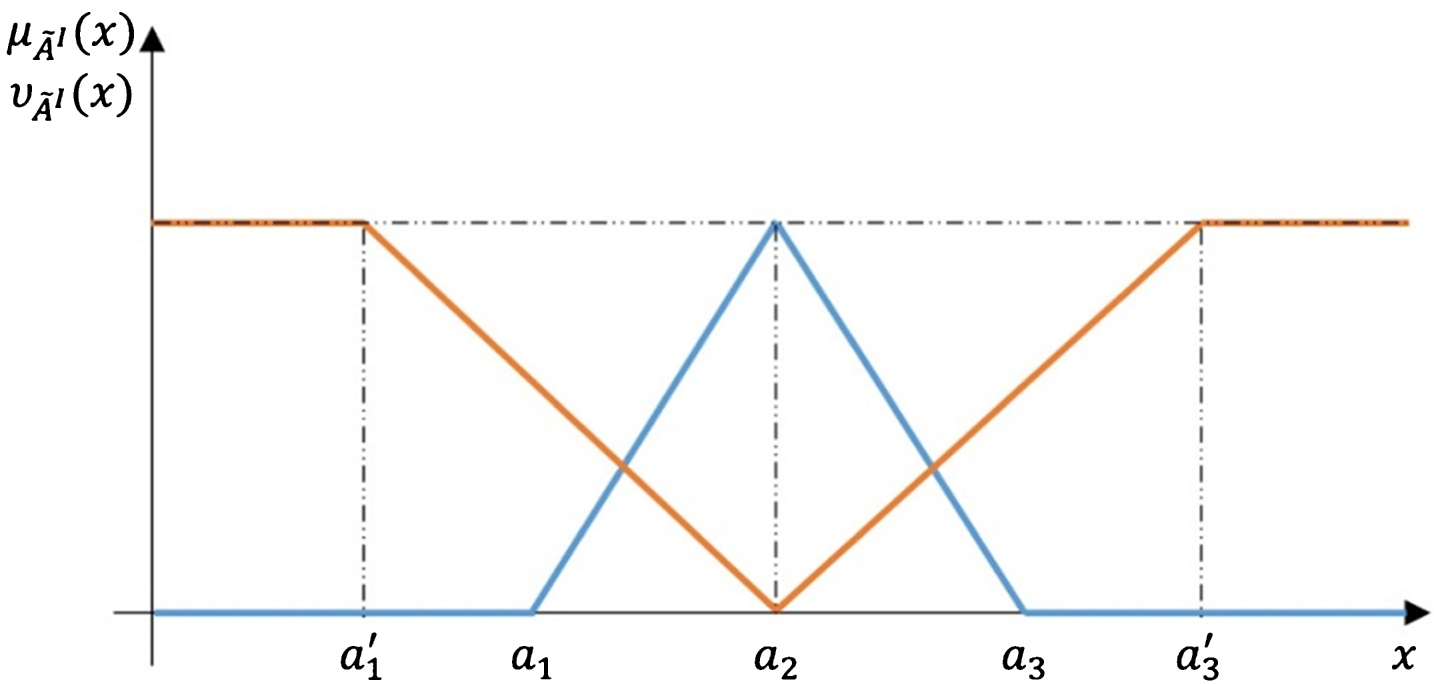
Membership and non-membership functions for a TIFN.
where l1 = min {a1b1, a1b3, a3b1, a3b3}, l2 =a2b2, l3 = max {a1b1, a1b3, a3b1, a3b3},
In extension of linear programming with triangular fuzzy numbers (focused by Lai and Hwang [17], Lotfi et al. [21], Kumar et al. [16]), in this section of the paper a linear programming with TIFNs with n variables and m constraints is defined in two different cases. The notations used in the formulations are defined by Table 1 in advance.
Description of the notations used in the formulations
Description of the notations used in the formulations
For this case of intuitionistic fuzzy linear programming, the coefficients of objective function are TIFNs, while technological coefficients and resource availabilities are of crisp values. The formulation is as follow,
The objective function of model (10) is a TIFN as
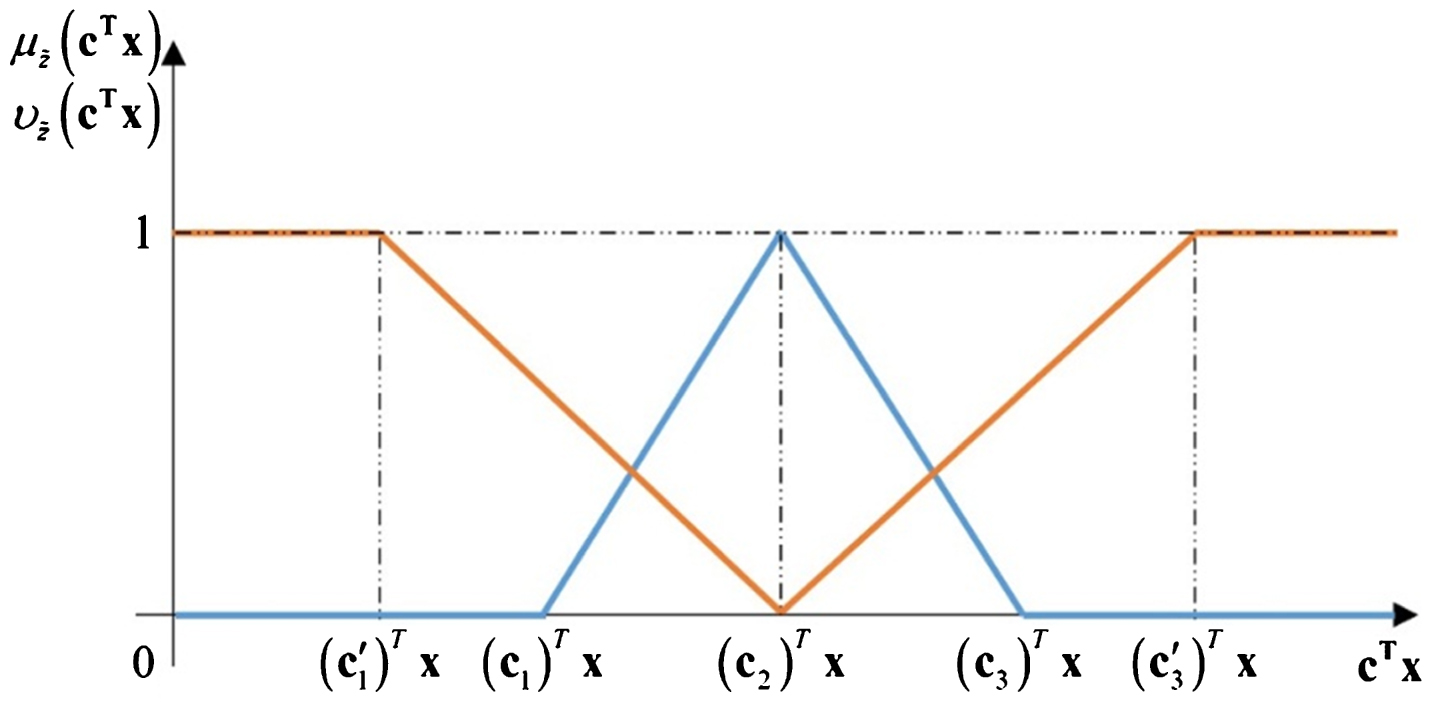
The TIFN of the objective function of models (10).
It is notable to mention that there is no method of decomposition for intuitionistic fuzzy objective function of linear programming problems in the literature. An advantage of this proposed method of decomposetion is that it forces the objective function of the obtained solution to be in a triangular form in both of the membership and non-membership functions (by help of the introduced multi-objective functions). A decomposition method of the literature Gupta and Mehlawat [12] which is used for triangular fuzzy numbers, can be extended to triangular intuitionistic fuzzy numbers, but as a shortcoming, it does not guarantee to have triangular form in both of the membership and non-membership functions of the objective function of the obtainedsolution.
The above-mentioned multi-objective formulation should be solved for efficient (Pareto optimal) solutions. In the literature of multi-objective optimization, various approaches such as goal programming, ɛ-constraint approach, fuzzy programming approach, etc. have been proposed and applied to multi-objective optimization problems. Zimmermann [36] for the first time applied a fuzzy programming approach (max-min operator) to solve a multi-objective model. Unfortunately, his solution approach may not give an efficient (Pareto-optimal) solution in some cases [3]. This weakness of fuzzy programming approach later was focused by the studies that introduced the hybrid versions of fuzzy programming method. LH [18], TH [32], SO [29], ABS [3], are some of these proposed methods (the studies of Celik et al. [8] and Mardani et al. [24] also may be of interest). Here, a new hybrid version of fuzzy programming approach is proposed to solve the model (11). The method is explained in the following steps.
where μ r (Z r ) for r∈ { 1, 2, …, R } (in this case R = 5) is the linear MF of the objective function Z r .
In the formulation (24), the continuous and non-negative variables λ0 and λ r are used to control the minimum satisfaction level of the objective functions as well as their compromise degrees. The value γ (0 ⩽ γ ⩽ 1) is also used to indicate the importance of λ0 and λ r . In the literature of multi-objective optimization γ is set to 0.4 experimentally.
Increase the NIS value for maximization type objective functions. Decrease the PIS value for minimization type objective functions. Change the given value for γ.
In order to obtain the intuitionistic fuzzy objective function value of model (10), the obtained optimal solution from the steps 1–4, is supplied to the objective function formula of model (10), and its intuitionistic fuzzy value is calculated.
The overall solution approach for linear programming with TIFNs is shown by the flowchart of Fig. 3.
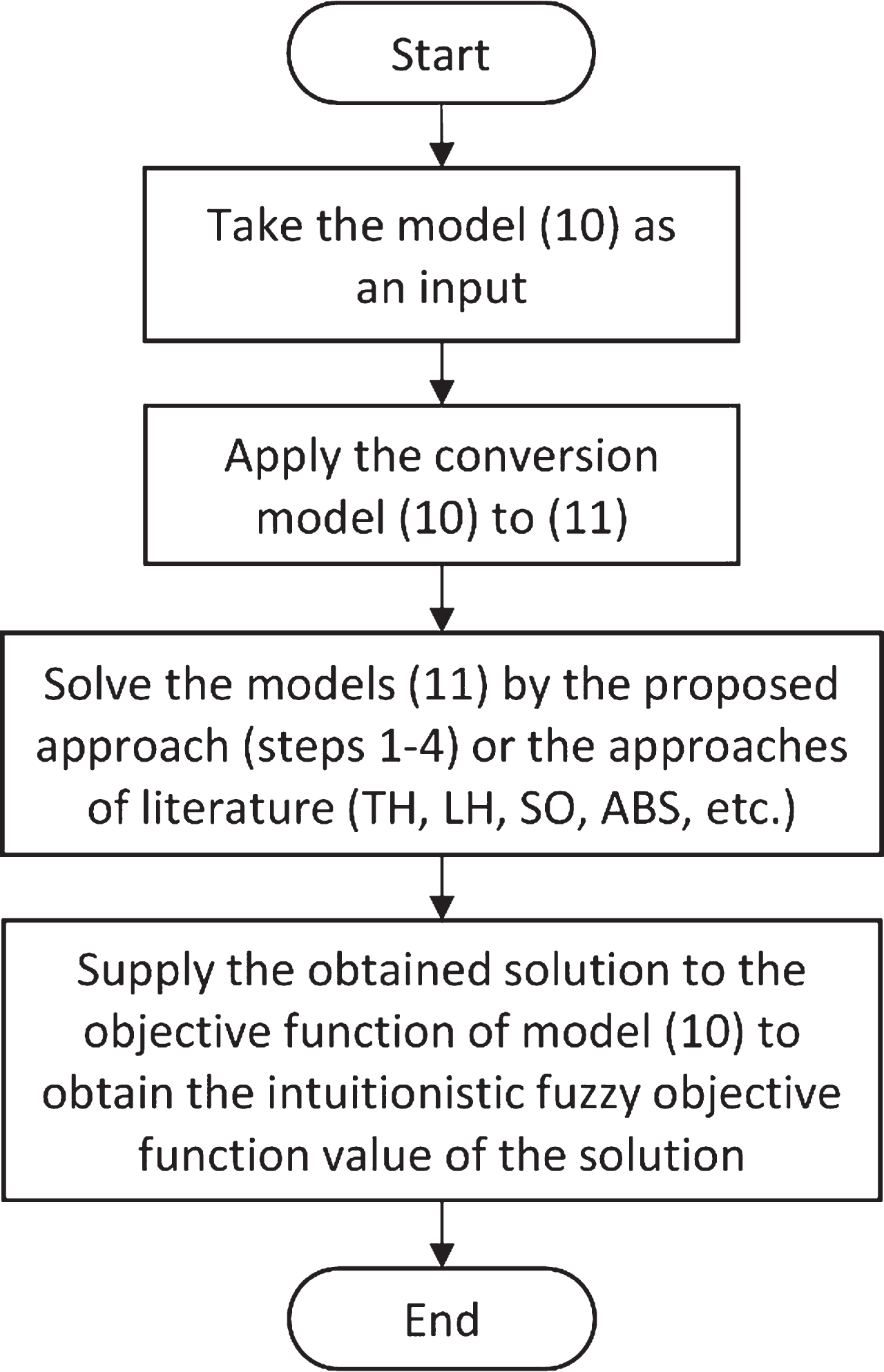
The flowchart of the proposed solution approach for intuitionistic fuzzy linear programming.
For this case of intuitionistic fuzzy linear programming, all coefficients and resource availabilities are TIFNs. The formulation of this case is as follow,
To convert model (25) to its crisp version, the objective function and the constraints should be changed in the conversion process. The same as Case 1, the objective function is converted to five crisp objective functions. On the other hand, considering the concept of Theorem 1, the constraints set of model (25) is converted to five sets of constraints and the equivalent multi-objective crisp formulation is written as follow.
The multi-objective formulation (26) can be solved by the hybrid fuzzy programming approach introduced in the previous sub-section for obtaining efficient (Pareto optimal) solutions.
It is notable to mention that, for a maximization type intuitionistic fuzzy problem, the same concept that resulted in converting the objective function and constraints of model (25) to the model (26) is used. Therefore, the model,
is converted to the following model.
In the cases mentioned in the previous sub-sections, the variables are in deterministic form. If in Case 2 of the intuitionistic fuzzy programming, the variables be considered as TIFNs, a simple modification can be applied to deal with such problem. In such case, first, using multiply operation of two TIFNs shown by Equation (7), the objective function and constraints of the intuitionistic fuzzy programming are simplified, then the decomposition approach which used to convert model (27) to model (28), is applied to decompose the simplified model.
Computational experiments
To study the performances of the proposed solution methodology of Section 3, we consider two example in this section. The first example is a linear programming model while the second one is of one of the applications of linear programming as transportation problem. Those are focused in the following sub-sections. Each example first is converted to its multi-objective crisp form using the conversion described in previous section, then, the multi-objective crisp form is solved by the proposed solution approach of previous section (steps 1–4) and also the multi-objective optimization approaches of the literature like LH [18], TH [32], SO [29], ABS [3] for potential comparisons. It is notable to mention that, Step 4 of the proposed approach is not applied in the examples, meaning that it is assumed the decision maker is satisfied with the obtained solution.
Example 1: Linear programming
As the first example, the following linear programming formulation with TIFN parameters is considered.
According to the solution methodology proposed in Section 3, formulation (29) is converted to the following multi-objective formulation.
As a multi-objective formulation, the model (30) was solved by the proposed solution approach (steps 1–4 of sub-section 3.1) as well as the approaches TH, SO, LH, and ABS. The obtained results are shown by Table 2. It is notable to mentioned that the value of γ is set to 0.4 in the proposed approach and the approaches TH, SO, LH, and ABS (if needed). This value for γ is suggested by the literature [3, 32]. However, using different values for γ in this example proved that this parameter has no effect on the obtained objective function value. And also in some of the approaches TH, SO, LH, and ABS the objective functions are weighted equally (if needed).
The obtained solution for Example 1 by different approaches
The obtained intuitionistic fuzzy objective function values of Table 2 are such obvious that no ranking function is needed for their comparison. According to these results, the highest intuitionistic fuzzy objective function value is obtained by the proposed approach and SO approach together. After these approaches, the TH approach performs better than the others while the lowest intuitionistic fuzzy objective function value is obtained by the LH and ABS approaches together.
In addition to these approaches, the method of Li and Wan [19] was used to solve this example. This method that follows a completely different structure than the approaches used in this study obtained the objective function value of (– 41.660, – 15.544, – 0.585; – 51.544, – 15.544, 7.615) which is exactly the same as the value obtained by TH method.
The performance of the proposed solution approach over those of literature is also evaluated by a transportation problem as one of the mostimportant applications of linear programming. For this aim a transportation problem with the data of Table 3 is considered.
Data of the transportation problem (Example 2)
Data of the transportation problem (Example 2)
According to the data of Table 3, the following linear programming formulation with TIFN parameters is considered.
Applying the methodology of Sub-section 3.1 to this example, the following multi-objective formulation is obtained.
The obtained solution for the variables of Example 2 by different approaches
The obtained intuitionistic fuzzy objective function value of Example 2 by different approaches
The multi-objective model (32) was solved by the proposed solution approach (steps 1–4 of sub-section 3.1) as well as the approaches TH, SO, LH, and ABS. The obtained results are shown by Tables 4 and 5. It is notable to mentioned that the value of γ is set to 0.4 in the proposed approach and the approaches TH, SO, LH, and ABS (if needed). However, using different values for γ in this example proved that this parameter has no effect on the obtained objective function value. And also in some of the approaches TH, SO, LH, and ABS the objective functions are weighted equally (if needed).
The obtained intuitionistic fuzzy objective function values of Table 5 can be compared with no ranking function. According to these results, the lowest intuitionistic fuzzy objective function value is obtained by the proposed approach and SO and ABS approaches together. After these approaches, although, there are some minor differences between the intuitionistic fuzzy objective function values obtained by TH and LH approaches, for an exact comparison of them, applying ranking functions of the literature of fuzzy theory is advised. In addition to these approaches, the method of Li and Wan [19] was used to solve this example. This method obtained the objective function value of (76406.24,83457.39,97218.75;70793.18,83457.39,107584.31) which is exactly the same as the value obtained by TH method.
A linear programming with triangular intuitionistic fuzzy parameters was solved in this paper. As all of the studies of the literature of this problem are constructed based on ranking functions, for the first time an approach with no ranking function was employed for the problem. For this aim, the triangular intuitionistic fuzzy objective function was decomposed to a multi-objective function to be solved instead of the initial problem. In order to solve the obtained multi-objective problem for its efficient solutions, a new multi-objective optimization approach was developed and suited to the obtained multi-objective problem. The computational experiments of the study, show the superiority of the proposed multi-objective optimization approach over the multi-objective optimization approaches of the literature of multi-objectiveoptimization.
As future study on this topic, the effect of ranking function based approaches can be studied and compared with the proposed approach and other approaches that apply no ranking function. Furthermore, fuzzy linear programming with type-2 fuzzy numbers can be of interest for the researchers.
Footnotes
Acknowledgments
The author is grateful of the editors and reviewers of the journal for their helpful and constructive comments that improved the quality of the paper.
This study was supported by Firouzabad Institute of Higher Education (research project no. 1396.001). The author is grateful of this financial support.