



Abstract
The growing attention of the recycling of WEEE led to the making of critical studies on how to manage this process such as to determine one of the most appropriate outsourcing firms. In the recent years, the determination of the most suitable firm to be managed for the recycling of WEEE for private and public institutions is a critical decision that has high level importance in terms of environmental, economic, social and even technological. For this aim, we try to determine the best alternative outsourcing firm for management of WEEE process for Municipality of Eyüp which is a district located in European side of Istanbul by using suggested MCDM methodology based on HFS. In this paper, a multi criteria decision making (MCDM) methodology based on hesitant fuzzy enveloped TOPSIS that gives experts extra flexibility in using linguistic terms to give their assessments has been proposed to determine the best outsourcing firm for Waste of Electrical and Electronic Equipment (WEEE). We have developed a mechanism based on hesitant fuzzy sets (HFS) for enabling decision makers to be easier in evaluation process of WEEE management.
Introduction
Selection of an appropriate outsourcing firm is a multi-criteria decision-making (MCDM) problem that needs detailed analysis from the points of many conflicted criteria. In this detailed analysis, the linguistic factors should also be considered as well as the numerically measurable factors. There is always uncertainty in such a complex decision making problem, and the usage of linguistic information is useful in coping with uncertainty. On the other hand, they are limited occasionally in that the linguistic models use single-valued and predefined terms that delimit the abundance of unrestrainedly ensuring the preferences of the experts and experts may have misgivings between different linguistic terms and need richer expressions to explain their knowledge more veraciously [40]. By the way, inherent complexity of decision-making process and on obtaining more realistic results makes difficult problem to be expressed in absolute crisp number, so researchers are usually apply to fuzzy numbers [24]. In some MCDM process, we have to handle with the situations such as the information about attribute weights is not fully known or exactly unknown due to time pressure, deprivation from knowledge or data, and the expert’s limited expertise about the problem domain. In this case, it would be more appropriate use of hesitant fuzzy sets (HFSs) in decision making process [48]. The use of hesitant fuzzy linguistic term sets (HFLTS) ensures experts a much more flexibleness in eliciting linguistic preferences through the use of context-free grammars that fix the rules to build flexible linguistic expressions to state preferences, especially it allows the use of comparative linguistic expressions [40]. As the proposed decision making methodology becomes fuzzier, more realistic results begin to be achieved as a result of the evaluations of decision makers are better reflected in the process. For this purpose, we aimed to obtain closer results to reality by defining membership functions to linguistic variables for decision makers in hesitant fuzzy environment.
Since developments occur in the global technology and the consumption of electronic goods increase, the industrial sector for production of electrical and electronic equipment (EEE) has become one of the fastest growing sectors in recent years [7]. Due to the growth of this sector, consumption of electronic goods has also increased as well as the production of them. The electronic products such as air conditioners, computer accessories, computers, digital cameras, mobile phones, refrigerators, televisions, and washing machines especially have very high disposal rate in developed countries. The reason for that is the shortening occurred in the life cycle of these products [1]. WEEE must have a disposal process to reduce the bad effect on environment that causes from hazardous substances. In addition, this disposal process may include recycling for obtaining more useful materials [24]. In this paper an outsourcing approach has been suggested to manage WEEE process. The decision related to determine the best outsourcing firm for WEEE management is a completely critical and strategic. Many solution methods have been developed and applied to e-waste management and planning problems [36]. One of the most popular and frequently used in these approaches is MCDM that is a completely effective decision-making tool for the solution of complex multi-criteria problems by taking into account qualitative and quantitative aspects [25, 36].
In this paper, hesitant fuzzy sets (HFSs) that able to use for linguistic variables for the selection of the best outsourcing firm has been used in MCDM process. Outsourcing firm selection analysis is performed by using fuzzy MCDM approach based on HFSs for Eyüp Municipality in Istanbul which is one of the largest and busiest districts. This paper is the first work for selecting WEEE outsourcing firm with using HFSs. By the way, HFSs are applied with fuzzy envelopes for the first time. So that the uncertainty, which is the intended use of the fuzzy sets, is better expressed, resulting in closer results to the reality. In this respect we claim that our work will contribute to the related literature and be the first paper in this area. The motivation of the work is to obtain a more appropriate decision-makingprocess for human by further fuzzification of usual fuzzy sets.
The rest of this paper has been organized as follows: Section 2 reviews the related literature about WEEE management and HFSs. Section 3 gives an overview about the proposed fuzzy based MCDM methodology. Section 4 gives a summary about an overview of WEEE for İstanbul. Section 5 includes a real case analysis for selection of the appropriate outsourcing firms for WEEE management in Istanbul. Finally, the obtained results and future research directions has been discussed into Section 6.
Literature review
There were many researches about expanding awareness for recycling of WEEE, identifying strategies for this aim and making selections among them. Since there is a decision-making process in most of these studies, MCDM methods are often applied. In this section the papers that have been recently published and are related to WEEE management and decision making approaches have been briefly summarized as follows: Queiruga et al. [12] described a method for ranking of Spanish municipalities according to their appropriateness for the installation of WEEE recycling plants. Bereketli et al. [24] developed a fuzzy hierarchical TOPSIS model to evaluate and to select of a WEEE strategy. Tsai and Hung [46] focused on the treatment and recycling system, and propose a two stage multi-objective decision framework. Gamberini et al. [38] analyzed a WEEE transportation network in the North of Italy by using an integrated solution approach. Achillas et al. [9] developed a methodology based on ELECTRE III to determine optimal location for treatment and recycling. Achillas et al. [4] presented a methodological framework for integrated assessment, developed to support optimal decision-making regarding the rationalized management of EEE at the end of their useful life. Bereketli et al. [23] considered a problem that was evaluation and selection of a waste treatment strategy for EEE and a fuzzy LINMAP model has been developed to solve this problem. Kara [43] proposed a methodology to integrate two multi-criteria decision methods for ranking of outsourcing companies of WEEE recycling. Ulukan and Genevois [21] presented a MCDM tool integrating fuzzy analytic hierarchy process (AHP) and fuzzy analytic network process (ANP) to select the best scenarios for WEEE management. Kaya [25] analyzed an outsourcing decision for WEEE management process by using a fuzzy MCDM approach. De Felice et al. [16] proposed a MCDM approach to improve WEEE management. Banar et al. [31] analyzed the site selection of the plants for planning and recycling of WEEE by using the methods of MCDM. An et al. [10] presented a MCDM approach by integrating interval AHP and VIKOR methods to select the most efficacious portfolio for solving problems caused by the informal e-waste. Capraz et al. [34] proposed a mixed integer linear programming model to determine the best WEEE recycling operation strategies. Zeng et al. [47] estimated Chinas new WEEE generation for the period of 2010–2030. Baxter et al. [26] presented highlights the implications life cycle assessment of the collection, transport and recycling of various types of WEEE in Norway. Shih et al. [20] proposed to generalize the PROMETHEE III model by introducing risk preferences of decision makers and illustrated an environmental evaluation of waste treatment plants for WEEE in Taiwan. De Souza et al. [37] presented a study targets e-waste management specialists and decision-makers in Brazil.
There are also some studies about the usage of hesitant fuzzy sets in recently. For example, Pei et al. [50] showed alternatives-linguistic terms decision matrix to represent linguistic assessments of alternatives. Deveci et al. [33] investigated the level of service quality of domestic airlines in Turkey. For this aim, they compared airline companies by using MCDM approach consisted of hesitant and interval type 2 fuzzy sets. Zhang et al. [51] defined the best /the worst additive consistency indices, and the average additive consistency index to measure the consistency level of a hesitant fuzzy preference relations. Osiro et al. [35] presented a group decision model for selecting metrics for supply chain sustainability management on the combination of HFLTS with the prioritization procedure of Quality Function Deployment (QFD) method. Asan et al. [44] proposed a new interval-valued hesitant fuzzy approach for DEMATEL.
Unlike above and published papers, in this paper a new MCDM methodology based on HFSs with Technique for Order Preference by Similarity to Ideal Solution (TOPSIS) on fuzzy envelopes has been suggested to determine the best firm to outsource in WEEE management. Thus, it is aimed that experts can make more flexible evaluations. The proposed HSFs based MCDM methodology has been applied on a real case analysis in district of Eyüp in Istanbul. As one of the obtained results, flexible evaluations in management of WEEE can be achieved. It is also intended to utilize the most efficient way to make a final decision from all of the criteria aspects such as verbal, numerical, conflicting with each other, etc. Finally, we aim to bring a novelty to the existing literature about WEEE management.
The proposed hesitant fuzzy based MCDM methodology
Hesitant fuzzy sets (HFSs) are an effective way to deal with the uncertainty in MCDM problems such as inherent vagueness of human preferences, not possible to use of real numbers, and some better situations to use fuzzy values and linguistic variables. This section includes the detailed information about the HFSs that we propose in our decision making process. HFSs have been developed as an extension of regular fuzzy sets by Torra [45]. In regular fuzzy sets, an element has a membership value but in cases where an element can have more than one membership value regular fuzzy sets are incapable. The main idea behind HFSs is to handle situations where a set of values are possible for the membership of a single element [5]. HFSs let the membership degree of an element to a set represented by multiple possible values [22]. The use of HFLTS supports the elicitation of comparative linguistic expressions in hesitant situations when experts hesitate between different linguistic terms to express their evaluations [19]. Hesitant fuzzy sets have recently received considerable attention from researchers working on the fuzzy logic. One of the most remarkable study through these papers can be accepted as the work of Rodríguez et al. [40]. They used linguistic information in group decision making by using HFLTS and context-free grammars. We applied to this paper mainly to constitute a new methodology about HFSs.
In this paper, unlike all the published studies about HFSs, we try to provide better translation of experts’ cognitive abilities to the evaluations with defining envelopes of HFSs in the form of triangular fuzzy numbers (TFNs). We also applied to TOPSIS methodology to extend the HFSs with the proposed fuzzy enveloped manner. The proposed methodology that is detailed in the following subsections has been used to determine the best alternative for WEEE management process.
Hesitant fuzzy sets
HFSs has been defined by Torra [45] as follows [5]: Let X be a fixed set, a HFS on X is in terms of a function that when applied to X returns a subset of [0, 1]. Mathematical expression for HFS is as follows [5]:
where hE (x) is a set of some values in [0, 1], denoting the possible membership degrees of the element x ∈ X to the set E.
Linguistic variable is a variable whose values are not precise numbers but words or sentences in a natural or artificial language that is closer to human beings’ cognitive processes. The definitions and about linguistic variables and hesitant fuzzy sets are given in the following [15, 41]:
where round assigns to β the integer number i ∈ {0, …, g} closest to β.
The comparative linguistic expressions are transformed into HFLTS by means of the transformation function EGH with respect to comparative linguistic expressions generated by GH.
where the upper bound and lower bound of HS are defined as:
The fuzzy sets are often applied to define the semantics of linguistic descriptors with using membership functions defined in the interval [0, 1] [17, 42]. Using triangular fuzzy numbers enables to represent the uncertainty and vagueness of such linguistic assessments in a better way and its linear membership function
In this paper, TFNs have been used to represent the envelopes of HFSs. With this way, we aim to achieve to reflect the hesitancy and uncertainty better with using membership functions for linguistic descriptors.
In this paper, we developed a hesitant linguistic group decision making model for determining the best WEEE outsource firm for district of Eyüp. For this aim, fuzzy envelopes in hesitant decision making have been constructed. The steps of the proposed algorithm are detailed as shown in follow:
and for alternatives, S22 is defined as;
Criteria evaluation scale for linguistic term set
Criteria evaluation scale for linguistic term set
Alternative evaluation scale for linguistic term set
in which each assessment
Also the criteria weights matrix can be shown as:
In which each assessment p nt ∈ S11, represents the preference degree of the criteria xi for expert ek. All evaluations again will be scored with linguistic terms set which have membership degrees separately.
where i ∈ {1, …… , n} n is the number of criteria, j ∈ {1, …… , m} m is the number of alternatives and k ∈ {1, …, t} is the number of experts.
The preference relations of criteria weights’ and criteria-alternatives evaluations can represented as follows:
All that calculations are made with triangular fuzzy numbers to obtain the fuzzy envelopes.
The collective preferences are represented by 2-tuple linguistic values for criteria weights preferences as follows:
and for criteria-alternative evaluations:
being i ∈ {1, 2, …, n}, j ∈ {1, 2, …, m} and s r ∈ S = {s0, … s g } .
First of all, these calculations are hold for criteria weights. The pessimistic and optimistic criteria weights are calculated separately for using the forthcoming steps of TOPSIS methodology.
If a preference is shown with (d
ij
, e
ij
, f
ij
) as TFN, the normalization procedure for optimistic evaluations can be applied as follows:
The normalized membership degrees of
where
where w i j represents the importance of criterion C i .
According to the Ministry of Environment and Urban Planning Report, 539 thousand tons of e-waste per year emerges in Turkey. Only 20 thousand tons of this waste is appropriately recycled. It is explained as computer monitors and televisions are mostly trashed. The most e-waste producing cities announced as Istanbul, Izmir and Ankara. The e-waste generation per capita in Turkey is about 7 kilograms. By the end of the year 2011, the amount of WEEE recycling in Turkey provided 8,200 kg and licensed WEEE Processing Facility Number 21. According to the Regulation on the Control of Waste Electrical and Electronic Equipment which issued by the Ministry of Environment and Urbanization in Turkey, recycling and recovery targets (domestic WEEE) is 4 kg/person in 2018.
As previously detailed, Istanbul ranks the first in generation of e-waste in the Turkey. Residents and business centers in Istanbul reveals quite much e-waste annually, so decisions taken by institutions such as municipalities for disposal of e-waste is strategic and important [25]. For this purpose, we apply a hesitant fuzzy decision-making methodology in order to assist the municipality for determination of the firms that will be outsourced for e-waste recycling in İstanbul.
Problem description and Objective
Our aim is to select the best outsourcing firm for Eyüp Municipality to manage all of the process for WEEE. Unlike other studies, we used HFSs for inclusion of uncertainty inherent in the process to the decision procedure precisely. The use of hesitant fuzzy linguistic term set (HFLTS) enables formal and flexible way to deal with uncertainty in comparative linguistic expressions [19]. HFSs are considered as a strong tool to express ambiguous information in the process of multi-attribute decision making problems [48]. Therefore, evaluation of experts is modeled with the help of HFSs and more objective and realistic results have been investigated. Unlike other studies used HFSs, this paper expresses the envelopes of HFSs in the form of triangular fuzzy sets. Thus, it is aimed better transfer of uncertainties arising from the evaluation of decision-makers to the calculations. It can be argued that better results will be obtained in these strategic decision processes where decisions are made taking into consideration multiple criteria such as WEEE management with the advantages provided by the hesitant fuzzy sets. It is also claimed that closer results to the reality can be obtained by the extension that we contribute to the regular hesitant fuzzy sets.
Hierarchical structure
The criteria used for the ranking of alternative outsourcing firms are examined in detail primarily with the review of relevant literature and ideas of experts who are working in the EEE sector. As a result of study, the criteria used in the evaluation of alternatives are determined as follows: (i) Organization (C1), (ii) Cost (C2), (iii) Environment (C3), (iv) Technology (C4), (v) Quality (C5). The names of firms which are also alternatives are not included due to confidentiality rules. Instead of sharing the names of firms, we call firms as “A, B, C, D, E” throughout the paper. The hierarchical structure regarding to the problem is shown in Fig. 1. In the scope of this paper, five alternative firms have been evaluated with respect to the five criteria as seen in Fig. 1. The aim is clarified as finding the most appropriate firm for WEEE management in Eyüp, İstanbul.

Hierarchical representation of problem.
As aforementioned in the previous sections, the selection of appropriate strategies for disposal of electronic waste is crucial decision for the firms, especially for the state institutions and organizations. The selection of outsourcing firm for this purpose is a completely strategic decision for municipalities. In this paper, it is aimed to determine the best outsourcing firm to be chosen for the management of WEEE by the Eyüp Municipality. Eyüp is a district of Istanbul located near the European side. The district of Eyüp, founded in 1936, has an area of 242 km2. Population of Eyüp district, which has 21 neighborhoods and 7 villages, is 323.000 according to population registration system data. The district has a short coastline on the edge of Golden Horn. The district name comes from Eyüp Ensari, whose tomb lies within its boundaries [13]. Hereinafter, the scores for alternatives and criteria, the result of the proposed method and summary tables can be shown in the following with regard to the steps of proposed methodology. The flowchart of the proposed methodology can be seen in Fig. 2.
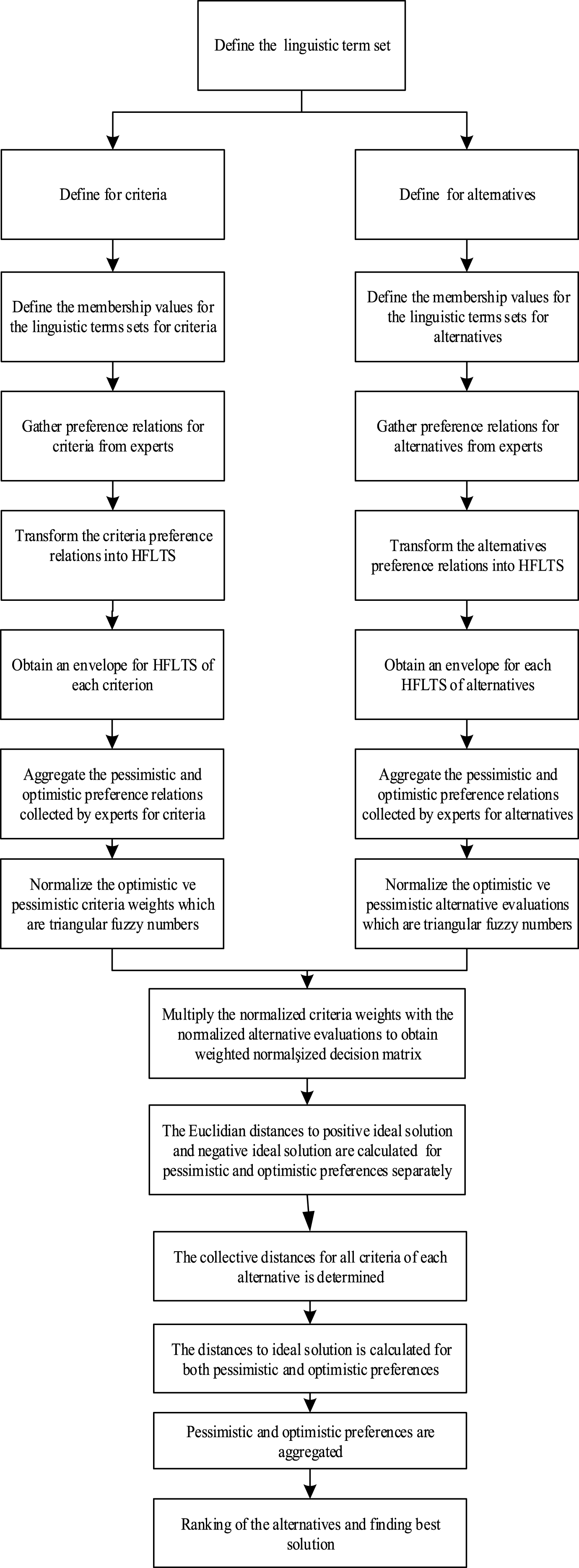
The flowchart of proposed methodology.
The evaluations for criteria and alternatives can be shown as Table 3 for each decision maker (DM).
Experts’ evaluations for criteria weights
The preference relations for the linguistic expressions of obtained by experts are transformed into HFLTS. After that, the envelopes for each HFLTS are calculated in fact each is a triangular fuzzy numbers. With the aggregation operator φ, the pessimistic and optimistic collective preference relations
Fuzzy pessimistic and optimistic preferences for alternatives based on C1
The decision matrix are normalized for criteria-alternative evaluations and then multiplied with the criteria weights which are calculated separately for pessimistic and optimistic preference as TFNs. After this step, we still continue to make the calculation both for pessimistic and optimistic preferences instead of aggregating them. As classical fuzzy TOPSIS methodology, the distances to the negative and positive ideal solutions for each pessimistic and optimistic value are calculated. The Euclidean distances to positive d+ (1, 1, 1) and negative d– (0, 0, 0) ideal solutions are obtained. Then, the distances from positive and negative ideal solution for pessimistic and optimistic preferences for each criterion have been obtained. We sum the distances on the basis of positive and negative ideal solutions. Table 5 shows the results for the summation of distances separately.
The sum of distances for each criterion to negative and positive ideal solutions
Then the distance to ideal solution of each alternative are calculated. We still keep the pessimistic and optimistic preferences distinguished for investigating whether they would give the same results/ranking. According to the distance values which are calculated separately for the pessimistic and optimistic preferences, the firm named A4 has been determined as the best alternative. The second best firm has been determined as the firm named A2. Ranking of the next alternatives varies according to the pessimistic and optimistic values. After this analysis, pessimistic and optimistic values are aggregated to find a single value to final solution. According to the solution which is obtained with aggregation also shows that the firm A4 is the best alternative to outsource of WEEE management. The second one is also determined as A2, and followed by A1, A5 and A3. To investigate the effect of aggregating pessimistic and optimistic preferences earlier – means whether the solution would be changed or not-, we aggregate the pessimistic and optimistic preferences after we constitute the weighted decision matrix. The distances to ideal solutions of each alternative can be seen in Table 6. The ranking of the alternatives after the calculation for this procedure can be also shown as Table 6.
The distances to ideal solution for the earlier aggregated preferences
Although the early aggregation is made for pessimistic and optimistic preferences, ranking remains unchanged. The firm named A4 is still determined to be preferred as the best alternative. This recalculation proves the validity of the results. This shows that experts could be more comfortable for evaluations in hesitant decision processes and the consistency of the evaluations.
Rapid developments in technology and consequently increase in the rate of consumption of electronic goods makes the EEE production sector one of the most important in recent years. This has brought the strategic question of how of electrical and electronic goods should be disposed. This question is especially important for large public institutions and organizations. One of the best answers to this problem is to choose an outsourcing firm for disposal of e-waste. In this paper, we present a proposal for which of the determined outsourcing firm should use for the management of WEEE process. For this purpose, we used fuzzy decision making process based on hesitant sets to select the best outsourcing firm alternative for Eyüp Municipality. The presence of conflicting criteria and hesitancy in decision-making has made the use of HFSs applicable. HFSs are also applied as a powerful tool to express uncertain information in MCDM problems as mentioned before. This paper proposes a new hesitant fuzzy decision making methodology with fuzzy enveloped TOPSIS. In this way, decision makers could be more flexible when using linguistic term sets which also have membership degrees to reflect the uncertainty and hesitancy better. For this reason, we have applied a real case study. At this point, we have carried out a ranking application among alternative firms for the management process of WEEE for a municipality. We have identified the company that the municipality should prefer first as a result of our calculated ranking.
We have also proved that the HFSs can be applied successfully to WEEE management. As future suggestions, different kind of MCDM methodologies can be applied to validate the results or different membership functions can be used to represent the linguistic descriptors.