



Abstract
The key objective of the present proposed work in this paper is introduced a new version of picture fuzzy set so called spherical fuzzy sets (SFS). spherical fuzzy set is a new extension of picture fuzzy sets and Pythagorean fuzzy sets. In spherical fuzzy sets, membership degrees are gratifying the condition 0 ⩽ P2 (x) + I2 (x) + N2 (x) ⩽1 instead of 0 ⩽ P (x) + I (x) + N (x) ⩽1 as is in picture fuzzy sets. In this paper, we investigate the basic operations of spherical fuzzy sets and discuss some related results. We extend operational laws to aggregation operators and introduce weighted averaging and weighted geometric aggregation operators based on spherical fuzzy number’s. Further a multi attribute decision making method is developed and these aggregation operators are utilized. Finally, we constructed a numerical approach for implementation of proposed technique.
Introduction
To address the issues of difficulties of acquiring sufficient and accurate data for real decision making due to the imprecision and ambiguity of socioeconomics, fuzzy set theory is one of the most powerful track for treating the multi-attribute decision making problems. Based on fuzziness circumstances fuzzy sets (FSs), developed by Zadeh [31], was initially used. In FSs each element x of the domain set contains only one index namely as degree of membership P (x) which oscillate from 0 to 1. Non-membership degree for the FS is straightforward equivalent to 1 - P (x). However, sometime FS has some drawbacks for example, it has no ability to show the neutral state (which neither favor nor disfavor). However, Intuitionistic fuzzy set (IFS) developed by Atanassov [3], to apprehend the uncertainties or inexact information about degree of membership. Atanassov’s IFSs are the generalization of Zadeh’s FSs. He utilized two indices (membership degree P (x) and non-membership degree N (x)) to define the IFS with the condition that 0 ⩽ P (x) + N (x) ⩽1. From last few decades, the IFS has been explored by many researchers and successfully applied to many practical fields like medical diagnosis, clustering analysis, decision making and pattern recognition [1, 34]. Later, the degree of membership and non-membership in IFSs may be denoted as interval values alternatively by crisp numbers. So, the interval valued intuitionistic fuzzy sets (IVIFSs), was developed by Atanassov and Gargov [4]. IVIFSs are an extension of FSs & IFSs. The IFS and IVIFS have been explored by many researchers like as [4, 5], and widely applied to many areas, such as group decision making [22, 27], similarity measures [11], multi-criteria decision making [24]. In 2017, Lui [19] introduced the Heronian aggregation operators of intuitionistic fuzzy numbers, also defined interaction partitioned Bonferroni mean operators [18] and Interval-valued intuitionistic fuzzy power Bonferroni aggregation operators [17] for intuitionistic fuzzy numbers. In 2018, Lui [20] introduced the Partitioned Heronian means based on linguistic intuitionistic fuzzy numbers for dealing with multi-attribute group decision making problems.
Since in some real life decision theory the decision makers deal with the situation of particular attributes where values of their summation of membership degrees exceeds 1. In such condition, IFSs has no ability to obtain any satisfactory result. To overcome this situation Yager [28] developed the idea of Pythagorean fuzzy set (PyFS) as a generalization of IFS, which satisfies that the value of square summation of its membership degrees is less then or equals to 1. Now the situation where the neutral membership degree calculate independently in real life problems, the IFS and PyFS fail to attain any satisfactory result. Based on these circumstances, to overcome this situation, Cuong and Kreinovich [9] initiated the idea of picture fuzzy set (PFS). He utilized three index (membership degree P (x), neutral-membership degree I (x), and non-membership degree N (x)) in PFS with the condition that is 0 ⩽ P (x) + I (x) + N (x) ⩽ 1. Obviously PFSs is more suitable than IFS and PyFS to deal with fuzziness and vagueness. H. Garg [12] introduced picture fuzzy weighted averaging operator, Picture fuzzy ordered weighted averaging operator, Picture fuzzy hybrid averaging operator under picture fuzzy environment. From last few decades, the PFS has been explored by many researchers and successfully applied to many practical fields like strategic decision making, Attribute decision making and pattern recognition [9, 26].
Sometimes in real life, we face many problems which cannot be handled by using PFS for example when P (x) + I (x) + N (x) > 1. In such condition, PFS has no ability to obtain any satisfactory result. To state this condition, we give an example: for support and against the degree of membership of an alternative are
The objectives of this paper are: (1) to introduce the spherical fuzzy set (2) to define the spherical fuzzy numbers (SFNs) and related basic operational identities, (3) to suggest score, accuracy and certainty functions for comparison, (4) to propose spherical aggregation operators and some debate on their properties, (5) to demonstrate a MADM method based on these aggregation operators under spherical fuzzy information.
The superfluity of this paper is planned as follows. In Section 2, the basic notion of Intuitionistic fuzzy sets, PFSs and their properties are presented. In Section 3, we introduce the concept of SFSs and their operational properties. Section 4, consist of the study of aggregation operators to aggregate the spherical fuzzy information. In Sections 5, we proposed the MADM method to deal with spherical fuzzy information and a descriptive example is illustrated to express the effectiveness and reliability of the suggested technique. The last Section 6, consist of the conclusion of the paper.
Preliminaries
The paper gives brief discussion on basic ideas associated to IFS and PFS with their operations and operators. We also discuss, more familiarized ideas which is utilized in following analysis
Then for 1 - (P A (r) + I A (r) + N A (r)) is said to be degree of refusal-membership of r in R.
Spherical fuzzy sets and their operations
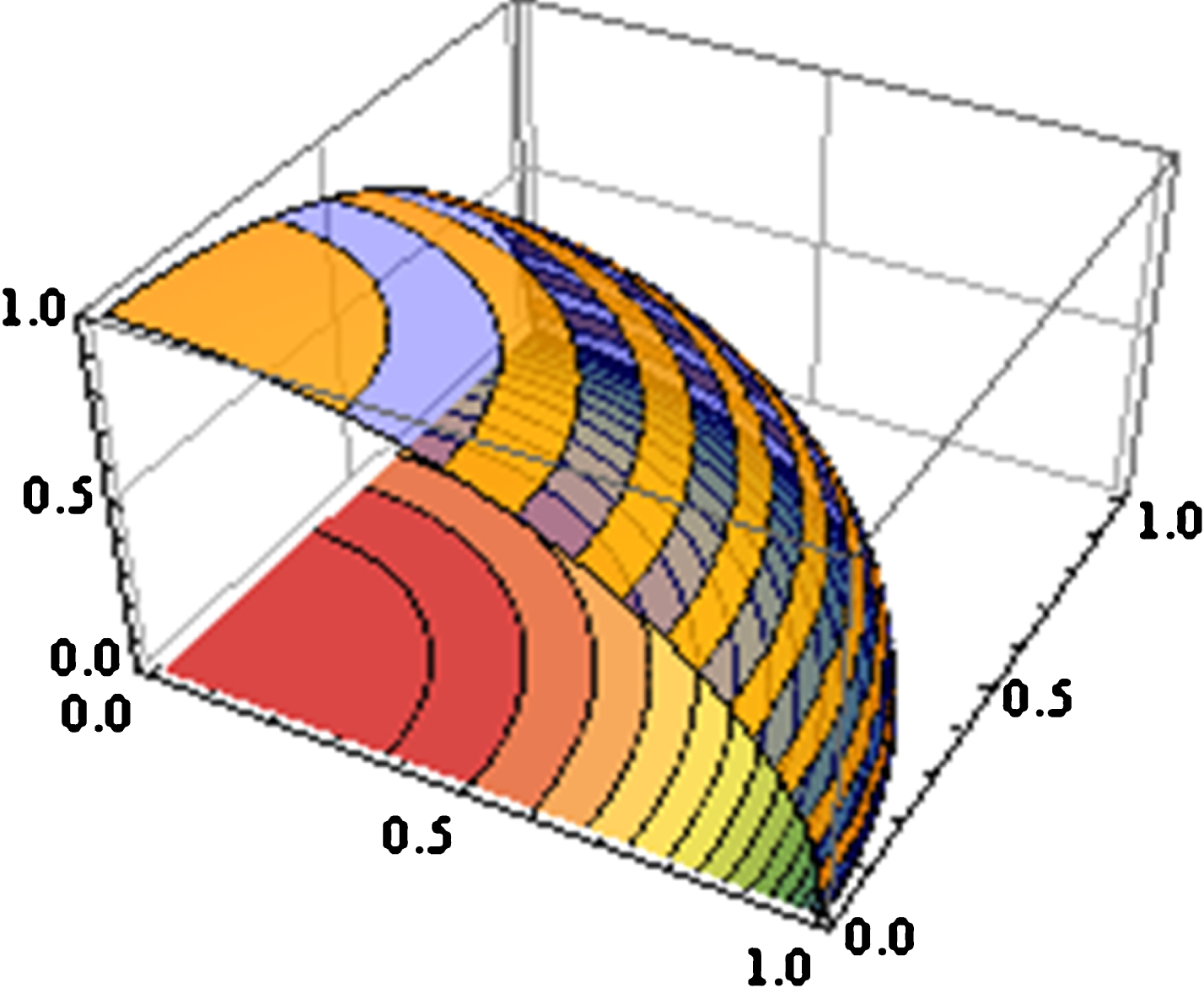
In this section, the idea of spherical fuzzy set (SFS), their operations and operators are introduced. The structure of SFSs give shields to the elements, which satisfies or dissatisfies the condition that values must oscillate from 0 to 1. We see in the figure : 1, which specifies the points where structure of Spherical fuzzy set give shield to the elements. Also, we familiarized with the contour of this graph in figure : 3.
Spherical fuzzy set is a direct generalization of Pythagorean fuzzy set and picture fuzzy set. An interesting scenario emerge when Pythagorean fuzzy sets (PyFS) and picture fuzzy sets both failed to handle the situation. Therefore, there is need the spherical fuzzy set to tackle this situation. The main difference between PyFSs and SFSs is that in SFSs we study the neutral degree, where as in PyFSs it doesn’t. In PFSs the connection of positive, neutral and negative grades of an object is given in unit close interval but in some cases the sum of the positive, neutral and negative grades of the object is greater than 1, so this situation leads us toward spherical fuzzy set.
Now using an example to understand that why spherical fuzzy set is suitable as compare to existing structure like IFS, PyFS and PFS. Cuong structure of PFS is prominence as it has the capability to deal with human opinion competently. In PFSs, we observed that the condition on membership degree belongs to unit interval. i.e. 0 ⩽ P (x) + I (x) + N (x) ⩽1. Therefore, it is observed that, we have restricted to assign values to membership degrees by own choice. Considering these points, an innovative structure of SFS is proposed which somehow give strength to the structure of PFS by expanding the space of membership degrees. i.e. 0 ⩽ P2 (x) + I2 (x) + N2 (x) ⩽1. For example, if we choose P (x) =0.7, I (x) =0.3 and N (x) =0.5. Then in this case 0 ⩽ P (x) + I (x) + N (x) =1.5 > 1. But by squaring P (x), I (x) and N (x) their sum becomes less than or equal to one i.e. 0 ⩽ (0.7) 2 + (0.3) 2 + (0.5) 2 ⩽ 1. This example indicate that SFS is more influential tool than PFS. Also observe that PyFS is also failed to deal such situation because PyFS does not deal with neutral membership. We conclude that all existing structure failed to deal such type of information, so this situation leads us to propose novel structure of SFSs. This example give strength to the novelty and effectiveness of proposed SFSs.
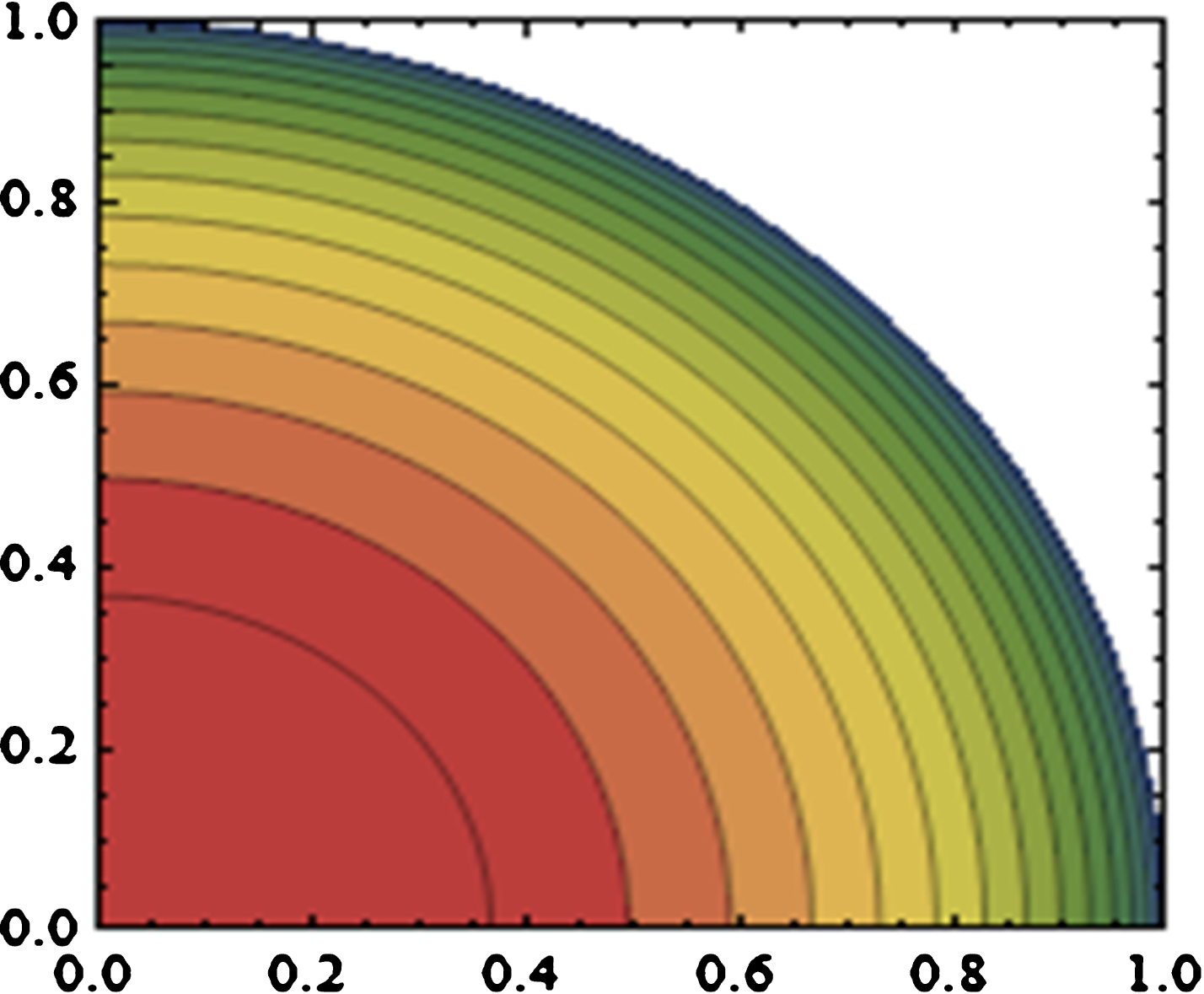
Now we see the contour of this graph.

when we are combining the both graph and their contour, we have.
is said to be spherical fuzzy set, where P
A
: R → [0, 1], I
A
: R → [0, 1] and N
A
: R → [0, 1] are said to be degree of positive-membership of r in R, neutral-membership degree of r in R and negative-membership degree of r in R respectively. Also P
A
, I
A
and N
A
satisfy the following condition:
For SFS {〈 r, P
A
(r), I
A
(r), N
A
(r) |r ∈ R 〉 }, which is triple components
are said to SFN and each SFN can be denoted by e =〈 P
e
, I
e
, N
e
〉, where P
e
, I
e
and N
e
∈ [0, 1], with condition that
e
j
⊆ e
k
iff ∀r ∈ R, P
e
j
⩽ P
e
k
, I
e
j
⩽ I
e
k
and N
e
j
⩾ N
e
k
; e
j
= e
k
iff e
j
⊆ e
k
and e
k
⊆ e
j
; e
j
∪ e
k
= 〈 max(P
e
j
, P
e
k
), min(I
e
j
, I
e
k
), min(N
e
j
, N
e
k
)〉; e
j
∩ e
k
= 〈 min(P
e
j
, P
e
k
), min(I
e
j
, I
e
k
), max(N
e
j
, N
e
k
)〉;
e
j
+ e
k
= e
k
+ e
j
; e
j
× e
k
= e
k
× e
j
; (e
j
+ e
k
) + e
l
= e
j
+ (e
k
+ e
l
); (e
j
× e
k
) × e
l
= e
j
× (e
k
× e
l
); τe
j
+ τe
k
= τ (e
j
+ e
k
), τ⩾ 0; τ
j
e
j
+ τ
k
e
j
= (τ
j
+ τ
k
) e
j
, τ
j
⩾ 0 and τ
k
⩾ 0;
Hence, we prove this.
(2) We have to show that e
j
× e
k
= e
k
× e
j
. Consider
Hence, we prove this.
The proofs of (3) and (4) are straightforward as (1) and (2).
(5) We have to show that τe j + τe k = τ (e j + e k ), τ ⩾ 0. Consider
Next
Hence, we prove this.
(6) We have to show that τ j e j + τ k e j = (τ j + τ k ) e j , τ j ⩾ 0 and τ k ⩾ 0. Consider
Furthermore
Hence, we prove this.
(7) We have to show that
Now
Hence, we prove this.
(8) We have to show that
Furthermore
Hence, we prove this.
Comparison rules for SFNs
In this section we introduce some functions which play an important role for the ranking of SFNs are;
(2) ac (e k ) = P e k - N e k which denoted as accuracy function.
(3) cr (e k ) = P e k which denoted as certainty function. Idea takes from Definition [3.2.1.], is the technique which using for equating the SFNs can be described as
(b) If sc (e j ) = sc (e k ) and ac (e j ) > ac (e k ), then e j > e k .
(c) If sc (e j ) = sc (e k ), ac (e j ) = ac (e k ) and cr (e j ) > cr (e k ), then e j > ek.
(d) If sc (e j ) = sc (e k ), ac (e j ) = ac (e k ) and cr (e j ) = cr (e k ), then e j = ek.
Spherical aggregation operators
This section gives some discussion about weighted aggregated operators according to defined operational properties of SFNs.
Spherical fuzzy number weighted averaging aggregation operators
This section describes the spherical weighted averaging aggregation (SFNWAA) operators by utilizing the defined operational properties of SFNs.
In which τ ={ τ1, τ2, …, τ
n
} be the weight vector of e
k
= 〈 P
e
k
, I
e
k
, N
e
k
〉, k ∈ N, with τ
k
⩾ 0 and
Where τ ={ τ1, τ2, …, τ
n
} be the weight vector of e
k
= 〈 P
e
k
, I
e
k
, N
e
k
〉, k ∈ N, with τ
k
⩾ 0 and
(a) For n = 2, since
and
Then
(b) Suppose that outcome is true for n = z that is,
(c) Now we have to prove that outcome is true for n = z + 1, by utilizing the (a) & (b) we have
Outcome is satisfying for n = z + 1. Thus, outcome is satisfied for whole n. Therefore
which done the proof.
(a) Idempotency: Let e
k
= 〈 P
e
k
, I
e
k
, N
e
k
〉, (k ∈ N) be any collection of SFNs. If all of e
k
= 〈 P
e
k
, I
e
k
, N
e
k
〉, (k ∈ N) are identical. Then there is
(b) Boundedness: Let e
k
= 〈 P
e
k
, I
e
k
, N
e
k
〉, (k ∈ N) be any collection of SFNs. Assuming that
(c) Monotonically: Let
with dimensions n, where kth biggest weighted value is eη(k) consequently by total order eη(1) ⩾ eη(2) ⩾ … ⩾ eη(n). τ = {τ1, τ2, …, τ
n
} is the weight vectors such that τ
k
⩾ 0 (k ∈ N) and
where eη(k) is kth largest value consequently by total order eη(1) ⩾ eη(2) ⩾ … ⩾ eη(n).
(a) Idempotency: Let e
k
= 〈 P
e
k
, I
e
k
, N
e
k
〉, (k ∈ N) be any collection of SFNs. If all of e
k
= 〈 P
e
k
, I
e
k
, N
e
k
〉, (k ∈ N) are identical. Then there is
(b) Boundedness: Let e
k
= 〈 P
e
k
, I
e
k
, N
e
k
〉, (k ∈ N) be any collection of SFNs. Assuming that
(c) Monotonically: Let
The spherical fuzzy weighted averaging operator only considers importance of the aggregated spherical fuzzy sets themselves. The spherical fuzzy OWA operator only concerns with position importance of the ranking order of the aggregated spherical fuzzy sets. To overcome the disadvantages of the aforementioned two spherical fuzzy aggregation operators, we may define the following spherical fuzzy hybrid weighted averaging operator.
with dimensions n, where kth biggest weighted value is eη(k) and
where eη(k) is kth biggest value consequently by total order eη(1) ⩾ eη(2) ⩾ … ⩾ eη(n) and kth biggest weighted value is
Idempotency: Let e
k
= 〈 P
e
k
, I
e
k
, N
e
k
〉, (k ∈ N) be any collection of SFNs. If all of e
k
= 〈 P
e
k
, I
e
k
, N
e
k
〉, (k ∈ N) are identical. Then there is
Boundedness: Let e
k
= 〈 P
e
k
, I
e
k
, N
e
k
〉, (k ∈ N) be any collection of SFNs. Assuming that
Monotonically: Let
Spherical fuzzy number weighted geometric aggregation operators
This section described the spherical weighted geometric aggregation (SFNWGA) operators by utilizing the defined operational properties of SFNs.
In which τ ={ τ1, τ2, …, τ
n
} be the weight vector of e
k
= 〈 P
e
k
, I
e
k
, N
e
k
〉, k ∈ N, with τ
k
⩾ 0 and
Where τ ={ τ1, τ2, …, τ
n
} be the weight vector of e
k
= 〈 P
e
k
, I
e
k
, N
e
k
〉, k ∈ N, with τ
k
⩾ 0 and
(a) For n = 2, since
and
Then
(b) Suppose that outcome is true for n = z that is,
(c) Now we have to prove that outcome is true for n = z + 1, by utilizing the (a) & (b) we have
Outcome is satisfying for n = z + 1. Thus, outcome is satisfied for whole n. Therefore
which done the proof.
(a) Idempotency: Let e
k
= 〈 P
e
k
, I
e
k
, N
e
k
〉, (k ∈ N) be any collection of SFNs. If all of e
k
= 〈 P
e
k
, I
e
k
, N
e
k
〉, (k ∈ N) are identical. Then there is
(b) Boundedness: Let e
k
= 〈 P
e
k
, I
e
k
, N
e
k
〉, (k ∈ N) be any collection of SFNs. Assuming that
(c) Monotonically: Let
with dimensions n, where kth biggest weighted value is eη(k) consequently by total order eη(1) ⩾ eη(2) ⩾ … ⩾ eη(n). τ ={ τ1, τ2, …, τ
n
} be the weight vector of e
k
= 〈 P
e
k
, I
e
k
, N
e
k
〉, k ∈ N, with τ
k
⩾ 0 and
where eη(k) is kth largest value consequently by total order eη(1) ⩾ eη(2) ⩾ … ⩾ eη(n).
Idempotency: Let e
k
= 〈 P
e
k
, I
e
k
, N
e
k
〉, (k ∈ N) be any collection of SFNs. If all of e
k
= 〈 P
e
k
, I
e
k
, N
e
k
〉, (k ∈ N) are identical. Then there is
Boundedness: Let e
k
= 〈 P
e
k
, I
e
k
, N
e
k
〉, (k ∈ N) be any collection of FNs. Assuming that
Monotonically: Let
with dimensions n, where kth biggest weighted value is eη(k) and
where eη(k) is kth biggest value consequently by total order eη(1) ⩾ eη(2) ⩾ … ⩾ eη(n) and kth biggest weighted value is
Idempotency: Let e
k
= 〈 P
e
k
, I
e
k
, N
e
k
〉, (k ∈ N) be any collection of SFNs. If all of e
k
= 〈 P
e
k
, I
e
k
, N
e
k
〉, (k ∈ N) are identical. Then there is
(b) Boundedness: Let e
k
= 〈 P
e
k
, I
e
k
, N
e
k
〉, (k ∈ N) be any collection of FNs. Assuming that
(c) Monotonically: Let
MADM method utilizing spherical aggregation operators
This section proposes the technique to solve the MADM problems by utilizing the spherical aggregation operators. For a MADM problem, assuming that C ={ c1, c2, …, c
m
} be any finite collection of m alternatives, G ={ g1, g2, …, g
n
} be any finite collection of n attributes and T ={ t1, t2, …, t
p
} be any collection of p DMs. If the zth (z = 1, 2, …, p) DM deliver the assessment of the alternative c
i
(i = 1, 2, …, m) on the attribute g
i
(i = 1, 2, …, n) under any discrete term set. Let
be the DM, where 〈P
e
jk
, I
e
jk
, N
e
jk
〉 are the collection of SFNs and represents the evaluation information of every alternative c
i
(i = 1, 2, …, m) on attribute g
i
(i = 1, 2, …, n). If τ ={ τ1, τ2, …, τ
n
} be the weight vector of attribute, with τ
k
⩾ 0,
Then, listed below the main technique of handling the MADM problems:
A Numerical example
This section describes a MADM problem, which is utilized to illustrate the pertinence and effectiveness for the procedure of decision making problems.
There are four manageable alternatives, (a) c1 is car company; (b) c2 is food company; (c) c3 is a computer company; (d) c4 is an arms company. According to the attributes company takes the decision, (a) g1 is the risk; (b) g2 is the growth; (c) g3 is the environmental impact. The weight vector of the attributes is τ = (0.35, 0.25, 0.40), and corresponding associated weight are ω = { 0.5, 0.2, 0.3 }. Now we can calculate the following spherical fuzzy number decision matrix as
(Case:2) Utilizing the SFNOWAA Operator to find out every value of the alternative as, Firstly we need score function of the each alternative
Now we rank the alternative in descending order according to the score values as,
Now by utilizing the SFNOWAA Operator to find out every values of the alternative as,
(Case:3) Utilizing the SFNHOWAA Operator to find out every value of the alternative as, Firstly we need an order decision matrices. by utilizing following formula
We multiply these scaler as in define multiplication
Now by utilizing the SFNHOWAA Operator to find out every value of the alternative as,
(Case:2) Now we find out the score, accuracy and certainty function values respectively by utilizing the Definition [3.2.1.] as,
(Case:3) Now we find out the score, accuracy and certainty function values respectively by utilizing the Definition [3.2.1.] as,
Thus, according to the scoring function ranking method of spherical fuzzy sets for SFNWAA operator, the ranking order of the suppliers e i (i = 1, 2, 3, 4) is generated as follows: e1 > e4 > e2 > e3. The best supplier for the enterprise is e1.
(Case:2) Now rank the all the alternative by utilizing the comparison technique in Definition [3.2.2.] for SFNOWAA operator as,
so, by utilizing the Definition [3.2.2.], we obtained the result which is
and by using the SFNOWAA, e1 is the best choose.
(Case:3) Now rank the all the alternative by utilizing the comparison technique in Definition [3.2.2.] for SFNHOWAA operator as,
sc (e1) =0.72 > sc (e2) =0.71 > sc (e4) =0.66 > sc (e3) =0.56 we obtained the result which is
and by using the SFNHOWAA, e1 is the best choose.
It is observing that using proposed aggregation operators of SFSs to aggregate the spherical fuzzy information. To choose the best alternative which is e1 from the set of alternatives. As SFSs is generalized as compared to FSs, IFSs, PyFS and PFSs and have the ability to deal with real life problems more effectively than the existing concepts as it is discussed to evaluation investment company to invest money problem is effectively applied.
Validity and reliability test
In particularly, to track the best capable alternative from given group decision matrices are not probable in practically. Wang and Triantaphyllou [26] initiated the test to evaluate the reliability and validity of the MADM techniques. These testing criteria are follow as
The reliability and validity of the suggested aggregation operator constructed by MADM technique is test by utilizing these testing criteria.
To examine effectiveness of the suggested approach utilizing test criterion no 1, then these decision matrices are attained by exchanging the degree of the membership (non-optimal alternative) and non-membership (worse alternative) in the original decision matrices as follows, after that original decision matrices are transform
sc (e1) =0.66 > sc (e4) =0.65 > sc (e2) =0.63 > sc (e3) =0.55 we obtained the result which is
and by using the SFNWAA, e1 is the best choose.
To test validity and reliability of suggested technique by utilizing test criterion 2 and 3, we transformed MADM technique into three smaller sub-problems as {e1, e2, e3}, {e2, e3, e4} and {e2, e4, e1}. Then by following stages of the suggested technique, accordingly to each sub-problem we suggest rank to their correspondences as e1 > e4 > e2, e4 > e2 > e3 and e1 > e2 > e3 respectively. After aggregating the inclusive rank, we attain e1 > e4 > e2 > e3 that is similar with original MADM technique. Hence it displays the transitive property. So, under test criterion 2 and 3 recognized by Wang and Triantaphyllou [26] the suggested technique is valid and reliable.
Comparative analysis
In order to verify the validity and effectiveness of the suggested techniques, a comparative approach is conductive using Pythagorean fuzzy TOPSIS method [30] and aggregation operators of PFS [12].
These two approaches are valid to solve the MADM problems, TOPSIS method which proposed by Hwang and Yoon [13] simple and useful method to solve the MADM problems with crisp numbers, which aims at choosing the alternative with the shortest distance from the positive ideal solution (PIS) and the farthest distance from the negative ideal solution (NIS).
According to Zhang and Xu [33], the first step is to identify the Pythagorean fuzzy positive ideal solution (PIS) and the Pythagorean fuzzy negative ideal solution (NIS) of the decision matrix, which are
The bigger is ζ i is, the better the alternatives and the most desirable alternative is ζ2 as given below.
ζ1 = 0 : 5865; ζ2 = 0 : 8115; ζ3 = 0 : 4758; ζ4 = 0 : 4164; ζ5 = 0 : 5700
The decision matrix utilized in this paper are not be solve as this above technique because in this paper we utilize positive, neutral and negative membership degrees that’s square sum is less or equal to 1. Pythagorean fuzzy TOPSIS method fail to solve such problems. So, our proposed technique is reliable and valid for such types of alternatives.
Picture fuzzy set initialized by B. C. Cuong [9] and Picture fuzzy aggregation operators which were introduced by Harish Garg [12] are listed as, (1) Picture fuzzy weighted averaging operator, (2) Picture fuzzy ordered weighted averaging operator, (3) Picture fuzzy hybrid averaging operator. By utilizing these aggregation operators, a decision making technique proposed for picture fuzzy environment. finally chose the best one alternative from decision matrices.
The above proposed aggregation operators for PFS deals with that real-life problem where sum of membership degrees are equals to 1. In situation where sum of membership degrees exceeds 1, PFS fails to give satisfactory results in such situation. On the other hand, technique proposed in this paper can give satisfactory results in such situations where sum of membership degrees is greater than 1, and chose the best alternative from decision making problems.
Conclusion
Information aggregation procedure plays a dynamic role throughout the decision making procedure and hence in this track, the comparative importance of the criteria remains unreformed in modified problems, then we proposed SFNWAA and SFNWGA operators has been executed to invention the best alternative. Almost all the researchers have operated the IFS by considering the positive and negative membership degrees only. But, it has been detected that in some circumstances, like in situation of voting, human thoughts including more degrees as, yes, neutral, no, refusal, and in situation where the sum of membership degree is greater than 1, which cannot be exactly characterized in IFS and PFS respectively. For this circumstance, Spherical fuzzy set, which is an extension of the PFS, has been utilized in the paper and correspondingly aggregation operators have been defined and used. Several required properties of these operators have also been explored in comprehensibly. Finally, based on these operators, a decision-making method has been established for ranking the dissimilar alternatives by utilizing spherical fuzzy environment. The suggested technique has been demonstrated with a descriptive example for viewing their effectiveness as well as reliability. A test to check the reliability and validity has also been conducted for viewing the supremacy of the suggested technique. Thus, the suggested operators provide a new direction to the information measure theory and give a new easier track to grip the uncertainties throughout the decision-making procedure.