



Abstract
In this paper, we introduce spherical fuzzy sets (SFSs) which is an advanced tool of the fuzzy sets, intuitionistic fuzzy sets and picture fuzzy sets. We investigate the basic properties of SFSs and compare the idea SFSs with picture fuzzy sets. The spaces of spherical membership grades and picture membership grades are examined by graphically. Some useful operation such as spherical fuzzy t’-norms and spherical fuzzy t’-conorms are introduced. Also introduced spherical fuzzy negator and some classifications of spherical fuzzy t’-norms and spherical fuzzy t′-conorms which are useful for development the aggregation operator to aggregate the spherical fuzzy information. Finally, a food circulation center evaluation problem is given as a practical application to demonstrate the usage and applicability of the proposed ranking approach.
Introduction
The complication of a system is growing every day in real life and to get the finest option from the set of possible one it is difficult for the decision makers. To attain single objective is difficult to summarize but not incredible. Many organizations found difficulties to set the motivation, goals and opinions complication. Thus, in organizational decisions, which simultaneously includes of numerous objectives, no matter takes an individual or by the committee. This reflection suggests that according to criteria solved optionally which restrict each decision maker to attain an ideal solution-optimum under each criteria involve in practical problem. Consequently, decision maker is more concentration to establishes more applicable and reliable technique to find the finest option. To handle the ambiguity and uncertainty data in decision making problems, the classical or crisp methods cannot be always effective. So, dealing with such uncertain situation Zadeh [21] in 1965 presented the idea of the fuzzy set. Zadeh assign membership grades to elements of a set in the interval [0,1] by offering the idea of fuzzy sets (FSs). Zadeh’s work in this direction is remarkable as many of the set theoretic properties of crisp cases were defined for fuzzy sets. FSs got the attentions of researchers and founds its applications in decision science, intelligence science, communications, engineering, computer sciences etc.
Atanassov’s [7] work on intuitionistic fuzzy set (IFSs) was quite remarkable as he extended the concept of FSs by assigning membership degree say P (x) along with non-membership degree say “N (x)” with condition that 0 ≤ P (x) + N (x) ≤1. Atanassov’s construction of IFSs is of exceptional reputation but decision makers are somehow restricted in assigning values due to the condition on P (x) and N (x). Sometimes sum of their membership degrees are superior then 1. In such situation, to attain reasonable outcome IFS fails. So, dealing with such situation Yager [19] in 2015, establish the concept of Pythagorean fuzzy sets (PyFS) by assigning membership degree say “P (x)” along with non-membership degree say “N (x)” with condition that 0 ≤ P2 (x) + N2 (x) ≤1.
In this paper we extend the concept of PyFS to Spherical fuzzy set by assigning neutral membership degree say “I (x)” along with positive and negative membership degrees say “P (x)” and “N (x)” with condition that 0 ≤ P2 (x) + I2 (x) + N2 (x) ≤1.
Atanassov’s structure discourses only satisfaction and dissatisfaction degree of elements in a set which is quite insufficient as human nature has some sort of abstain and refusal issues too. Such hitches were considered by Cuong [8] in 2013, to proposed picture fuzzy sets (PFS) define as (P (x) , I (x) , N (x)) where the elements in triplet represent satisfaction, abstain and dissatisfaction degrees respectively, under the condition that 0 ≤ P (x) + I (x) + N (x) ≤1. This structure of Cuong is considerably more close to human nature than that of earlier concepts and is one of the richest research area now. Cuong [9] in 2014, established the relations, compositions and find the distance between picture fuzzy numbers, also he gives the concept of picture soft sets. Phong at all [15] in 2014, give the concept about the compositions of some picture fuzzy relations. Cuong [11] in 2015, introduced the fuzzy logic operators for picture fuzzy sets. Singh [16] in 2015, introduced the idea related to correlation coefficients for picture fuzzy sets. Cuong [10] in 2015, established the ideas like convex combination of PFNs, alpha-cuts of PFS, picture fuzzy relations. Cuong [12] in 2016, established the classification of representable t’-norm operators for PFSs. Son [17] in 2016, introduced the concept about generalized picture distance measure and give its applications. Wei [18] in 2017, introduced the cosine similarity measures for PFSs. Garg [14] in 2017, introduced the picture fuzzy aggregation to aggregate the picture fuzzy information’s.
Cuong’s construction of picture fuzzy sets is of exceptional reputation but decision makers are somehow restricted in assigning values due to the condition on P (x) , I (x) and N (x). Sometimes sum of their membership degrees are superior then 1. In such situation, to attain reasonable outcome PFS fails. To describe this situation, we take an example, for provision and in contradiction of the membership degrees. The alternatives are (1/5),(3/5) and (3/5) respectively. This gratifies the situation that their sum is superior then 1 and PFS fails to deal such type of data. Dealing with such kind of circumstances, Ashraf [1] in 2018 proposed new structure by defining spherical fuzzy sets (SFSs) which enlarge the space of membership degrees P (x) , I (x) and N (x) somehow bigger than that of picture fuzzy sets. In SFS, membership degrees are satisfying the condition 0 < P (x) + I (x) + N (x) <1. Hierarchy structure of spherical fuzzy set is shown in Fig. 1.
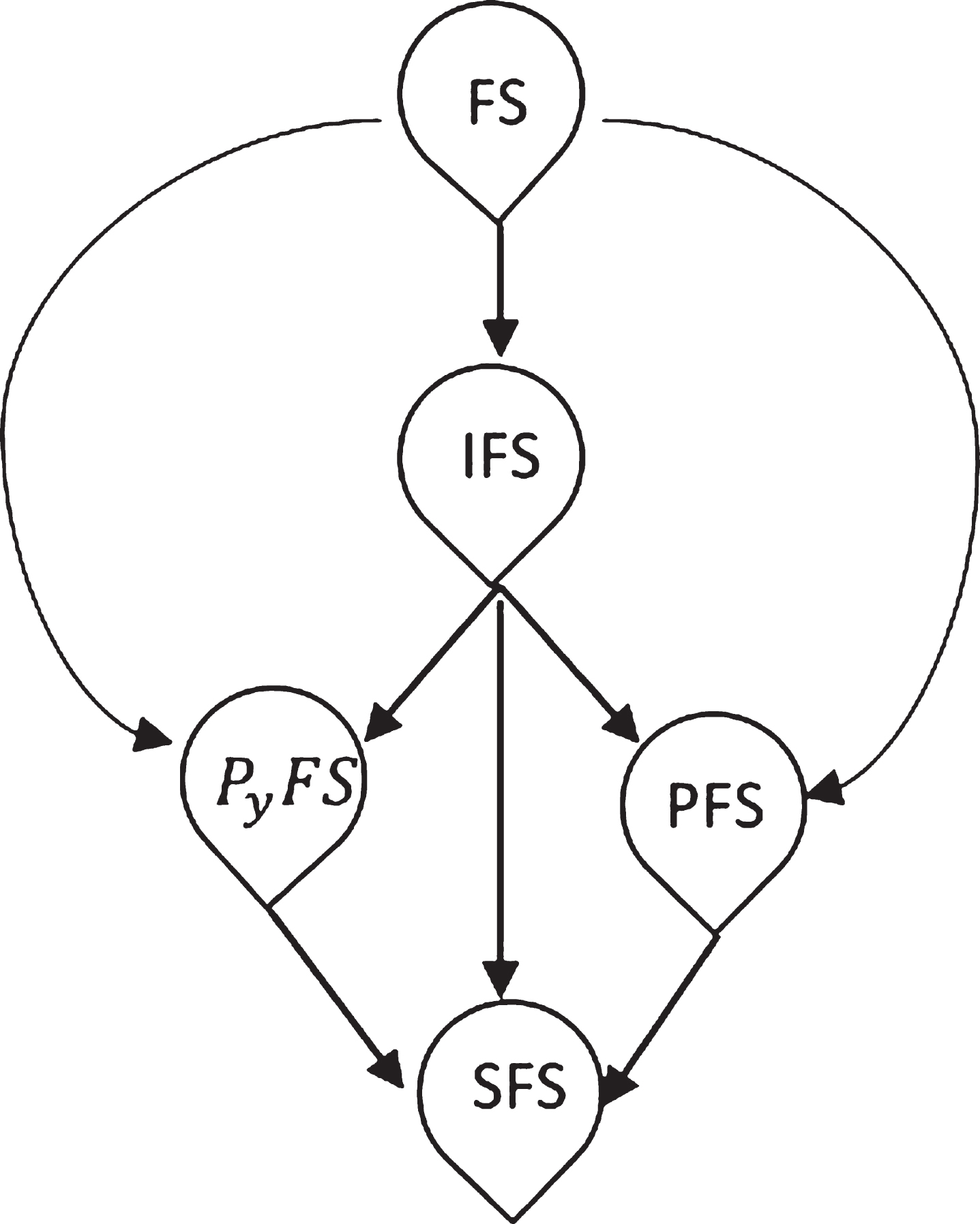
Hierarchy structure of spherical fuzzy set.
In this paper, we extend the notions of picture fuzzy t’-norm and picture fuzzy t’-conorm to the spherical fuzzy case. t’-norms and t’-conorms are used to define, intersection and union of spherical fuzzy sets and use to aggregate the spherical fuzzy information. After that, we generalize said representation theorems to spherical fuzzy connectives. Also, in this paper, we extend the TOPSIS method for spherical fuzzy numbers. Based on TOPSIS approach, a decision-making method has been established for ranking the alternatives by utilizing spherical fuzzy environment. The suggested technique has been demonstrated with an application to a food circulation center evaluation problem for viewing their effectiveness as well as reliability. The paper aims are: (a) to propose the idea of spherical fuzzy set (b) some debate on its basic operational characteristics, (c) define union, intersection based on t-norms and t- conorms, (d) establish spherical Fuzzy Negators and some classifications of spherical fuzzy t’-norm and spherical fuzzy t’-conorms, (e) extend the TOPSIS approach for SFNs and established a practical example that demonstrate the effectiveness as well as reliability of the suggested technique.
A FS in a set R is indicated by P j : R → [0, 1]. The function P j (r) indicate the positive membership degree of each r ∈ R.
An IFS in a set R is indicated by P j : R → [0, 1] and N j : R → [0, 1]. The functions P j (r) and N j (r) indicate the positive and the negative membership degrees of each r ∈ R, respectively. Furthermore P j and N j satisfy 0 ≤ P j (r) + N j (r) ≤1, for all r ∈ R.
Spherical fuzzy set and their basic operations
In this section, the idea of spherical fuzzy set and their operations are established. Here we explain that why we need spherical fuzzy sets? How it generalizes picture fuzzy sets? We made a comparison of spherical fuzzy set with that of picture fuzzy set also we examined their spaces graphically in Figs. 2 and 3.

Spherical fuzzy space (spherical representation).
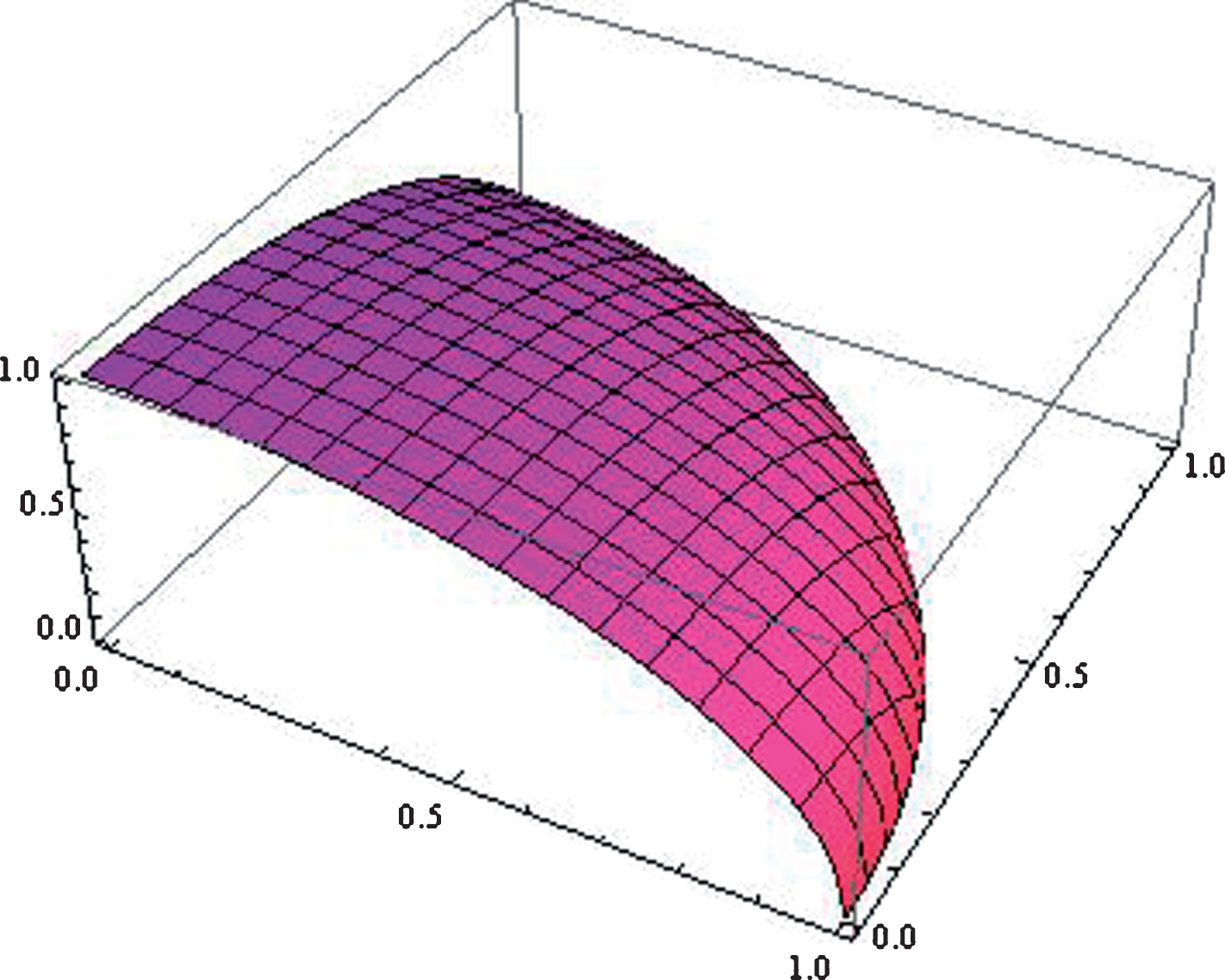
Spherical fuzzy space (3D).
Where P
j
: R → [0, 1], I
j
: R → [0, 1] and N
j
: R → [0, 1] are indicated the positive, neutral and negative membership degrees of each r ∈ R, respectively. Furthermore P
j
, I
j
and N
j
satisfy
Spherical fuzzy sets have its own importance in a circumstance where opinion is not only constrained to yes or no but there is some sort of abstinence or refusal. A good example of spherical fuzzy set could be decision making such as when four decision makers have four different categories of opinion about a candidate. Another example could be of voting where four types of voters occurs who vote in favor or vote against or refuse to vote or abstain. Spherical fuzzy set is a direct generalization of fuzzy set, intuitionistic fuzzy set and picture fuzzy set.
A question arises that why we need spherical fuzzy set or what are the boundaries of PFSs that leads us to spherical fuzzy sets? The main downside of PFSs is the restriction on it, i.e.,
As this condition does not allows the decision makers to assign membership values of their own consent. The decision makers are somehow limitations in a specific domain. We consider an example P
j
(r) =0.8, I
j
(r) =0.5 and N
j
(r) =0.3 which interrupts the condition that 0 ≤ P
j
(r) + I
j
(r) + N
j
(r) ≤1 but if we take the square of these values such as,
Another crucial thing to debate is that why we called it spherical fuzzy set? The answer to this question is very simple. Consider P
j
(r), I
j
(r) and N
j
(r) represents the degrees of positive, neutral and negative memberships of a spherical fuzzy set respectively such that
Note that, if we put I j (r) =0 in SPSs. Then SPSs reduced to Pythagorean fuzzy sets. Hence Spherical fuzzy sets are direct extension of Pythagorean fuzzy set and also the extension of picture fuzzy sets, also we seen the hierarchy structure (above) of the spherical fuzzy sets.
Let SFS (R) indicate the collection of all spherical fuzzy sets of R.
Now we assume F* can be define as;
If f ∈ F* this means that f1, f2 and f3 are thecomponents of f ∈ F*. i.e. f = (f1, f2, f3). Consider F* be any set and order relation ≤ F * on F* can be define as;
for all f, j ∈ F*. We define the projection mapping for components of f on F* as; pl1 (f) = f1, pl2 (f) = f2 and pl3 (f) = f3, for all f ∈ F*. We define infimum and supremum for each f, j ∈ F*;
Then (F*, ≤
F
*
) can be complete lattice, if φ ≠ A ⊆ F*, we have inf L = (inf pl1A, inf pl2A, inf pl3A), where
Units of F* can be indicated by 1
F
*
= (1, 0, 0) and 0
F
*
= (0, 0, 1). Note that if f, j ∈ F* then said to be incomparable w.r.t. ≤
F
*
if neither f ≤
F
*
j nor j ≤
F
*
f. Notation of incomparable is f||
F
*
j. Similarly, we can define lattice structure as, (F*, ∧ , ∨), where each f, j∈ F* ∃ f ∧ j and f ∨ j, note that
The union of two spherical fuzzy sets J1 and J2 in universe set R can be written as
The intersection of two spherical fuzzy sets J1 and J2 in universe set R can be written as
The complement of any spherical fuzzy set J1 in universe set R can be written as
In this section, we established spherical fuzzy negators which are extended form of picture fuzzy negators and intuitionistic fuzzy negators. Also define the spherical fuzzy t’-norm and spherical fuzzy t’-conorm.
N (0
F
*
) = 1
F
*
N (1
F
*
) = 0
F
*
.
Note that if ∀f ∈ F* we have N (N (f)) = f then given decreasing mapping N : F* → F* called involutive negator.
Suppose that we define f4 = 1 - f1 - f2 - f3. Then the involutive negator called standard negator, if mapping define as N l (f) = (f3, f4, f1), ∀f ∈ F*.
Suppose that N (0, r2, 0) = (i, 0, 0), where i > 0. Suppose f, f/ ∈ F* such that f, f/ ≤ F * (i, 0, 0) and f|| F * f/. we know that N is decreasing and involutive, N (f), N (f/) ≥ F * N (i, 0, 0) = (0, r2, 0)
Then pc3N (f) = pc3N (f/) = 0 and N (f), N (f/) are comparable w.r.t. ≤ F * .
Hence f, f/ are comparable w.r.t. ≤ F * . Which is a contradiction.
Similarly, we gain the contradiction for remaining cases.
Thus, N (R2) ⊂ R2.
Since N is involutive, then we have N (R2) = R2.
Now suppose that N (0, 0, 0) = (0, α, 0), 0 ≤ α ≤ 1.
Since N is decreasing and involutive, then
Then we attain β = 0 and N (0, 0, 0) = (0, 1, 0). □
Now, we define spherical fuzzy t’-norm and t’-conorm. These spherical fuzzy triangular norms help us to find the conjunction and disjunction operators for spherical fuzzy sets. These t’-norms are the extended form of picture fuzzy t’-norms and intuitionistic fuzzy t’-norms. Suppose for ∀f we define
T (f, j) = T (j, f), ∀f, j ∈ F* (commutativity) T (f, T (j, l)) = T (T (f, j) , l), ∀f, j, l ∈ F* (associativity) T (f, j) ≤
F
*
T (f, l), ∀f, j, l ∈ F*, j ≤
F
*
l, (monotonicity) T (1
F
*
, f) ∈ I (f) , ∀ f ∈ F* (boundary condition)
S (f, j) = S (j, f), ∀f, j ∈ F* (commutativity) S (f, S (j, l)) = S (S (f, j) , l), ∀f, j, l ∈ F* (associativity) S (f, j) ≤
F
*
S (f, l), ∀f, j, l ∈ F*, j ≤
F
*
l (monotonicity) T (0
F
*
, f) ∈ I (f) , ∀ f ∈ F* (boundary condition)
In our next study, we indicate f ∧ j = min(f, j) = {min(f1, j1), min(f2, j2), max(f3, j3)}, f ∨ j = max(f, j) = {max(f1, j1), min(f2, j2), min(f3, j3)}, ∀f, j ∈ [0, 1].
Tmin (f, j) = (f1 ∧ j1, f2 ∧ j2, f3 ∨ j3). T (f, j) = (f1 ∧ j1, f2j2, f3 ∨ j3). T (f, j) = (f1j1, f2j2, f3 ∨ j3).
Smax (f, j) = (f1 ∨ j1, f2 ∧ j2, f3 ∧ j3). S (f, j) = (f1 ∨ j1, f2j2, f3 ∧ j3). S (f, j) = (f1 ∨ j1, f2j2, f3j3).
In 2015, notation of picture fuzzy t’-norms and picture fuzzy t’-conorms established by the Cuong et al. [cuo1] and investigated the condition where we obtain similar representation theorem as inpicture fuzzy information. In our study, further usage we assume F* can be define as;
Similarly, we can define,
Then
Then
Properties of spherical fuzzy t’-norm and t’-conorm
Some classification of spherical fuzzy t’-norm
In this section, we define some subclasses representable spherical fuzzy t’-norm as:
Any spherical fuzzy t’-norm cannot be represented in the form of strict-strict-nilpotent spherical fuzzy t’-norm.
Some classification of spherical fuzzyt’-conorm
In this section, we define some subclasses representable spherical fuzzy t’-conorm as:
Any spherical fuzzy t’-conorm cannot be represent in the form of nilpotent-strict-strict spherical fuzzy t’-conorm.
Distance between SFSs
MADM problems by using TOPSIS method for SFNs
In this section, method for solving the MADM problems by utilizing TOPSIS method [22] for the spherical fuzzy information is established. Suppose that any finite collection C ={ c1, c2, …, c
m
} of m alternatives and any finite collection G ={ g1, g2, …, g
n
} of n attributes. Let
If weight vector τ ={ τ1, τ2, …, τ
n
} of attribute, with τ
l
≥ 0 and
In extensively, there are attributes which have two types (1) benefit criteria (2) worse criteria.
If given criteria is worse type then we use given below equation to modify the worse criteria into benefit criteria,
Where J c is the complement of J. If given criteria is benefit type then no need to be normalized. P a jk
An application to a Food circulation center evaluation problem
In this section, the proposed ranking method is applied to deal with circulation center evaluation problem. Consider a committee of decision-maker to perform the evaluation and to select the most suitable circulation center, among the three circulation centers F1, F2, F3 and F4. The decision maker evaluates the circulation center according to four attributes, which are given as follows: Cost of transportation (C1), the load of capacity (C2), the satisfy demand with minimum delay (C3), and the quality (C4):
According to the suitability ratings of three alternatives, F1, F2, F3 and F4 under four attributes C1, C2, C3 and C4 can be obtained as shown in Table 1.
Food circulation center information
Food circulation center information
Normalized Food circulation center information
Now we find the distance between NIS to each alternatives a
i
(i = 1, 2, …, m).
Hence F1 food circulation center is our finest alternative.
In this paper, we construct spherical fuzzy sets and examined how spherical fuzzy sets are advanced tools of the fuzzy sets, intuitionistic fuzzy sets and picture fuzzy sets. Spherical fuzzy set is the direct extension of Pythagorean fuzzy set, we seen that how we put neutral membership, I j (r) =0 in SPSs to reduce in Pythagorean fuzzy sets. Also seen that how SFSs is extension of picture fuzzy set by taking squares of the membership degrees we obtain the spherical fuzzy sets. In this paper, spaces of spherical membership grades and pictorial membership grades are examined by graphically. We developed spherical fuzzy t’-norms Ť, spherical fuzzy t’-conorms Š and introduced some classifications of spherical fuzzy triangular norms and conorms which are useful for establish the aggregation operator to aggregate the spherical fuzzy information. According to the importance of evaluating options and ranking fuzzy quantities in the design of algorithms that are used for solving fuzzy linear optimization problems such as simplex-based algorithms, an approach for ranking is proposed in this paper; to illustrate the usage, applicability, and advantages of the proposed ranking approach, it has been applied for evaluating the circulation center of food as an applicable problem. We have outlined a practical example about of an arrangement of drive frameworks to check the created approach and to show its common uses and adaptability as compare to conventional methods. A lot much work needs to be done on ideas because of its usefulness in practical problems. Some directions are graphs of spherical fuzzy sets, aggregation operators on these sets which will enable us to deal with different kind of practical challenges.
Footnotes
Acknowledgments
The authors 2,3,5 extend their appreciation to the Deanship of Scientific Research at King Khalid University for funding this work through research groups programs under grant numberR,G.P1/76-40.