



Abstract
With extensive applications of fuzzy numbers, many methods for fuzzy arithmetic especially the basic operations have been developed based on Zadeh’s extension principle. Among these methods, the interval arithmetic approach and the standard approximation method are the most important and commonly used exact and approximate methods, respectively. In this paper, regarding the continuous and strictly monotone functions of triangular fuzzy numbers, we propose an inverse distribution approach to deriving the exact or well approximate membership functions for arithmetic results by embedding the credibility measure of fuzzy sets into fuzzy arithmetic. Besides, some non-complicated and complicated examples are given to illustrate the performance of the new approach, together with a detailed comparison with the interval arithmetic approach and the standard approximate method. Furthermore, the inverse distribution approach is also applied to the fuzzy system reliability calculation based on fault tree compared with several current related researches.
Keywords
Introduction
In 1965, Zadeh [28] proposed the concept of fuzzy sets, and since then it has greatly changed the way of ambiguity and imprecision conventionally considered. Notably, the fuzzy arithmetic, as a significant element of the fuzzy set theory, becomes a well-formalized criterion that allows users to manage uncertain environments more reasonably, which has been widely applied in practice under fuzzy environments such as medical diagnosis, group decision making, transportation problems etc. (see, e.g., [1, 3]).
Initially, the arithmetic operations of fuzzy sets were defined based on Zadeh’s extension principle as a well-established and powerful tool.
According to Definition 1, the operations of max and min are included in the fuzzy arithmetic of fuzzy numbers which make the arithmetic be non-linear, computationally expensive and hard to be applied. Out of the need for solving practical problems, many approaches have been developed towards fuzzy arithmetic gradually aiming at simplifying the computational process, which can be mainly divided into two branches, i.e., approximate and exact approaches. Regarding the commonly used L-R fuzzy numbers, Dubois and Prade [9] initially proposed the classic standard approximation method. This method is easy to proceed and reduces computational complexity greatly, and thus is accepted as adequate and widely used in real applications so far [5, 25]. Nevertheless too frequent a use of this formula may lead to wrong results according to Dubois and Prade [9]. In order to reduce the error generated from the standard approximation, many other approximate approaches were proposed from different considerations to improve the approximate effect as much as possible. Thinking that the main error source of standard approximation is from approximating polynomial curves with straight lines, Giachetti and Young [11] came up with a parametric representation of fuzzy numbers and provided a method for performing fuzzy arithmetic. Based on the L-1-R-1 inverse function arithmetic principle, Chou [6] proposed a canonical representation of multiplication operation on triangular fuzzy numbers (TFNs). Besides, Guerra and Stefanini [12] presented another method to approximate and represent fuzzy numbers by means of piecewise monotonic interpolations and derived a procedure to control the absolute error associated to the arithmetic operations on fuzzy numbers. In order to obtain the approximations on the real line simply and flexibly, Coroianu et al. [8] discussed piecewise linear 1-knot fuzzy numbers, which have some desirable properties of original fuzzy numbers. Thereafter, Ban et al. [2] further studied the extend weighted L-R approximation of fuzzy numbers computed by the approach on the basis of results in Hilbert spaces, which can be applied to any L-R approximation.
However, no matter which approximate approach is applied, errors away from exact arithmetic results always exist, and sometimes they may be extremely large to produce erroneous results. Thus many exact approaches for fuzzy arithmetic were proposed, among which the most classical one is the interval approach initiated by Kaufmann and Gupta [14]. Instead of outputting the membership functions of arithmetic results, the interval arithmetic approach ends with the exact h-cuts of the actual results of basic fuzzy arithmetic, i.e., (⊕ , ⊖ , ⊗ , ⊘) on triangular fuzzy numbers or trapezoidal fuzzy numbers. Following them, lots of theoretical expansions and practical applications of interval arithmetic approach have been developed widely (see, e.g., [16, 22]). Besides, on the basis of credibility measure founded by Liu and Liu [19], Chutia et al. [7] proposed an alternative method to deduce the exact membership functions of results of basic fuzzy arithmetic on one or two TFNs, whose applications are restricted in the arithmetic operators and the number of TFNs. Recently, Zhou et al. [31] provided an operational law for fuzzy arithmetic to analytically and exactly calculate the inverse credibility distribution of some specific arithmetical operations based on the credibility measure, and Wang et al. [26] proposed the operations based on the mean chance measure to calculate the expected value or credibility that a fuzzy random event occurs. Compared with approximate manners, studies on exact manners for fuzzy arithmetic are limited, and do not provide a considerable improvement in the aspect of complexity.
Considering that a relatively exact membership function with uncomplicated calculation process could make an important impact on subsequent work, especially in the area of fuzzy optimization and decision making, in this paper, motivated by the recent results on inverse credibility distribution in Zhou et al. [31], we propose a novel inverse distribution approach for continuous and strictly monotone functions of TFNs, which could deduce the exact or a well approximate membership function of the arithmetic result based on the principle whether the inverse function can be easily derived or not. The underlying fundamentals of this approach mainly lie in the relationships of the membership function, the credibility distribution, and the inverse credibility distribution of a TFN, as well as the operational law presented in [31]. It is also proved that the new approach is applicable to not only TFNs but also any fuzzy numbers with continuous and strictly increasing credibility distributions. Some numerical experiments together with an example of fuzzy reliability analysis are further presented to show that a considerable improvement could be achieved when comparing with the classical standard approximation method, interval arithmetic approach and some other existing methods.
The rest of the paper is organized as follows. Section 2 briefly introduces the usual calculation methods for basic arithmetic on TFNs as well as some relevant concepts. Section 3 describes the details of the inverse distribution approach. Some numerical examples are then provided in Section 4 to illustrate the performance of the proposed approach. Following that, the novel method is further utilized to analyze fuzzy system reliability in Section 5. Finally, conclusions and contributions are listed in Section 6.
Preliminaries
In this section, a brief introduction is given for the usual calculation methods for fuzzy arithmetic on TFNs, including the interval arithmetic approach and the standard approximation method. Besides, the credibility measure developed from the possibility measure [29] and necessity measure [30], and the definitions of credibility distributions and inverse credibility distributions of fuzzy numbers are also reviewed, which would be employed in the following sections.
Two approaches for fuzzy arithmetic on TFNs
A TFN is usually denoted as ξ = (a, b, c), where b indicates the center value, and a, c indicate the lower and upper limit values, respectively. The membership function of ξ is expressed as
Suppose that ξ = (a1, b1, c1), η = (a2, b2, c2) are two TFNs. Then according to the standard approximation method, which was initially proposed by Dubois and Prade [9], the results of basic arithmetic operations on ξ and η can be obtained (as shown in Table 1). Here, it should be noted that with respect to operations ⊗ and ⊘, we only list the results for cases of ξ > 0 and η > 0, which implies a1 > 0 and a2 > 0.
Results of basic arithmetic via the standard approximation method
The results of arithmetic operations ⊕ and ⊖ of TFNs obtained via the standard approximation method are actually exact, while the results of ⊗ and ⊘ of TFNs are approximate and may be far from the exact values sometimes, which could lead to wrong conclusions or guidances for users.
Besides, it is known that the h-cuts of a TFN ξ = (a, b, c) define a set of closed intervals. For any h ∈ [0, 1], the interval is [(b - a) h + a, (b - c) h + c], which is depicted in Fig. 1, where the left and right limit values of h-cuts are denoted as
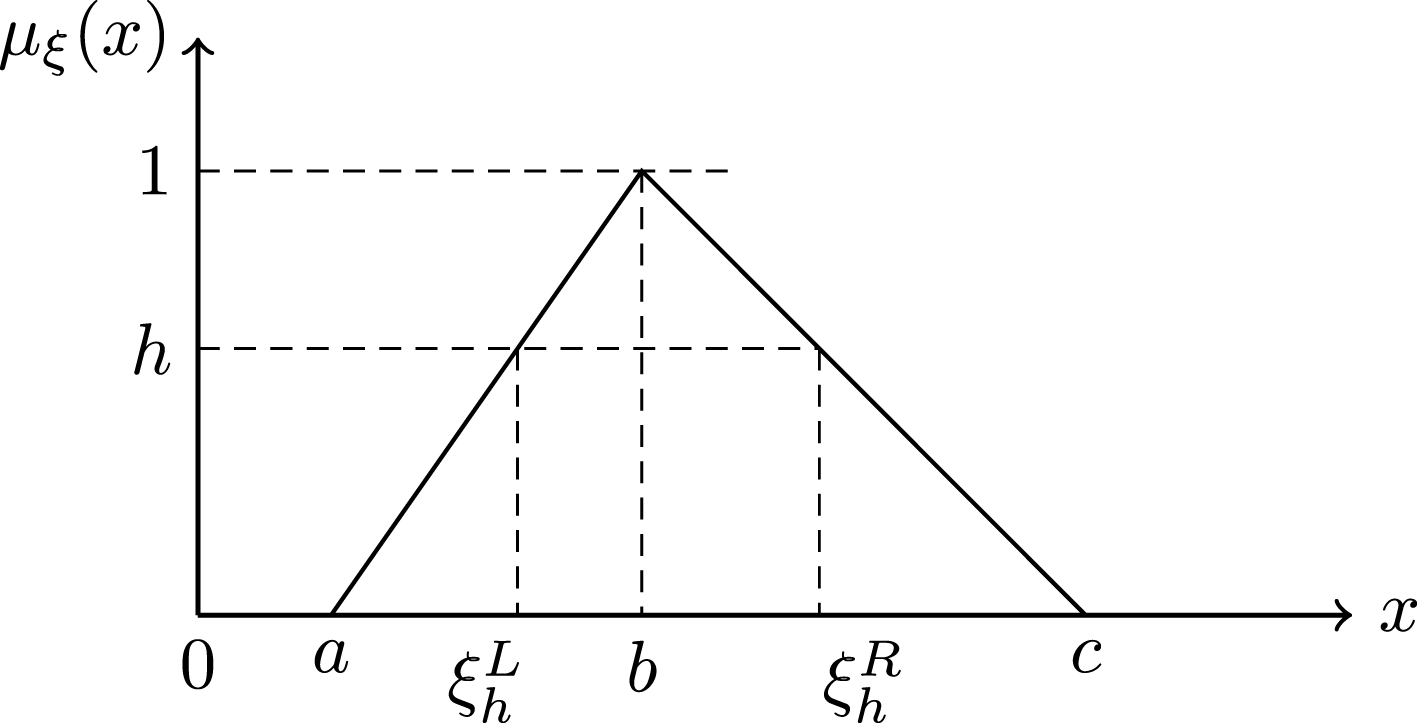
The h-cuts of ξ = (a, b, c).
Results of basic arithmetic via the interval arithmetic approach
Regarding the interval arithmetic approach, the membership functions of arithmetic results are not provided, which may cause inconvenience if users need to utilize the membership functions in their subsequent work. Additionally, the operations of max and min are still included in the results via the interval arithmetic approach, which would make the arithmetic complicated, especially when the signs of the left and right limit values of the fuzzy numbers are not the same or the number of TFNs involved in the arithmetic is substantial.
Credibility measure was suggested by Liu and Liu [19] to measure the credibility that a fuzzy event will occur, defined as the average of possibility measure and necessity measure, i.e.,
That is, Φ (x) is the credibility that the fuzzy number ξ takes a value less than or equal to x. Generally speaking, the credibility distribution of any fuzzy number is non-decreasing. Moreover, regarding fuzzy numbers with continuous and strictly increasing credibility distributions, the definition of inverse credibility distribution was proposed by Zhou et al. [31] as follows.
Besides, assume that ξ = f (ξ1, ξ2, ⋯ , ξ
n
), where ξ
i
are fuzzy numbers with inverse credibility distributions
Assume that ξ1, ξ2, ⋯ , ξ n are TFNs, and f (x1, x2, ⋯, x n ) is a continuous and strictly monotone function with respect to x1, x2, ⋯ , x n . In order to derive the membership function of fuzzy number ξ = f (ξ1, ξ2, ⋯ , ξ n ) analytically from membership functions of ξ1, ξ2, ⋯ , ξ n , this section first proves some theorems on relationships of the membership function μ, credibility distribution Φ, and inverse credibility distribution Φ-1 for a special type of fuzzy numbers, and then utilizes the theorems as well as the operational law proposed in [31] to develop a so-called inverse distribution approach. The detailed procedures of this approach are described step by step by taking TFNs for instance, and an elaborated flowchart is finally given as a summary.
Relations of μ, Φ and Φ-1
Similarly, if Φ (x) ≥0.5, it can be deduced that
From Theorems 2 and 3, it can be observed that there is a one-to-one relationship between the membership function μ and the credibility distribution Φ for a fuzzy number ξ with a continuous and strictly monotone credibility distribution. That is, provided that one of the two functions is known, the other one can be obtained immediately via Eq. (4) or Eq. (5).
According to Definition 3 and Theorem 4, if ξ is a fuzzy number with a continuous and strictly monotone distribution, there also exists a one-to-one relation between its credibility distribution Φ and the inverse credibility distribution Ψ (i.e., Φ-1), both of which are continuous and strictly increasing functions. Given one of the two functions, the other one is then derived by using the inverse operation directly.
Moreover, combining with the conclusions of Theorems 2 and 3, it follows immediately that for any fuzzy number ξ with a continuous and strictly monotone distribution, its membership function μ, credibility distribution Φ and inverse credibility distribution Φ-1 may be deduced from any one of the other two functions. The mutual relations of μ, Φ and Φ-1 will be utilized to design the inverse distribution approach in the following section.
Firstly, based on the definition of inverse credibility distribution (see Definition 3) and the strict monotonicity of credibility distribution, it can be known that the inverse credibility distributions
According to Theorems 1 and 5, for a fuzzy number ξ = f (ξ1, ξ2, ⋯ , ξ n ), if the conditions in Theorem 1 (or Theorem 5) hold, then both of the inverse credibility distribution and the credibility distribution of ξ exist, and may be calculated via Eq. (3) and Eq. (7), respectively, in accordance with the inverse credibility distributions of ξ1, ξ2, ⋯ , ξ n .
Finally, taking advantage of all the theorems proved in this section along with the operational law in Theorem 1, we develop an approach to deriving the membership function of fuzzy number ξ = f (ξ1, ξ2, ⋯ , ξ n ) in the light of membership functions μ ξ 1 , μ ξ 2 , ⋯ , μ ξ n of fuzzy numbers ξ1, ξ2, ⋯ , ξ n , whose basic idea is depicted briefly in Fig. 2.
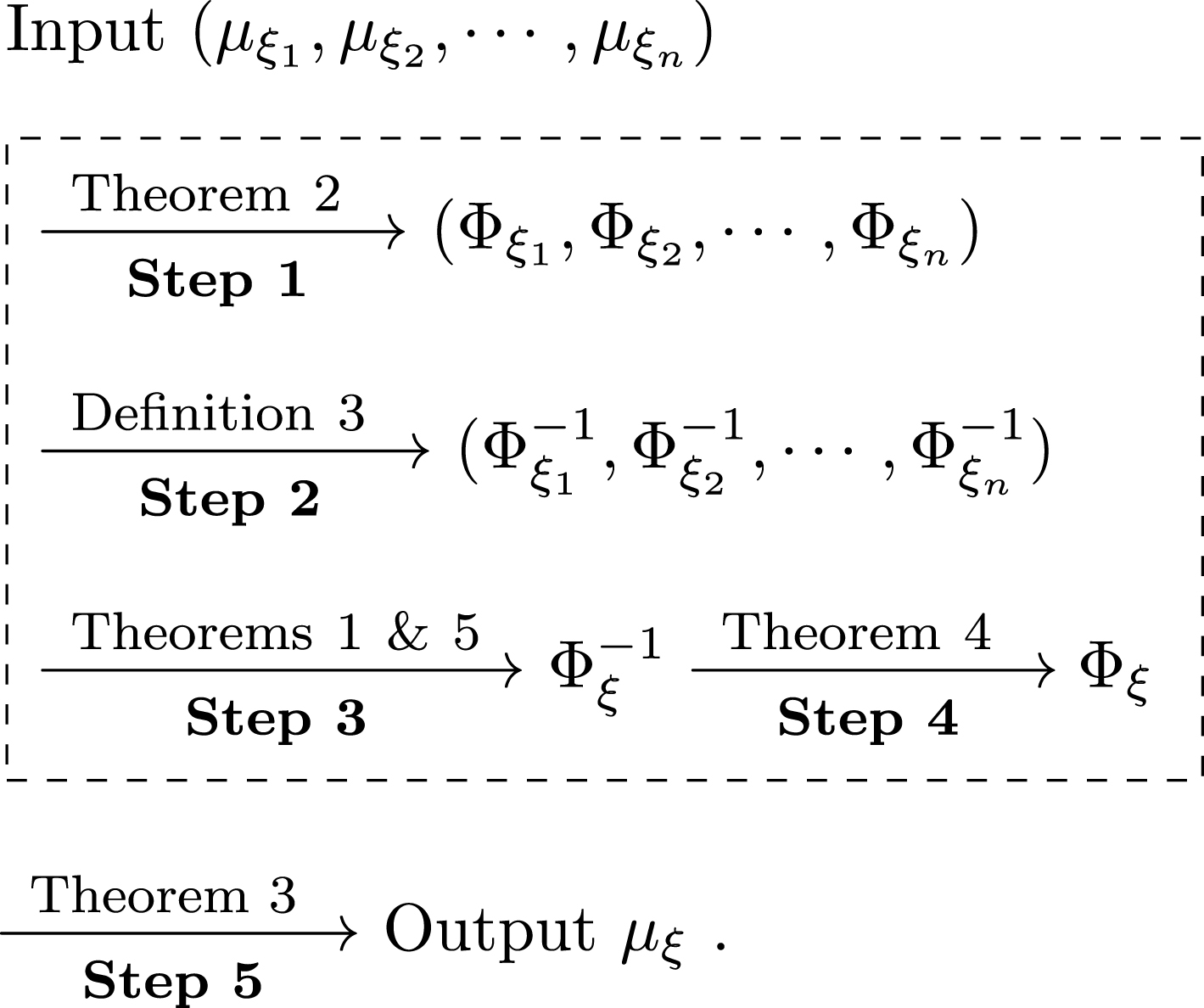
The basic idea of the inverse distribution approach.
As shown in Fig. 2, the credibility distributions Φ
ξ
, Φ
ξ
i
and the inverse credibility distribution
In Zhou et al. [31], it has been proved that a fuzzy number has a continuous and strictly increasing credibility distribution if and only it is an L-R fuzzy number and its shape functions L and R are continuous and strictly decreasing on the open intervals {x|0 < L (x) <1} and {x|0 < R (x) <1}, respectively. Several types of fuzzy numbers possess these properties, a typical one among which is TFNs. Since the arithmetic operations of TFNs are widely discussed in most literature due to its extensive applications while expressing the ambiguous valuations in practical problems, this section takes TFNs as an example to demonstrate the detailed procedures of the proposed approach depicted in Fig. 2 step by step as follows.
Without loss of generality, denote the triangular fuzzy numbers considered by ξ
i
= (a
i
, b
i
, c
i
), i = 1, 2, ⋯ , n, where a
i
, b
i
, c
i
represent the lower limit value, the center value, and the upper limit value of ξ
i
, respectively. Then according to Eq. (4) and the membership function of TFNs in Eq. (1), for each i (1 ≤ i ≤ n), the credibility distribution of ξ
i
is
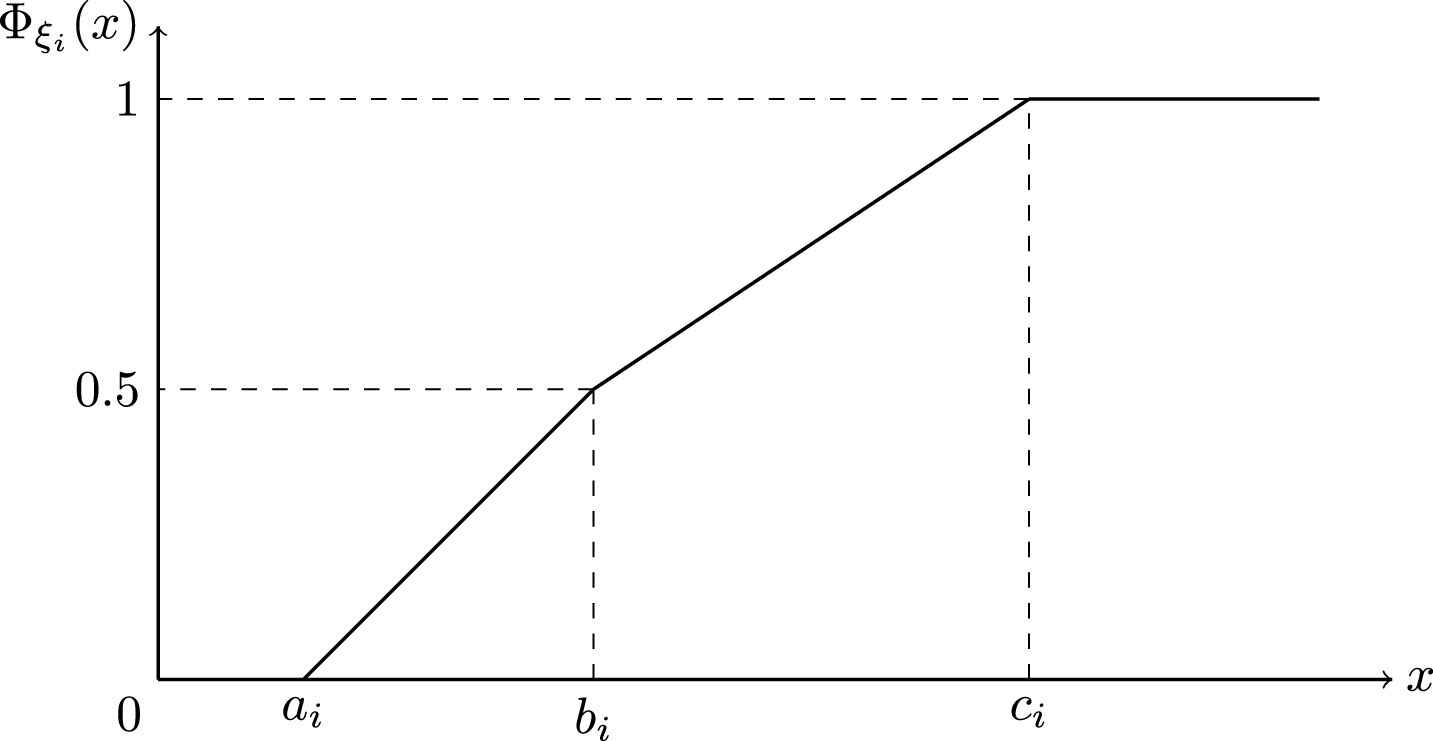
The credibility distribution of ξ i = (a i , b i , c i ).
From Fig. 3, it can be observed that the credibility distribution of ξ
i
= (a
i
, b
i
, c
i
) is continuous and strictly increasing in {x|0 < Φ (x) <1} = (a
i
, c
i
). Then according to Definition 3, for each i (1 ≤ i ≤ n), the inverse credibility distribution of ξ
i
can be deduced through the inverse operation directly as follows,
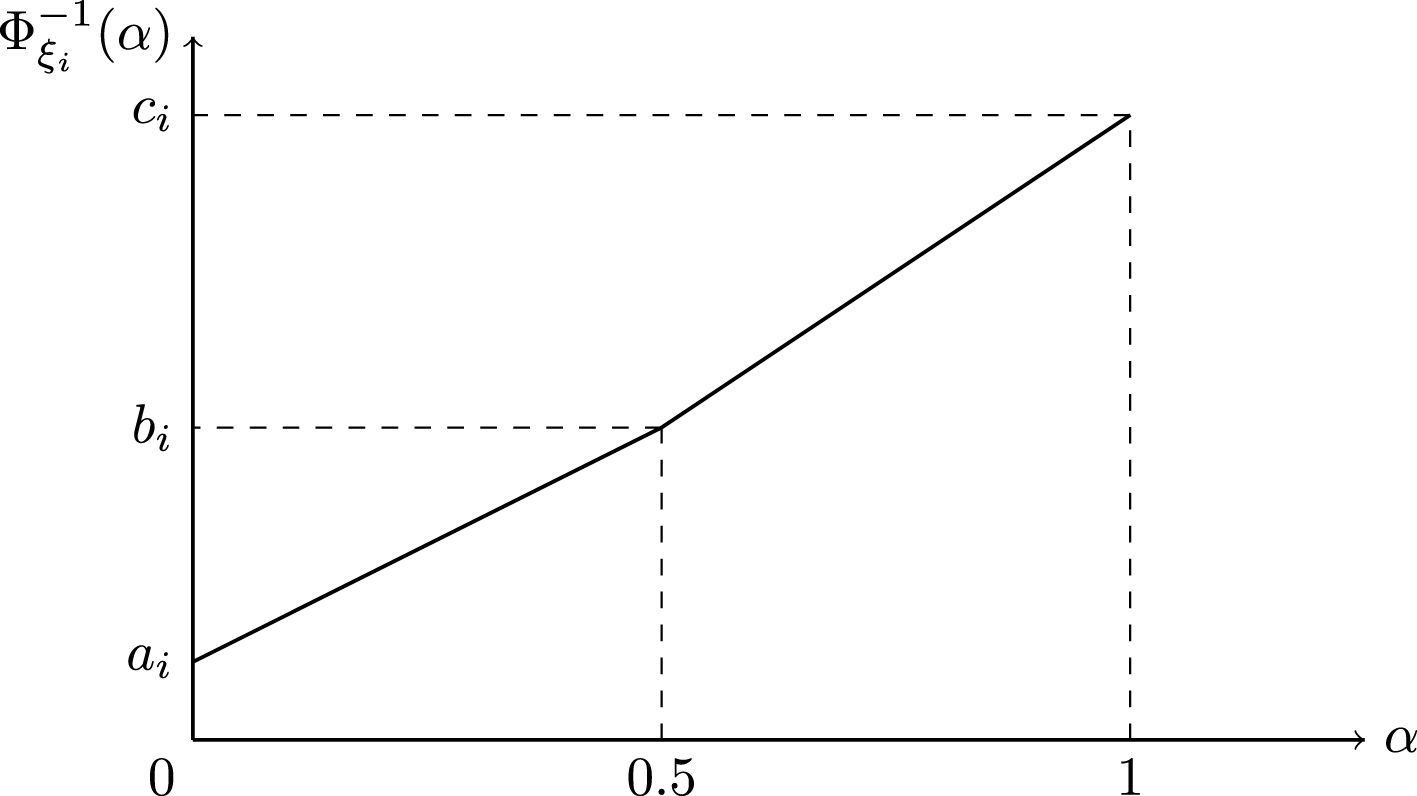
The inverse credibility distribution of ξ i = (a i , b i , c i ).
The third step of this approach is to derive the inverse credibility distribution of ξ = f (ξ1, ξ2, ⋯ , ξ
n
), denoted as
Going through Step 3, the inverse credibility distribution
In most cases, the inverse credibility distribution
As mentioned in Step 4, the credibility distribution Φ ξ (x) of the fuzzy number ξ = f (ξ1, ξ2, ⋯ , ξ n ) exists and is continuous and strictly monotone, and subsequently the exact credibility distribution of ξ (or a well approximation credibility distribution) is obtained via the inverse operation (or with the aid of software packages). Thus according to Theorem 3, we can straightforwardly get its membership function μ ξ (x) from Φ ξ (x) accordingly via Eq. (5).
So far, the detailed implementation procedures of the inverse distribution approach to deriving the membership function μ ξ (x) of ξ = f (ξ1, ξ2, ⋯ , ξ n ) have been presented step by step, where ξ1, ξ2, ⋯, ξ n are TFNs and f is a continuous and strictly monotone function. As a summarization of this section, a flowchart is provided in Fig. 5 to show the main scheme of this approach by taking TFNs for instance.
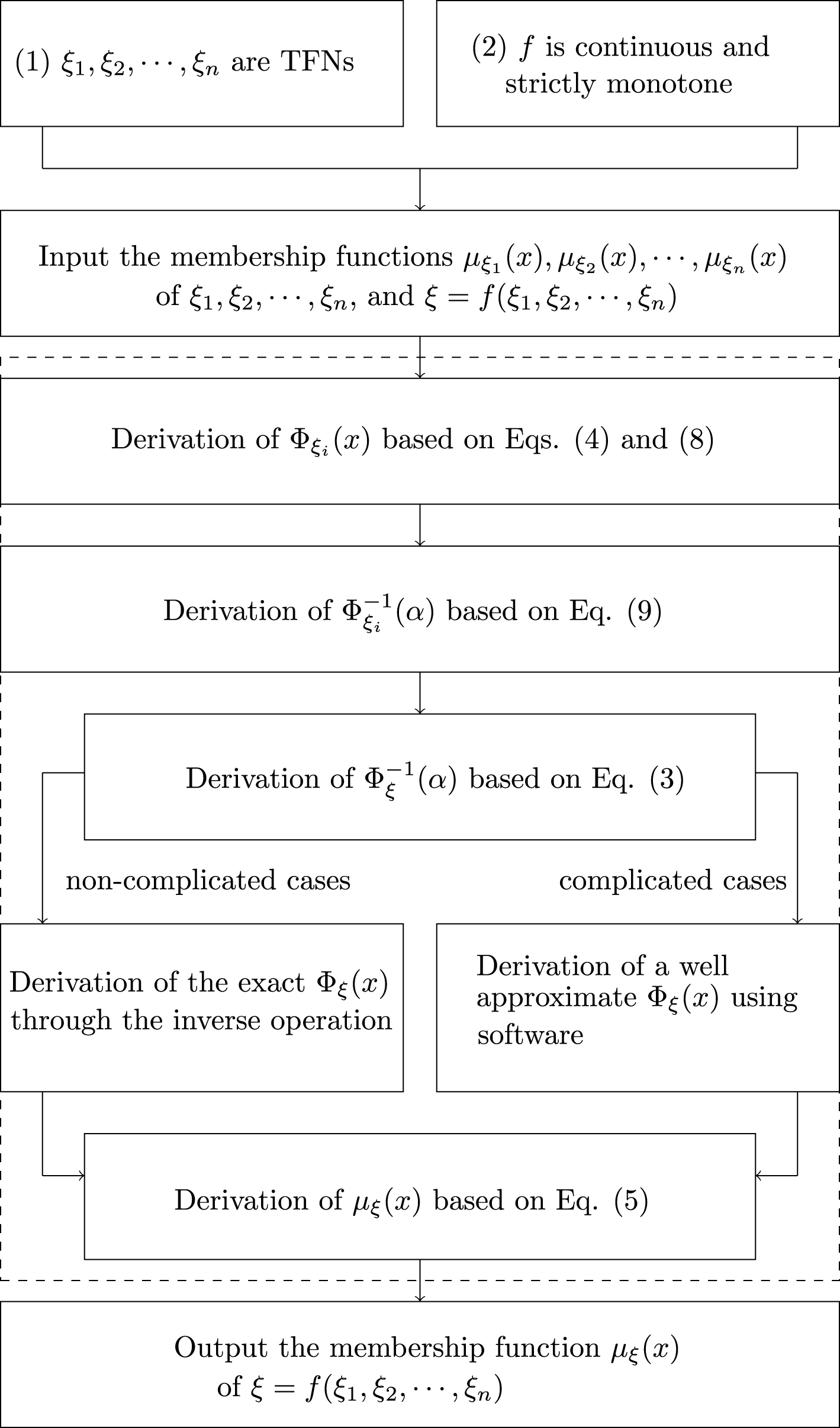
Flowchart of the inverse distribution approach.
At the end of this section, three critical points related to the proposed method should be emphasized. The first one is the applicable type of fuzzy numbers involved in the function f. Even though the above implementation procedures in Section 3.2 and the flowchart of the approach in Section 3.3 are presented by assuming that ξ1, ξ2, ⋯ , ξ n are TFNs, however, the proposed method is applicable to all fuzzy numbers with continuous and strictly increasing credibility distributions equally, which has been explained distinctly in Section 3.1. In other words, for ξ1, ξ2, ⋯ , ξ n with continuous and strictly increasing credibility distributions (equivalently, ξ1, ξ2, ⋯ , ξ n are regular L-R fuzzy numbers, see [31] for more details) and a strictly monotone function f, the membership function of fuzzy number ξ = f (ξ1, ξ2, ⋯ , ξ n ) can be derived similarly by performing Steps 1 to 5 described in Section 3.2. The only difference is the input, i.e., the corresponding membership functions of different types of fuzzy numbers ξ i .
Secondly, as for the precision of the results obtained through the inverse distribution approach, first of all, all the steps except Step 4 are obviously exact function transformation without any approximation. As for Step 4, if the inverse credibility distribution
Additionally, as to the monotone function f, from the perspective of optimization problems, it could be found that almost all objective and constraint functions in practical problems are indeed monotone with respect to the fuzzy parameters. Hence our method is extremely practical when dealing with fuzzy arithmetic in most fuzzy optimization problems in practice.
In this section, four numerical examples are listed to illustrate the performance and effectiveness of the inverse distribution approach we proposed for fuzzy arithmetic on TFNs, the most commonly used fuzzy numbers due to its intuition, convenience of use and computational simplicity. The first three examples are performed for general non-complicated cases taken from Guerra and Stefanini [12], in which the exact membership functions of arithmetic results can be derived. Properly speaking, numerical examples in the literature that studied fuzzy arithmetic are almost in similar forms with the examples in this paper. Besides, the last example is given to show how to proceed the proposed approach against complicated cases with the help of software. Regarding each example, contrasts and verifications are presented for the results derived from our approach with those derived from the interval arithmetic approach and the standard approximation method, respectively.
Firstly, the credibility distribution of ξ1 is deduced through Eq. (8) as
Next, in order to verify the correctness and effectiveness of the membership function we derive, the respective comparisons with the interval arithmetic approach and the standard approximation method are made and shown in Fig. 7.
In Fig. 6, the dot-dashed line depicts the membership function of ξ obtained through the standard approximation method described in Table 1, the solid line presents the membership function of ξ deduced through the novel inverse distribution approach proposed in this paper, while the h-cuts of ξ derived based on the interval arithmetic approach described in Table 2 for h = 0, 0.05, ⋯ , 1 are shown with two points marked with ‘•’. It can be noticed that all the points that indicate the left and right limit values of h-cuts of ξ just fall on the solid line, which verifies the correctness of the membership function we deduced. Subsequently, when 26 ≤ ξ ≤ 36, we can see that the membership degrees of ξ deduced from the standard approximation method are lower than the exact values, while when 36 ≤ ξ ≤ 46, the membership degrees of ξ are much higher than the exact values deduced from either our approach or the interval arithmetic approach.

The membership function of ξ in Example 1.
Firstly, since f is continuous and strictly decreasing with respect to x for x ≥ 0, based on Eq. (9), we can get the inverse credibility distribution of ξ as
Similarly, a comparative analysis with the interval arithmetic approach and the standard approximation method is made and depicted in Fig. 7. The h-cuts of ξ deduced based on the interval arithmetic approach are all consistent with that calculated with our approach. Besides, when 1 . 2-4 ≤ ξ ≤ 0 .7-4, the membership degrees of ξ deduced from the standard approximation method are lower than the exact values, while when 0 . 7-4 ≤ ξ ≤ 0 .4-4, the membership degrees of ξ are much higher than the exact values deduced from either our approach or the interval arithmetic approach.

The membership function of ξ in Example 2.
In this example, since f (x1, x2) is continuous and strictly increasing with respect to x1, and strictly decreasing with respect to x2 (x2 ≠ 0), based on Eq. (9), the inverse credibility distribution of ξ can be deduced. Then via the inverse operation, the credibility distribution of ξ is conducted immediately as
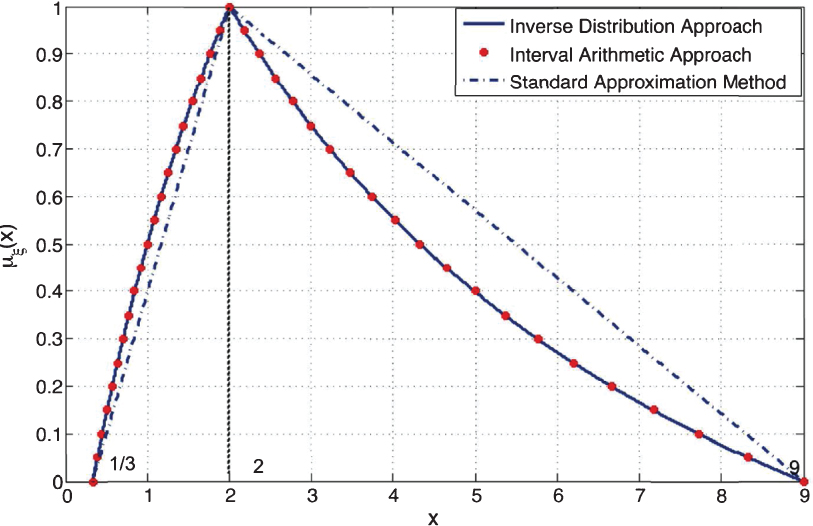
The membership function of ξ in Example 3.
Until now, regarding three different kinds of strictly monotone functions, i.e., strictly increasing, strictly decreasing, and strictly monotone, three corresponding simple examples are listed to illustrate the process and performance of the proposed inverse distribution approach. Besides, as mentioned previously, sometimes the inverse credibility distribution of ξ = f (ξ1, ξ2, ⋯ , ξ n ) obtained through Step 3 may be complicated so that the derivation of credibility distribution of ξ is too tough to proceed through the inverse operation. In order to handle this kind of cases, in this paper, we recommend to utilize some well developed software, e.g., Matlab, to obtain a well approximate function for the credibility distribution of ξ, and then continue the rest steps of inverse distribution approach to deduce a well approximate membership function for ξ. In the following, we present an example to illustrate the process.
Firstly, going through Steps 1 to 3, we can get the inverse credibility distribution of ξ as
Based on Eq. (5), the membership function of ξ can be derived as

The membership function of ξ in Example 4.
Based on the presentations of above four examples including non-complicated cases, i.e., Examples 1∼3 and complicated cases, i.e., Example 4, it is obvious that the correctness of results obtained by using the inverse distribution approach gets a great improvement when comparing with the commonly used standard approximation method for both cases. In Section 1, we have mentioned that in the standard approximation methods, the exact membership function curves are roughly approximated with straight lines, which can be observed directly from Figs. 6∼7. Even though the standard approximation method is simple and easy to proceed, however, at the expense of correctness, so this method is not recommended, especially in some practical engineering programming.
On the other hand, all the arithmetic results via our proposed approach are almost completely coincident with the results obtained through the interval arithmetic approach, including the well approximate membership function. In terms of the interval arithmetic approach, exact expressions for the left and right limit values of h-cuts of arithmetic result can be obtained, which may be used to conduct the exact membership function through the inverse function operation in essence. Similarly, for the complicated cases, the inverse function operation may be also tough to proceed, and then some techniques of curve fitting could be adopted through all kinds of software packages. But to our knowledge, this work has not been completed yet in the existing literature. In addition, the interval arithmetic approach merely provides the solutions for the basic arithmetic on TFNs, while for other types of fuzzy arithmetic, there is not a clear instruction. Besides, the operations of max and min are still included in the interval arithmetic approach, which may cause the calculation complicated, especially when the number of TFNs increases substantially. However, with the aid of the inverse distribution approach proposed in this paper, provided that the function of TFNs is continuous and strictly monotone, the exact or a well approximate membership function (rather than the h-cuts obtained by the interval arithmetic approach) would be derived through a relatively simple procedure, which could be used in the subsequent applications.
In system reliability analysis problems, owing to the infrequency of the hazard event and the instability of a system, it is always difficult to obtain exact probability of an event which results in the probability varying within a certain range. Thus many researchers address these problems in a fuzzy way (see, e.g., [15, 27]). In this section, an example of fuzzy system reliability introduced by Singer [23] is used to demonstrate the efficiency and accuracy of the inverse distribution method by comparing with the results in [4, 23] and those by the interval arithmetic approach.
A scenario of system reliability related to grinding machine safety is illustrated in Singer’s example, whose process can be described as a fault tree in Fig. 10, where the basic events A ∼ H contributing to the accident are described specifically in Table 3. According to Chen [4] and Singer [23], the possibilities of occurrence of the basic events are assumed as TFNs and denoted as ξ A ∼ ξ H , respectively. Since the spread values of fuzzy parameters in [4, 23] are set too small, which is not in accordance with practice due to the lack of effective and sufficient historical data in an uncertain environment, this paper enlarges the original spreads of ξ A ∼ ξ H to a comparatively reasonable range, see Fig. 10.
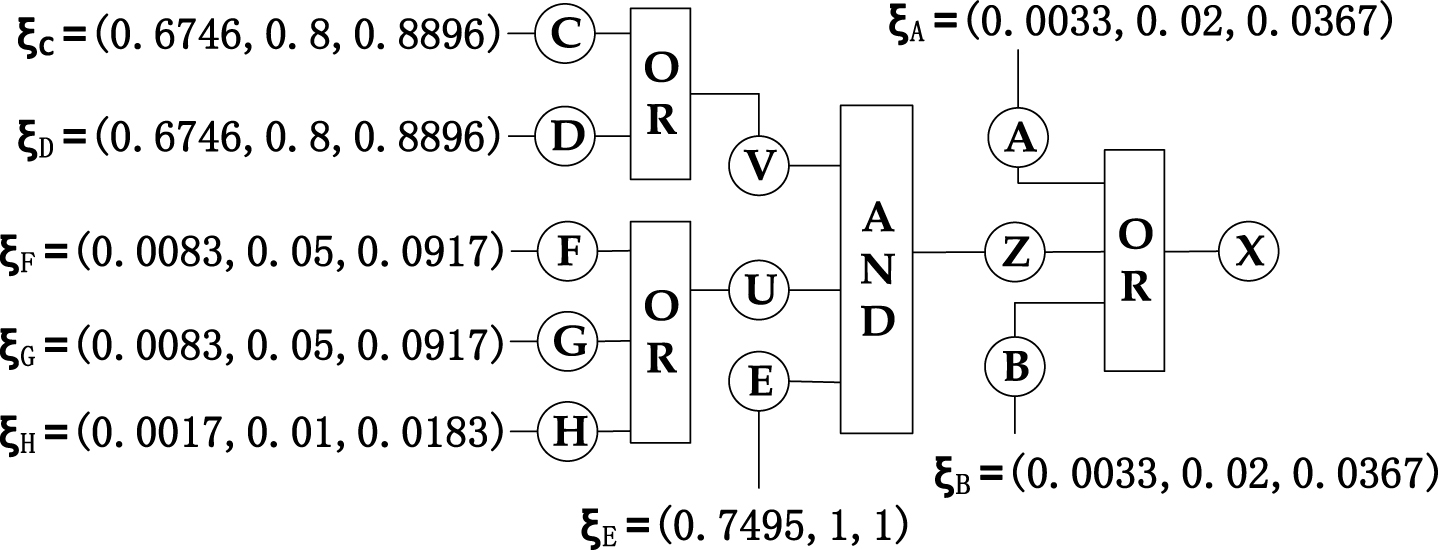
The fault tree and possibilities of occurrence of basic events.
The basic events contributing to the accident
Let X indicate the main event that people get hurt when coming to the working area of two grinding machines, whose possibility of occurrence as the system reliability is denoted by ξ. Based upon the fault tree in Fig. 10, the truth function of the main event X can be written as follows,
Apparently, the function f is continuous and strictly increasing with respect to ξ
A
∼ ξ
H
. Then referring to Eq. (3), the inverse credibility distribution of ξ is obtained as
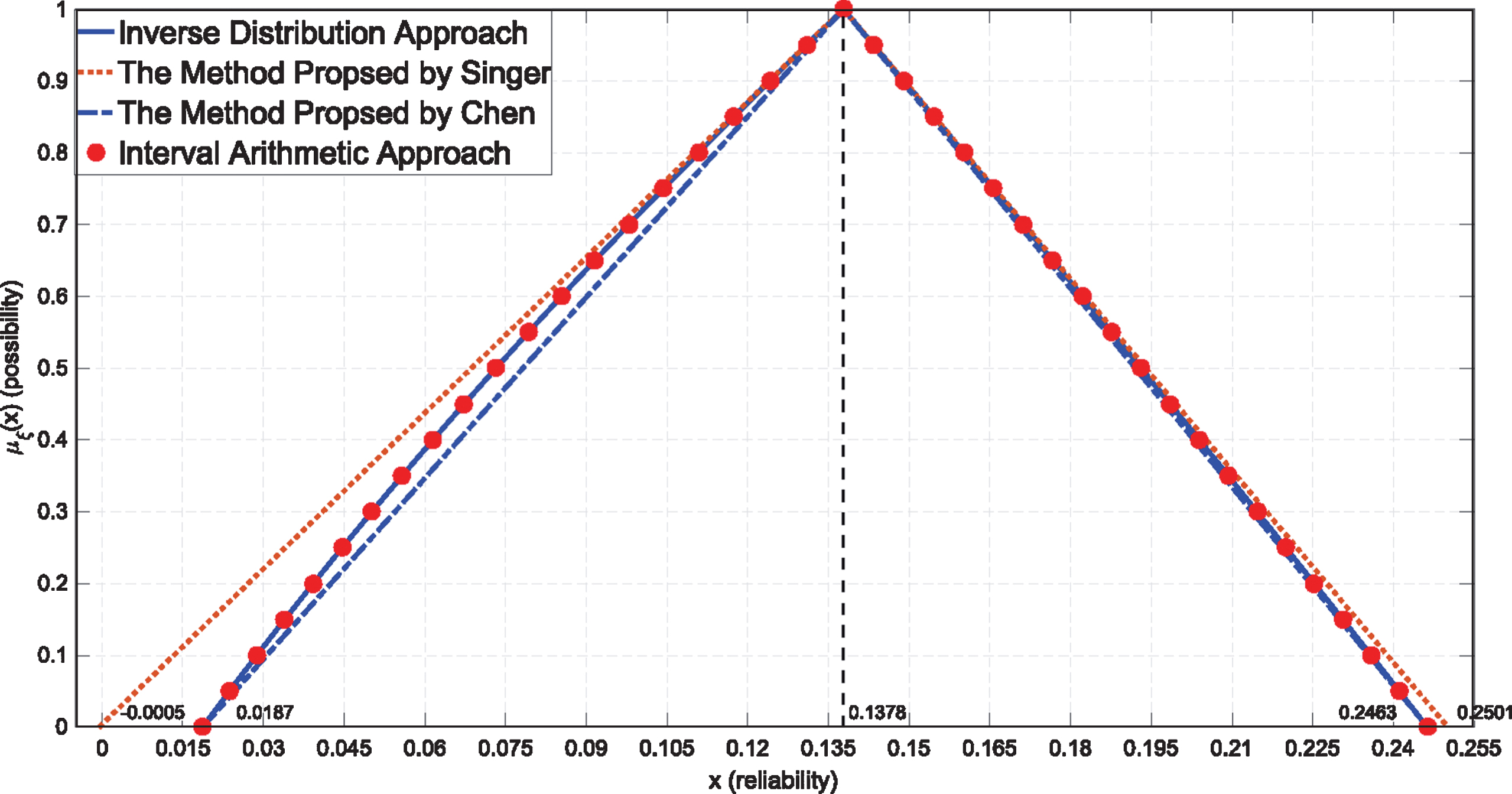
Membership functions of ξ via four different methods.

Membership functions of ξ under different parameter settings.
Additionally, for comparison, the other three approaches are utilized to deal with fuzzy arithmetic in this technical example as well. The first one is an approximation method from Singer [23], in which the add and multiplication operation on two TFNs ξ1 = (a1, b1, c1) and ξ2 = (a2, b2, c2) are defined by
The second one is the standard approximation method employed by Chen [4]. Besides, the interval arithmetic approach is also adopted to calculate the reliability of the grinding machine system. The results of the membership functions calculated by the three methods are presented graphically in Fig. 11 as well, in which the results in Singer [23] and Chen [4] are depicted by the dotted line and the dot-dashed line, respectively, and the h-cuts derived from the interval arithmetic approach are shown with ‘•’.
As shown in Fig. 11, all the points indicating the left and right limit values of h-cuts of ξ just fall upon the solid line when h = 0, 0.05, ⋯ , 1, which gives a strong proof for the correctness of the membership function we derived through the proposed inverse distribution approach. Although the mean value and the spreads of ξ deduced by Chen’s [4] method, the interval arithmetic approach and our method are completely equal, the solution accuracy of the standard approximation method employed by Chen [4] is apparently inferior to the other two methods, especially when the system reliability takes value within 0.0187 and 0.1378. As to the approximation method utilized by Singer [23], the solution accuracy performs worse compared with the results obtained by Chen [4].
Further, for demonstrating the performance of the four methods under different parameter settings, we change ξ C , ξ D and ξ E as (0.1333, 0.8, 1), (0.1333, 0.8, 1) and (0.1667, 1, 1), respectively. The aforementioned analysis procedure is homoplastically repeated, and then the obtained results are reported in Fig. 12 for comparison. Similar conclusions could be deduced as well from Fig. 12, in which the solution accuracy by Chen’s [4] method becomes worse with respect to the new parameters. Moreover, Singer’s [23] method even possibly returns a negative reliability in some cases, which distinctly reveals low-accuracy and impropriety of their approximation approach from the angle of real applications.
To sum up, the proposed inverse distribution approach is applied to a system reliability analysis problem related to grinding machine safety in this section. The numerical results demonstrate the efficiency and effectiveness of our method. All comparative study with the other three methods in the current literature is also conducted for different parameter settings, which shows the high accuracy of the proposed novel method.
In this paper, we have contributed to the research area of fuzzy arithmetic approach in the following three aspects: (i) for any fuzzy number ξ with a continuous and strictly increasing credibility distribution including TFN as a special case, some theorems on relations among its membership function μ
ξ
, credibility distribution Φ
ξ
, and inverse credibility distribution
Footnotes
Acknowledgments
This work was sponsored by “Shuguang Program” supported by Shanghai Education Development Foundation and Shanghai Municipal Education Commission (Grant No. 15SG36).