



Abstract
This paper presents boundless capacity, one server’s fuzzy and intuitionistic fuzzy queuing models. This study’s primary objective is to demonstrate and compare the performance of a single server queuing model with infinite capacity using fuzzy queuing theory and intuitionistic fuzzy queuing theory. This article demonstrates that intuitionistic fuzzy theory performs better when solving queuing problems. Furthermore, by integrating fuzzy queuing models into an intuitionistic fuzzy framework, their relevance in authentic situations is augmented. The fuzzy queuing theory model’s performance measurements are delivered as a range of values, but the intuitionistic fuzzy queuing theory model offers a broad array of values. In this context, the arrival and the service rates are both triangular (TFN) and intuitionistic triangular fuzzy numbers (TIFN). An assessment is performed to determine the evaluation criteria, employing a design protocol in which the fuzzy values are taken as-is without being turned into crisp values. As a result, in an ambiguous environment, we can use the proposed approach to pick scientific findings. In this study, we are using the TFN in an intuitionistic fuzzy environment, compensating for the degree of stability and denial so that the sum of both virtues is never higher than one. We proffered many non-normal arithmetic techniques for this sort of fuzzified integer. The envisaged compositions are intuitive and concise, as they evolved by utilising canonical algebraic mathematics. In real-world situations, this tactic is simple and straightforward to enact. The nearest interval number is then used to round a TIFN. The key advantage of this strategy is that it allows us to quickly solve a constrained unrestrained optimization model with TIFN coefficients using a multi-section heuristic. The prevailing methodologies and initiatives are destined to be relevant to different types of updated decision-making obstacles in focusing on economic equity, funding, presidency, and environmental sciences, which will be the focus of our future research. And two numerical problems are solved to showcase the sustainability of the suggested technique. In this queuing model, we predict a variety of components, including prospective queue length, expected system length, and sojourn time in both the queue and the system. The statistical analysis reveals that the quantified performance indicators of the intuitionistic fuzzy queuing model agree well with the performance measurements of the fuzzy queuing model. Even though the average correlation between the two concepts is nearly equivalent, TIFN provides a more extensive range of possibilities than TFN. Despite the fact that fuzzy set theory is used to contend with unpredictability in decision-making circumstances, it only relates to the extent of membership and lacks a model for reluctance. The fact that each asset’s affirmation and deprivation levels are comprehended is the special feature of intuitionistic fuzzy sets. As a consequence, it becomes more meticulous, suitable, and generalizable.
Keywords
Introduction
Queuing theory, or the study of waiting lines, is indeed one of the earliest and most routinely used empirical monitoring tools. The term “queuing theory” refers to a mathematical technique for analyzing waiting queues. The analysis of queue congeries and delays is one of the applications of queuing theory. Queuing model has an ancient legacy and has been designed to tackle issues in a broad array of sectors, including manufacturing, communication, and inventory control.
In the literature on queuing, those models have been widely utilized to obtain routine actions, design workplace conditions, and labor regulations. Many variables in queuing models may not be known correctly in a real-world scenario due to various reasons. Hence, there is a necessity to apply the fuzzy logic in the queuing systems to apply this concept to various situations in life and we can extend it to computer networks. Meanwhile, in many practical situations, the system designers or the researchers are in a need of clear data for decision-making. To overcome the vagueness, many researchers used a method of constructing a membership function for performance measures of the queue. Another of them is the idea of an intuitionistic fuzzy set, which might be considered a suitable method for defining a fuzzy set when the accessibility of data is insufficient to determine an ambiguous conception using a classical fuzzy set. Here we have used a novel approach to solve the practical problem and calculate the values like the No. of customers and their sojourn time in queue as well as in the system using both fuzzy and intuitionistic fuzzy numbers without changing its nature.
Single server queuing models are used in many real-life situations such as in ticket counters, beauty parlors, dispensaries, and so on., where many customers get their service based on certain queue disciplines. The arrival rate and service rate are supposed to obey certain distributions in the classical queuing theory. But when the data is unclear, fuzzy parameters play a vital role to get an optimized result. This work presents a new method for a single server infinite capacity fuzzy and intuitionistic fuzzy queuing model. In our day–to–day life situations, the values of many variables are unclear. To solve such situations, all input variables are taken as both fuzzy and intuitionistic fuzzy numbers which generates much more realistic results.
Many researchers have utilized various strategies in the annals of fuzzy queuing such as R.J.Li et al. [12] using Zadeh’s extension principle, D.S.Negi et al. [17] used the α-cut method and also random variables, Aydin et al. [4] used different membership functions in multi-server queuing models, J.P.Mukeba et al. [15] used the L–R method, S.Narayanamoorthy et al. [16] used the DSW algorithm for the multi-server model, Shin pin Chen [22] used parametric non-linear approach for bulk queues, Kao et al. [11] used parametric programming approach to find out the No. of customers and their waiting time. The membership function of the fuzzy cost function is proposed by S.Hanumantha Rao et al. [8] to get confident predictions for certain key metrics of a configurable 2 different service dedicated server Markovian gating queues with server starts and breakdown over N-policy. K.Usha Prameela et al. [25] used the ranking technique to convert fuzzy into crisp and solved the single server fuzzy queuing model with 2 classes. S.Hanumantha Rao et al. [7] proposed a solitary Semi –Markov queuing system with finite capacity, encouraged arrivals or discouraged arrivals, and a revised customer reneging policy. Ch. Swathi et al. [23] used probabilistic generator methods to calculate steady flow probability for both individual and multi-vacation situations. K.Atanavssov [2], that publication has been the first approach to providing a broader and comprehensive account of intuitionistic fuzzy set theory and it’s more adapted in a range of domains. K.Atanavssov [3] incorporated the intuitionistic fuzzy set, and he also departed from the temporal intuitionistic fuzzy sets. V.Vasanta Kumar et al. [26] transformed a fuzzy queue into a collection of conventional crisp queues using the alpha cut and Zadeh’s extension principle. P. K. Maji et al. [13] investigate intuitionistic fuzzy soft sets. S.S.Sanga et al. [19] used the probability generating function to produce the steady flow mathematical formulation for the probabilistic distributions and systems evaluation methods. A.Tamilarasi [24] used trapezoidal intuitionistic fuzzy numbers to investigate the intuitionistic fuzzy and queuing model. In fuzzy linear programming problems, Arpita Kabiraj et al. [1] used intuitionistic concepts in a linear programming problem. G.Chen et al. [6] investigated the optimum and equilibria techniques in fuzzy M/M/1 queues with all fuzzy numbers as control variables in this study. Jana et al. [9] used intuitionistic fuzzy linear programming to solve the transportation model. G.Kannadasan et al. [10] discussed an M/M/1 queuing model with a single working vacation, restless customers who refuse to wait, and fuzzy parameters. P.Rajarajeswari et al. [18] used the idea of alpha cuts and the extensions approach in intuitionistic fuzzy examples to build membership function parameters and quasi functions of system features using Non-linear Programming. R. Sethi et al. [20] applied a recursive approach to extract the stable distributions of queues and created the multiple performance indices and carried out numerical experiments to typify the functionality of the application index’s as various control parameters are changed. Aymen M. Al-Kadhimi [5] used queuing model analysis in a shopping malls during the pandemic(covid). Defuzzification is an inescapable step in the prior studies on fuzzy queuing models to retrieve the outcome. In this endeavor, an innovative technique has been developed to solve the queuing models using both fuzzy and intuitionistic fuzzy numbers without converting them to the classical ones and successfully extracting the result. Hence, this work provides a new version of solving queuing problems using fuzzy and intuitionistic fuzzy numbers, and it is worth making a conclusion in every unpredictable situation. That is, a simple way is prescribed to get a solution to the queuing problems. Queuing theory gives performance measures as values, fuzzy queuing theory has a range of values while the intuitionistic fuzzy queuing theory has a wide range of values. According to the results of the analysis, the fuzzy queuing model’s performance measurements are within the realm of the intuitionistic fuzzy queuing model’s computed benchmarks.
The following is a summary of the article’s framework: The essential definitions are presented in Component 2. The system model is described in Component 3. Component 4 establishes some theorems. The mathematical model is explained in Component 5. A mathematical illustration is furnished and solved in Component 6 to showcase the feasibility of the developed method. Eventually, component 7 brings this work to completion.
Preliminaries
The motive of this division is to give some basic definitions, annotations, and outcomes that are used in our further calculations.
The triangular fuzzy number is illustrated in Fig. 1.

Triangular fuzzy number.
(A)Addition
(B)Subtraction
(C) Multiplication
(D) Division
For any two TFN
A triangular fuzzy number
The triangular intuitionistic fuzzy number is illustrated in Fig. 2.
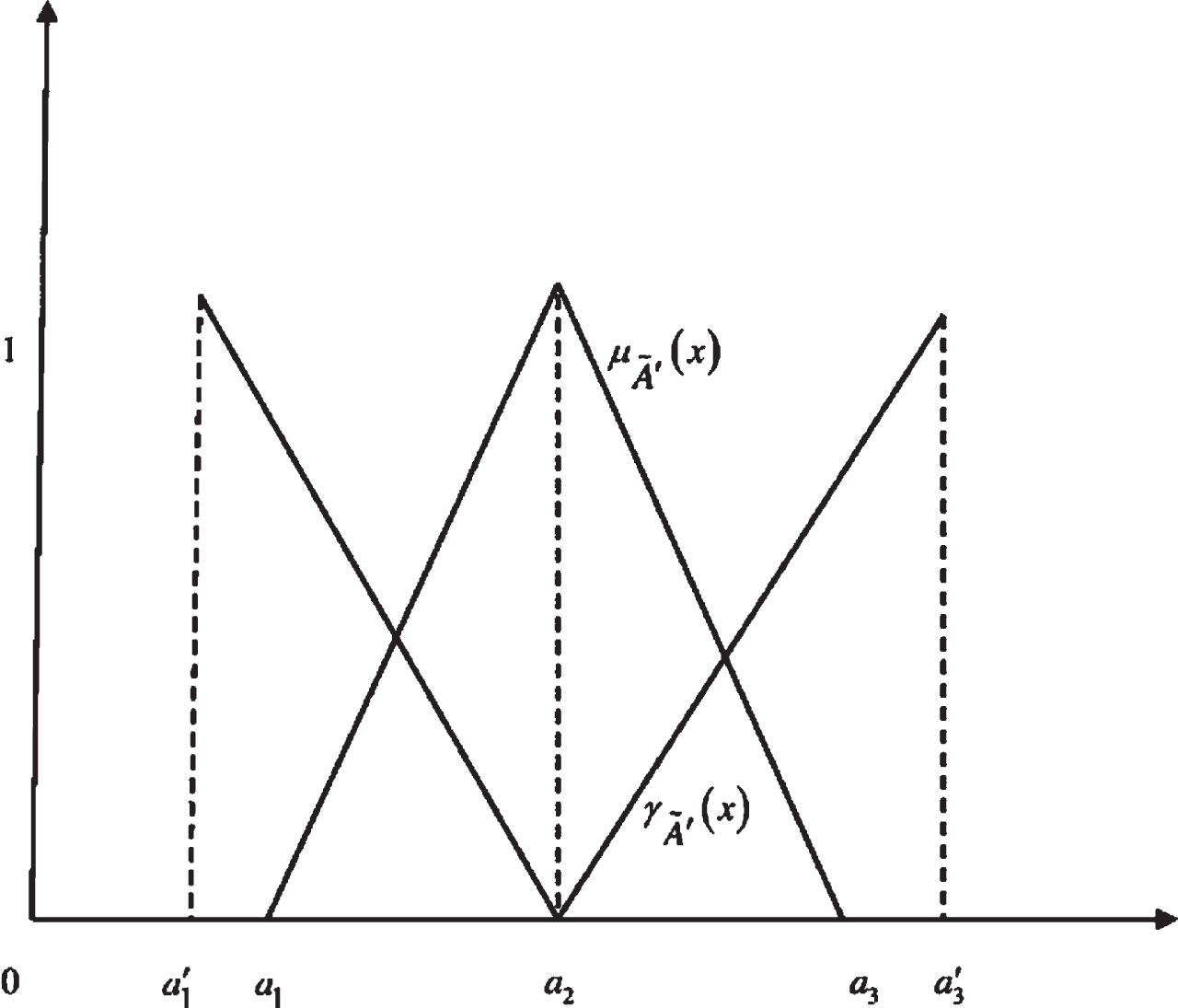
Triangular intuitionistic fuzzy number.
Cases: Let
Case:1 If
Case:2 If
For any two arbitrary TIFN
Addition
Subtraction
Multiplication
Division
In real life scenario, decision-makers select the value of
For any two TIFN
A queuing paradigm (FM/FM/1) : (∞/FCFS) with a single server’s unbounded limit is described. The first phrase in the model, FM, stands for the Poisson process; the second term, FM, stands for the exponential distribution; and the third term indicates the number of servers. In this context, the sequential elapsed time and processing times are presumed to be autonomous of one another. Consider a simple fuzzy queue with one server, where users queue up according to their Poisson distribution. Consumers must wait in line for their service if the server is swamped. However, they must access the server one by one to acquire a service that follows an exponential distribution. The arrival and service rates are calculated using both TFN and TIFN. There is no restriction on the number of people who can call. The major step is to establish assessment criteria employing both fuzzy and intuitionistic fuzzy numbers, and models are compared based on the average No. of customers in the queue and system, as well as their sojourn (waiting) time. The problems are overcome by keeping the fuzziness levels constant until the very end, rather than migrating to crisp. As a result, it is better suited to specific scenarios. By Little’s theorem, we have
Hypotheses and syntaxes
Hypotheses
Consider the infinite capacity (FM/FM/1) : (∞/FCFS) queuing model. The System is served by a single server. Interarrival rates are tweaked appropriately. In addition, service rates are disseminated concurrently. The arrival rate and service rate are taken as TFN and TIFN.
Syntaxes
Here we are using the following notations:
Greek Symbols
μ (x) → Membership function of x
γ (x) → Non-membership function of x
Intuitionistic fuzzy form of general poisson queuing model
For n > 0, the average rates of consumers’ movement into and out of state n must be equal under steady-state conditions. As a result, the state n might be altered to states n - 1 and n + 1 only.
Equating the average irate of customers’ flow into and outside of state n as follows
Again, comparing the average rate of customer movement into and outs of the state n = 0 as follows
Then substitute n = 1 in Equation (9), we get
Substitute the value of
Assume that the criteria are met for k,
where,
To prove the findings are true for n = k + 1, then substitute n = k in Equation (9), we get
where,
Hence the result is proved by mathematical induction. Therefore, we can conclude that
Thus, if
Then from (15)
We have,
From (20),
Then from (11), (13), (15), & (18)
If Part,
Assume that,
A queue is stable only if
By our assumption, we have
Only If Part,
Assume that,
Then the number of customers will get increased by one and the number increases from n to n + 1 in the system. After getting their service the customers leave the system, and due to their departure, the customer will leave n in the system, which implies that the number of customers in the system will decrease by one and change from n + 1 to n.
Hence, at any time
We have to prove that,
Consider that the system’s starting state is empty i.e.) no customers
New customers arrive at the rate of Poisson distribution
At n state,
At 0 state,
Since
It follows that
Here ρ′ ⩾ 1 is not possible due to the convergence property. Hence, we have
To prove,
Since,
Let
The following are the fabrication characteristics of the above model:
The No. of customers in the system
The sojourn time in the system
The No. of customers in the line
The sojourn time in the line
Assume in a xerox shop, about 45 people are looking for photocopies every hour. After seeing this the shop owner has decided to serve people more than in the above case. So, he decided to buy an elevated copying machine as he can serve approximately 48 individuals every hour.
Single server intuitionistic fuzzy queuing model with infinite capacity
Let
Determine the TIFN in the form of
Similarly, calculate the remaining parameters and the metrics of performance are calculated and tabulated in Table 2.
Performance Measures using TIFN
Performance Measures using TIFN
The above Figs. 3–10 depict the visualizations of Tables 1 2.
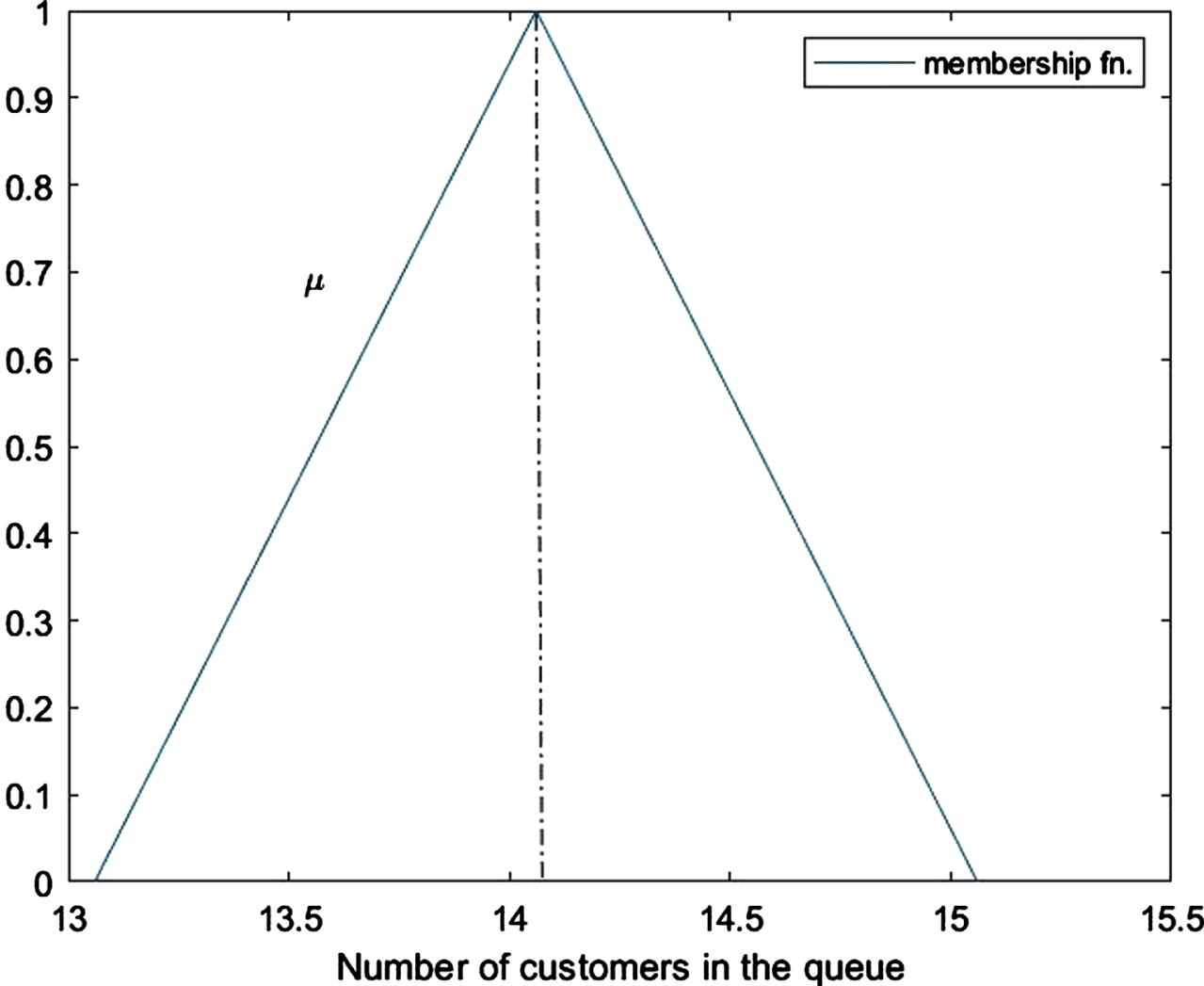
The number of customers in the queue
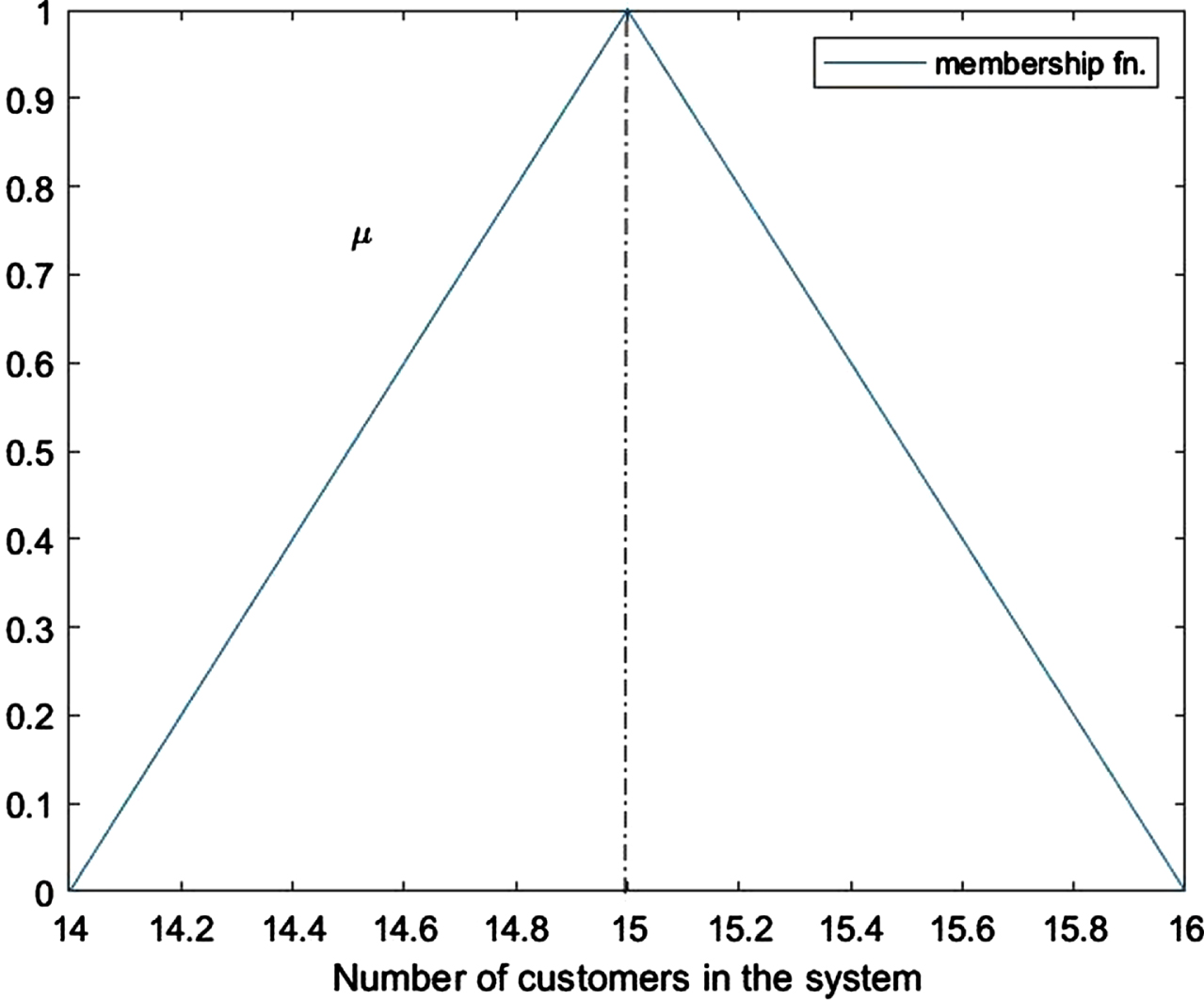
The number of customers in the system
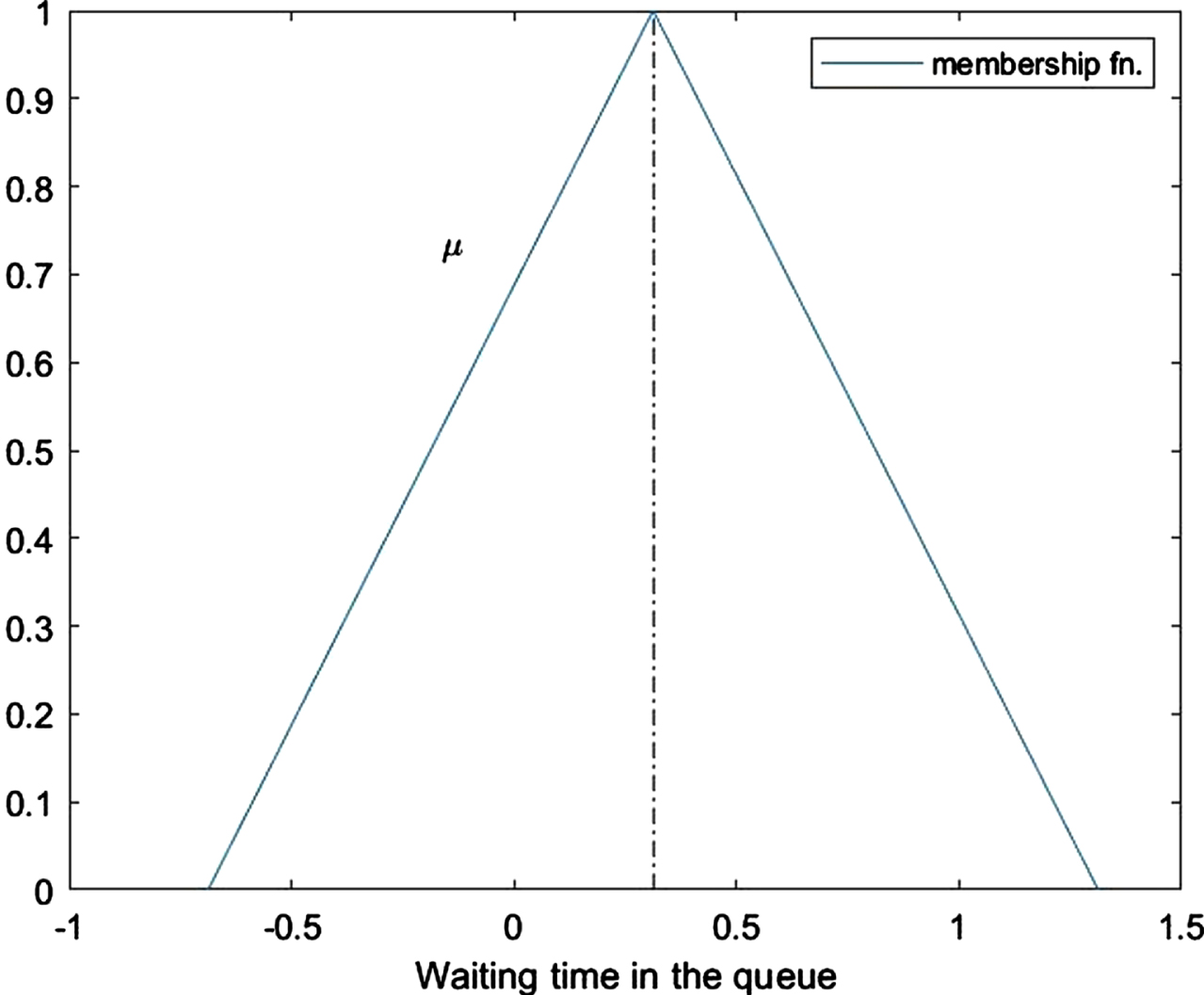
The waiting time of customers in the queue

The waiting time of customers in the system

The membership (μ) and non-membership (γ) function of the number of customers in the queue

The membership (μ) and non-membership (γ) function of waiting time of customers in the queue
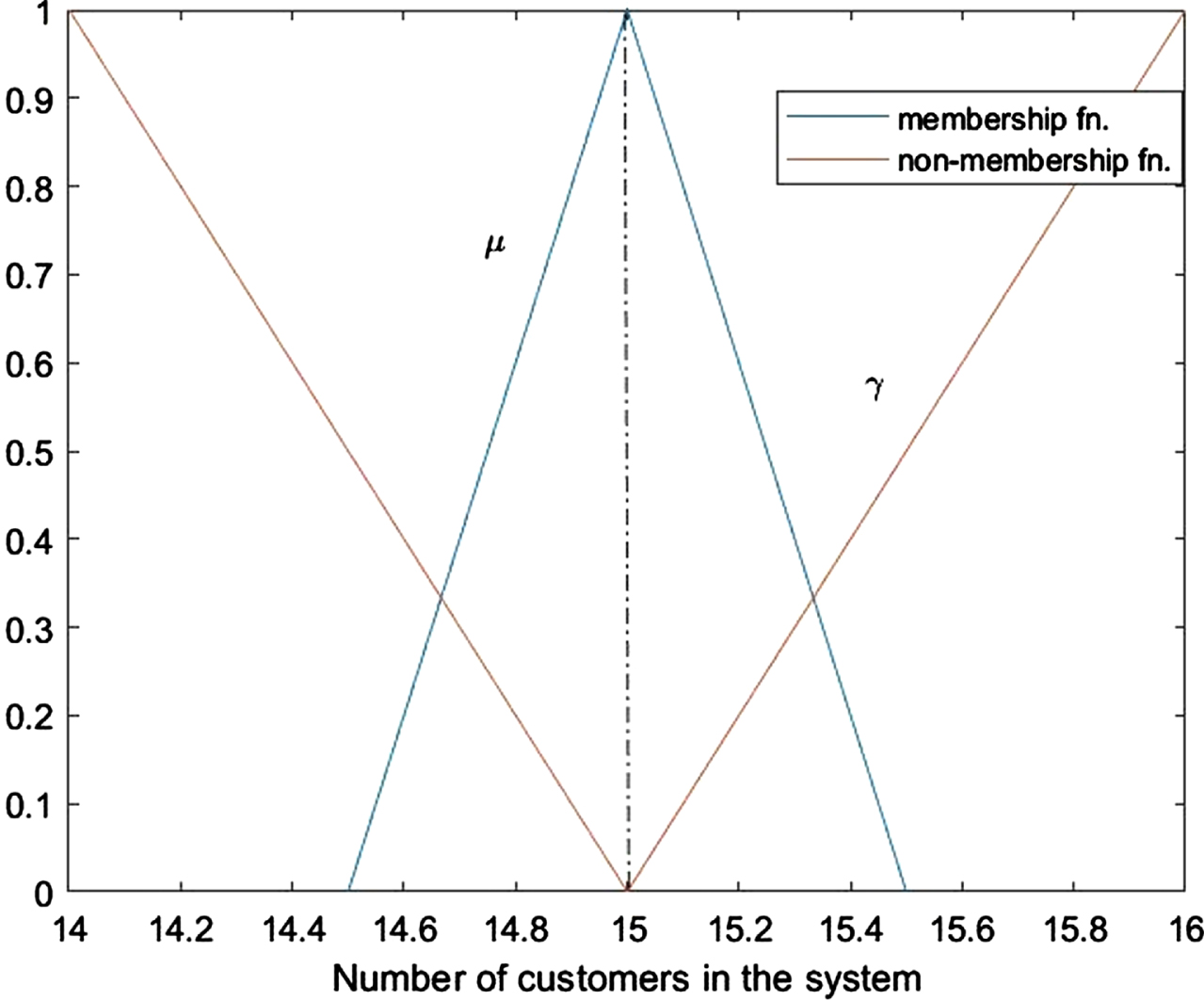
The membership (μ) and non-membership (γ) function of the number of customers in the system
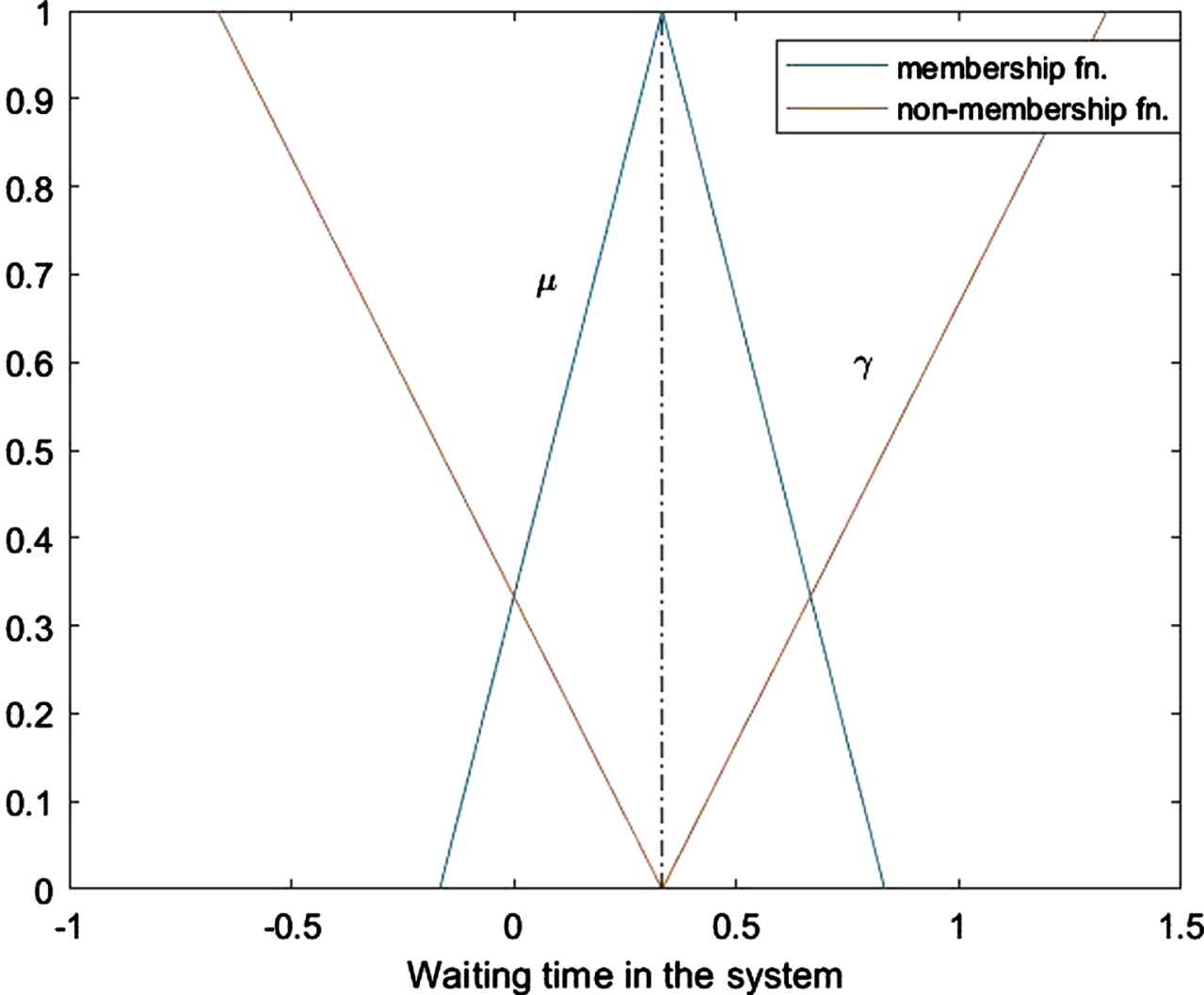
The membership (μ) and non-membership (γ) function of waiting time of customers in the system
Performance measures using TFN
Therefore, the value of
The mean value of both models is equal in the above discussion, but we can get a wider spectrum of virtues using TIFN than TFN. As a direct consequence, assessment methods for both the fuzzy queuing model and the intuitionistic fuzzy queuing model reveal that they are comparable. Even though the computed value of the fuzzy queuing model is well within the range of performance measures of the intuitionistic fuzzy queuing model. As an outcome, the procured result is consistent. When the dissemination of information to decision-makers is woefully inadequate, the analyst will choose to form opinions in a hazy environment. When the accessible information is too jumbled, IFS is a powerful platform for handling the situation and interpreting results. Because in fuzzy sets, only the degree of acquiescence is recognized, whilst an intuitionistic fuzzy set is characterized by a membership function and a non-membership function with a total of less than one. The intuitionistic fuzzy queuing model provides more information, which is beneficial when characterizing a queuing system. In one way, IFN melds the discrepancies and lack of precision of data. As a direct consequence, IFS could be used to assist users in drawing conclusions and conducting other activities that require comprehension but are intrinsically unspecific or dubious.
It uses the ambiguous set to investigate a single server modeling approach with infinite capacity in this study. Both the arrival and service rates are ambiguous figures. Because some of the model parameters are ambiguous, the action is taken to impose uncertainty on the raw data. The yield of the article is extremely useful for any business that has been exposed to the phenomenon of customers increasing the number of lines and service stations. As a result, the time spent queuing for customers is reduced, and customer satisfaction is raised. And here, we have suggested a different approach to solving queuing problems using both fuzzy and intuitionistic fuzzy numbers which give the anticipated No. of customers and the sojourn time of customers in the queue as well as in the system in a successful way. Under this interpretation, the intuitionistic fuzzy results give a wider array of information than the fuzzy measure. In this case, the problem is solved by leaving fuzzy and intuitionistic fuzzy values alone, without converting them to their crisp equivalents. By using this proposed method, the fuzzy optimal solution to queuing problems occurring in real situations can be easily solved. The prediction strategy can arrive at research facts, and the fuzzy and intuitionistic fuzzy queue with infinite capacity is discussed in further complexity. The hypothesized queuing system’s correctness and thoroughness are validated using the TFN and TIFN mathematical manifestations. A computational model depicts the extensibility of the preferred methodology. The intuitionistic fuzzy queuing model is significantly more practical and successful in monitoring and rating dimensions of queuing models because the intuitionistic fuzzy theory is more configurable. As a result, intuitionistic fuzzy queuing is one of the fittest modalities of computing quality objectives, according to this investigation, because the evidence gathered from the application is easier to recognize and appreciate. Discussions made in previous sections show that this new method, has the benefits of simplicity, comfortable, and extensible compared to the existing methods. Future research can focus on ascertaining how well the proposed framework fits with other queuing models and different sequential membership functions. The extent of this article can be ramped up by blending the deterministic parameters for the fuzzy numbers. Consideration of neutrosophic sets is another prospective direction for future research. The authors are working together on more advanced ideas for user contexts, such as situations in which multiple servers process a customer at the same time across a number of serving streams or phases.
Footnotes
Acknowledgment
The sincere gratitude to the referees for their insightful comments, as well as the authors of the journal/book that we used as a source of information.