The aim of this paper is to investigate information aggregation methods under Pythagorean trapezoidal fuzzy environment. Pythagorean fuzzy set, an extension of the intuitionistic fuzzy set which relax the condition of sum of their membership function to square sum of its non-membership functions is less than one. In this paper, we proposed some operational rules based on PTFNs and verified their some properties. we developed some aggregation operators to use the decision information represented by PTFNS, including the Pythagorean trapezoidal fuzzy weighted averaging (PTFWA) operator, Pythagorean trapezoidal fuzzy ordered weighted averaging (PTFOWA) operator and Pythagorean trapezoidal fuzzy hybrid averaging (PTFHA) operator. Furthermore, we proved their some desirable properties. Based on the (PTFWA) operator, the PTFOWA operator and the PTFHA operator, we presented some new method to deal with the multi-attribute group decision making (MAGDM) problems under the Pythagorean trapezoidal fuzzy environment. Finally, we used some practical example to illustrate the validity and feasibility of the proposed methods by comparing with other methods.
The idea of fuzzy set theory was developed by L.A. Zadeh [2] in 1965. In fuzzy set theory the degree of member ship function was discussed. Fuzzy set theory has been studied in many fields such as, medical diagnosis, computer science, fuzzy algebra and decision making problems. Later on the great idea of intuitionistic fuzzy set (IFS) theory was developed by Atanassov [1] in 1989, and discussed the degree of membership and non-membership function. IFS is the generalization of fuzzy set theory. There are many advantages of IFS theory such as, using in engineering, management science, computer science [3, 4]. IFS theory is investigated by many authors [3, 6] and are used for decision making [7, 15], medical diagnosis [14, 15], pattern recognition. Atanassov also presented several relation and different mathematically operations such as, algebraic product, sum, union, intersection and complement [13]. He also introduced the concept of pseudo fixed points of all operators defined over the IFSs. In 1986, many scholars have done works in the field of IFS and its applications. Particularly, information aggregation is a very crucial research area in IFS theory that has been receiving more and more focus. Ban et al. [41] developed the idea of trapezoidal fuzzy numbers and interval-valued trapezoidal umbers. Later on Wang and Zhang [9] developed the definition of intuitionistic trapezoidal fuzzy numbers (ITFNs) and interval-valued intuitionistic trapezoidal fuzzy numbers (IV ITFNs). As compared to intuitionistic fuzzy numbers, the intuitionistic trapezoidal fuzzy numbers make their membership and non-membership degrees no longer relative to a fuzzy concept. Excellent. or. Good., but relative to the trapezoidal fuzzy number; thus can express decision information in different dimensions and avoid losing decision preference information. Correspondingly on aggregation methods, Wang and Zhang [9] first proposed the definition and Hamming distance formula for intuitionistic trapezoidal fuzzy numbers. Moreover, they developed the intuitionistic trapezoidal fuzzy weighted averaging (ITFWA) operator and the multi-criteria decision making method with incomplete certain information. Wei [42] developed the intuitionistic trapezoidal fuzzy ordered weighted averaging (ITFOWA) operator and the intuitionistic trapezoidal fuzzy hybrid aggregation (ITFHA) operator. Wan and Dong [43] defined the expectation and expectant score of intuitionistic trapezoidal fuzzy numbers from the geometric angle. Wu [44] further developed the intuitionistic trapezoidal fuzzy weighted geometric (ITFWG) operator, the intuitionistic trapezoidal fuzzy ordered weighted geometric (ITFOWG) operator and the intuitionistic trapezoidal fuzzy hybrid geometric (ITFHG) operator.
Liu et al. [36] proposed the orness measure to reflect the or-like degree of the continuous quasi ordered weighted averaging (C-QOWA) operator is proposed. Moreover, some desirable properties of the C-QOWA operator associated with its orness measure are investigated. In addition, we apply the C-QOWA operator to the aggregation of multiple interval arguments and obtain the weighted C-QOWA operator, the ordered weighted C-QOWA (OWA-QOWA) operator, the combine C-QOWA (CC-QOWA) operator. Liu et al. [34], defined the different parameter of the generalized ordered weighted hybrid averaging (GOWHA) operator is employed, various conventional aggregation operators can be deduced, such as the ordered weighted averaging (OWA) operator and the ordered weighted geometric averaging (OWGA) operator. We further demonstrate that the OWHA operator and the GOWHA operator exhibit monotonicity with respect to the weighting vector. They introduced the generalized hybrid harmonic averaging (GHHA) operator, which can reflect the importance degrees of both the given arguments and the ordered position of the arguments. Liu et al. [35] defined the generalized linguistic ordered weighted hybrid logarithm averaging (GLOWHLA) operator, which extends the GLOWLA operator. We also construct a nonlinear goal programming model to determine GLOWHLA weights from observational linguistic variable values under partial weight information.
He et al. [37] defined the ith-order polymerization degree function and propose a new ranking method to further compare different hesitant fuzzy sets. In order to obtain much more information in the process of group decision making, we combine the power average operator with the Bonferroni mean in hesitant fuzzy environments and develop the hesitant fuzzy power Bonferroni mean (BM) and the hesitant fuzzy power geometric Bonferroni mean. We investigate the desirable properties of these new hesitant fuzzy aggregation operators and discuss some special cases. He et al. [40] defined the complements to the existing generalizations of BM under intuitionistic fuzzy environment, this paper also considers the interactions between the membership function and nonmember ship function of different IFS and develops the intuitionistic fuzzy interaction BM and the weighted intuitionistic fuzzy interaction BM. We investigate the properties of these new extensions of BM and discuss their special cases. Kumar et al. [24] proposed the major component of the set pair analysis (SPA) known as connection number has been constructed based on the set pairs between two preference values consists of every attribute and ideal pairs of it. Based on these connection numbers, an extension of technique for order of preference by similarity to ideal solution method is developed by combining the proposed connection number for IVIFSs and hence finding the best alternative (s) using relative degree of closeness coefficient. Liu et al. [33] introduced the generalized ordered modular averaging (GOMA) operator, which is a special case of the OQMA operator. Some special cases of the GOMA operator are discussed. An orness measure to reflect the or-like degree of the GOMA operator is proposed. We further extend the GOMA operator to the generalized ordered hybrid modular (GOHM) operator, which focuses not only on the degree of importance with respect to input arguments but also their serial positions. He et al. [38] extended the Atanassov’s intuitionistic fuzzy interaction Bonferroni mean (EIFIBM) and the extended weighted Atanassov’s intuitionistic fuzzy interaction Bonferroni mean, which can evolve into a series of BMs by taking different generator functions that reflect the different preference attitudes of the decision makers. In addition, some of the EIFIBMs are consistent with aggregation operations on the ordinary fuzzy sets, and some of the EIFIBMs consider the interactions between the membership and non membership functions of different Atanassov’s intuitionistic fuzzy sets; thus, they can be used in more decision situations.
Xu and Yager [17] defined some basic geometric aggregation operators, such as intuitionistic fuzzy weighted geometric (IFWG) operator, intuitionistic fuzzy ordered weighted geometric (IFOWG) operator, and intuitionistic fuzzy hybrid geometric (IFHG) operator, and applied them to multiple attribute decision making (MADM) based on intuitionistic fuzzy information. Xu and Yager [18] introduced the notion of dynamic IFWA operator and developed a methods to solve the dynamic intuitionistic fuzzy multi attribute decision making (MADM) problems. Wei [10] also worked in this field and introduced the notion of some induced geometric aggregation operators with intuitionistic fuzzy information, and also applied them to group decision making problems.
Like the other scholars, Wang [8] also worked in the field of intuitionistic fuzzy set and introduced the idea of intuitionistic trapezoidal fuzzy (ITFNs) numbers and interval-valued intuitionistic trapezoidal fuzzy (IVITFNs) numbers. Wang [9] not only developed the idea of these numbers, but also introduced the concept of Hamming distance for TIFNs as well as, introduced a series of averaging aggregation operators for ITFNs such as ITFHWA, ITFOWA and ITFWA aggregation operators. Garg [28] introduced along with their two aggregation operators, namely, interval-valued Pythagorean fuzzy weighted average and weighted geometric operators for different IVPFS. Secondly, an improved accuracy function under IVPFS environment has been developed by taking the account of the unknown hesitation degree. Garg [29] presented in the interval-valued intuitionistic fuzzy sets (IVIFSs) environment by incorporating the idea of weighted average of the degree of hesitation between their membership functions. Secondly, an IVIFSs based method for solving the multi-criteria decision making (MCDM) problem has been presented with completely unknown attribute weights. A ranking of the different attributes is based on the proposed generalized improved score functions and the sensitivity analysis on the ranking of the system has been done based on the decision-making parameters. Garg [30] Based on it, a new class of generalized geometric interaction averaging aggregation operators using Einstein norms and conorms are developed, which includes the weighted, ordered weighted and hybrid weighted averaging operators. Furthermore, desirable properties corresponding to proposed operators have been stated.
In 2013, Yager [11] also worked in the field of Pythagorean fuzzy (PFs) set and introduced the concept of PFs, which is a generalization of IFSs, in which the square of their sum less than or equal to 1. Like the other scholars Gou et al. [32] defined the Pythagorean fuzzy sets (PFs), as the generalization of the fuzzy sets, can be used to effectively deal with this issue. Therefore, to enrich the theory of PFs it is very necessary to investigate the fundamental properties of Pythagorean fuzzy information. In this paper, we first describe the change values of Pythagorean fuzzy numbers (PFNs), which are the basic components of PFSs, when considering them as variables. Garg [27] defined propose a novel correlation coefficient and weighted correlation coefficient formulation to measure the relationship between two PFSs. Pairs of membership, nonmember ship, and hesitation degree as a vector representation with the two elements have been considered during formulation. He et al. [39] developed the robust fuzzy programming (RFP) approach to solve the multiple responses optimization (MRO) problems. The key advantage of the presented method is that it takes account of the location effect, dispersion effect and model uncertainty of the multiple responses simultaneously and thus can ensure the robustness of the solution. Garg [31] defined shortcoming of some existing aggregation operators has been identified and then new operational laws have been proposed for overcoming these shortcoming. Based on these operations, weighted, ordered weighted and hybrid averaging aggregation operators have been proposed by using Einstein operational laws. Furthermore, some desirable properties such as idempotency, boundedness, homogeneity etc, are studied. Garg [26] proposed the Pythagorean fuzzy Einstein weighted geometric, Pythagorean fuzzy Einstein ordered weighted geometric, generalized Pythagorean fuzzy Einstein weighted geometric, and generalized Pythagorean fuzzy Einstein ordered weighted geometric operators, are proposed in this paper. Garg [22] proposed function, degree of hesitation between the element of IVPFS has been taken into account during the analysis. Based on it, multi-criteria decision-making method has been proposed for finding the desirable alternative (s). Garg [23] defined the Under these environment and by incorporating the idea of the confidence levels of each Pythagorean fuzzy number, the present study investigated a new averaging and geometric operators namely confidence Pythagorean fuzzy weighted and ordered weighted operators along with their some desired properties. Garg [25] defined the Based on these preferences and an improved score function, a score matrix has been formulated and then a linear programming based method has been proposed to solve MCDM problems with unknown attribute weights. Obviously, PFS is more capable than IFSs to model the vagueness in the practical problems.
Due to the motivation and inspiration of the above discussion, we generalized the concept of Pythagorean trapezoidal fuzzy set which give us more accurate and precious result as compare to the above mention operators. Thus keeping an advantages of the above mention aggregation operators. In this paper, we develop a series of Pythagorean trapezoidal fuzzy aggregation operators, including the Pythagorean trapezoidal fuzzy weighted averaging (PTFWA) operator, Pythagorean trapezoidal fuzzy ordered weighted averaging (PTFOWA) operator and Pythagorean trapezoidal fuzzy hybrid averaging (PTFHA) operator.
In this paper, we develop the following sections; In Section 2, we briefly reviews some basic concepts and operation laws related to trapezoidal fuzzy numbers and Pythagorean trapezoidal fuzzy numbers. In Section 3, we propose some Pythagorean trapezoidal fuzzy aggregation operators, such as Pythagorean trapezoidal fuzzy weighted averaging
(PTFWA) operator, Pythagorean trapezoidal fuzzy ordered weighted averaging (PTFOWA) operator and Pythagorean trapezoidal fuzzy hybrid averaging (PTFHA) operator and their properties. In Section 4, we develop a multiple attribute group decision making method based on the proposed operators under Pythagorean trapezoidal fuzzy environment. In Section 5, we give numerical example. In Section 6, we discuss and compare the proposed operator with Pythagorean fuzzy weighted averaging (PFWA) operator. Concluding remarks are made in Section 7.
Preliminaries
Definition 2.1. [1] Let L be a fixed set. An IFS, U in L is an object having the form:
where Ψu : L → [0, 1] and ϒu : L → [0, 1] represent the degree of membership and the degree of non-membership of the element l ∈ L to U, respectively, and for every l ∈ L:
For each (IFS), U in L,
Where πA (l) is called the degree of indeterminacy of l to U.
Definition 2.2. [9] Let P be intuitionistic trapezoidal fuzzy number, its membership function is
and its non-membership function is
where p, q, r, s ∈ R. Then is called intuitionistic trapezoidal fuzzy number. For convenience,
Definition 2.3. [9] Let be any two intuitionistic trapezoidal fuzzy numbers, and δ ≥ 0. Then,
Definition 2.4. [11] Let L be a fixed set. The PFs, U in L is an object having the form:
where ΨA: L → [0, 1] and represent the degree of membership and the degree of non-membership of the element l ∈ L to A, respectively, and for every l ∈ L such that,
For each PFs, U in L, where πU (l) is called the degree of indeterminacy of l to U.
Definition 2.5. [20] Let be a Pythagorean fuzzy value then we can defined the score function of as follows;
where
Definition 2.6. [20] Let be a Pythagorean fuzzy value then the accuracy degree of can defined as follows;
where
Definition 2.7. [20] Let and be any three PFNs and δ > 0. Then,
Definition 2.8. Let and be any two PTF, numbers and δ ≥ 0. Then,
Definition 2.9. [7] Let be Pythagorean trapezoidal fuzzy numbers, a score function s can be defined as follows;
Definition 2.10. [7] Let be Pythagorean trapezoidal fuzzy numbers, an accuracy function h can be defined as follows;
To determine the degree of an accuracy of the Pythagorean trapezoidal fuzzy numbers where The bigger the estimation of the further level of accuracy of the Pythagorean trapezoidal fuzzy numbers
Definition 2.11. Let and be any two PTF numbers, and δ ≥ 0, then the normalized Hamming distance between and is defined as follows:
Definition 2.12. For a normalized PTF decision making matrix where
is the PTF positive ideal solution and PTF negative ideal solution are defined as follows:
Definition 2.13. Let are PTF number and be PTF the positive ideal solution. Then, the distance between and denoted as if Then, .
Definition 2.14. [12] The normal distribution based method can be defined as follows:
where ΨΦ is the mean of the collection of 1, 2, …, Φ, and σΦ (σΦ > 0) is the standard deviation of the collection of 1, 2, …, Φ, such that,
Theorem 2.15. Let and be any two PTFNs, and consider Then, both and be PTF numbers.
Proof. Let and be two PTF numbers. Then,
Thus we obtain
Thus is PTF number. Since be PTF numbers, So
Thus is PTF number.
Theorem 2.16. Let and be any three PTFNs and δ, δ1, δ2, be any scalar numbers. Then,
Proof. (1) Proof is obvious.
(2) Using Definition 2.8 and operational law (1), such that,
Then, by operational law (3) in Definition 2.8, it follows that;
Also since
Then, we have
Hence,
(3) By the operational law (3) in Definition 2.8, we obtain
Then,
Averaging aggregation operators with pythagorean trapezoidal fuzzy numbers
We shall define averaging operators for aggregating Pythagorean trapezoidal fuzzy (PTF) numbers and study their properties as follows:
Definition 3.1. Let (j = £ =1, 2, …, Φ) be a collection of Pythagorean trapezoidal fuzzy numbers, suppose Ω be the set of Pythagorean trapezoidal fuzzy numbers, and let PTFWA, ΩΦ → Ω, such that,
Then, PTFWA is called Pythagorean trapezoidal fuzzy weighted averaging operator of dimension Φ. Especially, if ℏ = (ℏ 1, ℏ 2, …, ℏ Φ) T be the weighted vector of , with ℏ£ ∈ [0, 1] and , if Then, PTFWA operator is reduced to Pythagorean trapezoidal fuzzy averaging (PTFA) operator of dimension Φ, which is defined as follow;
By Definition 3.1 and Theorem (2.16), we can obtain the following result. In order to proof, we use mathematical induction.
Theorem 3.2. Let (£ =1, 2, …, Φ) be a collection of Pythagorean trapezoidal fuzzy numbers. Then, their aggregated value by using the PTFWA operator is an also PTF number such that,
where be the weighted vector of with ℏ£ ∈ [0, 1] and
Proof. The result first is follows from Definition 3.1 and Theorem 2.16, by mathematical induction we prove the second result, we show that Equation 13 satisfy the condition when Φ = 2.
Then, if Φ = k + 1, by operational laws in Definition 2.8, we have
Therefore Equation 13 hold for Φ = k + 1. Hence Equation, 13 hold ∀ Φ. To study some properties of PTFWA operator, we have following Theorem.
Theorem 3.3. (Boundedness) Let (£ =1, 2, …, Φ) be a collection of Pythagorean trapezoidal fuzzy numbers, and ℏ = (ℏ 1, ℏ 2, …, ℏ Φ) Tbe the weighted vector of, with ℏ£ ∈ [0, 1] andConsider thatthen we get
Proof. For any , we can get Ψ- ≤ Ψ£ ≤ Ψ+, ϒ- ≤ ϒ£ ≤ ϒ+. Suppose that
Consequently,
Therefore,
Since
Then,
Let
then, we have
From the above analysis, we can get result such that,
Therefore,
Theorem 3.4. (Monotonicity): Letbe a collection of Pythagorean trapezoidal fuzzy numbers, iffor all £, then
Proof. Let
Since for all £, then we have . Therefore, we have
Theorem 3.5. (Idempotency) If allare equal, i.e, , then
Proof. By Definition 15, we have
Definition 3.6. Let (£ =1, 2, …, Φ) be a collection of Pythagorean trapezoidal fuzzy numbers. Pythagorean trapezoidal fuzzy ordered weighted averaging (PTFOWA) operator of dimension n is a mapping and let PTFOWA:ΩΦ - > Ω, having weight vector ℏ = (ℏ 1, ℏ 2, …, ℏ Φ) Tsuch that ℏ£ ∈ [0, 1] and.
where (σ (1), σ (2), …, σ (Φ)) is a permutation of (1, 2, …, Φ) such thatfor all £, if ℏ = (ℏ 1, ℏ 2, …, ℏ Φ) T, then PTFOWA operator is reduced to be PTFA operator of dimensionΦ. We have The following result similar to Theorem 3.2.
Theorem 3.7. Let (£ =1, 2, …, Φ) be a collection of Pythagorean trapezoidal fuzzy numbers, then their aggregated value by using the PTFOWA operator is also PTF number such that,
wherebe the weighting vector ofwith ℏ£ ∈ [0, 1] andThe PTFOWA operator has the following properties.
Theorem 3.8. Let (£ =1, 2, …, Φ) be a collection of Pythagorean trapezoidal fuzzy numbers, and ℏ = (ℏ 1, ℏ 2, …, ℏ Φ) Tis the weight vector of, with ℏ£ ∈ [0, 1] and. Then, we have following.
(Idempotent): If all are equal, such that, , then
(Boundary): for all ℏ, where and
(Monotonicity): Let be collection of PTF numbers. If then
Theorem 3.9. Let (£ =1, 2, …, Φ) be a collection of Pythagorean trapezoidal fuzzy numbers, and ℏ = (ℏ 1, ℏ 2, …, ℏ Φ) Tbe the weighting vector of PTFOWA operator, with ℏ£ ∈ [0, 1] and. such that,
If ℏ = (1, 0, …, 0) T, then
If ℏ = (0, 0, …, 1) T, then
If ℏ=1, wi = 0, and i≠ £ then
where is the jth largest of . We shall define Pythagorean trapezoidal fuzzy hybrid averaging (PTFHA) operator in the following:
Theorem 3.10. Let (£ =1, 2, …, Φ) be a collection of Pythagorean trapezoidal fuzzy numbers. Pythagorean trapezoidal fuzzy hybrid averaging (PTFHA) operator of dimension n is a mappingPTFHA: ΩΦ - > Ωand ℏ = (ℏ 1, ℏ 2, …, ℏ Φ) Tis the weight vector of, with ℏ£ ∈ [0, 1] andwhereis the £thlargest of the weighted PTF numberand ℏ = (ℏ 1, ℏ 2, …, ℏ Φ) Tbe the weighted vector ofoperator, with ℏ£ ∈ [0, 1] and. Where n is the balancing coefficient, which plays a role of balance in such a case, if the vector ℏ = (ℏ 1, ℏ 2, …, ℏ Φ) Tapproachesthen the vectorapproaches
Theorem 3.11. Let (£ =1, 2, …, Φ) be a collection of Pythagorean trapezoidal fuzzy numbers, then their aggregated value by using the PTFHA operator is also PTF number such that,
Theorem 3.12. The PTFWA operator is a special case of the PTFHA operator.
Proof. Let , then
Theorem 3.13. The PTFOWA operator is a special case of the PTFHA operator.
Proof. Let then
Multiple attribute group decision making problem with pythagorean trapezoidal fuzzy environment
In this section, we apply the proposed aggregation operators to develop an approach for dealing with multiple attribute group decision making problems under the Pythagorean trapezoidal fuzzy environment.
Algorithm. For a group decision making problem. Let B = {B1, B2, …, Bm} be a finite set of alternatives, C = {C1, C2, …, Cn} be a finite set of attributes and p£ (£ =1, 2, … Φ) = {P1, P2, …, PΦ}, be the weighting vector of the attributes such that . Let the set of decision makers is denoted by Q = {Q1, Q2, …, Qt} whose weighting vector is ℏ = (ℏ 1, ℏ 2, …, ℏ Φ) T such that, ℏk ∈ [0, 1] and Consider that
is the Pythagorean trapezoidal fuzzy decision matrix,
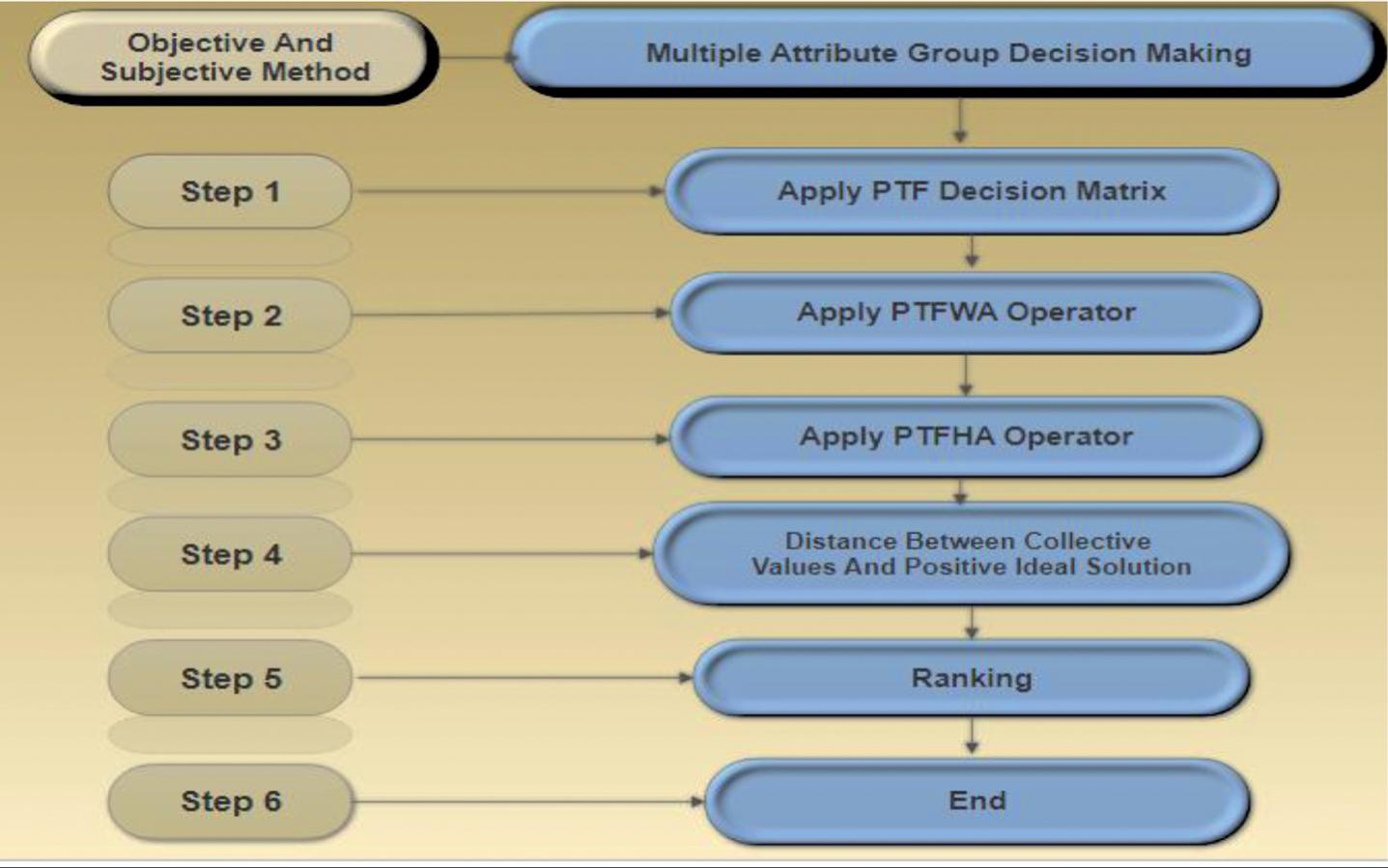
In the following, we apply the PTFWA and PTFHA operators to developed an approach to deal with multiple attribute group decision making problems consists of the following steps (see Fig. 1).
Flow chart of proposed algorithm.
Step 1. In this step, we construct the Pythagorean trapezoidal fuzzy matrix , in which the decision makers give their opinions related to each alternative with respect to each criteria.
Step 2. In this step, we apply the attribute weight on the PTFWA operator such that,
To determine the individual overall preference Pythagorean trapezoidal fuzzy values of the alternative Bi.
Step 3. We apply the PTFHA operator to derive the collective overall preference PTF values of the alternative Bi;
where ℏ = (ℏ 1, ℏ 2, …, ℏ Φ) T be the weighting vector of decision makers. with ℏk ∈ [0, 1] and Γ = (Γ1, Γ2, …, Γt) T be the associated weighted vector of the PTFHA operator, with Γk ∈ [0, 1] and
Step 4. Let be positive-ideal solution. Then calculate the distances between collective overall values and positive-ideal solution as follows:
Step 5. In this step, we determine the rank of all alternatives Bi in the form of descending order and select that alternative which has the highest value.
Step 6. End.
Numerical example
In this section, we are going to present an illustrative example of the new approach in a decision-making problem. We analyze that, a company wants to improve the service quality of domestic airline, for this purpose the civil aviation administration of the company wants to know which airline is the best in the company and then calls for the others to learn from it. They consider four possible alternatives Bi (i = 1, 2, 3, 4) such that,
= UNI Air
= Transasia
= Mandarin.
= Daily Air.
To evaluate these alternatives, the company has brought a group of decision makers. After the survey about passengers’ importance and perception for service criteria they found that cabin service is considered the most important factor of service quality, which can be interpreted easily because cabin service occupies more of a passenger’s travelling time than other aspects. Meanwhile, booking and ticketing service is less important. After analyzing the information, they consider four attributes/criteria Cj (j = 1;2; 3;4). Let p = (0.4, 0.3, 0.2, 0.1) be a weighting vector of the attributes Cj (j = 1; 2; 3; 4) such that,
= Cabin service.
= Check-in and boarding process.
= Booking and ticketing service.
= Responsiveness.
The group of experts evaluate and offer their own opinions regarding the results obtained with each alternative. The weights of experts of is given as ℏ = (0.15, 0.35, 0.30, 0.20) as the environment is very uncertain, the group of experts needs to assess the available information by using PTFNs. The expected results given in the form of PTFNs depending on the characteristic Cj and the alternative Bi such that, (k = 1, 2, 3, 4) as follows:
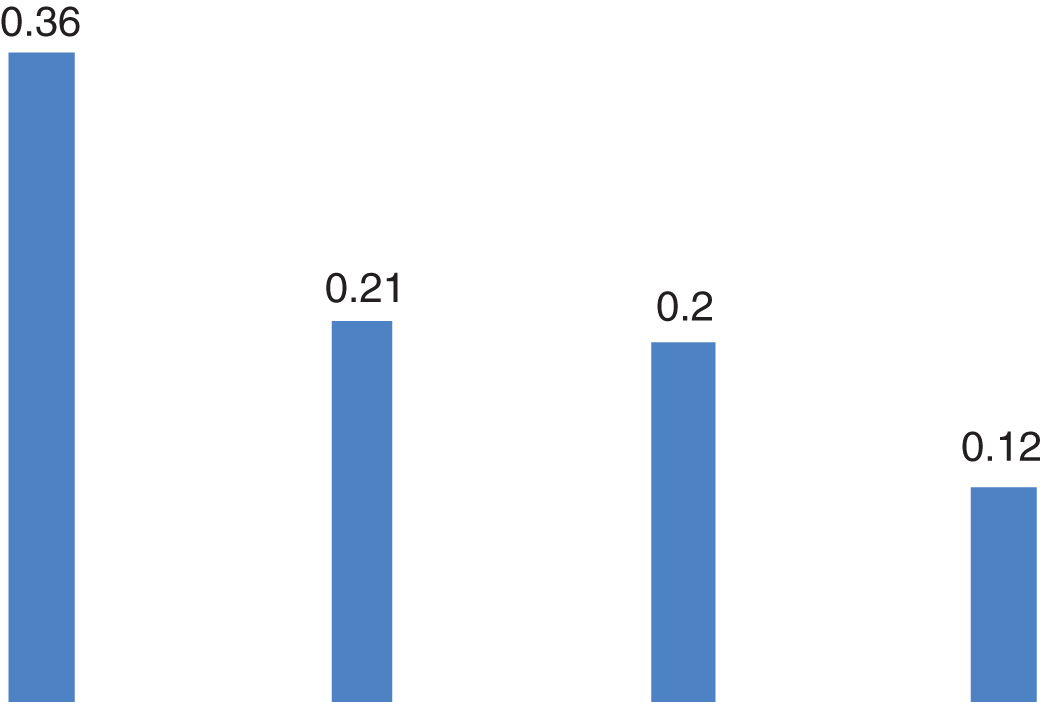
They constructed the decision matrix (k = 1, 2, 3, 4) as follows (see Fig. 2):
Score function.
Step 1. In this step, the decision makers give their opinions in the following tables
Z (1), Decision matrix of expert −1
C1
C3
B1
([0.4,0.5,0.7,0.5];(0.8,0.5)
([0.4,0.3,0.6,0.7];(0.7,0.4)
B2
([0.3,0.4,0.4,0.6];(0.4,0.8)
([0.3,0.4,0.5,0.6];(0.5,0.6)
B3
([0.5,0.4,0.2,0.3];(0.5,0.7)
([0.4,0.5,0.7,0.8];(0.4,0.7)
B4
([0.4,0.6,0.8,0.4];(0.4,0.8)
([0.3,0.4,0.5,0.7];(0.3,0.5)
C3
C4
B1
([0.8,0.2,0.3,0.4];(0.5,0.5)
([0.3,0.4,0.5,0.6];(0.6,0.5)
B2
([0.4,0.3,0.2,0.1];(0.4,0.7)
([0.4,0.5,0.3,0.1];(0.3,0.8)
B3
([0.3,0.4,0.5,0.6];(0.3,0.8)
([0.5,0.5,0.4,0.6];(0.7,0.7)
B4
([0.4,0.5,0.6,0.7];(0.5,0.6)
([0.4,0.3,0.1,0.3];(0.7,0.4)
Z (2), Decision matrix of expert −2
C1
C3
B1
([0.3,0.4,0.4,0.3];(0.5,0.6)
([0.7,0.5,0.6,0.3];(0.3,0.7)
B2
([0.4,0.3,0.6,0.3];(0.4,0.7)
([0.3,0.1,0.2,0.4];(0.3,0.8)
B3
([0.5,0.3,0.6,0.4];(0.5,0.6)
([0.2,0.1,0.3,0.5];(0.6,0.5)
B4
([0.9,0.6,0.4,0.1];(0.3,0.8)
([0.4,0.3,0.4,0.2];(0.4,0.8)
C3
C4
B1
([0.3,0.4,0.5,0.6];(0.9,0.2)
([0.4,0.5,0.2,0.3];(0.6,0.5)
B2
([0.4,0.5,0.7,0.2];(0.6,0.5)
([0.4,0.3,0.2,0.1];(0.4,0.7)
B3
([0.3,0.1,0.2,0.3];(0.3,0.4)
([0.6,0.8,0.9,0.2];(0.5,0.6)
B4
([0.4,0.3,0.4,0.6];(0.4,0.7)
([0.4,0.5,0.4,0.3];(0.4,0.7)
Z (3), Decision matrix of expert −3
C1
C3
B1
([0.9,0.3,0.1,0.2];(0.8,0.3)
([0.3,0.4,0.5,0.6];(0.7,0.4)
B2
([0.4,0.2,0.2,0.5];(0.9,0.2)
([0.4,0.5,0.6,0.4];(0.5,0.6)
B3
([0.3,0.4,0.5,0.7];(0.8,0.3)
([0.4,0.6,0.3,0.5];(0.5,0.6)
B4
([0.4,0.9,0.6,0.3];(0.9,0.3)
([0.6,0.3,0.1,0.4];(0.4,0.8)
C3
C4
B1
([0.1,0.4,0.5,0.3];(0.4,0.9)
([0.6,0.2,0.5,0.1];(0.3,0.9)
B2
([0.4,0.7,0.8,0.9];(0.5,0.5)
([0.4,0.6,0.3,0.2];(0.8,0.3)
B3
([0.6,0.8,0.3,0.2];(0.1,0.9)
([0.5,0.8,0.7,0.3];(0.4,0.7)
B4
([0.3,0.4,0.7,0.2];(0.8,0.5)
([0.3,0.5,0.6,0.9];(0.6,0.6)
Z (4), Decision matrix of expert −4
C1
C3
B1
([0.4,0.5,0.6,0.5];(0.7,0.5)
([0.3,0.4,0.5,0.4];(0.5,0.6)
B2
([0.9,0.6,0.3,0.4];(0.6,0.5)
([0.4,0.5,0.4,0.1];(0.3,0.7)
B3
([0.4,0.5,0.1,0.2];(0.4,0.7)
([0.7,0.6,0.3,0.2];(0.2,0.6)
B4
([0.4,0.5,0.1,0.2];(0.4,0.7)
([0.8,0.4,0.3,0.4];(0.3,0.8)
C3
C4
B1
([0.6,0.2,0.3,0.4];(0.3,0.7)
([0.4,0.5,0.6,0.9];(0.2,0.8)
B2
([0.4,0.5,0.6,0.7];(0.4,0.8)
([0.3,0.4,0.5,0.9];(0.3,0.8)
B3
([0.4,0.6,0.2,0.3];(0.4,0.9)
([0.6,0.7,0.8,0.9];(0.4,0.9)
B4
([0.4,0.6,0.3,0.4];(0.5,0.6)
([0.4,0.5,0.6,0.5];(0.3,0.9)
Step 2. In this step, we apply the decision information given in the Pythagorean trapezoidal fuzzy decision matrix, Z(k) (k = 1, 2, 3, 4), and using PTFWA operator to derive the individual overall preference Pythagorean trapezoidal fuzzy values of the alternative Bi such that,
= ([0.47,0.37,0.57,0.55];(0.71,0.46)
= ([0.33,0.39,0.38,0.45];(0.42,0.71)
= ([0.43,0.44,0.43,0.54];(0.57,0.71)
= ([0.37,0.49,0.40,0.54];(044,0.61)
= ([0.43,0.44,0.46,0.36];(0.63,0.49)
= ([0.37,0.31,0.46,0.29];(0.42,0.68)
= ([0.38,0.25,0.46,0.39];(0.36,0.52)
= ([0.96,0.44,0.40,0.25];(0.36,0.76)
= ([0.53,0.34,0.34,0.33];(0.63,0.51)
= ([0.40,0.43,0.45,0.52];(0.43,0.30)
= ([0.41,0.57,0.42,0.50];(0.63,0.50)
= ([0.43,0.58,0.47,0.37];(0.78,0.47)
= ([0.41,0.41,0.51,0.49];(0.56,0.59)
= ([0.62,0.53,0.41,0.42];(0.47,0.63)
= ([0.51,0.57,0.25,0.26];(0.35,0.72)
= ([0.48,0.45,0.33,0.45];(0.43,0.68)
Step 3. In this step, we apply the PTFHA operator to derive the collective overall preference Pythagorean trapezoidal fuzzy values . which has associated weighted vector Γ = (0.155, 0.345, 0.345, 0.155) T such that,
= ([0.46,0.39,0.40,0.40];(0.63,0.50)
= ([0.41,0.39,0.43,0.41];(0.61,0.51)
= ([0.42,0.43,0.40,0.44];(0.51,0.56)
= ([0.61,0.17,0.41,0.36];(0.60,0.59)
Step 4. In this step, we calculate the distance between collective overall values and Pythagorean trapezoidal fuzzy positive ideal solution z+ as follows:
Step 5. Now we arrange the scores of all alternatives in the form of descending order and select that alternative which has the highest score function. Since B1 ≥ B2 ≥ B3 ≥ B4, thus the most wanted alternative is B1.
Step 6. End.
Further discussion
In order to show the validity and effectiveness of the proposed methods, we utilize Pythagorean fuzzy (PFs) sets to solve the same problem described above. We apply the proposed aggregation operators developed in this paper. After simplification we determined the ranking result as Since B1 ≥ B2 ≥ B3 ≥ B4, thus the most wanted alternative is B1. In the above example, if we use PFs sets to express the decision makers evaluations then the decision matrix Z(1), Z(2), Z(3), Z(4) can be written as decision matrix Zξ(1), Zξ(2), Zξ(3), Zξ(4) by deleting the corresponding trapezoidal fuzzy numbers from Pythagorean trapezoidal fuzzy numbers which are shown in Tables 1–4 respectively. Yager [21] developed Pythagorean fuzzy numbers, such that sum of the square of membership and non-membership is less than or equal to 1. In [19] the proposed PFWA operators to deal with multiple attribute decision making with Pythagorean fuzzy information respectively such that,
Zξ(1) Decision matrix of expert −1
C1
C2
C3
C4
B1
(0.8,0.5)
(0.7,0.4)
(0.5,0.5)
(0.6,0.5)
B2
(0.4,0.8)
(0.5,0.6)
(0.4,0.7)
(0.3,0.8)
B3
(0.5,0.7)
(0.4,0.7)
(0.3,0.8)
(0.7,0.7)
B4
(0.4,0.8)
(0.3,0.5)
(0.5,0.6)
(0.4,0.7)
Zξ(2) Decision matrix of expert −2
C1
C2
C3
C4
B1
(0.5,0.6)
(0.3,0.7)
(0.9,0.2)
(0.6,0.5)
B2
(0.4,0.7)
(0.3,0.8)
(0.6,0.5)
(0.4,0.7)
B3
(0.5,0.6)
(0.6,0.5)
(0.3,0.4)
(0.5,0.6)
B4
(0.3,0.8)
(0.4,0.8)
(0.4,0.7)
(0.4,0.7)
Zξ(3) Decision matrix of expert −3
C1
C2
C3
C4
B1
(0.8,0.3)
(0.5,0.6)
(0.4,0.9)
(0.3,0.9)
B2
(0.9,0.2)
(0.7,0.4)
(0.5,0.5)
(0.8,0.3)
B3
(0.8,0.3)
(0.5,0.6)
(0.1,0.9)
(0.1,0.9)
B4
(0.9,0.3)
(0.4,0.8)
(0.8,0.5)
(0.6,0.6)
Zξ(4) Decision matrix of expert − 4
C1
C2
C3
C4
B1
(0.7,0.5)
(0.5,0.6)
(0.3,0.7)
(0.2,0.8)
B2
(0.6,0.5)
(0.3,0.7)
(0.4,0.8)
(0.3,0.8)
B3
(0.4,0.7)
(0.2,0.6)
(0.4,0.9)
(0.4,0.9)
B4
(0.5,0.6)
(0.3,0.8)
(0.5,0.6)
(0.3,0.6)
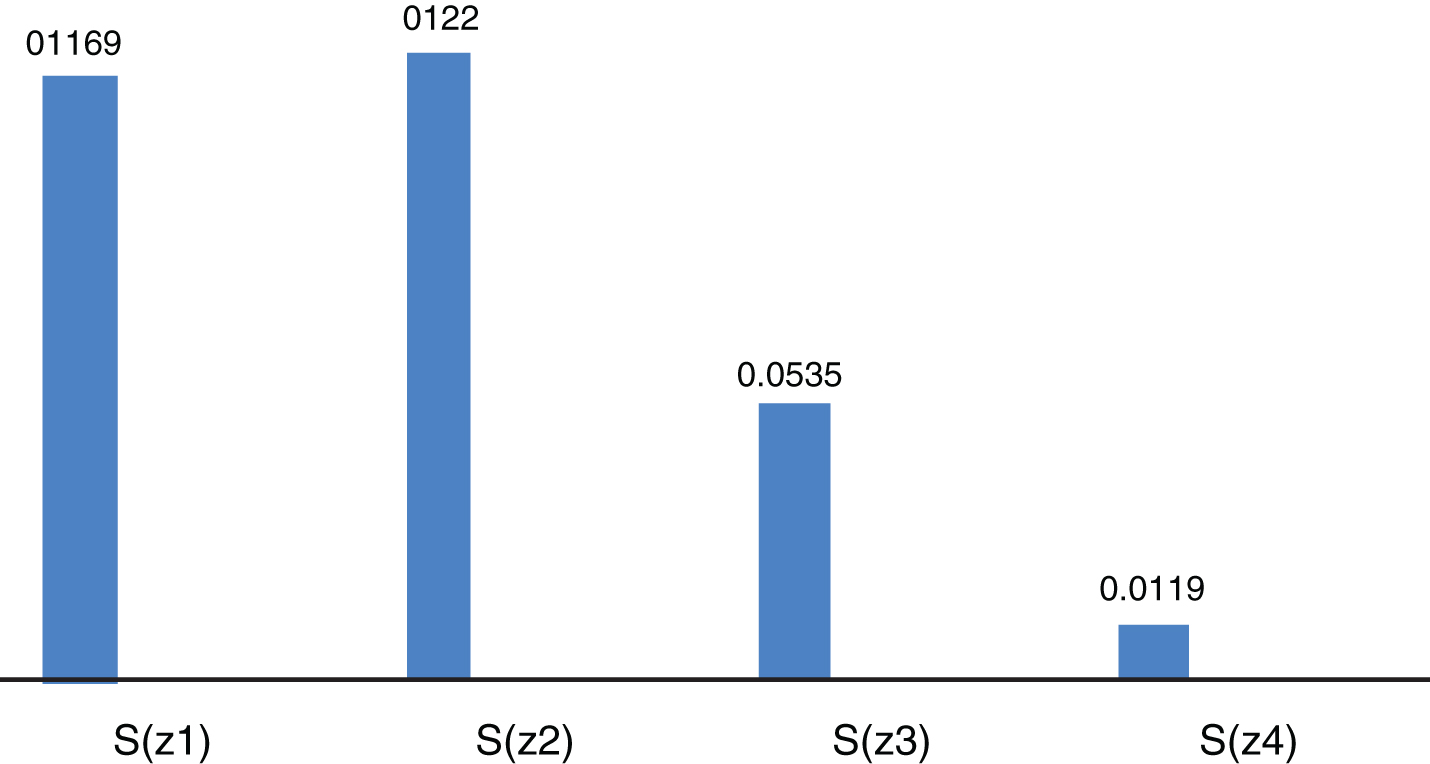
We further explain to find the best alternative of PFs, after the computation process of the overall reference values are as follows. By applying score function of pi (i = 1, 2, 3, 4) such that,
Now we find the ranking as B2 > B1 > B3 > B4. In this case, B2 is the best alternative (see Fig. 3).
Score function.
It is noted that the ranking orders obtained by this paper and by [19] are very different. This is because that all the trapezoidal fuzzy numbers are deleted from PTFNs, which make weak the ability of information representation of PFNs. Therefore PTFNs may better reflect the decision information than PFNs, by adding trapezoidal fuzzy numbers under the real decision making problem. Hence our proposed approach is more better than PFNs due to addition of trapezoidal Pythagorean fuzzy number.
Conclusions
In this paper, we introduced the idea of Pythagorean trapezoidal fuzzy sets. We have defined their basic properties and develop some operational laws for Pythagorean trapezoidal fuzzy numbers. Then we have discussed some new types of aggregation operators for Pythagorean trapezoidal fuzzy numbers consists of Pythagorean trapezoidal fuzzy weighted averaging (PTFWA) operator, Pythagorean trapezoidal fuzzy ordered weighted averaging (PTFOWA) operator and Pythagorean trapezoidal fuzzy hybrid averaging (PTFHA) operators. Moreover, we apply these aggregation operators to develop an approach to multiple attribute group decision making with Pythagorean trapezoidal fuzzy information. Finally, an illustrative example has been constructed to show the proposed MAGDM fuzzy information. Finally, an illustrative example has been constructed to show the proposed method. Our proposed method is different from all the previous techniques for group decision making due to the fact that the proposed method use Pythagorean trapezoidal fuzzy information, which will not cause any loss of information in the process. So it is efficient and feasible for real-world decision making applications. These operators can be applied to many other fields, such as data mining, pattern recognition and TODIM-TOPSIS method which may be the possible topic for the future research.
References
1.
AtanassovK.T., More on intuitionistic fuzzy sets Fuzzy sets and systems, 33(1) (1989), 37–45.
AtanassovK.T., An equality between intuitionistic fuzzy sets, Fuzzy Sets and Systems79(2) (1996), 257–258.
4.
LiD.F., Closeness coefficient based nonlinear programming method for interval-valued intuitionistic fuzzy multiattribute decision making with incomplete preference information, Appl Soft Comput11 (2011), 3042–3418.
5.
WanS.P. and LiD.F., Fuzzy linmap approach to heterogeneous MADM considering comons of alternatives with hesitation degrees, Omega41(6) (2013), 925–940.
6.
SzmidtE. and KacprzykJ., Intuitionistic fuzzy sets in some medical applications, in Computational Intelligence. Theory and Applications, Springer, pp, (2001), 148–151.
7.
ShakeelM., Induced averaging aggregation operators with interval pythagorean trapezoidal fuzzy numbers and their application to group decision making, The Nucleus2 (2017), 140–153.
8.
WangJ.Q., Overview on fuzzy multi-criteria decision making approach, Control Decision23 (2008), 601–606.
9.
WangJ.Q. and ZhangZ., Multi-criteria decision-making method with incomplete certain information based on intuitionistic fuzzy number, Control Decision24 (2009), 226–230.
10.
WeiG.W., Some induced geometric aggregation operators with intuitionistic fuzzy information and their application to group decision making, Appl Soft Comput10 (2010), 423–431.
11.
YagerR.R., Pythagorean fuzzy subsets. In Edmonton, Proc Joint IFSA World Congress and NAFIPS Annual MeetingCanada, (2013), pp, 57–61.
12.
XuZ.S., An overview of methods for determining owa weights, Int J Intell Syst20 (2005), 843–865.
13.
AtanassovK., New operations defined over the intuitionistic fuzzy sets, Fuzzy Sets Syst (1994), 137–142.
14.
DeS.K., BiswasR. and RoyA.R., An application of intuitionistic fuzzy sets in medical diagnosis, Fuzzy Sets and Systems117 (2001), 209–213.
15.
ChenZ. and YangW., A new multiple attribute group decision making method in intuitionistic fuzzy setting, Applied Mathematical Modelling35 (2011), 4424–4437.
16.
KharalA., Homeopathic drug selection using intuitionistic fuzzy sets, Homeopathy98 (2009), 35–39.
17.
XuZ.S. and YagerR.R., Some geometric aggregation operators based on intuitionistic fuzzy sets, Int J Gen Syst (2006), 417–433.
18.
XuZ.S. and YagerR.R., Dynamic intuitionistic fuzzy multi-attribute decision making, Int J Approx Reason (2008), 246–262.
19.
MaZ. and XuZ., Symmetric pythagorean fuzzy weighted geometric/averaging operators and their application in multicriteria decision-making problems, International Journal of Intelligent Systems (2016), 1–22.
20.
ZhangX. and XuZ., Extension of TOPSIS to multiple criteria decision making with pythagorean fuzzy sets, International Journal of Intelligent Systems29 (2014), 1061–1078.
21.
YagerR.R., Pythagorean membership grades in multi-criteria decision making, IEEE Trans Fuzzy Syst22 (2014), 958–965.
22.
GargH., A novel improved accuracy function for interval valued Pythagorean fuzzy sets and its applications in decision making process, International Journal of Intelligent Systems, Wiley32 (2017), 1247–1260.
23.
GargH., Confidence levels based Pythagorean fuzzy aggregation operators and its application to decision-making process, Computational and Mathematical Organization Theory23 (2017), 546–571.
24.
KumarK. and GargH., TOPSIS method based on the connection number of set pair analysis under interval-valued intuitionistic fuzzy set environment, Computational and Applied Mathematics (2016), 1–11.
25.
GargH., A linear programming method based on an improved score function for interval-valued Pythagorean fuzzy numbers and its application to decision-making, International Journal of Uncertainties, Fuzziness and Knowledge-Based Systems26 (2018), 67–80.
26.
GargH., Generalized Pythagorean fuzzy Geometric aggregation operators using Einstein t-norm and t-conorm for multicriteria decision-making process, Intenational Journal of Intelligent Systems, Wiley32 (2017), 597–630.
27.
GargH., A novel correlation coefficients between Pythagorean fuzzy sets and its applications to decision-making processes, International Journal of Intelligent Systems, Wiley31 (2016), 1234–1253.
28.
GargH., A novel accuracy function under interval-valued Pythagorean fuzzy environment for solving multicriteria decision making problem, Journal of Intelligent and Fuzzy Systems31 (2016), 529–540.
29.
GargH., A new generalized improved score function of interval-valued intuitionistic fuzzy sets and applications in expert systems, Applied Soft Computing, Elsevier38 (2016), 989–999.
30.
GargH., Generalized intuitionistic fuzzy interactive geometric interaction operators using Einstein t-norm and t-conorm and their application to decision making, Computer and Industrial Engineering, Elsevier101 (2016), 53–64.
31.
GargH., Novel intuitionistic fuzzy decision making method based on an improved operation laws and its application, Engineering Applications of Artificial Intelligence, Elsevier60 (2017), 164–174.
32.
Z.S.Gou, X.J.Xu, and P.J.Ren, The properties of continuous pythagorean fuzzy information, International Journal of Intelligent Systems31 (2016), 401–424.
33.
LiuJ., ChenH., XuQ.,et al. Generalized ordered modular averaging operator and its application to group decision making,&, Systems299 (2016), 1–25.
34.
Huayou ChenL.J., L.Zhou, Z.Tao
and Y.He, On the properties of the generalized OWHA operators and their application to group decision making, Journal of Intelligent and Fuzzy Systems27 (2014), 2077–2089.
35.
LiuJ., ChenH., ZhouL.., Generalized linguistic ordered weighted hybrid logarithm averaging operators and applications to group decision making, International Journal of Uncertainty Fuzziness and Knowledge-Based Systems23 (2015), 421–442.
36.
LiuJ., LinS., ChenH. and ZhouL., The continuous Quasi-OWA operator and its application to group decision making, Group Decision and Negotiation22 (2013), 715–738.
37.
HeY., HeZ., WangG. and ChenH., Hesitant fuzzy power bonferroni means and their application to multiple attribute decision making, IEEE Transactions on Fuzzy Systems23 (2015), 1655–1668.
38.
HeY. and HeZ., Extensions of Atanassov’s intuitionistic fuzzy interaction Bonferroni means and Their Application to Multiple attribute decision making, IEEE Transactions on Fuzzy Systems24 (2016), 558–573.
39.
HeY., HeZ., LeeD.H., KimK.J., ZhangL. and YangX., Robust fuzzy programming method for MRO problems considering location effect, dispersion effect and model uncertainty, Computers and Industrial Engineering105 (2017), 76–83.
40.
HeY., HeZ. and ChenH., Intuitionistic fuzzy interaction bonferroni means and its application to multiple attribute decision making, IEEE Transactions on Cybernetics45 (2015), 116–128.
41.
A.I.Ban
and D.A.Tus’e, Trapezoidal/triangular intuitionistic fuzzy numbers versus interval-valued trapezoidal/triangular fuzzy numbers and applications to multicriteria decision making methods, Sofia, In Conf on IFSs2014, pp. 10–11.
42.
WeiG., Some arithmetic aggregation operators with intuitionistic trapezoidal fuzzy numbers and their application to group decision making, J Comput5(3) (2010), 345–351.
43.
WanS.P. and DongJ.-Y., Method of intuitionistic trapezoidal fuzzy number for multiattribute group decision, Control Decis25(5) (2010), 773–776.
44.
WuJ. and CaoQ.-W., Same families of geometric aggregation operators with intuitionistic trapezoidal fuzzy numbers, Appl Math Model37(12) (2013), 318–327.