



Abstract
A new de-noising algorithm by using the Laplace model and the Normal Inverse Gauss model based on the non-subsampled contourlet transform is proposed. Firstly, the sub-band coefficients of non-subsampled transform are fitted by using the joint statistical model which can capture the texture information well of the natural image. Secondly, the new adjustment factor is introduced to improve the coefficients fitting accuracy of the joint statistical model. Finally, the new parameter estimation algorithm is proposed under the Bayesian estimation framework. The experimental results show that the proposed algorithm obtains better visual effects and de-noising results compared with the state-of-art de-noising algorithms.
Keywords
Introduction
With the development of science and technology, digital image is widely used in the field of daily life and scientific research, such as the digital camera photos, medical use of CT, remote sensing images in military and scientific research, etc. So the most important thing in the field of scientific research in today’s world is to get a satisfactory digital image. In reality, the image often influence by a variety of devices such as equipment and external environment during acquisition, conversion and transmission, this will make the image contain noise and reduce the quality of the image. So image de-noising is one of the most important tasks in image processing.
In order to solve the problem of image denoise, many methods of image de-noising had been put forward by many scholars, it mainly include Wavelet threshold de-noising [1–3], Filter de-noising method based on dictionary learning [4] and Multiscale transform de-noising [5–9] and so on. For the multiscale geometric analysis, the main methods at present are include Ridgelet transform [5], Curvelet transform [6], Bandelet transform [7], directionlets [8], hearlets [9, 10] and Contourlet [11] that proposed by Do et al. in 2002.
After that the non-subsampled Contourlet transform was proposed [12, 13]. At the beginning of the transform domain de-noising, it mainly included fixed threshold denoising method and the adaptive threshold denoising method. As the threshold singularity, it has been unable to meet the needs of people. Statistical modeling denoising method that based on transform domain is use relevant statistical models to modeling the image data, so the quality of de-noising depends on the choice and use of statistical models. Until now the methods for statistical modeling in contourlet transform domain are mainly included Laplace model [14], Generalized modeling [15–18], normal inverse Gaussian [19, 20], α stable distribution [21] and Hidden markov tree model [22, 23]. However, these single traditional models do not do well in fitting and modeling the variable image data. Hence, it cannot show its own advantages due to the drawbacks of the single model.
In this paper, with the development of multiscale and multiresolution analysis and the application state of statistical modeling method, we propose a de-noising algorithm combining the Laplace model with the normal inverse Gaussian model based on non-subsampled contourlet transform (NSC–JSM). We improve the estimation of the marginal standard deviation of the model in the process of Laplace modeling. At the same time, the advantages of the Normal Inverse Gauss model in image smoothing are fully preserved during the de-noising in joint model. This de-noising effect can meet people’s visual requirements batter, so it achieved better performance in image de-noising.
The paper is organized as follows. A brief review about non-subsampled contourlet transform is given in Section 2. The new image de-noising algorithm using Laplace model and normal inverse model is proposed in Section 3. The experimental results and discussions are given in Section 4. Finally, concluding remarks are given in Section 5.
Non-subsampled contourlet transform
During the process of Contourlet transform, because of the down sampling operation in the two stages of the LP and DFB, the redundancy of image Contourlet coefficients is greatly reduced, and this lead to the lack of translation invariance during the translation. And it will cause obvious ringing effect if we use this transform in image de-noising. In order to solve those problems, Arthur L Cunha, Jianping Zhou and Minh N Do put forward non-subsampled Contourlet transform (NSCT).
NSCT is an improvement of contourlet transform. The NSCT is a multi-scale, multi-direction and shift invariance image representation method by using down-sampling band-pass directional sub-band decomposition. Compared to the traditional contourlet transform, the main difference in structure is the elimination of the sampling structure in the decomposition and reconstruction. Firstly, the non-subsampled Pyramid filter bank (NSPFB) is used to decompose the original image at different scales, after the decomposition, the NSPFB can capture the singular points of the edge information. Then the high frequency coefficient is obtained with the organic combination of the information about these singularities. Above this we can realize the multi directionality of the image. Secondly, the coefficients are processed by using the directional filter bank (NSDFB) to realize the multiscale of the image. The NSCT cannot up-sampling and down-sampling in the procedure of image processing, but it employs the corresponding filters sampling and down sampling operation, and through to the image signal processing filter, so that the NSCT transform not only has the characteristics of multi-scale and multi-direction, but also has the shift-invariance. The transformation diagram is shown in Fig. 1.
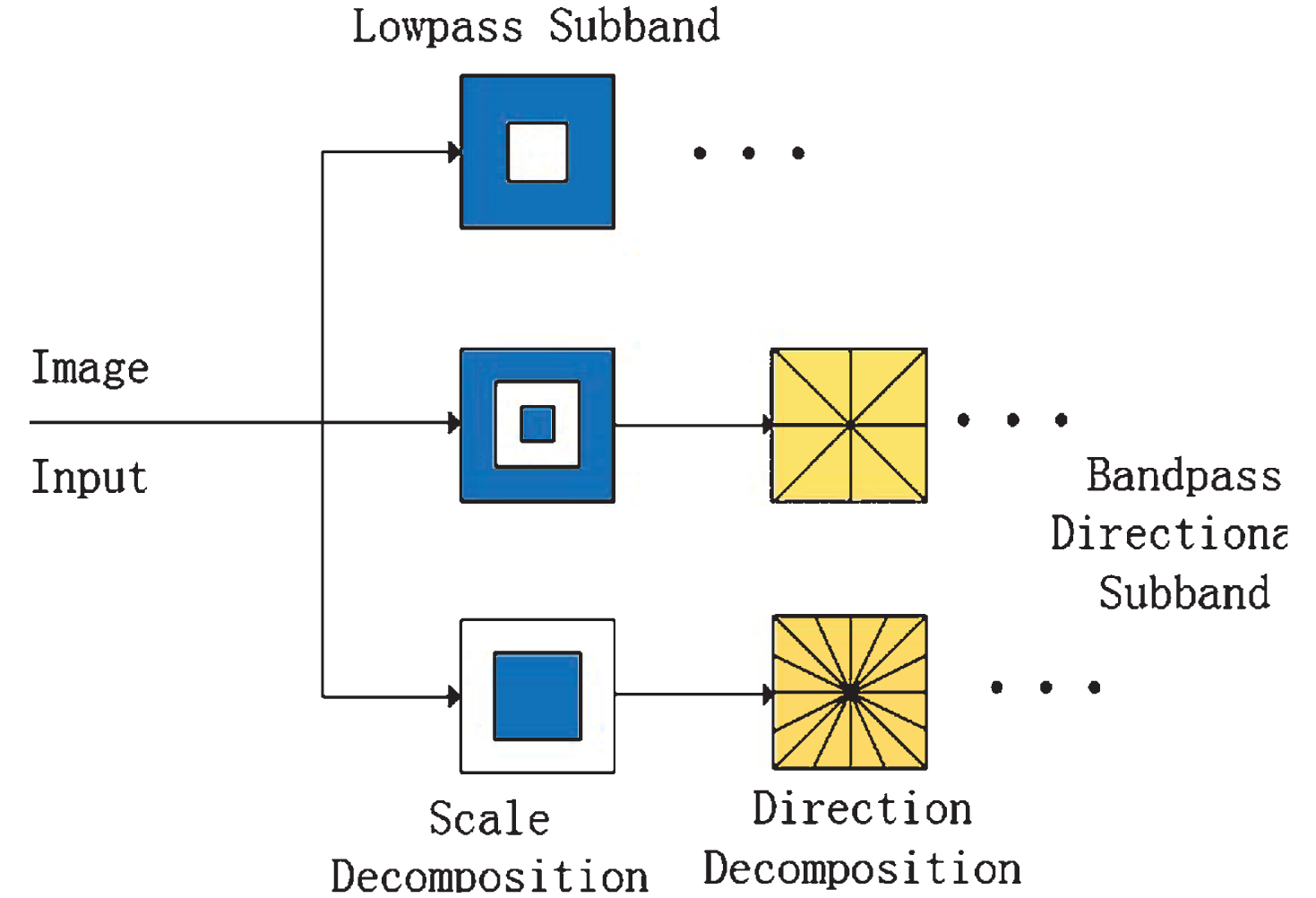
Schematic diagram of decomposition of non-sampled Contourlet transform.
The non-subsampled Pyramid filter bank (NSPFB) is a two-channel filter bank which can be divided into decomposition filter and synthesis filter. For the decomposition filter, its filter is
This allows NSPFB to be fully reconstructed. Its structure is shown in Fig. 2 (a).
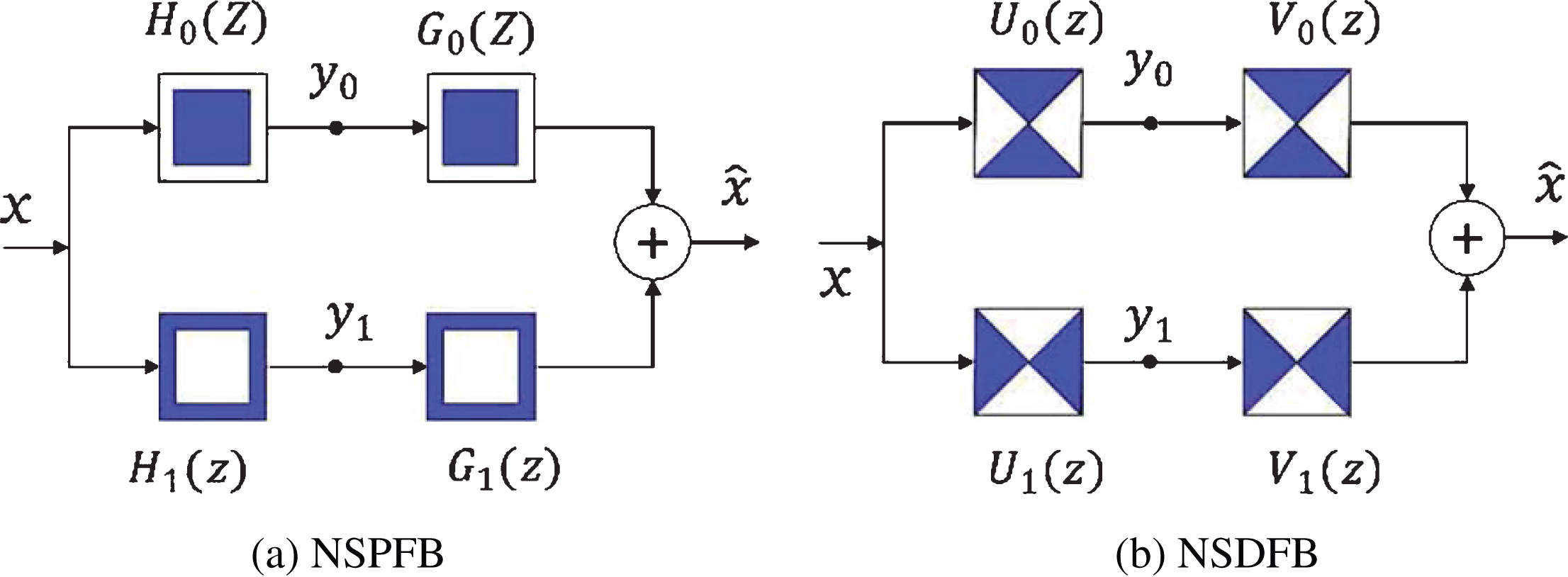
The structure of the non-subsampled filter banks.
The non-down sampling direction filter bank (NSDFB) is also a two-channel filter bank which can be divided into decomposition filter and synthesis filter.
U
i
(z) and V
i
(z) are decomposition filters and synthetic filters, which can satisfy the Bezout identity:
The direction of the filter bank is also consistent with the conditions of complete reconstruction. Its structure is shown in Fig. 2 (b).
As a kind of additive noise, Gauss white noise is a very common noise in the image, and the suppression of Gauss white noise has been a hot spot all the time. So here we have to deal with noisy images and assuming that the model is g = f + n, where f represents image without noise, n is noise and noisy images recorded as g. Then first we carry out the NSCT to obtain the transformation coefficient. Here, the expression of the transform coefficient is obtained:
For the image with Gauss noise, the noise can be used to simulate with the following expressions:
Laplace distribution model is a frequently used model, it belongs to a special case of generalized Gauss distribution. Here we model the coefficients of the noisy image with Laplace distribution model and set the prior p (x) of the real signal transform coefficient x to obey the Laplace distribution, so it is defined as follows:
In this formula, σ is the edge standard deviation of Laplace distribution, and b is parameters.
The MAP estimation method is used after we build the model. Then we get the estimated value of target coefficient
The MAP estimator is obtained as follows [24, 25],
According to the threshold de-noising theory of Donoho, we can see
In order to estimate the variance of the model we choose, we use the maximum likelihood estimation (ML) method to get the estimate variance in sub-band D of each noise (Here we use the sub-band as a unit):
But there is a problem in the estimation of the variance of the model, the estimation of the sub-band variance may be less than the noise variance. In this case, the Equation (11) does not be set up. So here, the variance estimation of the Generalized Gauss model is introduced here. For the Generalized Gauss model, the expression is:
According to the Equation (13), we can obtain the final estimation variance coefficient model:
For the Laplace distribution, it has some advantages in detail processing, but it has obvious mutation in some place, with the lack of smoothness. So here we can use the normal inverse Gauss (NIG) model to combine the Laplace model, which not only make up the shortage of the Laplace distribution, but also can improve the NIG effect in the details of the deal.
In [20], the NIG model is proposed which is a mixture model with a Gauss distribution of different mean and an inverse Gauss distribution, and its parameters are very flexible. The function of density of probability is:
Then we can use the criterion of the MAP to estimate w, the coefficient of NIG model, here we use
Here we make the first derivative of
Then, we can get as follows,
When using Equation (17) for image denoising, we need to estimate the parameters of the normal inverse Gaussian α, β and noise variance
Considering the image information contained in the NSCT coefficients of each scale, it is indicated that the higher the percentage of the total energy in the j level and k direction, the more detailed outline. The adjusting factor θ is defined as:
Based on the Sections 3.1 and 3.2, we can get the coefficients of MAP estimation obtained by the two models. Then get the joint of the coefficients by taking the corresponding proportion:
The variances of the coefficients obtained by different models are different. For the Laplace model and the NIG model, the variance of the coefficient sub-bands corresponding to
In this paper, the specific implementation of proposed algorithm is as follows:
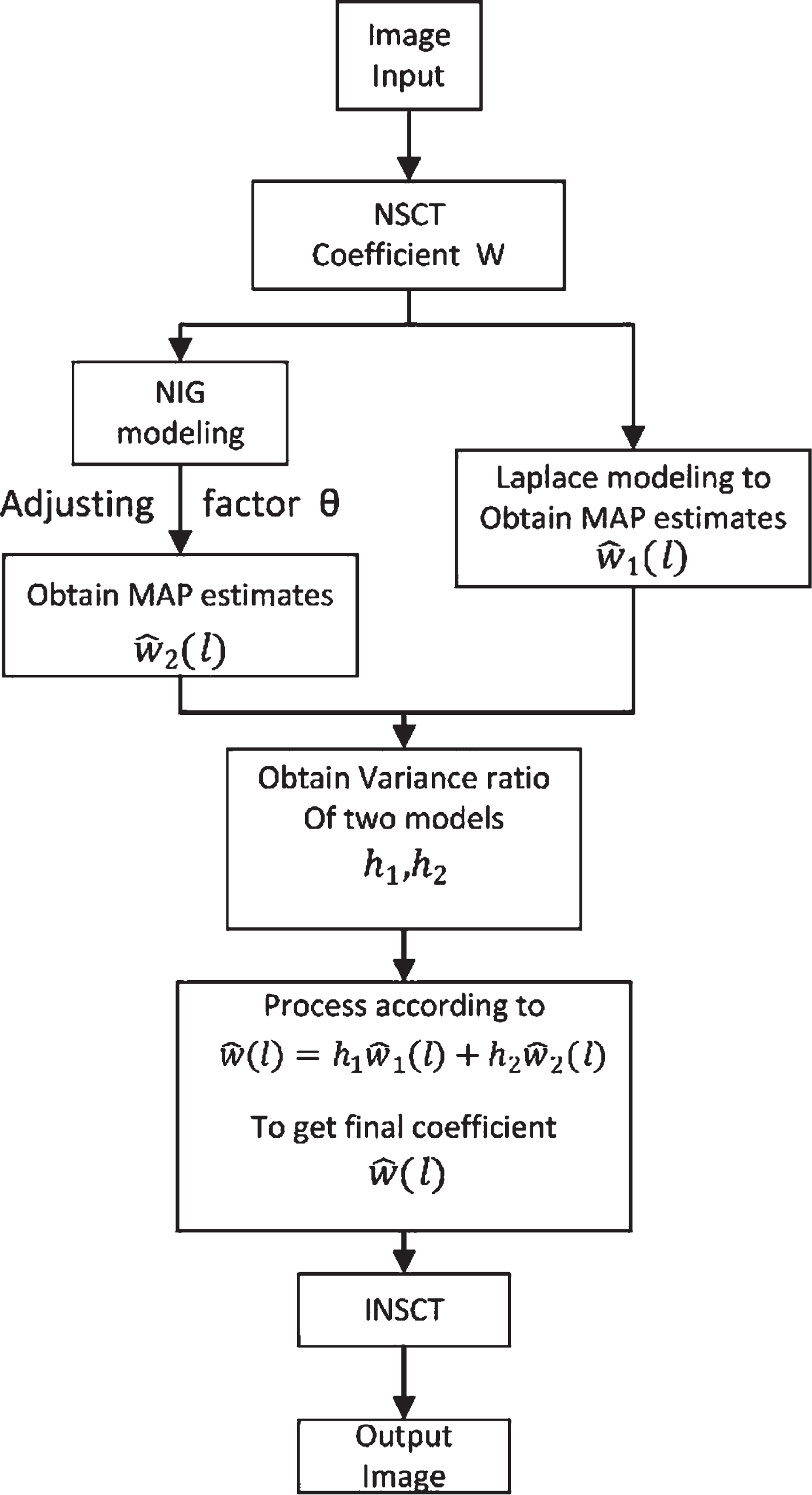
Flow Chart of Algorithm.
In this paper, the simulation experiment is using standard images Lena, Barbara, Peppers and Boat and Livingroom with size of 512 × 512. The test images are corrupted with Gaussian white noise in different variance. The proposed algorithm uses 5 layers of NSCT, in which the pyramid filter is max flat and the directional filter is dmaxflat7. In order to illustrate the effectiveness of the proposed algorithm, we select previous methods compared with the proposed algorithm, which are traditional BayesShrink [25], Laplace modeling de-noising (LM) [14], Generalized Gauss model de-noising (GGD) [16] and Normal Inverse Gauss (NIG) modeling de-noising [18]. In the Tables 1 and 2, sigma (σ) is standard deviation of noise, the greater the sigma, the more noise in the image. In experiment, if the noise is too small, the experiment is meaningless; if the noise is too big, the information in the image is lost seriously, and the image cannot be effectively restored. Therefore, 5 parameters are selected in the table, so that it is more meaningful in denoising. Here the peak signal to noise ratio (PSNR) and structural similarity (SSIM) [26] are utilized as the criterion of image evaluation in this paper. Table 1 is a comparison of PSNR in different methods of image de-noising. Table 2 is the different methods of image de-noising SSIM contrast.
PSNR values with various de-noising algorithms (dB)
PSNR values with various de-noising algorithms (dB)
SSIM values with various de-noising algorithms
Figures 4–8 show the results of several different de-noising methods for each image. There are many directional texture information in Barbara image, while Lena and Boat contain more detail information and contour information. The NSCT has excellent performance in detecting and capturing directional information, so in the treatment of noise it can also fully takes into account of various details in the original image. At the same time, in the process of processing, the parameters of different images and different noise levels are also different. Therefore, de-noising in this algorithm, The de-nosing image optimization is obtained by using Laplace model and normal inverse Gaussian model parameters and adaptive adjustment parameters in sub-band variance estimation. Table 2 shows the SSIM contrast of each image.
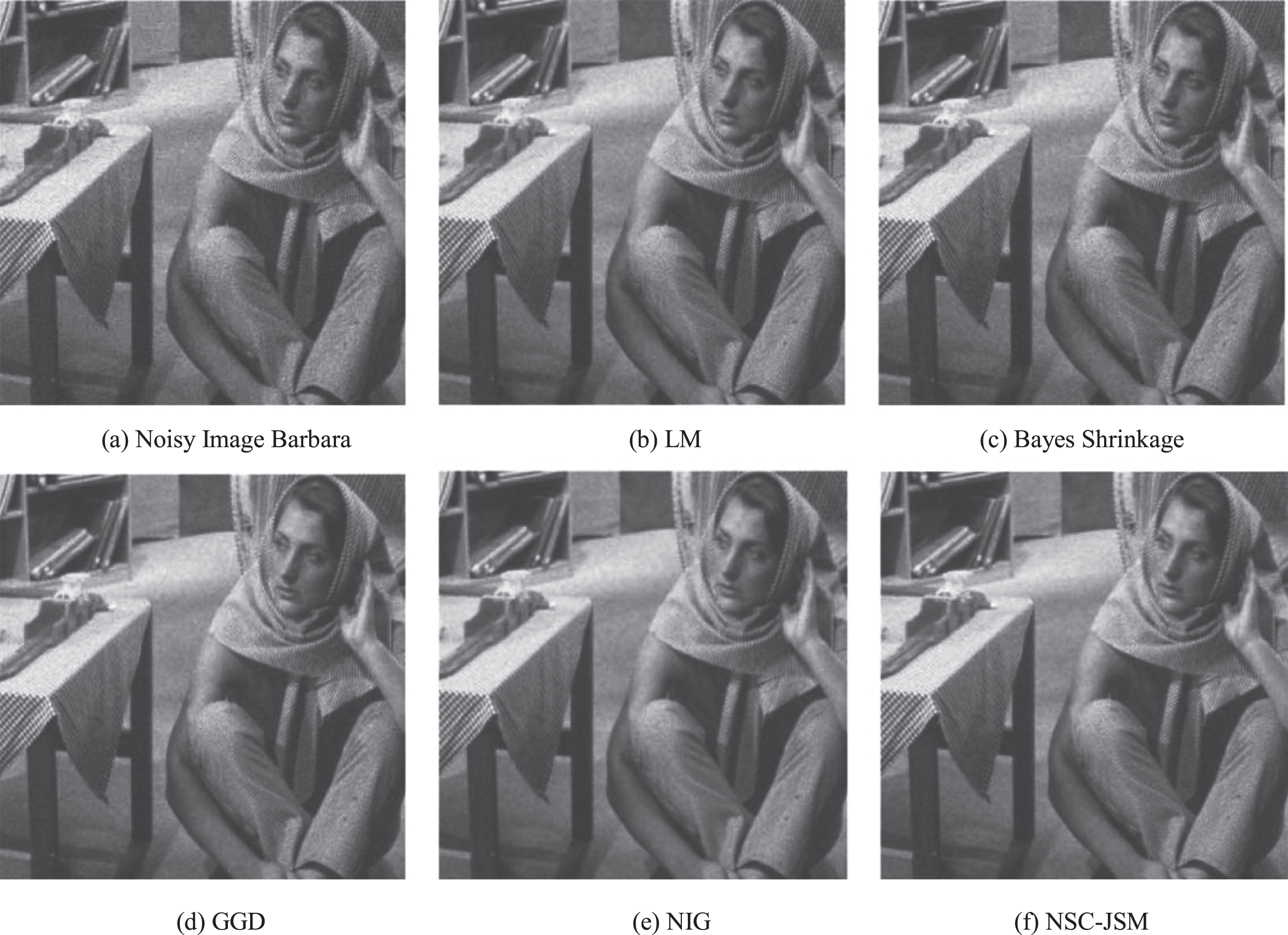
De-noising results of Barbara using different de-noising algorithms (σ = 20).

De-noising results of Peppers using different algorithms (σ = 20).
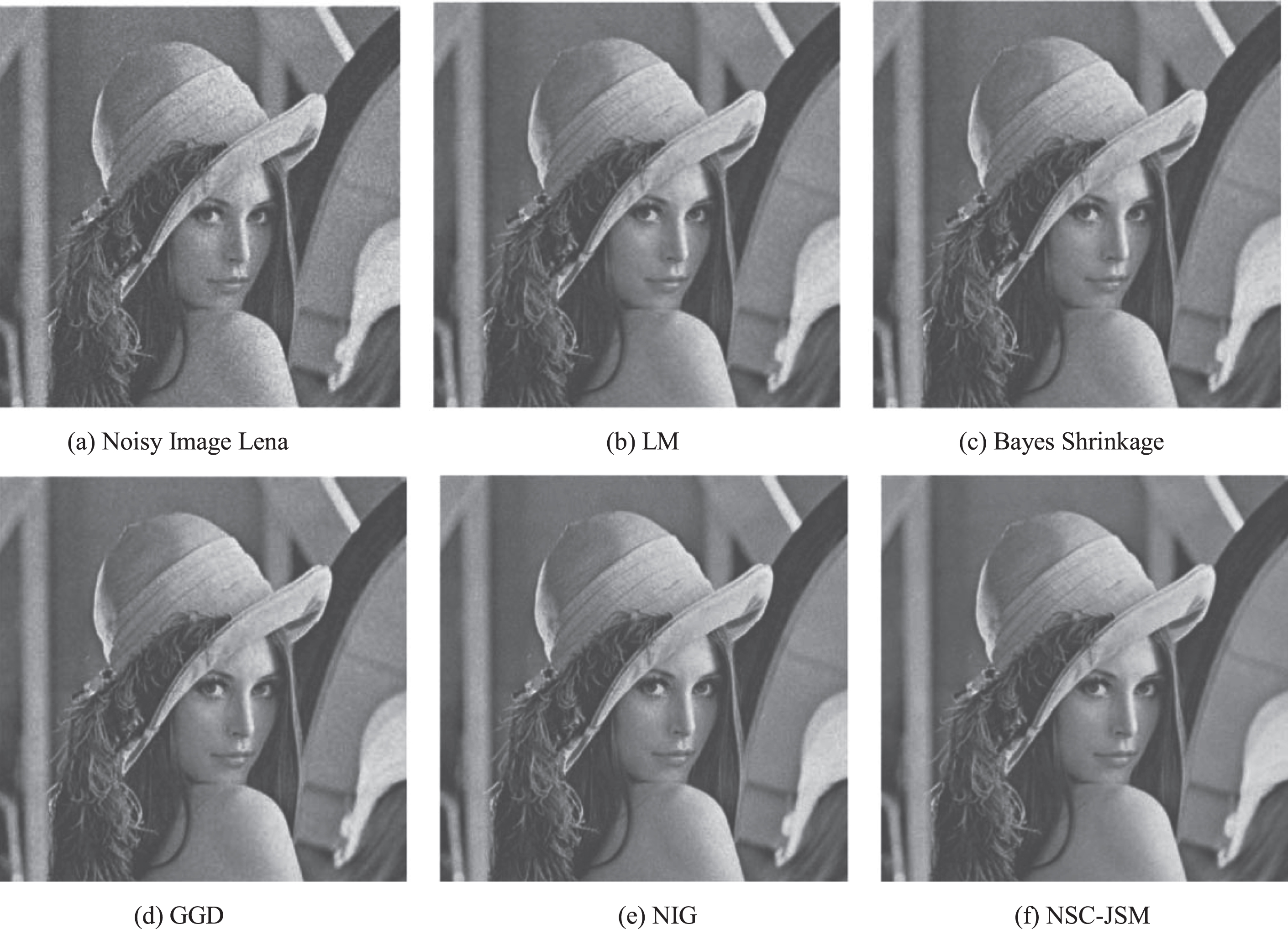
De-noising results of Lena using different algorithms (σ = 20).
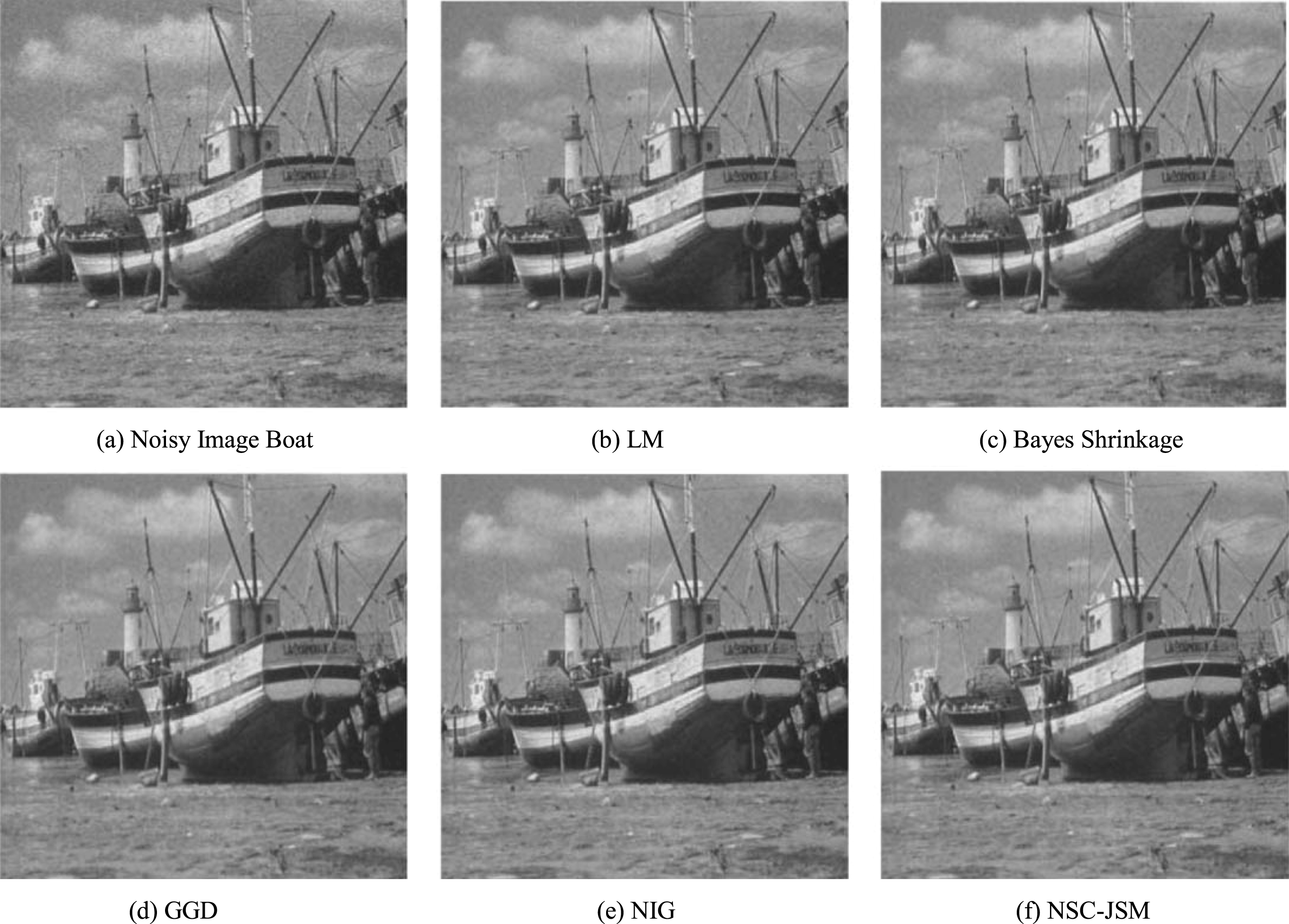
De-noising results of Boat using different algorithms (σ = 20).

De-noising results of Couple using different algorithms (σ = 20).
According to the experimental results, the algorithm has good de-noising effect. In this paper, we use two models to modeling image data and get variance of two model in coefficient sub-band, then the variance ratio of each model is obtained just like we show in format (25). Compared to single modeling denoising, the technique is more complex. So it has a certain degree of complexity. Then the time complexity of the algorithm and the other de-noising algorithms are compared in the Table 3. From the experimental results, it is clear to see that the proposed algorithm elapsed less time than Laplace, GGD, and NIG. Although it consumed more time than the Bayes Shrinkage, it can obtain the best de-noising effect than the other de-noising algorithms.
Elapsed time with different de-noising algorithms (seconds)
In this paper, we proposed a new image de-noising method with joint model based on non-subsampled contourlet transform. With the advantages of multi-resolution, multi direction and shift invariance of NSCT, we use Laplace model and NIG model to fit the natural image in the NSCT domain. Then, the de-noising results are obtained by using the combination of the two statistical models. The main contribution of this algorithm is that we do some improvement in the problem of estimating the standard deviation of sub-band noise during the Laplace modeling, and we also introduction the adjusting factor for the NIG model. Finally, the two models are effectively combined by using the coefficient sub-band variance ratio to achieve the optimization effect. The experimental results show that, the proposed algorithm can effectively remove the Gauss white noise in the image, and it outperforms better than the other state-of-art de-noising algorithms. And the proposed algorithm has higher computation complexity. The future work will extend the proposed algorithm to color image de-nosing, which is essential for image analysis and understanding.
Footnotes
Acknowledgments
This work is partially supported by National Natural Science Foundation of China; the grant number is 61563037; Outstanding Youth Scheme of Jiangxi Province; the grant number is 20171BCB23057; Natural Science Foundation of Jiangxi Province; the grant number is 20171BAB202018; Department of Education Science and Technology of Jiangxi Province; the grant number is GJJ150755.