



Abstract
— In this paper, new concepts are introduced to enhance the process of block identification in fuzzy graphs using sum distance metric and special type of cycles, which is called a strongest strong cycle, locamin cycle. An Algorithm is developed for retrieving information from Big-Data using block identification.
Introduction
Fuzzy graph theory was introduced by Azriel Rosenfeld [19] in 1975. Fuzzy graph theory is now finding numerous applications in modern science and technology especially in the fields of neural networks, expert systems, information theory, cluster analysis, medical diagnosis, control theory, etc. Rosenfeld [19] has obtained the fuzzy graph-theoretic concepts like bridges, paths, cycles, trees and connectedness and established some of their properties. Fuzzy Blocks were characterized by Sunitha and Vijaykumar [14]. Bhutani et al. introduced the concepts of strong arcs, fuzzy end nodes [6–8]. Concepts of m-polar fuzzy graph was discussed in [9]. Mathew and Sunitha identified different types of arcs in a fuzzy graph [13]. Sum Distance Metric was introduced by Tom and Sunitha [25].
Mathew and Sunitha [15] introduced a new connectivity parameter called cycle connectivity which is a new type of cycle called a strongest strong cycle (SSC), and a new subclass of fuzzy graphs called θ-fuzzy graphs. In this paper, we present characterization of blocks using Sum distance metric. Preliminaries required to derive the results of this paper are given in Section 2. Relation between arcs and strongest path using Sum distance metric is discussed in section 3. The concept of the SSC, locamin cycle, fuzzy blocks and their relationship with strongest path using sum distance metric and strength of connectedness is discussed in section 4, θ-fuzzy graph is characterized in section 5.
Big challenge in the business environment is combining structured and unstructured formats from various applications and projects into single format. Big Data handles this kind of data and provides valuable insights.
In the section 6, 7 we provide an algorithm and application in big data to find out blocks which are groups of similar data or cluster using Sum distance metric and strength of connectedness was given.
Preliminaries
First, we recollect some basic ideas from undirected graphs [16]. Recall that a crisp graph is an ordered pair G = (V, E)where V is the set of vertices of G, and E is the set of edges of G.
A fuzzy graph (f-graph) is a triplet G : (V, σ, μ), where σ is a fuzzy subset of a set V and μ is a fuzzy relation on σ. It is assumed that V is finite and nonempty, and μ is reflexive and symmetric. Thus, if G : (V, σ, μ) is a fuzzy graph, then σ : V → [0, 1], and μ : V × V → [0, 1] is such that μ (u, v) ≤ σ (u) ∧ σ (v) , for all u, b ∈ V, where ∧ denotes the minimum. We denote the underlying graph of a fuzzy graph G : (V, σ, μ) by G* : (V, σ*, μ*), where σ * = {u ∈ V : σ (u) >0} and μ * = {(u, v) ∈ V × V : μ (u, v) >0}. In examples, if σ is not specified, it is chosen suitably. In addition, G : (V, σ, μ) is called a trivial fuzzy graph if G* : (V, σ*, μ*) is trivial. That is, σ* is a singleton set. In a fuzzy graph G : (V, σ, μ), a path P of length n is a sequence of distinct nodes u0, u1, . . . , u n such that μ (ui-1, u i ) >0, i = 1, 2, …, n and the degree of membership of a weakest arc is defined as its strength. If u0 = u n , and n ≥ 3, then P is called a cycle and a cycle P is called a fuzzy cycle (f-cycle) if it contains more than one weakest arc. A single node is considered as a trivial path of length 0.
The strength of connectedness between two nodes x and y is defined as the maximum of the strengths of all paths between x and y and is denoted by CONN G (x, y). An xy path P is called a strongest xy path if its strength equals CONN G (x, y). An f-graph G : (V, σ, μ) is connected if for every x, y in σ*, CONN G (x, y) > 0. If G is disconnected, maximal connected fuzzy subgraphs are called components. Clearly, if G is connected, then any two nodes are joined by a path. An arc (u, v) is a fuzzy bridge of G : (V, σ, μ) if the deletion of (u, v) reduces the strength of connectedness between some pair of nodes. Equivalently, (u, v) is a fuzzy bridge if and only if there are nodes x, y such that (u, v) is an arc of every strongest x-y path. Note that the strength of connectedness between any different pairs of nodes in a connected graph is 1, whereas in a connected fuzzy graph, it can be any real number in (0, 1].
In [8], Bhutani and Rosenfield introduced the concept of a strong arc and a strong path as given. An arc (u, v) in G is called α-strong, if μ (u, v) > CONNG-(u,v) (u, v). An arc (u, v) in G is called β-strong, if μ (u, v) > CONNG-(u,v) (u, v). An arc (u, v) in G is called α-arc,if μ (u, v) > CONNG-(u,v) (u, v) A δ-arc (u, v) is called a δ*-arc if μ(u, v)> μ(x, y) where (x, y) is a weakest arc of G.
A strong arc is either α-strong or β-strong by [13]. A subgraph of a graph G = (V, E) is a graph H = (W, F), where W ⊆ V and F ⊆ E. A simple graph is an undirected graph that has no loops (edges starting and ending at the same vertex) and not more than one edge between any two different vertices. A simple graph with a single node is called a trivial graph, and the one with no edges is referred as an empty graph. Two vertices x and y in an undirected graph G are said to be adjacent in G if (x, y) is an edge of G. An edge may be also represented as xy or yx. The set of all vertices adjacent to a vertex x in G is called the neighbor set ofx, which is denoted by N(x). A graph G is called connected if there is a path joining any two nodes in G. A graph G is called a tree if it is connected and acyclic. The number of connected components in G is denoted by ω (G). A vertex v of G is said to be a cut vertex of G if ω (G - {v}) > ω (G) or G - {V} is trivial. Similarly, an edge e of G is called a cut edge if ω (G - {e}) > ω (G) or G - {e} is empty. G is said to be a complete graph if all the vertices in G are pairwise adjacent.
Basic definitions and results in fuzzy graphtheory
Note that, Sum distance in a fuzzy graph is a Metric.
Note that in a graph, a block cannot have bridges. However, in fuzzy graphs, a block may have fuzzy bridges.
Next theorem is the first characterization of blocks in fuzzy graphs due to Sunitha and Vijaykumar. The authors use strongest paths to characterize blocks.
G is a block. Any two nodes u and v such that (u, v) is not a fuzzy bridge are joined by two internally disjoint strongest paths. For every three distinct nodes of G, there is a strongest path joining any two of them not containing the third.
When the fuzzy graph is arc disjoint, the blocks can be easily characterized as in the following theorem as given by Mathew and Sunitha [15].
When the underlying structure of a fuzzy graph is a cycle, we can see that it will be a block only when it is strong and when it is the union of different strongest paths. Motivated, by this Mathew and Sunitha [15] introduced the concept of Strongest Strong Cycle.
G is a block. G is an SSC. G is a locamin cycle.
G is a block. G is an SSC. G is a locamin cycle.
The following are a set of necessary conditions for a fuzzy graph to be a block.
Every two nodes of G lie on a common strong cycle. Each node and a strong arc of G lie on a common strong cycle. Any two strong arcs of G lie on a common strong cycle. For any two given nodes and a strong arc in G, there exists a strong path joining the nodes containing the arc. For every three distinct nodes of G, there exist strong paths joining any two of them containing the third. For every three nodes of G, there exist strong paths joining any two of them which does not contain the third.
G is a block. Every two nodes of G lie on a common SSC. Each node and a strong arc of G lie on a common SSC. Any two strong arcs of G lie on a common SSC. For any two given nodes u and v such that (u, v) is not a fuzzy bridge and a strong arc (x, y) in G, there exists a strongest strong u-v path containing the arc (x, y). For every three distinct nodes, u
i
i = 1, 2, 3 of G such that (u
i
, u
j
) , i ≠ j is not a fuzzy bridge, there exist strongest strong paths joining any two of them containing the third. For every three distinct nodes u
i
i = 1, 2, 3 of G such that (u
i
, u
j
) , i ≠ j is not a fuzzy bridge, there exist strongest strong paths joining any two of them not containing the third.
In the following section, we establish the relationship between Sum distance metric and strength of connectedness in different types of arcs. In all examples, the membership value of a node is taken as 1, for simplicity; therefore, it will not be displayed in diagrams
Relationship between arcs and strongest path using sum distance metric
L (P) > μ (u, v),then d
s
(u, v) = μ (u, v) L (P) < μ (u, v), then d
s
(u, v) = L (p) L (P) = μ (u, v), then d
s
(u, v) = L (P) = μ (u, v)
Then,μ (u, v) > CONNG-(u,v) (u, v).
By [13], there exist a strongest path. Let it be P. We need to prove,d
s
(u, v) = μ (u, v)
Where k is sum of arc weight of other arcs in the path P.
Also,μ (u, v) > CONNG-(u,v) (u, v).
L(P) – μ (u, v) = k–j, by Equations (1) and (2) L (P) > μ (u, v) Then, k - j > 0 By definition, Sum distance metric,d
s
(u, v) = min {L (P) : P
i
∈ P, i = 1, 2, 3 . . .} Therefore, d
s
(u, v) = μ (u, v) L (P) < μ (u, v) Then this strongest path has minimum length than membership value of arc(u, v). Thus, d
s
(u, v) = L (P) L (P) = μ (u, v)
Thus, again by definition of Sum distance metric, d s (u, v) = min {L (P i ) : P i ∈ P, i = 1, 2, 3 . . .}
Therefore, d s (u, v) = μ (u, v) Hence the proof.□
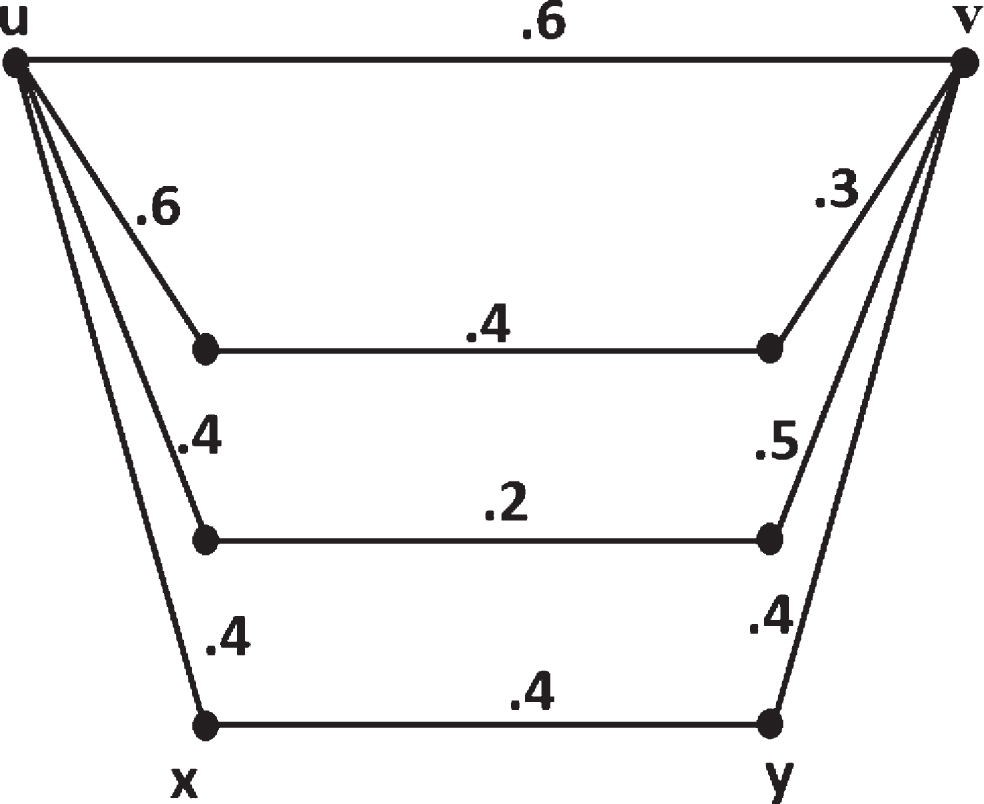
Fuzzy graph with strongest path.
Thus, d s (u, v) > CONNG-(u,v) (u, v) and there is a strongest u-v path u-x-y-v and also d s (u, v) = μ (u, v)
From Equations (3), (4), μ (u, v) = CONNG-(u,v)(u, v) + k.
This implies, μ (u, v) = CONNG-(u,v) (u, v)
Thus, by definition, (u, v) is α-arc. Hence the proof.□
Therefore,
By definition, Sum distance metric, d s (u, v) = min L (P), where P is the u-v path in G.
And L (P) =
By Equation (5), there exist u-v path whose sum distance is less than μ (u, v)
Since a path other than arc (u, v) should contain at least two arcs, there exist a path in which membership value of at least one arc is strictly less than μ (u, v), Also, d s (u, v) < CONNG-(u,v) (u, v) < μ (u, v)
This proves that this path is not strongest.
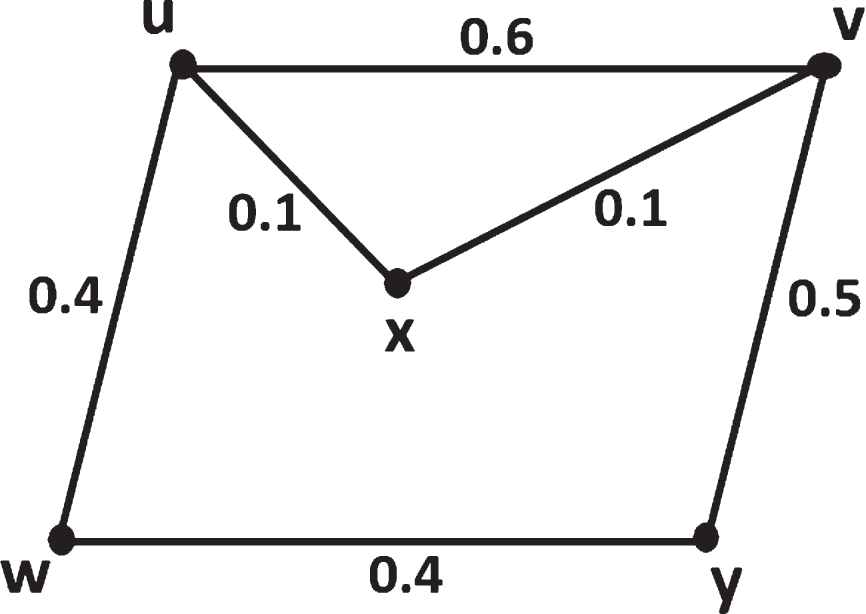
Fuzzy graph with α-arc.
Here, d s (u, v) < CONNG-(u,v) (u, v).
u-x-v path is not strongest path.
Then,
By definition of β-arc, there is a strongest path such that membership value of each arc is at least CONNG-(u,v) (u, v) Thus, by definition of Sum distance metric,
Hence the proof.□
Conversely, let there be a strongest path such that d s (u, v) = μ (u, v).
Since the path is strongest, strength of this path is equal to CONNG-(u,v) (u, v).
Thus, membership value of any arc in this path is at least CONNG-(u,v) (u, v)
Therefore, any strongest path in G - (u, v), will have length greater than CONNG-(u,v) (u, v) and hence d s (u, v) = μ (u, v).
By assumption, d s (u, v) = CONNG-(u,v) (u, v)
Thus, μ (u, v) = CONNG-(u,v) (u, v) and hence arc (u, v) is β-arc.

Fuzzy graph with β-arc.
There is a strongest u-v path u-w-x-y-z-v and d s (u, v) = μ (u, v)
Then, μ (u, v) = CONNG-(u,v) (u, v)
Also, d s (u, v) < CONNAG-(u,v) (u, v) = μ (u, v)
Thus, d s (u, v) < μ (u, v)
By definition of Sum distance metric, there exist a u-v path such that membership value of each arc in this path is strictly less than CONNG-(u,v) (u, v) and also the path P is not strongest.□
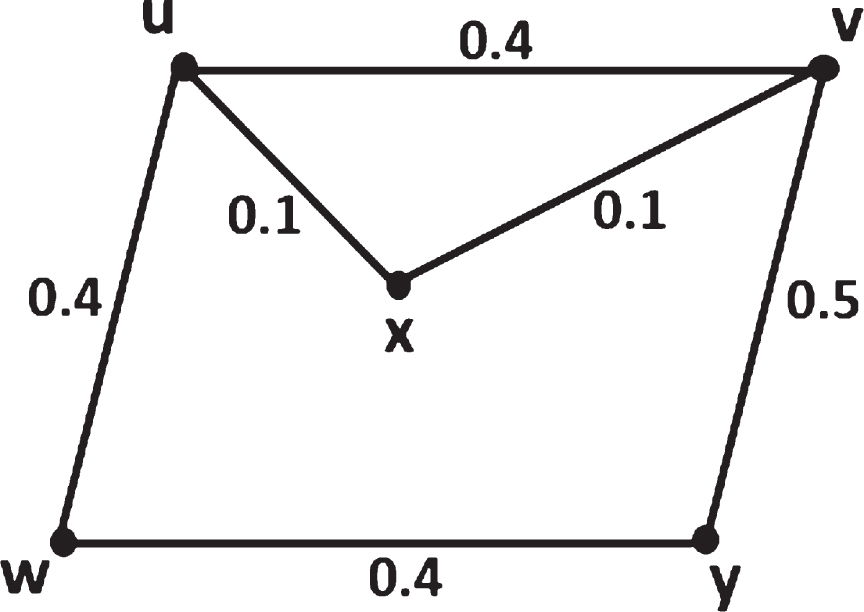
Fuzzy graph with β-arc.
There is a path u-x-v which is not strongest.
Then, (u, v) is unique weakest arc of at least one cycle in G.
This implies, every u-v path has strength greater than CONNG-(u,v) (u, v). Thus there exist a strongest u-v path.
By definition,
By definition of Sum distance metric,
By Equations (7) and (8), d s (u, v) < CONNG-(u,v) (u, v).□
Therefore, strength of path
The membership value of arcs of this path is greater than or equal to k (say). d
s
(u, v) cannot be greater than μ (u, v),by definition of Sum distance metric. Thus, we have d
s
(u, v) ≤ μ (u, v). d
s
(u, v) = μ (u, v) μ (u, v) = d
s
(u, v) ≥ CONNG-(u,v) (u, v) by assumption. This implies arc (u, v) is either α-arc or β-arc. d
s
(u, v) < μ (u, v).This implies there is a path whose length is strictly less than μ (u, v)
By assumption, d s (u, v) ≥ CONNG-(u,v)(u, v), this path is not strongest. Hence the proof.□
Bhutani and Rosenfeld [8] introduced the concept of locamin cycle to characterize blocks in arc-disjoint fuzzy graph. Here, we characterize SSC, locamin cycle and fuzzy blocks using Sum distance metric.
Since, G is an SSC and every path must be strongest and strong.
Therefore, by lemma 3.1, 3.2, 3.4, d s (u, v) ≥ CONNG-(u,v) (u, v),for every arc in G.
The converse of the theorem follows from lemma 3.7
Hence the proof.□
By theorem 4 [15], G is an SSC.
Therefore, all cycles are strongest strong.
Thus, by lemma 3.1, 3.4, d s (u, v) ≥ CONNG-(u,v) (u, v).
Conversely, Assume d s (u, v) ≥ CONNG-(u,v) (u, v) in G.
Since the underlying Crisp graph is cycle and by theorem 4.1, G is an SSC. If possible, suppose that G is not locamin. Then, there exists some node w such that w is not on a weakest arc of G. Let (u, w) and (w, v) be the two arcs incident on w, which are not weakest arcs. This implies that the path u-w-v is the unique strongest u-v path in G, which is in contradiction to the assumption that G is an SSC.□

SSC and locamin cycle.
When the underlying structure is a cycle, we can see that the concepts of SSC and locamin cycle are equivalent and become a block. Hence, we have the following.
By theorem 5 [15], G is an SSC.
By theorem 1, the result follows.□
According to Mathew and Sunitha [15], in a θ-fuzzy graph which is a block, the concepts of strong path and strongest path coincide, and thus, the concepts of strong cycle and SSC are also equivalent.
Then by theorem 5 [15], there is an SSC.
And, it is a θ-fuzzy graph. Therefore, for each pair of nodes u and v, either there is no strong cycle passing through u and v or all strong cycles passing through u and v have the same strength. Thus, there exist α-arc or β-arc and all the paths are strong.
By Lemma 1, 2, 4 d s (u, v) ≥ CONNG-(u,v) (u, v), for every arc in G.
Conversely, Assume d s (u, v) ≥ CONNG-(u,v) (u, v), for every arc in G.
By theorem 3, G is a block.□
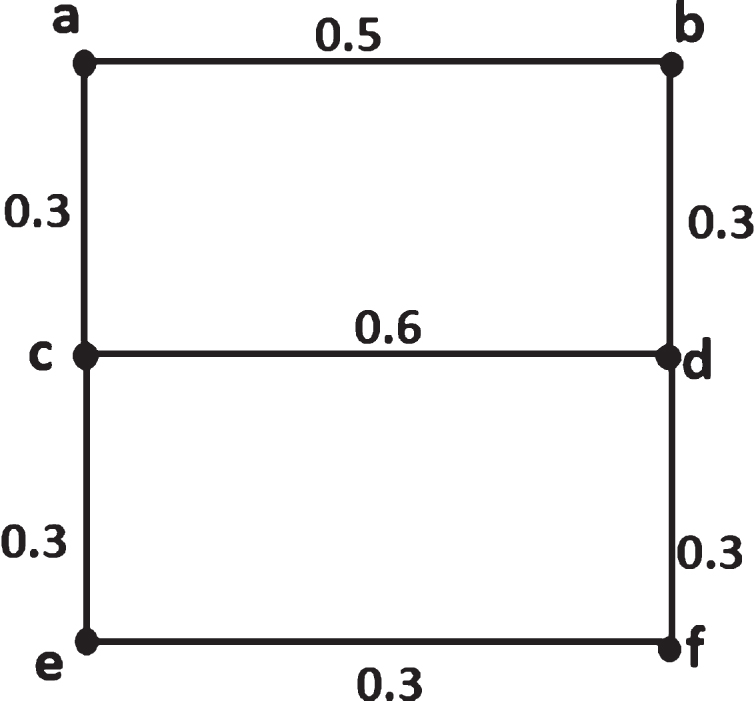
θ-fuzzy graph.
Let G : (V, σ, μ) be a fuzzy graph. Then the algorithm to find blocks using Sum distance metric is given by the following steps. Calculate strength of connectedness of each arc in the graph G. Let H
k
be the collection of arcs having same strength of connectedness k and d
s
(u, v) ≥ CONNG-(u,v) (u, v)in G, for every arc which are adjacent to each other. Required Block or cluster is given by
The complexity in calculating strength of connectedness between every pair of vertices is O (n2) as given in [4]. Also, in calculating sum distance, the time complexity is O (n2) according to [18], where n denotes the number of vertices in the fuzzy graph. Since the above algorithm calculates strength of connectedness and sum distance between every pair of vertices the time complexity is O (n2).
Application of block identification using sum distance metric and strength of connectedness in Big-Data
Big data is always being generated by everything around us. Every digital process and social media exchange produces it. Systems, sensors and mobile devices transmit it. Big data is arriving from multiple sources at an alarming velocity, volume and variety. To extract meaningful value from big data, you need optimal processing power, analytics capabilities and skills.
Hadoop is an open-source software framework for storing big- data and running applications on clusters of commodity hardware. It provides massive storage for any kind of data, enormous processing power and the ability to handle virtually limitless concurrent tasks or jobs.
We design an algorithm to retrieve information of similar data from servers represented as nodes using sum distance metric and strength of connectedness
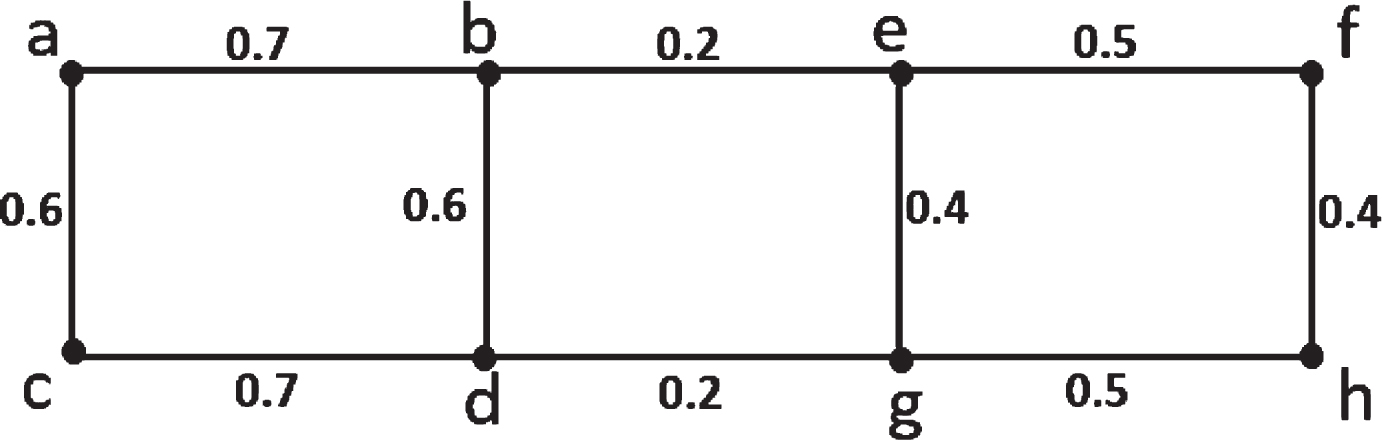
In Fig. 7, we represent fuzzy graph model. Let nodes a, b, c, d represent data related to particular format and e, f, g, h of another. The membership value of similar data is same, but the interconnecting arc has different membership value.
Fuzzy graph model.
In Fig. 7, the strength of connectedness of all arcs in a, b, c, d is 0.6 and e, f, g, h is 0.4.
Also, d s (u, v) ≥ CONNG-(u,v) (u, v), for every adjacent arc in H0.6 and H0.4 but interconnecting arcs (b. e), (d, g) have different strength of connectedness.
a, b, c, d, e, f, g, h were the clusters formed by above algorithm.
The identification and extraction of blocks in graphs is widely used in many areas of science and technology, including chemistry, communication networks, clustering and Big-Data analysis. In this paper, relationship between Sum distance metric and strength of connectedness in types of arcs, locamin cycle, SSC, θ-fuzzy graph is discussed. In addition, an algorithm and application to sort data in Big-Data analytics through block identification is presented. This work can be further extended to different type of fuzzy graphs such as (1) m-polar fuzzy graphs (2) intuitionistic fuzzy graphs (3) interval valued fuzzy graphs.