



Abstract
The concepts of covering and matching in an intuitionistic fuzzy graph using strong arcs are introduced and established many interesting properties on it. The notion of paired domination in intuitionistic fuzzy graph using strong arcs is also studied. The strong paired domination number γ spr of complete intuitionistic fuzzy graph and complete bipartite intuitionistic fuzzy graph is determined and investigated many interesting properties on it.
Introduction
Concept of graph theory have applications in many areas of computer science, including data mining, image segmentation, clustering, image capturing, networking, etc. An intuitionistic fuzzy set is a generalization of the notion of a fuzzy set. Intuitionistic fuzzy models gives more precision, flexibility and compatibility to the system as compared to the fuzzy models.
In 1983, Atanassov [4] introduced the concept of intuitionistic fuzzy set as a generalization of fuzzy sets. Atanassov added a new components which determines the degree of non-membership in the definition of fuzzy set. The fuzzy sets give the degree of membership, while intuitionistic fuzzy sets give both the degree of membership and the degree of non-membership, which are more or less independent from each other, the only requirement is that the sum of these two degrees is not greater than one. Intuitionistic fuzzy sets have been applied in a wide variety of fields including computer science, engineering, mathematics, medicine, chemistry, economics, etc.
Review of literature
In 1975, Rosenfeld [21] discussed the concept of fuzzy graph whose basic idea was introduced by Kauffman [9] in 1973. The fuzzy relations between fuzzy sets were also considered by Rosenfeld and he developed the structure of fuzzy graphs, obtained analogs of several graphs theoretical concepts. Atanassov introduced the concept of intuitionistic fuzzy relation. Different types of intuitionistic fuzzy graphs and their applications can be found in several papers. Sahoo and Pal [23] discussed the concept of intuitionistic fuzzy competition graph.
After Rosenfeld [21] the fuzzy graph theory increases with its various types of branches, such as - fuzzy tolerance graph [29], fuzzy threshold graph [28], bipolar fuzzy graphs [18, 34], highly irregular interval valued fuzzy graphs [13, 15], isometry on interval-valued fuzzy graphs [17], balanced interval-valued fuzzy graphs [11, 16], fuzzy k-competition graphs and p-competition fuzzy graphs [32], fuzzy planar graphs [27, 35], bipolar fuzzy hypergraphs [30, 31], m-step fuzzy compitition graphs [26], completeness and regularity of generalized fuzzy graphs [37], fuzzy phi-tolerance competition graphs [14], intuitionistic fuzzy graphs with categorical properties [20] etc. Fuzzy graph is used in telecommunication system [33]. A new concept of fuzzy colouring of fuzzy graph is given [36]. Nayeem and Pal introduced shortest path problem on a network with imprecise edge weight [10].
Akram and Davvaz [1] defined strong intuitionistic fuzzy graphs. They also discuss intuitionistic fuzzy hypergraphs with applications [2]. Balanced intuitionistic fuzzy graphs is discuss by Karunambigai et al. [8]. Sahoo and Pal [23] discussed the concept of intuitionistic fuzzy competition graph. They also discussed intuitionistic fuzzy tolerance graph with application [24], different types of products on intuitionistic fuzzy graphs [22] and product of intuitionistic fuzzy graphs and their degrees [25]. Akram and Akmal defined intuitionistic fuzzy graph structures [3]. Ghorai and Pal introduced operations on m-polar fuzzy graphs [7] and ceratin types of product bipolar fuzzy graphs [6].
Preliminaries
A graph is an ordered pair G = (V, E), where V is the set of all vertices of G, which is non empty and E is the set of all edges of G. Two vertices x, y in a graph G are said to be adjacent in G if (x, y) is an edge of G. A simple graph is a graph without loops and multiple edges. A complete graph is a simple graph in which every pair of distinct vertices is connected by an edge. The complete graph on n vertices has
A node cover in a graph G = (V, E) is the set of nodes such that each edge of the graph is incident to at least one vertex of the set. The minimum number of nodes in a node cover of G is the node covering number α0 (G) of G. A set of nodes in a graph G is independent if no two nodes in the set are adjacent. The node independent number β0 (G) of a graph G is the maximum cardinality of an independent set of nodes in G [5].
An arc cover of a graph G without isolated nodes is the set of arcs of G that covers all nodes of G. The arc covering number α1 (G) of a graph G is the minimum cardinality of an arc cover of G. A set of arcs in a graph G is independent if no two arcs in the set are adjacent. A matching M in a graph means an independent set of arcs in G. If e = (u, v) ∈ M, then we can say that M matches u to v. A matching of maximum cardinality is called a maximum matching. The arc independent number β1 (G) of G is the cardinality of a maximum matching. A matching M is called a perfect matching if M matches every node of G to some node of G [5].
Intuitionistic fuzzy graphs
An intuitionistic fuzzy set A on the set X is characterized by a mapping m : X → [0, 1], which is called as a membership function and n : X → [0, 1], which is called as a non-membership function. An intuitionistic fuzzy set is denoted by A = (X, m A , n A ). The membership function of the intersection of two intuitionistic fuzzy sets A = (X, m A , n A ) and B = (X, m B , n B ) is defined as mA∩B = min {m A , m B } and the non-membership function nA∩B = max {n A , n B }. We write A = (X, m A , n A ) ⊆ B = (X, m B , n B ) (intuitionistic fuzzy subset) if m A (x) ≤ m B (x) and n A (x) ≥ n B (x) for all x ∈ X. Now, the intuitionistic fuzzy graph is defined below. Throughout the paper, we denote min {x, y} = x ∧ y and max {x, y} = x ∨ y. Now the intuitionistic fuzzy graph is definedbelow:
V = {v0, v1, …, v
n
} such that σ1 : V → [0, 1] and σ2 : V → [0, 1], denote the degree of membership and non-membership of the vertex v
i
∈ V respectively and 0 ≤ σ1 (v
i
) + σ2 (v
i
) ≤1 for every v
i
∈ V (i = 1, 2, …, n). μ1 : V × V → [0, 1] and μ2 : V × V → [0, 1], where μ1 (v
i
, v
j
) and μ2 (v
i
, v
j
) denote the the degree of membership and non-membership value of the edge (v
i
, v
j
) respectively such that
Two types of intuitionistic fuzzy graphs are defined in literature. The difference is on the condition on non-membership value of an edge with end vertices. These conditions are
The condition on membership value remain same. With both these assumptions, lot of theorems are established on intuitionistic fuzzy graphs. But, we notice that there is a difference on complement. The complement of an intuitionistic fuzzy graph G, defined in [1] with condition (2) is structurally similar to the crisp graph, but it does not hold the property
For this reason, we assumed condition (1) in this paper. Let us consider an example of intuitionistic fuzzy graph.
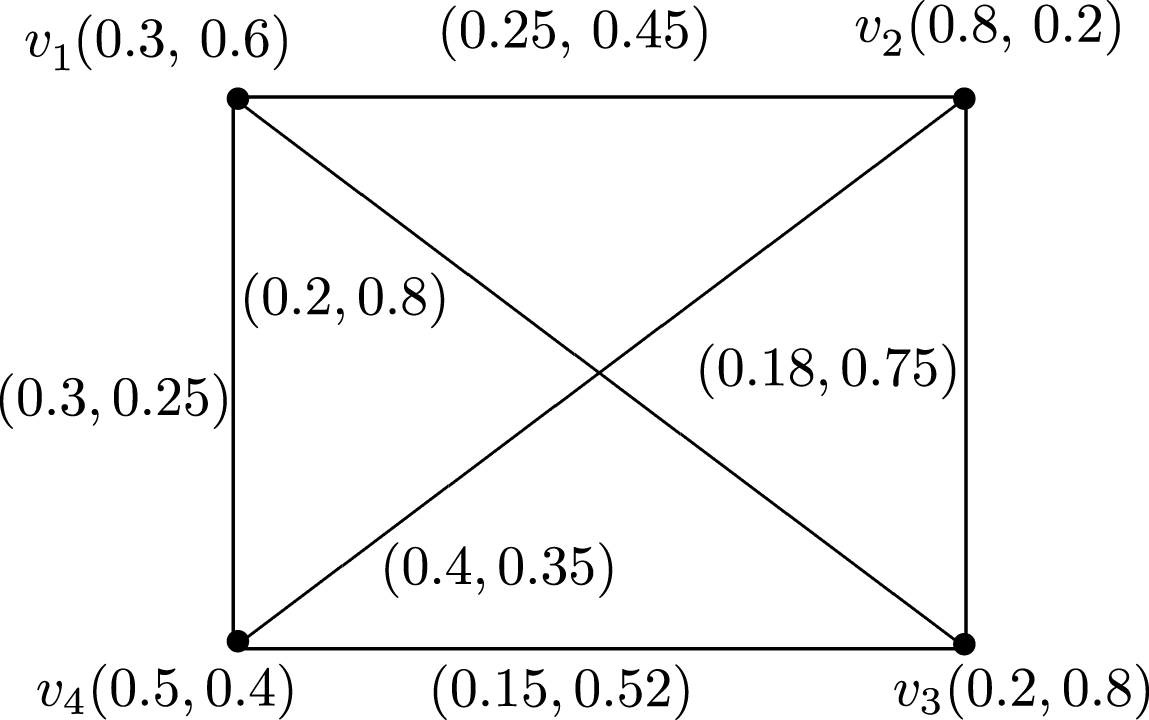
An intuitionistic fuzzy graph.
An intuitionistic fuzzy graph G = (V, σ, μ) is said to be bipartite if the vertex set V can be partitioned into two non empty sets V1 and V2 such that μ1 (v i , v j ) =0 and μ2 (v i , v j ) =0 if v i , v j ∈ V1 or v i , v j ∈ V2. Further, if μ1 (v i , v j ) = σ1 (v i ) ∧ σ1 (v j ) and μ2 (v i , v j ) = σ2 (v i ) ∨ σ2 (v j ) for all v i ∈ V1 and v j ∈ V2, then G is called a complete bipartite graph and is denoted by Kσ′,σ′′.
In this section, the concept of covering and matching in intuitionistic fuzzy graphs using strong arcs are discussed and established many interesting results. First, we defined strong node cover in intuitionistic fuzzy graphs.
Hence, α s 10 = (n - 1) μ1 (u, v).
Similarly,
Hence, α s 20 = (n - 1) μ2 (u, v).
The strong independent number of an intuitionistic fuzzy graph G is denoted by β s 0 (G) = β s 0 = (β s 10 , β s 20 ), where β s 10 is the maximum membership value of the strong independent set of nodes in G and β s 20 is the minimum non-membership value of the strong independent set of nodes in G. A maximum strong independent set in an intuitionistic fuzzy graph G is the strong independent set of maximum membership value and minimum non-membership value.
Now, we determine βs0 of complete intuitionistic fuzzy graph, complete bipartite intuitionistic fuzzy graph and intuitionistic fuzzy cycle.
Now, we defined strong cover and strong covering number in intuitionistic fuzzy graphs.
The strong arc independent number or strong matching number of an intuitionistic fuzzy graph G is denoted by β s 1 (G) = β s 1 = (β s 11 , β s 21 ), where β s 11 is the maximum membership value of the strong matchings of G and β s 21 is the minimum non-membership value of the strong matchings of G. A maximum strong matching in an intuitionistic fuzzy graph G is the strong matching of maximum membership value and minimum non-membership value.
Now, we determine βs1 of complete intuitionistic fuzzy graph, complete bipartite intuitionistic fuzzy graph and intuitionistic fuzzy cycle.
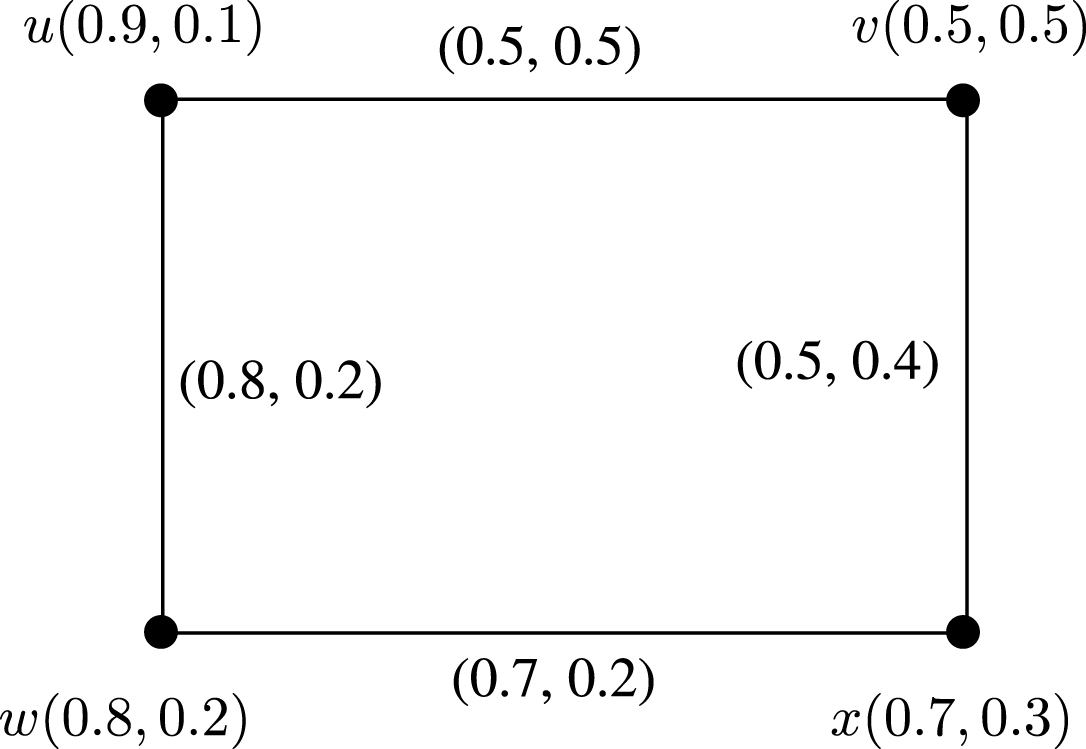
Illustration of strong covering in intuitionistic fuzzy graph.
Now, W (D1) = (0.7 + 0.5, 0.2 + 0.4) = (1.2, 0.6), W (D2) = (0.5 + 0.7, 0.4 + 0.2) = (1.2, 0.6), W (D3) = (0.8 + 0.5, 0.2 + 0.4) = (1.3, 0.6) , W (D4) = (0.8 + 0.5 + 0.7, 0.2 + 0.4 + 0.2) = (2.0, 0.8) , W (D5) = (0.8 + 0.5 + 0.5, 0.2 + 0.4 + 0.4) = (1.8, 1.0), W (D6) = (0.5 + 0.7 + 0.5, 0.4 + 0.2 + 0.4) = (1.7, 1.0), W (D7) = (0.8 + 0.7 + 0.5, 0.2 + 0.2 + 0.4) = (2.0, 0.8) and W (D8) = (0.8 + 0.5 + 0.7 + 0.5, 0.2 + 0.4 + 0.2 + 0.4) = (2.5, 1.2). Among these the minimum value is (1.2, 0.6). Hence, α s 0 = (1.2, 0.6). Here, u and v are adjacent, so they are not independent, but they are strong independent, since they are not connected with any strong edge.
The strong independent sets are D1 = {u, v},D2 = {u, x} and D3 = {v, w}. Now, W (D1) = (0.8 + 0.5, 0.2 + 0.4) = (1.3, 0.6), W (D2) = (0.8 + 0.5, 0.2 + 0.4) = (1.3, 0.6) and W (D3) = (0.5 + 0.7, 0.4 + 0.2) = (1.2, 0.6). The maximum value among these is (1.3, 0.6) and hence β s 0 = (1.3, 0.6).
The set X = {(u, w) , (v, x)} is the only strong arc cover and strong matching in G and W (X) = (0.8 + 0.5, 0.2 + 0.4) = (1.3, 0.6). Hence α s 1 = β s 1 = (1.3, 0.6).
α
s
0
+ β
s
0
= W (V) ≤ m α
s
1
+ β
s
1
≥ n
Let β
s
0
= W (M
s
0
), where M
s
0
is a maximum strong independent set of nodes in G. That is no two nodes in M
s
0
are adjacent to each other by a strong arc and thus the node in V - M
s
0
strong cover all the strong arcs of G. Hence, V - M
s
0
is a strong node cover of G and α
s
0
is the minimum value of such strong node covers. Hence, α
s
0
≤ W (V - M
s
0
) = W (V) - β
s
0
.
From (1) and (2), we have α s 0 + β s 0 = W (V).
Since W (V) ≤ m always by definition of W (V). Hence, α s 0 + β s 0 = W (V) ≤ m.
The second inequality follows directly, since the value of the strong arcs are considered for determining α s 1 , β s 1 and m is the sum of the node values.
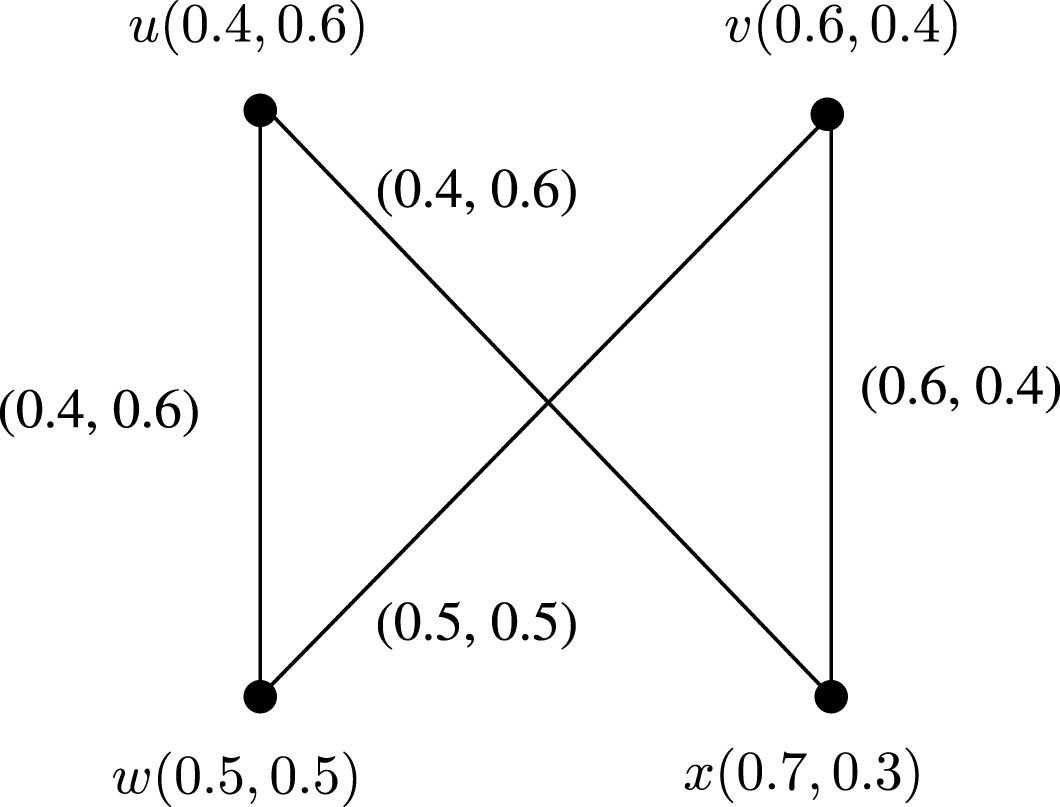
Perfect strong matching.
In this section, we have introduced paired domination in intuitionistic fuzzy graphs using strong arcs based on perfect strong matching and established some results.
The strong domination number of an intuitionistic fuzzy graph G is denoted by γ s (G) = γ s = (γ s 1 , γ s 2 ), where γ s 1 is the minimum membership value of strong dominating sets of G and γ s 2 is the maximum non-membership value of strong dominating sets of G.
The strong paired domination number of an intuitionistic fuzzy graph G is denoted byγ spr (G) = γ spr = (γ spr 1 , γ spr 2 ), where γ spr 1 is the minimum membership value of strong paired dominating sets of G and γ spr 2 is the maximum non-membership value of strong paired dominating sets of G.
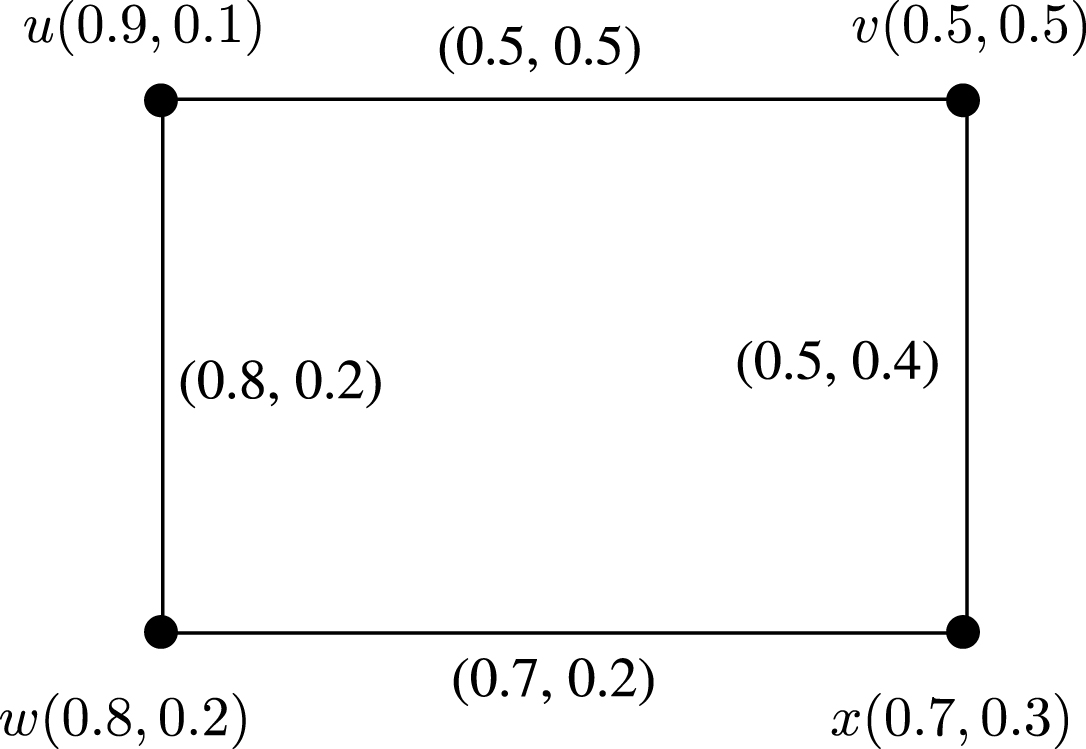
Illustration of paired domination in intuitionistic fuzzy graph.
Now, value of these sets are: W (D1) = (0.8 + 0.5, 0.2 + 0.4) = (1.3, 0.6), W (D2) = (0.7 + 0.5, 0.2 + 0.4) = (1.2, 0.6) and W (D3) = (0.8 + 0.5 + 0.7 + 0.5, 0.2 + 0.4 + 0.2 + 0.4) = (2.5, 1.2). Here,D2 is a strong paired dominating set with minimum membership value and maximum non-minimum membership value. Hence, strong paired domination number is γ spr (G) = (2.5, 1.2).
Hence, γ spr 1 (Kσ′,σ′′) = μ1 (u, v) + μ1 (u, v) =2μ1 (u, v) and γ spr 2 (Kσ′,σ′′) = μ2 (u, v) + μ2 (u, v) =2μ2 (u, v).
In this paper, covering and matching in intuitionistic fuzzy graphs using strong arcs are defined. The concept of strong cover node, strong independent number, strong arc cover and strong matching in intuitionistic fuzzy graphs using strong arcs are determined and obtained the relations among them. Also, paired domination in intuitionistic fuzzy graphs using strong arcs is introduced. The strong paired domination number γ spr of complete intuitionistic fuzzy graph and complete bipartite intuitionistic fuzzy graph is determined and investigated many interesting properties on it. We are extending our research work to (1) Chromatic number in intuitionistic fuzzy graphs, and (2) Colouring of intuitionistic fuzzy graphs.
Footnotes
Acknowledgments
Financial support of first author offered by Council of Scientific and Industrial Research, New Delhi, India (Sanction no. 09/599(0057)/2014-EMR-I) is thankfully acknowledged.
The authors are thankful to the reviewers for their valuable comments and suggestions to improve the presentation of the paper.