



Abstract
In this study, we provide a generalization of fuzzy threshold graphs, and introduce three notions, which are intuitionistic fuzzy threshold graphs, intuitionistic fuzzy alternating 4-cycle, and threshold dimension of intuitionistic fuzzy graphs. Then we discuss some properties about intuitionistic fuzzy graphs, and obtain two main results. The first one is that under some conditions, an intuitionistic fuzzy graph is equivalent to an intuitionistic fuzzy threshold graph. The second one is that the underlying graph of an intuitionistic fuzzy threshold graph is a split graph, and conversely, a given split graph can be used to construct an intuitionistic fuzzy threshold graph. Finally, we give two applications of intuitionistic fuzzy threshold graphs, which are used to control water resource and power resources, respectively. Through the two applications, we know that intuitionistic fuzzy threshold graphs are more appropriate than fuzzy threshold graphs in controlling water resource and power resource, because intuitionistic fuzzy sets are more suitable and powerful to deal with uncertainty and vagueness compared to fuzzy sets.
Keywords
Introduction
Fuzzy graph theory was introduced by Rosenfeld in 1975 [44], ten years after the concept of fuzzy set first proposed [50]. This theory can represent all the systems properly due to the uncertainty or haziness of the parameters of systems. For example, a family group can be represented as a graph, where a vertex represents a family member of the family, and an edge represents the resemblance between two related family members. Obviously, fuzziness should be considered to represent edges because we could not characterize resemblance with classical mathematics theories. Since the reality is full of uncertainty, fuzzy graphs occur in many situations. Now fuzzy graph theories are growing fast from both theories and applications in various fields, and have become a vast branch [4, 49].
Intuitionistic fuzzy sets (IFSs) proposed by Atanassov [11] is a generalization of fuzzy sets [50–53], and an IFS is defined by a membership degree, a non-membership degree and a hesitancy degree. So IFSs are more suitable and powerful to handle uncertainty and vagueness compared to fuzzy sets. Further in 1999, Atanassov [10] introduced the concept of intuitionistic fuzzy relations and intuitionistic fuzzy graphs (IFG), where an intuitionistic fuzzy set is used to characterize each vertex or each edge. Afterwards, much more attention have been attracted in this subject [1–3, 54]. More specifically, in 2006, Karunambigai and Parvathi [36] introduced another type of IFG as a special case of Atanassov’s IFG, and applied these concepts to find a shortest path in networks [22]. Parvathi et al. [37] defined some important operations on IFGs. Karunambigai et al. discussed arcs in IFGs [21], and introduced constant IFG in [23]. Gani et al. [24] defined the concept of degree, order and size of an IFG, and studied point set domination of IFGs [25]. Akram et al. [1–3, 34] introduced many new concepts including intuitionistic fuzzy hypergraphs, strong IFGs, intuitionistic fuzzy cycles, intuitionistic fuzzy trees, intuitionistic fuzzy planar graph, and double domination on IFGs. Clearly, further research on IFGs is becoming a research pot now.
Threshold graphs as special graphs have beautiful structures and possess many important mathematical properties. This concept was first introduced by Chvatal and Hammer [18] in 1973, and plays an important role in graph theory as well as in many areas, such as computer science, psychology, artificial intelligence and so on. For example, Bipartite threshold graphs were studied in [19]. Andelic and Simic [9] presented properties of threshold graphs. Especially, Samanta and Pal [45] first introduced the fuzzy threshold graph in 2011. Afterwards, Makwana et al. [27] discussed the extraction of illumination invariant features using a fuzzy threshold based approach. Pramanik et al. [41, 42] proposed interval-valued fuzzy threshold graph (IVFTG) and interval-valued fuzzy planar graphs in 2016. However, it should be noted that little work has been done on intuitionistic fuzzy threshold graph, which can be considered as a special IFG. So it is interesting to discuss about intuitionistic fuzzy threshold graphs later to perfect IFG theories.
Based on the above analysis, it is really meaningful for us to study intuitionistic fuzzy threshold graphs(IFTGs) compared to fuzzy threshold graphs, where uncertainty and vagueness will be characterized by intuitionistic fuzzy sets instead of fuzzy sets. Therefore in this paper, we will first give the definition of IFTGs and then introduce other notions, such as intuitionistic fuzzy alternating 4-cycle, threshold dimension of IFGs and so on. Further, we will discuss about properties related to IFTGs, including the relationship between IFTGs and its underlying graphs, the connection between IFGs and IFTGs, and so on. Finally, we will give applications of IFTGs in controlling water resources and power resource, and try to show the importance of researches on IFTGs.
Preliminaries
Some definitions necessary are given below.
Let G = (V*, E*) be a graph, where V* and E* denote the set of vertices and edges of G*, respectively. ∀x, y ∈ V*, we say that x and y are adjacent if (x, y) ∈ E*, i.e., (x, y) is an edge. We call G* = (V*, E*) a simple graph if G* = (V*, E*) does not have loops and multiple edges. Besides, a simple graph is called a complete graph if ∀ x, y ∈ V*, x and y are adjacent.
We say a fuzzy relation v symmetric if and only if v (x, y) = v (y, x), ∀x, y ∈ X.
(μ
A
, v
A
) is an IFS on V*. (μ
B
, v
B
) is an IFR on V*(or IFS on E*),
where
(μ
A
, v
A
) is an IFS on V*. (μ
B
, v
B
) is an IFR on V*(or IFS on E*), where
Specifically, from Definition 2.5, we know that there is no edge between the vertex x and the vertex y when μ B (x, y) =0 and v B (x, y) =0. However from Definition 2.6, we know that there is no edge between the vertex x and the vertex y when μ B (x, y) =0 and v B (x, y) =1.
Further, let G0 = (A, B) be a graph, μ A (x) =1, v A (x) =0, ∀x ∈ V. By Definition 2.5, we know G0 = (A, B) is an intuitionistic fuzzy graph only when v B (x, y) =0, ∀x, y ∈ V. However, by Definition 2.6, we know G0 = (A, B) is always an intuitionistic fuzzy graph.
(2) Throughout this paper, G* = (V*, E*) denotes the underlying graph of an IFG G = (A, B), where μ
A
(x) ≠0 or v
A
(x) ≠1 , ∀ x ∈ V*
μ
B
(x, y) ≠0 or v
B
(x, y) ≠1 , ∀ (x, y) ∈ E*.
Let A be an intuitionistic fuzzy subset on V* and B be an intuitionistic fuzzy subset on E* (see Table 1). Then based on A and B we can get an IFTG (see Fig. 1) with t1 = 0.5 and t2 = 0.6, and here we denote this graph as G = (A, B ; 0.5, 0.6).
Membership degrees and non-membership degrees for vertices and edges
Membership degrees and non-membership degrees for vertices and edges
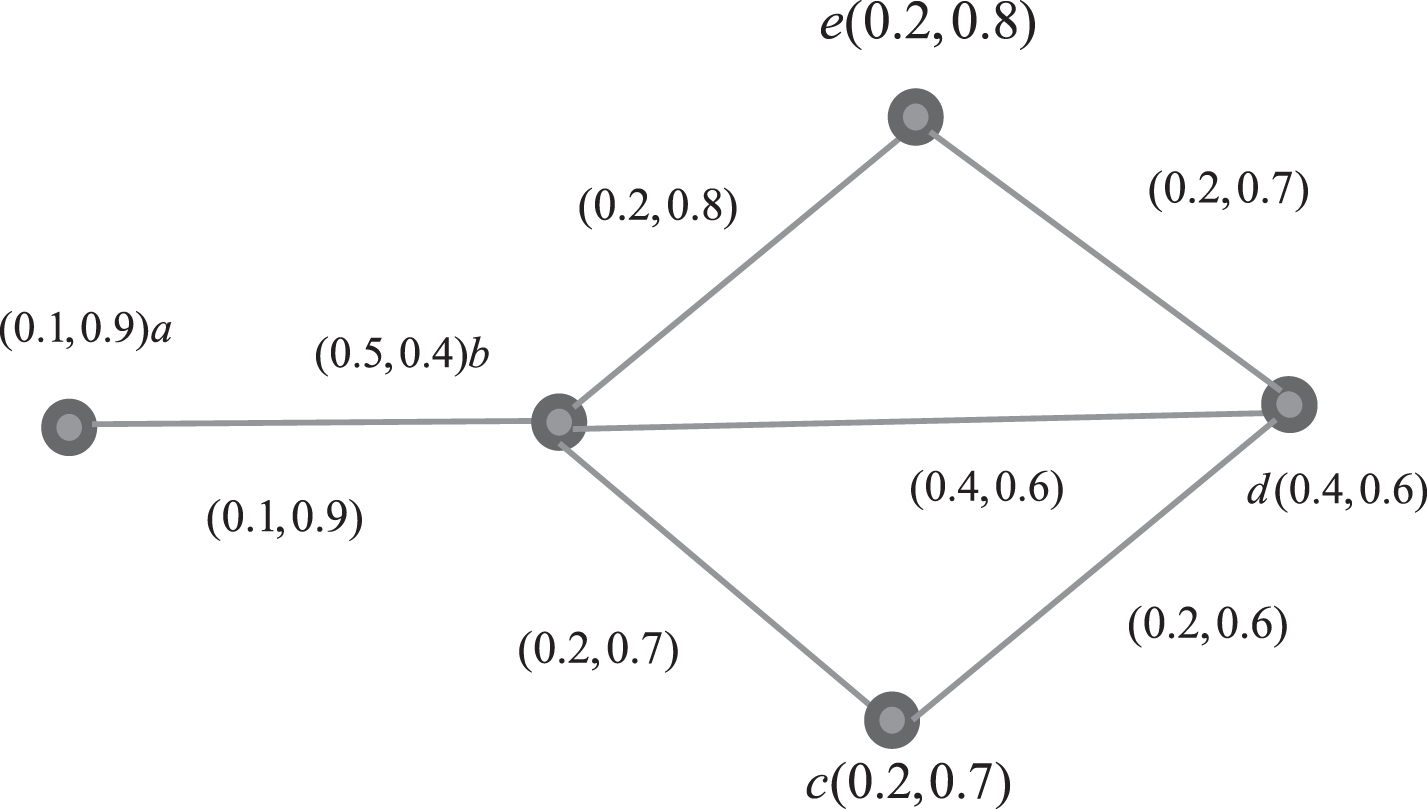
An IFTG G = (A, B ; 0.5, 0.6).
Note that
Note that for an IFG, we know v
A
(u) =0 for all u ∈ U. Take t2 = n, then there exist non-negative real numbers t1, t2 such that
μ
B
(a, b) ≠0 and v
B
(a, b) ≠0 ((μ
B
(a, b) , v
B
(a, b)) ≠ (0, 0)); μ
B
(c, d) ≠0 and v
B
(c, d) ≠0 ((μ
B
(c, d) , v
B
(c, d)) ≠ (0, 0)); μ
B
(a, c) =0 and v
B
(a, c) =0 ((μ
B
(a, c) , v
B
(a, c)) = (0, 0)); μ
B
(b, d) =0 and v
B
(b, d) =0 ((μ
B
(b, d) , v
B
(b, d)) = (0, 0)),
we say that the four vertices constitute an intuitionistic fuzzy alternating 4-cycle.
an intuitionistic fuzzy path P4: (μ
B
(a, d) , v
B
(a, d)) = (0, 0) (μ
B
(b, c) , v
B
(b, c)) ≠ (0, 0); or (μ
B
(b, c) , v
B
(b, c)) = (0, 0) (μ
B
(a, d) , v
B
(a, d)) ≠ (0, 0). an intuitionistic fuzzy square C4: (μ
B
(a, d) , v
B
(a, d)) ≠ (0, 0) (μ
B
(b, c) , v
B
(b, c)) ≠ (0, 0). an intuitionistic fuzzy matching 2K2: (μ
B
(a, d) , v
B
(a, d)) = (0, 0) (μ
B
(b, c) , v
B
(b, c)) = (0, 0).
By the definition of IFG, we know that
Since G = (A, B ; t1, t2), then
From Equation (3.1), (3.2),(3.3) and (3.4), we obtain
Obviously, Equation (3.5) contradicts with Equation (3.6). Therefore we get the conclusion.□
s1 < min {μ
A
(u) |u ∈ K} and ∑u∈V*-Kμ
A
(u) ≤ s1 and s1 ≤ max {μ
A
(u*) + s1|u* ∈ K} ≤ t1 < min
where n = |V*|
IF
;
where n = |V*|
IF
;
(1) If U ⊆ V* - K, from the condition (I), (II) and (III), we get that
(2) If U∩ K ≠ ∅, and K is the largest clique, then we know that there exists one and only one vertex u* such that U ∩ K = {u*}. From the condition (I), (II) and (III), we get that
Necessity: Suppose U ⊆ V* is not an independent set in G*, then we know that U ⊆ K or
(1) If U ⊆ K, then there exist at least two vertices in U, such as u1 and v1, such that the two vertices are adjacent. Since the two vertices both belong to K, then from the condition (III), we have
This contradicts with Equation (3.7).
(2) If U∩ (V* - K) ≠ ∅, then there exist at least two vertices in U, such as u1 and v1, such that the two vertices are adjacent. It should be noted that one of the two vertices belong to K, then from the condition (III), we have
This contradicts with Equation (3.7).
Therefore we know that if
Assume V* - K is not an independent set, then there exists an edge (a, b) in V* - K such that
Since K is the largest clique, then there exist distinct vertices c, d in K such that
Thus the four vertices a, b, c, d constitute an intuitionistic fuzzy alternating 4-cycle, and by Proposition 3.3 we get the contradiction. Therefore V* - K is an independent set, and G* is a split graph.
Conversely, if Since G* = (V*, E) is a split graph, we can get the largest clique K and the independent set V* - K in G*. Then, we modify the membership degree and non-membership degree for each vertex and each arc in G* over and over, until we get an IFG, which satisfies the conditions (I), (II) and (III) in Theorem 3.1. That is, we obtain an IFTG finally.□
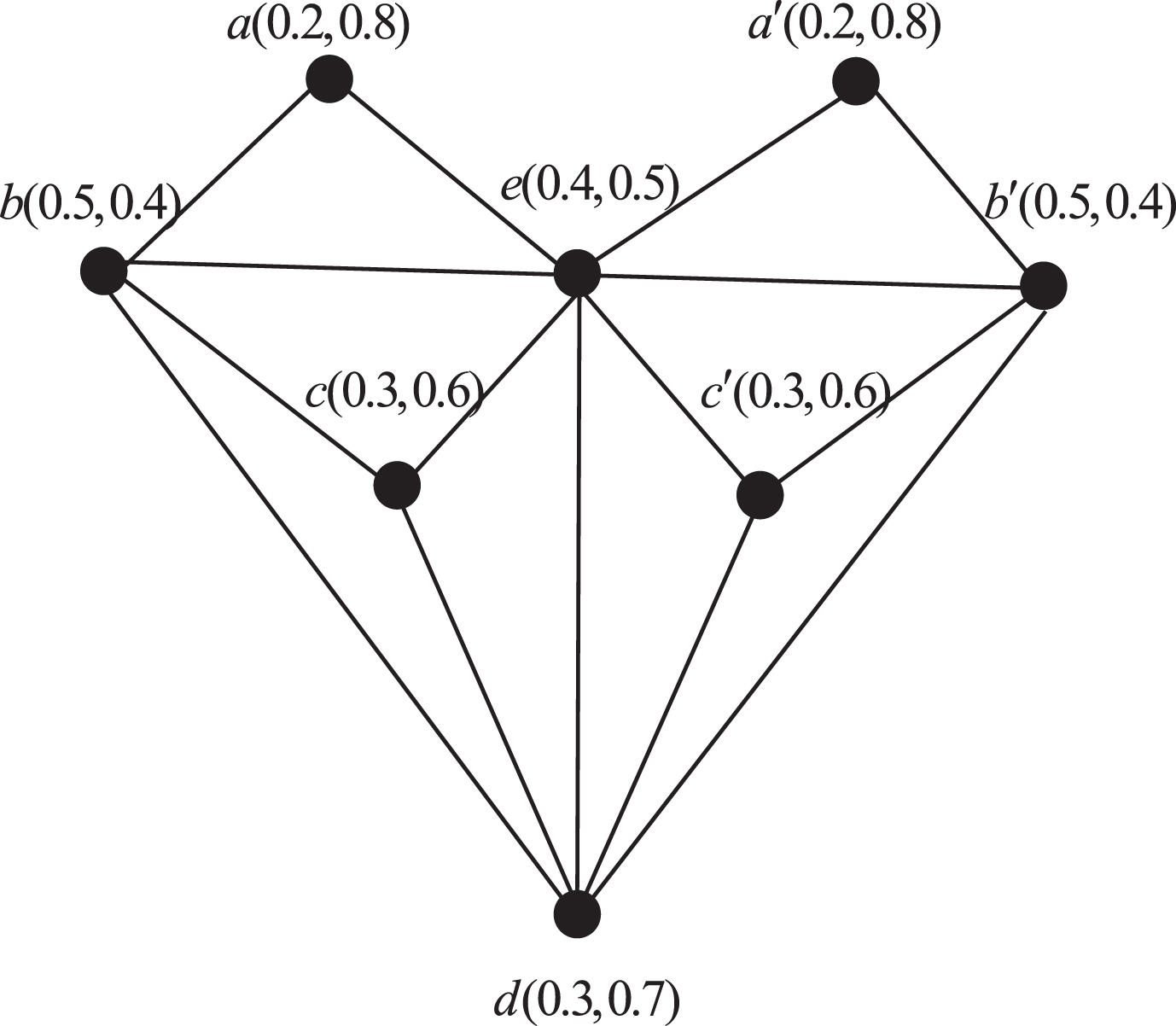
An IFG with t (G) =2, and tp (G) =3.
By Definition 3.3 and Definition 3.4, we can get
Obviously, t (G) ≤ tp (G) ≤ |E (G) |.
In reality, it is easy to find IFTGs can help solve resources allocation problems in intuitionistic fuzzy surroundings. Especially, IFTGs are helpful to control the flow of information. In the following, we mainly discuss about two applications of IFTGs in resource controlling.
In order to apply IFTGs in resource controlling, it is necessary to get a partition of IFGs. That is, we need to search intuitionistic fuzzy threshold subgraphs, G1, G2, ⋯ , G k , which cover the edge set of G, and tp (G) = k.
Generally, it is difficulty to find intuitionistic fuzzy threshold subgraphs from IFGs. However, from Theorem 3.5, we know that t (G) = tp (G) = n - α (G) when G = (A, B) is an triangle free IFG, where α (G) is the number of vertices of the maximum independent set of G*, and n is the number of vertices of G*.
Below we give an algorithm for searching intuitionistic fuzzy threshold subgraphs from an triangle free IFG.
An application of intuitionistic fuzzy threshold graph in water resource controlling
It is well known that urban water supplies have a great effect on people’s life. People can not live without water. It is really crucial for reservoirs to provide enough water for cities.
Assume there are six cities, i.e., a, b, c, d, e, f, and two reservoirs, i.e., x, y. The amount of water provided by the two reservoirs varies every day. It is worth noting that there exists an important problem about water leakage in underground pipelines, and this directly causes water waste of each city. Obviously, in order to control water resource of each city, we need to know the amount of actual water consumption, estimated water leakage and unforeseen water consumption. Besides, the two reservoirs need to supply the required amount of water to guarantee the basic water consumption for six cities, while the two reservoirs also has the minimum amount of water storage, which is used for keeping the normal water level of the reservoir.
In order to control water resource, we need to find the minimum amount of replenishment water, which should be retained for cities. Thus at any time, the two reservoirs can supply enough water to guarantee the basic city water consumption. For simplicity, we need to convert the original data into equivalent real numbers between 0 and 1 in advance. Here the water network system can be modeled as an IFG (see Fig. 3), i.e., G = (A, B), where six cities and two reservoirs can be represented as vertices. That is, the IFG has eight vertices, i.e., a, b, c, d, e, f, x, y, and each of them has membership degree and non-membership degree. Now we choose the city “a”, and the reservoir “x” as representatives, and give the meaning of μ
A
(a), v
A
(a), μ
A
(x), v
A
(x), μ
B
(a, x) and v
B
(a, x). More details are shown below: An intuitionistic fuzzy graph related to water resource. μ
A
(a) denotes the amount of actual water consumption of the city “a”; v
A
(a) denotes the amount of water leakage of the city “a”; 1 - μ
A
(a) - v
A
(a) (i.e., the hesitancy degree of a to A) denotes the amount of unforeseen water consumption of the city “a”. μ
A
(x) denotes the amount of water supply of the reservoir “x”; v
A
(x) denotes the minimal amount of water storage of the reservoir “x”; 1 - μ
A
(x) - v
A
(x) (i.e., the hesitancy degree of x to A) denotes the amount of unforeseen water consumption of the reservoir “x”. μ
B
(a, x) denotes the non-droughty degree between the city “a” and the reservoir “x”, and v
B
(a, x) denotes the droughty degree between the city “a” and the reservoir “x”, where (a, x) is an edge of the IFG.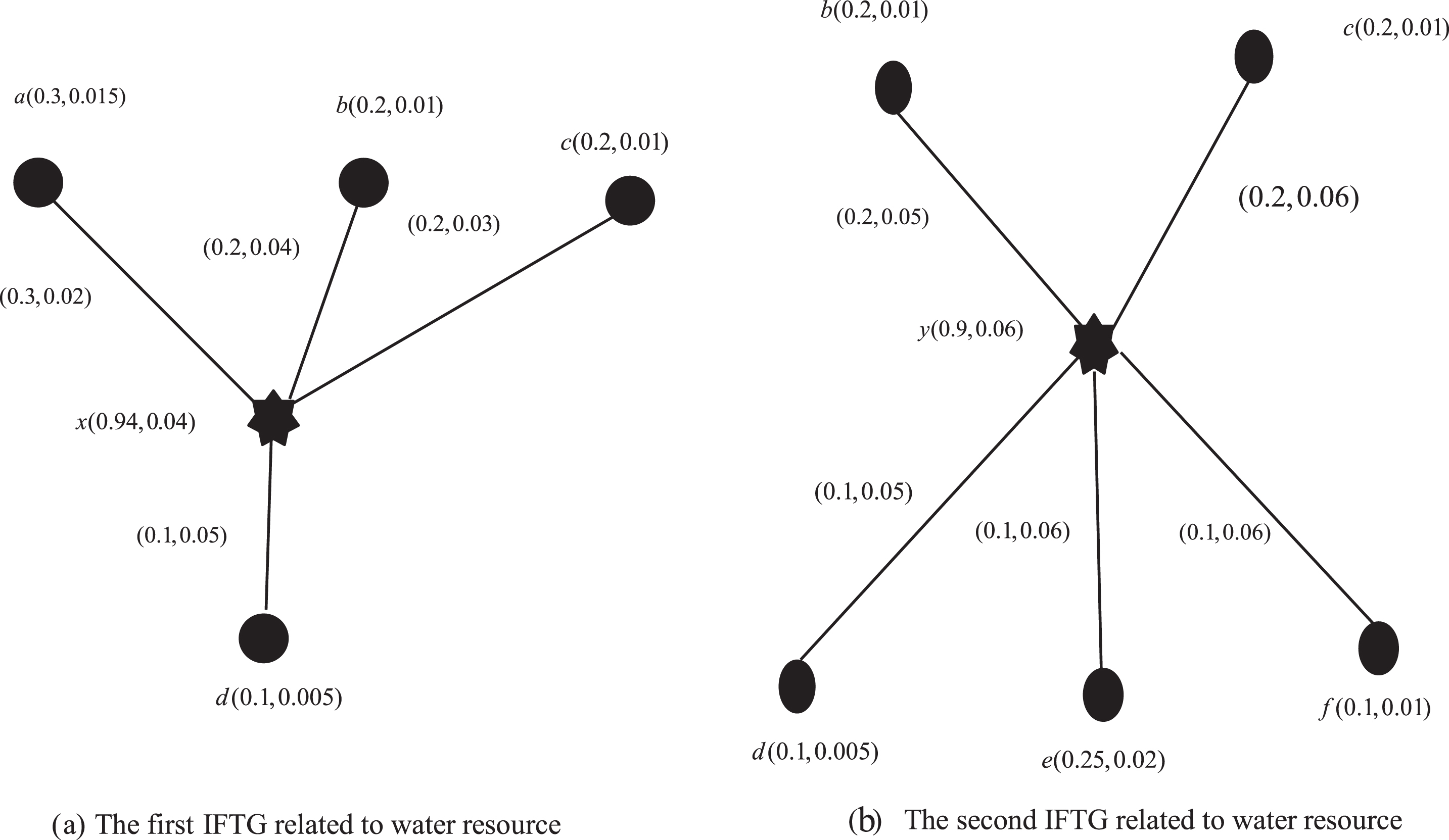
Since the amount of water consumption of each city is dominated by reservoirs, therefore by Algorithm 1, we know that the threshold dimension is easily to be determined by the number of reservoirs. Let us see the IFG shown in Fig. 3, where the threshold dimension is 2, and the intuitionistic fuzzy threshold partition number is also 2. That is, we can induce two intuitionistic fuzzy threshold subgraphs (see Fig. 4) from this IFG.
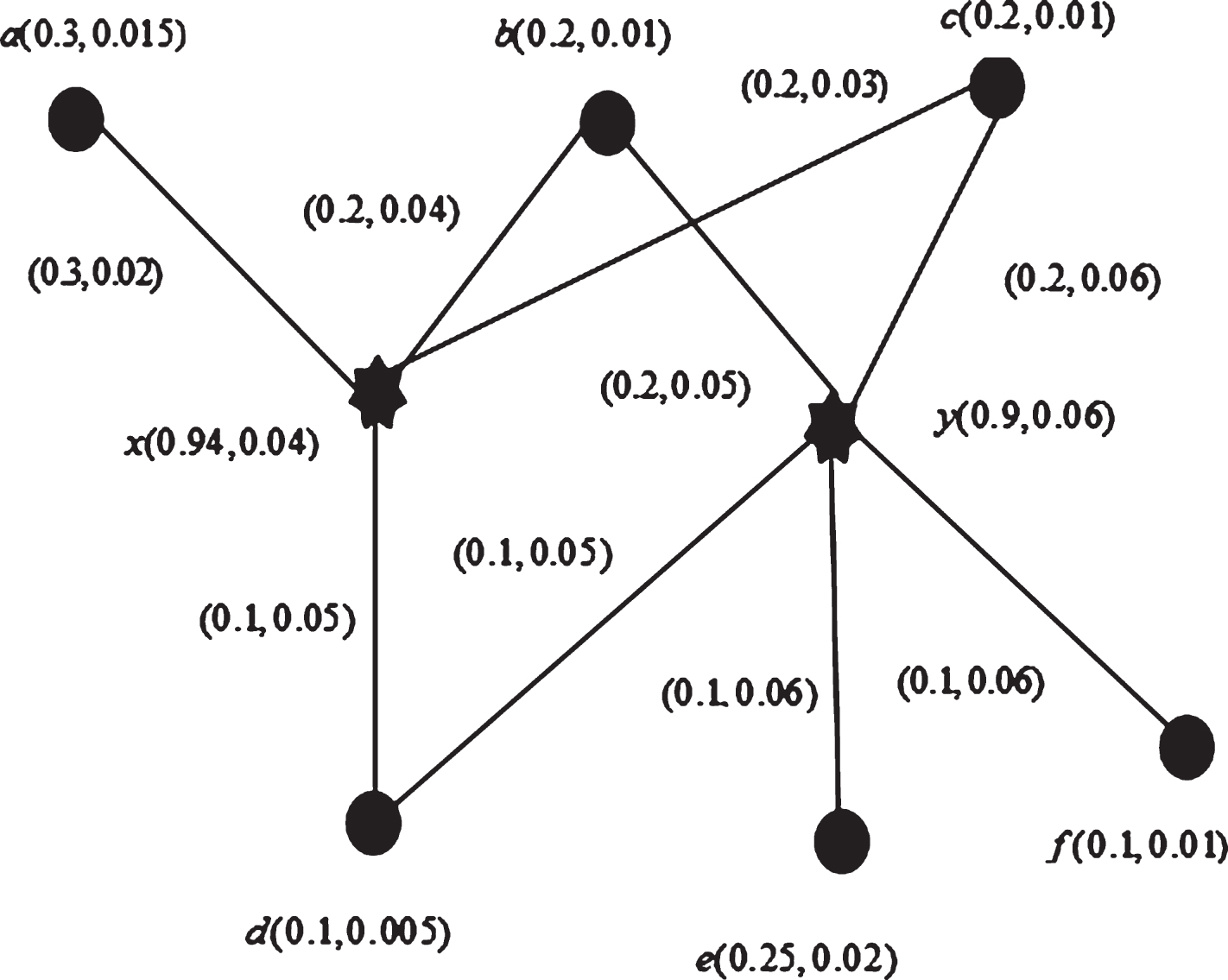
Two intuitionistic fuzzy threshold subgraphs related to water resource.
It should be noted that the threshold t1 means the limit amount of water replenishment, and m - t2 means the limit amount of water leakage and unforeseen water consumption, where m is the number of elements of maximum independent set of the underlying graph of IFTG. For example, we can obtain that t1 = 0 .94 and t2 = 3.96 from the first IFTG of Fig. 4, and t1 = 0 .9 and t2 = 4 . 954 from the second IFTG of Fig. 4. Note that {a, b, c, d} is the maximum independent set of the underlying graph of the first IFTG, and
Therefore we know that the reservoir “x” can provide 0.94 amount of water replenishment for the four cities, which need at least 0.8 amount of water for actual water consumption, and 0.04 (0 . 04 = 4 -3 . 96) amount of water for water leakage and unforeseen water consumption. Simultaneously for the second IFTG, the maximum independent set is {b, c, d, e, f}, and
Therefore we know that the reservoir “y” can provide 0.9 amount of water replenishment for the five cities, which need at least 0.85 amount of water for actual water consumption, and about 0.046 (0 . 046 = 5 -4 . 954) amount of water for water leakage and unforeseen water consumption.
From the above analysis, we know that it is really important to apply IFTG in controlling water resources. Moreover, through this application, we know that IFTGs are more appropriate than fuzzy threshold graphs in controlling water resource.
Nowdays, people’s life is closely related to electricity. It is really important for power stations to supply enough electricity for running cities.
Assume there are five cities, i.e., a, b, c, d, e, and two power stations, i.e., x, y. The amount of electricity provided by the two stations varies from day to day. What we can not ignore is the loss of power when electricity is transmitted from power stations to cities. Obviously, in order to control power resource, on the one hand, we need to know the amount of actual electricity consumption, estimated power loss and unforeseen electricity consumption of each city. On the other hand, we need to know the required amount of electricity supplied by the two power stations for running five cities. Besides, we also need to know the minimum amount of electricity storage for maintaining power stations.
What we’re focusing on is to find the minimum amount of replenishment electricity, which should guarantee the basic electricity consumption of each city. For simplicity, we need to convert the original data into equivalent real numbers between 0 and 1 in advance. Here the grid system can be modeled as an IFG (see Fig. 5), i.e., G = (A, B), where five cities and two power stations can be represented as vertices. That is, the IFG has eight vertices, i.e.,
μ
A
(a) denotes the amount of actual electricity consumption of the city “a”;v
A
(a) denotes the amount of the power loss of the city “a”; 1 - μ
A
(a) - v
A
(a) (i.e., the hesitancy degree of a to A) denotes the amount of unforeseen electricity consumption of the city “a”. μ
A
(x) denotes the amount of electricity supply of the power station “x”;v
A
(x) denotes the minimal amount of electricity storage of the power station “x”; 1 - μ
A
(x) - v
A
(x) (i.e., the hesitancy degree of x to A) denotes the amount of unforeseen electricity consumption of the power station “x”. μ
B
(a, x) denotes the degree of no loss of power grid from the power station “x” to the city “a”, and v
B
(a, x) denotes the degree of power grid loss from the power station “x” to the city “a”, where (a, x) is an edge of the IFG. μ
B
(x, y) denotes the transfer of electricity from the power station “x” to the power station “y”, and v
B
(x, y) denotes the power grid loss between the two power stations,
Since the amount of electricity consumption of each city is dominated by power stations, therefore by Algorithm 1, we know that the threshold dimension is easily to be determined by the number of power stations. Let us see the IFG shown in Fig. 5, where the threshold dimension is 2, and the intuitionistic fuzzy threshold partition number is also 2. That is, we can induce two intuitionistic fuzzy threshold subgraphs (see Fig. 6) from this IFG.
An intuitionistic fuzzy graph related to power resource. Two intuitionistic fuzzy threshold subgraphs.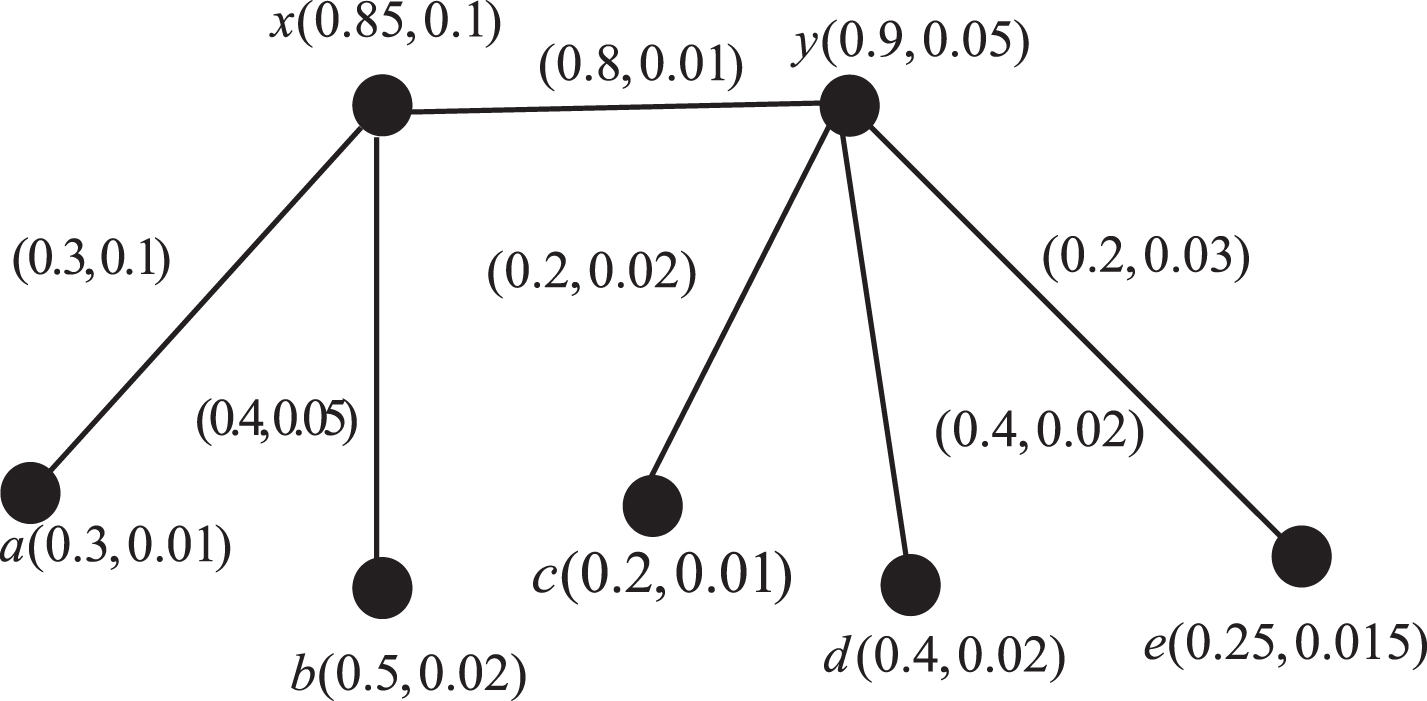
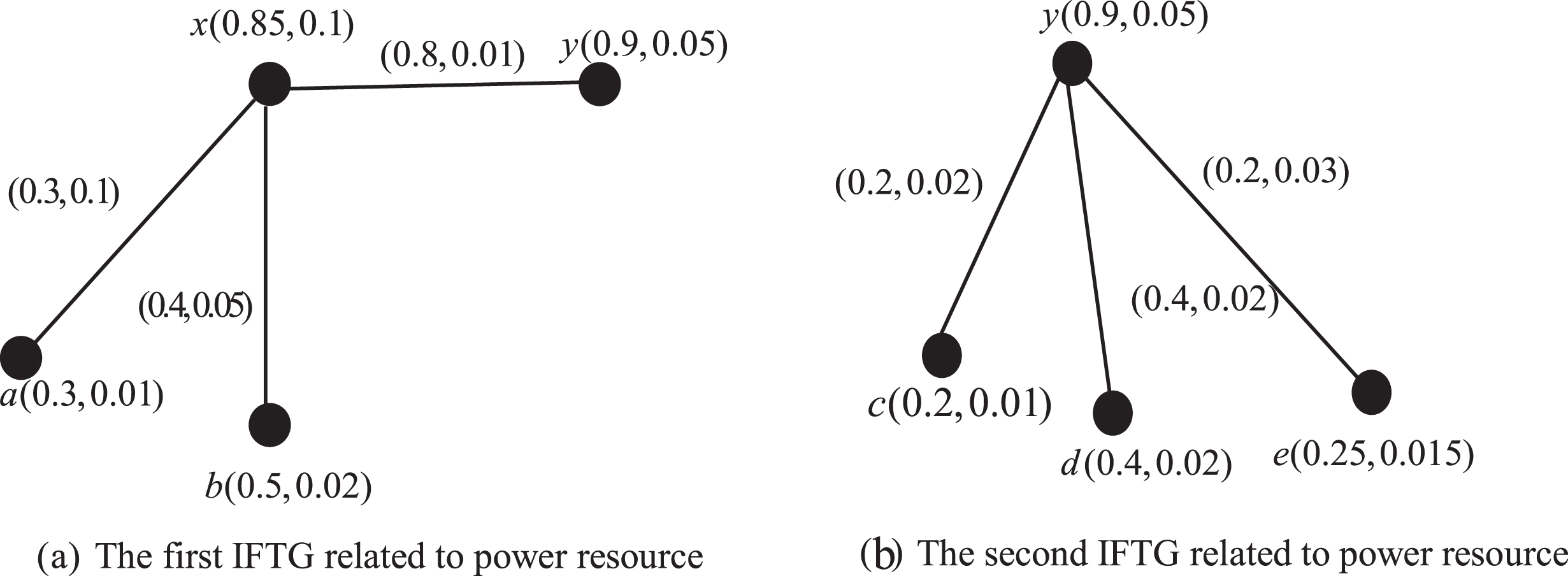
It should be noted that the threshold t1 means the limit amount of electricity replenishment, and m - t2 means the limit amount of power loss and unforeseen electricity consumption, where m is the number of elements of maximum independent set of the underlying graph of a IFTG. For example, we can obtain that t1 = 0 .9 and t2 = 2.92 from the first IFTG of Fig. 6, and t1 = 0 .9 and t2 = 2 . 955 from the second IFTG of Fig. 6. Note that {a, b, y} is the maximum independent set of the underlying graph of the first IFTG, and
From the first IFTG of Fig. 6, we know the power station “x” can provide 0.85 amount of electricity replenishment, while the power station “y” can also provide 0.9 amount of electricity replenishment. Obviously, the two power stations can supply enough electricity for two cities, which need at least 0.8 amount of electricity for actual consumption. Besides, we know there are about 0.08 (0 . 08 = 3 -2.92) amount of power loss and unforeseen electricity consumption. Simultaneously for the second IFTG, the maximum independent set is {c, d, e}, and
Therefore we know the power station “y” can provide 0.9 amount of electricity replenishment for three cities, which need at least 0.85 amount of electricity for actual consumption. What’s more, we also know there are about 0.045 (0 . 045 = 3 -2 . 955) amount of power loss and unforeseen electricity consumption.
From the above analysis, we know that it is really important to apply IFTG in controlling power resources. Moreover, through this application, we know that IFTGs are more appropriate than fuzzy threshold graphs in controlling power resource, because intuitionistic sets are more suitable and powerful to deal with uncertainty and vagueness compared to fuzzy sets.
Considering intuitionistic fuzzy sets are more suitable and powerful to deal with uncertainty and vagueness compared to fuzzy sets, intuitionistic fuzzy models can give more precision and compatibility than fuzzy models in many applications. So we have introduced the notions of IFTGs, intuitionistic fuzzy alternating 4-cycle, and threshold dimension of IFGs. We have proved that under some conditions, an IFG is equivalent to an IFTG. Some other properties related to IFTGs have also been studied in this paper. Especially, we have obtained that the underlying graph of each IFG is a split graph, and conversely, for a given split graph can be converted to an IFTG. Finally, two applications of IFTGs have shown that IFTGs can be used to control water resource and power resource, and this shows that IFTGs are more appropriate than fuzzy threshold graphs in controlling water resource and power resource.
Our future work will be done on applications of IFTGs in set packing problems, and we will propose efficient algorithms to search the IFTGs from IFGs. Besides, we will further discuss about the relationships between IFTGs and its intuitionistic fuzzy independent sets, and try to do a deep research on the IFTGs theory.
Footnotes
Acknowledgments
Professor Guantao Chen, Georgia State University of the USA, provides important suggestions to improve the quality of this paper. The authors are very grateful for his contributions.
This paper is supported by NSFC (No. 61572011), and Hebei Key Laboratory of Machine Learning and Computational Intelligence.