



Abstract
Traditional multiple deferred state (MDS) sampling plan by variable is not able to decide about lots of products whose proportion parameter (p) is uncertain. In this study, fuzzy MDS (FMDS) variable sampling plan is proposed when p is not precise for the inspection of normally distributed quality characteristics in two cases known and unknown standard deviation. The plan parameters are obtained by the optimization problem, in which the objective function is considered to minimise sum of the fuzzy producer’s and consumer’s risks and the constraints are formulated by use of two-point approach under the specific fuzzy values of the producer’s and consumer’s risk, indexed by fuzzy limiting and acceptable quality levels. The proposed plan includes variable fuzzy single sampling plan (FSSP) as a special case. The obtained results show that the operating characteristic curve of FMDS variable plan seems to be closer to the ideal one with smaller required average sample number compared to variable FSSP. An industrial example is presented to illustrate the proposed plan in real applications.
Keywords
Introduction
An acceptance sampling plan is often used to test whether a submitted lot should be accepted or rejected. In general, the acceptance sampling plans are categorized into attribute and variable plans. A major advantage of the variable sampling plan is that it obtains the same operating characteristic (OC) curve with a smaller required sample size. Therefore, variable sampling plan may be appropriate in reducing inspection cost when the inspection is expensive.
Most sampling schemes utilize only the current lot information on sentencing a production lot. Unfortunately, these kinds of plans are not suitable for purposes involving costly or destructive testing, because in practice they often need large sample size in order to provide adequate producer’s and customer’s risks. In order to overcome the mentioned shortcoming, conditional sampling plans were developed in which past, future and current lot information are applied to decide about manufacturing production. Conditional sampling procedures have been considered by many scholars. “Chain sampling” is a conditional plan which was developed by Dodge [13], Dodge and Stephens [14]. Wortham and Mogg [36] studied “dependent state sampling inspection” by attributes in which the past lots information is used to make a decision criterion. The concept of “multiple deferred (dependent) state” (MDS) attribute sampling plan was first introduced by Wortham and Baker [35] in which they used the several successive future (past) lots information. Further studies can be found about MDS attribute sampling plan in Varest [33], Soundararajan and Vijayaraghavan [29], Govindaraju and Subramani [17]. Balamurali and Jun [5] extended MDS attribute sampling plan to MDS variable sampling plan based on approximate sampling distribution for one-sided specification limit under known and unknown variance cases. The variable MDS based on the process yield index was studied by Wu et al. [38] in which they used the conventional variable single sampling plan as a reference plan. Wu et al. [37] presented MDS variable sampling plan based on the normal distribution with two-sided specification limits. Also, Yan et al. [39] used the coefficient of variation of the quality characteristic to design MDS sampling plan. The theory and technique of bayesian MDS sampling plan was presented by Latha and Subbiah [23] applying Gamma prior distribution. A reduction in the sample size was their obtained result by utilize of the bayesian attribute sampling plan without a cost function for a prior distribution. Senthilkumar et al. [28] proposed bayesian repetitive deferred sampling plan by variables in which they used the succeeding lots information under repetitive group sampling plan. The optimal MDS sampling plan was studied under a Gamma-Poisson model by Balamurali et al. [4]. They showed that their proposed plan has a minimum average sample number (ASN) for decision.
One of the usual assumption to design a traditional sampling plan is that the proportion of defective items (p) is assumed crisp. But in real world, there are many cases in which p is not precise. So one can describe it based on fuzzy logic. In this case, sampling plans should be planned in a fuzzy environment by using fuzzy sets theory. Chakraborty [11] studied a class of single sampling plan based on fuzzy optimization. An acceptance sampling plan with fuzzy quality characteristics was discussed by Tong and Wang [31]. Baloui Jamkhaneh et al. [6] introduced fuzzy single sampling (FSSP) by attribute. They showed that their proposed plan is well-defined. A new sequential sampling plan based on sequential probability ratio test for fuzzy hypotheses testing was introduced by Baloui Jamkhaneh and Sadeghpour Gildeh [8]. Fuzzy MDS attribute sampling plan was proposed by Afshari et al. [1] when the inspection is not perfect. Also Afshari and Sadeghpour Gildeh [2] prepared tables to find the parameters of fuzzy MDS attribute plan by use of two-point approach. In order to make more details about fuzzy sampling plan see Kahraman et al. [20], Divya [12], Baloui Jamkhaneh et al. [7], Turanoglu et al. [32], Afshari et al. [3], Tamaki et al. [30], Sampath [27], Grzegorzewski [18, 19], Ohta and Ichihashi [25], Venkateh and Elango [34], Kanagawa and Ohta [21].
Although one of the advantages of the traditional MDS variable sampling plan is that it needs small sample size to decide about the submitted lot, it is not able to sentence the manufacturing productions when the process quality is not precise. So, in this study, fuzzy MDS (FMDS) variable sampling plan is proposed to make decisions in manufacturing productions whose quality characteristics follow normal distribution. We discuss the case as standard deviation is known or unknown. Also, it is shown that the proposed plan is an extention of the existing traditional MDS variable sampling plan and variable FSSP. Moreovere, the comparisons between the proposed plan and variable FSSP are also investigated.
The reminder of this paper is organised as follows. First, the existing traditional MDS plan is briefly reminded in the next section. We fuzzify MDS plan in Section 3. In addition, the tables are prepared to determine the proposed plan parameters in this section. Section 4 deals with the industrial application of the proposed plan. Fuzzy expected disposition time and fuzzy ASN of the proposed plan are given in Sections 5 and 6, respectively. Finally, the proposed plan is compared with variable FSSP in Section 7. Moreover, we consider operating procedure of FSSP by variable in this section. Some conclusions are remarked in last section. In this paper, to solve the nonlinear optimization problem the codes “fmincon” and “fminbnd” in the Matlab R2014a Software are used.
Classic MDS variable sampling plan
In this section, MDS variable sampling plan is reviewed in classic case. Then this plan is developed into a fuzzy environment in next section. The following assumptions should be valid to apply MDS variable sampling plan (Soundararajan and Vijayaraghavan [29]): The serial lots must be generated by a continuing process. Lots need to have a constant fraction nonconforming. The quality characteristic of interest follows a normal distribution.
Suppose that the quality characteristic has the upper specification limit U and follows a normal distribution with unknown mean μ and known standard deviation σ. Then the operating procedure in the MDS variable sampling plan is as follows:
Therefore, MDS variable sampling plan has four parameters, namely k rσ , k aσ , m σ and n σ . Let p be the fraction nonconforming in a lot which is expressed as
According to Balamurali and Jun [5], probability of lot acceptance is given by
Whenever the standard deviation is unknown, the sample standard deviation S is used instead of σ. In this case, the plan operates similar to known-standard deviation case. In the case of unknown-standard deviation, the symbols k rs , k as , m s and n s are applied instead of k rσ , k aσ , m σ and n σ , respectively. According to Duncan [16], Balamurali and Jun [5] the lot acceptance probability for the standard deviation unknown case is given by
In this section, firstly we recall one way of ordering fuzzy numbers which is given in Dubois and Prade [15]. Then, MDS variable sampling plan is considered in a fuzzy environment.
Now, we want to study MDS variable sampling plan when p is imprecise. For simplicity in calculation, let p be a triangular fuzzy number
Let the quality characteristic of interest have the upper specification limit U and follows a normal distribution with unknown mean μ and standard deviation σ. Standard deviation may be known or unknown.
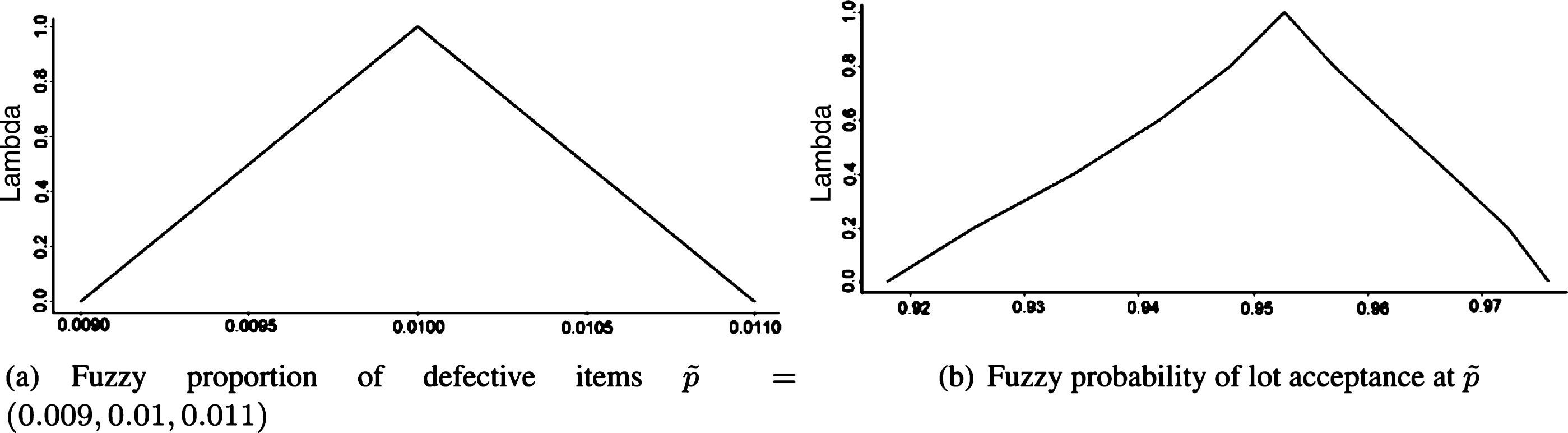
Fuzzy probability of lot acceptance at
The operation procedure in known-standard deviation fuzzy multiple deferred state (KSD-FMDS) variable sampling plan is the same steps given in Section 2. So, KSD-FMDS variable sampling plan is determined by four parameters, namely k
rσ
, k
aσ
, m
σ
and n
σ
. If k
rσ
= k
aσ
then the proposed plan reduces to the known standard deviation FSSP (KSD-FSSP) by variable (see Section 7). When the lower specification limit L is required, we use statistic
According to (3) and Buckley’s approach (Buckley [9, 10]) the λ-cut of lot acceptance fuzzy probability is given by
By using the representation theorem of fuzzy numbers given in Klir and Yaun [22], one can obtain the membership function of
Assume the KSD-FMDS plan with parameters m
σ
= 1, n
σ
= 41, k
rσ
= 1.98 and k
aσ
= 2.19. Also, let the proportion of defective items is a fuzzy number
Example 2
Consider all the assumptions of Example 1. We want to plot OC curve of this plan. The OC curve plots the probability of lot acceptance against the proportion of defective items (see Montgomery [24]). In order to plot the OC curve of KSD-FMDS plan,
Let

The λ-cut of FOC band of variable KSD-FMDS for different values of λ.
Fuzzy sampling plans are usually determined by considering two points on their FOC band, namely
One may arrive at a class of KSD-FMDS variable plans satisfying above conditions. Among this class of plans, the authors select a unique plan involving minimum sum of risks for given
0 and 1 cuts of parameters of KSD-FMDS with corresponding producer’s and consumer’s risks indexed by
Suppose λ-cut of
On the other hand, since minimise the sum of errors may increase the sample size, we consider the following condition on the optimization problem:
The values of parameters k
rσ
, k
aσ
, m
σ
and n
σ
in KSD-FMDS variable sampling plan are tabulated in Table 1 for several combinations of
For example if
From each submitted lot, take a random sample of size 6 and compute
The operating procedure in unknown-standard deviation fuzzy multiple deferred state (USD-FMDS) variable sampling plan is same the steps given in Section 2, except that here the sample standard deviation
Although the operating procedure of the proposed plan in known and unknown standard deviation cases are similar to each other, the determination of parameters in unknown standard deviation scheme is different from the known standard deviation case. It is clear that
According to (4) and using Buckley’s approach, the λ-cut of lot acceptance fuzzy probability in USD-FMDS is given by
By applying the representation theorem of fuzzy numbers, one can obtain the membership function of
If
The values of the parameters m
s
, n
s
, k
rs
and k
as
for USD-FMDS plan are reported in Table 2 for several combinations of
For example, if
0 and 1 cuts of parameters of USD-FMDS with corresponding producer’s and consumer’s risks indexed by
39 observations for flatness (in μm)
In this section, real industry data of thin film transistor liquid crystal displays (TFT-LCD) are considered that have also been applied by Yen et al. [40] and the data are reported in Table 3. According to Pearn and Wu [26], flatness is one of the critical quality characteristics. If the flatness of glass is not in control, the TFT-LCD products may result in a certain degree of chromatic aberration. Consider a supplier in manufacturing TFT-LCD products in Taiwan, the production specifications of flatness for a particular model of non-alkali thin-film glass is U = 25 μm. According to a written agreement between the supplier and the consumer, assume the values of
Fuzzy expected disposition time of the proposed plan
The major limitation of the proposed plan is the waiting line which may create until disposition of future lots is determined. Firstly, we discuss about this issue for KSD-FMDS. Then USD-FMDS will be considered. Now, consider the following symbols:
A: Event of unconditional acceptance of a lot,
R: Event of unconditional rejection of a lot,
D: Event of deferring disposition,
U: Event of unconditional acceptance or rejection of a lot,
W: Variable denoting the number of lots that a deferred lot has to wait before disposition,
P A : Probability that a lot is unconditionally accepted,
P R : Probability that a lot is unconditionally rejected,
P D : Probability that a lot disposition is deferred,
P U : Probability that a lot is unconditionally accepted or rejected i.e. waiting time is equal to zero.
P (W = i): Probability that the waiting time before disposition for a lot is exactly i lots.
Wortham and Baker [35] showed the waiting time distribution for traditional MDS attribute sampling plan is given as (i ≥ m)
Now, we want to obtain the expected disposition time of KSD-FMDS variable plan when the proportion parameter is uncertain. Let the proportion parameter be a fuzzy number
Hence, according to (17) the λ-cut of fuzzy expected disposition time of KSD-FMDS variable plan designated as
Now, let the standard deviation be unknown. In USD-FMDS variable plan, the general term for λ-cut of waiting time distribution is similar to (17), except that by using (13) and sample standard deviation S instead of σ, the formulas for P
A
, P
R
and P
D
are given as:
Therefore, the λ-cut of fuzzy expected disposition time of USD-FMDS variable plan designated as
Let
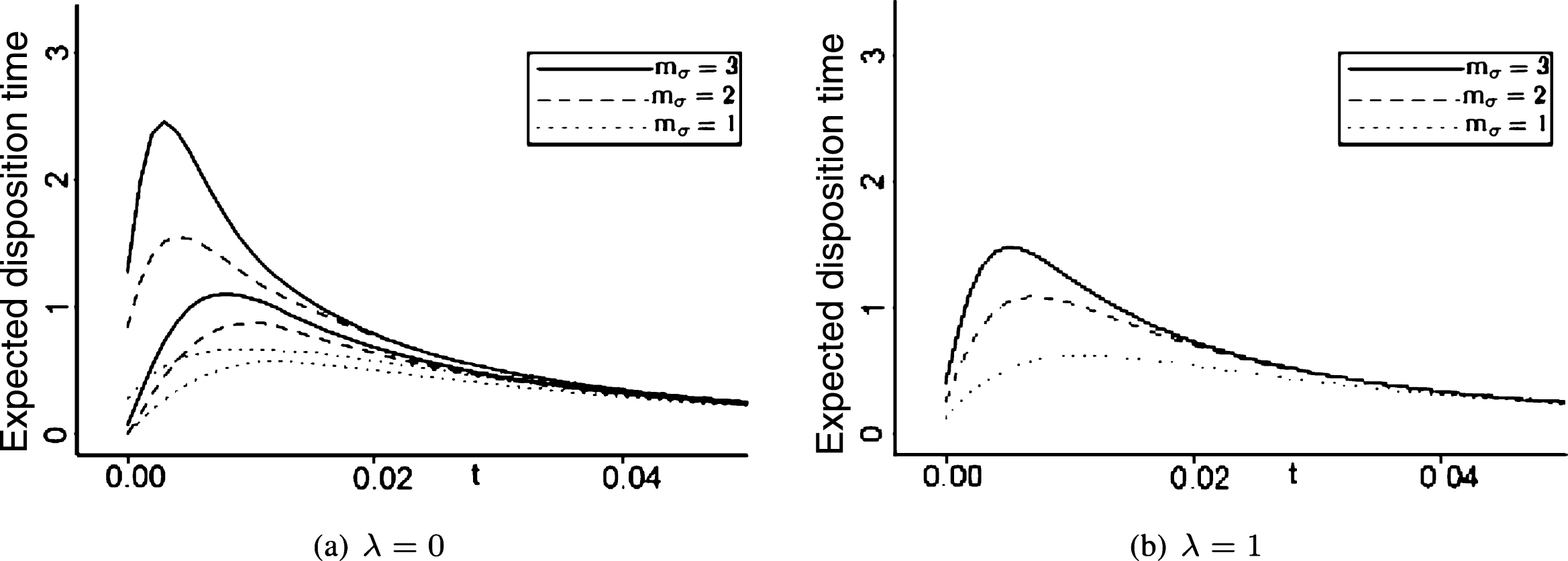
Comparison of λ-cut of fuzzy expected disposition times of KSD-FMDS for m σ = 1, 2, 3 as n σ = 4 under λ = 0, 1.
Also, Fig. 4 shows 0 and 1 cuts of fuzzy expected disposition time of USD-FMDS plan. According to Fig. 4(a) and (b), it can be described that the λ-cut of
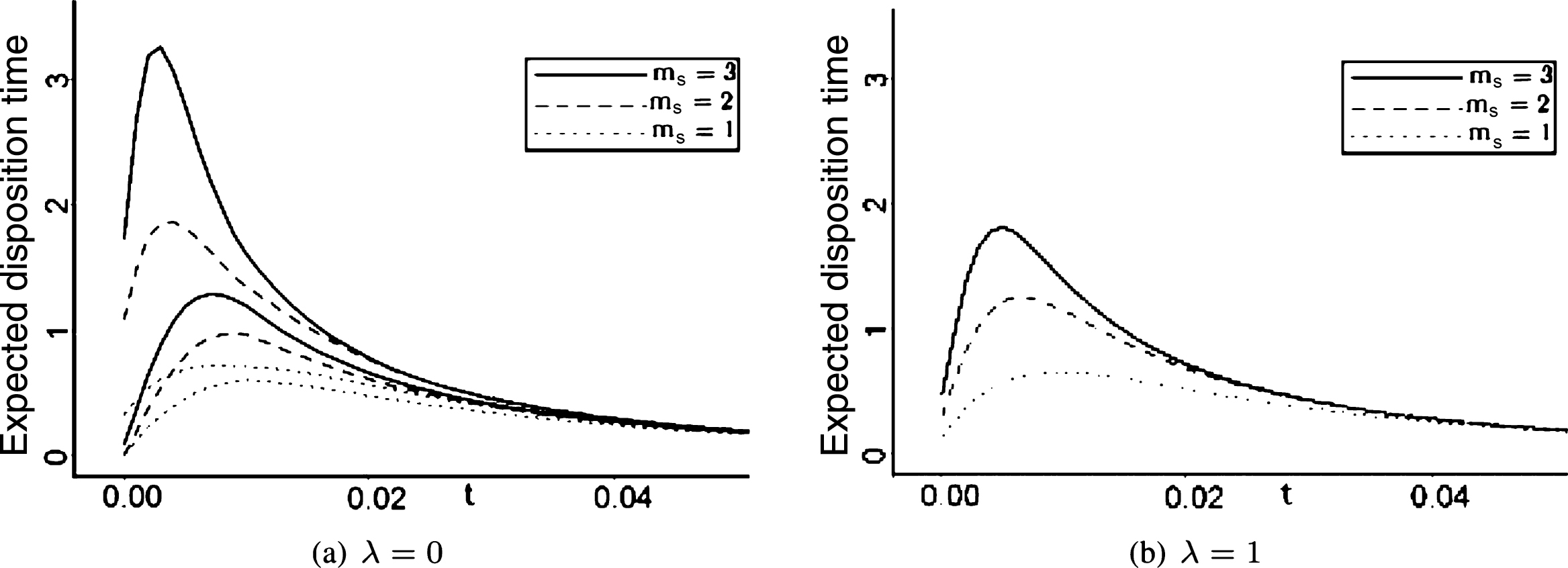
Comparison of λ-cut of fuzzy expected disposition times of USD-FMDS for m s = 1, 2, 3 as n s = 14 under λ = 0, 1.
Fuzzy average sample number (
Assume KSD-FMDS plan with parameters m σ , n σ , k aσ and k rσ . Let N be a random variable that shows the number of inspected items. By using (17) and fixing the sample size in n σ , fuzzy probability distribution of N is given as follows:
By using Buckley’s approach, λ-cut of fuzzy average sample number of KSD-FMDS plan (
0 and 1 cuts of fuzzy ASN in KSD-FMDS when n σ = 4 and m σ = 1, 2, 3
The values of
0 and 1 cuts of fuzzy ASN in USD-FMDS when n s = 14 and m s = 1, 2, 3
Table 5 displays 0 and 1 cuts of Comparison of λ-cuts of fuzzy ASN of KSD-FMDS and USD-FMDS when m
σ
= 1, 2, 3 and m
s
= 1, 2, 3 under λ = 0, 1. There is increasing trend in There is increasing trend in The values of There is decreasing trend in There is decreasing trend in 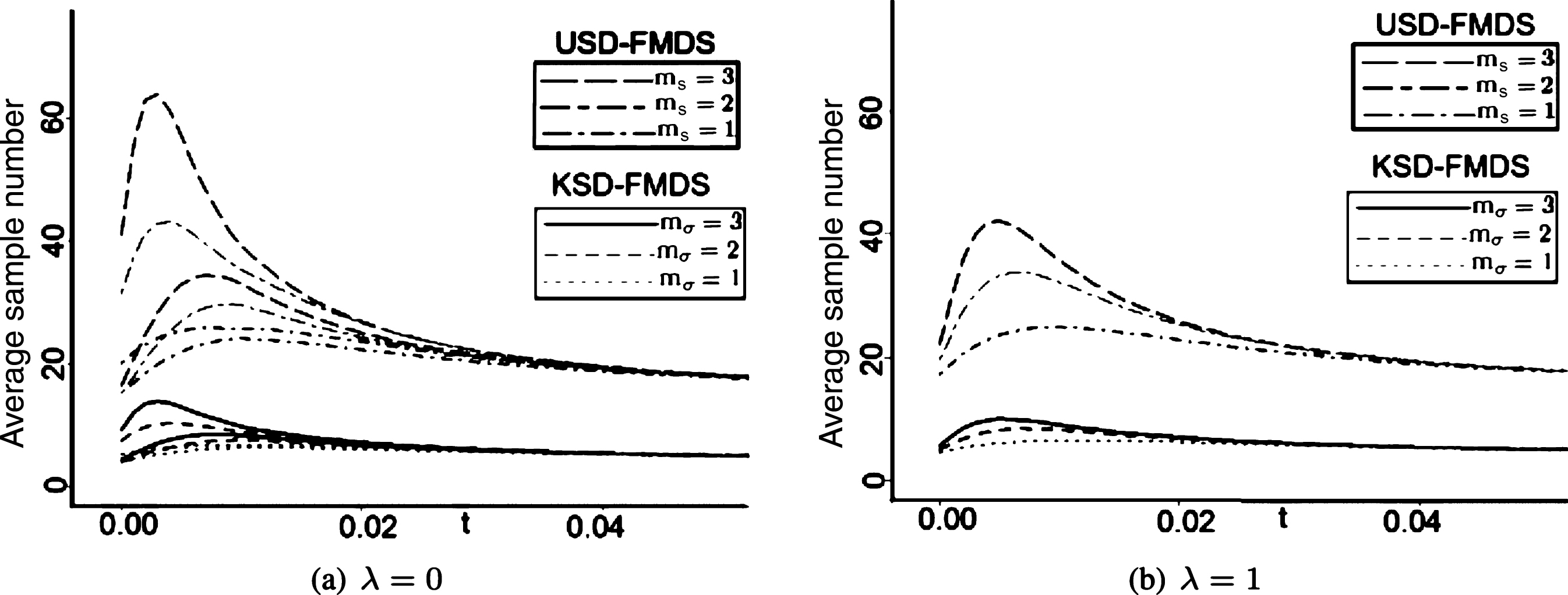
In this section, we want to make some comparisons between the proposed plan and FSSP by variable from two aspects: comparison of their average sample number and comparison of their FOC band. In order to make these comparisons, we firstly consider the operating procedure of FSSP by variable when the fraction of nonconforming items is a fuzzy number
Algorithm of operating procedure in FSSP by variable
Assume that the quality characteristic has an upper specification limit U and it follows a normal distribution with unknown mean μ and standard deviation σ. When the standard deviation σ is known, the operating procedure is as follows:
So, variable FSSP in the known standard deviation case has two parameters, namely k σ and n σ .
By using Buckley’s approach, λ-cut of fuzzy lot acceptance probability in variable FSSP for the known standard deviation case is given by:
If the standard deviation is unknown, the sample standard deviation S is used instead of σ. In this case, the plan operates similar to known-standard deviation case. In the unknown standard deviation case, the symbols k s and n s are applied instead of k σ and n σ , respectively. According to Duncan [16], Montgomery [24] and Buckley’s approach, λ-cut of fuzzy lot acceptance probability in unknown standard deviation case is obtained as:
Comparison of fuzzy ASN proposed plan with FSSP in known and unknown variance cases
In general, a sampling plan is more desirable as it has a smaller average sample number. Table 6, presents 0 and 1 cuts of fuzzy average sample number of FSSP by variable and the proposed plan in both known and unknown standard deviation cases for some selected combinations of In the standard deviation known case we have In the standard deviation unknown case we have
According to Table 6, it is clear that the proposed plan in both cases is more efficient than FSSP by variable in terms of average sample number needed to reach the same decision.
Comparison of FOC bands
In order to make a simple comparison between the proposed plan and the variable FSSP in known standard deviation case, assume that m
σ
= 2, n
σ
= 17, k
rσ
= 1.78 and k
aσ
= 2.07 for KSD-FMDS. k
σ
= 2 and n
σ
= 25 for FSSP in the known standard deviation case.
Figure 6(a) and (b) exhibit 0 and 1 cut of FOC bands of the proposed plan and FSSP. In Fig. 6, the plot of dashed and solid curves are FOC bands of FSSP and FMDS plan in known standard deviation case, respectively. According to Fig. 6, one notes that there is no big differences in the probability of lot acceptance between two plans when the proportion parameter is small or large, but at the middle part (where the proportion parameter starts to drop), 0 and 1 cuts of lot acceptance probability in proposed plan is smaller than FSSP. FOC band of the proposed plan seems to be similar to the ideal curve. We should add that the same results were obtained when standard deviation is unknown.
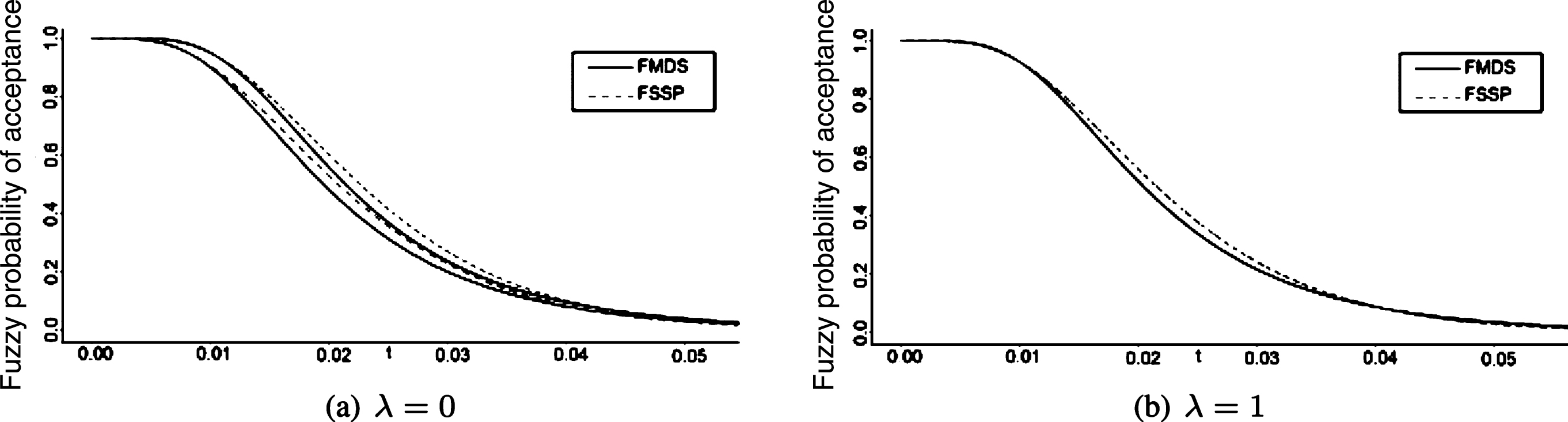
Comparison of λ-cuts of FOC band of KSD-FMDS and FSSP in known standard deviation case under λ = 0, 1.
In this paper, in order to enhance the effectiveness of the traditional MDS variable sampling plan for deciding on the manufacturing productions in a fuzzy environment, a new sampling scheme, namely FMDS variable sampling plan, was developed based on fuzzy proportion parameter for the inspection of normally distributed quality characteristics. In the proposed plan both current and forthcoming lots information are applied for decision. For practical use, tables of the plan parameters with several commonly used quality levels and risks were constructed. Also, the authors used fuzzy ASN and FOC band (curve) of the plan as measures to make a comparison between the developed plan and FSSP variable plan. The obtained results showed that the proposed plan is preferable since it is not only significantly reduces ASN compared to FSSP variable plan, but also its FOC band (curve) seems to be closer to the ideal one under the same condition. Also it was shown that the proposed plan reduces to the FSSP variable sampling plan and traditional MDS variable sampling plan under some conditions. For further directions, extensions of FMDS variable sampling plan can be developed for non-normal distributed quality characteristics. Also it can be extended by using of the process capability index on sentencing the submitted lot.