



Abstract
Selecting and developing superior industries for regional adjustment can optimize industrial structure and promote regional coordinated development, which is an inevitable choice to promote regional economic development. Forestry industry is an important ecological resource and advantageous economic industry in China. Optimizing regional forestry industry structure is conducive to promoting the formation of forestry green supply chain and forestry green circular economy. At the same time, forestry development is highly dependent on forest resources endowment and natural conditions. The eastern part of China is the southern forest region. The congenital ecological location advantage is better, which makes the industrial structure advantage and location advantage better. The central region has the advantage of national strategic policy support, but its forestry resource endowment is not strong. This paper adopts the dynamic deviation-share method to study the total amount, structure and location competitiveness of forestry industry in 16 provinces. By comparing the forestry economic structure and regional competitive advantages of provinces, the author analyzed the comprehensive competitiveness and differences of forestry development and screened out the forestry dominant industries. The results show that the northeast forest region is rich in forest resources and has a good industrial structure, but its geographical location is not good at economic development level, its development conditions are not superior, and its competitive potential is weak. The industrial structure of the western region is very poor, but the forest resources are abundant, and the ecological advantages are good, which can offset the impact caused by the inadequate industrial structure. The forestry development in the eastern region mainly relies on the development of economic forest product planting and collecting industry, flower and ornamental plant planting. It has strong competitiveness and rapid development in the field of forestry economy. This study is of great significance for improving the level of provincial forestry economic development, building green forestry economy and narrowing the gap of provincial forestry economic development.
Introduction
From the development history of the world economy, we can see that the growth and development of regional economy always depends on the exertion of its unique advantages which are different from other regions [1]. Choosing and developing advantageous industries has opened up a new way for regional adjustment and optimization of industrial structure and promotion of regional coordinated development, which has become an inevitable choice for promoting regional economic development and has gradually been attached importance to by all regions [2]. On the one hand, the formation and development of regional superior economy needs to rely on regional resources to explore the advantages of local characteristics; on the other hand, it needs to make rational allocation of various resources according to market demand [2, 3], and combine these two aspects to form relevant industries and products with competitive advantages in the market, so as to promote the integration of regional economy [4]. Through the rational allocation of regional production factors, we can select and develop the corresponding regional superior industries, and make them the core and foundation of promoting the development of regional superior economy [5]. Practice has proved that under the condition of market economy, organic combination of regional development and superior industries, based on local actual conditions, giving full play to comparative advantages and taking the road of superior and characteristic economy are the fundamental and effective ways to enhance regional economic competitiveness and achieve sustainable development of regional economy.
In the process of industrialization and economic development, the continuous improvement of regional industrial specialization has become a general feature of regional economy and national economic growth [6]. At the same time, China’s economic growth has always been accompanied by sustained regional industrial convergence. Relevant studies show that from 2005 to 2017, the number of provinces with high degree of industrial convergence in China accounted for more than 75% of all provinces [7]. Among them, the number of provinces with serious industrial convergence accounted for about 50% of all provinces, indicating that there are more provinces with industrial convergence in China. This phenomenon has always had a negative impact on the development and progress of regional economy and even on national economic construction and development [8, 9]. In the process of regional economic development, only by allocating superior resources to high-efficiency and competitive industrial sectors, cultivating and developing regional superior industries, can regional competitive advantages be formed and regional economic advantages be strengthened. Therefore, how to scientifically and reasonably select and determine regional superior industries, and attach importance to, cultivate and support them, has become the primary topic of regional economic development. In the region represented by a province in an administrative region, the development of its regional economy is the result of the comprehensive function of many industries [10]. For regional development, how to select and develop regional superior industries, give full play to regional comparative advantages, and ultimately form regional superior economy according to the conditions of regional resources, economy and society is of great importance. Within a larger region, there are many advantageous industries based on the regional advantageous conditions [11–13]. Forestry, as an important part of the regional industrial structure, has its specific significance in selecting and developing the advantageous forestry industries.
The main contribution of this paper is to using dynamic deviation-share method to study the total amount, structure and location competitiveness of forestry industry in 16 provinces. By comparing the forestry economic structure and regional competitive advantages of provinces, the author analyzed the comprehensive competitiveness and differences of forestry development and screened out the forestry dominant industries.
This paper is organized as follows: The related work is introduced in Section II. Fuzzy comprehensive evaluation method and hierarchical data and analysis in section III. Competitiveness of forestry industry and estimating method in section IV. Dynamic deviation-share empirical study of forestry tertiary industry in section V. Finally, Conclusions are given in Section VI.
Related work
At present, the main ways for major forest product producers to promote the development of forestry industry are to participate in international trade, promote the international allocation of forest resources, and enhance the international competitiveness of forestry industry through the trade of forest products and overseas direct investment in forestry industry [14]. Therefore, the research on forestry industry mainly focuses on the conditions and market issues of forest products trade [15, 16]. This paper mainly analyses the market conditions, prices, business strategies, forest products certification and other forestry micro-enterprises and forestry industry policies at the meso-level from the perspective of microeconomics. Stewart et al. (2009) used the econometric model to analyze the agricultural and forestry industrial agglomeration in 447 economic regions of Tennessee and the economic growth brought by industrial agglomeration [17]. Marchak et al. (201 1) took the development process of forestry industry in BC Province of Canada as an example to analyze the impact of social, political and economic factors on forestry development [18]. Roos et al. (2013) from the perspective of international cooperation, discussed how forestry industry can carry out transnational cooperation through joint ventures, strategic alliances and other forms in order to further enhance the internationalization of forestry industry [19]. At the same time, the forestry industry sector needs to maintain the competitiveness of the industry by improving research and development capacity, innovation capacity and commercialization [20, 21]. Through literature search and collation, we can see that foreign scholars’ research on regional superior industries mainly focuses on the comparative advantages, competitive advantages, regional division of labor and industrial development of different regions and industries. Foreign research on forestry industry mainly focuses on the conditions and market issues of forest products trade, mainly from the perspective of microeconomics to analyze the market conditions, prices, business strategies, forest products certification and other forestry micro-enterprises, involving the research on the whole forestry industry level [22, 23]. It mainly concentrates on sustainable development of forestry, forestry industry cluster, selection of forestry leading industry, regional competitiveness of forestry industry and forestry industry policy [24]. From the point of view of research methods, there are both qualitative analysis and quantitative analysis. Quantitative analysis methods are mainly used to analyze the agglomeration of forestry industry, the contribution of forestry product processing industry to the region, etc [25, 26]. Qualitative analysis methods are used to analyze the market environment of forestry products, the management strategy of forestry enterprises, and the impact of forest certification.
From the point of view of research methods, there are grey relational degree models, etc [27]. But only the data at the beginning and end of the research period are used in the research, and the continuous changes of industrial structure and regional competition in the research period are not taken into account [28]. It is not enough to refine the research period to every year, to carry out the longitudinal comparison between years, to carry out the horizontal comparison among provinces and regions, and to expose it [29]. The dynamic deviation-share method can solve this problem. Therefore, in order to avoid static deviation-share analysis considering only the development of forestry industry at the base and the end of the research period, and not the development of forestry industry in the middle years, this study uses dynamic deviation-share analysis method to refine the research period to each year and show the dynamic changes of forestry industry development year by year [30, 31]. In order to scientifically reveal the changing rules and trends, the horizontal and annual longitudinal comparisons between provinces and regions are made.
The proposed methodology
Fuzzy comprehensive evaluation method
(1) determine the evaluation factors and evaluation levels
Set U = {u1, u2, ⋯ u m } as an evaluation factor set, where m is the number of evaluation factors.
V = {v1, v2, ⋯ v n } for the rating set, where n is the number of reviews.
(2) Structure evaluation matrix
First, the single factor fuzzy evaluation, from the factors u i (i = 1, 2, ⋯ m), the factors of the evaluation degree v j (j = 1, 2, ⋯ n) of membership, so that the first factor to draw a single factor evaluation set r i = (ri1, ri2, ⋯ r in ).
A total evaluation matrix R is constructed.
Among them, r ij it is indicated that the evaluation object can be judged as the degree of membership v j .
(3) Calculation of membership degree
The formula (1) can be used to calculate the membership value:
The bigger the indicator value, the better:
The smaller the indicator value, the better the situation:
In the formula, u
i
as the characteristic value, r
ik
is the form the membership degree of the fuzzy relation matrix, the fuzzy relation matrix is obtained, which is not enough for the evaluation of the things. In the evaluation of factors, each factor in the “evaluation objectives” in the possession of a different weight. Therefore, it is needed to give the weight distribution of evaluation index, that is A = (a1, a2, ⋯ , a
m
), a fuzzy subset on a given U:
Comprehensive evaluation score:
In the association rules in a binary representation of the calculation patterns of redundancy, if the transaction attribute with multiple values and must be exclusive, or convert the transaction into binary sequence will be the number of transaction attribute values directly into binary representation appear redundant probability is bigger [32, 33]. Because certain concept level itself very is possibly big, the description concept string of character possibly very is also long, like this, the direct concept retrieval possibly must spend the very much time to process the core page exchange, and moreover, the memory concept level also needs many spaces [34]. Therefore, this article proposed newly one kind is suitable for the data mining function general code method, in such of level partial ordering relations may indicate by the code, when data mining so long as the processing level code might and solve the memory and the retrieval question effectively. Hierarchical evaluation system as shown in Fig. 2.
In the formula one, we demonstrate the objective function for the model, where the c (x
k
) + ∇ c (x
k
)
T
d ≤ 0, h (x
k
) + ∇ h (x
k
)
T
d = 0, denotes the restriction term. OWN way according to their control of the data, the level of the file can be divided into multiple data segments, can to control good data segments are divided into management, OWN can also be for the first time divides the data segment, according to the need of some one or a few second division, so as to realize finer division that can be divided into many times, this has been on file in order to achieve fine granularity partition as much as possible. Accordingly, the problem is then transferred into the formula 13.
Each leaf node (that is, last non-divided minimum data segment) has two kinds of permissions to read and write. Each non-leaf node also has two primary kinds of permissions to read and then write. If the OWN needs to divide the data segment under the core sub-non-leaf node Different read and write access control, then the non-leaf node access permissions are empty, if the non-leaf node read and write permissions are granted, then the node below the division of all the data segments have access to this authority based on the following function.
The algorithm is based on the logical structure of the file stored in the physical memory. Each data segment in front of the file will have a file data segment header used to store some of the attributes of the data segment. For the better presentation of the model, we denote the listed formula 15 and 16 as the prior information.
The access rights of the different roles are grouped into a table, while the user is assigned a role, and then according to the assigned role to then get the appropriate access to the need to maintain multiple access control “ability table.” In this paper, data segment access control through Access control codes are broken down to gain access to data segments and access rights, eliminating the need to create and maintain “capabilities tables” that can be defined as the listed perspectives, respectively.
Which collect the names of all the different string in a b-tree way index, as the name of each different name string by name identifier uniquely identifies the index return. Use the name comparison between the index that avoids the repeated strings as can reduce the computation and storage costs to a minimum.
The main idea of the path join algorithm is to decompose a complex path expression into several of the simple path expressions. Each expression produces an intermediate result that can be used at a later processing stage, and then combine these intermediate results up to get the final query results as follows.
This innovation method proposed which in the XISS system (processing had regular way expression inquiry) to overcome has possibly requested based on in the tree traversal traditional method in the XML data tree to search more spatial the flaw, this method decomposed a complex way expression into the general base book way expression set. The Fig. 1 shows the sample.
Hierarchical data overview.

Hierarchical evaluation system sample.
Tourism resources evaluation is well divided into the quantitative evaluation and the qualitative evaluation two kinds. Qualitative evaluation is mainly according to the actual experience of evaluators of the general nature and characteristics of the tourism resources, quality, function, etc., for the description and analysis on the text. Because qualitative evaluation and evaluators of work experience, the feeling and mood has a lot to do at that time, as the evaluation results with a greater degree of subjectivity, different evaluators or the same evaluators may vary in different environment evaluation and chestnut. Distribution of forestry resources as shown in Fig. 3.

Distribution of forestry resources in China.
As shown in the Fig. 4, we discuss the hierarchical evaluation system sample. We believe that in the general determination of the weight, the use of analytic hierarchy process is more appropriate. This is because the analytic hierarchy process to a complex problem expressed as an orderly hierarchical structure, through two comparison, judgment, calculation, easier to determine the weight of the index, especially when the number of indicators or sub-index system is less, while the fuzzy comprehensive evaluation is in a fuzzy environment taking into account the impact of a variety of factors, for a purpose to make a comprehensive decision on things.
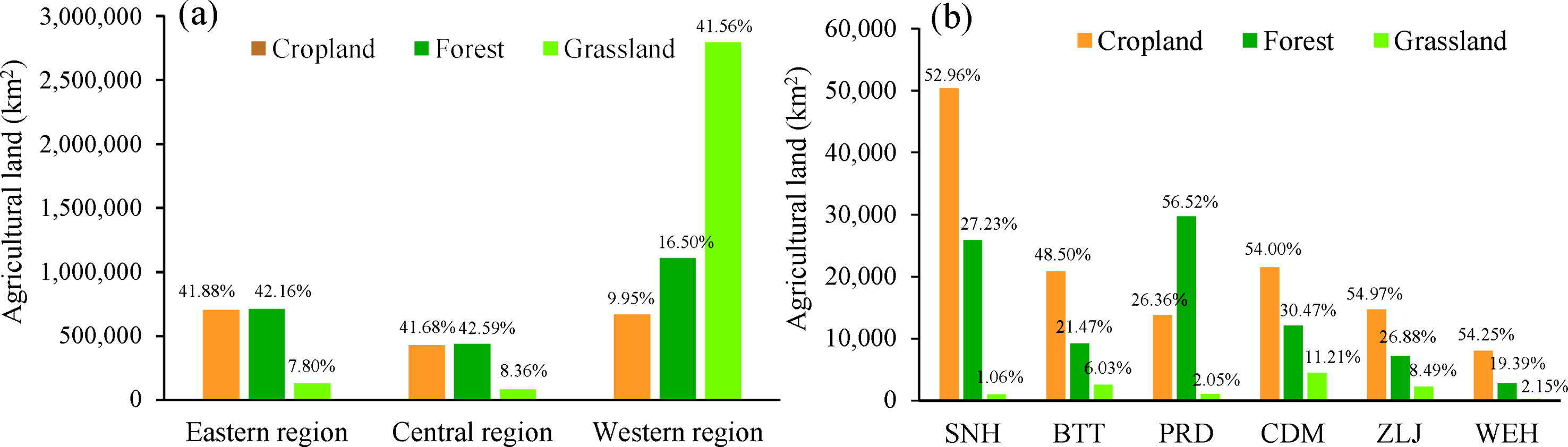
Forestry industrial structure in different regions.
Current situation of competitiveness of forestry industry
Forestry industry plays a fundamental role in the development of national economy, and at the same time it has a special regulating role in the construction of ecological environment. This paper analyses the characteristics of forestry industry and the current situation of regional development of forestry industry in China, finds out the main problems existing in the development of forestry industry market, and makes an in-depth study on the causes of these problems. The premise and foundation of industrial regional competitiveness. The planting and collecting of economic forest products account for an absolute proportion (59.03%) of the forestry-related industries in the primary industry. Therefore, economic forest is the main economic source in the primary industry of forestry in China, followed by the planting of flowers and other ornamental plants. Although the planting of flowers and other ornamental plants started late, its industry has begun to take shape at present. Its industrial output value accounts for 10.40% of the forest-related industry in the primary industry of forestry industry in China. With the improvement of quality of life and the increase of demand, flower planting industry has broad prospects for development. The cultivation and planting of forest trees account for 8.16% of the forestry-related industries in the primary industry of China’s forestry industry. Forestry breeding and seedling raising can be divided into two aspects: forestry breeding and forestry seedling raising. The proportion of the scale of the two industries is 8.82% and 91.18, respectively. Forestry seedling raising accounts for a higher proportion and policy driving is obvious. Wood and bamboo account for 77.34% of the collection and transportation of timber and bamboo, and the collection and transportation of bamboo account for a relatively small proportion. This is due to the limitation of the output area. The main production of bamboo in China is in the south, but also reflects the policy orientation. Because the ecological environment effect of forestry industry is becoming more and more important, and in recent years, the state has issued policies to restrict deforestation, resulting in a decline in the overall development rate of industries that rely on timber resources.
From the point of view of industrial structure, with the strengthening of forestry ecological function and the external non-economic nature of forest processing process, the whole industry is facing the problem of capacity upgrading. The distribution of forest resources in China is unbalanced, that is, there are more forest resources in the southwest, middle-south and northeast regions, accounting for about 70% of the total forest resources in China. The forest resources in North China and East China are equal, accounting for 15% of the total, while the forest resources in Northwest China are less than 15%. According to the detailed report of the eighth Forestry Inventory data, the forest resources in southwest China account for 29.17% of the total forest area in China. Sichuan and Yunnan are the two provinces with the most abundant forest resources, accounting for 8.4% and 9.3% of the whole country, respectively. This is because southwest China is close to Southeast Asia. In the subtropical monsoon climate, the annual rainfall is more, so the trees grow faster, resulting in the largest forest coverage in the country; the forest area in the central and southern region accounts for 21.77% of the country; the geographical characteristics of the central and southern region are mainly hills and intricate River systems, which has created lush forests, of which Guangxi is the most important. The forestry industry in Heilongjiang Province is well developed, up to 6.4%, and the proportion of forests in other provinces is less than 5.0%. By contrast, the forestry resources in Northeast China are relatively rich and the quality of forests is high. The forest area in Heilongjiang Province alone accounts for about 10% of the whole country. The forest area in North China accounted for only 15.79% of the total forestry in China, while the forest resources in East China did not dominate the whole country, only 15.45% of the whole country.
Overall, China’s forest resources are exhausted, so to develop the forestry industry, we need to find a new way. Through modern science and technology, relying on regional economic development, we should vigorously develop the secondary and tertiary industries of forestry. In view of the environmental conditions in Northwest China, we should mainly cultivate and cultivate forests, and exploit and use them appropriately.
Model building and estimating method
The dynamic deviation-share method is the extension and expansion of the static deviation-share method. It regards the development of a certain regional economy as a dynamic process, expands the research time year by year, and takes its superior region or the whole country as a reference frame. The total Gi of its own industrial growth can be decomposed into the national share component Ni, knot. The structure deviation component Pi and the competitiveness deviation component Di are used to evaluate the strength and weakness of regional industrial economic structure and competitiveness and to identify industries with relative competitive advantages. Its basic form is:
where bij,0 is the economic variable value of base period in i region j industry and bij,t is corresponding variable value of the reporting period, Bj,0 and Bj,t is the corresponding variable value of higher level region, N
ij
is regional growth deviation share, P
ij
is industrial structure deviation share, D
ij
is competitive power deviation share and the sum of the three share is regional economic variable growth value (G
t
). By introducing homothetic concept variables, the competitiveness component (D
ij
) of the traditional shift-share model (composed of three effects) is decomposed into pure competitiveness component (
When the Esteban model is used to analyze the output values of forestry industry and its sub-industries, the model is expressed as:
This study mainly considers the following three factors when choosing samples: (1) China’s provincial forestry resources endowment is quite different, and it is difficult to give consideration to 31 provinces and regions of the whole country, and it is not significant to study some provinces with unknown forestry characteristics or Shaolin, such as Beijing and Tianjin, so this study excludes the selection of forestry resources endowment in these regions. Given strong provinces and regions; (2) Considering the east, middle, West and northeast of China, this study chooses as many provinces as possible that can represent these four regions as samples and the number is relatively average; (3) Because of the inconsistency of statistical caliber, unit and scope, many indicators are difficult to quantify, and at the same time, some provinces lack of indicators data. The provinces with strong data availability and less missing data are selected as samples. Dynamic deviation of internal structure of forestry Industry and different level as shown in Tables 1–4.
Dynamic deviation of internal structure of forestry Industry-Empirical study of share
Dynamic deviation of internal structure of forestry Industry-Empirical study of share
Dynamic deviation-share of internal structure of forestry primary industry
Dynamic deviation-share of internal structure of forestry secondary industry
Dynamic deviation-share of internal structure of forestry tertiary industry
Dynamic deviation-share empirical study
The calculation process of Gi, Ni, Pi, Di and PDi values of three forestry industries in 16 provinces in recent seven years is listed. At the same time, the empirical results of dynamic deviation-share of three forestry industries and their internal industrial structure are obtained. Jilin and Heilongjiang are the forestry areas in Northeast China. They are rich in forest resources and have a good foundation of forestry industrial structure, but their geographical position is in Northeast China. Their development conditions are not superior, and their competitive potential is poor.
Analysis of location competitiveness
The average of Pi <0 in 16 provinces indicates that their forestry primary industry lacks the advantage of industrial structure. PDi <0 and according to the order of PDi from big to small is Hunan, Hubei, Inner Mongolia, Jilin, Guizhou, Heilongjiang, Yunnan, Hainan, Sichuan, Guangdong, Jiangxi, Liaoning, Fujian and Zhejiang. The growth rate is slower than that of the whole country and needs to be promoted by the whole country. Although some areas are northeast forest areas, southern collective forest areas and large forestry provinces, they overemphasize the development of secondary and tertiary industries while neglecting the development of primary industry, or because of geographical location, they have no conditions for the development of primary industry, such as Guizhou, Sichuan, etc., or they pay attention to the development of forest industry and attach great importance to basic forestry. Some of them belong to the western region. The poor forestry base and the fragile ecological areas lead to the poor forestry basic industry, which leads to the slow development of the primary industry.
In the secondary forestry industry, the growth rate of 16 provinces is higher than that of the whole country and they all have the advantages of industrial structure. Guangxi, Jiangxi, Anhui and Yunnan are the dominant industries. In the secondary forestry production of Guangxi, Anhui and Yunnan, the dominant industries are wood, bamboo and rattan furniture manufacturing, non-wood forest products processing and manufacturing. In the second forestry production of Jiangxi, the dominant industries are wood, bamboo and rattan furniture manufacturing and non-wood forest products processing. Wood, bamboo and rattan furniture manufacturing is a dominant industry. In Guangxi, Jiangxi, Anhui, Yunnan and Hubei, PDi >0 and decreases in turn. The growth rate of secondary production ranks low, and the dominant industries are not secondary production but tertiary production. However, the dominant industries in secondary production are non-wood forest products processing and wood, bamboo and rattan furniture manufacturing. The growth of forestry chemical products manufacturing is the slowest, and the competitiveness of secondary industry is the lowest.
Forestry tertiary industry: 16 provinces Pi >0, the growth rate is higher than that of the whole country and has the advantage of industrial structure. Guangdong, Hunan, Anhui, Guangxi, Hubei, Guizhou, Fujian and Yunnan take it as the dominant industry; Guangdong’s forestry tertiary industry takes forestry professional technical services as the dominant industry, Anhui, Guangxi, Guizhou and Yunnan as the dominant industry. Fujian’s forestry tertiary industry takes forestry tourism and leisure service as its dominant industry, Hunan’s forestry tertiary industry takes forestry ecological service as its dominant industry, Hubei’s forestry tertiary industry takes forestry public management and organizational service as its dominant industry, and Yunnan’s forestry tertiary industry takes forestry ecological service and forestry public management and group as its dominant industry. Weaving service is a dominant industry. Further screening of forestry superior industries in various provinces shows that Guangxi has superior industries, followed by Anhui, Guizhou, Hubei, Hunan and Yunnan, Heilongjiang, Guangdong and Sichuan, Zhejiang, Fujian, Jiangxi, Hainan, and finally Inner Mongolia, Liaoning and Jilin.
Conclusions
In this study, we used dynamic deviation-share to clarify the advantages of forestry industry in the east, middle, West and northeast of China, three times and internal industrial structure, location competitive advantage and comprehensive competitiveness, and screened out the dominant forestry industries. We can draw the following conclusions. The development of China’s forestry industry is insufficient, showing the phenomenon of “the middle is more important than the two ends", which is not conducive to the formation of forestry green supply chain and forestry green circular economy. Forestry secondary production is the fastest growing, followed by primary production and tertiary production is the slowest. The shortage of primary production will lead to insufficient supply of raw materials. The shortage of tertiary production will not be able to utilize resources effectively in time, reduce energy consumption and pollution, will destroy the ecosystem, and is not conducive to the construction of green circular economy and green supply chain in forestry. Forestry development is highly dependent on forest resources endowment and natural conditions. Forestry in eastern China grew fastest, followed by central China and Western China. The eastern part of China is the southern forest region. The congenital ecological location advantage is better, which makes the industrial structure advantage and location advantage better. The central region has the advantage of national strategic policy support, but its forestry resources endowment is strong and fewer provinces, which also reduces its forestry development. The western region is ecologically fragile and economically poor, with the weakest development. The competitive advantage of forestry industry structure and location shows a cyclical trend. The type of forestry industry has changed from growth type to recession type to growth type. Managers should accurately distinguish the life cycle of forestry industry and its advantages and take corresponding measures to ensure the healthy development of forestry industry. As far as the east, middle, West and East are concerned, the effect of location competition is greater than that of industrial structure.
The dynamic deviation-share method adopted in this study includes five indicators: Gi, Ni, Pi, Di and PDi, each of which has a specific meaning. The indicators are few but can fully reflect the reasons for regional industrial economic growth. The changing trend of each year can be clearly reflected. This method will examine the period in detail. The static method only chooses 2-year data of base period and reporting period, but it cannot study the process of intermediate change in depth; it does not need to select other indicator variables, and there are already five conventional indicators, namely Gi, Ni, Pi, Di and PDi. Need to calculate according to the algorithm, to avoid the subjectivity problem caused by the selection of other indicators. In addition, there are many advantages in forestry economic development. This study only chooses two factors of industrial structure advantage and regional competitive advantage to analyze. It is impossible to list all the comprehensive advantages of forestry industry economy. However, it is important to understand whether they will interact with each other and what kind of impact they will have. If they have an impact, then another model should be established to study the interaction between the two factors. Some provinces have both the advantages of forestry industrial structure and forestry location. Whether the interaction between the two will have an impact on the development of forestry industry economy, what impact will it have, and what is the mechanism of the interaction with the development of forestry economy, which is also the direction to be studied in the next step.