



Abstract
Music education plays a particularly important role in China’s existing education systems at all levels. With the development of Internet of Things (IoT) technology, interactive teaching methods are more and more widely used. Therefore, a piano teaching system model design algorithm is proposed based on the IoT technology to design the function of the piano teaching system, which is of great help to improve the quality of piano teaching. The current mature technical framework and development language are compared, the key technologies of the IoT using the system architecture is determined, and the structural design methods of the piano teaching system analyzed, mainly using the SSH framework (ie Stmts, Spring and Hibernate’s model, based on this paper, a model design algorithm is proposed for building a piano teaching system based on the IoT technology. Finally, the algorithm and system are tested and implemented through experiments. The research results show that the algorithm uses the hardware underlying direct control development method, with an average scan of 12 times in 0.3 s, the recognition probability can be increased to 0.999719, the algorithm is effective, and the designed piano teaching system is fully functional. The research in this paper provides a theoretical reference for the wide application of IoT technology and the optimal design of piano teaching system.
Keywords
Introduction
The traditional piano teaching management is mainly based on manual methods, and there are problems such as inefficient management and chaotic management, which seriously restricts the development of piano teaching activities [1]. In the context of the IoT, computer technology and information technology have achieved faster development. The IoT information technology has been applied in piano teaching. Due to the limitations of teaching methods and universality, the construction of piano teaching information is still in its infancy, and currently Most existing piano teaching systems are based on the C/S architecture [2]. The current status and problems of the development of piano teaching information is analyzed, the piano teaching system is studied based on IoT technology, and the design scheme of piano teaching management system is proposed. In the context of the IoT, in the construction of the piano teaching management system, in order to improve the teaching activities and teaching progress for each teaching administrator and students, the B/S architecture must be used when constructing the system [3]. When designing the system structure, it is necessary to ensure the stability, safety and scalability of the system structure. The use of excellent framework technology and structure plays an important role in the stable operation of the system. In-depth analysis and research are needed when designing the system [4].
The IoT technology connects information to the Internet through information-sensing devices such as radio frequency identification, infrared sensors, global positioning systems, laser scanners, gas sensors, etc., in accordance with agreed protocols, for information exchange and communication. A network intelligently identifies, locates, tracks, monitors, and manages [5]. In many current computer systems, the IoT plays an important role. The piano teaching system in this paper introduces the IoT technology. When the piano teaching management system is implemented, the MVC design idea is used as a guide, and Struts is used as the program control view. The presentation control component adopts Spring as the business logic processing control component and Hibernate as the data access model, which not only realizes the sharing of data coupling between piano teaching data display and business processing, but also realizes through B/S application. The openness of the piano teaching management system is made [6].
This paper is divided into three parts. The first part summarizes the research literature of piano teaching system based on C/S architecture and B/S architecture mode. The second part proposes the piano teaching system model design algorithm based on IoT technology. The piano teaching management system is realized by the idea of the current mature SSH framework and MVC mode. The third part verifies the effectiveness of the algorithm through experiments, and verifies that the implemented system has high cost performance and improves the efficiency and science of piano teaching.
Related work
Since computer application technology originated in the West and was first applied, computer-based piano teaching software was first launched and applied in the West, and in the process of development, it has provided a new piano learning path for the majority of piano hobbyists. Many scholars have studied this. Singh J proposed that during the development of the piano teaching system software, it also experienced a number of different processes, and along with the development of information technology, the piano version of the current popular B/S mode was finally formed from the original desktop stand-alone version. Since the piano teaching software based on the B/S mode can bring a better learning experience to the piano learners, the piano teaching software based on the B/S framework has achieved good development [7]. Zhu L believed that through the application of the stand-alone version of the piano teaching software, although it can assist the piano learners to learn relevant knowledge to a certain extent, but because the stand-alone version of the piano learning software system is not easy to update and difficult to share learning materials, it is not To a wide range of applications [8]. Nitti M et al. proposed that the gradual emergence of C/S mode network application system has promoted the development of piano teaching software, and gradually formed some piano teaching software based on C/S mode. Scholars have adopted C/S mode. The piano teaching software is researched and believes that this type of software will dominate for a long time [9]. Wang YPE et al. proposed that because the new piano teaching software based on C/S mode can not only realize network application, online sharing of piano learning materials, but also provide a more optimized piano teaching experience, so it is based on C. The /S mode piano teaching management system has become the main system of piano teaching, and it has also influenced piano teaching for a long time [10]. Sim S et al. proposed a user information Web service discovery system based on the IoT, which uses the collaborative recommendation algorithm to recommend information that meets their needs. The system is also suitable for teaching and can achieve good results [11]. Kang H et al. proposed an intelligent teaching file sharing software based on the level of teaching facilities, using the IoT technology to automatically identify the teaching facilities, thus judging the appropriate e-learning method, which provides a huge amount of piano teaching in different environments [12]. Friansa K et al. developed an IoT based instructional monitoring system that monitors the teaching process during piano teaching and effectively manages the teaching process [13]. Hwang H C et al. proposed a reliable message transmission system based on MQTT protocol, which can be used in teaching to effectively transmit teaching information and facilitate feedback on teaching conditions [14]. Hongtao LI et al. researched the digital virtual community, and the proposed digital virtual community based on the IoT can also be applied to the construction of piano teaching virtual community, which is helpful for teachers and students to communicate and facilitate follow-up teaching progress [15].
All in all, with the continuous development of computer technology, people gradually find that the management of piano teaching software based on C/S mode needs to be carried out simultaneously on the server side and the client side, which seriously affects the piano learning experience of the client users, so it has gradually begun to study. Some of the new piano teaching software, based on the most famous piano teaching software based on B/S mode, because it combines the latest mainstream design patterns with the piano teaching and uses browser components with unlimited access. In addition, it provides a better learning experience for piano learners, so the research of B/S based piano learning software system has gradually become a hot research direction in China [16–18].
Iot technology and piano teaching system design algorithm
IoT technology based on system design architecture
The IoT technology is to solve the mutual mutual perception, mutual communication and mutual control before the object and the object. Therefore, the IoT technology meets the two requirements of the data collection and instruction execution of the fourth generation management system. In addition, the IoT technology is often used in the customer’s architecture design, thereby reducing the processor cost of the physical end [19, 20]. The IoT technology moves the complex computing work to the cloud for processing. The physical end only provides basic data to the cloud and executes cloud commands. In the IoT system, in order to be able to perceive the behavior of teachers and students, it is necessary to add the identification methods available to the IoT technology to teachers or students. Based on the basic idea of IoT technology, the IoT system is usually divided into three layers or four layers. The three-tier architecture is divided into the sensing layer, the network layer, and the application layer. The four-layer architecture strengthens the hardware facilities of the sensing layer and is divided into sensors, sensor networks, network layers, and application layers. In this design, each sensor does not form a sensor network, but directly sends the data to the cloud application layer, so the three-layer architecture of the IoT system is selected. In this design, the sensing layer perceives the basic behavior data of people or objects, the network layer passes the data to the application layer, the application layer receives the data, processes and processes them to form various instructions, and the network layer sends the application layer instructions to the sensing layer, and the layer’s hardware system executes the application layer instructions. Therefore, in the three-tier architecture of the IoT, the application layer is regarded as a high-rise cloud, reflecting the wisdom of the entire system. Excellent cloud computing capabilities will make the IoT system more intelligent.
Teaching system structured design method
The application and development of the piano teaching management system is not only simple to complete the design of the system and put into practical application. In the current rapid development of information technology, the ultimate goal of the demander is to obtain information of convenience, real-time and reliability. Therefore, the realization of the piano teaching management system also needs to meet the needs of modernization. The specific requirements are as follows: During the use of the piano teaching management system, it is highly possible to adjust the demand, so the demand is constantly changing in real time. In order to make the application of the original function unaffected under the adjustment of the new function, the system needs to be well scalable to meet the constant adjustment of the demand. The most concerned about each university is the efficiency problem, which is also the most direct experience of the use of personnel on the system. Therefore, in the process of implementing the piano teaching management system, the system needs to be in the first time for the command request made by the system user when implementing the function. Respond internally and try to avoid the lengthening of the response time, so that the user’s experience is enhanced. In order to make the design and implementation of the system to maximize the convenience of piano teaching management, this requires that the piano teaching management system designed and implemented in this paper must fully investigate the needs of all aspects of piano teaching management. Based on the function design of the system and the improvement of the matching between the functional modules can meet the needs of piano teaching management, providing technical support for piano teaching management and improve the quality of piano teaching management in universities or training institutions. The realized piano teaching management system must have sufficient stability to ensure the good operation of the daily management of the university and to ensure that the system collapse does not occur.
The structured method is more traditional, mainly including three types, namely structural analysis, structured design and structured programming. The idea of structured design is to divide a more complicated system problem into several sub-problems, and then solve each subsystem separately, and then integrate the solution results of each sub-question to form the solution result of complex problems. In the structured design approach, using top-down design ideas, every solution process needs to be refined. Based on the most basic foundations and principles, combined with practical experience, the solution process of complex problems is determined. In the process of solving complex problem decomposition, the main technical methods used are structured time language, data flow graph, decision table, data dictionary, etc., to ensure that the interpretability of system problem solving is strong enough. The structural design method needs to follow the following principles in solving the problem: each function module in the designed system only needs to implement one function or a series of similar functions; the system function modules are called by using the process design language. The data exchanged between functional modules can be directly used as data, ensuring the independence between system function modules, the amount of functional information between modules minimized.
Algorithm for designing piano teaching system based on IoT technology
When implementing the piano teaching management system, the SSH framework is used (ie Stmts, Spring and Hibernate) mode. The SSH framework divides the system into four different levels. The most basic is the presentation layer of the system. The presentation layer of the system uses the Stmts framework. The framework used by the system’s business logic layer is the Spring framework. The framework used by the system’s persistence layer is the Hibernate framework. The final level of the SSH framework is the module layer. At these levels, Stmts is the basic part of the system. Struts can separate the model, view, and controller, that is, the separation of MVC, and connect to the database through JDBC, so that the operation of the database is more persistent. Spring plays a central role in supporting the business logic layer, reducing the degree of coupling between modules within the system and increasing the cohesion between system modules. Aiming at the functional requirements analysis and non-functional requirements analysis of the piano teaching management system, the design and implementation of the system provides a convenient, efficient and reasonable platform for the piano teaching management department to improve the scientific, electronic and scientific management of teaching management. In the design of the piano teaching management system, it is necessary to provide six functional modules, namely the student information management module, the teacher information management module, the course information management module, the class information management module, the class information management module and the system maintenance management module. The function module in turn contains several sub-function modules. Figure 1 shows the detailed functional structure of the piano teaching management system.
Detailed function structure of piano teaching management system.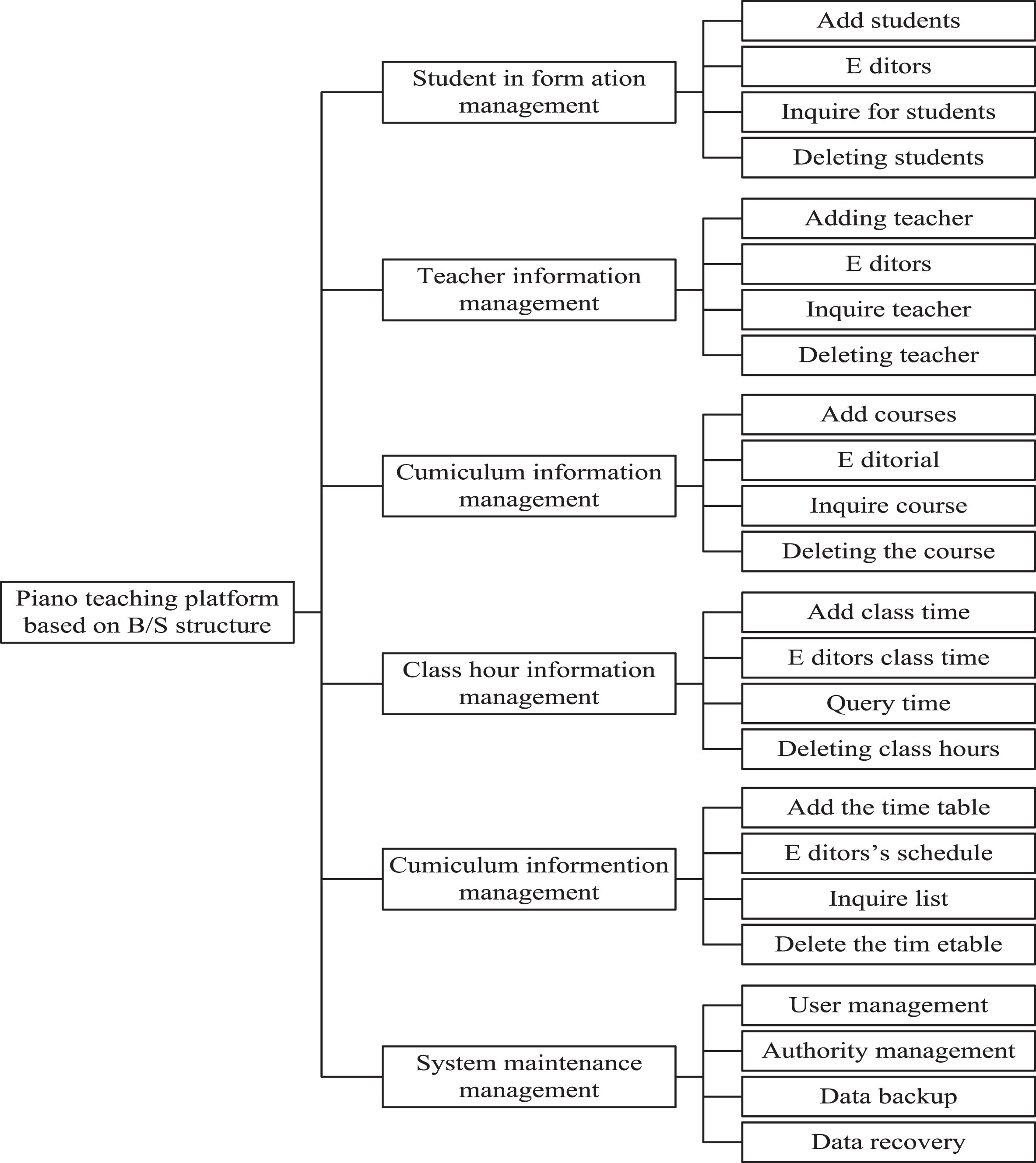
According to the detailed functional structure diagram of the system shown in Fig. 1, the IPO of the system is shown in Fig. 2.
Total IPO diagram of the system.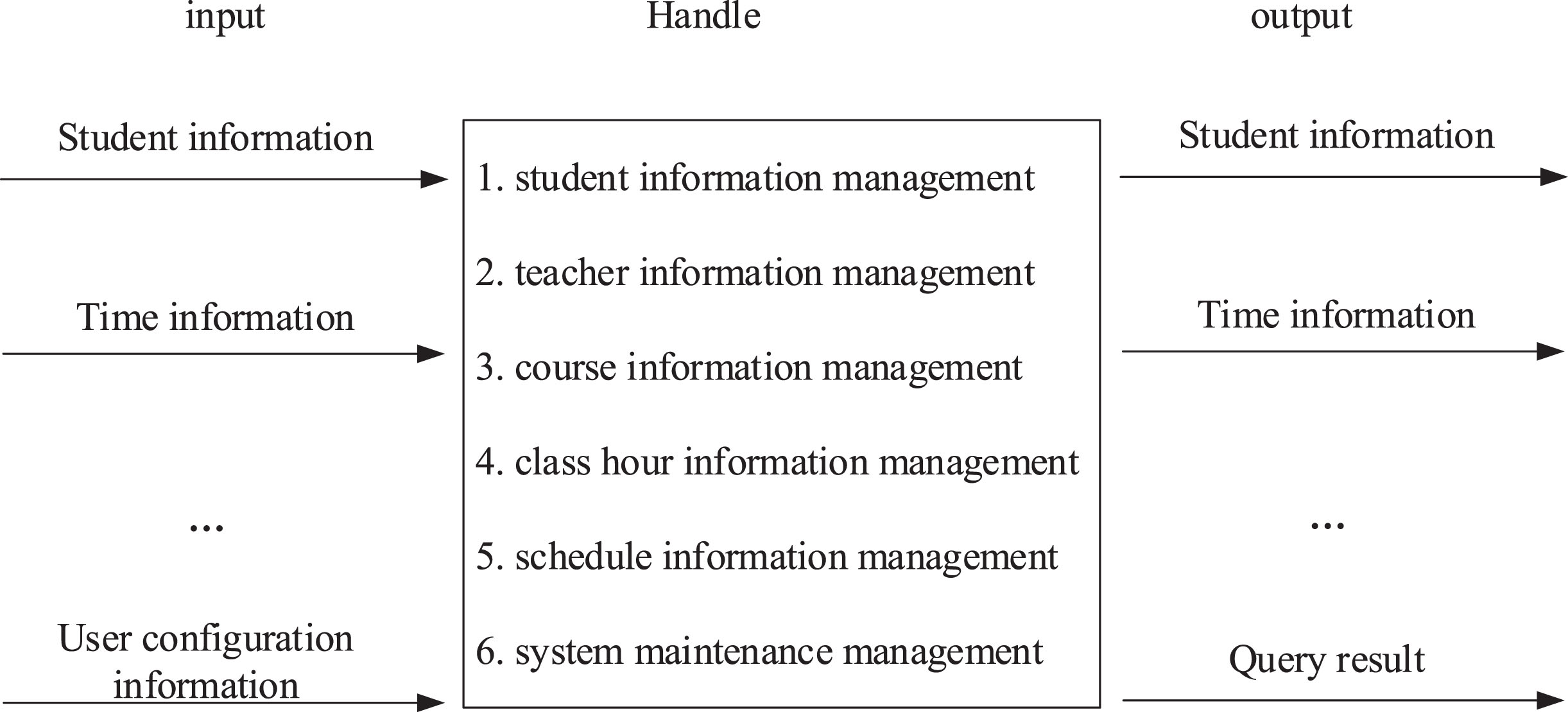
In the UHF band, the RFID system can recognize the distance as far as 10 m to 15 m. Therefore, many RFID cards will appear in the RF energy region. These RFID cards have the same response frequency, all of which are 915 MHz, so long-distance RFID systems will occur. The common collision phenomenon affects the recognition efficiency of the RFID system. Therefore, the long-range RFID reader is designed with anti-collision algorithm. The latest generation of UHF band RFID reader uses the “fixed frame time slot ALOHA algorithm". By modifying the “Q value” parameter, the reader can be adjusted in one. The number of time slots opened in the scan frame. The FSA algorithm is simple and easy to implement, but the conflict time slot and the idle time slot cause the recognition efficiency of the system to decrease. The total number of time slots of the card reader frame scanning period is N, and the total number of external RFID cards is m. The probability of having x RFID cards in one time slot in the frame scanning period is subject to the binomial distribution:
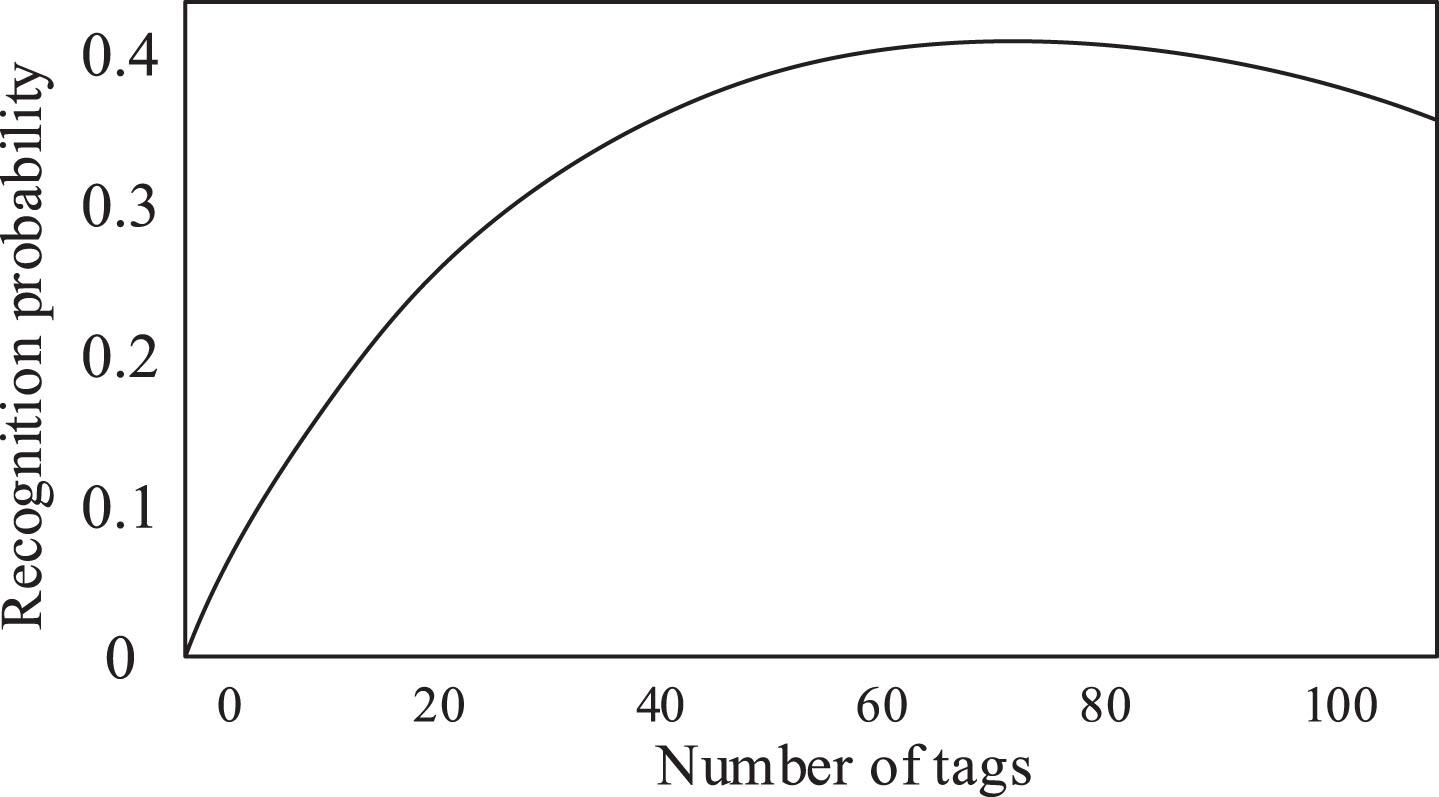
Recognition efficiency chart of frame time slot is 256. Recognition efficiency chart of frame time slot is 64.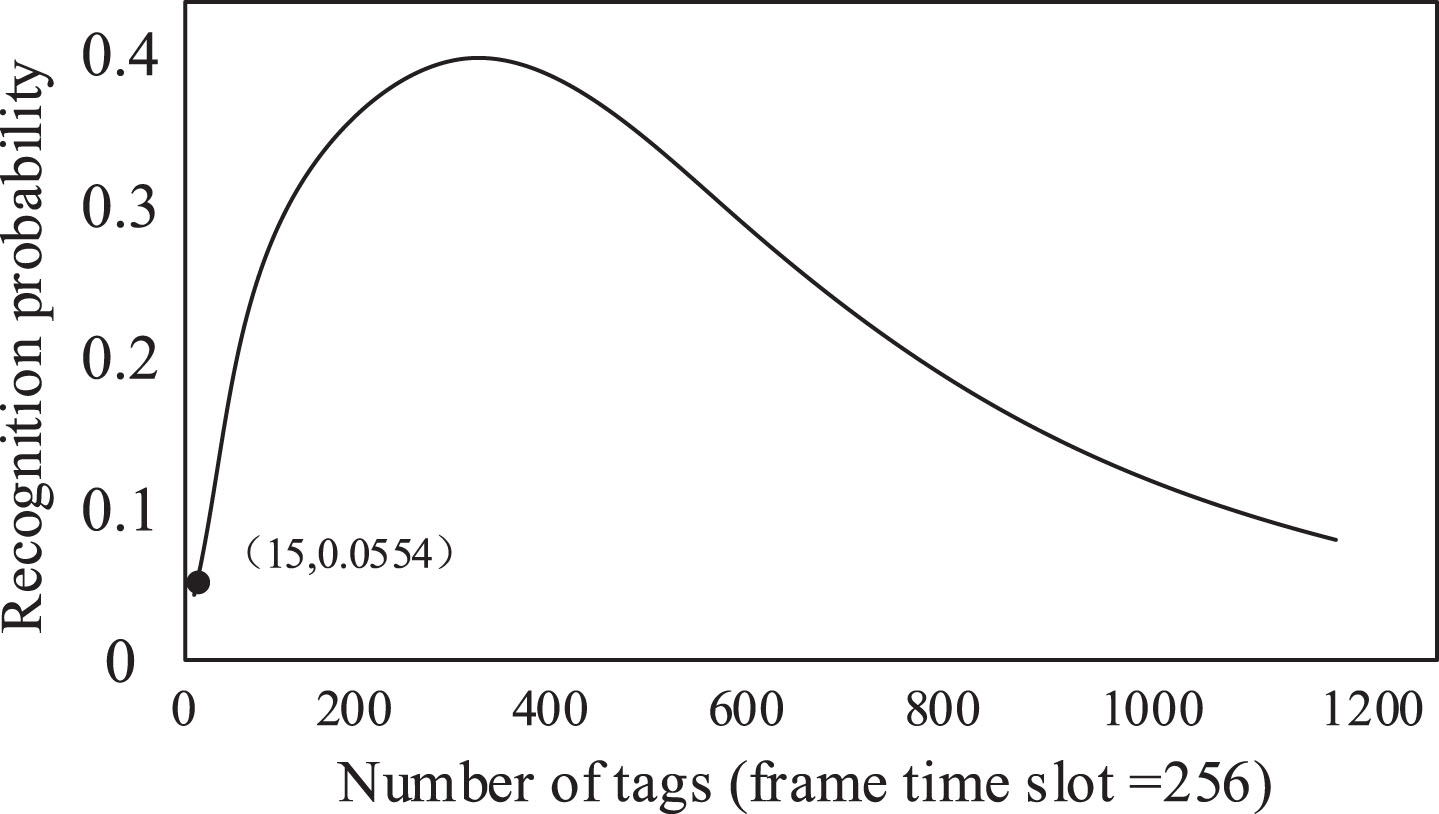
Where
When M indicates the frame length and the number of RFID cards, the maximum number of RFID cards recognized by the system is:
According to the EPCGEN2 standard, the total number of time slots N of the frame scanning period is selected in the form of 2
Q
. When the total number of slots in the frame scanning period is equal to the number of external RFID cards, the channel utilization rate of the system is the highest, so that n = 2
Q
,
Through the above mathematical analysis, determine the optimal frame time slot of the RFID reader, first determine the number of RFID cards that may appear in the scene. At present, theoretical teaching and off-campus training in colleges and universities are carried out on a professional basis. Therefore, it is divided into two classes according to the common one. The scale of 30 people per class is the most common scene where 60 people appear at the same time. The card reader frame time slot n = 2 Q , Q must be an integer, so when Q = 6, the card reader frame time slot n = 64 has the best recognition efficiency. 4 is an identification efficiency curve when the number of external RFID cards changes from 0 to 100 when the number of frame time slots of the card reader is set to 64, and the highest recognition efficiency is 0.3708 when the number of RFID cards is 64, which is the most common. In the full professional teaching activities, the number of RFID cards is 60, and the system can also obtain a better recognition efficiency of 0.3702.
Experimental environment and conditions
Based on the above analysis of requirements and detailed design analysis, the development environment is: development platform for My Eclipse, server for Apache, database server for SQL Server 2008, development language for Java. The piano teaching management system is developed in B/S mode. The computer environment that needs to be configured during design is as follows: the operating system must be above Windows XP version (recommended to use Windows7), the computer memory should be higher than 1 G, the CPU and browser do not have a hard requirement (IE browser is recommended), and the browsing mode should be set to 1024*768.
Performance experiment and algorithm implementation of piano teaching system based on IoT technology
System testing refers to the integration of the actual application and the developed system, and the implementation of the system to test the system to detect the operating status of the system, is in line with the pre-development requirements. In the process of testing the system, the requirements analysis is compared with the developed system to verify whether the required requirements are developed, and find problems in the development process and improve them in time. We will test our development system using black box testing and white box testing to verify that the system being developed has good operating efficiency. Among the eight functional modules in the piano teaching management platform, the student information management module is used as the test object, and the tests of other modules are similar to the module, and will not be described here. For white box testing, the system is deployed in the LAN to eliminate the limitations and instability of the external network speed. The Load Runner performance testing tool is used to test the system’s data processing capabilities and service load with a large amount of users and large amounts of data. An example table of performance tests is shown.
Figure 5 is a screenshot of the login process Action response time.
Login process Action response chart.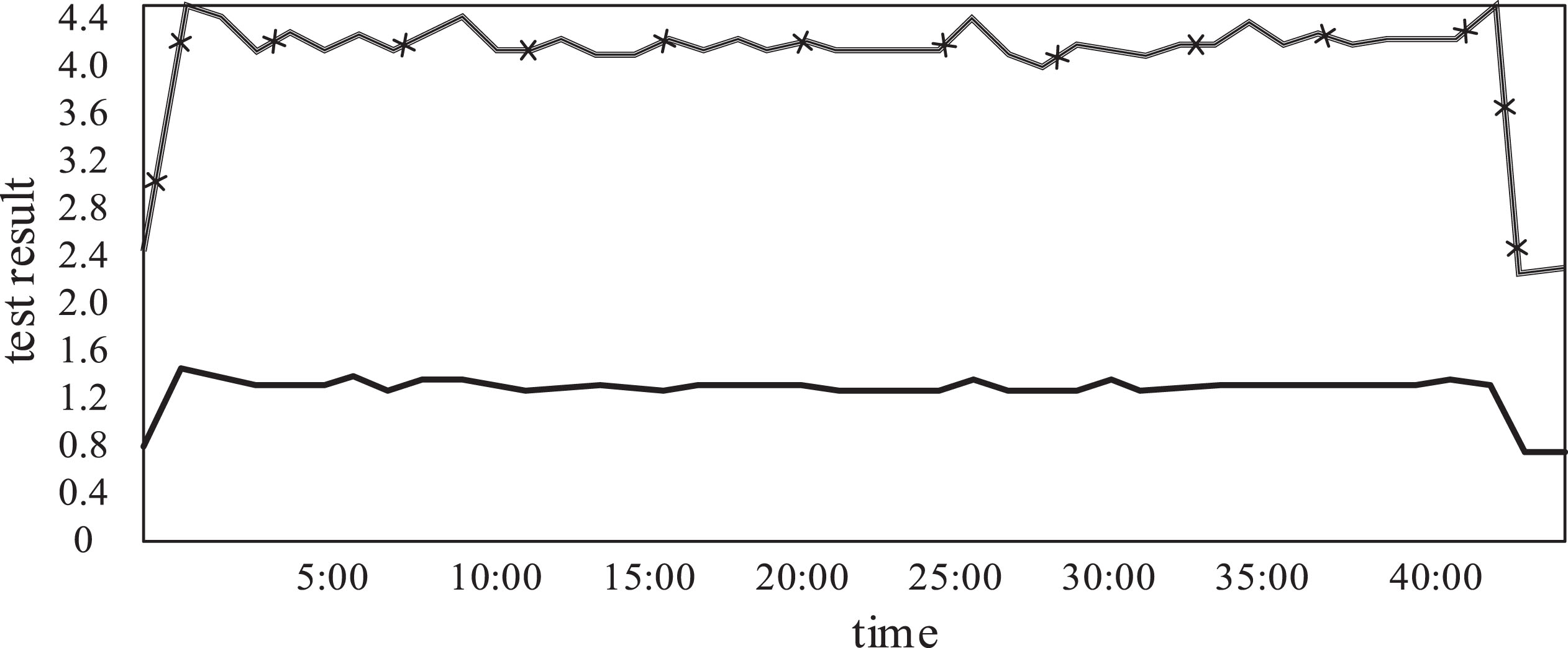
It can be seen from the above two test results that the average response time of the entire Action is 3.945 seconds: the average response time of the login operation is 1.185 seconds. Fig. 6 is a screenshot of the server response time.
Response time variation diagram of server.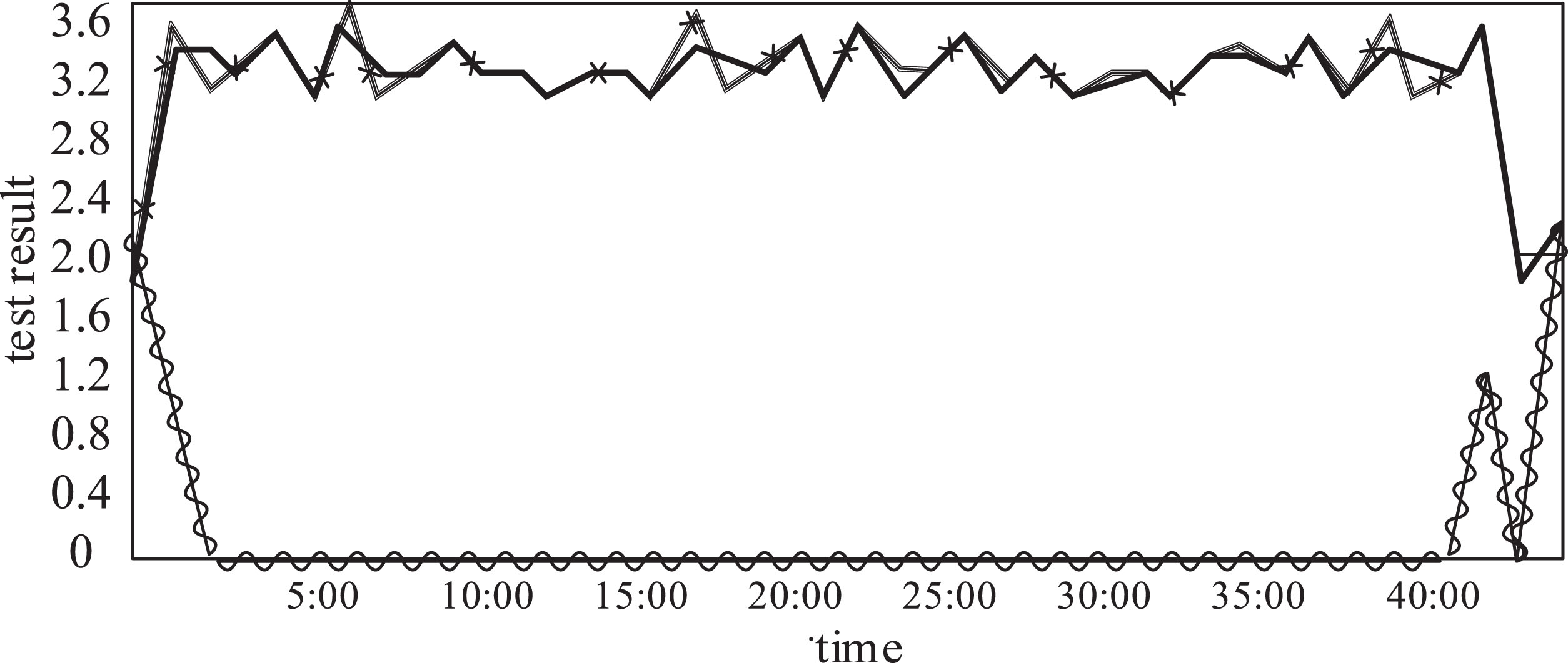
Performance test cases
Comparison of measured data
The test results are similar to the above calculation results. Experiments show that the card reader with frame time slot N = 256 uses the method of secondary development of dynamic library by the manufacturer, and the recognition probability of one scan is 0.984420. Using a card slot with frame time slot N = 2, using the development method of direct control under the hardware, the average scan time is 0.3 times in 0.3 s, and the recognition probability can be increased to 0.999719. In summary, the anti-collision algorithm optimizes the number of frame slots after the card reader, in a person carrying an experimental device scene, the recognition probability is greatly improved, reducing the miss sweep rate, indicating the anti-collision algorithm optimization method of this study effective, improving the efficiency of identification of laboratory corridors and laboratory access. Therefore, according to the number of RFID cards appearing in different scenarios of teaching management, dynamically adjusting the frame time slot of the RFID card reader can more accurately identify the teacher and student behavior.
The actual scheme and process of piano teaching management work are combined, using the SSH framework technology in J2EE technology system, under the B/S framework, the demand analysis and system design of the piano teaching management system suitable for colleges and training institutions. After the system uses the mature framework technology to determine the system structure framework, the system is coded using the Java language. In the specific experiment and application of the system, the system shows more powerful recognition performance can more accurately identify the teacher and student behavior, the recognition probability can be increased to 0.999719, and the running speed of the system is greatly improved compared with the traditional algorithm. The average scan is up to 12 times in 0.3 s. Moreover, after the B/S framework-based application system is designed, it only needs to be deployed to the server. The client only needs to access the service through the browser, which greatly reduces the client operator’s operation compared with the traditional method. Operational complexity is easy for teachers and students to use. After the piano teaching management system is designed and completed, it has basically reached the goal of system design after testing. However, there are still some problems, including the improvement of the aesthetics of the page design, the applicability of the system, the steps of system operation and the process needs to be further simplified, etc., and in the later research work, these problems will be gradually solved and improved.