Decision making using algebraic operations on soft effect matrix as new category of similarity measures and study their application in medical diagnosis problems
Available accessResearch articleFirst published online September 9, 2019
Decision making using algebraic operations on soft effect matrix as new category of similarity measures and study their application in medical diagnosis problems
A new category of similarity measures is investigated in this work, we first introduce the concept of effect matrix of type 2-tuple and study some of their properties. Moreover, from the soft set we find the pictures of type regular and irregular using effect matrix of type 2-tuple. An effect matrix of type 2-tuple is better than effect matrix of type 1-tuple, because we can deal with two different sets (a family of objectives) and (a family of parameters) in the same problem. This burden can be alleviated by application of type 2-tuple. Some applications of soft effect matrix of type 2-tuple in decision making problems are studied and explained. In this work we deal with pictures. Moreover, the similarity measure between two different soft sets under the same universal soft set can be studied and explained its applications in medical diagnosis problems.
The problem of decision making with similarity measurement between fuzzy numbers, fuzzy sets, soft sets and vague sets have been studied by many mathematicians in different ways see ([4, 34]). In 2013, [11] the concept of effect matrix is studied and then the pictures of type regular and irregular which are found by effect matrix from the sound. There are many problems in economics, medical science, environments, engineering, and so forth, have various uncertainties. Molodtsov [28] initiated the concept of soft set theory as a new mathematical tool for dealing with uncertainties. After Molodtsov’s work, some operations and applications of soft sets in algebras and topologies were studied by many researchers see ([1, 26]). To address decision making problems based on fuzzy soft sets, Feng et al. introduced the concept of soft level sets of fuzzy soft sets and initiated an adjustable decision making scheme using fuzzy soft sets [6] and then operations and applications of fuzzy soft sets in algebras and topologies are introduced see ([10, 31]).
In 2014, the concept of induced fuzzy soft set is introduced [9]. The colours and soft sets are used in this paper. An induced fuzzy soft set is the key to soft set and colour. Some researchers studied the colours and their applications. Further, there are many an important different applications are discussed (see 2, 3, 29).
In this work for any soft set (H, A) over a universe U and the parameter set A we can generate a picture using effect matrix of type 2-tuple.. This method is useful and it will help us to study many of the soft sets from the different problems in economics, medical science, environments, engineering, and so forth and then make comparison between them over the same universal soft set to help us in our everyday lives in many ways. Some applications of effect matrix of type 2-tuple in in medical diagnosis problems are illustrated.
Preliminaries and basic results
We will show some past results and basic definitions in this section.
Assume that E is a set of parameters, U is an initial universe set, P (U) is the power set of U and K is a subset of E. We say (F, K) is a soft set over U if F is a multi-valued function of K into P (X). The family of all soft sets over a universe U and the parameter set E is denoted by SS (UE) and denoted by SS (UA) when the parameter set is a subset A of E.
Assume that U is an initial universe set and E is a set of parameters. Let IU denotes the collection of all fuzzy subsets of U. We say FA ; A → IU is a fuzzy soft set over (U, E), where A ⊆ E and if e ∈ E ∖ A and if e ∈ A. Also, it is defined by (a fuzzy subset of U) and we refer to family of all fuzzy soft sets over (U, E) byFS (U, E).
Assume that (H, A) is a soft set over U. Then is called an induced fuzzy soft set over (U, E), whereξ : SS (UA)→ FS (U, E) is a mapping which is given as:
for (H, A) ∈ SS (UA) the image of (H, A) under ξ denoted by , is defended as following:
Assume {p1, p2, p3, . . . , pm} is a family has m members of mathematical operations on , where I ∈ N and each member of the family {p1, p2, p3, . . . , pm} can be applied on in the form pj (yi), where j = 1, 2, 3, . . . , m ≤ I. Assume {q1, q2, q3, . . . , qn} is a family has n members of mathematical operations on which can be also applied on in the form of qk (yi), where k = 1, 2, 3, . . . , n ≤ I. Let pj (j = 1, 2, 3, . . . , m) and qk (k = 1, 2, 3, . . . , n) be arranged in rectangular matrix, where the operations pj and qk represent the rows and columns respectively of matrix as the following arrangement.
Where yjk = (yj, yk) ;1 ≤ j ≤ m, 1 ≤ k ≤ n}. Then next step is to imagine that there exists some graph formed from that two sets of operations pj and qk such operator pj is connected with each qk. This oriented connection between pj to qk [(pj, qk)]. This effect is oriented and the corresponding rectangular graph of effects is called the “effect graph” it’s convenient to symbolize effect between pj and qk. The notation refers to the presence of the effect. Therefore the, above arrangement can be represented as follows:
Assume that there exists a rectangular matrix of coefficients in the, following form:
Let us symbolize the effect graph by the symbol i.e, to
Where is an effect graph. If the oriented effect (pj, qk) could be interpreted mathematically as some oriented algebraic operation ∧ originating at pj and ending at qk (i.e.il from pj toil qk)
This algebraic operator ∧ may refer to addition multiplication inner product subtraction ... etc.). The quantity [pj] ∧ [qk] may be scaled (or normalized) simply by multiplication with the corresponding scaled (normalization) coefficient,yjk: that is
The symbol (•) refers to a special type of matrix multiplication in which each element of the matrix E is multiplied with the corresponding element in the matrix and this special type of the multiplication matrix is called “Effect product”.
The special type of the quantity is a matrix and its called “Effect matrix of ” and denoted by .
Algebraic operations on effect matrix of type 2-tuple
Assume that R1 = {xi|i = 1, 2, 3, . . . , I} and R2 = {yj|j = 1, 2, 3, . . . , L} are two collections of distinct objects where I, L ∈ N. Assume that there exists some finite positive number m of algebraic operations; p1, p2, p3, . . . , pm, which can be applied on R1 in the formpt (xi), where t = 1, 2, 3, . . . , m ≤ I . Assume that there exist another finite positive number n of other algebraic operations; q1, q2, q3, . . . , qn, which can be also applied on R2 in the form of qk (yj), where k = 1, 2, 3, . . . , n ≤ L . Assume that there exists a rectangular matrix of coefficients in the following form:
Where atk = (xt, yk) for all t = 1, 2, 3, . . . , m ≤ I and k = 1, 2, 3, . . . , n ≤ L. Let us symbolize the effect graph by the symbol in the following form:
Then the special type of the quantity is a matrix and it’s called “Effect matrix of typei2-tuple” and denoted by .
Definition
Let (F, A) be a soft set over a universe U = {u1, u2, …, uI} and the parameter set A ⊆ E = {e1, e2, …, eL}. Also, let p1, p2, p3, . . . , pI and q1, q2, q3, . . . , qL be algebraic operations on U and on E, respectively. Define as follows:
, where h ≤ I with t ≡ h ( I). And define byqk = F. Then is called Soft effect matrix of type 2-, and atk = (ut, ek) ∈ U × E
Lemma
If ek ∈ E - A, then atk ([pt] ∧ [qk]) , for all ut ∈ U.
Proof: Since ek ∈ E - A, thus F (ek) = φ and hence |F (ek) |=0. However, atk ([pt] ∧ [qk]) = [pt (ut)] ∧, for all atk = (ut, ek)∈ U × E. Therefore we consider thatatk ([pt] ∧ [qk]), for all ut ∈ U.
Lemma
If is a soft effect matrix of type 2-tuple, then the cardinality of {pt} t≤m in satisfies | {pt} t≤m| = n.
Proof:
Since is a soft effect matrix of type 2-tuple, then there exists soft set over a universe U = {u1, u2, …, um} and the parameter set A ⊆ E = {e1, e2, …, en} with and qj = F. However, then the cardinality of {pi} i≤m in dependent on cardinality of E. That means | {pt} t≤m| = |E|. But |E| = | {e1, e2, …, en} | = n. Hence | {pt} t≤m| = n.
Remark
we will consider new definitions more general by dealing with (m × n) cells instead of (n2) cells.
Definition
Let be a collection of colours and S be a quadrilateral shape which is divided into (m × n) of equal sub-square shapes (cells), where each cell has colour Ai for some (1 ≤ i ≤ μ). Then the line which is passing through at least two cells of colour Ai is called path and denoted by P (Ai).
Example
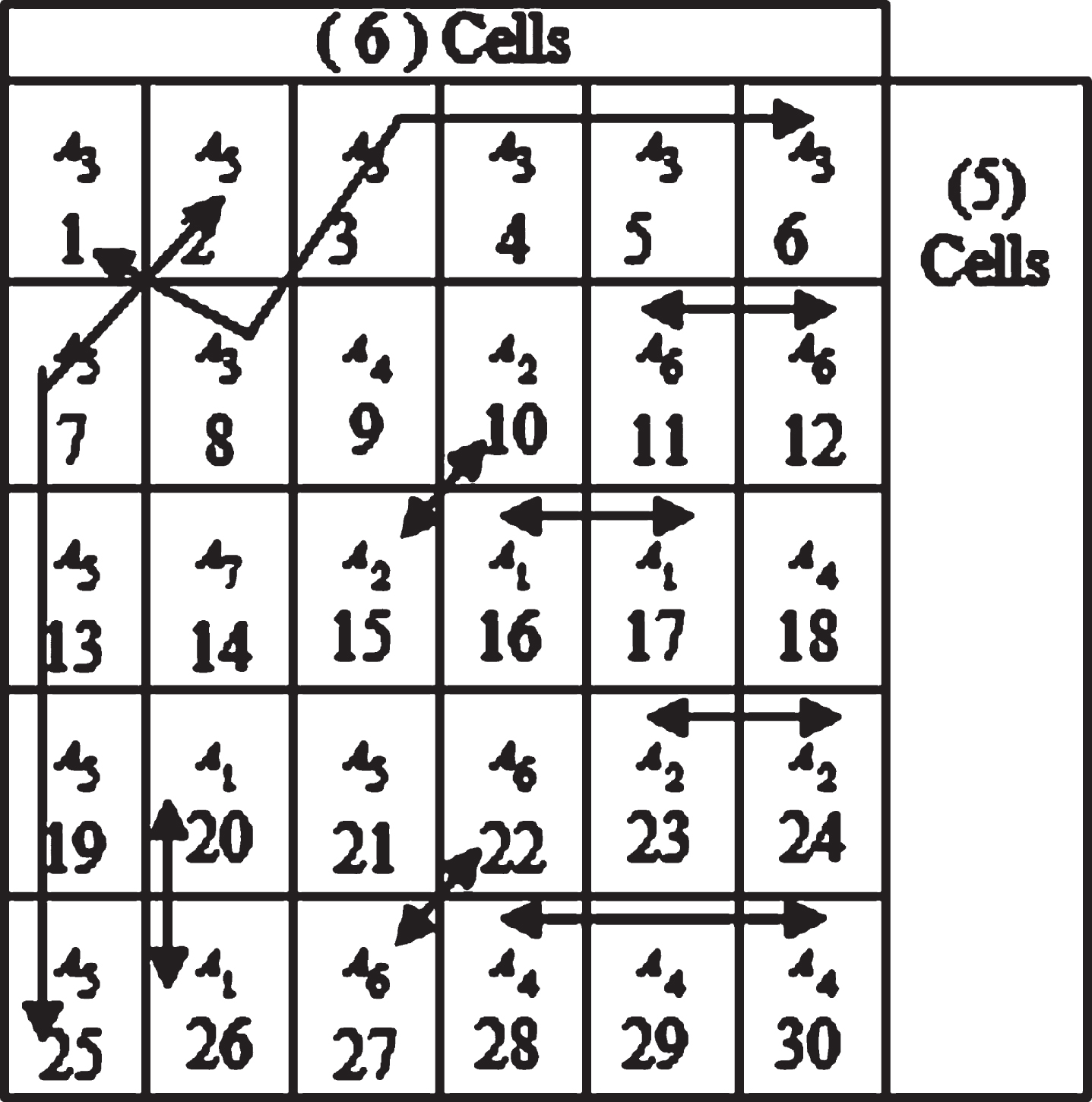
Let S be a quadrilateral shape consists (30) cells, where each cell has colour Ai for (1 ≤ i ≤ 7) as follows:
Then the following are hold in above example:
There are 9 paths which are passing through 26.
There are two paths of types P (A1),P (A2) and P (A6).
There is a single path for each type of {P (A3) , P (A4) , P (A5)}.
There exists no path of type P (A7).
There is no path of type P (A4) between cell 9 and cell 18.
Definition
Let be soft effect matrix of type 2-tuple generated a picture consists of (m × n) cells, where the area of all the cells are equal and each cell has a special colour. Then for each pair of cells cij and ckl whose colour A are called A- connected, if there is a path P (A) between them. In every other case are called A- disconnected.
Definition
Let be soft effect matrix of type 2-tuple generated a picture consists of (m × n) cells, where the area of all the cells are equal and each cell has a special colour, this picture is called regular if all pairs of cells whose colour A are A- connected.
Definition
Let be soft effect matrix of type 2-tuple generated a picture consists of (m × n) cells, where the area of all the cells are equal and each cell has a special colour, this picture is called irregular if there are at least two cells whose colour A are A- disconnected. Moreover, if any picture has more one path of the same type. Then it is an irregular picture.
Steps of the work
In the present work, for any soft set (F, A) over a universe U = {u1, u2, …, um} and the parameter set A ⊆ E = {e1, e2, …, en}, we can find picture consists of (n × m) square shapes, where the area of all square shapes are equal and each square shape is called cell and has a special colour. Let μ be the number of colours in a given problem and cij, for all (1 ≤ i ≤ m ; 1 ≤ j ≤ n) be elements in soft effect matrix of type 2-tuple which is introduced in this work. Then for each colour given, there is a semi open set or in real numbers R, where (2 ≤ r ≤ μ - 1) and , it is represent the level of this colour. Moreover, this generated picture may be regular or irregular. The procedure of this work can be compressed as following steps:
Find the soft effect matrix of type 2-tuple .
Assume Max [cij] = L , Min [cij] = K and μ is a number of the colours.
Where and each of Ai (i = 1, 2, . . . . . , μ) represent a special colour.
Remarks
If more of the colour are given, then a good picture will be seen.
Remark
If we choose (μ) colours it is not necessary all (μ) colours are appear in a picture. [see Example (3.13)].
Example
Suppose that U is the set of men whose looking for job under consideration, say U = {x1, x2, x3}. Let E be the set of some attributes of such men, say E = {e1, e2, e3, e4}, where e1, e2, e3, e4 stand for the attribute “healthy body”, “hearing activity”, “smell activity”, “sight activity”, respectively. Suppose that the soft set (F, A) where A = {e1, e3, e4} , describing the Dr. X opinion to detect the right man for the job was defined by F (e1) = {x1} , F (e3) = {x1, x2} , F (e4) = φ. Find and determine the type of the picture (regular or irregular) that is generated by the soft effect matrix of type 2-tuple .
Solution.
Assume A1 = white, A2 = yellow, A3 = orange, A4 = rose, A5 = red, A6 = green, A7 = blue, A8 = violet, A9 = brown, A10 = black, thus μ = 10. Also, we consider that
where atk = (xt, ek) ∈ U × E and
where and are defined as follows;
where h ≤ 3 with t ≡ h ( 3), and qk = F. Now, we need to find [pt (xt)] and [qk (ek)] for all (1 ≤ t ≤ 3) and (1 ≤ k ≤ 4) as the following:
,
Where n (SS (UA)) =29 = 512 and n (SS (UE)) = 212 = 4096.
Where and each of Ai (i = 1, 2, . . . . . , μ) represent a special colour
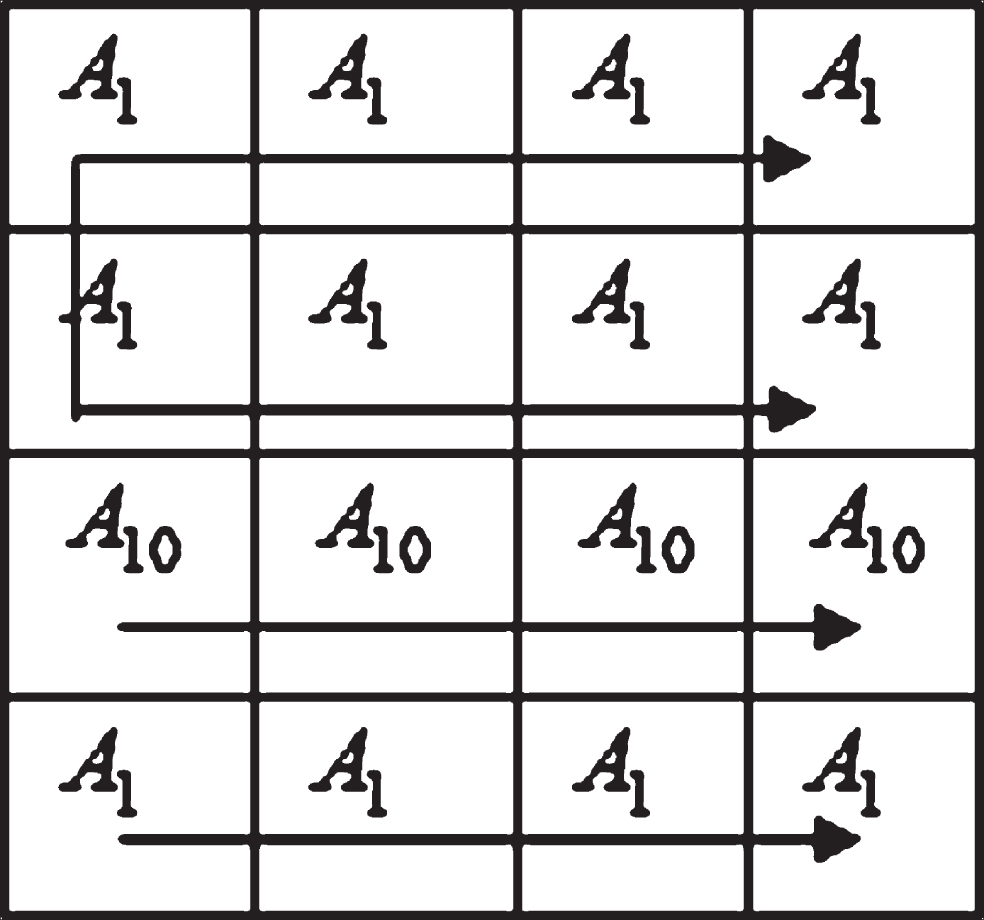
Then there are eight cells cij∈ {c11, c12, c13, c14, c21, c22, c23, c24} whose colourA1 and all of them are A1- connected of type p (A1) and four cells ckl∈ {c31, c32, c33, c34} whose colourA2 and all of them are A2- connected of typeP (A2). So the picture which is generated by soft effect matrix of type 2-tuple is a regular picture (see Fig. 3).
Shape consists 30 cells.
Shape has two paths.
Regular picture with two paths.
Remark
If we replace the soft set (F, A) over the same an initial universe set U and the same set of parameters E in example (3.13). Then,
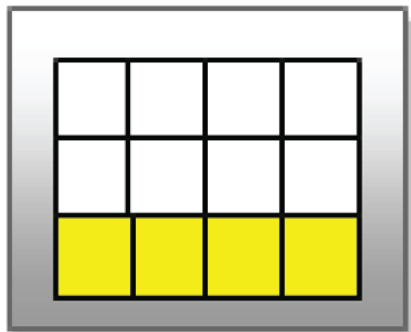
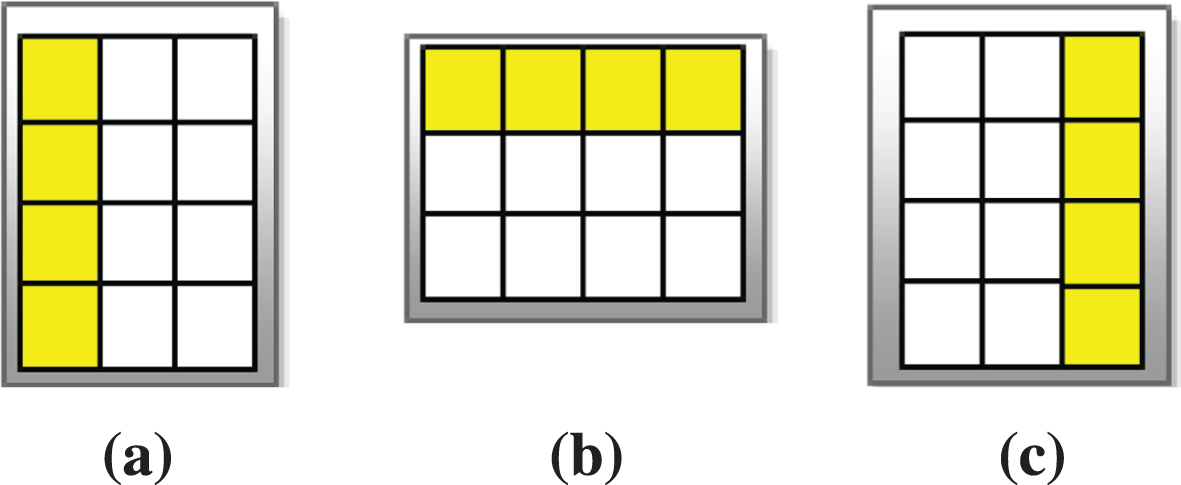
We can turn Fig. (3), see Figs. (4-a,b,c). For example, let (G, B) be a soft set where B = {e1, e2, e3} , G (e1) = {x2, x3} , G (e2) = φ, G (e3) = {x3}. Then we have:
we can consider new picture see Fig. (6) in the following example.
Example
See example 3.13, If we replace redefine soft set (F, A) as follows: F (e1) = {x1, x3} , F (e3) = {x1, x2} , F (e4) = φ. Then we consider the following, , , n (SS (UA))/n (SS (UE)) = 0 . 125 . Also, |F (e1) |=2, |F (e2) |=0, |F (e3) |=2, |F (e4) |=0. Hence we consider that;
Then there are three cells cij∈ {c11, c12, c13, c14} whose colour A10 and all of them are A10- connected of type P (A10), three cells ckl∈ {c21, c22, c23, c24} whose colourA1 and all of them are A1- connected of type p (A1) and three cells ckl∈ {c31, c32, c33, c34} whose colourA2 and all of them are A2- connected of type P (A2). Therefore we generated new regular picture see Fig. (6).
Regular picture with three paths.
Definition
Let (F, A) and (G, B) be two different soft sets over the common universal soft set (U, E). Then (F, A) and (G, B) are called equivalence and they are denoted by (F, A) ≈ (G, B) if and only if they have the same soft effect matrix of type 2-tuple .
Remark
It is clearly, the relation ≈ is an equivalence relation on SS (UE). Verifications of reflexivity, symmetry and transitivity. Then we can divide the set SS (UE) into equivalence classes. Denote the equivalence class of (F, A) by [F, A] . Where [F, A] = {(G, B) ∈ SS (UE) | (G, B) ≈ (F, A)} . Further, if any soft set (G, B) ∈ SS (UE) has regular (irregular) picture, and (F, A) has irregular (regular) picture then we say (G, B) and (F, A) are not equivalent. Moreover, if(G, B) , (F, A) ∈ [F, A]. Then [G, B] = [F, A] and either both of the soft sets (F, A) and (G, B) have regular pictures or irregular pictures.
Example
Suppose that U = {x1, x2, x3, x4} is a set of four patients. Let E be a set of some diseases, say E = {e1, e2, e3, e4}, where e1, e2, e3, e4 stand for the attributes “body temperature”, “cough with chest congestion”, “ cough with no chest congestion”, respectively. Suppose that the soft set (F, A) describing the Dr.X opinion to detect the emergency state was defined by A = {e1, e3, e4} , F (e1) = {x1} , F (e3) = {x1, x2} , F (e4) = φ. In addition, we assume that the “emergency state” in the opinion of another Doctor, say Dr.Y, is described by the soft set (G, B), where B = {e1, e2, e3}, G (e1) = {x1} , G (e2) = φ, G (e3) = {x1, x4}. Now, we need to find [pt (xt)] and [qk (ek)] for all (1 ≤ t ≤ 4) and (1 ≤ k ≤ 4) as the following: , ,.
Where n (SS (UA)) =212 = 4096 and n (SS (UE)) =216 = 65536.
a44 ([p4] ∧ [q4]) = [p4 (x4)] ∧ [q4 (e4)] =0. Then, the soft set (F, A) generated soft effect matrix of type 2 tuple as follows:
Similarity, we can find the soft effect matrix of type 2-tuple for (G, B) which is defined as follows:
Hence [G, B] = [F, A]. That means both of the soft sets (F, A) and (G, B) have the same picture, because they have the same soft effect matrix of type 2-tuple. Then Dr. X and Dr. Y their opinions are equivalence.
Here we consider picture has more one path of the same type. Hence it is irregular picture see Fig. (8).
An irregular picture.
Similarity Measurement and Their Applications in Medical Diagnosis Problems
Several researchers have studied the problem of similarity measurement between fuzzy sets, fuzzy numbers, vague sets and soft sets in different ways. In this work a measure of similarity between two soft sets has been given using effect matrix of type 2-tuple. In another side, sometimes there are two soft sets (F, A) and (G, B) in SS (UE) nearly they are similar. That means F (e) = G (e) for most of e ∈ E. So its not necessary they have different pictures. That means if there are two Doctors say Dr. X (his opinion is(F, A)) and Dr. Y (his opinion is (G, B)), then we say Dr. X and Dr. Y their opinions are similarity or equivalence if and only if they have the same soft effect matrix of type 2-tuple and hence we consider that their pictures are similar. This idea can be extension in many fields to solve some decision making problems, if we assume (F, A) is our model and {(Fi, Ai) |1 ≤ i ≤ k} is the family of soft sets over (). Then we recommend to choose (Fi, Ai) for some 1 ≤ i ≤ k) if (Fi, Ai) is equivalence with our model (F, A).
Example
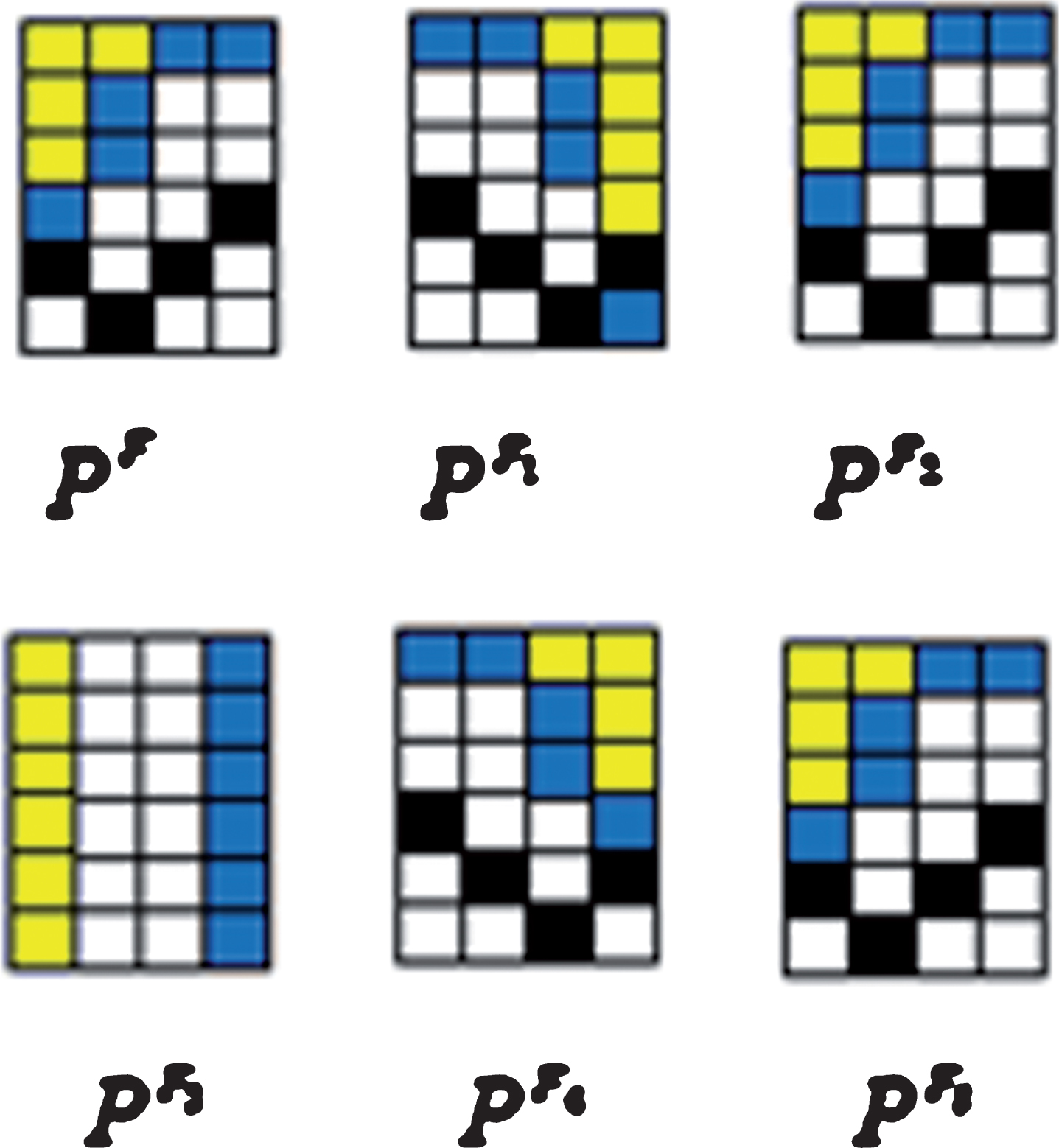
Let U=c1,c2, c3,c4,c5,c6 which is the set of six patients. Let E be a set of some diseases, say E = {e1, e2, e3, e4}, where e1, e2, e3, e4 stand for the attributes “body ache”, “headache”, “loose motion”, “breathing trouble”, respectively. Suppose Γ = {(Fi, Ai) |1 ≤ i ≤ 5} is a family of soft sets describing the emergency state of the patients with respect to the given diseases. Moreover, Mr. Z is a employee in the hospital and he need to know which one of the patients need to enter to the intensive care unit. Suppose that the soft set (F, A) describing hospital’s model to choose the emergency state of the patients that need to enter to the intensive care unit with respect to the given diseases. For any soft set (F, A) let us refer to its generated picture by PF. Let PF,PFi be defined respectively, where 1 ≤ i ≤ 5 as follows:
The collection of pictures.
That means hospital’s model is PF. Further, Mr. Z need to choose which one of the patients is equivalence with hospital’s model and then he will decide to enter him to the intensive care unit or no. Now, to help Mr. Z we need to answer the questions:
Is there any member (Fi, Ai) in Γsuch that PFi =PF?
Is there any member (Fi, Ai) in Γsuch that PFi≠PF?
We consider the following two pictures {PF2, PF5}are equivalence with hospital’s model. Then we recommend Mr. Z to choose the second and fifth of the patients. Moreover, we consider the following three pictures {PF1, PF3, PF4} are not equivalence with hospital’s model. Then we do not recommend Mr. Z to choose the first, third and fourth of the patients.
Remark
It is clearly, If hospital’s model has regular (irregular) picture, then we do not recommend Mr. Z to choose any one of the patients that is described as irregular (regular) picture.
Conclusion
In this paper, we have introduced the notions of the effect matrix of type 2-tuple and their picture. Using this, idea of picture consists of (m × n) cells, we have studied A- connected, A- disconnected, regular pictures and irregular pictures. Further, for any pair of soft sets (F, A) and (G, B) in SS (UE) we defined relation ≈ on SS (UE) by (F, A) ≈(G, B) if they have the same effect matrix of type 2-tuple. That means if there are two persons say Mr. X (his opinion is (F, A)) and Mr.Y (his opinion is (G, B)), then we say Mr. X and Mr.Y their opinions are equivalence if and only if (F, A) ≈ (G, B). Similarity measure of two soft sets has been given using effect matrix of type 2-tuple and an application of this to solve a decision making problem in medical diagnosis has been shown. The author is hopeful that this modified concept will yield more natural results and will be more useful in dealing with some problems related to uncertainty.
References
1.
AktaşH. and
ÇağmanN., “Soft sets and soft groups,”, Information Sciences177(13) (2007), 2726–2735.
2.
BalleriniL., HogbergA., LundstromK. and BorgeforsG., Colour image analysis technique for measuring of fat in meat: An application for the meat industry, Electronic Imaging4301 (2001), 113–142.
3.
BalleriniL., Genetic snakes for medical images segmentation, Lectures Notes in Computer Science1596 (1999), 59–73.
4.
CavoneG., DotoliM., EpicocoN. and SeatzuC., A decision making procedure for robust train rescheduling based on mixed integer linear programming and Data Envelopment Analysis, Applied Mathematical Modelling52 (2017), 255–273.
5.
ChenD., TsangE.C., YeungD.S. and WangX., The parameterization reduction of soft sets and its applications, Computers & Mathematics with Applications49(5-6) (2005), 757–763.
6.
FengF., JunY.B., LiuX.Y. and LiL., “An adjustable approach to fuzzy soft set based decision making,”, Journal of Computational and Applied Mathematics234(1) (2010), 10–20.
7.
HerreraF., AlonsoS., ChiclanaF. and Herrera-ViedmaE., Computing with words in decision making: Foundations, trends and prospects, Fuzzy Optimization and Decision Making8(4) (2009), 337–364.
8.
HoangLe., Measuring analogousness in picture fuzzy sets: From picture distance measures to picture association measures, Fuzzy Optimization and Decision Making (2016), 1–20.
9.
MahmoodS., On intuitionistic fuzzy soft b - closed sets in intuitionistic fuzzy soft topological spaces, Annals of Fuzzy Mathematics and Informatics10(2) (2015), 221–233.
10.
MahmoodS., Dissimilarity Fuzzy Soft Points and their Applications, Fuzzy Information and Engineering8 (2016), 281–294.
11.
MahmoodS., Generation the Regular Pictures and Irregular Pictures from the Sound by Using Effect Matrix , published in, Journal of Mathematical and Computational Science3(2) (2013), 668–693.
12.
MahmoodS., Soft Regular Generalized b-Closed Sets in Soft Topological Spaces, Journal of Linear and Topological Algebra3(4) (2014), 195–204.
13.
MahmoodS. and MuhamadA., Soft BCL-Algebras of the Power Sets, International Journal of Algebra11(7) (2017), 329–341.
14.
MahmoodS., Soft Sequentially Absolutely Closed Spaces, International Journal of Applications of Fuzzy Sets and Artificial Intelligence7 (2017), 73–92.
15.
MahmoodS., Tychonoff Spaces in Soft Setting and their Basic Properties, International Journal of Applications of Fuzzy Sets and Artificial Intelligence7 (2017), 93–112.
16.
MahmoodS. and HameedF., An algorithm for generating permutations in symmetric groups using soft spaces with general study and basic properties of permutations spaces, J Theor Appl Inform Technol96(9) (2018), 2445–2457.
17.
MahmoodS. and HameedF., An algorithm for generating permutation algebras using soft spaces, Journal of Taibah University for Science12(3) (2018), 299–308.
18.
MahmoodS. and Abd UlrazaqM., SoftAlgebras of the Power Sets, American Journal of Mathematics and Statistics8(1) (2018), 1–7.
19.
MahmoodS. and AlradhaM., Soft Edge ρ-Algebras of the power sets, International Journal of Applications of Fuzzy Sets and Artificial Intelligence7 (2017), 231–243.
20.
MahmoodS. and Abd UlrazaqM., New Category of Soft Topological Spaces, American, Journal of Computational and Applied Mathematics8(1) (2018), 20–25.
21.
MahmoodS., New category of the fuzzy d-algebras, Journal of Taibah University for Science12(2) (2018), 143–149.
22.
MahmoodS., Fuzzy Lindelof Closed Spaces and Their Operatios, Journal of General Mathematics Notes21(1) (2014), 28–136.
23.
MahmoodS. and Al-BatatZ., Intuitionistic Fuzzy Soft LA- Semigroups and Intuitionistic Fuzzy Soft Ideals, International Journal of Applications of Fuzzy Sets and Artificial Intelligence6 (2016), 119–132.
24.
MahmoodS., UlrazaqM., Abdul-GhaniS. and Al-MusawiA., s–Algebra and s–Baire in Fuzzy Soft Setting, Advances in Fuzzy Systems2018 (2018), Article ID 5731682, 10 pages.
25.
MajiP.K., RoyA.R. and BiswasR., Fuzzy soft sets, Journal of Fuzzy Mathematics9(3) (2001), 589–602.
26.
MajiP.K., BiswasR. and RoyA.R., “Soft set theory,”, Computers & Mathematics with Applications45(4-5) (2003), 555–562.
27.
MengJ., JiangY., XuX. and PrianandaI., Support top irrelevant machine: Learning similarity measures to maximize top precision for image retrieval, Neural Computing and Applications (2016), 1–10.
28.
MolodtsovD., Soft set theory first results, Computers & Mathematics with Applications37(4-5) (1999), 19–31.
29.
MoninG., Recent methods for predicting quality of whole meat,, Meat Science49(1) (1998), S231–S243.
30.
PreeH., HerwigB., GruberT., SickB., DavidK. and LukowiczP., On general purpose time series similarity measures and their use as kernel functions in support vector machines, Information Sciences281 (2014), 478–495.
31.
SamaherA., ShukerM., MayadahA. and Abu FirasA., New Branch of Intuitionistic Fuzzification in Algebras with Their Applications, International Journal of Mathematics and Mathematical Sciences2018 (2018), Article ID 5712676, 6 pages.
32.
YangC., A not on soft set theory, Computers and Mathematics with Applications56 (2008), 1899–1900.
33.
YueZ., An avoiding information loss approach to group decision making, Applied Mathematical Modelling37 (2013), 112–126.
34.
YueZ., A group decision making approach based on aggregating interval data into interval-valued intuitionistic fuzzy information, Applied Mathematical Modelling38 (2014), 683–698.