



Abstract
The shockwave signal is affected by the weapon launch and the external environment, and it is often mixed with many kinds of noise, some even submerged. To detect and extract the shockwave signal under low signal-to-noise ratio, the transient signal SNR, the power-law detector of the higher-order cumulant spectrum (HOCS) and the Dual-tree complex wavelet transform (DTCWT) extraction model are proposed in the study. The average power of noise under different SNR was calculated by comparing the average power of the background noise with the instantaneous power of the shockwave. Based on the power-law detection of HOCS, the power-law of the two spectra was analyzed. After the DTCWT, the optimal threshold of the maximum posterior estimation was denoted by layer by layer, then the shockwave signal was extracted by the inverse transform, and the validity of the model was verified by the measured data. Results demonstrate that the signal to noise ratio of the transient signal can reflect the true magnitude of the average power of the noise, and the conventional SNR reduces the average power of the noise, and the error ratio is up to 70%. The power-law detector of bispectrum diagonals has the good effect on Gaussian white noise suppression, and can detect the signal to noise ratio of -15dB. The DTCWT can realize multiple peak shockwave extraction with the smaller amplitude, and the mean square error (MSE) of measured signal extraction can reach 0.0189. The proposed method provides a good reference for the detection of shockwave signal and the extraction of the multi-peak waveform in low signal-to-noise ratio.
Introduction
The characteristics of transient signals are not all 0 in the finite time domain, but 0 in the remaining time domain. The transient signal detection has been a difficult spot in the study because of the unknown factors such as signal-to-noise ratio, arrival time and waveform parameters.
The shockwave belongs to the transient signal and has its own characteristics besides the characteristic of general transient signal. The pressure rises quickly; the duration is short and long, the disturbance noise is large, with single or more pulse sound and so on. With the development of testing technology, more and more researchers have focused on the transient signal of the shockwave in recent years and conducted a lot of researches [1–4].
The general test signals are random, and the test signals with noise and interference are random and need further detection and noise reduction. The power-law detector is often used for the detection of transient signals, while the low signal-to-noise ratio test signal needs to be further analyzed with the high order spectrum. However, for the use of large capacity storage (64MSa) to obtain the shockwave signal and the post-analysis method, the calculation is very large [5, 6]. At the same time, interference noise affects the extraction of shockwave signal, especially the special signal waveform with multiple waveforms and different peak amplitude.
Wavelet analysis is often used for high signal-to-noise ratio of the shockwave signal noise reduction, the effect can meet the requirements [7], but Gibbs effect and frequency aliasing has certain influence of time delay and energy [8], inappropriate peak waveform analysis of different sizes, such as ground reflection, the projectile shock, underwater detection, etc.
Based on the above analysis, this study put forward the transient signal SNR, establish the double power-law spectrum detector and diagonal slice spectrum dual-tree complex wavelet transform based on the model, the ratio of shockwave signal simulation of different signal to noise, and the measured waveforms are analyzed, aiming at low SNR shockwave signal detection and extraction of the offer reference.
State of the art
At present, a lot of research work has been done on the detection and noise reduction of shockwaves and other transient signals.
LI Yan-Jie [9] analyzed and removed the vibration and noise in the shockwave test, and restored the shockwave signal, which provided the basis for the shockwave to remove the noise. AL.L. Ramos [10] carried out the frequency analysis of the projectile muzzle shockwave and shockwave, using the delayed treatment, received shockwave data, they verified the shockwave was the shape of “N”, the amplitude is far less than the shockwave, and the time ahead of the conclusion. A Chacon-Rodriguez [11] evaluated five preprocessing algorithms and detected the sound of the gun. Using the ROC curve method to denoise and detect the noise of the gun in the low power VLSI circuit. Luo Bo [12] proposed a power-law detector of autocorrelation function, and realized the detection of non-Gauss transient signals in underwater Gauss noise. It was pointed out that power-law detector is suitable for detecting underwater shockwave containing noise. Yu Tongkui [13] used time-frequency analysis, FIR filter and transient signal energy calculation to analyze transient ship signals, getting the characteristic spectrum, break through the identification technology of transient noise generation and end time, and pointing out the validity of high-order spectrum statistics. Aiming at the short time burst communication signal, Xiong Shujun [14] proposed an improved the power-law detector of the higher-order cumulant spectrum (HOCS) with clock improved. The detection result is better than the traditional power-law detector, but the signal intermediate frequency is only 3 kHz.
Brian [15] pointed out that wavelet analysis can be used for high signal-to-noise ratio under shockwave signal analysis, then pair frequency analysis and comparison of the wavelet transform, wavelet analysis with the shockwave and shockwave processing, waveform and signal at the time. Zhang Yanfang [3] lists five kinds of typical curve of the measured wave, contains the superposition of oscillation signals, ballistic wave and shaking moment of impact signal, reflected wave and the incident wave superposition of the shockwave signal, the exponential attenuation of shockwave signal, filtering, fitting and wavelet technology were used respectively to the processing, it is concluded that wavelet can effectively eliminate the conclusion of the oscillating shockwave signal. Lai Fuwen [7] further USES wavelet to analyze the muzzle impulse noise signal, succeeded in removing noise and high-frequency coefficients of the wavelet, extracted the play sequence parameters and shooting speed, but not for a single waveform for further analysis. Kingsbury [16, 17] pointed out that the complex wavelet was better than the discrete wavelet, and proposed the DTCWT transform. Wentao Liu pointed out the shortcoming of wavelet transform [18], is proposed based on dual-tree complex wavelet transform signal noise reduction method, but only the low frequency of shockwave signal is analyzed, whether can be used in the shockwave signal needs to be further verified.
The above research results mainly for shockwave signal or other transient signal detection and wavelet analysis, and aimed at the shockwave transient signal and its detection under low SNR of study is less, especially the shockwave extraction under low signal-to-noise ratio of related work less. In this paper, the instantaneous power of the transient signal of the shockwave is compared with the average power of the background noise, and the signal to noise ratio is proposed to calculate the power error. The power-law detector of bispectrum diagonal slice was established and compared with the traditional power-law detector. DTCWT transform (DTCWT) is performed for the multi-peak simulated shockwave signal, and the shockwave signal is extracted based on the threshold value of the maximum posterior estimation. It provides a basis for detection and extraction of shockwave signal under low SNR.
The rest of this article is organized as follows. The third section describes the shockwave signal model and calculates the signal bandwidth of the shockwave. A HOCS power-law detector is established. The time delay and energy statistics of the shockwave group were analyzed by DTCWT. In the fourth section, the average power error of noise is analyzed using transient signal SNR. Using HOCS power-law detector, the simulation of different SNR is calculated and the threshold is obtained. Through the analysis of DTCWT, the threshold was obtained and the waveform was extracted. The last section summarizes this paper and gives the relevant conclusions.
Methodology
Shockwave transient signal mode
Shockwave model
The most commonly used expression of the shockwave pressure variation is
In Equation, is the normalized pressure, is the time of positive pressure action.
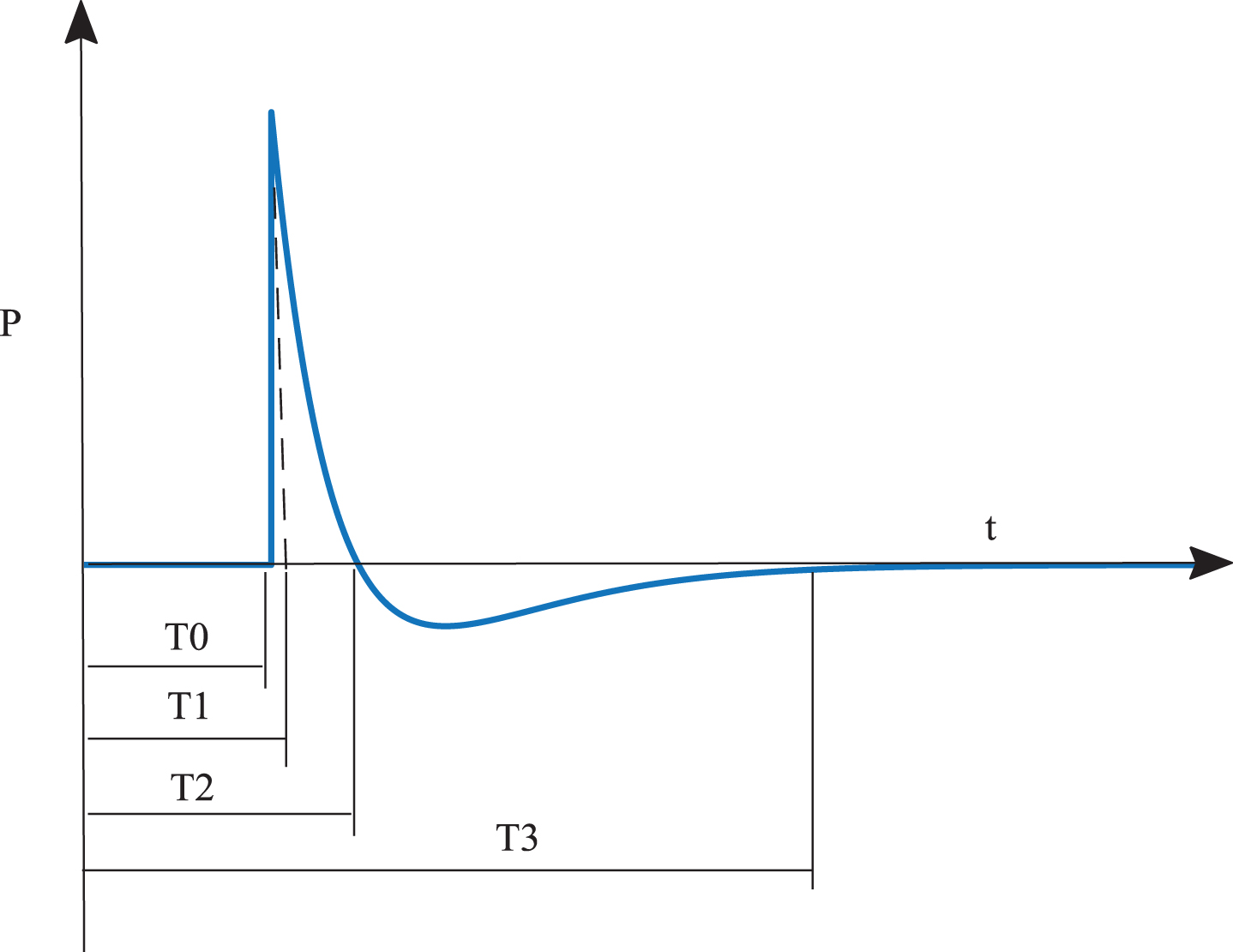
According to Equation (1), the ideal shockwave history curve is deduced as shown in Fig. 1, rise time, positive pressure time, and negative pressure time.
Ideal shockwave process curve.
The Fourier transform of formula (1) yields the spectral function as follows:
To estimate the bandwidth required for p (t), we can make d|P (jω) |/ - dt = 0 and find that whenω = 1/t0, the frequency response |P (jω) | has a maximum value:
|P (jω) | is a continuous function, angular frequency ω→ ∞. If the maximum frequency component of the shockwave is 1/100 of the main peak frequency, then from the following formula:
Find out the highest angular frequency ω h = 200/t0
Get the highest frequency:
So the bandwidth occupied by the shockwave p (t) is 0 ∼ f h . The smaller the caliber of the weapon, the smaller the corresponding shockwave t0, the gun shockwave t0 is about 0.3ms, the corresponding bandwidth is about 0 ∼ 100kHz.
The principle of power-law detector
Nuttall [19] proposed a Power-law detector. When the additive sequence is Gaussian white noise, the square of the discrete Fourier transform amplitude is an exponential random variable with independent distribution. At this time, no signal exists. When the signal appears, the time discrete Fourier transform (DFT) Amplitude square value no longer subject to exponential distribution, then you can determine the existence of a signal.
The basic assumption put forward by Nuttall is
Nuttall thinks that the detection of transient signals in the Gaussian background can be considered as the detection of any M-point signal in N-point DFT data. Here M refers to the spectral component of the transient signal, and the signal strength is unknown, which is similar to the detection of unknown signal shape spectrum, so he proposed the following non-parametric Power-law detection method.
Where is the kth amplitude squared value of the received time-series signal DFT result, is the threshold, is a nonnegative real number. The basic idea of Equation (7) can be expressed as follows: When the signal exists, the amplitude of its M data points is uniformly distributed in N Fourier Transforms, and then the exact probability distribution function depends on the instant State signal itself.
Notice that in Equation (7), the test statistic is only the sum of the squares of the periodic pattern values. It should also be noted that no prior knowledge of the signal is required in Equation (7), so a priori knowledge of the signal and noise less.
Since the above Power-law detector needs to pre-whiten the data, Nuttall also proposes a constant false alarm detection expression that does not require pre-whitening:
Through the actual shockwave signal processing, it is found that most of the transient shockwave signals exhibit non-Gaussian characteristics, so we can consider the use of higher-order spectrum to reduce the influence of Gaussian background noise to improve transient signal detection performance [14].
C3x (τ1, τ2) represents the third-order cumulative amount.
Substituting |B3x (ω1, ω2) |2 for X
k
in Equation (7) yields a high-order-based Power-law detector:
In Equation (9), when the diagonal slice of ω1 = ω2 is taken, the bispectrum diagonal slice (
Furthermore, the dual spectral diagonal chip Power-law detector that does not require pre-whitening is obtained:
Definition of DTCWT
DTCWT contains two parallel decomposition trees; two separate real wavelets are needed to compute the real and imaginary coefficients separately. In practice, the dual-tree algorithm is adopted to realize decomposition transformation [16, 17].
The Fig. 2 shows the double-tree complex wavelet decomposition transform of one-dimensional signal, while h0 (n) and h1 (n) are the low-pass and high-pass filters, respectively, of the tree A decomposition, it produces the real part of the low frequency and frequency wavelet coefficients;g0 (n) and g1 (n) are the low-pass and high-pass filters, respectively, of the tree B decomposition process, it produces imaginary low-frequency and high-frequency wavelet coefficients; ↓2 indicates down sampling operation.

Analysis FB for the DTCWT.
The function of the real part filter ψ
h
(t) and the function of the imaginary part filter ψ
g
(t) is a complex wavelet, which is
The excellent performance of the dual-tree complex wavelet is derived from the analytical nature of ψ
c
(t). For ψ
c
(t) to satisfy the analytical nature, ψ
h
(t) and ψ
g
(t) are required to form a group of Hilbert transform pairs, which is
The necessary and sufficient condition for the two orthonormal wavelet functions to form a Hilbert transform pair is: two low-pass filters satisfy the half-sampling delay condition, then the orthogonal wavelet basis has:
Equation (14) is Equation (17), and it is called (17) half frame shift condition. Since the half-frame shift is equivalent to doubling the sample size of the low communication number at each scale, this greatly avoids the occurrence of out-of-sample phenomena caused by the binary sampling. The selection of binary tree structure and special filter makes the transformation invariant and frequency unbiased.
Anti-double tree complex wavelet transform is the inverse transform of DTCWT, and the upper sampling operation ↑2 is adopted.
Using Mallat algorithm for discrete wavelet transform (DWT) has the translation sensitivity, and to design the reasonable filter dual-tree complex wavelet transform can eliminate the defects, and can achieve the result of approximate shift invariance. Figure 3 for the input of a set of shockwave signal, with dual-tree complex wavelet transform and discrete wavelet transform respectively four layer decomposition structure by the corresponding wavelet functions and scale translation sensitivity test results. The left image is the transformation result of the two-tree complex wavelet to the step signal, and the right image is the result of discrete wavelet transform. d1 ∼ d4, a4 represents the reconstructed signal at each scale. It can be seen from the figure that when the signal is delayed, the result of the double tree complex wavelet transform also has the corresponding delay, and it will not be as obvious as the discrete wavelet transform.

The shift test for the two transforms. (a) DTCWT, (b) Real DWT.
A small shift of the signal affects the amplitude of the wavelet coefficients near the singularity and has a great influence on its coefficient distribution. Amplitude normalization is a duration of 0.009ms shockwave signal simulation, with 1 MHZ sampling rate respectively of original signal and the signal sampling time delay six sampling period, respectively the three layers using DTCWT and DWT decomposition, computing the wavelet coefficient of energy. The third layer of wavelet coefficients is shown in Fig. 4. The energy coefficient of DTCWT is the same, and the difference in the energy of DWT is doubled, indicating that DTCWT is stable.

Energy of the coefficients test for the two transforms. (a) DWT Squared 2-norm=1.1e+03, (b) DTCWT Squared 2-norm=1.29e+03, (c) Delay Signal DWT Squared 2-norm=563, (d) Delay Signal DTCWT Squared 2-norm=1.29e+03.
Detection and extraction process
The process for signal x (t) is shown in Fig. 5. First of all, HOCS Power-law is used to detect the data, and the threshold is judged according to the contrast. If H1 is established, DTCWT extraction is performed. Otherwise, H0 has no valid signal. DTCWT decompose, calculate the threshold T, and further processes the coefficients of each layer, and finally by inverse transform to synthesize noise reduction signal

The process diagram.
Signal noise ratio
The commonly used signal to noise ratio (SNR) is defined as the ratio of the average power of the signal to the average power of the noise during the duration of the signal. However, for the signal to noise ratio [20] of transient noise, it is more meaningful to use the instantaneous power and the average power ratio of the noise.
In this type, P s is the instantaneous power of transient noise, P n is the is the average power of background noise.
A statistical analysis of shockwaves(The sampling interval is 1US, and the sampling point is 5728.) with a positive action time of 0.009ms for the normalized amplitude normalization is carried out, the average power of the signal is 0.0042 dBW, while the instantaneous power is 0.014 dBW, and random noise superimposed on 0dB signal-to-noise ratio. Compared to the original shockwave as shown in Fig. 6. It can be seen from the diagram that the effective time of the original shockwave signal is 10ms.The mean power is used to calculate the signal to noise ratio, which is equivalent to reducing the signal energy, which leads to the decrease of the average power of the noise, which leads to the misjudgment of the signal detection.

Contrast of different SNR signals.
Two power calculation methods, noise power statistics for signals with a signal to noise ratio of –15∼+15dB and an interval of 5dB.The result is as shown by Table 1, Pn1 is the average power of background noise calculated using average power, Pn2 is the average power of the background noise calculated by the instantaneous power of the signal. By contrast, it is found that the power gap between the superimposed noises is increasing with the decrease of the signal to noise ratio. The error of –5dB is 0.0311dBW and about 2.2 times the transient power, –10dB is about seven times, –15dB is about 22 times, and the error ratio is up to 70%
Average power of different SNR signals
Therefore, this paper uses the instantaneous power of the signal to calculate the signal to noise ratio.
Using DFT Power-law testing and HOCS Power-law testing to test signal to noise ratio (SNR) of 0, -5, -10 and -15dB shockwave simulation signals, the two algorithms are shown to four signal analysis results, such as Fig. 7, the results of the test are Table 2. As can be seen from figure Fig. 7, when the signal to noise ratio is -10dB, the signal has been submerged in the noise. Meanwhile, the DFT spectrum is mixed together, and the HOCS diagonal spectrum shows an obvious advantage in the suppression of noise; when the signal to noise ratio is -15dB, the noise has a certain influence on the diagonal spectrum, but it does not affect the detection of the signal.

Analysis results of different spectrum algorithms. (a) 0dB Single-Sided Amplitude Spectrum, (b) –5dB Single-Sided Amplitude Spectrum, (c) –10dB Single-Sided Amplitude Spectrum, (d) –15dB Single-Sided Amplitude Spectrum, (e) 0dB 1-1/2 Signal Spectral Density Estimate, (f) –5dB 1-1/2 Signal Spectral Density Estimate, (g) –10dB 1-1/2 Signal Spectral Density Estimate, (h) –15dB 1-1/2 Signal Spectral Density Estimate.
Statistics of different detectors
Comparison of detection statistics of DFT Power-law and HOCS Power-law two detector, it can be seen that the detection ability of HOCS Power-law is much higher than that of DFT Power-law. The DFT Power-law detector is at the same order of magnitude
at four signal-to-noise ratios, and the threshold value of the detection threshold is more than 3e-05.For signals that are not applicable to the signal to noise ratio -5dB. HOCS Power-law detector is suitable for four kinds of the signal to noise ratio because of the suppression of HOCS on noise. The detection threshold can be set to 2e-04.
The HOCS Power-law detector detects the impulse signal of the signal to noise ratio of -10dB and different frequencies. The statistical results are as shown in Table 3. Changing the time of barotropic zone by setting different functional distances, then the detection statistics of different frequencies are obtained according to the frequency of the estimated signal. Comparing the threshold of HOCS Power-law detected above, it can be concluded that the frequency of the signal has little influence on the detection.
Detection results at different frequencies
Mean square error
In general, signal-to-noise ratio (19) and mean square error (20) are used as two methods to evaluate the noise effect. The higher the signal-to-noise ratio, the better the de-noising effect. The smaller the mean square error, the better the denoising effect.
In Equation:
y i denotes the signal after denoising.
x i represents the original noisy signal.
N is the signal length.
In practical application, due to the detected signal effective duration is unknown, signal-to-noise ratio (18) is more meaningful than formula (19), in order not to cause confuse, this article only uses the mean square error (MSE) as an evaluation index of signal extraction.
According to the maximum posterior estimation and the Donobo threshold denoising theory [21], the soft threshold is derived.
In Equation, σ is the marginal standard deviation of the Laplace distribution, and
The variance of each noise observation subband is estimated as follows:
Because of
Further, the threshold can be calculated:
In order to verify the denoising effect of DTCWT, the shockwave of the noisy double peak was extracted. The double peak shockwave often appears in the actual measurement, and the translation invariance of DTCWT has the advantage. Figure 8 shows the extraction effect of DTCWT and DWT, where DTCWT adopts the maximum posterior estimation threshold(25), and DWT adopts adaptive software threshold. Contrast waveform denoising effect, both can remove noise, smaller shockwaves to the second amplitude amplification, further analysis found that DTCWT waveform more approach the original shockwave, Gibbs effect of mutations in slightly smaller than DWT.

The noise reduction for the two transforms.
The simulation of seven different signal-to-noise ratio (SNR) was carried out respectively by DTCWT and DWT, and the MSE statistical results were shown in Table 4. The smaller MSE, the better the noise reduction effect. By analyzing different SNR shockwave, the SNR - 10 dB below the shockwave signal is completely submerged in the noise, the signal-to-noise ratio under 15 dB DTCWT and DWT both MSE result is above 0.5, further illustrates the - 10 dB below the difficulty of signal detection and extraction. Compared with DTCWT and DWT, DTCWT is always less than DWT, indicating that DTCWT is better than DWT.
MSE results for the two transforms
The actual shockwave signal (sampling rate 1 MHz) obtained from a certain test [5, 6] is processed according to the flow chart of Fig. 5. First, the HOCS Power-law detection is carried out, we analyze it according to Equation (12), and we get the bispectrum diagonal. As shown in Fig. 9, the spectrum display signal is more obvious, and the noise interference is less. The detection result is 0.0235, which is higher than the threshold. It is concluded that the shockwave signal exists.

Analysis results of HOCS 1-1/2 spectrum algorithm.
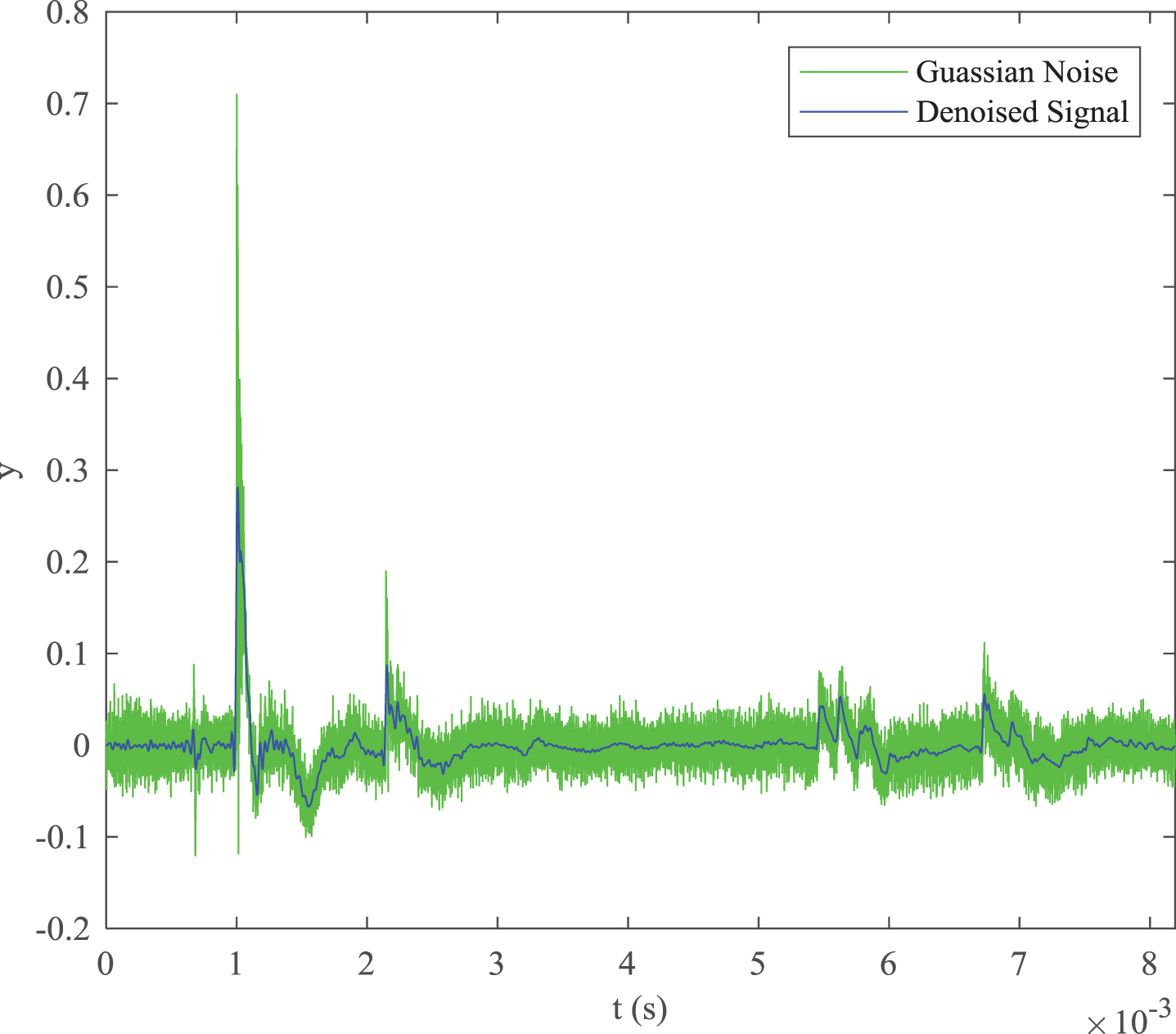
According to HOCS Power-law, the existence of shockwave is detected, then start to implement DTCWT four-layer decomposition, and the threshold value is estimated according to Equation (25). The threshold is obtained, and the wavelet coefficients of each layer are processed. Then the noise reduction signal (blue curve waveform in Fig. 10) is obtained by IDTCWT synthesis. Comparing the two waveform curves, it is found that the actually measured shockwaves have different amplitude peaks and the noise has a greater impact on them. The DTCWT can extract a plurality of waveforms whose amplitude is smaller in the noise, and the waveform is intact.
The noise reduction for DTCWT.
After the shockwave signal is extracted, the MSE calculated according to formula (20) is 0.0189.The validity of the DTCWT algorithm is further illustrated. The experimental results show that the DTCWT algorithm is not only effective for the waveform of the main peak shockwaves, but also further achieves the small amplitude shockwave extraction before and after the main peak and provides further possibilities for the analysis of the ground reflection, secondary deflagration and projectile shock.
To detect and extract the shockwave signal under low SNR, the different SNR simulation signal and the measured data were analyzed based on the transient signal SNR, the power-law detector of HOCS and the DTCWT based on the maximum posterior threshold value in the study.
The following conclusions could be drawn: The signal to noise ratio of transient signals is more meaningful, and the average power size of background noise is evaluated accurately. HOCS power-law detector is better than the traditional Fourier transform, which is not affected by Gaussian noise in a certain signal-to-noise ratio, and the calculation is small. DTCWT invariance of the shockwave signal analysis of multiple peaks has the advantage, based on the maximum a posteriori estimation of the threshold can filter out most of the noise, can also extract the amplitude smaller shockwave form.
Thus, simulation theory and actual signal analysis combined with the proposed transient signal SNR, the high-order spectral power-law detector and dual-tree complex wavelet extraction model are more practical, for low SNR extraction under shockwave signal detection and multi-peak waveform provides a reference. However, due to the high noise types in the shockwave signal, further classification of noise is required in future, and the accuracy and robustness of threshold estimation are further improved.