



Abstract
Medical image restoration is a fundamental issue in the area of medical signal processing, which aims recove high quality medical image from its degradation observation. Recently, the methods with nonlocal self-similarity prior have led to a great improvement on many medical image restoration tasks. Nevertheless, the nonlocal technique is generally embedded with only one kind of constraint, such as sparsity or low-rank in the conventional model, which limits their abilities and show good performance on certain prior. To address this problem, in this paper, we present a novel medical image restoration method with multiple nonlocal-based prior regularizations. The surfacelet transformation is introduced to construct a cubic sparsity constraint to a group of nonlocal similar patches. Likewise, due to the self-similarity existed in the medical image, two extra kinds of nonlocal-based priors, nonlocal total variation and nonlocal weighted low-rank, are also exploited to constrain the local smoothness and nonlocal relationship jointly. In this way, each of the designed priors can well recover a group of patches with similar structure. And then, the designed priors are combined into a unified proposed optimization framework, which will obtain the advantages from all of them simultaneously. Finally, to solve the objective function in the proposed framework, we develop an iterative numerical scenario based on alternating direction multipliers method. The extensive experiments on test medical images demonstrate that our proposed model outperforms the comparison methods on both of visual quality and objective evaluation results.
Introduction
MRI is an important method of medical diagnosis, which is accurate and has little damage to the human body. However, MRI also has the disadvantage of excessive scanning time, resulting in motion artifacts due to the movement of the patient. And it is not conducive to obtaining correct examination results. Besides, another challenge in MRI processing is the noises produced by the natural attribute of the imaging system, the motion displacement of the patent, the existence of some metal foreign body, the influence of the external environment and etc.
Researchers have proposed a flurry of methods to solve these problems, including accelerating the sampling procedure, and having the origin image restored. The reconstruction and denoising of MRI image can be treated as part of image restoration task and be both modeled by the following degenerate process.
Then the task of recovering x is completed by solving the following equation
And the solution is more complicated in other situations. If H is a undersampling matrix in some transform domain, which always happen when the signal is sampled below the Nyquist rate, it’s a highly underdetermined problem to reconstruct x from undersampled data y because that there are more variables than the equation. There exist lots of possible solutions. However, if x is sparse, x can be reconstruct in a high possibility according to the CS theory [1, 2] with a measurement matrix H that is highly incoherent with Φ. x is sparse if it can be written as x = Φc, where Φ = {Φ1, Φ2, ⋯ , Φ N } is so called sparsifying transform domain basis of i N and c is a vector containing much more zero entries than nonzero entries, written as ∥c ∥ l 0 = k = N.
According the CS theory, the estimation of the restoration task is reconstructed by linear programing
In order to gain better robustness to noise, different kinds of regularization prior (i.e., sparse prior) about the image are added as penalty term R (x).
The first term punishs those solution based on distance measure (i.e., mean square error
The first is isotropic and the second one is anisotropic l1-based TV [5]. Total variation has been introduced by Rudin-Osher and Fatemi (ROF) in [3] as an edge-preserved local image transform. Because the image polluted by the noise have a larger total variation than noise-free image, it can indicate the smooth degree and is used widely in deburring and denoising.
Besides TV norm, low rank is another popular approach that capture the nature of the signal like images and videos. Hoverer, minimizing rank (x)is proved a NP hard problem, so we minimizing the convex envelope of rank (x), so-called nuclear norm instead.
A low-rank matrix refers to a matrix with a linear correlation between rows and columns or columns of a matrix, which has generally only a few large singular values. With the low-rank matrix completion, some elements of a low-rank matrix lost or damaged can be recovered according to the known elements. The training sample is divided into multiple sub-blocks, then the low-rank matrix recovery algorithm is used to learn from the sub-blocks and find the weight of the image used in block reconstruction. Lingala et al. [6] have also found a way to apply both low-rank constraints and sparse priors to the reconstruction of magnetic resonance images. And high acceleration and background separation are achieved by apply low-rank in a decomposition model [7, 8].
In addition to exploiting a prior information about original image, developing effective methods to exploit the self-similarity has been the topic of much research recently. Non-local methods assume that structural self-similarity in different patches of an image is ubiquity. Therefore, redundant information existing in images patch with similar texture and structures can restrain noise and provide detail for each other. And nonlocal regularizers have shown significant improvement on performance in image restoration tasks. Enlighten by successful application of nonlocal means, several non-local methods have also been proposed in image filtering [9], denoising [10, 11] and dehazing [12].
Due to the advantage of the nonlocal technique in image restoration, we present a novel approach that designs three nonlocal embedded constraint and puts them into a unified optimization framework, which can not only obtain better visual quality but also preserves more fine structures, to address the medical image restoration problem. The main contributions of our work are as follows. We design a nonlocal sparsity constraint based on surfacelet transformation. To exploit the redundant information, we firstly group the self-similarity nonlocal patches into cubic matrix as a basic processing unit. And then, we constrain the sparsity of the unit by surfacelet transformation, which can better preserve the two dimensional structures of image patches. We combine the designed cubic nonlocal sparsity constraint, the weighted nonlocal low-rank constraint and nonlocal total variation into a unified framework, which can exploit the advantages of the three regularization items simultaneously. An iterative numerical scheme based on alternating direction multiplier method is developed to solve the objective function in the proposed framework efficiently and effectively. At last, we implement extensive test experiments and compare our proposed with some existing excellent restoration algorithms on two representative restoration tasks, image compressive sensing and denoising. The results of the experiments show that our method outperforms others for various noise levels and compressive sampling rates.
Nowadays many methods have been proposed for image processing. Such as image denoising, image reconstruction [13–19, 20] and basic theories of image processing [21–23]. This method can be used in the people’s life, such in the medical area and so on.
The work in [24] proposed a way to deal with the image denoising, through this way can get a computationally simple denoising method by using the LRA. This method is different from the other SVD-based methods, the LRA in SVD domain avoids learning the basis for representing image patches, which usually is computationally expensive. The result of this method shows that it can effectively reduce noise in the image denoising. Besides this way of imaging denoising, in work [25] also proposed an efficient way, they proposed an implementation of distributed parallel optimization of K-SVD method on Spark, the result of the experiment shows that this method can not only get a good speed-up ratio, but also remains the details of the image. In work [26], they proposed a new method of image denoising, which can be used for completion and denoising of multilinear data.
Besides image denoising, in order to get better image, image reconstruction is also very important. Recent years, there are lots of new methods have been proposed for image reconstruction, in order to get a better result of the image reconstruction, there are a lot of papers which proposed new methods to obtain better results. As for the recovery of the image, Bayesian methods can be used, in work [27] they use the Bayesian method to recovery the images which are incomplete. The work in [14] W. Dong, G. Shi, X. Wu, and L. Zhang proposed use the AR models to construct adaptive sparsity regularizations for CS image recovery. In work [15], they proposed a new method to make the image restoration which is named SAIST. In this algorithm, they take a low-rank method which towards SSC and provide a conceptually simple interpretation from a bilateral variance estimation perspective. They proposed a new class of image recovery which is called SAIST. The work in [25], they proposed a new method of image restoration called SAIST. This algorithm generalizes the Bayes-Shrink from local to nonlocal models in order to solve the noise data. After the experiment, the result shows that this method can solve the image processing efficiently, especially when the noise levels is high and in the situation with large amount of missing data.
The basic theory of image reconstruction is also important, as for the theory in [28] proposed a novel iteratively reweighted TV regularization for CS reconstruction. This method is mainly used the posteriori estimation of the image gradients to compute the weight of spatially adaptive. Yue Lu and Minh N. Do combined the multi-scale pyramid and multi-directional filter bank (NDFB) and proposed the Surfacelet transform [29], which is suitable for the processing of 3D images. They proposed a new family of filter banks, named NDFB, which can achieve the structured construction. In work [30] presents a novel image classification framework by using the low-rank matrix and Laplacian group sparse. In order to improve the deficiency of the total variation in compressive sensing, they proposed a new method in work [13], which can solve a combination of total variation and a new regularization term under the framework of compressive sensing.
Total variation (TV) is a method which uses the fact for most of the images have a detail distribution of gradients, for that TV [31–33] can be used as a model which can be modeled as a Laplace distribution. In work [31] proposed a new method of CS, for that by using an adaptive reweighted TV strategy to get a much better preserve image. They also get the weight of the low rank regularization by using the redundancy of non-local image patches. The result of the experiment shows that their method is much better than the others approaches. The work in [32] proposed a new compressed sensing method which combines both of the external and the internal information together to get the high-performance reconstruction of image reconstruction. They use the probabilistic atlas to control the level of the gradient regularization at each image location, within a weighted TV regularization prior. The result of the experiments show that this method is better than the other approaches, especially for different sampling rates and noise levels. The work in [33] proposed a method of saving the gradient histogram. They invented an efficient optimization method, which was developed and has achieved a satisfied result for kernel estimation. They combine the gradient histogram preservation prior with the previous method of image deburring, the new method shows that in this way can improve the simulations. And the result of the new method shows that it can achieve a high SSIM.
Recently, low rank approximation [34], low rank representation [35], sparse representation [36] have shown strong capabilities in signal approximation and subspace separation, which attract attention of the academic circles recently. In work [37], they made a very comprehensive theoretical analysis of low rank matrix recovery, and proposed a matrix decomposition into the sum of low rank matrices and sparse matrices. The representation-based theory has been widely used in artificial intelligence, image processing, pattern recognition [38, 39], computer vision and other fields.
Our proposed method
With the deep analysis about the previous related works, we can see that the nonlocal technique is great effective for image restoration due to the redundant local similar structures included in the image itself. And also, some ripe applications of nonlocal technique has been realized in many practical visual restoration tasks. Thanks for the good ability in preserving the textures and edges, the nonlocal technique based methods achieved excellent results and attracted more and more attentions recently. In light of the advantages of nonlocal technique, we proposed three kinds of nonlocal-based regularization constraints, which embedded the nonlocal techniques into the conventional low-rank, total variation and sparse models. And then, a comprehensive framework will be established with the mentioned three kinds of regularizations jointly to address the medical image restoration problems.
Weighted nonlocal low-rank constraint
Low rank prior attracted many attentions recently due to its good performance in area of signal processing. To our best knowledge, the low rank model, which is first proposed in robust PCA, can find the latent subspace structure of signals and extract the relationship among them. With the robust PCA, the following low rank model is implemented on different images to address background modeling in [40] as
Though the successful applications in background subtraction has been achieved with Equation (4), for single medical image, there is not enough related images that can be used for restoration problem. Hence, our proposed method adopted a patch-based prior model to restore the medical image from its compressive observation or degradation version, which can search some related patches to help us to establish the low rank constraint. In fact, similar to the natural image, there are a lot of self-similarity patches existed in the nonlocal areas of medical image itself. So, different from the traditional low rank model for video, we can impose the low rank constraint on the groups of similar patches in single image. Some studies have shown that the patches with similar structures lie in the same low-dimensional subspace and the matrix composed of these patches has low rank property.
Let x
i
∈ R
n
be a patch image with the size of
With the matrix P
i
, we constructed a nonlocal low rank prior with the weighted nuclear norm in [41] as
Introduced by Rudin-Osher and Fatemi (ROF) in [3], total variation is a noising removing algorithm that has superb performance comparing with least square methods based on L2 norm. And it can provide sharp image without spurious noise. Moreover, the solving of constrained minimization problem is fast and simple. TV has been developed and combined with other methods [42–44] since it is proposed by ROF.
Regularization term proposed by ROF is basically L1 norm of the gradient.
where
In order to acquire a better presentation of the image, non-local TV is used in our model. Comparing to NWTV, NLTV [45] does not weight the gradient by the magnitude of the gradient. Instead, the weight is determined not only by local structural around x but also the spatial similarity of neighborhood area of image.
Compared with TV, the non-local penalty term considers both the position information and gray level information of all pixels in the neighborhood of the pixel. Therefore, R NLTV can describe the texture and detail adaptively according to patch-by-patch structure similarity, and the edge and texture is preserved better in reconstruction of image.
In view of the advantage of nonlocal total variation regularization, we introduced the NLTV as one of the regularization members of our proposed nonlocal-induced framework for medical image restoration. In the conventional total variation framework, the recovered image will generate much artifacts and serious stairs effect, which would loss many details of texture structures and edges. Nevertheless, by embedding the nonlocal technique, it is believed that more details and local textures would be preserved to improve the visual quality.
The similar image patches are stacked into a three- dimensional array in our model, and the image stack can be seen as a 3D signal. Because of the similarity of structural and textual among these patches, and correlation among the pixels in a patch, the 3D signal has high redundancy. And this fact suggests us that with proper transform, an efficient representation for the signal is possible. And if the redundancy is exploited in denoising, the reconstruction algorithm can achieve better robust to the noise.
Surfacelet Transform has a strong ability for signal processing. It has strong multi-dimensional signal processing capability and implements multi-directional multi-scale decomposition of multi-dimensional signals. It has been used in video denoising application [46, 47] for its characteristic of low redundancy and high computation efficiency. The video is a special 3D signal with one temporal dimension and two spatial dimensions. And the 3D signal formed by similar images patches have also three dimensions.
In light of the advance of surfacelet, we collect a cubic matrix with the similar nonlocal patches extracted from the original medical image, and then enforce the sparsity constraint on it with surfacelet transformation. The mentioned sparsity constraint S (x) is designed as follows:
In this section, we give our proposed objective function by combining the above three nonlocal-based constraints as follows.
In this section, we will present a efficient numerical solution to solve the proposed objective function in Equation (9) Due to the three nonlocal-based constraints, solving the problem in Equation (9) is a challenging task. To obtain a high quality recovered image, we adopt the iterative numerical scheme based on alternating direction multiplier method (ADMM) to get an approximate convergence solution.
To decouple the variables, we introduce three auxiliary variables u, v, q and then the optimization in Equation (9) can be convert into the following constraint problem:
And then, the augmented Lagrange function of constrained Equation (10) can be obtained as follows.
Next, with the ADMM, we can solve the optimization in Equation (12) iteratively. At the k-th iteration, by fixing other variables, we can firstly obtain an x subproblem about as
Equation (13) is a typical convex quadratic cost function which can be solved easily, and its closed-form solution can be achieved by forcing its derivate to be zero.
Removing the terms independent of u, we have
The minimization in (15) is the so-called nonlocal total variation recovery problem. Its solution can be computed with the method presented in [45].
Similarly, by removing terms independent of v, we can obtain
Incorporating Equation (10) into Equation (16), the minimization can be converted into the following form
Assume that
According to the reweighted scenario presented in [48], we define the j-th element of weighted vector ω as follows:
Next, we obtain the subproblem for q by fixing others as
With the definition in Equation (20), q is solved by
With the above description, our comprehensive proposed algorithm is summarized in detail in Algorithm 1.
In this section, we evaluate the performance of the proposed method and compare it with several benchmark methods. The performances of our experiments are evaluated on four gray medical images. The test images are shown in Fig. 1. We perform experiments on two kinds of restoration tasks that are compressive imaging and denoising. Due to the limited space, we only show parts of the visual restoration results. To evaluate the performance objectively, we take the PSNR as the objective evaluation indicator.

Medical images for testing.
When testing the performance on medical images compressive reconstruction, the degradation kernel H is defined as an under-sampling matrix, which only selects parts of the original data for generating the observation image. Our proposed method is compared to some recent excellent algorithms for compressive reconstruction. The comparison methods include total variation-based nonlocal compressive reconstruction method (TVNCR) in [49], the collaborative sparsity-based compressive reconstruction method (CSCR) in [50], block compressive reconstruction with directional transforms (BCRDT) [51], compressive reconstruction with multi-hypothesis (CRMH) [52] and nonlocal low-rank based compressive reconstruction (NLRCR) proposed by [53]. The parameters for our proposed method are set empirically as: λ1 = 2 . 0, λ2 = λ3 = 1.0, μ1 = μ2 = 0.1, the maximum iterative step K = 80. The patch size in our experiment is set to be 8 ×8, and the number of nonlocal similar patch used for designed regularization is set to be 20. The parameters for other comparison methods are set to be same with their papers. The experiments are implemented six times on each test image and the average PSNR result versus undersampling ratio is reported finally in Fig. 4. Due to the limited space, we only show part of the visual reconstructed results in Figs. 2–4 when the undersampling ratio is 60%.

The visual reconstruction results on image 1.

The visual reconstruction results on image 2.
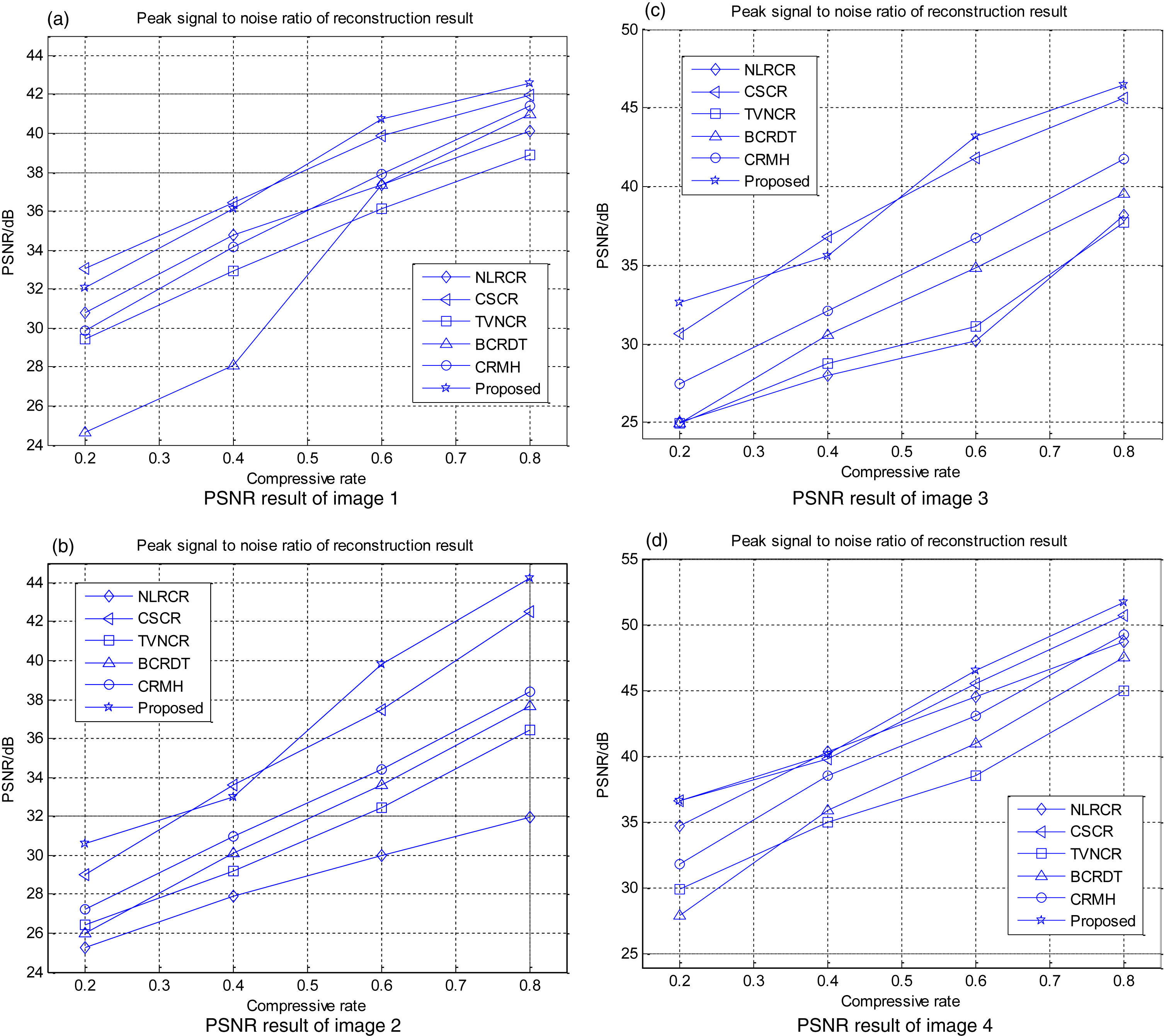
The PSNR curve of reconstruction result by comparison methods.
From the visual results, it can be seen that our proposed method shows better performance on edge and details recovery, which is significant quality evaluation of restoration tasks. Additionally, our method also obtains the highest objective indicator among the comparison methods, and shows obvious advantage when under-sampling ratio is low. In a word, both of the visual and objective results verify the competitive performance and effectiveness of our proposed method.
In this subsection, we test the denoising performance on medical images. In denoising experiment, the degradation kernel H is defined as an identity matrix, and extra noise is introduced into the observation image. In our experiments, the Gaussian white noise is used and the standard deviation is varied from 5 to 35 with 10 as interval. The compared algorithms include total variation-based denoising method called TVAL in [54], Image denoising via simultaneous sparse coding (IDSSC) in [55], nonlocal joint regularization-based image denoising method (IDNJR) [56], image denoising with gradient histogram preservation (IDGHP) [57–60], and weighted nuclear norm-based image denoising (IDWNN) method in [21]. The parameters for our proposed method are set same as the compressive reconstruction experiments. Similarly, we only show the part of denoising visual results when the noise deviation is 20 in Figs. 5, 6 respectively. The curves of average PSNR and SSIM results versus noise standard deviation are plotted in Figs. 7 and 8 to evaluate the denoising performance objectively.
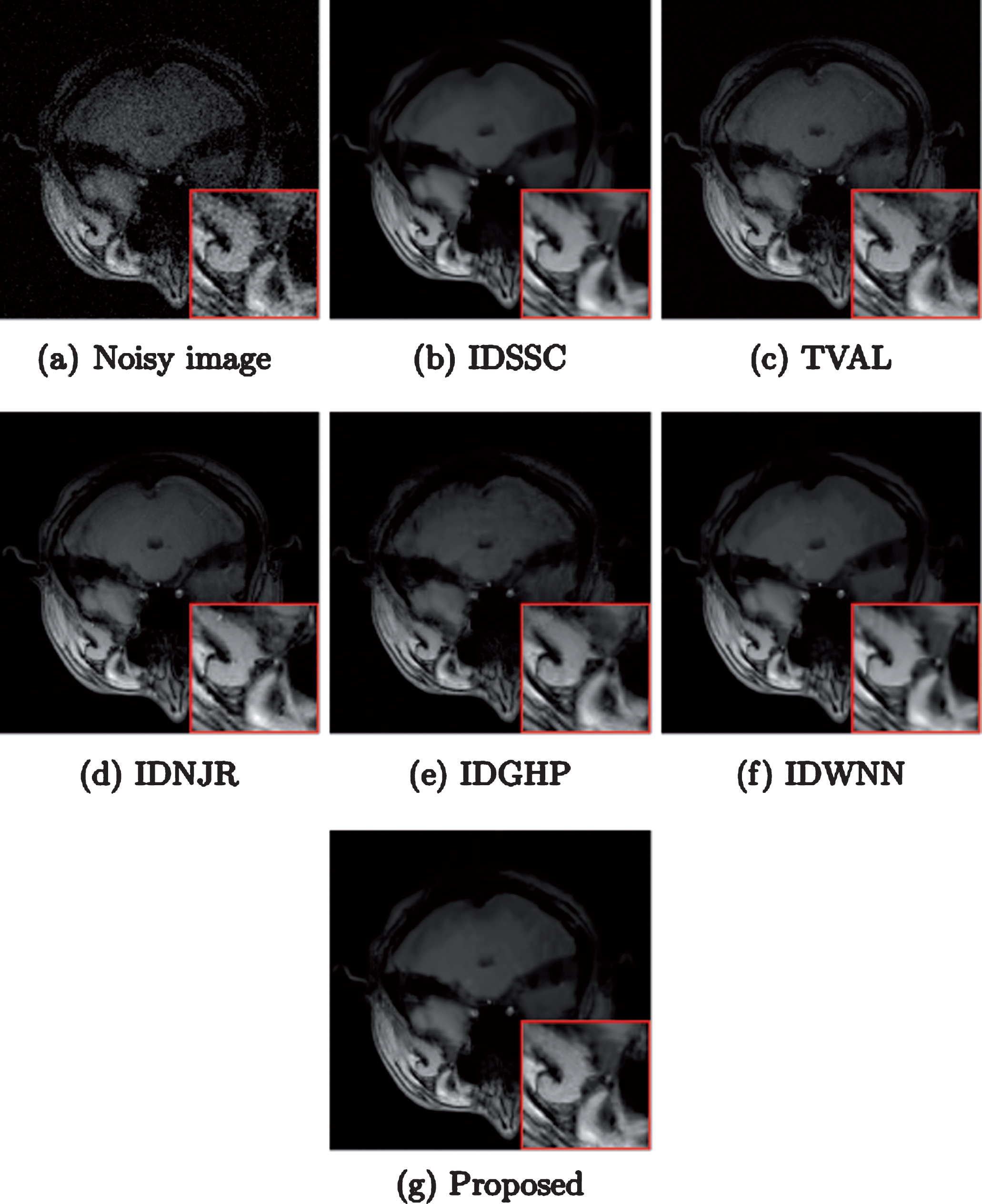
The denoising visual results on image 1.

The denoising visual results on image 3.
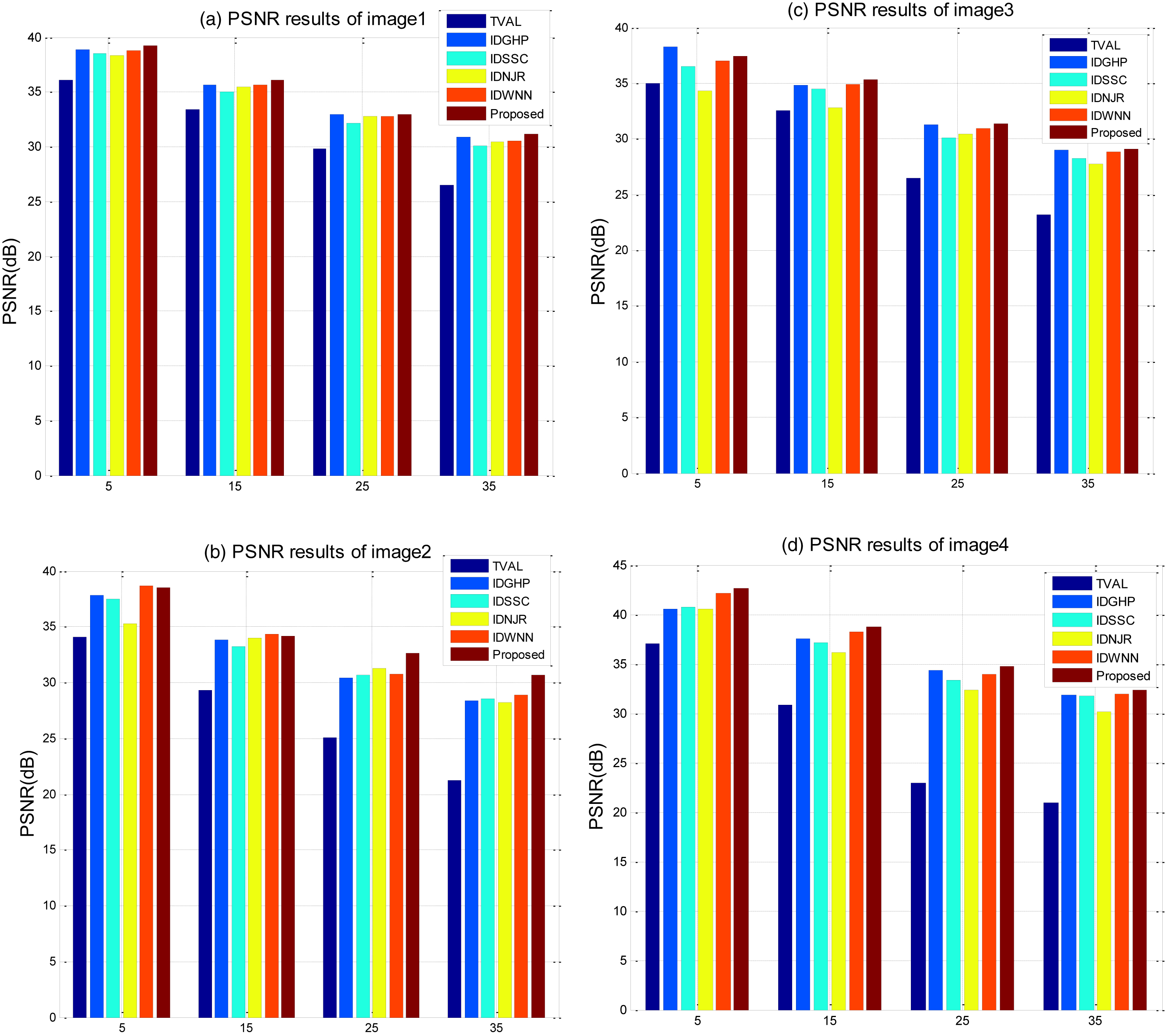
The PSNR results of test images.
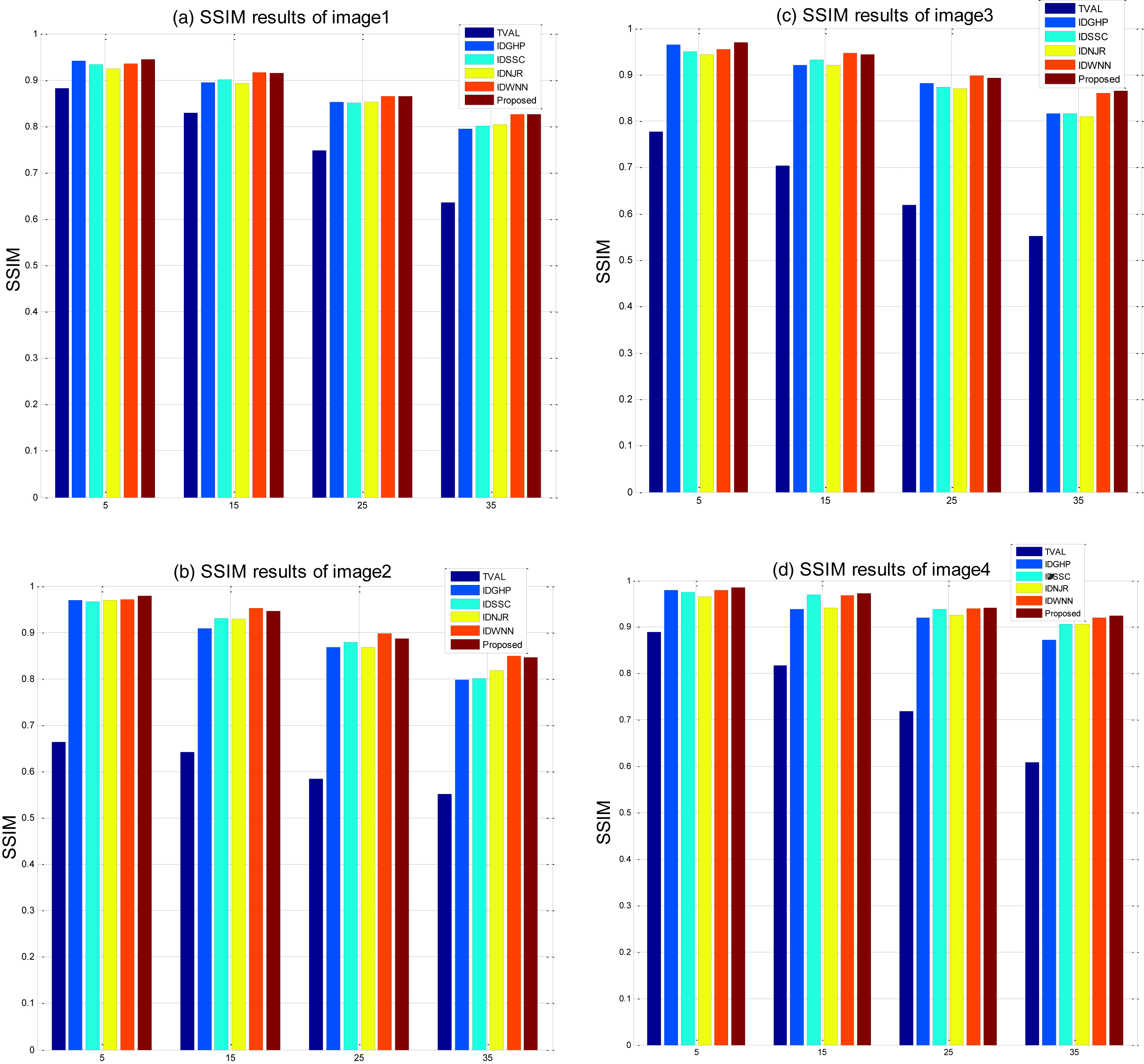
The SSIM results of test images.
From the visual results, all the comparison methods remove the most of noise existed in medical image. However, our method shows advantage on fine structures preservation and improve the visual quality greatly. The highest PSNR and SSIM curves also demonstrate that our proposed denoising method outperforms other existing excellent methods.
In this paper, a novel nonlocal-based multiple constraints framework is presented to address the medical images restoration problem. The proposed method exploits three kinds of patch-based nonlocal priors, which are nonlocal weighted low-rank, nonlocal total variation and nonlocal sparsity under surfacelet transformation, as constraints and incorporated them into a unified framework to gain the advantage from these priors simultaneously. To further improve the performance on details recovery, we introduce the surfacelet transformation to construct a cubic sparsity prior, which can better preserve the two-dimensional structures of nonlocal patches. Different from the conventional approaches, which focus on either nonlocal self-similarity or local smoothness preservation, our proposed method jointly constraint the two aspects in the same framework. Furthermore, an iterative optimization technique based on ADMM is proposed to solve the framework effectively to obtain an approximate solution.
The performance of our method is evaluated on two kinds of representative medical image restoration tasks, medical image compressive reconstruction and denoising. Various visual recovered results show the advantage of our proposed method on fine structures preservation. And also, the PSNR curves verifies the superiority compared to current conventional algorithms.