



Abstract
The concept of Hesitant Fuzzy Sets (HFS) came into picture where a set is created of the possible membership values that are willing to participate for contribution to the fuzzy sets. HFS has recently become very popular between researchers who are working on variants of fuzzy logic. This paper highlights the research queries related to the Scientometric analysis of HFS by studying 410 research publications from the Web of Science (v.5.31) database (from inception of Web of Science online data till 2017). This paper answers questions pertaining to the important terms and concepts for HFS, co-authorship patterns in HFS, dominating research areas of HFS, and countries with maximum research paper contribution, co-citation patterns for first authors and bibliographical coupling for organizations. A brief outline of the citation analysis is also made in the form of a sub-section.
Introduction
Fuzzy logic is known to have resolved several research issues when it comes to applications in all areas including data analytics, mobile computing, cloud computing etc. Through the past several years it has been seen that researchers across the globe are trying out various variations to fuzzy logic. This is because fuzzy logic has proved its strength in handling uncertainty. This uncertainty however can be further divided into sub categories like data imprecision, randomness, ambiguity and incompleteness. Hence researchers are adopting several theories to resolve issues related to this fuzziness. Type-2 fuzzy logic, for instance, is known for its capabilities in maintaining the “footprint of uncertainty” for a given problem [1]. This means that an uncertainty value will be associated with each membership value. On similar lines, for further resolution of fuzziness in data, Hesitant Fuzzy Sets (HFS) was introduced [2]. As the word hesitant suggests, there might be some possible values of membership function and corresponding membership values but not all of them will reflect belonging in the fuzzy set. For example: “He is tall” is the given problem. Now tall can have belonging as 0.70, 0.71 or 0.69. This shows values share close quarters. Hence the concept of hesitant fuzzy sets came into picture where a set is created of the possible membership values that are willing to participate for contribution to the fuzzy sets. HFS, Type 2 fuzzy logic, fuzzy metaheuristics and neutrosophic fuzzy are all different extensions to fuzzy logic. HFS can be used in combination with Intuitionistic Fuzzy and other variants of fuzzy logic like type-2 fuzzy logic for various interdisciplinary applications ranging from natural language processing to real time decision making.
A lot of research is being done nowadays on hesitant fuzzy sets. Since this is a hot topic in research hence this paper tries to present a Scientometric analysis of HFS from the inception of online data available on Web of Science to 2017.
This paper helps to assist its readers in answering some of the significant research questions as follows: Important terms and concepts to be analyzed in depth for studying HFS Co-authorship patterns for research papers in HFS Dominating research areas in HFS Countries with maximum research paper contribution in HFS Co-citation patterns for first authors of research papers in HFS Bibliographical coupling for organizations publishing research work in HFS Top cited research publications in HFS
The following section outlines the methodology adopted for analyzing the answers to the above-mentioned research questions.
Adopted methodolgy
For analyzing the research patterns in HFS, the authors have used a direct search query on Web of Science (v.5.31) database. As shown in Fig. 1, all the research papers with the keyword “hesitant fuzzy” in web of science from the year 1989 to 2017 are mentioned, which are 410 in number. This search includes research publications which are indexed in SCI-Expanded, SSCI, ESCI and A&HCI databases. The retrieved documents contain:
Articles
Abstract of published items
Art exhibit reviews
Bibliography
Books
Biographical-items
Book chapters
Book reviews
Chronology
Corrections
Additions
Database review
Data paper
Discussions
Early access
Editorial material
Excerpt
Fiction
Hardware review
Letter
Meeting abstract and Meeting summary
News item
Note
Proceedings paper
Record review
Reprint
Retracted publication
Script
TV or Radio review

Search results for Hesitant Fuzzy in Web of Science (v.5.31) database.
After retrieving the above-mentioned publications, they were analyzed and studied in depth to spot the answers to our research queries. These queries were solved in both an automated and manual manner. For the manual analysis, data representation pictorial representations were formed that could be easily comprehended by the readers. For the automated analysis, VoSviewer is used. The next section describes the analysis conducted in detail.
This section highlights the outcomes obtained from research analysis of results obtained in the previous section.
Manual analysis
In order to prove the significance of HFS in various interdisciplinary fields, the research areas corresponding to the 410 publications were analyzed. It is observed that the top 5 research areas are (see Fig. 2): Computer science with 322 publications Mathematics with 61 publications Engineering with 56 publications Automation control system with 22 publications Operations research management science with 21 publications
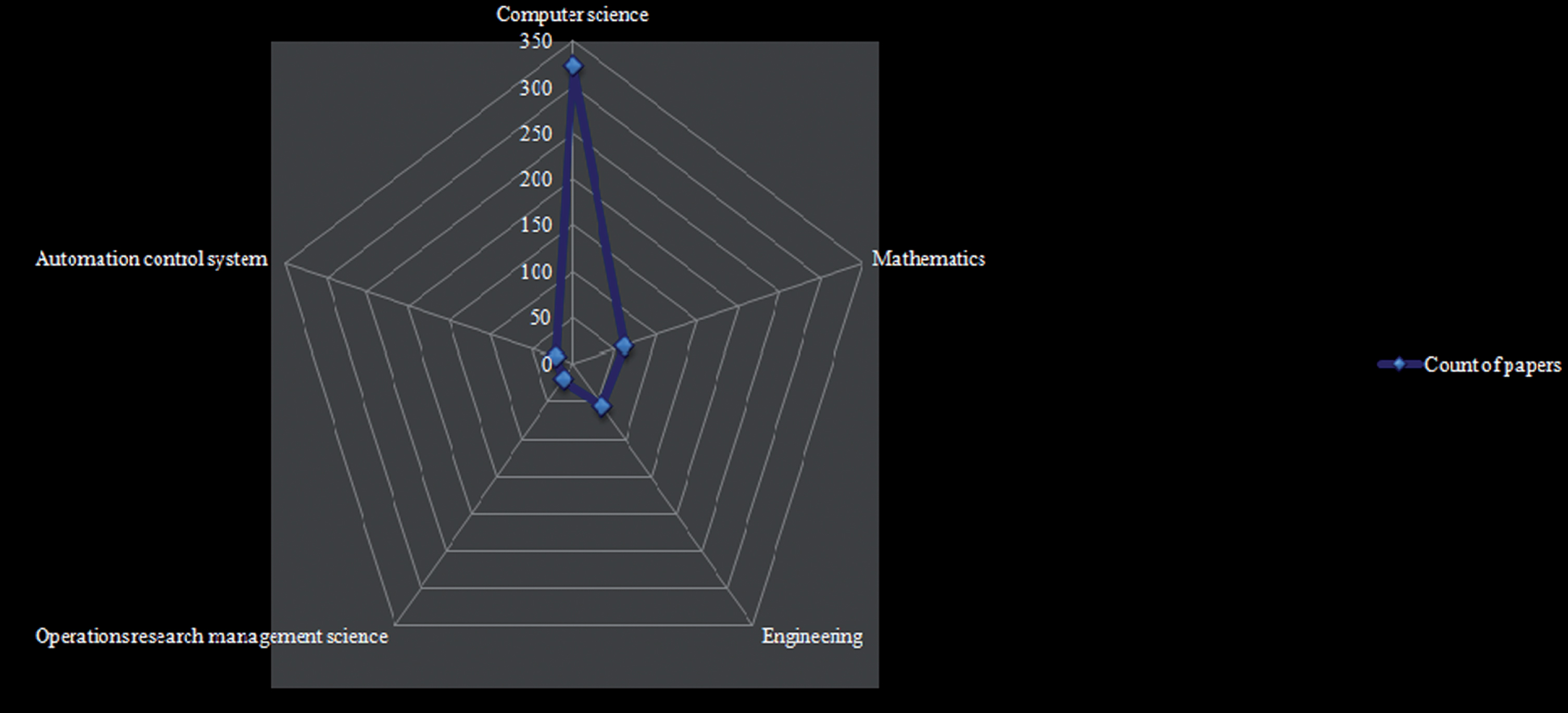
Top research areas for HFS.
This in turn proves how the use of HFS is not limited to any one branch of engineering.
Next in line is the study for finding out the countries that offer maximum research paper contribution in HFS. As shown in Fig. 3, China outnumbers the other countries in this area and gains the topmost position followed by Iran and Spain. The detailed analysis is as follows:
China contributed for 317 research publications
Iran contributed for 29 research publications
Spain contributed for 26 research publications
South Korea contributed for 14 research publications
Pakistan and Saudi Arabia contributed for 13 research publications
Turkey contributed for 11 research publications
England contributed for 8 research publications
India and Taiwan contributed for 6 research publications
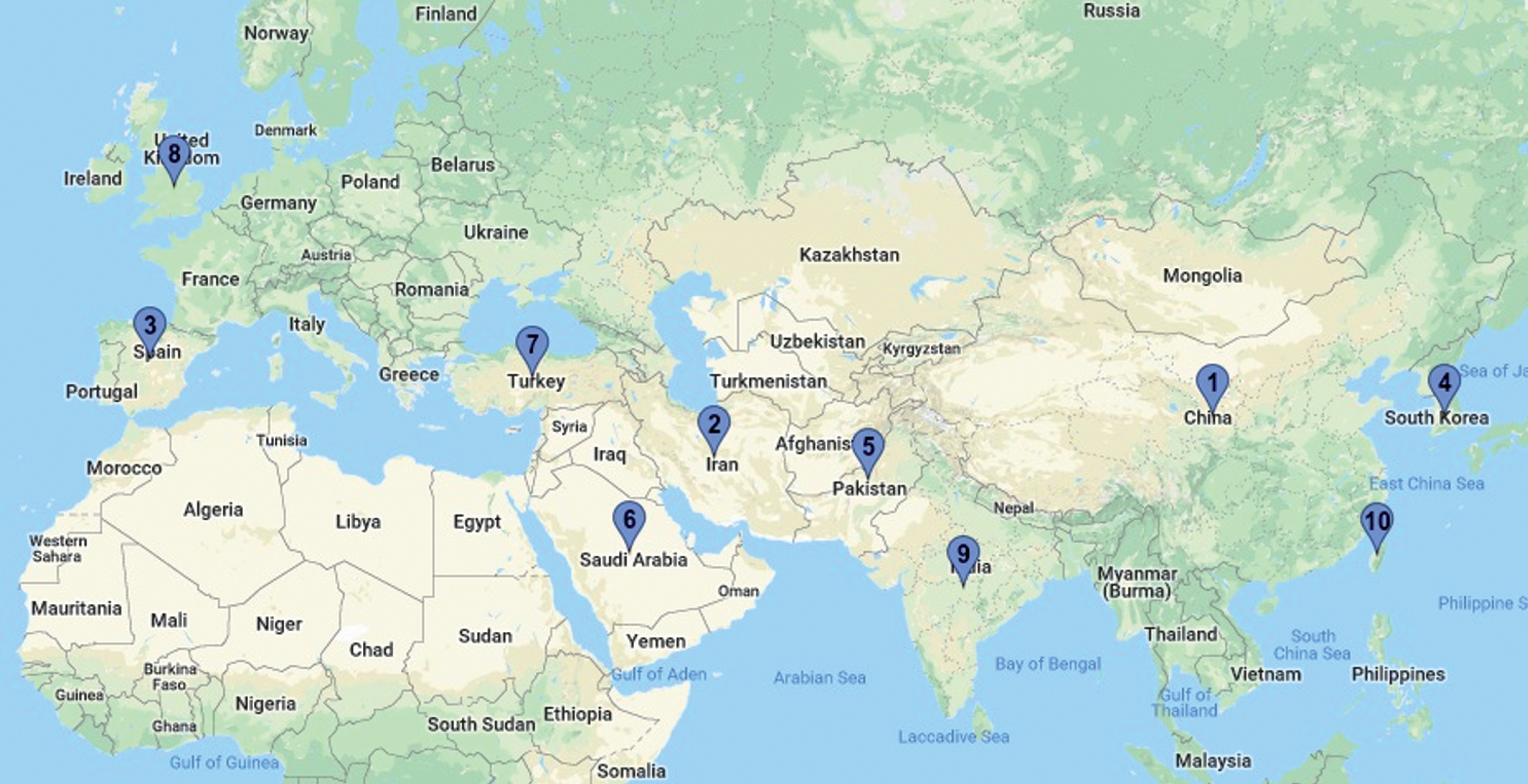
Mapping the top 10 countries that offer maximum research paper contribution in HFS.
For any research topic, there exists a set of control terms that are significant for a reader if he/she wants to study that topic in detail. For instance, if a person wants to study clustering algorithms then he/she has to study “K-Means”. Similarly, there exist some concepts related to HFS, like entropy, fuzzy set, operators, dual hesitant fuzzy set, intuitionistic fuzzy set, multiple attribute decision, hesitant fuzzy semigroup, hesitant fuzzy linguistic information, hesitant fuzzy subalgebra, optimization model etc. These control terms are well mapped in a heat map as shown in Fig. 4.
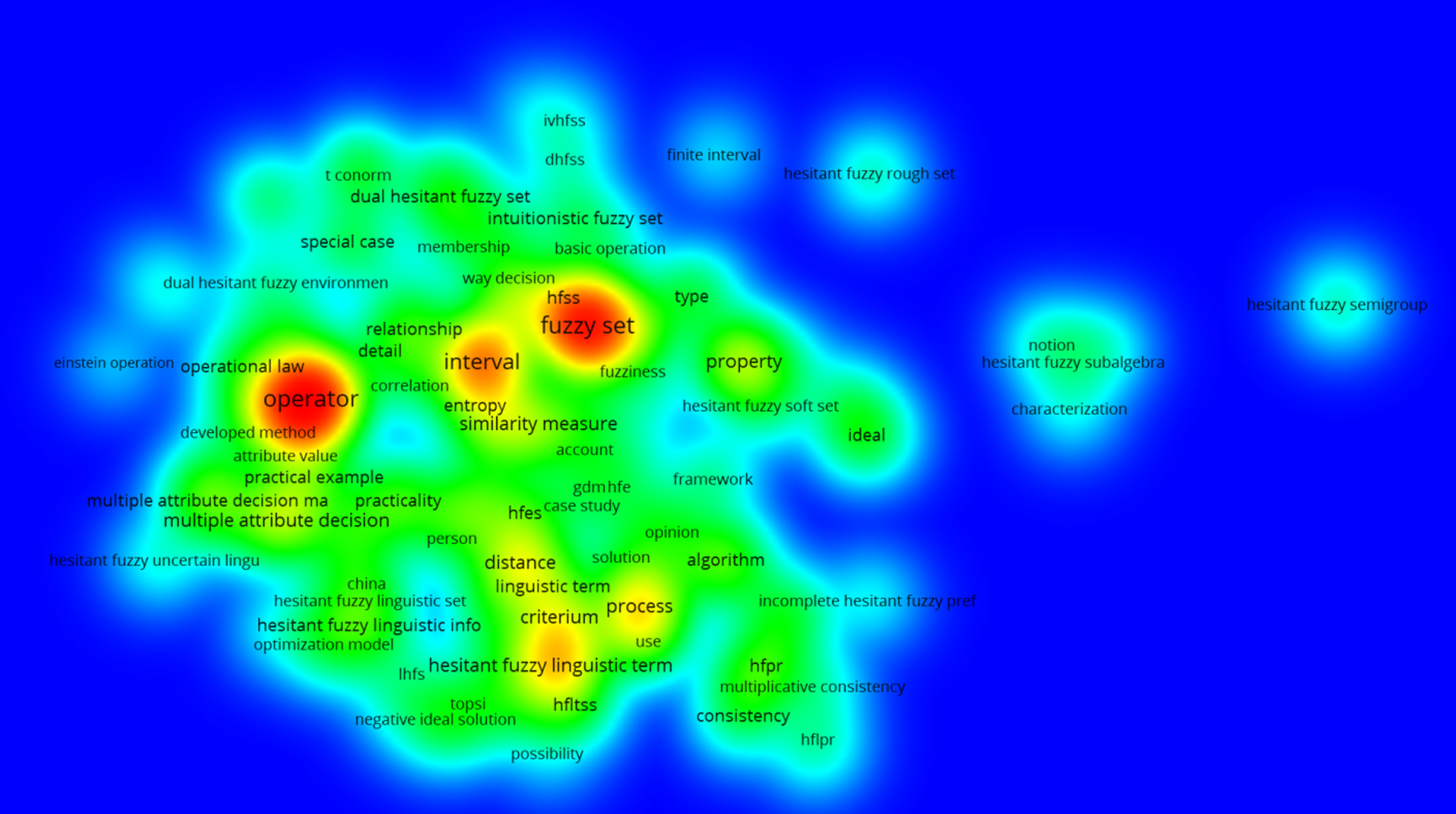
Heat map for spotting significant control terms.
For further adaption, these clusters of Fig. 4 are modeled into density cluster visualization as presented in Fig. 5. The smaller clusters are well merged into one another and no normalization method is used to cluster creation using seed value as 3. The significance of these clusters is that the terms that are closely related to each other lay under one cluster. The merging boundaries of these clusters show that these concepts are inter related and study of one is necessary for the study of the other.
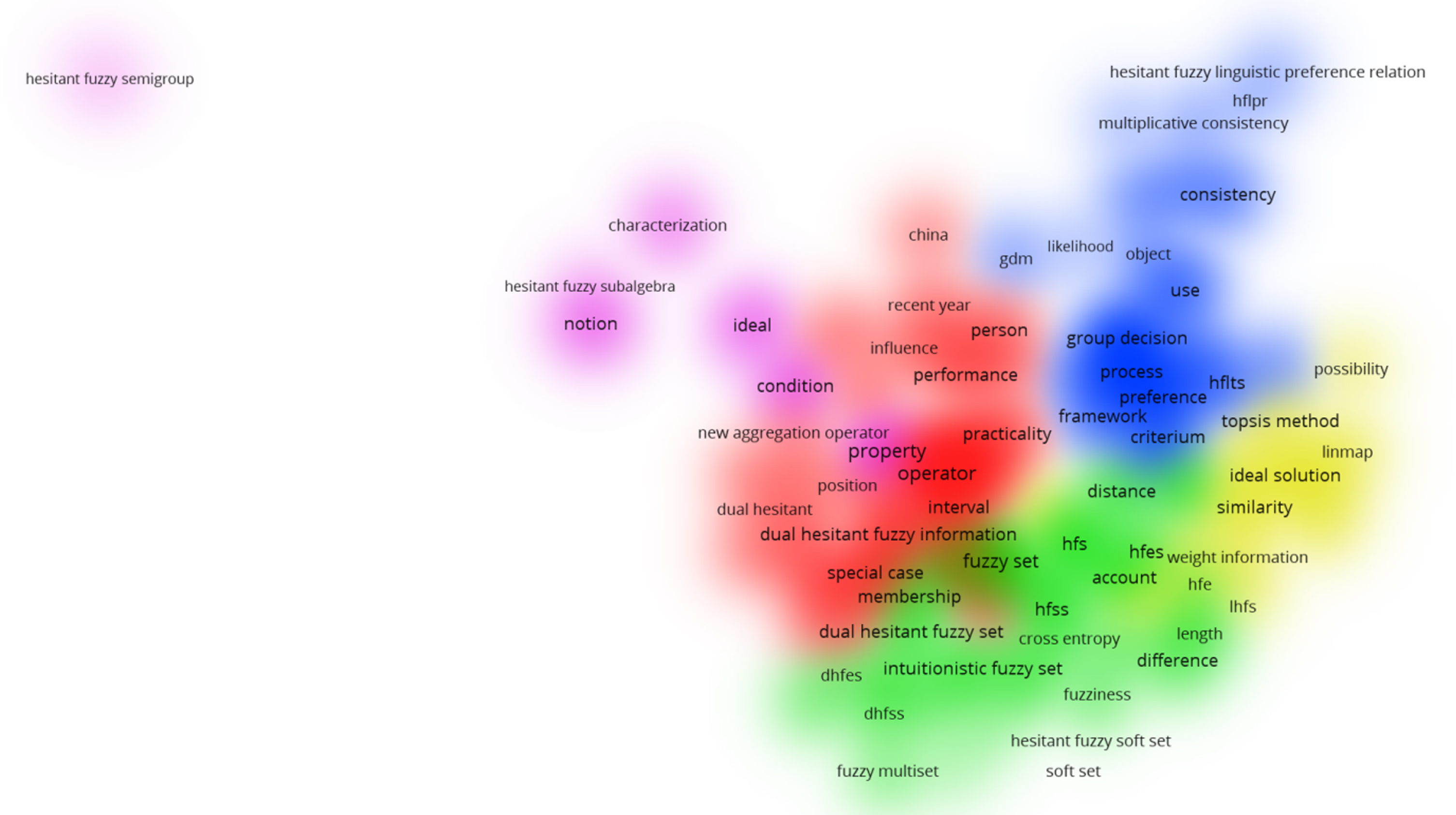
Cluster density visualization of control terms.
For the Scientometric analysis of HFS, the co-citation between the first authors of these 410 research papers is done which is visualized in Fig. 6. The thick density of this graph illustrates how the authors are citing each other’s work as much as they can, which is in turn helpful for the research community as a whole.
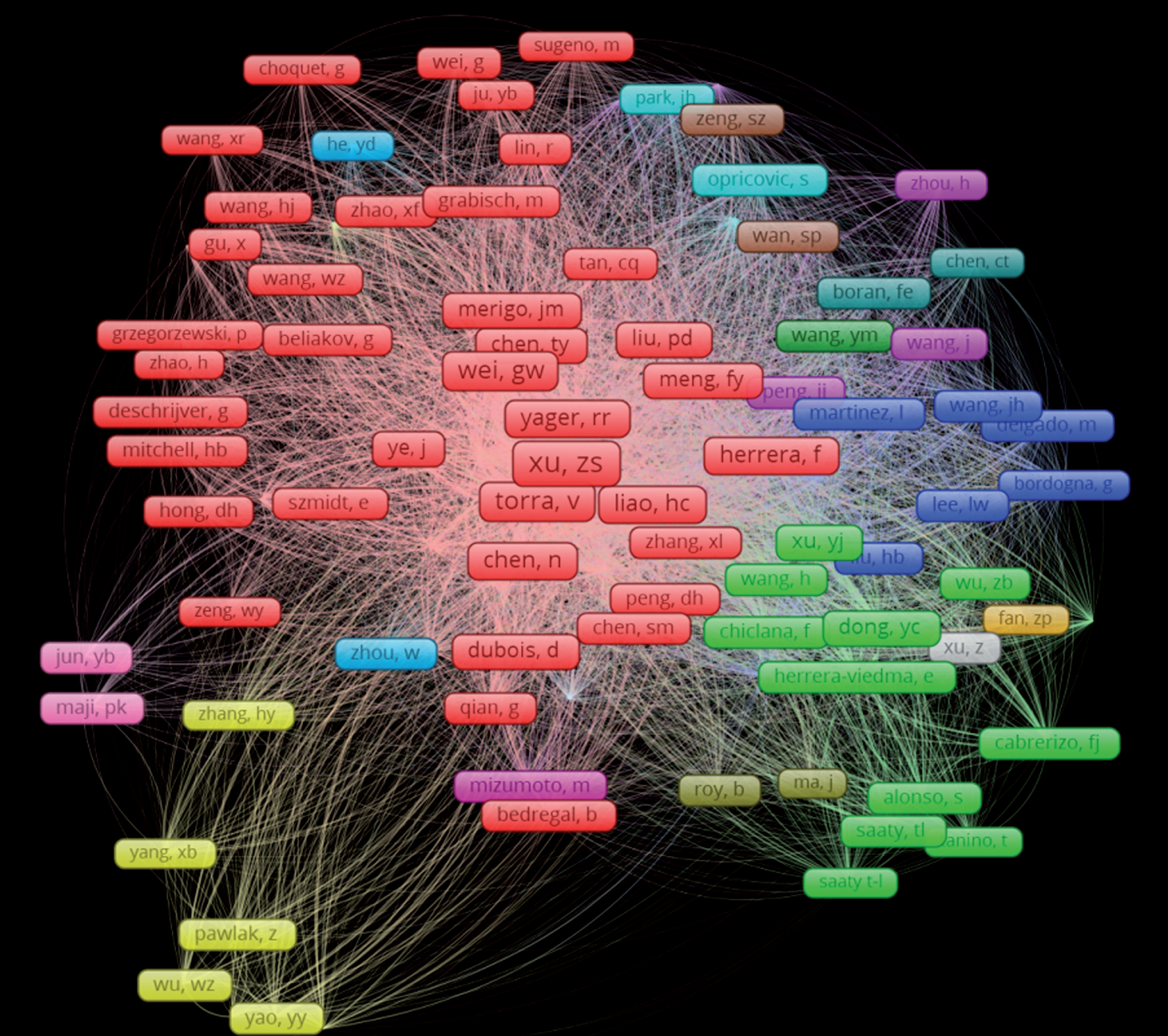
Co-citation network by first author.
In Fig. 7, VoS viewer is used for depicting the bibliographical coupling between organizations contributing to research in HFS. The concept of bibliographical coupling is mainly reflecting the co-citation of works exchanged between two or more organizations. Higher is the bibliographical coupling, higher is the co-citation value. The topmost organizations that have contributed for the maximum publication in the field of HFS are:
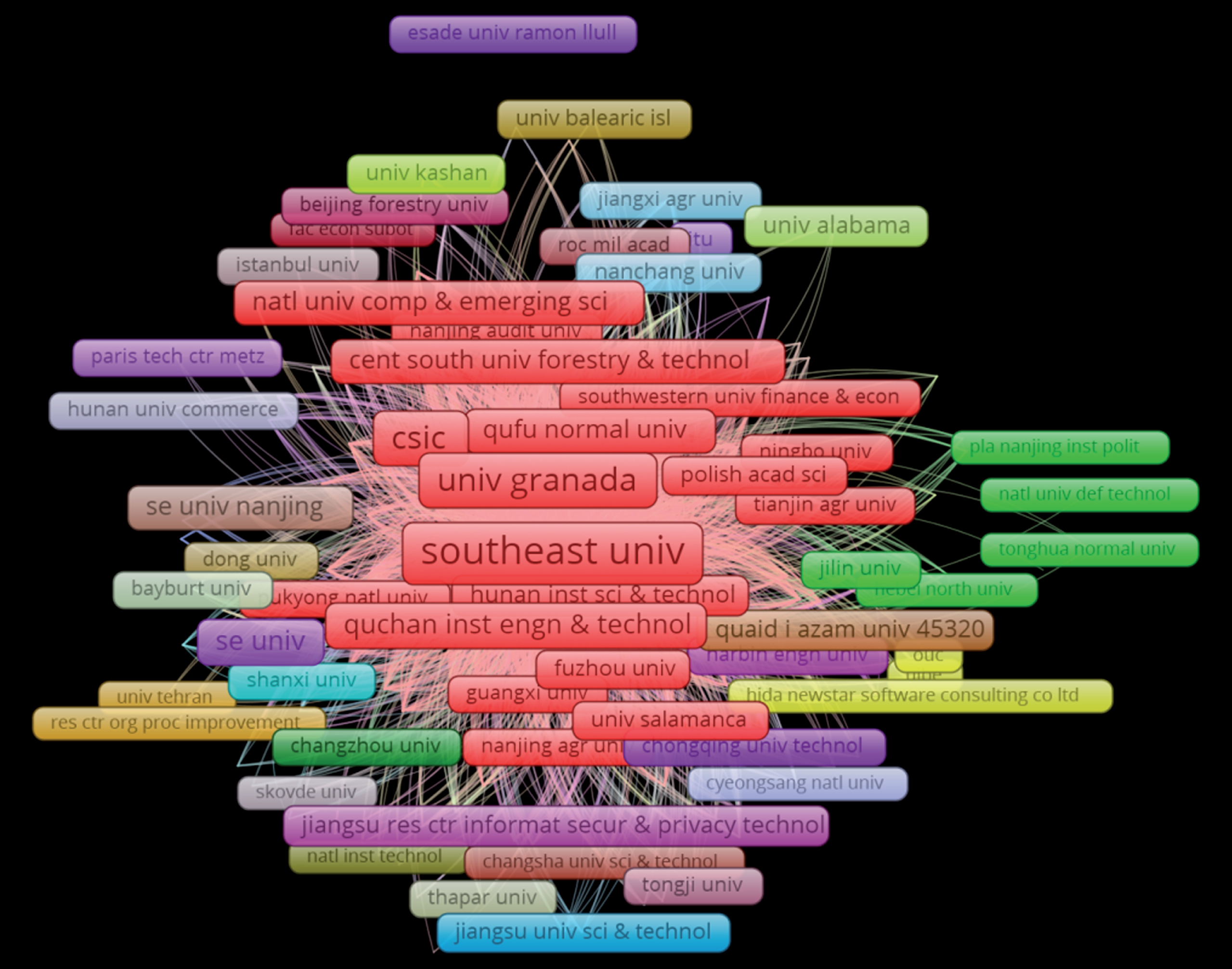
Bibliographical coupling between organizations contributing to research in HFS.
Sichuan university with 55 paper publications
Southeast university with 38 paper publications
Central south university with 35 paper publications
PLA university of science technology with 20 paper publications
Beijing institute of technology and Hebei university with 16 paper publications each
Chongqing university of arts sciences with 13 paper publications
University of Granada with 12 paper publications
Hohai university and Zhejiang university of finance economics with 11 paper publications each
Co-authorship is essential for any Scientometric study. For HFS, the co-authorship pattern is visualized in Fig. 8.

Co-authorship pattern for HFS.
There is a total of 410 research papers in this area out of which the number of average citations per article is 32.28. The cumulative number of citations for these articles is 13235 while the ones without self citation are 8782. A total of 2773 articles have cited these publications. The sum of citations per year has gradually increased over time and hence it is also expected to increase in the coming years. The top 10 research papers in this field according to the total citations achieved are shown in Table 1.
Now for further Scientometric analysis, we analyze the citations of the top 3 research publications in this area.
The top 3 Web of Science categories where [3] is cited and referred is as follows: Computer science artificial intelligence Computer science interdisciplinary applications Computer science information systems
The top 3 Web of Science categories where [4] is cited and referred is as follows: Computer science artificial intelligence Computer science interdisciplinary applications Computer science information systems
The top 3 Web of Science categories where [5] is cited and referred is as follows: Computer science artificial intelligence Computer science interdisciplinary applications Computer science information systems
Now it is easy to observe that the top 3 Web of Science categories for these top 3 cited papers are the same. This helps in understanding that HFS are used mainly in applications that cater to artificial intelligence and information science, that too majorly in computer science. Interdisciplinary applications related to computer science is also a major citation source for such papers. This reflects the popularity of HFS in various research domains. This also shows that the use of HFS is not limited to just one discipline. The analysis is concluded from the citation related data available on Web of Science (v.5.31) database as shown in Fig. 9.

Snapshot of Citation analysis data for HFS.
In this study the papers have been taken from 1989 because the data before that is not available for Web of Science (v.5.31) database. Also, it would have been incorrect to include the present year (2018) because number of papers will vary and increase till the year end. Hence the time span is taken to be 1989– 2017. The research paper publication related to HFS is expected to grow in the coming future with a high pace.
HFS is gaining popularity among researchers and is posing as a feasible solution to research problems in various interdisciplinary areas of application. This paper presents an in-depth analysis for studying the research trends for HFS using Web of Science (v.5.31) database. The analysis for 410 research papers of this domain is carried out in an automated and manner way. Research queries like important terms and concepts for HFS, co-authorship patterns, dominating research areas, countries with maximum research paper contribution, co-citation patterns for first authors and bibliographical coupling for organizations is highlighted. A sub section for brief citation analysis has also been provided. These studies enhance the general knowledge of any novice reader on a research topic and how has its evolution been since its inception. In the future, this kind of study can further be extended for other variants of fuzzy logic like fuzzy metaheuristics and neutrosophic fuzzy as well.
Details of top 10 highly cited research papers in HFS