



Abstract
The group decision-making is a process that multiple experts participate in analysis and decision-making for multiple attributes, which can assist decision makers to set priorities and make the best decision. The linguistic truth-valued intuitionistic fuzzy lattice can better express both comparable and incomparable linguistic information, which can also better to deal with positive and negative linguistic information at the same time. To deal with the decision-making problem with fuzzy linguistic information, we propose an approach for group decision making based on linguistic truth-valued intuitionistic fuzzy lattice. For the comparable fuzzy linguistic information, the linguistic truth-valued intuitionistic fuzzy weighted averaging operator and the linguistic truth-valued intuitionistic fuzzy ordered weighted averaging operator are presented to aggregate evaluation information of multiple experts. For the incomparable fuzzy linguistic information, positive reference nearness degree and negative reference nearness degree are introduced to deal with incomparable result with different preferences. We discuss an algorithm of group decision making, in which the decision results are alternative according to the decision makers’ preferences. A practical example is provided to illustrate the validity and rationality of the developed approach.
Keywords
Introduction
The group decision-making is an overall process in which multiple experts participate in analysis and decision-making for multiple attributes, and it is an important branch in analysis, expert system and so on. With the development of science, the factors and concepts that can only be described quantitatively in many fields are urgently needed to be qualitatively studied. Based on that, there are many researches of uncertain information [3, 23]. Due to people’s judgments on things in the real world are inaccurate, Zadeh introduced fuzzy sets theory, and many experts and scholars introduced fuzzy sets theory into multi-attribute group decision making [1, 24]. With the development of the study, the fuzzy set theory was introduced to many fields, such as fuzzy rules [16, 21], fuzzy interpolative reasoning [2, 17], and fuzzy propositional logic [11, 22]. Because people have different degrees of hesitation about things, fuzzy sets cannot fully express such information, Atanassov proposed an intuitionistic fuzzy set in 1968, since then, intuitionistic fuzzy set has been widely used in many fields [4, 28].
For the aggregation problem of intuitionistic fuzzy sets in decision-making process, the various aggregation operators of fuzzy sets have been given, among which the weighted averaging operator and the ordered weighted averaging operator are most widely used [13], Xu put forward intuitionistic fuzzy weighted averaging operator, intuitionistic fuzzy ordered weighted averaging operator and intuitionistic fuzzy hybrid aggregation operator [26, 27]. Wan et al. developed a new preference degree of intuitionistic fuzzy values, and constructed a multi-attribute group decision making method based on preference degree [20]. Subsequently, Wan et al. extended the intuitionistic fuzzy sets to trapezoidal intuitionistic fuzzy number sets and developed some new generalized aggregation operators, then utilized the presented operators to propose a new multi-attribute group decision making method with incomplete weight information [19]. Wan et al. extended trapezoidal intuitionistic fuzzy numbers to interval-valued intuitionistic fuzzy numbers and given a heterogeneous multi-attribute group decision making [18]. Gupta et al. used trapezoidal intuitionistic fuzzy numbers to represent fuzzy information, and proposed trapezoidal intuitionistic fuzzy weighted averaging operators [9]. They established a new intuitionistic fuzzy multi-attribute group decision-making model to solve the problem of factory location.
Linguistic information processing is the carrier of human thinking and the accumulation of human intelligence. Therefore, natural language should be regarded as the entry point of uncertain artificial intelligence research. The qualitative linguistic value representation is the basis of human thinking, which has randomness and fuzziness. Human beings have remarkable characteristics in processing fuzzy or uncertain information, and they often use natural language to describe uncertainty and make judgments. Therefore, to make machines intelligent, we must enable machines to simulate human ability of dealing with linguistic information, and the process that human handle linguistic information is more reflected in the uncertainty of linguistic information. Because of the difficulty of evaluation with accurate numerical values, it is more accustomed to express with fuzzy linguistic values. Rodriguez et al. used the form of hesitant fuzzy linguistic term sets to express linguistic values [12]. Pang et al. proposed a concept of probabilistic linguistic term set and some aggregation operators [10]. However, some linguistic information in decision-making problem is incomparable, and a simple chain structure cannot express this property. Therefore, combining with the idea of linguistic algebra and the characteristics of natural language, Xu et al. proposed the linguistic truth-valued lattice implication algebra [25]. On this basis, Zou et al. established a linguistic truth-valued intuitionistic fuzzy lattice, which can simultaneously process comparable and incomparable fuzzy linguistic value information from both positive and negative aspects [7]. Based on the linguistic truth-valued intuitionistic fuzzy lattice, the linguistic value inference model has been constructed [6, 8].
From the above, the present methods to deal with linguistic decision-making problems mainly reflect in the following aspects. Fuzzy set theory regards the linguistic information as the value of the linguistic variable, which is vague and fuzzy. In the research of fuzzy set theory, we notice that most of the researches focus on the fuzzy information process based on membership function. From the perspective of cybernetics, membership functions transform fuzzy information into a quantitative relation and facilitate computer to process, so it is possible to solve the control problems with fuzzy information. Fuzzy linguistic values can be characterized by the corresponding membership functions. Therefore, the existing research results of fuzzy set theory have become a method to process linguistic value information. The linguistic term is another method to process linguistic value information, which has many advantages. While linguistic information is convenient for intuitive expression, it can also describe the fuzziness and uncertainty of the objective and human thinking. Using linguistic form to describe preference information is suitable for the fuzziness and uncertainty of human thinking, which can help decision makers grasp the real state of things, reduce the cognitive pressure of decision makers in the decision-making process, and improve the efficiency of decision-making. Although the above two methods have advantages in dealing with linguistic information, they can not handle both comparable and incomparable at the same time. Considering the superiority of the algebraic structure, we propose an approach for group decision making combining with the linguistic truth-valued lattice implication algebra.
In some real-life situations, decision makers may prefer to express their decision-making information by using linguistic values instead of the accurate numerical values under vagueness and uncertainty in the process of group decision-making problem, which is more closer to the daily expression. And considering everything has two sides with positive and negative, decision makers can evaluate programs according to their advantages and disadvantages at the same time. Moreover, we also consider the situation that incomparable linguistic information will increase the difficulty of the decision-making process. Therefore, in this paper we will pay attention to these issues, and investigate the approach for group decision making based on linguistic truth-valued intuitionistic fuzzy lattice. In order to do that, the remainder of this paper is organized as follows: Section 2 briefly reviews basic concept on linguistic truth-valued intuitionistic fuzzy lattice. In Section 3, we propose linguistic truth-valued intuitionistic fuzzy weighted averaging operator and linguistic truth-valued intuitionistic fuzzy ordered weighted averaging operator to aggregate the comparable linguistic information. In Section 4, we introduce positive reference nearness degree and negative reference nearness degree to deal with the incomparable linguistic information. Section 5 establishes an approach for group decision making based on linguistic truth-valued intuitionistic fuzzy lattice and a practical example to illustrate the rationality.
Preliminaries
In this section, we briefly review the concept of linguistic truth-valued intuitionistic fuzzy lattice, seeing the following definitions for more details.
((h
i
, t) , (h
j
, f)) ′ = ((hn-j+1, t) , (hn-i+1, f)). ((h
i
, t) , (h
j
, f)) → ((h
k
, t) , (h
l
, f)) = ((hmin(n,n-i+k,n-j+l), t) , (hmin(n,n-i+l), f)). ((h
i
, t) , (h
j
, f)) ∪ ((h
k
, t) , (h
l
, f)) = ((h
max
(i,k), t) , (h
max
(j,l), f)). ((h
i
, t) , (h
j
, f)) ∩ ((h
k
, t) , (h
l
, f)) = ((h
min
(i,k), t) , (h
min
(j,l), f)).
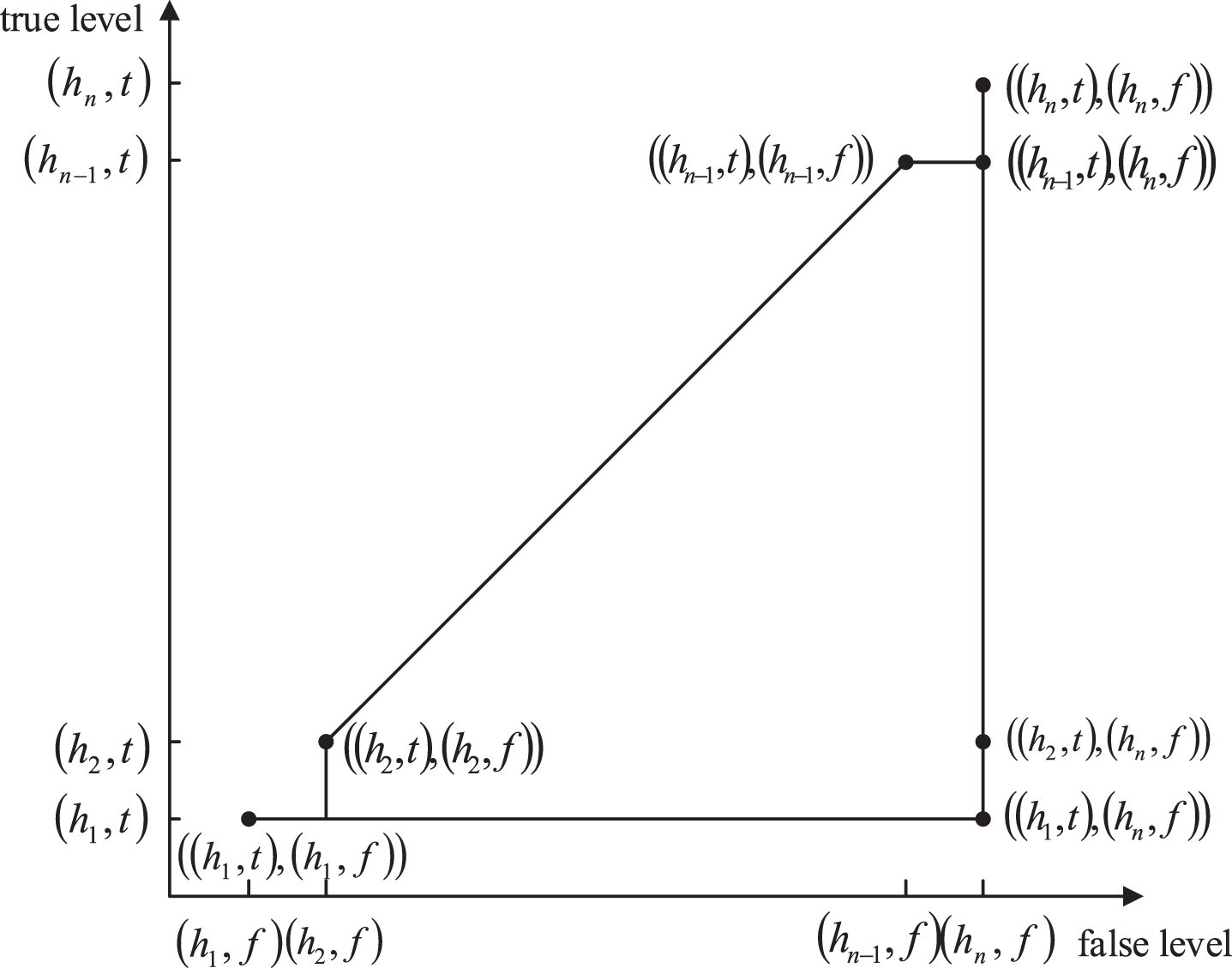
Hasse diagram of linguistic-valued intuitionistic fuzzy lattice.
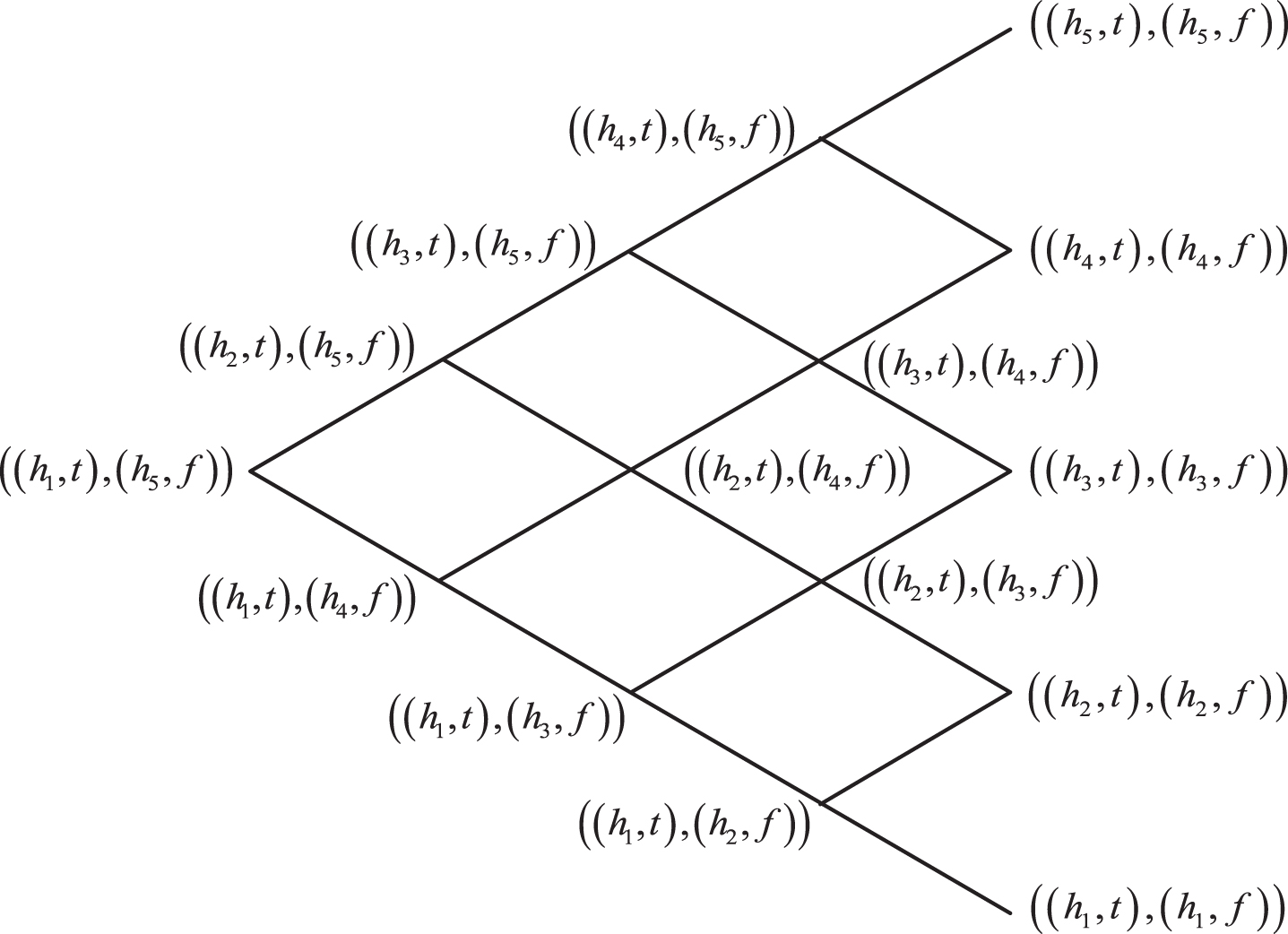
Hasse diagram of 10-element linguistic truth-valued intuitionistic fuzzy lattice.
On the premise that 10-element linguistic truth-valued lattice implication algebra. Let L5 = {h i |i = 1, 2, 3, 4, 5} be a set of five hedge operators, where h1 =“slightly”, h2 =“rather”, h3 =“extremely”, h4 =“very”, h5 =“absolutely” and h1 < h2 < h3 < h4 < h5. And let L2 = {t, f|t =“true”, f =“false”} be an element linguistic truth-valued set.
((h
i
, t) , (h
j
, f)) and ((h
k
, t) , (h
l
, f)) are comparable if and only if i = k or j = l. ((h
i
, t) , (h
j
, f)) and ((h
k
, t) , (h
l
, f)) are incomparable if and only if k ∈ {i - 1, . . i - 2, ⋯ , 1} and l = j + 1, or k ∈ {i + 1, i + 2, ⋯ , j - 1} and l = j - 1, which is recorded as ((h
i
, t) , (h
j
, f))//((h
k
, t) , (h
l
, f)).
In order to deal with the comparable linguistic information within the aggregation process based on the linguistic truth-valued intuitionistic fuzzy lattice, we propose the linguistic truth-valued intuitionistic fuzzy weighted averaging operator and the linguistic truth-valued intuitionistic fuzzy ordered weighted averaging operator.
Linguistic truth-valued intuitionistic fuzzy weighted averaging operator
LTV - IFWA (a1, a2, a3, a4, a5) =
Idempotency: If ∀a
l
= a, ∃w
l
≥ a (l = 1, ⋯, m), then LTV-IFWA (a1, a2, ⋯ , a
m
) = a.
Boundedness: ((h1, t) , (h1, f))≤ LTV-IFWA (a1, a2, ⋯ , a
m
) ≤ ((h
n
, t) , (h
n
, f)).
Monotonicity: Let C = {c
l
|c
l
∈ LI2n, l = 1, ⋯, m} be a set of linguistic-valued intuitionistic fuzzy values, if a
l
≤ c
l
, then LTV-IFWA (a1, ⋯ , a
m
) ≤ LTV-IFWA (c1, ⋯ , c
m
).
For any a
l
, w
l
∈ LI2n (l = 1, ⋯ , m), if ∀a
l
= a, ∃ w
l
≥ a, then w
l
∩ a
l
= w
l
∩ a = a. According to the Definition 2, we can obtain that: LTV-IFWA (a1, …, a
m
)=LTV-IFWA (a, …, ((h1, t) , (h1, f)) and ((h
n
, t) , (h
n
, f)) are the maximum and minimum element of LI2n, LTV-IFWA (a1, …, a
m
) ∈ LI2n, then ((h1, t) , (h1, f)) ≤ LTV-IFWA (a1, ⋯ , a
m
) ≤ ((h
n
, t) , (h
n
, f)). If ∀a
l
≤ c
l
, then a
l
∩ w
l
≤ c
l
∩ w
l
and
LTV-IFOWA
Idempotency: If ∀a
l
= a, ∃u
r
≥ a, then LTV-IFOWA(a1, a2, ⋯ , a
m
) = a.
Boundedness: ((h1, t) , (h1, f))≤ LTV-IFOWA (a1, a2, ⋯ , a
m
) ≤ ((h
n
, t) , (h
n
, f)). Monotonicity: Let C = {c
l
|c
l
∈ LI2n, l = 1, ⋯ , m} be a set of linguistic-valued intuitionistic fuzzy values, d
r
is the rth largest linguistic-valued intuitionistic fuzzy value in c
l
, if b
r
≤ d
r
, then LTV-IFOWA (a1 , ⋯ , a
m
) ≤ LTV-IFOWA(c1 , ⋯ , c
m
).
Permutability: If
The proof of 1 to 3 is the similar to the Theorem 2.□
4. Since
Hence LTV-IFOWA(a1, ⋯ , a
m
)=LTV-IFOWA
In the above Section 3, for comparable linguistic information aggregation problem, we give two linguistic truth-valued intuitionistic fuzzy aggregation operators. But in the real life, there are many situations where the linguistic information is incomparable, in order to handle this problem, we propose the positive linguistic truth-valued intuitionistic fuzzy reference nearness degree and the negative reference nearness degree in this section.
For any a1, a2, b ∈ LI2n, wherea1//a2, a1 ∪ a2 = b, β is the reference nearness degree, including the positive reference nearness degree β T and the negative reference nearness degree β F . If β (a1, b) > β (a2, b), then we can get that the reference nearness degree partializes a1, and we have the following corollary.
If reference nearness degree is β
T
, then it partializes ((h
i
, t) , (h
j
, f)); If reference nearness degree is β
F
, then it partializes ((h
k
, t) , (h
l
, f)).
If reference nearness degree is β
T
, then:
Since p ≥ i, q ≥ j, then max (i, p) = p, min (j, q) = j. Hence Similarly, β
T
(((h
k
, t) , (h
l
, f)) , ((h
p
, t) , (h
q
, f))) Since j < l, then β
T
(((h
i
, t) , (h
j
, f)) , ((h
p
, t) , (h
q
, f))) > β
T
(((h
k
, t) , (h
l
, f)) , ((h
p
, t) , (h
q
, f))) Hence reference nearness degree β
T
partializes ((h
i
, t) , (h
j
, f)). If reference nearness degree is β
F
, then:
Since p ≥ i, q ≥ j, then min (i, p) = i, max (j, q) = q. Hence Similarly, β
F
(((h
k
, t) , (h
l
, f)) , ((h
p
, t) , (h
q
, f))) Since i > k, then β
F
(((h
i
, t) , (h
j
, f)) , ((h
p
, t) , (h
q
, f))) < β
F
(((h
k
, t) , (h
l
, f)) , ((h
p
, t) , (h
q
, f))) Hence reference nearness degree β
F
partializes ((h
k
, t) , (h
l
, f)).
The proof is completed.□
If we are more focus on the positive influence of the linguistic information, then we can get:
Since β
T
(((h3, t) , (h3, f)) , ((h3, t) , (h4, f))) > β
T
(((h2, t) , (h4, f)) , ((h3, t) , (h4, f))), then it partializes ((h3, t) , (h3, f)). If we are more focus on the negative influence of the linguistic information, then we can get:
Since β
F
(((h2, t) , (h4, f)) , ((h3, t) , (h4, f))) > β
F
(((h3, t) , (h3, f)) , ((h3, t) , (h4, f))), then it partializes ((h2, t) , (h4, f)) .
In this section, we develop an approach for group decision making based on linguistic truth-valued intuitionistic fuzzy lattice and an illustrative example shows the proposed approach seems more effective for decision making under a fuzzy environment with both comparable and incomparable linguistic information.
An approach for group decision making based on linguistic truth-valued intuitionistic fuzzy lattice
In order to deal with the group decision making problem based on linguistic information, for the comparable linguistic information, we first utilize the proposed LTV-IFWA operator to aggregate attribute values and LTV-IFOWA operator to aggregate the integrated attribute values. And then utilize the proposed positive reference nearness degree or negative reference nearness degree to deal with the incomparable linguistic information. Finally, we can get a comprehensive assessed value to set priorities and choose the best one. The detailed steps are as follows.
Suppose that there are n alternatives A η (η = 1, ⋯, n), m attributes G τ (τ = 1, ⋯ , m) with the attribute weighted vector W = (w1, w2, ⋯ , w m ) T , where w τ ∈ LI2n and t experts e δ (δ = 1, ⋯ , t) with the integrated attribute weighted vector U = (u1, ⋯ , u t ) T , where u δ ∈ S.
Illustrative example
Considering an example that there is a middle school, the principle wants to choose an excellent teacher. There are four candidates and six assessment indexes of comprehensive quality: physical and psychological quality, cultural scientific quality, professional moral quality, instructional design and manage ability, scientific research ability and self-study and innovation ability. And in order to evaluate the candidates, we select three experts.
The set of alternatives is A = {A1, A2, A3, A4}, the set of attributes is G = {G1, G2, G3, G4, G5, G6}, the set of experts is E = {e1, e2, e3}.
According to the above indexes, the assessment results of four teachers A1,A2,A3,A4 provided by three experts e1, e2, e3 are listed in Tables 1–3,“true” and “false” of linguistic truth-valued intuitionistic fuzzy lattice in this paper are equal to “strong” and “weak”, then we can determine the excellent teacher.
The evaluation values of expert e1
The evaluation values of expert e1
The evaluation values of expert e2
The evaluation values of expert e3
Based on 10-element linguistic truth-valued intuitionistic fuzzy lattice, we utilize an approach for multi-attribute group decision making based on linguistic truth-valued aggregation operator to slove the problem.
The structure diagram of the result is shown in Fig. 3.
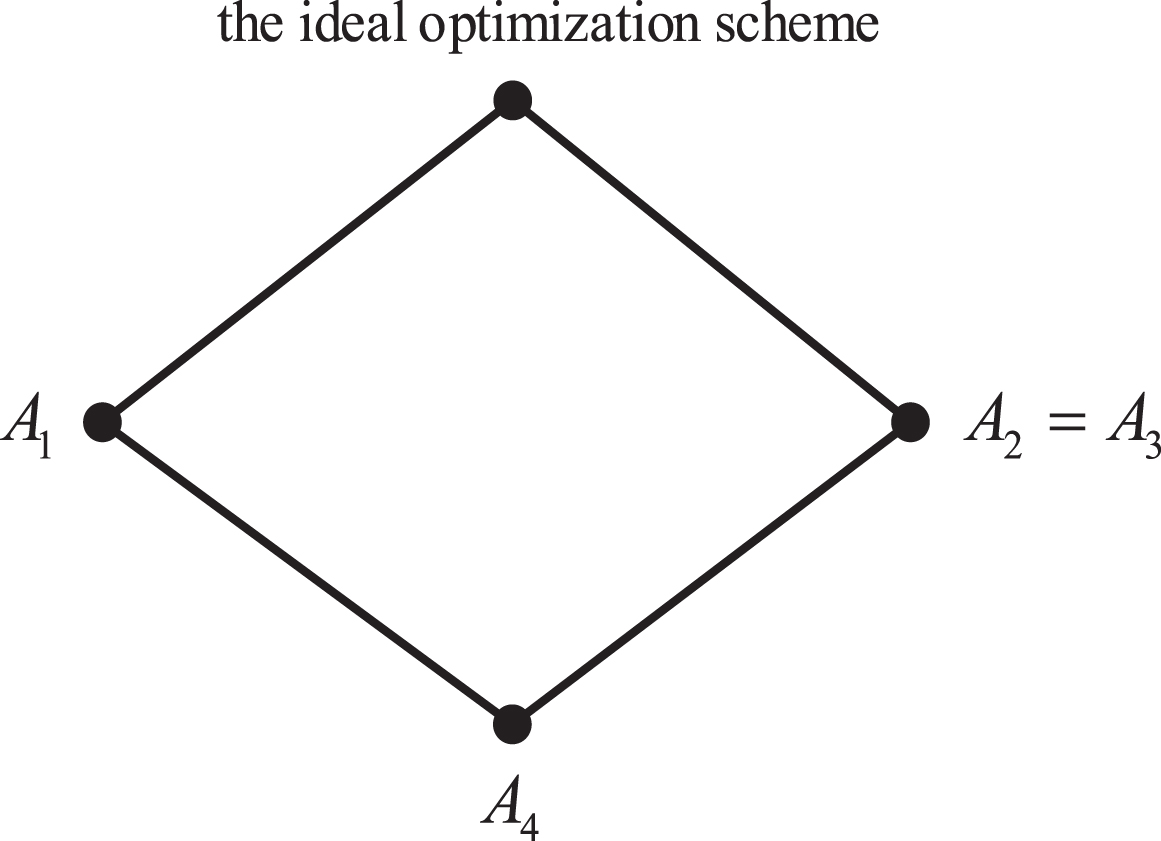
Hasse diagram of ranking result.
Hence A1 > A2 = A3 > A4, and the excellent teacher is A1.
In the above example, we use the proposed LTV-IFWA operator to aggregate attribute values and LTV-IFOWA operator to aggregate the integrated attribute values. The new approach for group decision making can evaluate the four candidates by the comparable and incomparable linguistic intuitionistic fuzzy values from both positive and negative sides, so that we can get the general assessment. In order to get more detailed result, considering the situation that we prefer the good qualities of a teacher, we choose the positive reference nearness degree to evaluate the ability of three candidates. On the other hand, if we focus on the negative side of the candidates, we can use the negative reference nearness degree to get another assessment. In this way, we can choose the best candidate more reasonable and comprehensive according to the preference of decision makers. According to the above example, comparing with other aggregation operators, we can conclude that there are some advantages in the proposed group decision making approach based on linguistic truth-valued intuitionistic fuzzy lattice.
The method we presented can deal with the linguistic information problem in the process of the decision making. In the multi-attribute decision making problem, we use linguistic information to get a more visualized decision information. The proposed method can retain the linguistic values of decision-making information by the decision makers, so that the problem of dealing with linguistic decision-making information will change into handling the linguistic values directly, which is more closer to the daily expression. The method we presented can deal with both positive and negative linguistic values within the group decision making problems. In the process of handling complex problems, we often need to deal with the knowledge by qualitative description instead of quantitative description in the real situation, which is expressed by natural language. Considering the advantages and disadvantages of every objection, the linguistic-valued intuitionistic fuzzy aggregation operators based on the linguistic truth-valued intuitionistic fuzzy lattice are proposed to describe these qualitative descriptions by the positive side and the negative side at the same time, which will make the assessment information more comprehensive to get a more reasonable result. The method can also handle comparable and incomparable information at the same time. For the incomparable decision-making problem, the proposed reference nearness degree including positive reference nearness degree and negative reference nearness degree can deal with the problem according to the real situation, which will assist decision makers set priorities and make the best decision under the uncertain linguistic situation and reduce the difficulty of the decision-making process.
In this paper, we deal with the linguistic group decision making problem and linguistic uncertain information aggregation problem based on linguistic truth-valued intuitionistic fuzzy lattice. The proposed LTV-IFWA operator and LTV-IFOWA operator can aggregate the comparable linguistic truth-valued intuitionistic fuzzy pairs. The presented reference nearness degree can deal with the incomparable linguistic truth-valued information, and experts can choose positive reference nearness degree or negative reference nearness degree according to their preferences to make the decision-making method more practical and reasonable. The proposed method can deal with not only positive and negative but also comparable and incomparable fuzzy linguistic-valued information evidences together during the group decision making process, which can make assessment information more comprehensive and fully make the decision-making process more intelligent.
The further work is to consider the case where the weights are unknown, and to raise the method of determining linguistic-valued weights of in-depth study. Then we can apply the theory into some areas under uncertainty environment with some linguistic information such as uncertainty reasoning, linguistic evaluation and so on.
Footnotes
Acknowledgments
This work is partially supported by the National Natural Science Foundation of P.R. China (Nos. 61772250, 61502068) and the National Natural Science Foundation of Liaoning Province (No. 2015020059).