



Abstract
The aim of this paper is to construct a matrix of interpersonal influences employing TOPSIS and then to apply the matrix in influence model and doubly extended TOPSIS. Entries of that matrix are obtained from coefficients of relative closeness. Such a systematically constructed matrix performs better than the direct influence matrix because of the consideration of alternatives under certain criteria/attributes. Implementation of such influence matrix improves an influence model and group decision process. In this paper, TOPSIS is used for individual as well as group decisions. Once the decisions are reached by individuals with the help of TOPSIS, then coefficients of relative closeness are obtained and matrix of interpersonal influences is constructed. This matrix is used in influence model and to construct the influenced decision matrices. These influenced decision matrices are aggregated to get the collective decision. This strategy is based on the fact that the decisions taken by individuals affect their collective decision in future.
Introduction
Decision making is one of the most important processes that human being go through in their daily life activities such as businesses, services and managements. In this process, certain weights are assigned to different criterion, whereas all the weights are obtained either from the group of experts or from intuitive ways. These weights are an essential part of any decision be it individual or collective and heavily dependant on an input data available to group of experts or individuals. Ambiguities and uncertainties in the data make decision making process even more complex. Fuzzy set theory [11] has played a vital role in decision making since its inception in 1965. Fuzzy sets constitutes a suitable framework to formulate decision making models given the fact that uncertainties and ambiguities are present in input data.
Aruldoss et al., [1] studied and compared different multi criteria decision making (MCDM) methods. It is observed that TOPSIS (Technique for Order of Preference by Similarity to Ideal Solution) plays a significant role in MCDM. This method is based on the fact that the solution should be near to the ideal situation and far from the worst situation. More specifically, relative closeness (RC) of alternatives to the ideal solution is calculated and an alternative for which coefficient of RC is maximum is chosen. Many researchers have employed TOPSIS to solve various decision making problems based on different theories such as fuzzy soft set, intuitionistic fuzzy soft set, hesitant fuzzy soft set and dual hesitant fuzzy set theories [2–6, 17]. Some recent advancements of TOPSIS in high-order fuzzy extensions and its applications have been observed in [26, 27].
Kacprzak [23] presented a doubly extended TOPSIS method for GDM where TOPSIS is applied twice. At first stage, each expert suggests its own ranking of alternatives using TOPSIS and at the second step, it is applied on their combined data which is then aggregated by using the weights of experts obtained from their individual decisions.
Group decision making (GDM) is a procedure by which a group of experts collectively selects the best alternative out of a finite set of available alternatives. On the other hand, Social influence network theory presents a mathematical modal of the process of attitude changes which occur in a social network of interpersonal influences. Degroot [10] presented this process as an iterative process and studied its convergence. The goal of the social influence network theory (SINT) is to predict and explain the attitude changes in small groups [7]. It uses an individual’s initial attitude and attitudes of other members in a small group to predict the attitudes of group members as a result of their interactions. This idea originated from the French’s formal theory of social power (1956), which proposes a simple model of network of interpersonal influence entering into the process of opinion formation. Social network analysis has grown rapidly since 1970 and has several applications in Sociology, Anthropology and Business Managements. After 30 years of French’s theory, Friedkin [24] studied this theory with the relationship between social and cognitive structures. He presented a model in the form of N equations for N members of a group. Friedkin and Johnsen [9] presented a recursive definition for the influence process in a group of N members, where the interpersonal influences of N members were represented in the form of a matrix W = (w ij ) and w ij represents the influence of jth member on the ith member. This matrix plays a vital role in influence models and group decision processes. Several researchers are investigating group decision making (GDM) problems employing the social network theory [8, 21]. Capuano et al. [21] presented fuzzy group decision making process with incomplete information guided by a social influence. Recently, Lu et al. [25] proposed a framework based on social network analysis.
Influence models contribute significantly in GDM. Khalid and Beg [8] proposed an influence model of evasive decision makers. Chu et al. [12] defined the group preference relation with directed social network connections. Preference relations express the likings of experts for each alternative over others. In order to express the preferences, a widely adopted way is by means of pairwise comparison. Many researchers have applied fuzzy preference relations (FPRs) to describe the experts’ judgment in GDM process [8, 13–16].
Experts are usually allowed to interact freely with each other and exchange their opinions. To the best of our knowledge, influence models in the existing literature involve the matrix of interpersonal influences which is formed according to experts’ opinions.
In this paper, we present an influence model and a doubly extended TOPSIS involving a matrix of interpersonal influences which is formed by using the coefficients of RC. This matrix plays a significant role in influence model and doubly extended TOPSIS. Doubly extended TOPSIS with this matrix of interpersonal influences is an extension of the idea presented by Kacprzak [23]. According to him, the influence of one expert on all other experts remains the same whereas our method proposes pairwise influences of the experts. Each individual of a group of experts provide its ranking of alternatives. They may chose the same or different alternatives. Taking into consideration of these two cases, entries of matrix W are taken from the coefficients of RC. This is a systematically developed matrix rather than the experts, free opinions.
Preliminaries
This section includes some preparatory definitions that are required in the sequel.
The alternative x i is absolutely outranked by the alternative x j if p ji = 1.
The alternative x i is preferred over the alternative x j if p ij ∈ (0.5, 1].
The alternative x i is outranked by the alternative x j if p ji ∈ (0.5, 1].
There exists an indifference between the alternatives x i and x j if p ij = 0.5 .
A FPR P can be represented by m × m matrix P = (p ij ) .
Once experts have expressed their preferences, n individual FPRs P1, P2, . . . , P
n
are available. A matrix
Social influence network theory
Social influence network theory deals with the problems related to the change of opinions with the passage of time. Interpersonal influences of experts play an important role in setting up their reconsidered opinions. These problems can be formulated as an iterative process.
Friedkin et al. [9] presented a simple recursive concept for the influence process in a group of N actors. This influence model [8] was investigated in terms of its convergence.
Let W = (w
ij
) be the matrix of interpersonal influences among n experts with w
ij
∈ [0, 1] and ∑j=1
n
w
ij
= 1. The diagonal matrix A = diag (a11, a22, . . . , a
nn
) is obtained from the matrix W by calculating a
ii
= 1 - w
ii
, i = 1, 2, . . . , n. The matrix A is interpreted as the susceptibility of all experts to interpersonal influence. With the initial opinion y(1), the following iterative scheme is defined to find the revised and final opinion:
If (I - AW) is non-singular, then this process reaches the following
TOPSIS method
TOPSIS is a commonly used MCDM method [1] which was introduced by Hwang and Yoon [22]. The process is carried out as follows:
Step 1. Construction of a decision matrix D .
here A i (i ∈ {1, 2, . . . , m}) and c j (j ∈ {1, 2, . . . , n}) denote the alternatives and criteria, respectively.
Step 2. Formation of a standard (normalized) decision matrix R .
If matrix D is already normalized, then skip this step.
Step 3. Obtain the weighted normalized decision matrix V .
V = [v
ij
] m×n = [w
j
r
ij
] m×n, i ∈ {1, 2, . . . , m}, where
Step 4. Determination of positive ideal solution (PIS) A+ and negative ideal solution (NIS) A-.
and
Step 5. Calculation of separation measurements of positive ideal
∀i ∈ {1, 2, . . . , m}
Step 6. Evaluation of RC of alternatives to the ideal solution, that is,
Step 7. Set up the preference order.
TOPSIS based matrix of interpersonal influences
TOPSIS is a widely utilized MCDM method in which an alternative is chosen on the basis of preference order. This method is a process of obtaining the coefficients of RC to rank the alternatives under consideration of some attributes and starts with the construction of decision matrices by the experts. Coefficients of RC for each alternative are calculated through distance measures between the entries of decision matrix and positive and negative ideal solutions. An alternative is chosen for which the coefficient is maximum without consideration of how much greater is this than the others. Coefficients of RC calculated by the experts are considered as their influence weights for other experts. In this way, n2 influence weights for n experts are evaluated and a matrix of order n × n is formed. Taking into account of the preference order of alternatives as well as the amount of coefficients, the following definition suggests how the matrix W = (w ij ) p×p of interpersonal influences of p experts is developed.
W = [a lk ] p×p with
(2) experts chose different alternatives in their individual decisions, then
W = [a lk ] p×p with
Entries a
lk
of the matrix W represent the amount of influence of k
th
expert upon l
th
expert. When two experts choose the same alternative and RC (xσ(m)) is maximum for k
th
expert, then this value is taken as a
lk
due to its characteristic of being maximum. When two experts choose different alternatives then the influence of k
th
expert is the amount of difference between
Now we present influence model and doubly extended TOPSIS utilizing the matrix W. These two approaches consists of three significant steps (Fig 1): Individual decisions of experts. Construction of the matrix W. Combine decision of experts by using W.
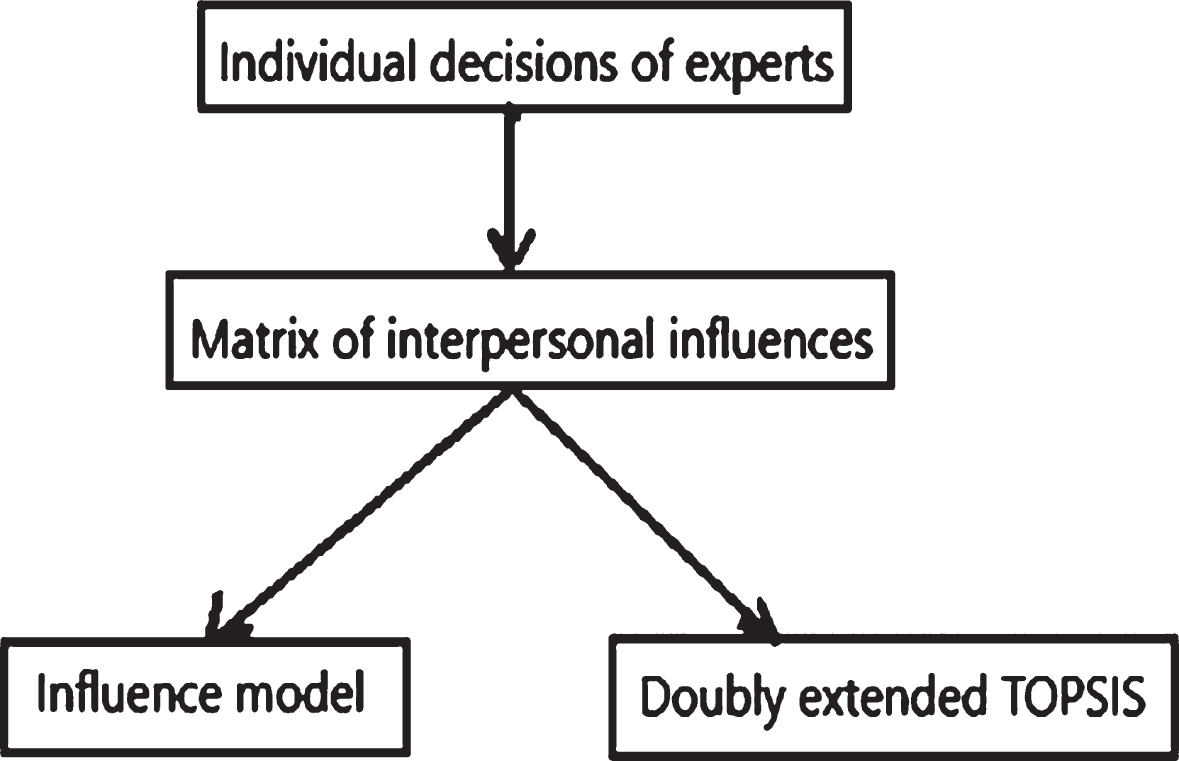
Graphical representation of the procedure.
In some real life situations, a person faces the problem of selecting an alternative, it follows the decisions taken previously by some experts individually. But after some time, there may arise some influences among those experts. Taking into account of those influences, a decision making technique is applied again. Influence model presented by Friedkin et al. [9] and doubly extended TOPSIS presented by Kacprzak [23] are two different techniques. Influence model is a group decision technique and an iterative procedure while TOPSIS is utilized both for individual and group decisions and a non-iterative procedure. The purpose of presenting the extended ideas together in both techniques is to show the vast utilization of the matrix of interpersonal influences.
Influence model represented in section 2.1 involves a matrix W = (w ij ) n×n of interpersonal influences of n experts. The values of w ij are not chosen by a mathematical formula or technique in the existing comparable literature, and experts are usually independent to interact with each other. The values of w ij are chosen by direct observation such that w ij ∈ [0, 1] and ∑j=1 n w ij = 1 for i = {1, 2, . . . , n}.
To solve a practical problem, influence model based on the above defined matrix W consists of the following steps:
Also weight vectors W k = {wk1, wk2, . . . , w kn } with ∑ n j=1w kj = 1, w kj ∈ [0, 1] are provided for n criterion/attributes by p experts.
and get the matrix
Get the corresponding priority vectors
of P
k
where
Now find
on each alternative x i .
Find the column vector that represents the final preference of each expert over the set of alternatives X .
Rank the alternatives by using
Choose the alternative x
i
for which
An illustrative example is given to explain the method.
Decision matrices provided by three experts are as follows:
And
For expert e1 : C1 = 0.2939, C2 = 0.3430, C3 = 0.1998, C4 = 0.6569, note that
C3 < C1 < C2 < C4 .
For expert e2 : C1 = 0.4092, C2 = 0.0901, C3 = 0.3634, C4 = 0.6366, obviously,
C2 < C3 < C1 < C4 .
For expert e3 : C1 = 0.4045, C2 = 0.5954, C3 = 0.7142, C4 = 0.7857, clearly
C1 < C2 < C3 < C4 .
and normalized matrix W =
Entries of the matrix W are also explained in Fig. 2. The matrix A of susceptibilities of each expert is as follows
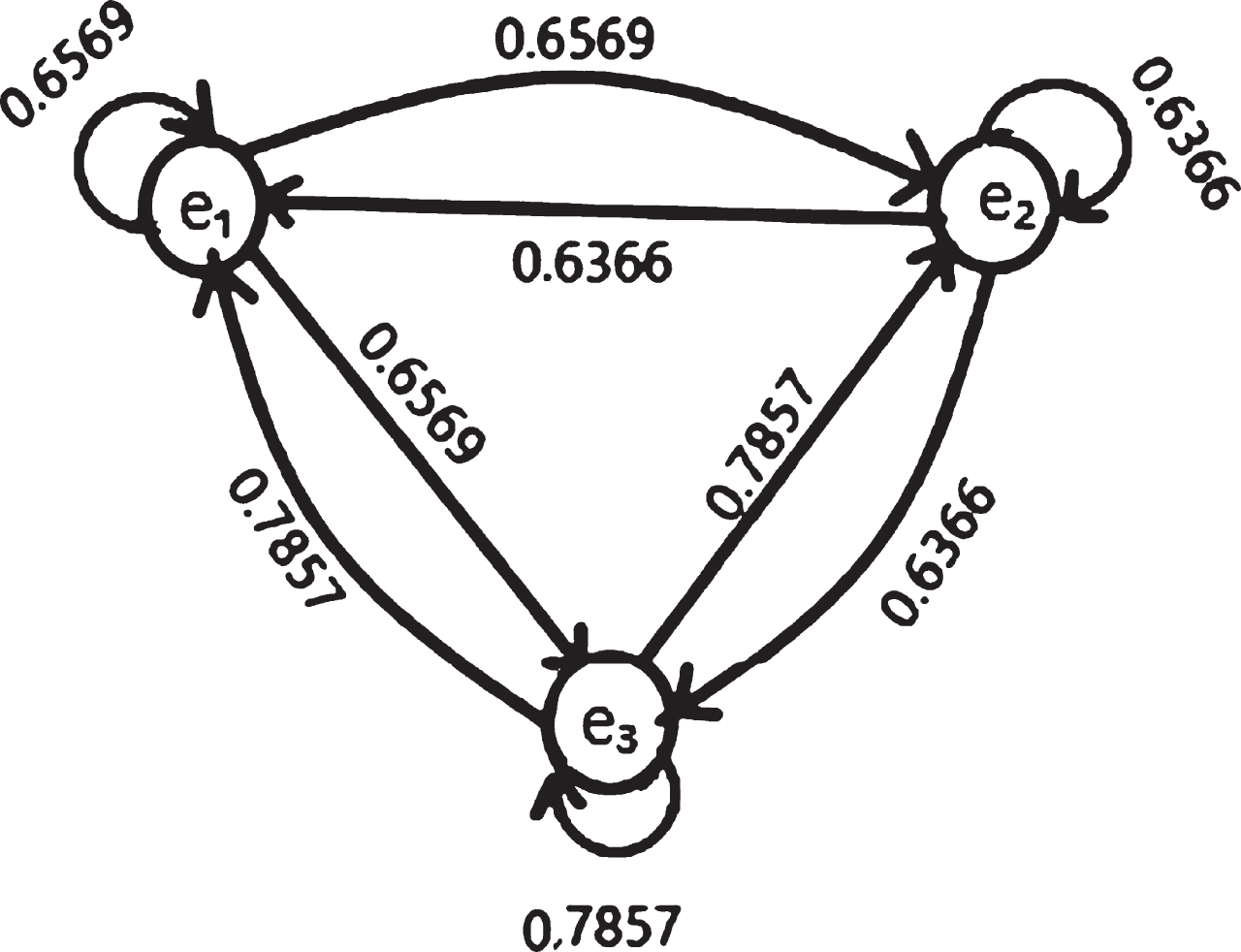
Graphical representation of W.
The following matrices represent the available information according to each alternative.
(I - AW) -1 (I - A) =
Final opinions about each alternative are as follows:
Accordingly, the final opinions of three experts are as follows.
Now find the values of
which implies x3 ≽ x1 ≽ x4 ≽ x2.
In this method TOPSIS is applied twice in a group of k experts. Each expert gives a decision independently and then by using the coefficients of RC, matrix of interpersonal influences is developed as defined in Definition 3.1. Employing this matrix, influenced decision matrices are developed and then TOPSIS is applied to calculate a combined decision.
Stepwise description of this method is as follows:
k = {1, 2, . . . , p}.
For k = {1, 2, . . . , p} , select the weight vectors W k = {wk1, wk2, . . . , w kn } , with ∑ n j=1w kj = 1 and w kj ∈ [0, 1].
To illustrate the method, consider the following example:
For expert e1 : C1 = 0.3330, C2 = 0.5330, C3 = 0.2, C4 = 0.4665,
C3 < C1 < C4 < C2 .
For expert e2 : C1 = 0.3822, C2 = 0.1174, C3 = 0.1765, C4 = 0.8234,
C2 < C3 < C1 < C4 .
For expert e3 : C1 = 0.7502, C2 = 0.5751, C3 = 0.4501, C4 = 0.5,
C3 < C4 < C2 < C1 .
Since three experts select different alternatives, therefore matrix of interpersonal influences based on coefficients of RC is as follows.
whose entries are explained in Fig 3,
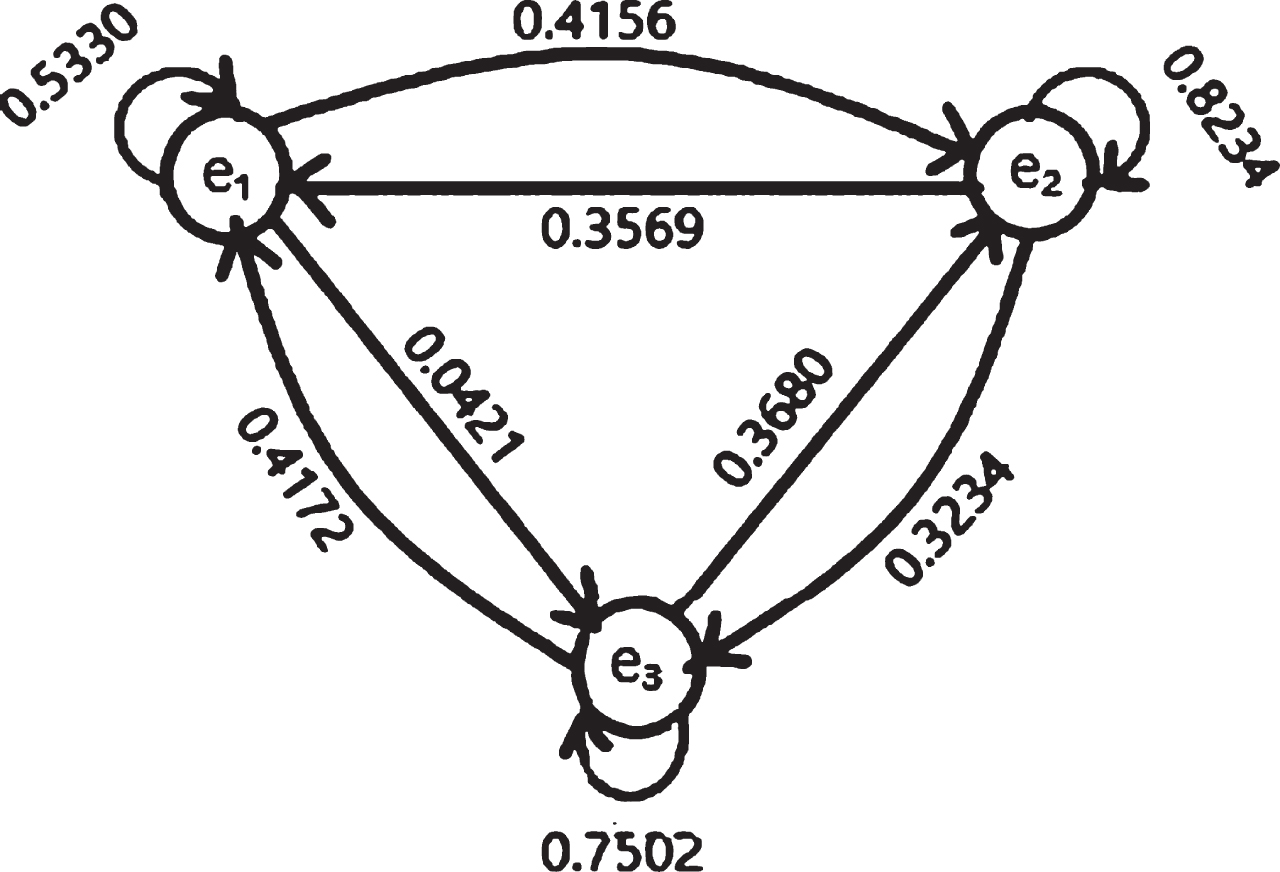
Graphical representation of W
and normalized matrix
The matrix A of susceptibilities of each expert is as follows
Calculate (I - AW) -1 (I - A) to find the influenced decision matrices.
(I - AW) -1 (I - A) =
Positive and negative ideal solutions are:
and the distances are:
Coefficients of RC are:
C1 = 0.51882
C2 = 0.47946
C3 = 0.44321
C4 = 0.66760
The method presented in section 3.1 combines the influence model and TOPSIS. It works together with preference relations over the set of alternatives and the matrices consisting of values of alternatives under consideration of multi criteria. TOPSIS is a MCDM method which is applied on the decision matrices and results in the coefficients of RC. These coefficients lead to develop the matrix of interpersonal influences. This matrix plays an important role in the influence model. In example 3.1, three experts choose the same alternative x4 by using TOPSIS but finally they select x3 after applying the influence based decision making method which includes the preference relations. In this way, we can recognize the role of preference relations in the selection of alternatives.
Doubly extended TOPSIS was presented by Kacprzak [23] without consideration of interpersonal influences. He calculated the weights by using coefficients of RC obtained from expert’s individual decisions and then by using those weights, he developed an aggregated collective matrix. Moreover, individual decisions of experts were not considered in the sense, whether they take same or different decisions (whether they choose the same or different alternatives).
It is worth mentioning that the matrix W in this paper is developed by considering the decisions of experts with two aspects, whether they agree with each other or not. Entries of W are the weights which represent the influence of each expert on the others. By using this matrix, we formed the decision matrices for individuals instead of a collective matrix. Due to the construction of individuals’ decision matrices, there is an advantage of obtaining both individuals or collective decisions.
Note that the utilization of influence model described in section 3.1 depends upon the availability of preference relations, whereas the doubly extended TOPSIS described in section 3.2 does not require the preference relations.