



Abstract
Due to the industrial emissions, poor disposal of wastes, mining, deforestation, increased use of fossil fuels and vicious agricultural activities, environmental pollution rapidly arises and becomes one of the most serious problems of the contemporary world. Humanity tries to abstain from living in polluted cities because of its effects adversely to quality of life. As the utilization of Multi-Criteria Decision Making (MCDM) techniques plays a key role in choosing the most suitable option between all feasible alternatives, this work proposes a hybrid MCDM method to rank the major cities from the least polluted to the most polluted according to the types of pollution. Owing to the capability to tackle imprecise and uncertain decision information, intuitionistic fuzzy (IF) sets are employed as well as some of the important properties of these concepts are studied. An integrated method combines IF Simple Additive Weighting (IF-SAW) for determining the weights of the types of pollution and IF Preference Ranking Organization Method for Enrichment Evaluations (PROMETHEE) technique for ranking the major cities. In ranking phase, modification and improvement of classical PROMETHEE into the IF environment is accurately implemented. A Group Decision Making (GDM) process which deals with both quantitative and qualitative factors in an uncertain environment is developed. The effectiveness and applicability of the proposed methodology is numerically illustrated with real world data of environmental pollution in major cities and the study showed that IF-PROMETHEE method could be used in environmental pollution problem as an efficient method.
Introduction
The problem of environmental pollution is a complex consequence of forces connected with various interrelating factors. No single cause can be considered as the root cause of environmental impairment. Unplanned urbanization, population growth, deforestation, agricultural and industrial development, thermal power plants, poverty are some of these causes. The major cities are the most affected by these problems.
In such situations, MCDM techniques appear to be as a useful technique to deal with these problems. Most MCDM problem can be assessed on multiple attributes/criteria, quantitatively and/or qualitatively, to achieve the best solution from all feasible alternatives. These attributes are broadly elucidated by vague data or human judgements. At this point, fuzzy environment, primarily suggested by Zadeh [1], emerged and ushered a new era. It is employed to handle the concept of partial truth, where the truth value may range between completely true and completely false [2]. In this study, in order to assess attributes containing both qualitative and quantitative data, numerical values (crisp data) and linguistic variables (decision makers’ opinions) are simultaneously used. This was our main motivation to resort fuzzy environment, especially IF area.
Unlike classical fuzzy sets, the concept of IF set is more flexible to capture the uncertainty and vagueness. IF set theory, as the generalization of fuzzy set theory, is an effective tool in dealing with fuzzy information where it has a membership degree, a non-membership degree and a hesitancy degree. Thus, the focus of this study is majored on IF logic that have already engaged tenable attention and interest from academics.
The rest of this study is organized as follows: the next section presents literature review based on important studies in fuzzy MCDM. Section 3 briefly discussed origins of IF sets with mathematical notations and various IF operations. In the fourth section, classical PROMETHEE and its progress in IF environment is put forward. Section 5 contains application using our approach with elucidative tables and schemes. Short concluding remark with general perspectives to the overall study is given and suggestions for a future work are expressed in the last section.
Literature review
For recent years, scholars have widely attempted to develop MCDM techniques in IF environment. Onar et al. [3] proposed a multi-expert hierarchical fuzzy MCDM method with linguistic terms to prioritize wind energy technologies using Interval-Valued IFS (IVIFS). Otay et al. [4] integrated IF Data Envelopment Analysis (DEA) with IF Analytic Hierarchy Process (AHP) method with a real case study from Turkey. Oztaysi et al. [5] developed an MCDM algorithm for alternative-fuel technology selection using IVIFS applied to a utility company in the USA. Kahraman et al. [6] applied AHP and TOPSIS methods in IF MCDM area for outsource manufacturer selection problem. Cali and Balaban [7] combined VIKOR with ELECTRE I in IF environment by employing entropy method to identify the weights of criteria and decision makers.
As for environmental pollution, Kaya and Kahraman [8–10] revealed a new tool for risk assessment of air pollution with fuzzy Process Capability indices (PCIs) and presented a methodology using PCIs in the six-sigma approach. Ekmekçioğlu et al. [11] proposed fuzzy multicriteria disposal method and site selection for municipal solid waste. Kahraman and Kaya [12] also proposed a methodology based on PCIs concerning to the water pollution.
PROMETHEE has also engaged scholars’ attention and it is applied as a ranking method in many studies. Liao [13] proposed an MCDM method for evaluation of alternative energy exploitation projects. Krishankumar et al. [14] considered supplier selection problem while Rani and Jain [15] employed an MCDM method based on Entropy Measure in a problem of selection of the antiretroviral drugs for HIV/AIDS to reduce the infection of HIV. For a comprehensive understanding of the overall aspect, it is worth to see [16] as a literature survey for studies up to 2010.
IF sets
This section of the paper commonly introduces the basic ideas of IF. The basic definitions and notations can be found in Atanassov’s studies [17, 18].
Preliminaries
Let a set E be fixed and let A ⊂ E be a fixed set. An IF set, denoted as A* in E, is a set that has a form as
It is known that 0 ≤ μ A (x) + v A (x) ≤1 and thus, 0 ≤ μ A (x) ≤1 and 0 ≤ v A (x) ≤1 obviously.
As every ordinary fuzzy set has the form {〈 x : μ
A
(x) , 1 - μ
A
(x) 〉 : x ∈ E } and 0 ≤ μ
A
(x) + v
A
(x) ≤1, it can be described π
A
(x) called as “the degree of non-determinacy (uncertainty) of the membership” of element x ∈ E which is denoted by:
In the case of π A (x) =0, IF set turns into classical fuzzy set that satisfies v A (x) =1 - μ A (x).
By aid of the expressions above, we can also write an IF set more comprehensive as:
For being more obvious and elucidative, we briefly define an IF number as 〈μ A , v A 〉 in overall study.
In this section, we introduce four basic arithmetic operations which we use in our methodology [17, 20].
Let A ={ 〈 x, μ A (x) , v A (x) 〉 : x ∈ E } and B ={ 〈 x, μ B (x) , v B (x) 〉 : x ∈ E } two IF sets, then we have:
and
n is a positive integer or n = 1/k with k a positive integer. Former is used for multiplication of IF number by a positive integer, while latter is used for a division of IF number by a positive integer.
The proposed method is illustrated, validated and compared against two different IF MCDM methods in terms of its ranking performance. In a ranking phase executed by TOPSIS method, we employed two IF operations described as below:
where
and
The following tables represent linguistic terms that we employed. It should be noted that Table 1 [17] is used in determining weights of criteria referring to the question: “How important are the following types of pollution in terms of total environmental pollution?” while Table 2 [19] is used in assessing values for both Noise Pollution and Light Pollution referring to the question: “How high is the noise (light) pollution of each city?” The responses are obtained from experts according to their judgements and they are represented in fifth section.
Linguistic variables for weights
Linguistic variables for weights
Linguistic variables for qualitative criteria
SAW
For a given set of m alternatives, i.e. A ={ a1, a2, …, a m }, and a given set of the n criteria, i.e. C ={ c1, c2, …, c n }, we briefly revise steps of classical SAW as below:
Note that all the n i j values lie between 0 and 1 as a consequence of normalization.
m × n matrix is constructed where the number m stands for criteria and the number n stands for decision makers’ opinions.
For step 1, there is no need to calculate the normalized matrix, as the components of IF numbers are positive real numbers that are lower than or equal to 1.
For the next step, using the Equation (6) in IF environment, we calculate weighted IF decision matrix, i.e. W T = [W1, W2, …, W n ], where W j =〈 wμ j , wv j 〉. For final step, aggregation of IF numbers performed via the Equation (3) where the IF numbers are recursively summed. Note that all operations with IF numbers are properly done in fuzzy environment without defuzzifying them. As we minded to make all operations in fuzzy environment, we developed a hybrid algorithm by persisting in IF numbers while passing from weighting phase to ranking phase.
PROMETHEE
Among various MCDM approaches, PROMETHEE, developed by Brans [22], further extended by Brans and Vincke [23] and Brans and Mareschal [24], has been widely used and applied in various areas of science, management, engineering, marketing, finance etc.
In this study, we use PROMETHEE II as it enables a complete preorder which is needed more than the partial one even if the authors claimed that the partial preorder contains more realistic information. For better and detailed information about all types of PROMETHEE methods, we encourage the readers to refer [16, 23].
Before expressing IF-PROMETHEE, it is worth to revise the classical PROMETHEE’s steps and its general framework. Thus, given the data and the weights of each criterion, here are the steps of the algorithm:
Moreover, p value, i.e. a preference threshold, and q value, i.e. an indifference threshold, are determined. Some small deviations in the determination of p and q values do not often draw important variation in the obtained ranking and thus, the authors claimed that decision makers are able to determine these values easily in accordance with their judgments. In order to prevent the variability of p and q values, we standardize these values as follows:
Namely, it is rational to assign one-fourth of the range of i th criteria and three-fourth of the range i th criteria for q and p values respectively.
Hence, at the end of this step, we obtain n matrix with m x m size.

Type V Function: Criterion with linear preference and indifference area.
It should be mentioned that the general preference function p (x, y) represents the intensity of option x compared to option y such that p (x, y) = 0 means an indifference between x and y, p (x, y) = 1 means strict preference of x over y where (x, y) can be denoted as d = f (x) - f (y). We note that this function has to be a non-decreasing and all d numbers must be equal to zero for negative values.
Preferences indices π (a i , a j ) are employed to reveal preference of the decision maker on any alternative a i simultaneously comparing with alternative a j .
Hence, via n matrix previously calculated, we reduce to one matrix with m x m size.
and
for every i = 1, 2, …, m
These values assure to possess partial preorder, named as “PROMETHEE I” The highest leaving flow and the lowest entering flow show the best alternative performance via partial ranking.
In this case, the high value of new flow for alternative a as compared to alternative b means that the alternative a outranks alternative b.
All operations are performed in the IF environment by using the Equations 6).
Let AC ij =〈 acμ ij , acv ij 〉, A and C signify “Alternative” and “Criteria” respectively, an IF matrix for i = 1, 2, …, m where m is the is the number of the alternatives and for j = 1, 2, …, n where n is the number of criteria.
For the step 1, the process of standardization of threshold p and q values into the IF environment is calculated as below:
Let
Thus, using again Equation (6), q
j
=〈 qμ
j
, qv
j
〉 is obtained where qμ
j
= 1 - (1 - meanμ
j
) 1/2 and
For the step 2, in order to subtract two IF number, we use Equation (4) to calculate the distance IF matrix where the elements of IF matrix d
k
can be noted as
According to the conditions of the subtraction in IF environment, the followings are observed: For all n matrix, the diagonals must be equal 〈0, 1〉. In case membership value μ of any cell of matrix is greater than 0, then the transpose of that cell must be equal <0,1>. These two rules provide that any line of the matrix with m x m size has, at most, 1 + 2 + … + m - 1, i.e.
For the third step where the general preference function matrix P
k
(d) of each criterion must be calculated, we assess the new formula which is appropriate in IF environment, depending on V. type function, as indicated below:
Note that the elements of IF matrix P
k
(d
k
) can be noted as
For step 4, with respect to the weighted vector W T = [W1, W2, …, W n ] obtained by IF-SAW where the elements of W T can be noted as W k =〈 wμ k , wv k 〉, outranking relation matrix π (WP k ) can be calculated in two level.
In first level for all k = 1, 2, …, m, that the elements of IF matrix WP
k
can be noted as
In the second level, we finish building the outranking relation matrix π (WP k ) as follows:
π (WP
k
) =〈 πμ
ij
, πv
ij
〉 for every i = 1, 2, …, m where
For step 5, leaving flow, i.e. Φ+ (π), and entering flow, i.e. Φ- (π) measures are calculated in two level. First, we calculate
Second, using by (6), we compute
Within this step, we can obtain the partial order, i.e. PROMETHEE I order, and we possess the Φ+ (π) and Φ- (π) values for every alternative in IF environment where the higher μ value in IF numbers is preferential in a partial ranking.
From the beginning, all calculations are performed in IF environment. However, in order to obtain the final rankings, i.e. Φ
net
values, we need to defuzzify the IF numbers. For the last step, to remedy this, we propose a new formula as below:
The proposed formula is significant since differences of (ϕμ i - ϕv i ) and (φμ i - φv i ) imply the positive outrank and the negative outrank in a crisp value respectively. We proposed Equation (22) as a new defuzzification formula to be used in IF-PROMETHEE.
Since all criteria are considered as “benefit”, the highest Φ net value shows the most polluted city while the lowest one signifies the least polluted city. Note that these Φ net values are crisp numbers which vary between –2 and 2.
Even though there are many types of pollution that affects our environment, we considered the most important ones for the seven most populated cities in Turkey. For this study, C1 to C6 are defined as “air pollution”, “water pollution”, “soil pollution”, “noise pollution”, “radioactive pollution” and “light pollution” and A1 to A7 are defined as İstanbul, Ankara, İzmir, Bursa, Antalya, Adana and Konya, the most crowded cities in Turkey in descending order.
The hierarchy of our prosed model is represented in Fig. 2.
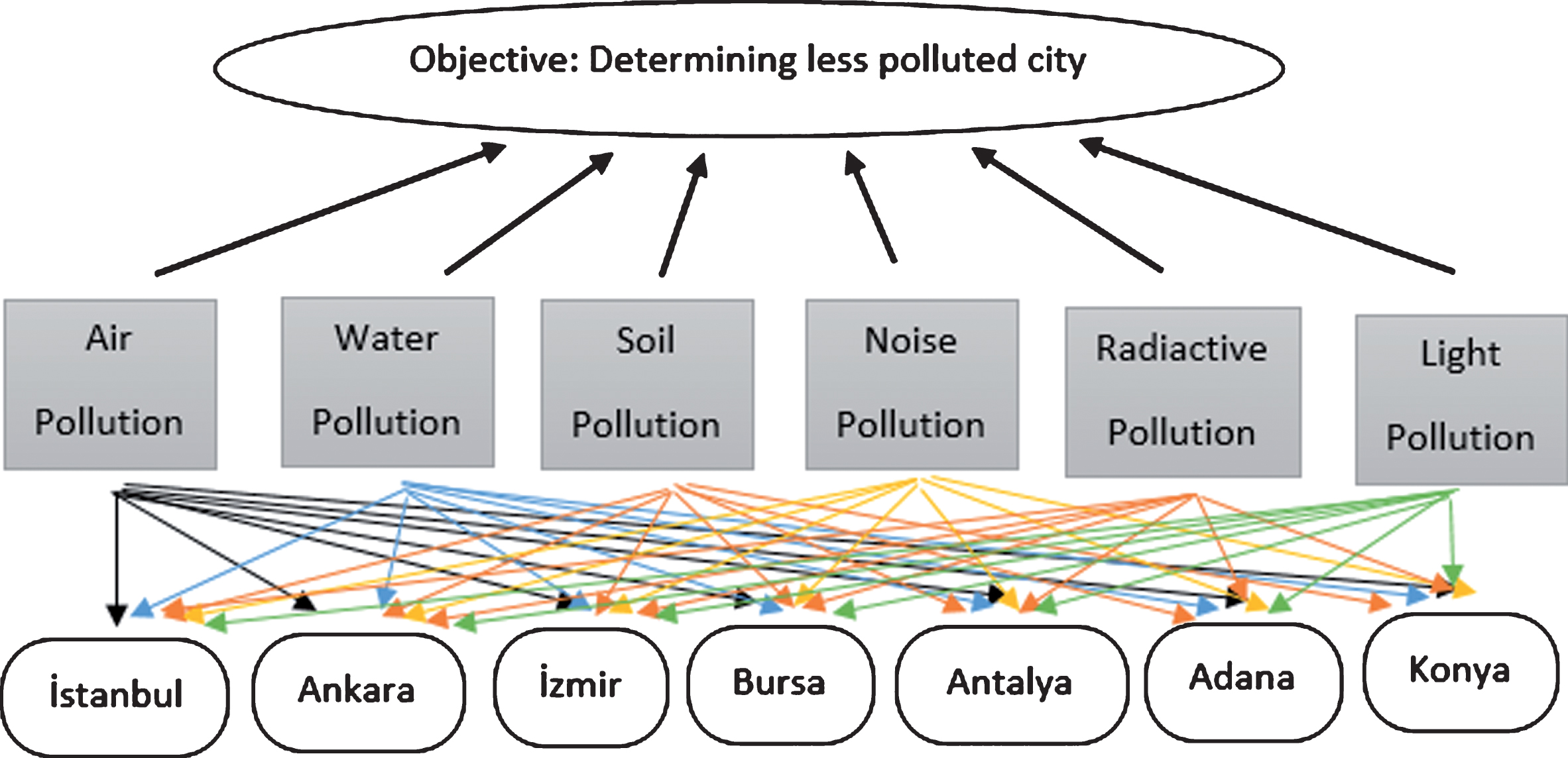
Hierarchical structure of environmental pollution problem.
Among several types of pollution coming from different sources and having different consequences, air pollution has a vital role for a clean environment. It is formed by the presence of pollutants in the atmosphere. These pollutants can exist in the form of particulate matter such as dust or excessive gases like carbon monoxide or other vapors that cannot be effectively removed through natural cycles. Depending on the concentration of air pollutants, various effects can appear as smog increases, higher rain acidity, reduction in the supply of oxygen to the heart especially in people suffering from heart disease, pollen allergies, higher rates of asthma, crop depletion etc. According to the European Environment Agency (EEA), more than 97 percent of Turkey’s urban population is exposed to unsafe amounts of particulate matter pollution. From the evidence available, Turkey emerges as a country with one of the highest rates of premature deaths in Europe [25].
Water pollution involves any contaminated water, whether from chemical, particulate, or bacterial matter that degrades the water’s quality and purity. Water pollution can occur in oceans, rivers, lakes, and underground reservoirs, and as different water sources flow together through the water cycle the pollution can spread. The effects of water pollution include decreasing the quantity of drinkable water available, lowering water supplies for crop irrigation, and affecting fish and wildlife populations that require water of a certain purity for survival.
Soil, or land pollution, is contamination of the soil that prevents natural growth and balance in the land whether it is used for cultivation, habitation, or a wildlife preserve. Some soil pollution, such as the creation of landfills, is deliberate, while much more is accidental and can have widespread effects. Thus, it can lead to poor growth and reduced crop yields, loss of wildlife habitat, water and visual pollution, soil erosion, and desertification.
Noise, or sound pollution, is an excessive noise with harmful impact on the activity of human life. It is one of the biggest health risks in urban life that it can cause hypertension, high stress levels, tinnitus, hearing loss, sleep disturbances and other hazardous effects. Despite being related to increased health problems, it is often overlooked.
Radioactive pollution refers to physical pollution as a result of release of radioactive substances into the environment during nuclear activities such as nuclear explosions, nuclear weapons tests, mining of radioactive areas, disposal of radioactive waste, accidents at nuclear power plants as well as use of radiation in medicine. Exposing to radiation can cause not only harmful diseases, also cancer or human death.
Light pollution is a pollution occurred by inappropriate, obtrusive or excessive use of artificial light. Some main causes are alteration or degradation of natural light in the environment as a consequence of industrialization and modernization and it results in headache incidence, body fatigue, medically defined stress, or increase in anxiety. It also affects the quality of life and safety of humans. As a side effect, excessive nighttime lighting interestingly releases more than 12 million tons of carbon dioxide into the atmosphere every year.
Data information
In order to generate air pollution data, we consider typical air pollutants that cause immediate concern. Both PM10 (Particulate Matter) particles, the fraction of particulates in air of very small size (<10μm), and SO2 are exploited in “mg” by using monthly average values taken from many measurement stations for every city. Hence, it is shortly noted that an air pollution quality relies on SO2 and concentrations of PM10.
People who use a source of drinking water need to monitor the level of nitrates in their well water. Thus, for Water Pollution data, we present annual average nitrate level which is derived from many potable water sources for every city. Therefore, the water pollution values refer to average nitrate quantity in “mg/L”.
As one of the major source of environmental devastation is caused by modern food production, modern fertilizers that consist of varying amounts of nitrogen (N), phosphorus (P) and potassium (K) are considered for a soil pollution. Total quantity used on the basis of plant nutrient content (N, P, K) and pesticides that are substances including insecticides, herbicides, fungicides, rodenticides, nematocytes, acaricides are figured in “tons”. The higher the value is, the more the agricultural activity is indicative.
Average activity concentrations of radionuclides (Ra-226, Th-232, K-40 and Cs-137) in the soil samples in “bq/kg” (special unit of radioactivity) are considered as a Radiactive Pollution data.
Noise pollution is measured in logarithmic units called decibels while light pollution is measured in photometry. However due to the lack of the data about both pollutions, we resorted to demand the opinions of competent decision makers. Moreover, linguistic scale in Noise criterion is used for the evaluation of alternatives to make the procedure easy for experts. As seen, four quantitative and two qualitative criteria are defined.
In Table 3, ratings of all cities based on quantitative criteria which are aggregated from [25] are shown. The linguistic data belonging to two qualitative criteria are given in the next subsection.
Collected Data for Quantitative Criteria for each alternatives [25]
Collected Data for Quantitative Criteria for each alternatives [25]
Let a
ij
a value of alternative A
j
∈ A on quantitative criteria x
i
∈ X. Since the phyiscal dimensions and measurements of quantitative criteria are different, a
ij
needs to be normalized. In order to establish an MCDM problem under Atanassov’s IF environment, we specify a new transition rule as below, inspired from both [14, 26].
and
Note that, since all criteria can be considered as benefit because of the fact that the aim of this study is to find the most polluted city and then the most cleanest city, we can simply transformed these a
ij
values into IF numbers indicated as
Values of parameters α i ∈ [0, 1], β i ∈ [0, 1], δ i ∈ [0, 1] and γ i ∈ [0, 1] are determined according to characteristics of the algorithm. Thus, as it is experimentally appropriate to assign these numbers close to 1, we fix as α i = 0, 9 and β i = 0, 85 for the quantitative criteria i = 1, 2, 3 and 5. We also define α4 = α6 = 0, 9 and β4 = β6 = 0, 85 where we use them in third step of PROMETHEE where i = 4 and i = 6 stand for qualitative criteria.
In this study, we developed a GDM method in an uncertain environment where DMs’ expressions are aggregated into single group decision opinions.
Data collection is provided by a questionnaire through the assessment of five decision makers, who are supposed to express their opinions using seven linguistic terms according to the scale given in Table 1. Each linguistic variable is associated to an IF number. The importance weights of the experts are decided through their experience and skills in the related field. The weight vector for the experts is t j = (0.25, 0.25, 0.25, 0.125, 0.125) where the sum of the values is equal to 1.
The linguistic data acquired from the experts and the associated IF numbers for each criterion according to the decision makers are given in Tables 4 and 5.
DM’s evaluation of criteria with IF numbers
DM’s evaluation of criteria with IF numbers
DM’s evaluation of criteria
Let X ij =< μ ij , v ij > a criteria-decision maker matrix in IF environment where i = 1, 2, …, 6 and j = 1, 2, …, 5 define number of criteria and number of decision makers respectively.
Since a normalization procedure is not required, we can directly aggregate the evaluation scores of criteria by utilizing the importance weights assigned to the experts derived from the Equation (6) and we obtain t j . X ij matrix. Finally, using the Equation (3) by applying the operation recursively, we obtain the sum of the rows.
In Table 6, last column of the table can be considered as weights of each criterion that are taken into account in second phase.
Aggregated of evaluation matrix and average of each criteria with IF numbers
As the linguistic data is required, similar study is also conducted for two qualitative criteria in order to determine IF values for each alternative by applying IF-SAW method under GDM process where the number of decision makers and their weights are the same. However, unlike the work above, information is provided by using only five linguistic terms according to the scale given in Table 2. As the procedure is based on IF-SAW, it is preferred to present the decision makers’ opinions with linguistic variables as indicated in Tables 7 and 8, for the Noise and Light Pollution, respectively.
Evaluation matrix of five DMs among alternatives for noise pollution
Evaluation matrix of five DMs among alternatives for light pollution
The IF results of two tables after using IF-SAW method can be seen in Table 9 in the next subsection.
IF values of alternatives according to all criteria
Considering weights of all criteria, the IF values of two qualitative criteria and the IF values of four quantitative criteria obtaining by the transformation rule from pure data into IF environment, we can employ IF-PROMETHEE to the following inputs in Table 9 in which all numbers are rounded two decimal after comma.
Applying the steps in the IF-PROMETHEE section, a preference threshold p value and an indifference threshold q value are determined as in Table 10.
PROMETHEE’s threshold values for each criterion
PROMETHEE’s threshold values for each criterion
In the next steps, the distance IF matrix d k and the general preference function matrix P k (d) are respectively calculated for every criteria. Tables 11 and 12 represent the distance and general preference function values for the first criterion.
Differences of each alternatives for the first criterion
Type V general preference function values for the first criterion
Since the IF weight vector that is calculated is W T = [〈0.9, 0.05〉, 〈0.7, 0.23〉〈0.48, 0.4〉, 〈0.38, 0.5〉〈0.75, 0.18〉, 〈0.22, 0.66〉] (see Table 6, last column), we obtain the weighted general preference function matrix WP k (d) for each criterion as represented for the first criterion in Table 13.
Weighted general preference function values for the first criterion
For Step 5, by using six WP k (d k ) matrix, we obtain the outranking relation matrix π (WP k ) as in Table 14.
General outranking relation matrix
Finally, Φ+ (π), i.e. positive outrank, Φ- (π), i.e. negative outrank, and defuzzied net flow values, i.e. net outrank, are represented in Table 15.
Net flow and ranking of each alternative via IF-PROMETHEE
The highest net outrank shows the most polluted city among others.
In order to test the robustness and accuracy of our methodology, we applied two other methods for a ranking phase, namely IF-TOPSIS inspired from [27] and IF-SAW. According to values shown in Table 16, results obtained by IF-PROMETHEE are very close to the results conducted by two other methods.
Ranking orders with three MCDM methods
According to our results, Konya is the least polluted city between the major cities in Turkey. Even though there is an agriculture-based industry in the area, the city follows firmly anti-pollution regulations. It also features transportation and transfer stations that sort through garbage and take out recyclable materials. Bursa is the most polluted city. The city’s groundwater has been found to contain some pollutants higher than the World Health Organization’s recommended amount. The extension of the city due to increasing population is leading to further deterioration of the land like deforestation and construction activities.
In order to have an acceptable pollution level, cities should take some measures as reducing industrial smokestack emissions, increasing the use of renewable power sources, prioritising rapid transit, planning effective sewage treatment, preventing deforestation. A series of policy on energy conservation and energy use must be adopted and government responsibility and intensifying penalties must be clarified.
Conclusion
In this study we presented intuitionistic fuzzy multi-criteria group decision making (FMCGDM) model for environmental pollution problem in major cities. We integrated PROMETHEE and SAW in order to provide a complete ranking of alternatives and to capture uncertain situation involving hesitancy in the evaluation process.
To the best of our knowledge, although several fuzzy PROMETHEE approaches have been previously proposed, no study has yet integrated SAW and PROMETHEE in an environmental pollution problem. In terms of originality, PROMETHEE has firstly been employed in this field. We demonstrated how the proposed approach could provide a well-structured and coherent solution.
For a future work, the techniques that are used in this study can be applied to similar cities around the world. Same or other MCDM methods can be employed in Hesitant Fuzzy (HF) area for the environmental problem.
Footnotes
Acknowledgments
This research has been financially supported by Galatasaray University Research Fund (19.402.002)