



Abstract
The region encircled by the circle of radius
Keywords
Introduction
The fuzzy set (FS) theory was introduced by Zadeh in 1965 to address vague and imprecise information. 1 A membership value between 0 and 1 is assigned to each element in an FS. FSs have been used in many domains, such as clustering, medical diagnosis, pattern recognition, etc. Gorzalczancy examined interval-valued fuzzy sets (IVFSs) in 1987 because FS's approach to uncertainty would be better if its membership values are intervals. 2 In 1986, Atanassov developed the concept of intuitionistic fuzzy sets (IFSs) since it is impossible to identify the non-membership value of an element in a FS. 3 The membership and non-membership values of each element in an IFS range from 0 to 1, and their sum is less than or equal to 1. Although IFSs perform better than FSs in uncertain conditions, they may perform even better in some circumstances if their values are expressed in terms of intervals. Therefore, interval-valued intuitionistic fuzzy set (IVIFS) which was introduced by Atanassov and Gargov in 1989, 4 uses closed intervals to express the membership and non-membership values. Circular IFS (C-IFS), which Atanassov introduced in 2020 as an extension of IFS, 5 represents each element as a circle encircling IFS. There are several researchers who are actively studying C-IFSs. Alimohammadlou et al. used C-IFSs in the manufacturing industry. 6 C-IFSs were used by Alsattar et al. for developing IoT monitoring devices. 7 Using the Tomada de Decisão Interativa Multicritério (TODIM) technique, Ashraf et al. discussed the application of C-IFSs. 8 Higher order C-IFSs were employed in the forecasting process by Ashraf et al. 9 Present worth analysis was discussed on IVIFS and C-IFS by Boltürk and Kahraman. 10 Bozyiğit and Ünver used parametric C-IFSs in the multi-criteria decision-making (MCDM) process. 11 Çakir and Demircioğlu used Preference Ranking Organization Method for Enrichment Evaluation (PROMETHEE) technique in MCDM problem. 12 The DM problem using C-IFSs are further discussed by Çakır and Taş, 13 Çaloğlu Büyükselçuk and Sarı. 14 Evaluation Based on Distance from Average Solution (EDAS) method was applied in MCDM using C-IFSs by Garg et al. 15 C-IFS in evaluation of human capital was employed by Imanov and Aliyev. 16 Kahraman and Otay extend Vlsekriterijumska Optimizacija I Kompromisno Resenje (VIKOR) method using C-IFSs. 17 Divergence measure for C-IFSs was found by Khan et al. 18 C-IF Analytic Hierarchy Process (AHP) and VIKOR method were employed by Otay and Kahraman. 19 ELimination Et Choix Traduisant la REalité (ELECTRE) III method in C-IFSs was employed by Yusoff et al. 20 Circular IVIFSs (C-IVIFSs), introduced by Gajalaxmi et al. depict each element as a circle encircling an IVIFS. 21 Gajalaxmi et al. introduced and used aggregation operators, score, and accuracy functions for C-IVIFSs in DM. 22
Since distance measures are very effective at comparing two objects based on their uneven content, they are vital in applications where ambiguity of information is a critical component, such as MCDM, pattern recognition, and clustering. For the past few decades, researchers have been actively working on distance measures of FS extensions. FS's distance measures are described by Xuecheng. 23 Ashraf et al. developed distance measures for IFSs based on difference sequence. 24 Distances measures on intuitionistic hesitant FS were introduced by Chen et al. 25 For IVIFSs, Dugenci created a distance measure. 26 Park et al. briefly examined distance measures for IVIFSs. 27 Furthermore, additional distance measures for IVIFSs were introduced by Qin et al. and used in DM. 28 For C-IFSs, Chen created distance measures. 29 Xu and Wen discussed the use of distance measures for C-IFSs in DM. 30
The Technique for Order Preference by Similarity to Ideal Solution (TOPSIS) method is one of the most popular MCDM techniques. The principle of TOPSIS is that the best alternative is the one that has the shortest distance from the positive-ideal solution and the farthest distance from the negative-ideal solution. Sun et al. briefly extended the TOPSIS approach in Picture Fuzzy Sets (PFSs), 31 whereas Sindhu et al. extended the TOPSIS method in bipolar PFSs and employed it to MCDM problems. 32 Joshi et al. selected a renewable energy source using the TOPSIS approach in IFS. Using TOPSIS, 33 Kahraman et al. employed IFSs with ordered pairings in DM. 34 The TOPSIS method for single and IV hybrid enthalpy FSs was developed by Olgun et al. 35 The TOPSIS approach for IVIFSs in the MCDM problem was developed by Qin et al. 28 Alkan and Kahraman extend TOPSIS in C-IFS to select hospitals in pandemic situation. 36 In parametric C-IFS, Bozyiğit and Ünver expand TOPSIS. 11 Using TOPSIS and C-IFSs, Büyükselçuk assessed the Industrial IoT service. 37 Chen used the TOPSIS approach to apply C-IFSs in MCDM. 29 In order to solve the supplier selection problem, Kahraman and Alkan offered the C-IF TOPSIS approach. 38
The distance measure is a useful tool for TOPSIS method, which is one of the most effective approaches to apply in MCGDM situations. This work focuses on distance measures for C-IVIFSs and their application in the TOPSIS decision-making technique.
The objectives of this study are To develop distance measures for C-IVIFSs To apply the distance measures in MCGDM problem To employ TOPSIS method in solving the MCGDM problem To compare the result with existing results to validate the proposed technique
The outline of this study: Section 2 gives the preliminaries in which the definitions from literature are given. In Section 3, distance measures for C-IVIFSs are proposed and mathematically validated. The proposed distance measures are Normalized Hamming, Normalized Euclidean, Hausdorff-Normalized Hamming and Hausdorff-Normalized Euclidean distances. In Section 4, MCGDM problem is discussed and TOPSIS method is employed to solve the problem and the results obtained are compared with the results of existing distance measures. Sensitivity analysis is also done in this section to validate the proposed measure. Section 5 is the conclusion part.
Preliminaries
Definitions which are defined in the literature and used in this study are presented in this section.
4
Let
Let








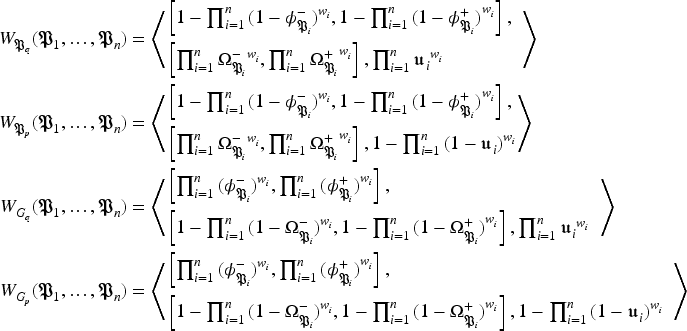
Let X be a non-empty set. The set



22
Let
Distance measures on C-IVIFSs
Let
if
where C is also a C-IVIFS in X.
In
let
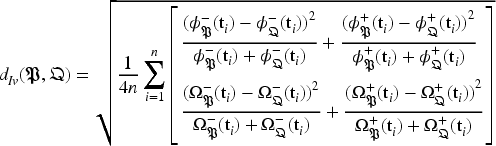
Normalized Hamming Distance
Normalized Euclidean Distance
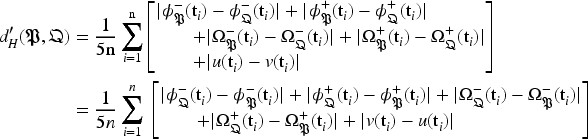
Hausdorff-Normalized Hamming Distance
Hausdorff-Normalized Euclidean Distance




Normalized Hamming distance
Let



To prove
If
We have,

a) We know that,





On adding all these above equations,




Hence (a) is proved
b) Now,




Hence (b) is proved
c) We have,

Hence (c) is proved
d) Let





Now,





On adding all these, we get,


Now,





On adding all these, we get,


Hence (d) is also proved
Since all the conditions for a distance measure are satisfied by
Note 3.4:
Normalized Euclidean distance
In this section, we develop TOPSIS method to handle MCGDM problems using C-IVIFSs.
Solving MCGDM using C-IVIFS
TOPSIS is a technique for evaluating and arranging alternatives in a situation where several criteria are taken into account. The closeness ratio is used in TOPSIS to rank the options.
Let
The steps of TOPSIS are employed below:




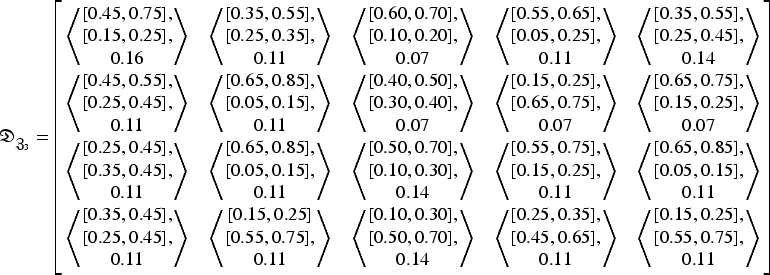
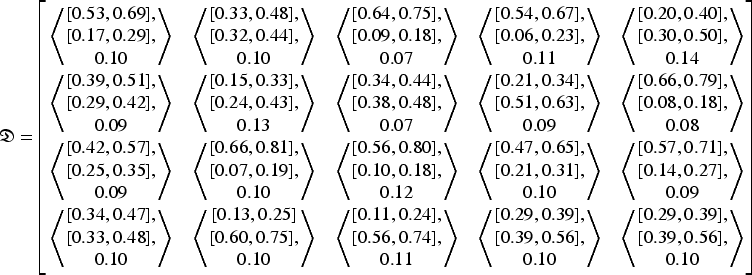
We adapt this problem from literature. 26
Following market research and initial screening, four potential cloud services-SAP Sales on Demand
Five criteria (attributes), including performance
The objective is to determine which of the four cloud services is better. TOPSIS is the technique used in this instance.





Distance measures between the alternatives and the ideal solutions.
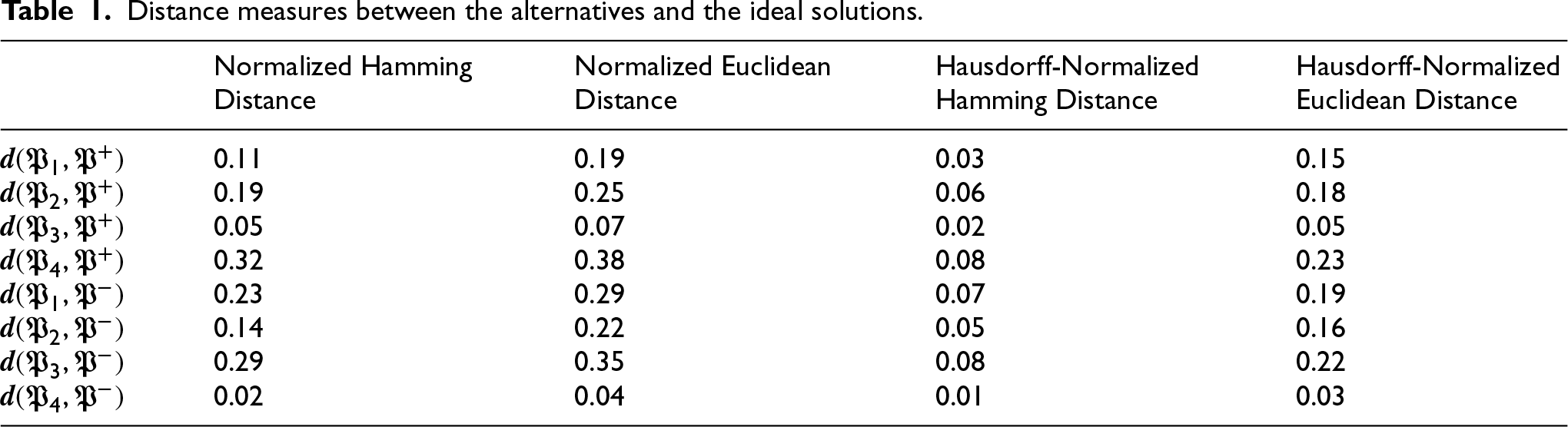
Distance measures between the alternatives and the ideal solutions.
Relative closeness of the alternatives.

In all the distance measures,
Hence, Microsoft Dynamic CRM
Sensitivity analysis shows how the suggested distance measures of C-IVIFS are stable and robust in the presence of imprecise or uncertain data when the underlying membership or non-membership information are marginally perturbed.
The systematic procedure outlined in Section 4.1, which also ranks the various alternatives, successfully overcomes the difficulty of MCDM in the C-IVIF environment. However, if the decision-maker chooses to increase, lower, scale, or divide an assessment value for any of the alternatives based on specific criteria during the analytical process, it may or may not have an impact on the final ranking of the alternatives.
Consider the circumstance in which any or all of the evaluation values in illustration 4.1 are scaled by a specific factor. In this, we use two operators
Let 

One of the criteria is scaled by any C-IVIFS. Criteria 5 in illustration 4.1 is security; in the present world, cloud service security needs to be prioritised more to protect an extensive amount of data. In light of this, the decision-maker wants to scale the evaluations for each alternative of the security criterion by
The procedure is same as in section 4.1, but after step 2, the criterion

Relative closeness of the alternatives.
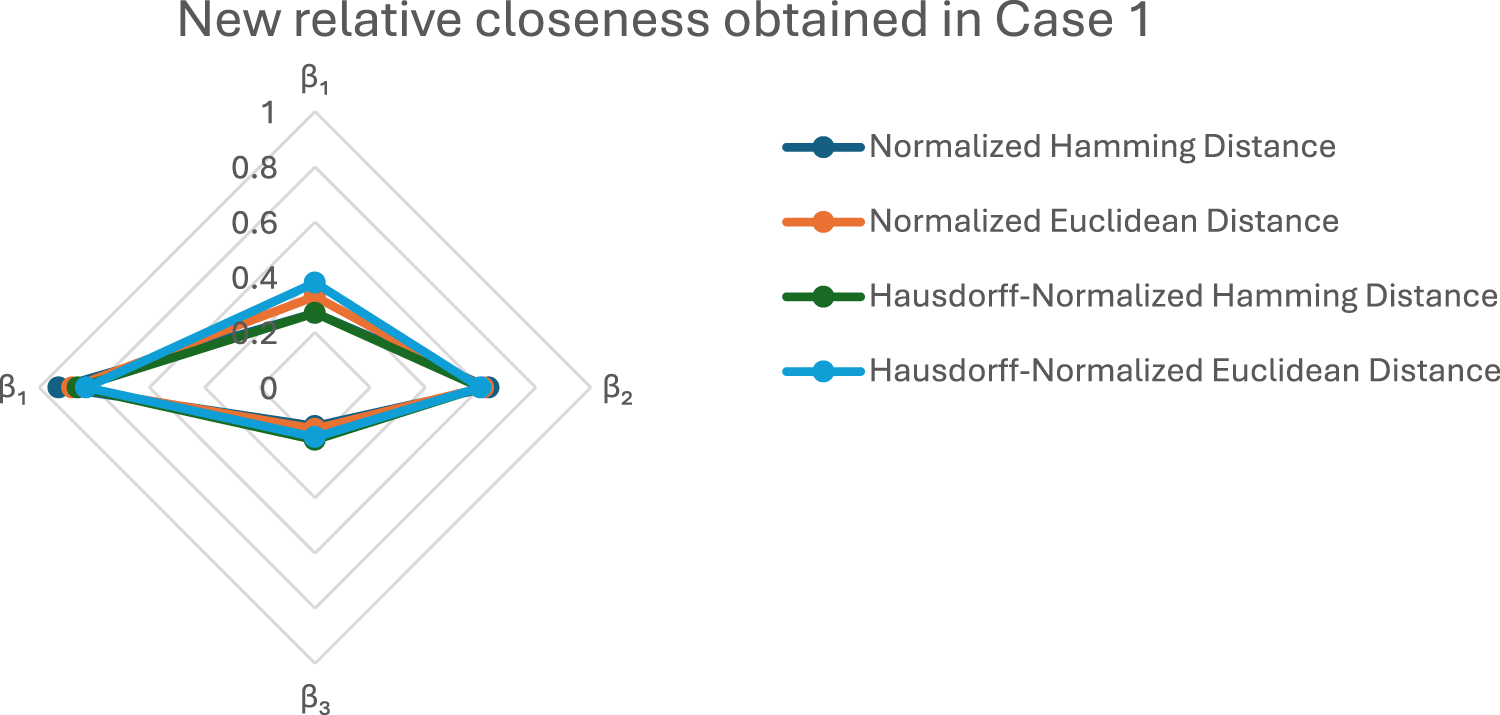
New relative closeness obtained in Case 1.
New relative closeness of the alternatives (Case 1).

In this case, each criterion is scaled by a separate factor.
After step 2, the criterion

New relative closeness obtained in Case 2.
New relative closeness of the alternatives (Case 2).

In this case, each criterion is scaled by the unique factor.
After step 2, the criteria
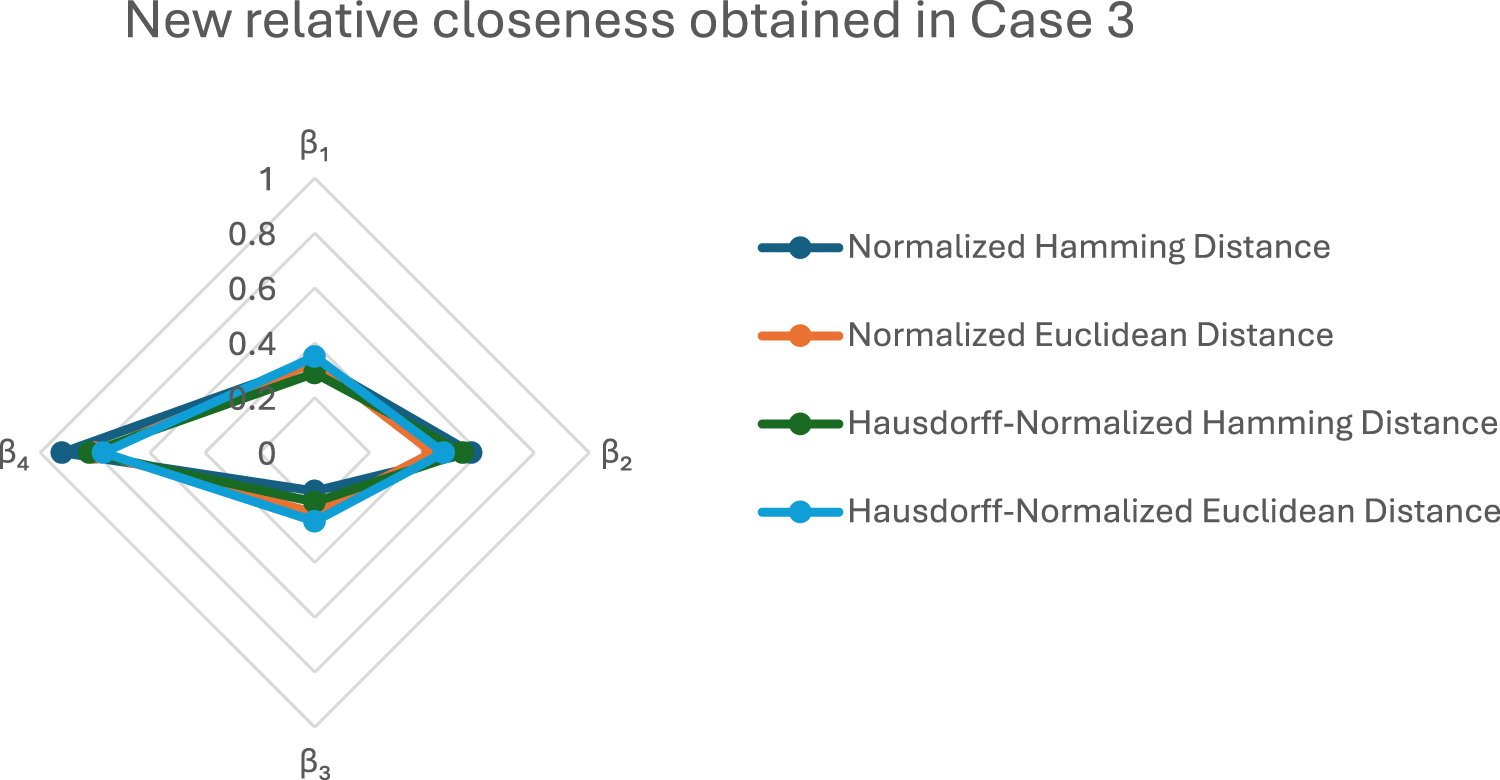
New relative closeness obtained in Case 3..
New relative closeness of the alternatives (Case 3).

The same instance is evaluated using the already existing distance measures and the results are computed in Table 6.
Existing distance measures values.

From the Table 6, it can be seen that the ranking of alternatives by the existing distance measures and the newly proposed distance measures are similar, hence our proposed distance measures are valid.
The distance measures of circular interval-valued intuitionistic fuzzy sets are the primary objective of this study since they are important in many different application domains. The following distance measures are suggested: Normalized Hamming, Normalized Euclidean, Hausdorff-Normalized Hamming, and Hausdorff-Normalized Euclidean distances. The developed distance measures are applied to a group decision-making problem from the literature, and the TOPSIS approach is used to solve the problem. This led to the finding of the better cloud service. In order to verify the suggested distances, the same problem is examined using the literature's existing distance measures, and the results showed that they aligned with the proposed distances. To quantify and demonstrate the robustness of the proposed approach, sensitivity analysis is done by using the operators
Footnotes

Funding
The authors received no financial support for the research, authorship, and/or publication of this article.
Declaration of conflicting interests
The authors declared no potential conflicts of interest with respect to the research, authorship, and/or publication of this article.