



Abstract
Medical image processing is an interdisciplinary subject of integrated medical imaging, mathematics, computer science and other disciplines. With high spatial resolution, high signal-to-noise ratio and high resolution of soft tissue, the technology can accurately locate the target areas of interest in medical images, thus providing useful information for clinicians to formulate disease treatment plans. These techniques include digital subtraction angiography, magnetic resonance imaging, computed tomography, ultrasound imaging and positron emission tomography. The purpose of this paper is to study the application of fuzzy C-means clustering in image analysis of critical medicine. This paper discusses the classification effect, clustering process, iteration times and running time of different algorithms, and the segmentation effect of different algorithms. By designing parameters and carrying out simulation experiments, the traditional clustering algorithm and improved local adaptive method are compared, and the problem of long coding time of traditional image compression algorithm is solved. The simulation results under the same working environment show that the coding speed of the algorithm is about five times faster than that of the traditional image compression algorithm without affecting the signal-to-noise ratio and compression rate, which proves the superiority of the algorithm.
Introduction
Medical image processing is an interdisciplinary subject in the fields of comprehensive medical imaging, mathematics, and computer science. It is a modern information processing tool that uses mathematical methods and computers. It is a technique for processing images produced by different medical imaging devices [1–3]. These technologies include digital subtraction angiography, magnetic resonance imaging, computed tomography, ultrasound imaging, and positron emission tomography. These imaging techniques present a wealth of information about the anatomy and functional status of human tissues and organs. Among them, due to the high spatial resolution of MRI, high signal-to-noise ratio and high resolution to soft tissue, more and more are used in the field of clinical medicine. With these medical images, human organs and tissues are examined, qualitatively and quantitatively analyzed to obtain clinical information on related diseases, which brings great convenience to the diagnosis of clinicians. With the continuous development of medical imaging technology and its wide application in clinic, the diagnostic accuracy of diseases has been greatly improved, and the information demand provided by medical imaging is becoming more and more intense. Medical imaging plays an important role in computer-assisted medical, image-guided surgery and tumor radiotherapy. As the role of medical imaging becomes more and more important and the demand becomes more and more intense, the medical images produced by the imaging device are also greatly increased. Therefore, medical image processing technology has an increasingly important status and role [4, 5].
The relevant parameters of fuzzy C-means clustering method mainly include fuzzy clustering center parameter selection, clustering category C, fuzzy weighted index m, and iterative termination error parameters. There are 4 ways to set the initialization parameters. The manual intervention method refers to pre-operation of the image to be processed, and selects several points in multiple regions of the image as initial values. There are usually two methods: one is to randomly select multiple points in the image, and then calculate Theaverage of these points is taken as the initial value; another method is to select any point in the image to be processed as the initial value. The random setting method refers to randomly selecting several values from 0–255 as initial values. Although the method given randomly is simple and feasible, if the difference between the selected initial value and the actual cluster center is too large, the number of iterations of the algorithm will increase and the time cost will increase. The clustering result given method calculates the initial center value by hard clustering, and then uses the result as the initial center value of the fuzzy clustering [6]. The histogram method refers to selecting an appropriate peak point as an initial value according to the gray histogram of the image during image generation. The gray level of the image can be analyzed by a histogram. The square of the pixel area with the higher image gray value is reflected in the histogram as the peak of the wave. Similarly, the area of the pixel whose gray value is lower represents the trough of the wave. The number of cluster categories affects the final segmentation effect, but there is no uniform standard for the selection of cluster categories, most of which are based on experience. If there is a large gap between the number of selected cluster categories and the number of actual cluster categories, the classification effect will be seriously inconsistent with the actual situation, and the segmentation effect will be greatly reduced [7–9]. At present, the value of the fuzzy weighted index m is inconclusive, and most of them are selected according to experience. When the value of m is 1, the algorithm degenerates to hard c. The mean clustering algorithm usually chooses a value of 2 in a reasonable range, and the result is better [10]. The value of m in the algorithm is 2.
The main work of this thesis is as follows:(1) The basic image segmentation theory and algorithm are studied. The theory of image processing and related image segmentation methods is introduced. The advantages and disadvantages of the relevant segmentation algorithm are analyzed in detail. (2) Simple analysis of cluster analysis and fuzzy mathematics theory. The steps and principles of clustering are introduced in detail, and the specific process is given. The clustering algorithm is summarized. (3) Aiming at the problem of traditional fuzzy mean clustering algorithm in segmentation, the advantages and disadvantages of the algorithm are analyzed, and a new space function is proposed. An improved local adaptive fuzzy mean clustering algorithm is obtained. The steps of the algorithm are introduced in detail. Finally, the traditional fuzzy mean clustering algorithm and the improved local adaptive method are compared by simulation experiments, and the effectiveness and effectiveness of the new algorithm are confirmed. (4) Applying the new algorithm to brain bone image segmentation, the types of image segmentation selected are isolated, frosted glass and vascular adhesion type. Design parameters and compare them. Finally, the simulation results show that the algorithm is better than other traditional algorithms.
This article details the terminology of medical image processing and clustering algorithms and gives a mathematical representation of the clustering. Then, the whole clustering process is analyzed and summarized. Three clustering methods are studied, and the principles, advantages and disadvantages of various clustering methods are discussed. Then introduce the fuzzy theory, including the concept of fuzzy set and fuzzy membership. Finally, the principle and detailed steps of the classical fuzzy clustering algorithm are given. The classification effects of different algorithms, clustering process analysis, algorithm iteration times and running time are discussed. Perform simulation experiments to compare the segmentation effects of different algorithms. Finally, it is concluded that the fuzzy C-means clustering algorithm proposed in this paper solves the problem of long coding time of traditional image compression algorithms. Under the same working environment, the encoding speed of the algorithm is about 5 times higher than that of the traditional fractal compression algorithm without affecting the signal-to-noise ratio and compression ratio, which proves the superiority of the algorithm.
Proposed method
Related work
Three-dimensional reconstruction of medical images is an important aspect of image processing. The factors affecting the reconstruction effect are, on the one hand, the quality of the acquired image, including the amount of data collected (including layer spacing, image resolution, number of pixels). Another important factor is image segmentation. The accuracy of image segmentation directly determines the accuracy of 3D reconstruction. The segmentation of medical images is divided into two-dimensional segmentation and three-dimensional segmentation according to different processing objects. 3D segmentation can directly treat slice datasets as 3D data that can be segmented in 3D. It can also be based on slice segmentation, taking into account grayscale and spatial position data between slices. The above correlation provides more information than a single slice, resulting in better segmentation results. The redundant image is constructed by blurring the expected value of each slice, increasing the feature size of each pixel, and then using the fuzzy mean clustering method for the segmentation process. Medical images are inherently ambiguous.
(1) Medical images have gray-scale ambiguity: ct values in the same tissue vary greatly, such as the density of teeth, sinuses, and femurs; in the same object, ct values are not uniform, such as the density of the outer surface of the femur and internal bone marrow.
(2) Geometric fuzziness: large voxels on a boundary usually contain boundaries and objects at the same time; the relationship between the edges, corners and regions of objects in the image is difficult to describe accurately. Some lesions invade the surrounding tissue and their edges cannot be clearly defined.
(3) Uncertainty: Under normal circumstances, if a lesion occurs (for example, a lump on the surface of the organ and a spur on the surface of the bone), a structure that does not exist in the normal tissue or part may appear. Its appearance makes building models difficult. Different from normal images. In medical images, many artifacts come from the patient’s body position motion, the bed’s uniform linear motion, and this uncertainty is not random, so it is not appropriate to use geometric probability theory. Because the fuzzy set theory is uncertain about the image. Gender has a good ability to describe so many scholars at home and abroad have applied fuzzy theory to the field of image processing technology and achieved good results. Especially in image enhancement, image segmentation and edge detection, the effect is better than the traditional image processing method.
The main goal of image segmentation is to divide the image into regions that do not overlap each other and have their own characteristics. When an image is processed, the objects to be processed in different images are often different, and the areas they occupy are also different, so it is necessary to divide the object and the background in different images. For example, in order to determine a lesion area in a medical image, it is first necessary to separate the lesion area in the image from normal tissue; when performing face recognition, it is necessary to extract a face from the background of the picture. After the text is recognized, image segmentation techniques are also needed. The result of image segmentation will directly affect subsequent higher level image processing. Successful segmentation will facilitate feature extraction description, image recognition and classification.
Teppola and Minkkinen proposed several related concepts about fuzzy C-means clustering. First, a hidden path process modeling method is given. Secondly, the application and difference of PCM algorithm and FCM algorithm in process monitoring are introduced. The difference between these algorithms is large because the membership values produced by the different algorithms and the resulting typical values have different interpretations. In FCM, membership is relative and corresponds to the partition information, ie their sum. The “partition constraint” in PCM has been relaxed, so the calculation of the so-called typical values is no longer relative. Instead, these values represent some degree of typicality of the class prototype, which in turn corresponds to different process states [11, 12]. MahelaOP and ShaikAG proposed a power quality disturbance detection and classification method based on Stokewell transform and decision tree initialization fuzzy C-means clustering. And compared with the rule-based decision tree based on S transform. The PQ disturbance was simulated by MATLAB software, and the simulation results were in accordance with IEEE-1159 [13, 14]. MalligaL and RajaKB propose a new enhanced content-based medical image retrieval (CBMIR) based on MFCM clustering technology. To retrieve the image, the Haralick and Texture spectral features are first extracted from the database medical image. Therefore, features extracted from database images are clustered by FCM clustering techniques [15, 16]. LongTN, MaiDS and PedryczW introduce a method that uses a fuzzy clustering algorithm called IIT2-FCM to calculate membership using local spatial information between pixels and their neighboring pixels. An interval fuzzy C-means clustering algorithm based on spatial information is proposed. A semi-supervised interval type 2 FCM clustering algorithm for satellite image analysis is proposed. The algorithm is applied in the classification of multi-spectral image land cover [17, 18]. SongZ, WangL and DuanS construct a memristor pulse coupled neural network (m-pcnn) for medical image processing. The memristor decreases exponentially over time and can be used to adjust the PCNN threshold online. Integrating the memory of the memristor into the PCNN can make the network biologically functional. The introduction of nanoscale memristors can also significantly reduce the size of PCNN [19, 20].
Image segmentation
(1) Definition of image segmentation
Medical image segmentation technology is an important part of medical image processing. The purpose of medical image segmentation is to use this technique to accurately locate the target areas of interest to medical images, thereby providing clinicians with favorable information for developing disease treatment options. Medical image segmentation is challenging and meaningful. Medical image segmentation uses computer to extract quantitative information of different tissues of an image. According to the principle of consistency, the whole image is divided into several regions. In a single region and regions in two adjacent regions that meet the consistency requirements, the merger will lead to the destruction of consistency. According to the angle of image segmentation, the principle of consistency mainly reflects the characteristics of the image (texture, grayscale) from the medical point of view. After segmentation, the region has special meanings in anatomy and physiology, and the same region represents the same organization. For example, CSF, white matter and gray matter. Medical image segmentation plays an important role in medical image processing and is a key step in medical image processing. The use of computers to classify human tissues not only provides an auxiliary diagnostic basis for tissue lesions, but also plays an important role in medical image registration and three-dimensional reconstruction. In clinical practice, the accuracy and speed of medical image segmentation are very high, and the human body has large differences in anatomy. Although there are many medical image segmentation algorithms, it is far from perfect.
(2) Image segmentation algorithm
The segmentation method differs depending on the purpose of the segmentation, the nature of the properties and the purpose. For example, according to the discontinuity of pixel characteristics on the boundary between regions and the similarity of attributes in the target region, the segmentation algorithm can be divided into an edge-based segmentation algorithm and a region-based segmentation algorithm. According to the change of the state of the segmentation target, it can be divided into static image segmentation and dynamic image segmentation.
Fuzzy C-means algorithm
The C-means algorithm, also known as the k-means algorithm, is a rough division of the sample set. The root function c-means clustering algorithm uses the clustering objective function as the criterion for sample clustering. When the function value is the smallest, the clustering result is obtained.
The description of this algorithm should be: set the cluster sample set X = {x1,x2, . . . , x
n
}, the number of cluster categories c, where the cluster center of the i-th category is mi(i = 1,2, . . . , c), using u
ij
(i = 1,2, . . . , c, j = 1, 2, . . . , n) to represent the membership of the j-th sample to the i-th cluster center, and have u
ij
∈ [0, 1] u
ij
∈ [0, 1] The objective function in the hard C-means algorithm is:
Where ∀j = 1, 2 . . . , n, there is u ij = 1 or u ij = 0.
Details as follows:
c: The number of cluster centers expected by the algorithm is 2≤ c ≤ n
ɛ: Iteration stops the threshold.
Preselecting c cluster centers M (b) = {m1, m2, . . . , m c }, in addition, the iteration count is set to b = 0;
Then
Where ∀i = 1, 2,...,c;
The fuzzy C-means algorithm can be described as: set the sample set X = {x1, x2, …, x
n
}, the number of cluster centers is c, m is the fuzzy weight index, and the membership degree is u
ij
(i = 1,2,...,n), where u
ij
∈ [0, 1], the cluster center is C = {v1, v2, … v
c
}, and the objective function is:
Among them ∀j = 1, 2, ·· · , n.
There is ||x j - v i || = (x j - v i ), the Euclidean distance from the jth sample to the i-th cluster center vi, usually m ∈ [1 . 5, 2 . 5].
The fuzzy c-means algorithm steps into:
The first step is to initialize each parameter, set the number of cluster centers c (2≤c ≤ n), stop threshold ɛ, fuzzy weight index m, select the initial cluster center V(b) = {V1, V2, …, V C }, the iteration counter is recorded as b = 0;
For ∀i, j, such as ∃i, r, there are
The third step: update the cluster center matrix V(b+1):
Where ∀i= 1, 2,, c′,
The fourth step: If ||V (b) - V(b+1) || < ɛ, the cluster stops, output U and V, otherwise b =b + 1, the second step of the steering algorithm.
After the iteration of the algorithm is terminated, the fuzzy membership matrix U corresponds to the fuzzy partition of the sample.
The solution method of the fuzzy C clustering algorithm is as follows:
First solve the minimum value of the algorithm, and use the Lagrangian multiplier method to convert the objective function:
Then find the partial guides for u
ij
, v
i
and λ:
Let the above partial derivative function value be 0, and find the cluster center:
Obtain:
The same can be obtained:
Therefore:
Finally, the updated membership matrix is available:
Calculate the minimum value of the objective function, and then analyze, when the membership value is larger, it indicates that the pixel points are closer; when the membership value is small, it indicates that the pixel points are far from the cluster center. The membership matrix is greatly affected by the clustering distance between the pixel and the cluster center.
Clustering is a classification that is different from classification. This is the process of classifying data objects in an unsupervised state. Traditional clustering algorithms divide data samples according to certain criteria during the clustering process. Due to the accurate classification conditions of the traditional clustering algorithm, namely the “or” or “classification” criteria, the clustering results tend to fall into the local optimization, which leads to the unsatisfactory clustering effect. However, in practical applications, sample concentration samples tend to be numerous, it is difficult to determine the category attributes, and the ambiguity is unclear. The same sample belongs to one class to a certain extent, and the other part will belong to one or more other categories, resulting in practical application. It is very difficult to classify accurate class objects into samples. For the problems of uncertainty and ambiguity, fuzzy set theory can be well solved. Fuzzy clustering algorithm is the combination of clustering algorithm and fuzzy concept. Samples in the sample set can belong to multiple categories at the same time, and the degree of membership reflects the extent to which the sample belongs to a certain category.
Hierarchical clustering can also be called hierarchical clustering method. The clustering method adopted by the algorithm is to divide or merge the data in the sample multiple times, and finally achieve the purpose of clustering. Therefore, the algorithm has two ways: top down, bottom up. By the way, I want to put the sample data into a broad category, and then classify the categories according to the size of the distance or according to the judgment of the function. First, divide a small class into two categories and distinguish them into two small classes. Then decompose the subclass in the same way, and finally separate each sample separately, if you do not separate each sample separately during segmentation or have reached the distance threshold segmentation threshold number and stop segmentation; If taking a bottom-up approach, the whole process is just the opposite, so that each individual sample becomes a small class, and then these small classes are repeatedly combined according to the corresponding distance criterion and the corresponding function, and the number of class clusters is gradually reduced, and finally, it is summarized into a large class. If you do not merge with a large class during the merge process to reach the distance threshold or the merge threshold, the merge will stop. In related research, most clustering studies using merged models.
The partition-based clustering algorithm divides the objects in the sample set into several categories, each of which represents a cluster. The above process is repeated and repeated until the clustering result satisfies the convergence condition of the criterion function. The partition-based clustering algorithm first needs to select X initial cluster centers. Under this setting, the samples are divided, the above process is repeated, and the clustering results are continuously adjusted and updated. The classification criterion in the clustering process is based on the basic principle of the clustering algorithm. In the partition-based clustering algorithm, for a sample set containing Y data, the number of selected cluster centers X must satisfy k n .
Experiments
Data set
The experimental data in this paper is from the BRATS.2016 database MR914 brain bone image. In the image, the contrast between the brain bone region and the normal region pixels is significant, and each super pixel region is distinguished based on the statistical characteristics of the gray histogram. Brain tumors are usually embedded in normal brain tissue, and brain tumors at different stages show different states. Therefore, we also selected images of brain bones that were poorly differentiated and differentiated early in the disease. Due to the spread of tumors in brain tissue, highly differentiated images are diffused, resulting in poor border length and poor image pathology. This poses a great challenge for performing medical image analysis processing.
Experimental procedure
The specific steps of this paper combined with the non-local mean fast FCM algorithm are as follows: Set the search radius R, the similarity neighborhood radius, and the filter parameter H in the non-local mean algorithm. Set the classification number c, the fuzzy weight coefficient M and the iteration termination threshold; A non-local mean algorithm is used to preprocess the simulated and measured images; Obtaining an initial clustering center of the denoised image in step b by using an automatic selection rule of the initial clustering center; The cluster center obtained in step c is used as the initial cluster center of the algorithm to segment the image denominated in step b.
The specific process of this method in this paper is as follows:
Start ⟶ enter image ⟶ set related parameters ⟶ non-local mean denoising ⟶ initial cluster center selection ⟶ fast fuzzy C-means clustering based on histogram clustering ⟶ output segmentation result ⟶ end, if the cluster does not meet the condition, repeat Clustering.
LlabEenvironment
Operating system: Windows7 (64-bit) Ultimate Edition;
Cpu: AMD Ruilong 73800X processor (r7) 7 nm, 8 core 16 thread 3.9 GHz;
Memory: 8GB;
Program: MATLABR2016a compiler.
Discussion
Comparative analysis of segmentationmethods
(1) Comparative analysis of image segmentation effects
This paper preprocesses the image by separating the skull and other operations. Figure 1 is a schematic diagram of the segmentation results using different image segmentation algorithms using noise images with an intensity of 9%, including the original image, IFCM, WFCM, and the fuzzy C-means clustering algorithm.
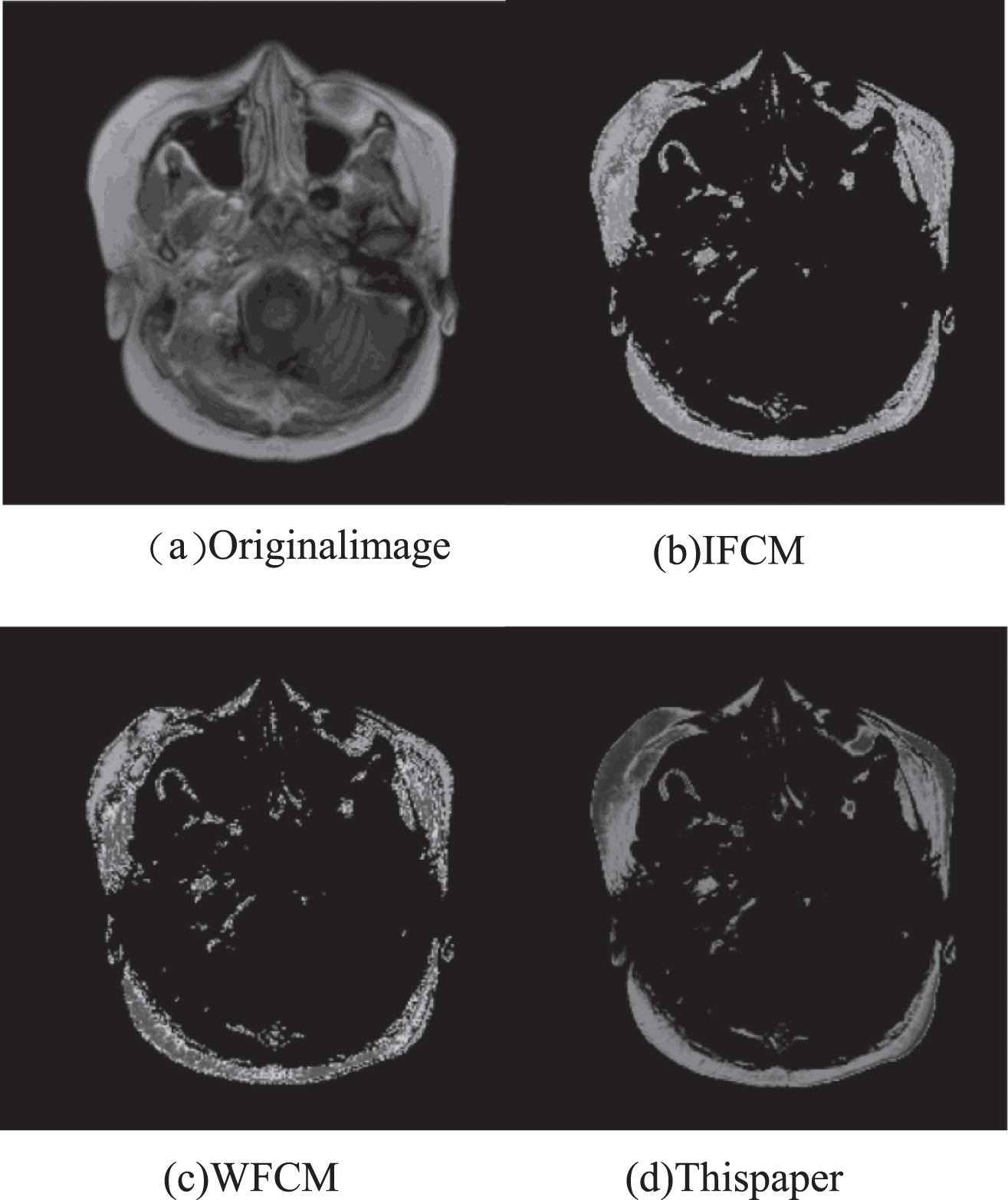
Image segmentation effect analysis.
As can be seen from the segmentation renderings, the IFCM algorithm and the WFCM algorithm are very sensitive to strong noise. After segmentation, there are still many noises in the image, and the detail retention is weak, and the image edge effect processing is rough, resulting in insufficient segmentation precision. However, the fuzzy c-means clustering algorithm in this paper can segment the target region better, and the noise points in the segmentation result are few, showing good robustness against strong noise. At the edge of the image, the algorithm has a smoother effect and can better distinguish the boundaries between brain tissue.□
(2) Comparative analysis of performance of different segmentation algorithms
One hundred and fifty objects are selected, and the objects are divided into three categories according to attributes. Each category contains fifty data. The improved fuzzy c-means algorithm needs to set the following parameters: maximum iteration number, cohesion weight value, fuzzy index, threshold, maximum number of classifications, and cohesion weight values.
The experimental parameters of the BRATS.2016 database used to test the performance of the algorithm are set to the fuzzy index M2, the threshold value is 0.002, the maximum number of iterations is 120 Maxb, the cohesive weight value is M = 0.5, and the maximum number of classifications is 15012 Maxc. According to the actual distribution characteristics of the iris dataset, the algorithm classifies the dataset into three categories, otherwise the classification is wrong. The results of several experiments are shown in Table 1 and Fig. 2.
The results of three differentalgorithms are analyzed
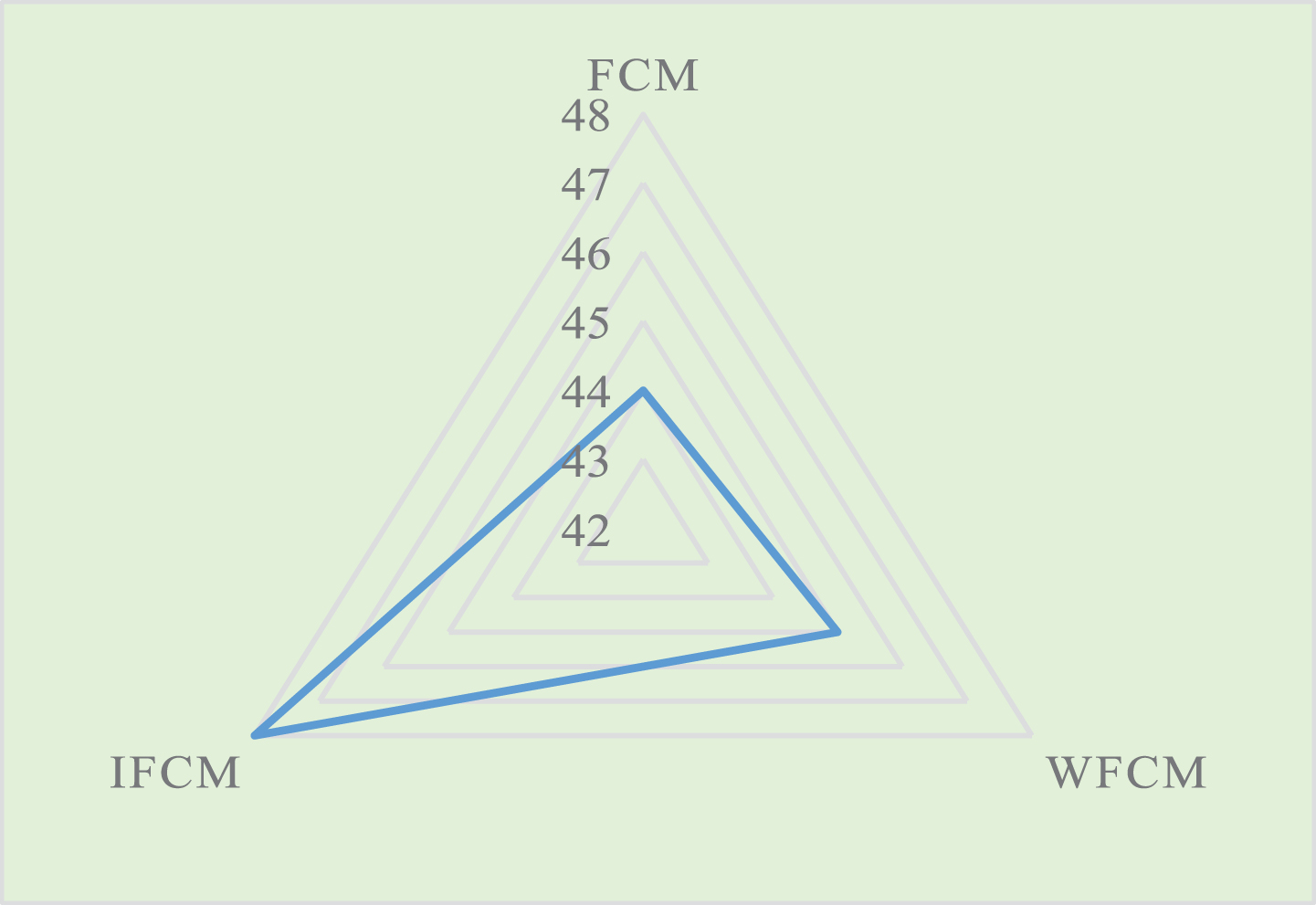
The results of three different algorithms are analyzed.
(3) Analysis of iteration number and running time of fuzzy clustering method
Select three types of brain bone images: isolated, vascular adhesive, and frosted glass. Mark the brain bone images with A, B, and C respectively, as shown in Fig. 3. Then use FCM, FCMS, FLICM, and the algorithm to segment the A, B, and C images. By calculating the number of iterations of each algorithm as shown in Table 2 and Fig. 3, the running times are as shown in Table 3 and Fig. 4.
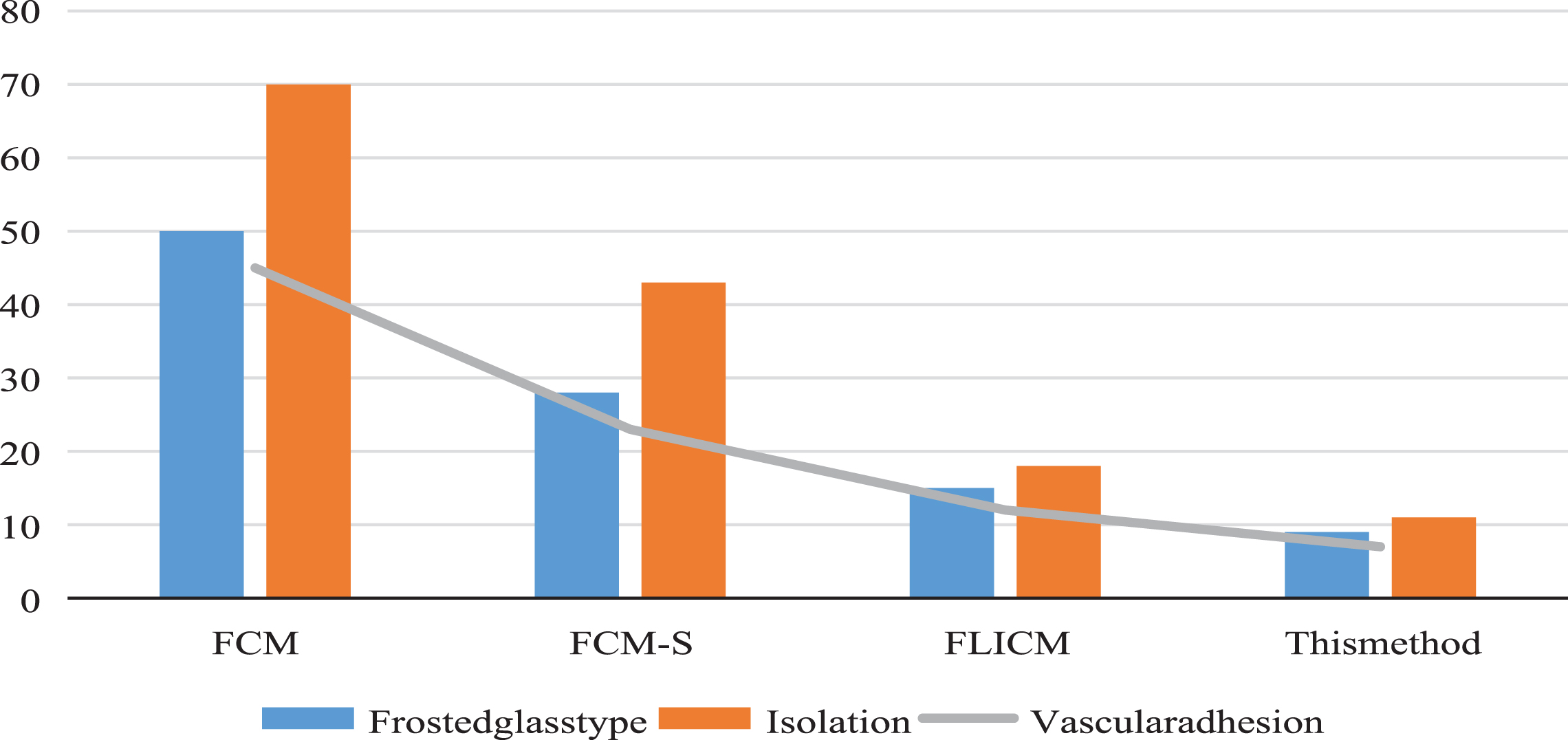
Number of iterations of fuzzy clustering method.
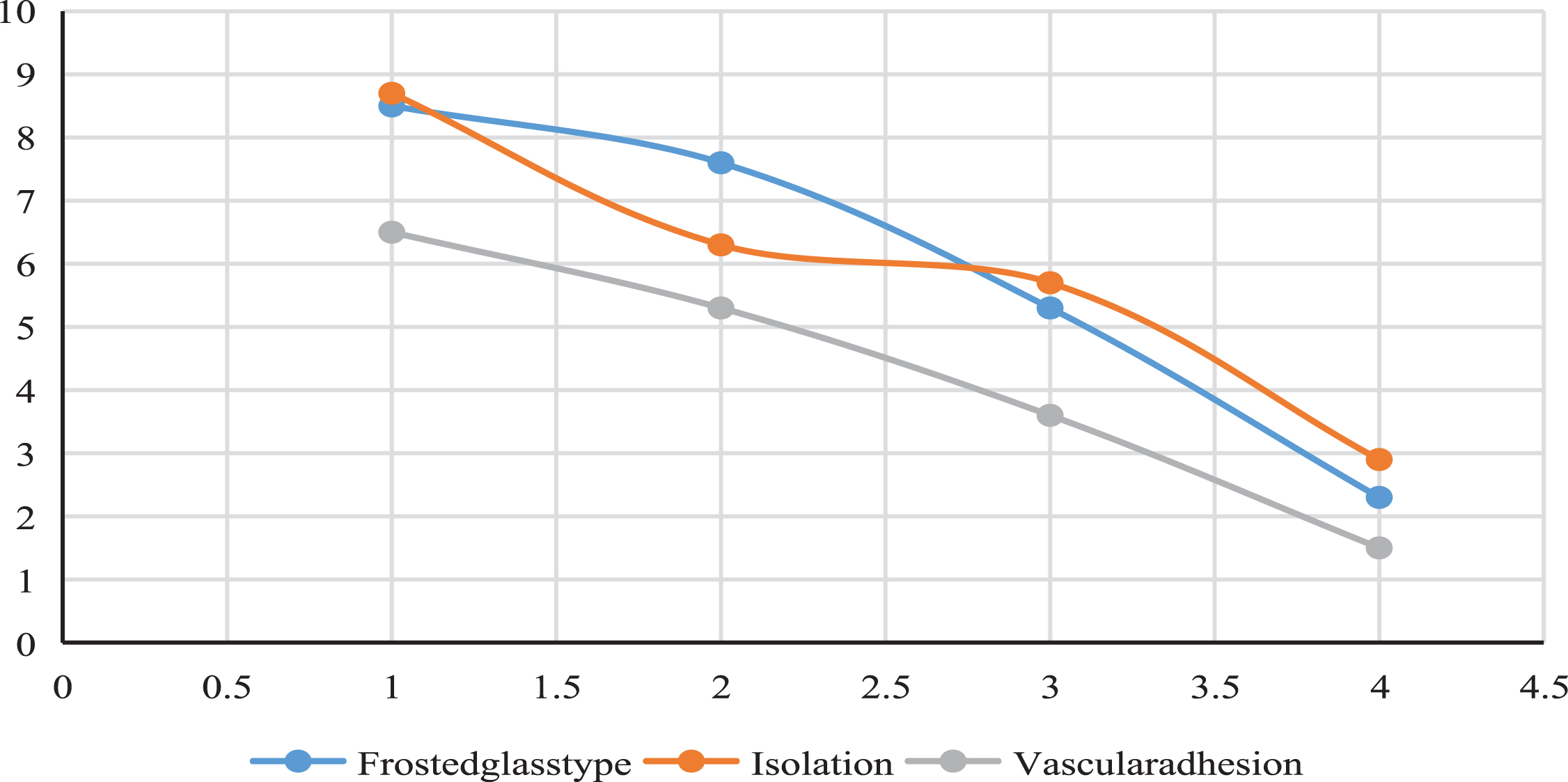
Running time analysis of fuzzy clustering method.
Number of iterations of fuzzy clustering method
Running time analysis of fuzzy clustering method
In the above algorithm, the traditional FCM algorithm reaches the termination condition with the largest number of iterations and the longest algorithm running time. Compared with the FCMS and FLICM algorithms, compared with the traditional FCM algorithm, the number of iterations and the running time of the algorithm are the least, which is related to the change of the fuzzy membership of the algorithm after one iteration. In terms of iteration number and algorithm efficiency, the fuzzy c-means clustering algorithm is superior to FLICM algorithm, FCM algorithm and FCMS algorithm in brain segmentation.
Researchers in the fields of medicine and engineering are constantly exploring the application of fuzzy clustering analysis. In addition to segmentation and compression of medical images, fuzzy cluster analysis also has important applications in blood image analysis, 3D medical image analysis, and medical image retrieval. Blood image analysis plays an important role in modern medical diagnosis. The FCM was used to analyze digital blood images, cluster and count cells, and further discuss the problem of cell overlap. The method is applied to the processing and analysis of three-dimensional medical images such as CT, spiral CT, and MRI to identify bones at the bones and joints. After reconstruction, the 3D model can clearly reproduce the anatomy. Content-based medical image retrieval is one of the key issues to be solved in order to establish an effective medical image storage structure and improve retrieval speed. Experiments show that the method is feasible by the improved FCM clustering algorithm image. Applied to image retrieval, good results can be achieved in terms of accuracy and real-time. The system based on phase display and weight evaluation feedback adjustment method can further improve retrieval performance.
Fuzzy clustering analysis can deal with multiple variables without prior knowledge classification decision, which has unique advantages compared with other medical image segmentation and compression methods, such as medical image segmentation, compression and other fields, some of which are widely used. The results show that the method has important applications in hospital comprehensive evaluation, disease classification evaluation, hospital syndrome model research and clinical medicine, such as decision analysis. In image segmentation or compression, the judgment or compression effect of segmentation is the basic starting point, and there is no acceptable influence on vision loss or vision. For medical images, the requirements of image segmentation are more favorable to clinical needs, after compression and reconstruction to ensure data. Reliable, and there is no quantitative measurement performance index, which will inevitably lead to problems such as diagnosis errors. Therefore, medical and scientific researchers are now required to improve the image processing methods of medical image segmentation and compression effect evaluation systems, for example; managers urgently need to use them. The image processing method is followed by the establishment and improvement of laws and regulations related to the diagnosis of liability accidents. The correct rate of fuzzy C-means clustering applied to the processing and analysis of CT, spiral CT, MRI and other three-dimensional medical images is shown in Table 4 and Fig. 5:
Accuracy of fuzzy clustering analysis
Accuracy of fuzzy clustering analysis

Accuracy of fuzzy clustering analysis.
This paper proposes a research method with higher classification accuracy for the BRATS.2016 database, which can converge more quickly. Because the random or selective is abandoned, the initial cluster center can avoid running the program multiple times, making the algorithm converge faster. More usable. Since the original cluster center used a method of merging cluster centers with each other, it took time for each iteration, so the running time of the improved algorithm was not as fast as expected. However, by improving the algorithm, the average time spent is reduced.
In order to solve the problem of poor medical image segmentation, this paper proposes an improved medical image fuzzy c-means clustering method for high noise and uneven brightness. Image quality degrades due to some intuitive noise in the medical image. According to the characteristics of medical images, the gray-scale similarity judgment method of neighborhood window is adopted, and different fuzzy factors are selected to cluster and segment the images. Through the simulation experiment, the problem of long coding time of the traditional algorithm is solved. Under the premise of not affecting the signal-to-noise ratio and compression ratio, the coding speed of the algorithm is about 5 times higher than that of the traditional fractal compression algorithm, which proves the superiority of the algorithm.
In this paper, in addition to segmentation and compression of medical images, fuzzy clustering analysis also has important applications in blood image analysis, 3D medical image analysis, and medical image retrieval. Blood image analysis plays an important role in modern medical diagnosis. The FCM was used to analyze digital blood images, cluster and count cells, and further discuss the problem of cell overlap. The method is applied to the processing and analysis of three-dimensional medical images such as MRI, CT, and spiral CT to identify bones at the bones and joints. After reconstruction, the 3D model can clearly reproduce the anatomy.
Footnotes
ACKNOWLEDGMENTS
This work was supported by The 13th Five-Year Plan of Higher Education Science Research of China Higher Education Association, The special subject of E-education in 2018.
No. 2018 XXHZD03.
Topic Name: Construction and Application of Online Course Quality Evaluation Index System in Colleges.
Project moderator: Yuwen NING.