



Abstract
Image recognitionan is an important part of pattern recognition, It has been widely used in modern production and life. Using computer technology and modern information processing technology to complete human visual cognition and understanding. Thus, It have become a hot topic about how to study image recognition based on medical color feature extraction. This study firstly studied the existing literature, explored and analyzed relevant theories and technologies, and studied several algorithms related to current image recognition. Then the image recognition algorithm based on wavelet moment and support vector machine is combined with the artificial intelligence technology based on image feature extraction theory to establish the color medical image recognition algorithm based on wavelet moment and support vector machine. In order to verify the feasibility and advancedness of the new algorithm, practical experiments are carried out, and the experimental results are compared and analyzed by statistical method. The concrete chart proves the correctness of the conclusion. The final of the new algorithm is proved to be successful.
Introduction
With the rapid development of modern computer technology and information technology, pattern recognition technology has been unprecedented rapid development, which was put forward in the 1920s. The goal of this technique is to use computers to classify objects. Therefore, the recognition results can be consistent with the objective things or deviation is very small. Identification methods mainly include machine identification, computer identification or machine automatic identification. With the wide application of this technology in production and life, it has received extensive attention and research.
For the problems raised in this paper, many researchers have conducted a large number of in-depth and extensive research, and achieved good results. The so-called pattern is to obtain the spatial information of things through the observation of specific targets. The concrete object is the concrete representation form of the thing, and the representation form of the thing obtained from the model is called the pattern in the field [1]. More than 75% of external information is available through the human visual system. Therefore, visual images provide abundant and effective information for human brain thinking and analysis. In addition to the fact that human visual system can obtain images, the meaning of images is more extensive and macroscopic, which mainly refers to the observation entities of various forms and means obtained by human eyes through direct or indirect effects [2]. The image recognition result is not the output of the complete image. Through certain processing, the effective features of the image are extracted, and different algorithms are used for decision making and classification. Need pattern recognition, computer vision, image understanding and other multidisciplinary knowledge and comprehensive application [3]. Pattern recognition has developed from the initial simple character recognition and fingerprint recognition to higher-end target recognition, which is mainly applied in the transportation field, medical field, military technology, space exploration and other fields involving national interests, playing a very important role, bringing great progress and benefits [4]. Invariant moment algorithm is an image recognition method based on the extraction of the mathematical features of translation, rotation and scale change. It is a method that USES the moments of image distribution to describe the gray statistical feature moments [5].
The second part of this paper discusses and analyzes the theory and technology involved in the subject, which is of great significance to the research of image invariant moments. In the third part, the classification algorithm of image recognition is compared and analyzed, and the image recognition algorithm is established on the basis of the theoretical research and technical analysis of wavelet moment and support vector machine, which is also the focus and important achievement of this paper. The fourth part is to verify the proposed algorithm through specific experiments, hoping to process the experimental results through statistical analysis, so as to prove the feasibility and advancement of the new algorithm. The fifth part is the summary and induction, and points out the direction of future research.
State of the art
Image recognition is currently widely used in many aspects of the national economy interest in every country, and brings great convenience and interest for the national economic and technical development and production and life. For example, the application of image recognition is showed in Fig. 1 in the field of face recognition.
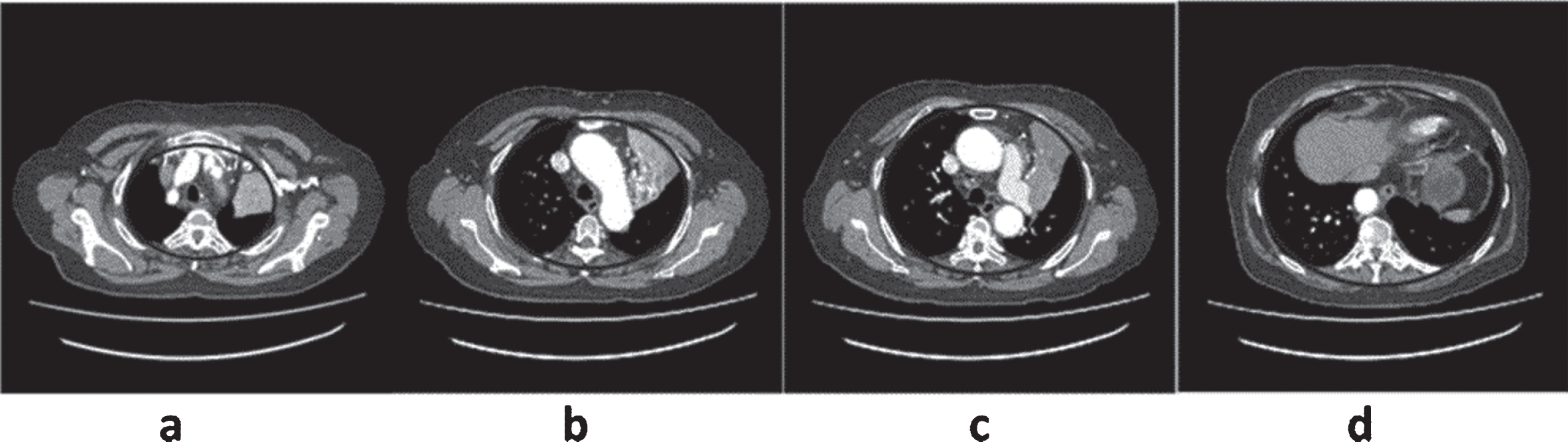
Image recognition in human chest organ tissue extraction.
In the technology and process of image recognition, the most important step is to extract the characteristics of the image, which directly affects the design and classification accuracy of subsequent related technologies, and even be very important to the feasibility of classification the effectiveness of the system recognition algorithm [6]. Therefore, the concept of wavelet invariant moment is proposed by studying the definition of wavelet multi-scale analysis and invariant moment.
The basic theory of wavelet multi-scale analysis: Wavelet transform is a signal of time scale analysis method, which can also analysis in time domain and frequency domain, and can get local features of the signal in the two areas, and it has multi-resolution [7]. From the point of view of theory, Fourier analysis in traditional methods can be replaced by wavelet analysis, which includes the continuous wavelet transform, discrete wavelet transform and dyadic wavelet transform and so on.
Moment in-variants based on the three B spline wavelet: the wavelet expression is shown in formula 1 when the three B spline wavelet is selected as the wavelet basis function.
In formula 1,
The characteristics of the three B spline wavelets: the finite smoothing, the symmetry, the compactness, the Gauss approximation. It can identify objects with similar shapes based on effectively extraction of the local features of images [8].
Wavelet moment in-variants: The global and local features of the image can be obtained by selecting different j and k, and the invariant of wavelet moment can be found in the formula 2:
In formula 2, j = 0, 1, 2 . . . , k = 01, . . .2j+1, q = 0, 1, 2, 3. Wavelet moment in-variants are invariant to rotation. And the discrete angle integral and the wavelet transform are selected in the process of implementing the algorithm. In order to calculate the wavelet moment of a given image in the polar space, the image should be moved to make its center of gravity at the origin of the coordinate, and the mapping of image pixels is located in the unit circle at the same time [9].
Classification algorithm in image recognition
BP algorithm: a reasonable adjustment of the weight is the key to the BP algorithm. Two methods are included in the BP algorithm, one of which is to conduct a return error and weight adjustment after each input of a sample. And the other is to calculate the total error after all the sample input [10]. In general, the second method is selected to avoid the problem of slow convergence caused by the first method.
The total error expression is shown in the formula 3:
The method is generally named batch training or periodic training, which can ensure the total error to change along the direction of reduce, and the process is shown in Fig. 2.

Batch of training process of BP algorithm.
Parameter tuning algorithm of wavelet neural network: Wavelet neural network’s connection weights, scale system and the translation coefficient and other parameters are determined through the network training. There are many methods to determine the parameters of wavelet neural network, but the most commonly used method is the gradient descent method. Therefore, the BP algorithm is also applied to the wavelet neural network, which can be used to obtain the objective error function as shown in formula 4,
In formula 4,
Disadvantages of wavelet neural network: In the case of multi-dimensional input, the sample of the network grows exponentially with the increase of the input dimension of the network, and the network structure becomes larger, which makes the network convergence rate decreased significantly. There is no method to determine the number of hidden layer nodes. The initialization parameter of wavelet network is an important question, which means the process of the whole network is not convergent if the scale parameter and displacement parameter initialization is inappropriate. And a self-adaption selection of wavelet basis functions are failed to take [11].
Support vector machine: Based on the theory of statistics, a machine learning method is proposed called vector machine, which is proposed in the shortest time, but has the most applicability. The method can be used to solve a lot of problems in the practical applications such as of small cost, nonlinear, high dimension and local minimum points, which makes it more quickly and conveniently. Support vector machine method is based on the VC theory and structural risk minimization theory. And seek the best balance point by searching for the best balance between the learning accuracy of the specific training samples and the ability to identify any sample without error using limited sample information, which makes generalization ability to get the best play. The original intention of the support vector machine is proposed is to solve the two kinds of linear separable problem in pattern recognition applications [12]. With the role of kernel function in the input space, the inner product of high dimensional feature space is replaced by the support vector machine. And solve or avoid the problem of “dimension disaster” which is almost inevitable in algorithm.
Invariant moment feature algorithm is a method of image recognition by extracting the features of translation, rotation and scale in-variance of the target image.
Compared to the neural network method which is based on empirical risk minimization principle, the support vector machine based on the statistical theory of VC and structural risk minimum principle of has better generalization ability, getting the results based on limited the number of support vectors obtained conclusions and the global optimal point from the finite sample information [13].
The extraction of Hu moment feature: the image of the standard 128*128 should be got firstly, and then carry out the procedure of rotation, translation and scale changes, which constitute training sample images, and get the prior knowledge of the image recognition in the early period. Then the Hu moment feature of the image can be obtained [14].
The extraction of Zernike moment and wavelet moment feature: These two kinds of moment features have one, and only one, rotation in-variance. Therefore, it is necessary to ensure that the moments of the image are not deformed after translation or scaling. Thus, the Zernike moment of the image can be obtained after the image is normalized. In order to complete the matrix extraction of image Zernike moments and wavelet moments, the wavelet matrix should be extracted the normalization of the image through the formula 2 [15].
Results analysis and discussion
In order to verify the theory and algorithm is feasible and advanced, and prove that the research is correct and successful, the actual experimental verification and statistical analysis of the results of the theory and algorithm is necessary and illustrate with specific data.
Classification algorithm for support vector machines
Polynomial kernel function is selected as the kernel function of the algorithm, and the support vector machine is used to train the training image. The different parameters are obtained by using different moment features, and the classification tests are carried out. The results are showed in Table 1, and the results of the histogram are showed in Fig. 3.
Support vector machine (SVM) classification effect
Support vector machine (SVM) classification effect

Support vector machine (SVM) classification effect.
It can be found through the chart that the method makes full use of the prior knowledge, and the training time is not more than 0.01 seconds. And the recognition rate is the highest for wavelet moment, while for Hu moment is the lowest, while it can be found that the method did not produce shock, and its stability is very good.
Based on the structure of BP neural network, the Wavelet odd function is selected as nonlinear function selection of neurons, and error back-propagation method is selected as the method to modify parameter, and the functions and methods are set together to form a wavelet neural network. Through the training and testing of training images, results are shown in Table 2, and the histogram is shown in Fig. 4.
Wavelet neural network classification effect
Wavelet neural network classification effect
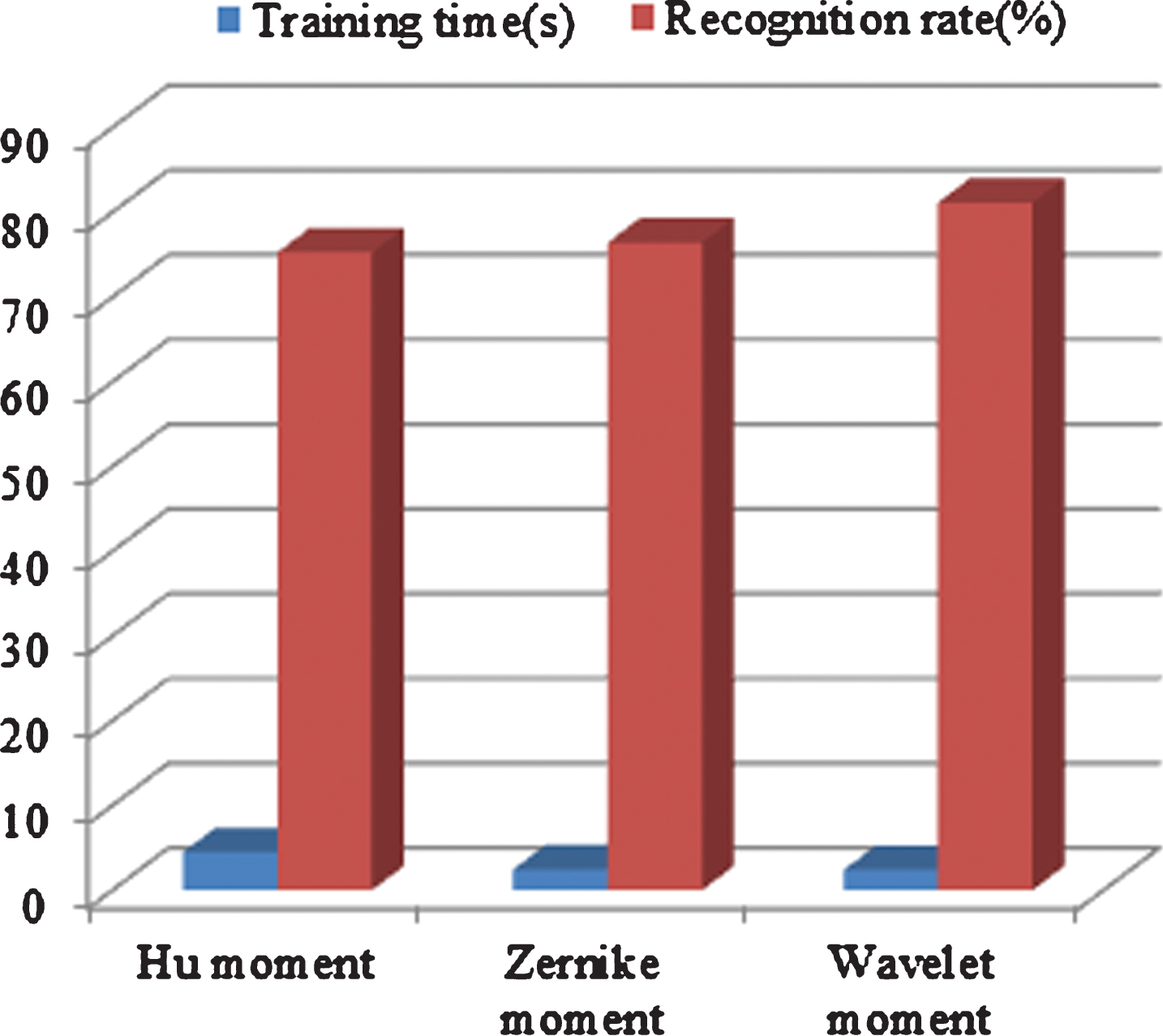
Wavelet neural network classification effect.
It can be found through the chart that although the structure of the BP neural network is improved, and the wavelet neural network greatly reduces the classification time, but the recognition rate is not significantly improved. The reasons may be that the initial parameters of the design are blind, and some parameters such as weight, size and so on are selected randomly.
The test result in the first two sections of the picture is obtained in the absence of noise interference. In order to verify the performance of the algorithm against noise, a different intensity of noise is added to the picture, In accordance with the order of NOS1, NOS2, NOS3 gradually increasing noise intensity. The recognition results are showed in Table 3, and the histogram is showed in Fig. 5 which presents the results more directly and clearly.
The BP neural network and SVM to add noise image recognition results
The BP neural network and SVM to add noise image recognition results

The BP neural network and SVM to add noise image recognition results.
From the chart it can be found that the wavelet moment has a very obvious advantage, and its anti-noise performance is very good, and it has a high recognition rate in any case. At the same time, with the increase of noise intensity, it can be found that the recognition rate of BP neural network is significantly higher than that of SVM classification algorithm. And even in the case of very high noise intensity it can still get a very high recognition rate under the combination of wavelet moment and SVM classification recognition algorithm. However, the recognition rate is still decreasing with the increase of noise intensity. Therefore, the DE-noising pretreatment before the image recognition is necessary in order to get a better result.
Medical image color feature extraction and classification algorithm design has formed a complete image recognition technology. Firstly, the research status of this topic is analyzed, and then relevant theories and technologies are analyzed. On this basis, the wavelet moment and support vector machine image recognition algorithm are established, and the performance of the algorithm is verified by experiments. Through the statistical analysis of the experimental results, it is proved that the new image recognition algorithm is feasible and advanced. Therefore, the study on the new algorithm is successful and the study in this paper is meaningful.
Footnotes
Acknowledgments
The study was supported by “Research and Application demonstration of Equipment IoT Management Technology for police station (Grant No. 2019KY0888)”.
Supported by Guangxi Key Laboratory of Cryptography and Information Security in 2019: “A Study on the Key Technology of Vehicle Warning System Based on the Deep Learning of fine-grained classification (No. GCIS201812)”.