



Abstract
Technology has enabled us to carry the world on our tips. Cloud computing has majorly contributed to this by providing infrastructure services on the go using pay per use model and with high quality of services. Cloud services provide resources through various distributed datacenters and client requests been fulfilled over these datacenters which act as resources. Therefore, resource allocation plays an important role in providing a high quality of service like utilization, network delay and finish time. Biogeography-based optimization (BBO) is an optimization algorithm that is an evolutionary algorithm used to find optimized solution. In this work BBO algorithm is been used for resource optimization problem in cloud environment at infrastructure as a service level. In past several task scheduling algorithms are being proposed to find a global best schedule to achieve least execution time and high performance like genetic algorithm, ACO and many more but as compared to GA, BBO has high probability to find global best solution. Existing solutions aim toward improving performance in term of power execution time, but they have not considered network performance and utilization of the systems performance parameters. Therefore, to improve the performance of cloud in network-aware environment we have proposed an efficient nature inspired BBO algorithm. Further, the proposed approach takes network overhead and utilization of the system into consideration to provide improved performance as compared to ACO, Genetic algorithm as well as with PSO.
Introduction
Service-oriented computing paradigm maximizes benefit from hardware resources at data center. The shared pool of resources achieves the objective function, which depends on optimization criteria. Cloud computing provides scalable infrastructure, platform, and SaaS modeler. The resources exhibit their availability at host level inside the data center. In this technology, consumers hire resources from cloud service providers using various types of pricing models. It includes subscription based, pay as you go based pricing of data center components. The (service level agreement) legal contract between cloud service providers and cloud computing customers assures the quality of service and resource availability. The legal contract, i.e., service level agreement, may violate when the resource outage per day or per month is available. Cloudlets scheduling on virtual machines is the major concern in scalable cloud aura [1, 2]. Cloud service providers assure minimum downtime when the user requests map on virtual machines. Cloudlet scheduler maps the users’ requests on an appropriate resource (virtual machine) which completes the tasks in minimum time (ms). Job scheduling system focuses on to find optimal global resources to map the cloudlets. There is a constraint on user request parameters. The detailed survey exhibits that researchers solved the cloud resource provisioning issue using static, dynamic, and meta-heuristic techniques. Artificial Intelligence techniques used to deal with this challenging issue. Genetic algorithm, colony optimization, and astrology based Big-Bang Big-Crunch cost aware techniques used to short out the concern of SaaS modeler scheduling. These techniques provide an optimal global solution [3, 4]. Cloud computing is an emanate paradigm which provides a shared pool of resources and broad network access to allocate the resources with minimum management efforts. Everything as service-based technology reshapes the computing world and shifts Information Technology, hardware platform, and application on data center at a remote location with zero downtime.
Cloud is elastic, pay per use and reliable system which aims to provide an efficient system with least makespan (Total Execution Time) and no overloaded server to improve the utilization of the system. Therefore, to provide a best efficient system and improved QoS, this paper proposes a Biogeography based-optimization a meta nature inspire learning based heuristic model [1] for resource allocation in the cloud. This model assures finding the global best solution in the least searching time as compared to other nature-inspired algorithms like ant colony optimization, PSO and genetic algorithm.
Paper is structured as follows: Section 2 presents existing work from the field of resource allocation in the cloud to improve various performance parameters like cost, power, utilization & SLA. Section 3 presents motivation and problem statement. Section 4 discourses the proposed model using BBO with its mathematical description and various phases of the algorithm.
Section 5 describes the simulation setup, scenarios, and results. This section showcases a comparative study of the existing algorithms with proposed algorithm using various performance matrices. Section 6 concludes the work with result outcomes and future work.
Related work
Efficient cloudlet allocation is a prominent research topic in scalable cloud infrastructure. The related works cover static, dynamic, and nature-inspired meta-heuristic evolution based techniques for task provisioning in scalable cloud. Researchers have focused on different performance metrics, optimization parameters [5–6]. Khan [7] covered efficient load balancing using Ant Colony optimization techniques. Authors focused on the performance metric, service level agreement (SLA) violation, minimum overhead on user bases in a different geographical region, and power-saving at the data center. Efficiency and resource utilization improve using CPU utilization factor. Variation of the different parameter improves the efficiency of the resources. Lu [8], exhibited a load-adaptive cloud resource scheduling model based on nature-inspired ant behavior-based optimization method. Authors realize that adaptive resource provisioning in the cloud services achieves the goal. Santanu Dam et al. [9] proposed a novel nature-inspired evolution based algorithm, which distributes the cloudlets on shared pool of resources.
Simulation performed using CloudAnalyst toolkit. Results demonstrate that the prominent ant colony approach outperforms the traditional resource allocation approaches. It includes First Come First Serve (FCFS), local search algorithm like Stochastic Hill Climbing (SHC), bio-inspired Genetic Algorithm (GA). The author focused only on limited performance metrics without using the ANN model. Kousalya et al. [10] presented a modified nature-inspired Ant algorithm for the Grid infrastructure provisioning. The unutilized time of the resources and makespan of jobs taken into account for better utilization of resources. Tawfeek et al. [11] exhibits the scheduling policy based on nature-inspired iterative optimization method. The nature-inspired technique allocates the incoming jobs on the virtual machines. Cloudsim toolkit uses for simulation purpose. Results revealed that the nature-inspired ant-based optimization outperforms the first come first serve and round-robin static algorithms. The performance metrics include response time, makespan, and resource operational cost.
Sun et al. [12] introduced the prominent features, the construction and the realization method used ant colony optimization method. Authors did not focus on optimization using the neural network-based model. Efficiency demonstrates using an experimental study in a scalable cloud environment. Mathiyalagan et al. [13] described that Grid scheduling problem effectively solved using the nature-inspired technique. In a cloud environment, it may give optimal results. Liu et al. [14] presented an adaptive ant colony algorithm in grid infrastructure used for scientific application. Experimental results reveal the model efficiency in task provisioning and balancing the load among the shared pool of resources. The performance will improve while using a bio-inspired analogy.
Bagherzadeh et al. [15] covered scheduling based on nature inspired meta-heuristic technique (ACO). The author demonstrated its competitiveness with existing techniques. The ACO-TMS adopts a new state transition rule for finding satisfactory scheduling results. The Chiang et al. [16] exhibited improved scheduling performance metrics. Performance compares against bio-inspired scheduling method. The author focused on workflow scheduling for dependent tasks only. Florin Pop et al. [17] presented a decentralized scheduling algorithm problem of dependent tasks scheduling. The presented approach follows the features of the bio-inspired (Genetic approach).
Particle swarm optimization have been proposed for energy efficiency in cloud taking into consideration power efficiency of the system [19].
Buyya [2] et al. presented a bio-inspired evolution based genetic algorithm approach which addresses resource provisioning problems in cloud computing, using deadline, and budget as a quality constraint [20, 21]. The Gu [8] et al. presented load balancing on virtual machines using the bio-inspired genetic technique. The experiment exhibits that this strategy has relatively optimal. The algorithm solved the provisioning and virtual machine migration high-cost issue. The author proclaimed the quality of service improvement in scalable cloud aura.
Singh S, Chana [13] has presented a rigorous review of resource allocation algorithms and has presented categories of resource allocation algorithms based on SLA, power, cost, nature-inspired, trust algorithms etc. paper presents a survey of various allocation algorithm presented in multiple reputed journals. The author has presented allocation algorithms for task allocation, VM allocation, workload allocation. The second part of the paper presents a comparison of various resource allocation (RSA) as shown in Figs. 1 and 2. Figure 3 shows various type of cost-aware algorithm which are proposed by various authors like for a group of task, or independent task-based or reducing the cost for VM allocation rather than task allocation.
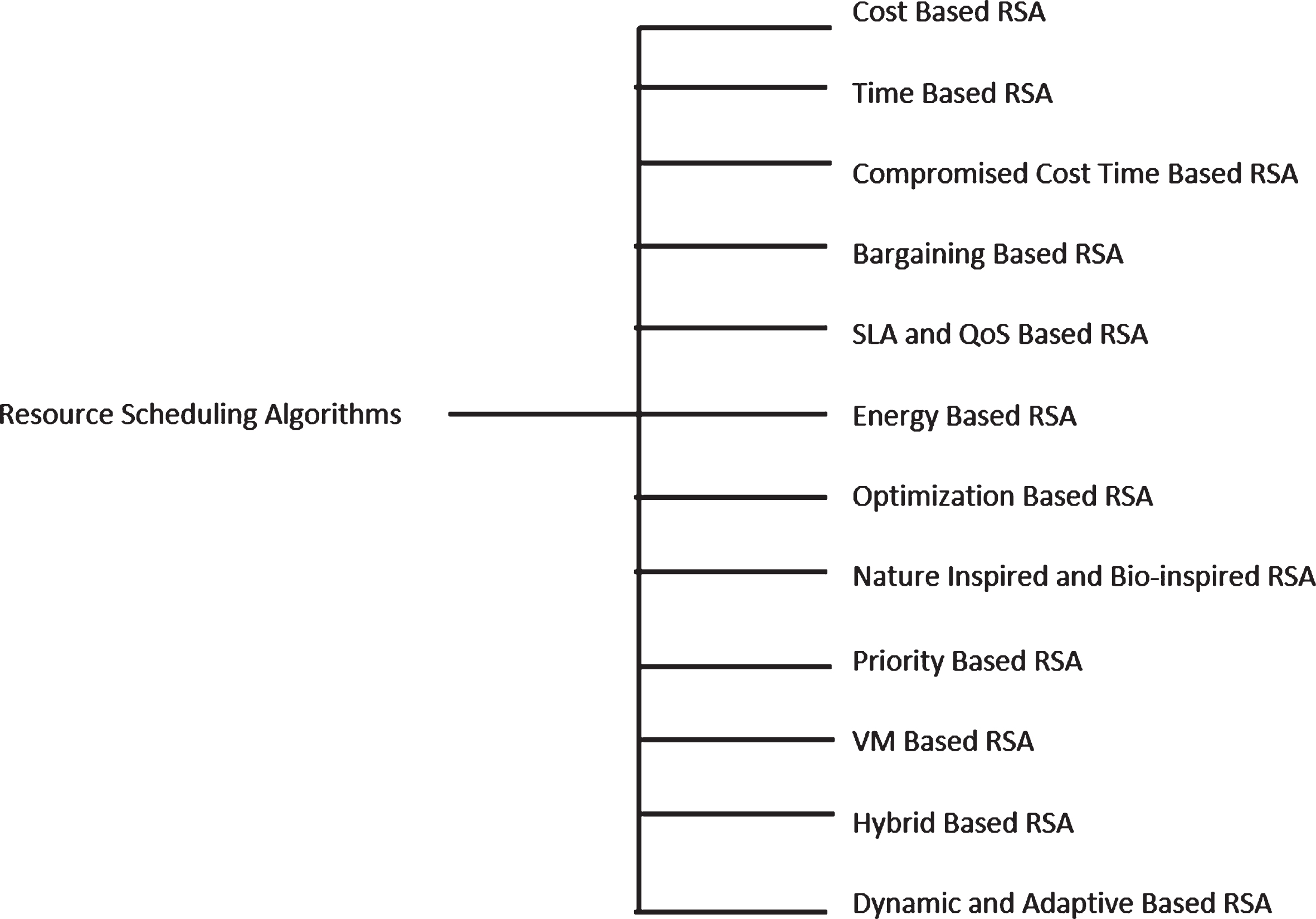
Type of resource allocation.

Energy based resource allocation.

Cost based resource allocation.
Figure 4 discusses various nature-inspired algorithms for cloud scheduling namely genetic algorithm (GA), ACO, Firefly, honey bee and PSO for scheduling and load balancing in cloud. This review helps the researchers to get an overview of work done in the field of resource allocation and load balancing in cloud. S. Singh presented a survey on resource scheduling and its changes from the field of cloud SaaS, PaaS & IaaS. The work compared the exiting approaches for resource and task scheduling in cloud and compared the work based on quality of service parameters taken into consideration [13].
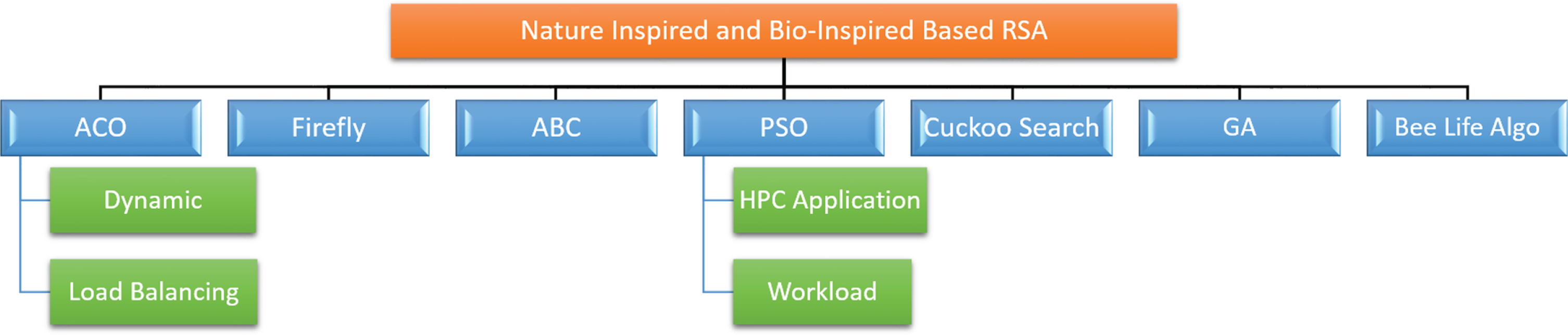
Nature inspired resource allocation.
Nayyar et.al has proposed multiple solution to improve resource allocation for task scheduling. Some of the solutions are scheduling using swarm optimization, Advanced swarm and advanced ACO, the idea behind using dynamic algorithm is to make decision-based on current load and performance of the system [22–28]. Arunarani et al. [29] presented a survey of existing task scheduling techniques for cloud over the period of time, author has also categorized the algorithms in various sections and has compared the algorithms over various performance matrices.
Resource allocation in distributed computing is primary entrusting that must be overseen for ideal use of the cloud condition. In these different kinds of employment booking and load, adjusting approaches have been utilized for this reason. Different errands on the cloud must be assigned to various assets for the anticipation of a moderate calculation process at the cloud. In the past work different calculations and improvement, approaches have been utilized to minimize make spans. A task scheduling algorithm in which VM’s (Virtual Machine) are designed as resources, cloudlets are designed as a task and schedule all the task by allocating each of the resources. Many task scheduling algorithms have been out there which are giving a result on the basis of the performance but all of them are not effective in term of finding a global solution in the least time and network delay is not taken into consideration.
As discussed most of the existing algorithms takes into consideration only execution time, power and cost into consideration of improving the performance of the system considering network load as idle. To overcome this, nature-based improvement approach BBO (Biography Based Optimization) is proposed for enhancement of makespans and optimizes network delay at same time.
Proposed methodology
In this section, the task scheduling algorithm is proposed using BBO taking network delay and execution time as a fitness parameter. The algorithm works on the basic fundamentals of Biogeography-based optimization, which is a metaheuristic.
The premise of BBO calculation depends on two fundamental parts: Migration Mutation
1. Migration
Migration includes two principles form migration and resettlement. Migration and resettlement are influenced by different factors, for example, separation of an island to the closest neighbor, the size of the island, the natural surroundings appropriateness list (HSI) and so on. HIS includes different factors, for example, precipitation, vegetation, atmosphere and so forth. These variables support the presence of species in a living space. Natural surroundings that are appropriate for the home of organic species will have high HSI. An environment with a high HSI will be possessed with a substantial number of species, so will have a high migration rate and low movement rate (since the natural surroundings are about soaked with species). Thus, an environment with low HSI will have a modest number of species. This thought is utilized as a part of BBO for completing relocation. In BBO, as in other advancement calculations, at first, countless arrangements are produced arbitrarily. Related to every arrangement there will be a HSI. Every arrangement created is considered a living space. Every arrangement or living space is a gathering of reasonableness record factors (SIVs). Reasonableness record factors show the appropriateness of the living space to which it has a place. High HSI natural surroundings are comparable to the great arrangement and low HSI living space is undifferentiated from the poor arrangement. Through movement high, HIS arrangements share a great deal of highlights with poor arrangements and poor arrangements can acknowledge a considerable measure of highlights from great arrangements. The connection between species check, migration rate, and displacement rate appears in the figure, where I is the greatest movement rate, E is the most extreme resettlement rate, S0 is the balance number of species and Smax is the greatest species tally. The choice to alter every arrangement is taken in light of the movement rate of the arrangement.
2. Mutation
Another essential procedure in this enhancement strategy is transformation. Transformation is the sudden extreme change made to the HSI of any living space because of certain disastrous occasions. The change expands the assorted variety among the populace. Every competitor solution’s’ is related to a change likelihood. Sudden changes in the atmosphere of one living space or different episodes will cause sudden changes in HSI of that territory. In BBO calculation, this circumstance can be demonstrated as sudden changes in the estimation of SIV. Every individual from one living space has its own likelihood. On the off chance that this likelihood is too low, at that point this arrangement has a high opportunity to transform. In a similar way, if the likelihood of an answer is high that arrangement has somewhat opportunity to change. Thusly, arrangements with high HSI and low HSI have somewhat the opportunity to improve a superior SIV in the following cycle. Not at all like high HSI and low HSI arrangements, medium HSI arrangements have a more noteworthy opportunity to advancement better arrangements after transformation method.
Features of BBO - A proficient calculation for enhancement. Doesn’t take excess computational time.
Here Mmax is known as a parameter defined by the user, Ps is the count of the species of a particular habitat. Pmax is the count that is maximum in the species. Mutation is implemented according to the given mutation probability of every habitat by substituting an SIV from the habitat with a differently created SIV. Figure 5 demonstrates the evolvement in specie which act as a sample schedule for us. As shown in Fig. 5 specie will immigration and emigration rate higher the rate lesser the time to achieve the best solution, moreover the immigration rate and emigration rate should be nearly the same to get the best global solution with best fitness value. Table 1 illustrates various notations used in mathematical formulation of the proposed solution.

Notations
I is Maximum immigration rate, E is maximum emigration rate.
Immigration Rate (Ri) can be expressed as:
Similarly, Emigration Rate can be expressed as below:
Make a population of N candidate solutions and initialize it {xk} While no (condition to terminate) For every xk, make emigration probability μk α fitness of xk, With μk For each xk, make immigration probability ωk = 1 - μk {zk} ← {xk} For every individual zk (k = 1, ... ... ,N) For every independent variable index s Use ωk to decide whether to immigrate to zk If immigrating then Use {μi } to select the emigrating candidate xj zk(s) ← xj(s) End if Next independent variable index: s ← s + 1 Probabilistically mutate zk Next candidate: k ← k + 1 {xk } ← {zk } Next generation
3. Population generation
In proposed work population is defined as a set of task to be scheduled with randomly allocated virtual machine id over resources in datacenter which is virtual machines. The population is collection “n” such schedules generated randomly called solution. Each solution is evaluated with a fitness function which is a combination of total execution time and network delay.
Equation 7 defines the fitness function for the proposed BBO algorithm.
Figure 6 shows the flow diagram for the proposed solution using BBO explaining all the phases of BBO and stopping condition. The proposed solution uses a key point of immigration and emigration from BBO algorithm, which decides immigration rate to be high in starting i.e when new a schedule is generated new random behaviors can be introduced in schedule from other scheduled (population). Whereas keeping emigration rate to be at lowest, with time immigration rate slows down and emigration rate increases which influence the algorithm to adapt features from best schedule generated and evolve accordingly generating better schedules.
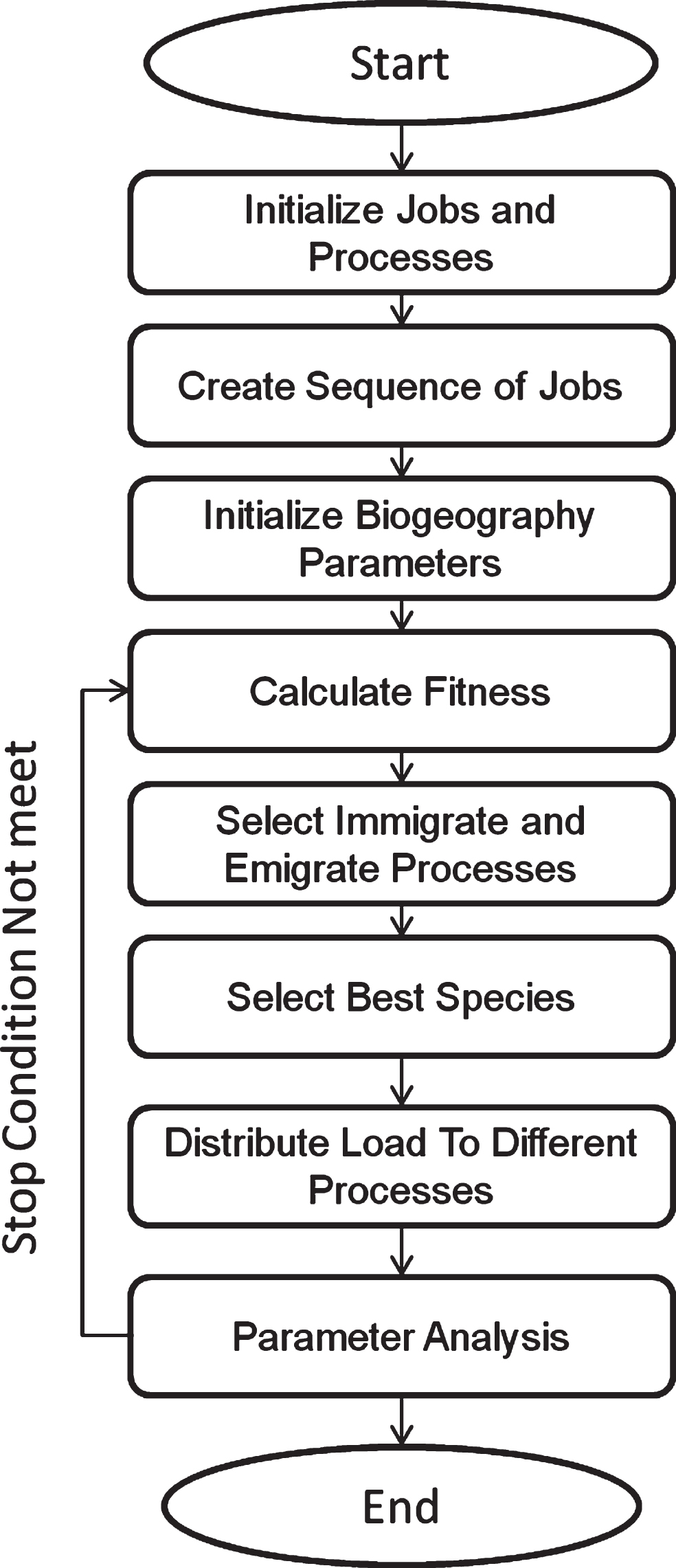
Flow Diagram of Proposed algorithm.
The proposed model and algorithm is tested and simulated on Cloudsim 3.0 API. The proposed algorithm is tested with existing simple ACO and Round Robin from literature with a fixed amount of VM’s (Virtual Machine) acting as resources for scheduling and cloudlets (tasks) increasing from 100 to 7000. Simulation environment consists of 2 scenarios with 2 & 4 datacenters. Datacenter configuration, network delay and VM configuration of resources are given in time 2, Tables 3 & 4. Table 5 shows various heterogeneous task.
Datacenter configuration
Datacenter configuration
Datacenter network delay configuration
Type of virtual machines (VM’s)
Shows type of tasks
A number of virtual machines is set to 2 VM’s. Cloudlets: range between 100 to 7000. Figures 7 & 8 shows the performance of the proposed algorithm with increasing tasks (Cloudlets) taking VM count as 2 & 10. In the simulation of genetic algorithm, the following setup is considered the initial population is 100, iteration count is 150 and crossover probability is 0.3. Results show that the proposed algorithm finds a much better global schedule, with least execution time and is not affected by an increase or decrease of resources i.e. VM’s. Figures 9 & 10 compares network delay of execution all tasks with an increasing number of tasks comparing the output with the Genetic algorithm and shows improvement with reduced network delay with an increase in number of tasks. Figures 4 and 5 also depicts that the proposed algorithm is not affected by the increase in resources. Where network delay is a part of the total execution time of a task.

Comparison of existing Genetic algorithm (GA) and proposed BBO with 2 VM’s.
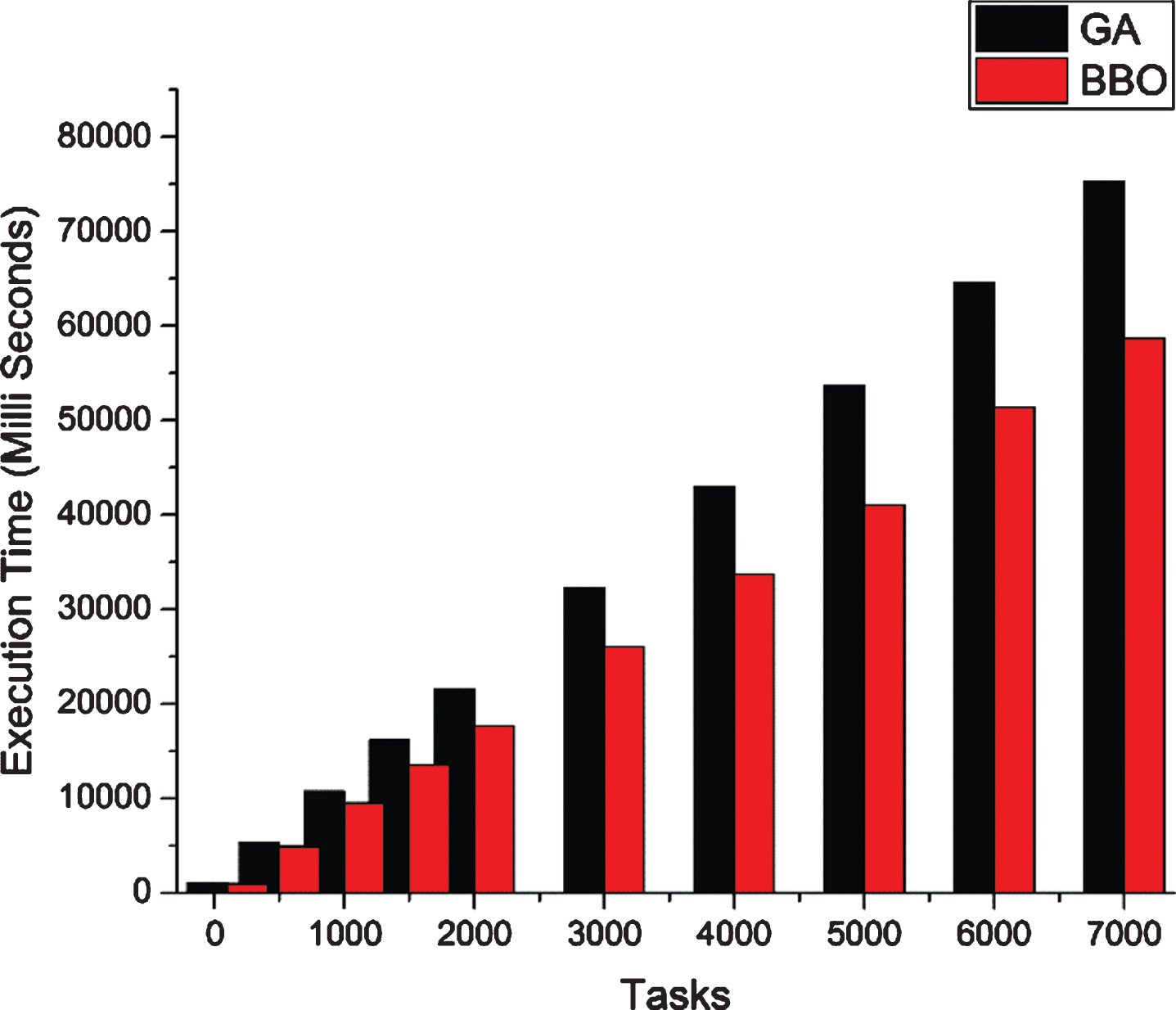
Comparison of existing Genetic algorithm (GA) and proposed BBO with 10 VM’s.
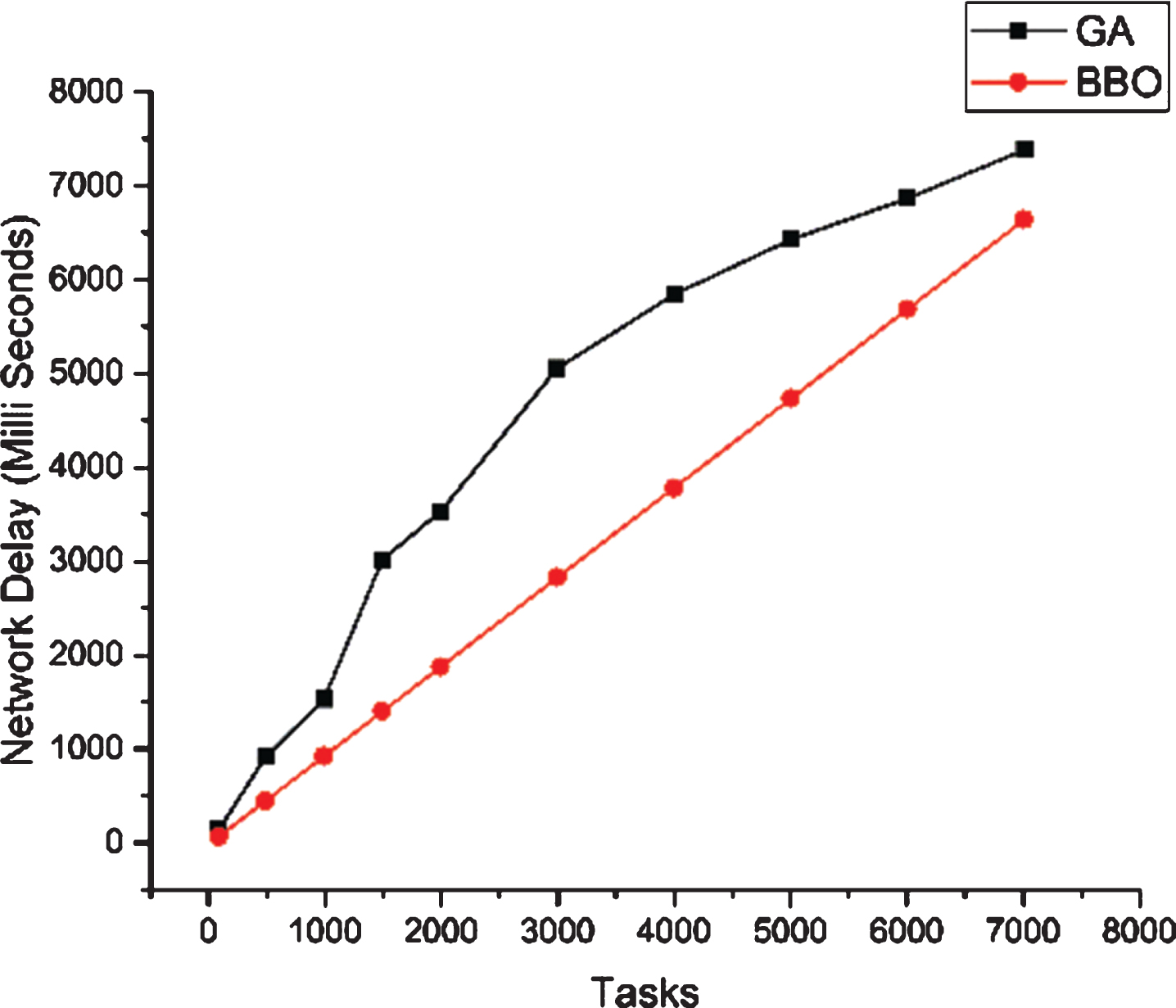
Comparison of network cost for GA and proposed BBO with 2 VM’s.
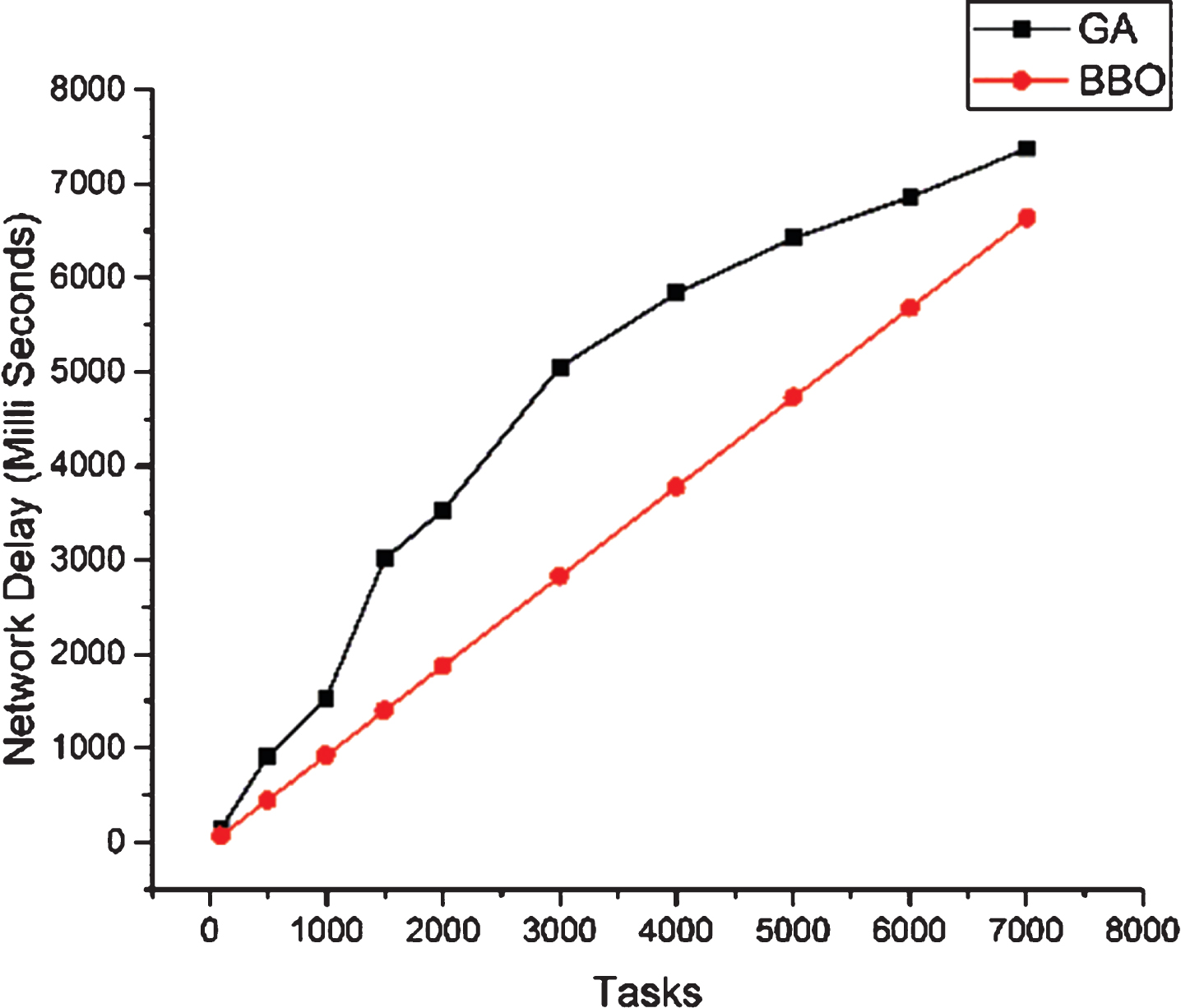
Comparison of network cost for GA and proposed BBO with 10 VM’s.
In this test plan, a fixed number of cloudlets for the request and the number of VM’s will be changing from 14 to 16. Cloudlets count is fixed to 500. Figure 11 shows the performance study of execution time for BBO and GA with increasing VM’s. Figure 12 presents a comparison of network cost with increasing virtual machine. Scenario 2 proves the improved performance of BBO with scaling resources because scenario 1 only proves the improvement with increasing load of tasks only.

Comparison of Execution time for GA and proposed BBO with 500 tasks and increasing VM’s.
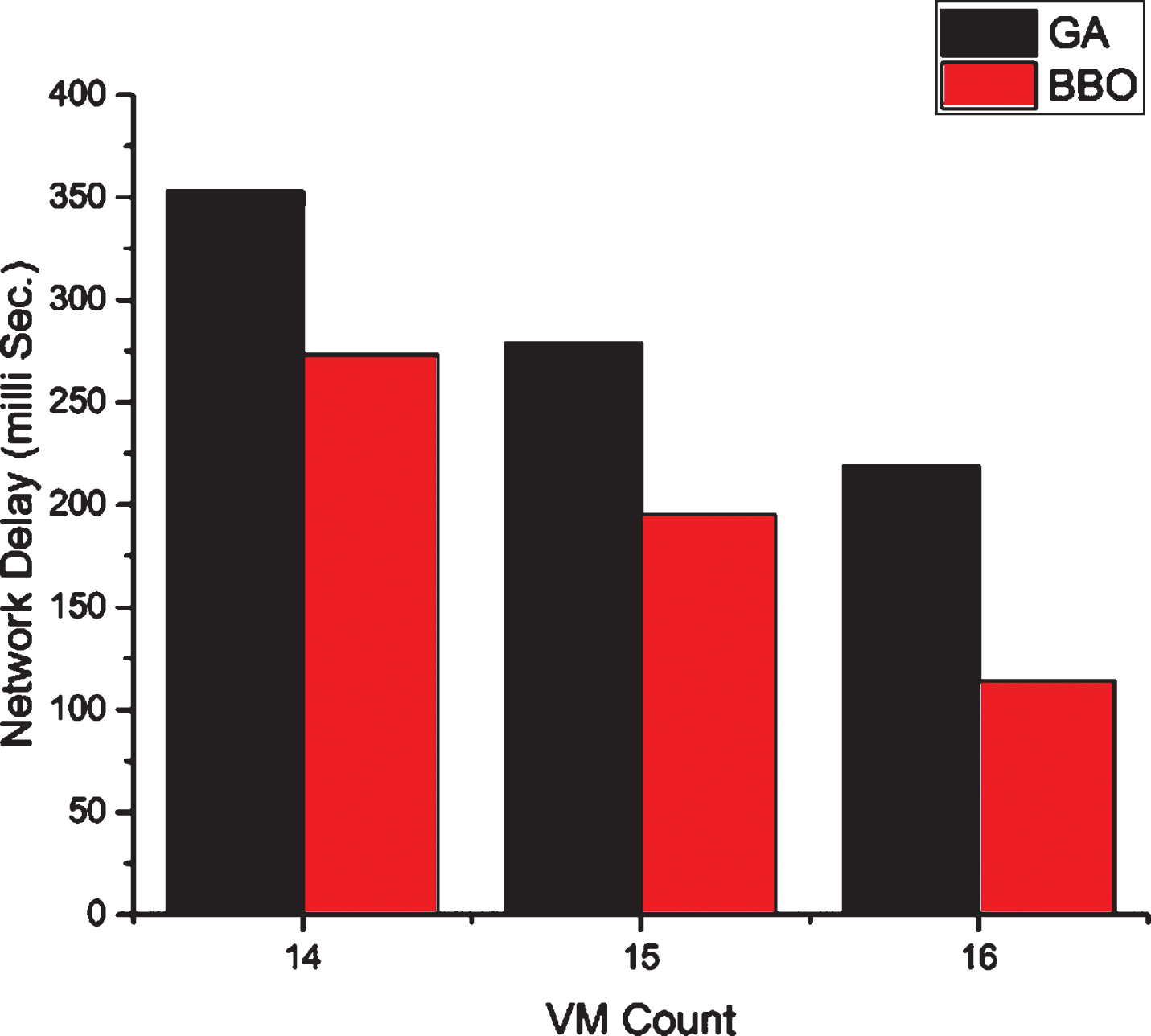
Comparison of network cost for GA and proposed BBO with 500 tasks and increasing VM’s.
In this scenario, the comparison of proposed algorithm with various other static and dynamic algorithms such as Particle Swarm Optimization and Ant Colony algorithm. Figures 13 & 14 shows the comparison of the proposed algorithm with existing Ant Colony algorithm(ACO), Particle Swarm Optimization PSO over 2 matrices Makespan (Total Execution Time) and Network cost with increasing number of task load over the cloud infrastructure. From these experimental results as shown in Figs. 8 & 9 states proposed BBO algorithm performs better than ACO, PSO, and GA with increasing load. The experiment also shows the performance study of existing learning-based algorithm from literature using Makespan and network cost as a measure to study their performance.

Comparison of existing Genetic algorithm (GA), ACO, PSO and proposed BBO.
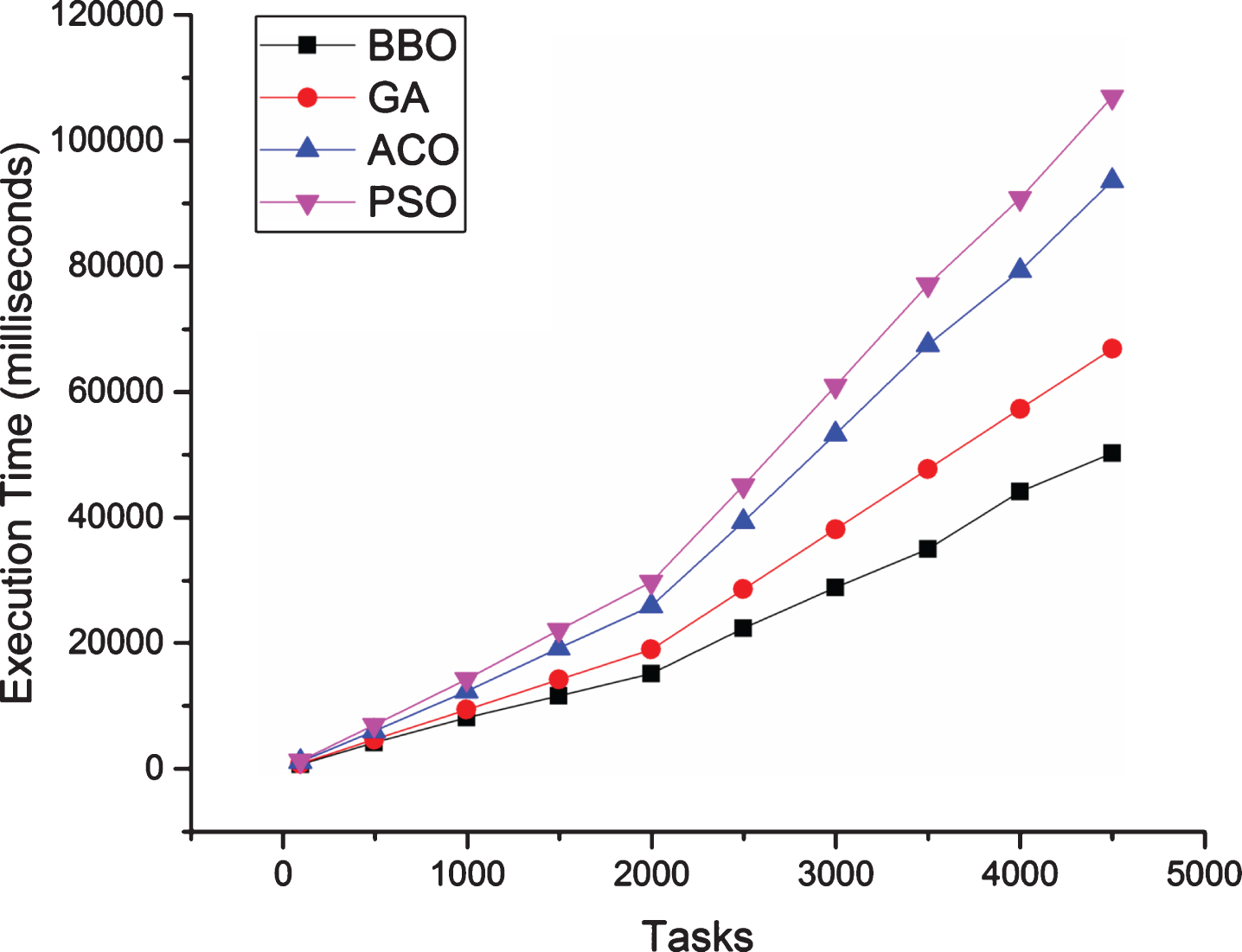
Comparison of network cost for GA, ACO, PSO and proposed BBO.
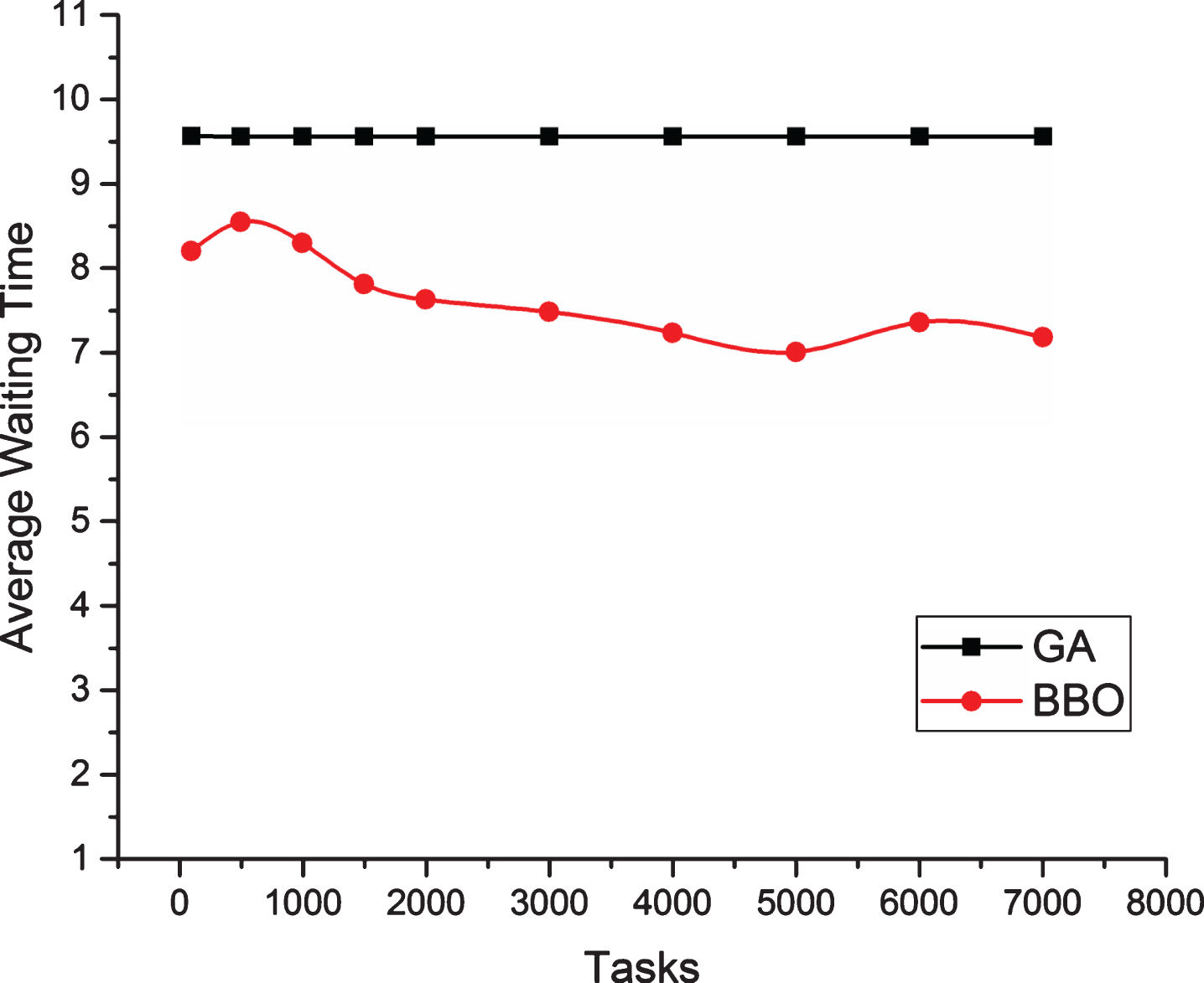
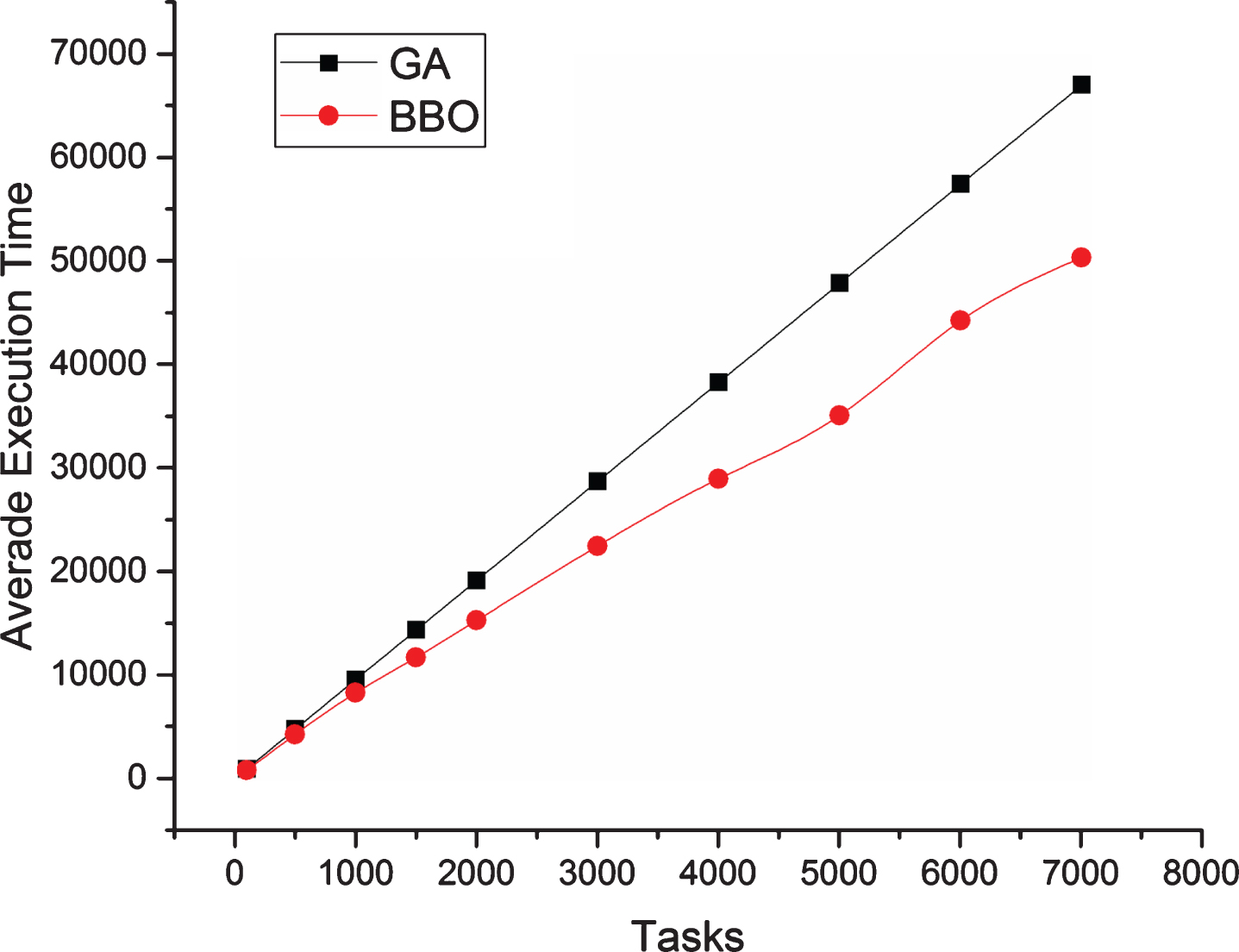
Figure 15 shows the performance of BBO using average execution time. Results show that the proposed algorithm performs better than GA. Figure 16 shows the performance of BBO using average waiting time. Results also showcase that the proposed algorithm performs better than GA and the average waiting time based on their arrival is comparatively improved.
Average Execution Time.
Average Waiting Time.
From the result section, it is shown that the proposed BBO algorithm outperforms existing algorithms. Network cost and total execution time is used as a performance matrix for comparing the proposed algorithm with the existing algorithm. The result shows proposed BBO provide better performance in term of network cost and execution time. The aim of experiment and result section is to test the performance of the proposed algorithm under various scenarios like testing the performance with increasing task load with an increase in number of tasks and second scenario with increasing resources i.e. increasing virtual machine. The proposed work tries to provide the user with the least network cost for a task and tries to reduce execution time to improve the performance of datacenter. The proposed algorithm will perform better than any static and dynamic algorithm because proposed BBO tries to find a global best solution in various iterations with least network cost and execution time. Since the result section already shows that the proposed algorithm performs better than a dynamic algorithm like PSO and ACO which are considered to be better than any static algorithm like round-robin, SJF (shortest job first), min-min and max-min algorithms [30–36]. In future proposed algorithm can further be used to improve power and cost efficiency in the cloud. From results it is clear that proposed algorithm can deal with multiuser access and can reduce the processing delay of each request by reducing the waiting time of a request. Moreover each healthcare request from users can be executed in the least time [18]. The proposed model will be best suited for designing an elastic resource allocation algorithm and fault-tolerant environment to improve performance and Quality of Service of the cloud. In future the system can be used to improve power efficiency of the system using neural networks.