



Abstract
By controlling the transaction background and data of supply chain enterprises, supply chain finance can reduce the degree of information asymmetry in the process of enterprise financing and provide more financing mode options for enterprises. In this paper, the author analyzes the statistical optimization of supply chain financial credit based on deep learning and fuzzy algorithm. We use particle swarm optimization to train BP neural network and improve the previous algorithm. By changing the speed of the particle search in the weight space, that is, updating the weight of the net-work, the mean square error of the network output is gradually reduced. Simulation results show that the model is helpful to analyze the correlation between supply chain finance and economy, compared with the traditional BP neural network, the original data of BP neural network based on particle swarm optimization is better fitted, so it can be used to predict supply chain financial credit level.
Introduction
Since the 1990s, the market competition environment has become more and more complex [1]. Among them, there are not only adverse conditions that aggravate the competition of enterprises, such as the increase of competitors and the expansion of competition scope, but also conditions that are conducive to the competition and cooperation of enterprises, such as the development of information technology brings about the cost reduction and rapid response of enterprises, new markets brought by technological innovation, etc [2, 3]. In order to deal with this complex and changeable environment, many enterprises have made strategic adjustment step by step. Horizontal integration is to make enterprises focus on the cultivation of core competitiveness and make better use of external resources to achieve complementary advantages with other enterprises in order to achieve the purpose of gaining advantages in the competition. With China’s successful accession to WTO, there has been a revolution in enterprise management [4]. Agile manufacturing and dynamic enterprise alliance have become a new mode of enterprise competition and development trend. Supply chain is a modern management mode that conforms to the development trend of enterprises, takes the system integration as the guidance, emphasizes “horizontal integration", constructs supply chain, uses external resources of enterprises to respond to market demand quickly, and improves the core competitiveness of enterprises [5, 6].
With the rapid development of information technology, it is possible for knowledge, technology and information to be widely spread and shared all over the world [7]. The rapid development of high salary technology not only improves production efficiency and shortens the cycle of product renewal, but also intensifies the intensity of market competition, which is achieved by expanding production, reducing production costs or expanding sales as the core competitiveness The era of profit has passed, enterprises must find new profit growth point, supply chain management came into being [8]. A typical supply chain is composed of manufacturers, suppliers, distributors/wholesalers, retailers, consumers and other stages (entities). The characteristics of multi participants, cross regions, and multi links in the supply chain make the supply chain vulnerable to the influence of external environment and internal adverse factors of each entity in the chain, thus forming the supply chain risk [9, 10]. In terms of operation, with the acceleration of the clock speed of industry innovation, the shortening of product life cycle and the compression of time to market lead to the difficulty of matching supply and demand, which increases the vulnerability of supply chain against risk. Risk management in supply chain is not only equivalent to dealing with disaster events, but also means the effort to keep an increasingly complex supply chain system running effectively at the lowest possible cost, and at the same time, it can’t reduce product quality and customer satisfaction [11]. Supply chain risk is different from single enterprise risk. Its source includes not only the internal and external environment risk of each node enterprise, but also all kinds of risks in the process of cooperation between each node enterprise in the supply chain [12, 13]. Supply chain risk seriously affects the benefits of supply chain and even the fate of enterprises, so supply chain risk management has received more and more attention and research.
The cooperation among enterprises in the supply chain will lead to various risks because of information asymmetry, information distortion, market uncertainty and other political, economic, legal and other factors. In order to make the enterprises in the supply chain get satisfactory results from cooperation, we must take certain measures to avoid the risks in the operation of the supply chain, such as improving the transparency and sharing of information, optimizing the contract mode, establishing the supervision and control mechanism, etc., especially we must use various means to implement the incentives through the operation of the incentive mechanism in all stages of the cooperation, so as to make the supply chain enterprises Cooperation between industries is more effective. Supply chain risk is everywhere, and the trend of globalization is increasing this risk [14]. Uncertainty is everywhere in the supply chain [15]. Many scholars in the study of supply chain management have mentioned the problem of uncertainty and the risk it brings. Because of the existence of uncertainty, which leads to the distortion of demand information, it is necessary to meet all kinds of uncertainties and potential risks, reduce information delay and events in the process of information transmission, and reduce the risk in the process of supply chain operation [16, 17]. Therefore, when making the decision of supply chain, enterprise managers can’t pursue efficiency blindly. They must consider more factors comprehensively and make a scientific assessment of income and risk to make a correct decision.
To ease the constraints of enterprise financing depends on logistic financial innovation. Supply chain finance, as an innovative financial product subverting the traditional financing mode, can use the supply chain operation data to drive the transformation of credit use mode of commercial banks, provide receivables financing, prepayment financing, inventory financing and strategic relationship financing for supply chain enterprises, and become an effective way to ease the financing constraints of enterprises [18]. From the theoretical perspective, information economics believes that supply chain finance can help enterprises get rid of financing difficulties by controlling the transaction background and transaction data of supply chain enterprises, reducing the degree of information asymmetry in the process of enterprise financing, and providing more financing mode options for enterprises [19, 20]. From the perspective of practice, commercial banks can realize the interconnection between themselves and core enterprises by focusing on the overall situation of the supply chain, which is conducive to forming a more active cooperation relationship, so as to better serve the upstream and downstream enterprises of the supply chain. In this context, on the one hand, by making strategic commitment to the upstream and downstream enterprises of the supply chain, the core enterprises promote the upstream and downstream enterprises to increase the investment of special assets, and provide support for the acquisition and optimal allocation of the overall financial resources of the supply chain; on the other hand, the core enterprises implement the strategy of combining industry and finance, transfer soft information to the commercial banks, and promote the commercial banks provide financial support for core enterprises and their upstream and downstream enterprises by relying on broad loan technology [21]. From this point of view, the combination of strategic commitment and industry finance has become a new perspective to explain the relationship between supply chain finance and corporate financing constraints [22]. Therefore, exploring the non-linear boundary conditions between supply chain finance and enterprise financing constraints under the regulatory role of strategic commitment and industry finance becomes an effective way to further understand the essence of supply chain finance and solve the financing problems of enterprises.
Related work
The mechanism of supply chain finance to alleviate the financing constraints of enterprises lies in that, relying on the transaction background and transaction information of supply chain, supply chain finance can reduce the degree of information asymmetry and transaction cost between supply chain financial liquidity risk bearers and supply chain enterprises, and help supply chain enterprises obtain financial resources [23]. The cash flow gap of supply chain enterprises mainly exists in the difference of accounts receivable and inventory turnover period, while supply chain finance can effectively solve the cash flow gap of supply chain enterprises by relying on basic assets such as accounts receivable, inventory and prepayment. Hu pointed out that supply chain finance, relying on the credit advantages of core enterprises, can make up for the lack of credit of upstream and downstream enterprises through the credit guarantee of core enterprises. At the same time, it can expand the channels of enterprise loan mortgage through innovative financial instruments, activate enterprise inventory and accounts receivable, and solve the financing constraints of enterprises. Li also regards supply chain finance as the behavior of commercial banks integrating credit into the upstream and downstream enterprises of the supply chain from the perspective of credit. By enhancing credit, he promotes the upstream and downstream enterprises of the supply chain to establish long-term strategic synergy and helps financing enterprises obtain financial support. Li explored the regulatory role of financial development level in the relationship between supply chain finance and corporate financing constraints. Zhang studied the regulatory role of property right nature in the relationship between supply chain finance and corporate financing constraints, and found that supply chain finance has a positive impact on easing supply chain corporate financing constraints.
The combination of industry and finance is an effective way to solve the problem of corporate financing constraints. It mainly realizes the integration of industrial capital and financial capital by means of the participation of real enterprises and holding financial institutions. From the theory of information economics, the combination of industry and finance can promote the internalization of external financial institutions, further reduce the degree of information asymmetry between the entity enterprises and financial institutions, and then ease the degree of enterprise financing constraints. In a word, when a real enterprise shares in a bank, its debt will be increased, and its bank loan will also be increased [24]. By participating in non bank financial institutions, real enterprises can promote closer cooperation between enterprises and bank financial institutions, expand financing channels, and reduce the pressure of financing costs. Specifically, the combination of industry and finance can solve the problem of information asymmetry through the following three mechanisms: first, the combination of industry and finance can significantly affect the allocation of credit resources of financial institutions, which helps to reduce the difficulty of enterprises to obtain financing; second, enterprises can rely on the relationship network formed by the combination of industry and finance to establish good contact with other financial institutions, so as to expand their access to financial resources; third The actual controller can manage the enterprise’s earnings through the control right [25].
From the perspective of enterprise practice, external financing can improve the liquidity of enterprise’s own funds and effectively alleviate the financing constraints of enterprises. Enterprises gain control over financial institutions by participating in financial institutions, can participate in their credit decision-making, and reduce the financing cost of enterprises. In the case of insufficient control, the enterprise can participate in the credit decision-making of financial institutions by combining with other shareholders [26]. The scale economy, scope economy and synergy formed by the combination of industry and finance can promote financial institutions to provide more suitable financial services and production and operation information for the development of supply chain enterprises, which is conducive to the management and control of supply chain risks and the realization of the balance between risks and benefits.
From the business point of view, Jingdong Finance includes two parts: B2B and B2C. The B2B part is supply chain finance, which provides financing and investment services for Jingdong system suppliers. Including: order financing, warehousing receivables financing, accounts receivable financing, entrusted loan financing, Beijing Baobei, Beijing Small Credit, Yuncang Jingrong, etc. Investment includes: cooperative investment trust plan, asset package transfer plan, etc. The scope of this paper is the financing business of Jingdong Finance B2B. For B2C, Jingdong has launched financial channels for ordinary users, including insurance, financial management, gold, credit transactions for ordinary consumers. The financing mode of Qiaodan is that Jingdong assists commercial banks to provide suppliers with capital requirements in the process of goods purchase, production and shipment according to the purchase order issued by Jingdong to suppliers. The product is suitable for suppliers with strong performance ability and good credit, and stable market price and long shelf life. Figure 1 shows the supply chain finance.
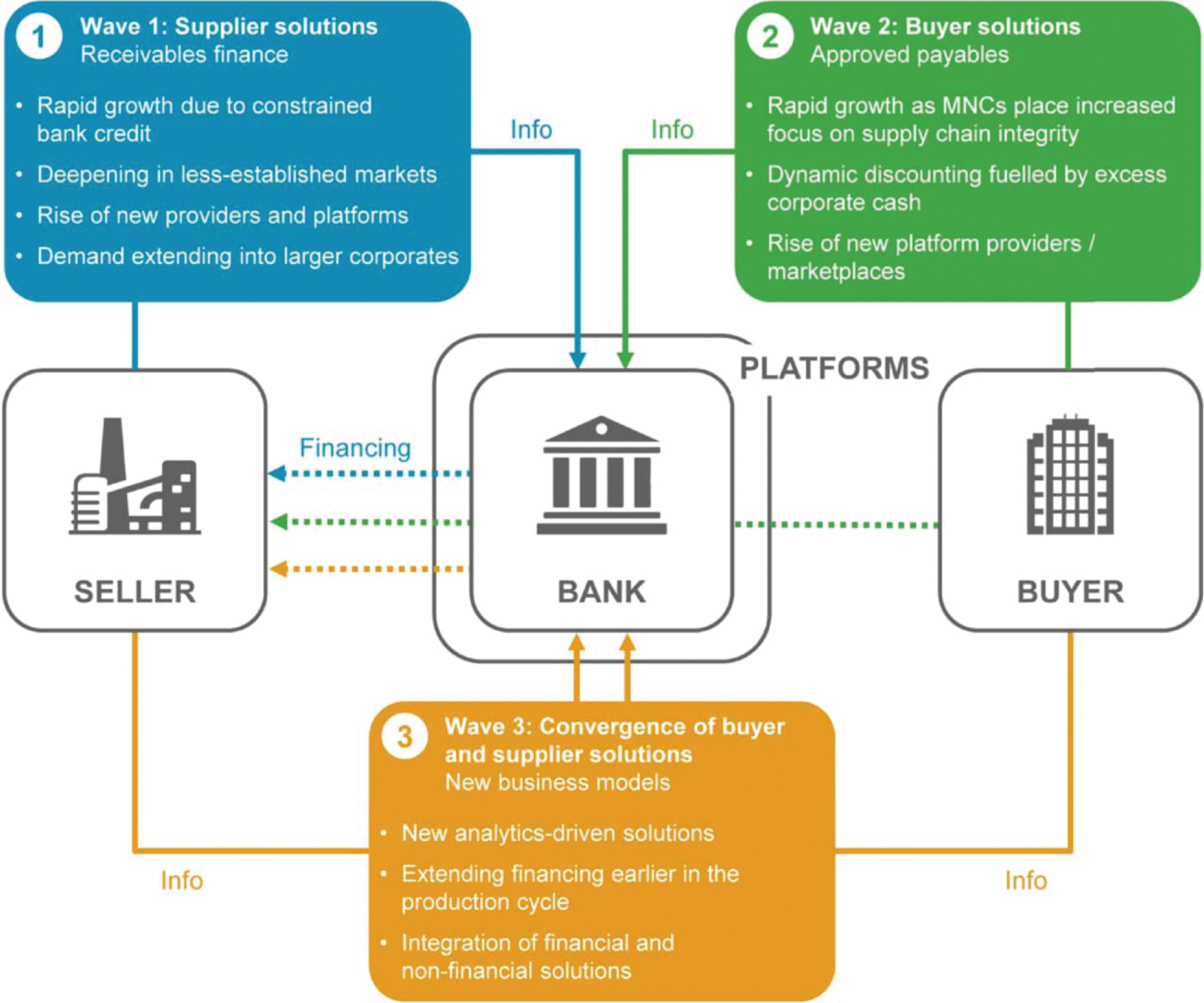
Supply Chain Finance.
Principles of particle swarm optimization
The basic principle of the PSO algorithm is based on an optimization tool that is superior to the group intelligence method for simulating the foraging behavior of flock animals such as birds. The PSO algorithm is inspired by this group of animal foraging behaviors and is used to solve some engineering optimization problems. In the PSO algorithm, all particles have an adaptive value, and there is a speed to determine their search direction and moving distance. The particles then search in the solution space based on the position of the optimal particle in the population. During the search process, the particle updates itself by tracking two extreme values: The first extreme value is called the individual extremum Pbest, which is the optimal solution found by the individual particles; the other extreme value is called the global extremum gbest, which is the optimal solution currently found by the entire group.
We assume that the particles are searched in a D-dimensional target space, with □ particles forming a community. Among them, the i-th particle is represented as a D-dimensional vector:
The flight speed of the i-th particle is also a D-dimensional vector:
The optimal position of the i-th particle found in the entire solution space is called the individual extremum, which is recorded as:
The optimal position searched by the entire particle swarm is called the global extremum and is recorded as:
As long as the particle finds the individual extremum and the global extremum, the particle can update its state through formulas (1), (2), that is, the particle can change its current speed and position:
In the formula: W is the inertia weight; C1, C2 is the learning factor, the value interval is between (0,2), vim is the velocity of the particle; f is the t generation; r1, r2 is the arbitrary number between (0,1).
The algorithm flow is as follows:
STEP 1: Particle swarms are initialized, including population size and location and velocity of all particles;
STEP 2: The fitness values of all particles are calculated;
STEP 3: The fitness value of each particle is compared to the individual extremum. If the fitness value is greater than the individual extreme value, the individual value is replaced by the fitness value;
STEP 4: The fitness value of each particle is compared with the global extremum. If the fitness value is greater than the global extremum, the global extremum is replaced by the fitness value;
STEP 5: According to formulas (4–5), (4–6), the velocity and position of the particles are updated;
STEP 6: If the error satisfies the requirement or the maximum number of iterations is reached, the algorithm ends. Otherwise, the algorithm returns to STEP 2 to continue with the following steps. The algorithm flow chart is shown in Fig. 2:

Flow chart of the particle swarm optimization.
Particle swarm optimization and genetic algorithm as two different forms of intelligent optimization methods can be well applied in engineering examples. Of course, the differences in principles and characteristics between them make them play different roles in different practical applications. Equation (6) shows that the particles move in the solution space due to the interaction between the particles. Throughout the solution process, the inertia weight w, learning factor C1, C2 and maximum speed Vmax are combined to ensure that the particle balances the global and local search capabilities. Unlike the genetic algorithm using binary coding, the particle swarm algorithm uses real coding. In terms of coding methods, the particle swarm algorithm is much simpler than the genetic algorithm. One of the characteristics of particles in the particle swarm algorithm is that these particles have the ability to remember. They can use the self-learning and external learning to enable the next generation of particles to gain more empirical knowledge, so that the particles can search for the optimal solution in a short time. The principle of information sharing in genetic algorithms is that chromosomes are shared with each other and information flows in both directions. However, the information sharing principle in the particle swarm optimization algorithm is one-way. Particles only pass the searched global extremum to the other particles, which reduces the probability of information duplication and saves more information processing time. Hard limit function
The hard limit function is expressed as:
There is another form of expression for this function, namely:
The expression formula of the Sigmoidal function is Equation (9) or Equation (10):
he expression of the Gaussian function is:
For a tutor to learn, assuming that the expected output corresponding to input X is d, the content of the learning algorithm of the neuron is to determine the weight adjustment amount ΔW(k) of the neuron, and obtain the weight adjustment formula as
Among them, η is the learning rate and 0 < η< 1.
δ learning rules. The δ learning rule is also called the gradient descent method or the steepest descent method, which is a commonly used neural network learning method.
The basic principle of the gradient descent method can be expressed as follows: It is assumed that the goal of neuron weight correction is to minimize the scalar function J(W). If the current weight of the neuron is W(k), then the weight correction formula for the next moment is assumed to be:
Among them, ΔW(k) represents the correction amount of the current time. Obviously, expectations and each correction are:
J[W(k + 1)] A is carried out for the first-order Taylor expansion, and then gets
J(W) represents the gradient vector at W = W(k). When ΔW(k) = –ηg(k) is set, the weight correction amount takes a smaller value along the negative gradient direction, and the second item on the right side of equation (10) is necessarily less than zero, then equation (9) must be established. This is the basic principle of the gradient descent method [24].
The δ learning rule for neurons can be expressed as: Since the gradient descent method uses the gradient value of the objective function, in the δ learning rule of neuron weight adjustment, the neuron basis function takes a general linear function, and the excitation function takes the Sigmoidal function, that is,
The purpose of adjusting the weight of a neuron using the δ learning rule is: By training the weight W, the output error square
The neurons of the training sample to {X, d} is minimized. The gradient vector is obtained by calculation:
Assume that ΔW (k) =-η ∇ J (W), the following weight correction formula, can be obtained:
Therefore, the weight adjustment formula is:
The initial weight of a neuron is usually taken as a random value near zero. The δ learning rule is the most widely used learning rule and is commonly used in single-layer, multi-layer perceptron and BP networks, The algorithm s shown in Fig. 3:

Genetic algorithm.
The principle of using PSO to train BP neural networks is: The position of the particles in the particle swarm represents the set of weights in the current iteration in the BP neural network. The number of weights in the neural network and the number of thresholds determine the dimension of each particle. By changing the speed of the particle search in the weight space, that is, updating the weight of the network, the mean square error of the network output is gradually reduced. PSO achieves smaller mean square errors by continuously optimizing the weights and thresholds of the neural network. The particle with the smallest mean square error generated during each iteration is taken as the current global optimal particle, that is, gbest of the algorithm formula (4). The algorithm flow chart is shown 4:
The algorithm steps are as follows:
STEP 1: The inertia weight and population size of the PSO module are initialized, and the total particle allocation position and velocity combination (X i ,0, V i ,0) is randomly given. Neural network as show in Fig. 4.
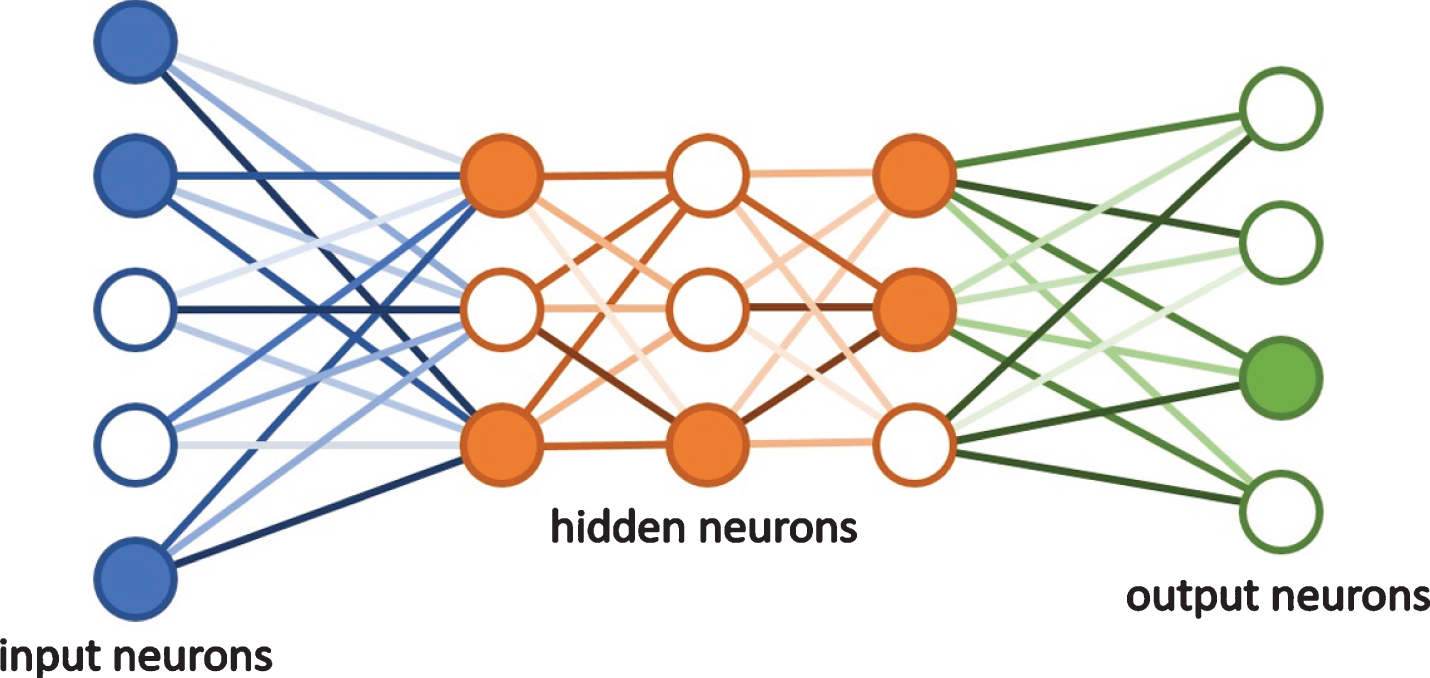
neural network.
STEP 2: The BP neural network with the particle position X i ,0 as a parameter is constructed, and the fitness value of the particle is calculated according to the formula, and then the optimal P i position of the individual is defined as X i ,0. By comparing all P i fitness values, the global optimal position P g is obtained.
STEP 3: The BP neural network with the X i ,0-position parameter of the particle position is constructed, and the fitness value of the particle is calculated according to the formula. Then, the position corresponding to min [f(X i ), f(P i )] is taken as the new individual optimal position P i .
STEP 4: min [f(X i ), f(P i )] corresponding position is taken as the new global optimal position P g .
STEP 5: According to formula, the position and velocity of all particl9es are updated.
STEP 6: The condition is judged. If the termination condition is met, the algorithm ends, otherwise it returns to STEP1 and restarts.
The BP neural network algorithm is mainly divid-ed intoz forward propagation of signals and back propagation of errors. The specific performance is that the signal experiences the forward propagation of the input layer, the hidden layer, and the output layer. At the same time, the existence of the error causes the signal to be selected for back propagation, that is, the direction of signal propagation is the output layer - the hidden layer - the input layer. Analysis of the BP neural network structure diagram in Fig. 1 can obtain the quantitative relationship between each layer. The meaning of the relevant variables is shown in Table 1.
Variable meaning of BP neural network
Variable meaning of BP neural network
In the neural network structure, when the output signal of the output layer does not match the expected signal value, an output error E is generated. At the same time, the direction of propagation of the signal is reverse propagation. From the output layer through the hidden layer to the input layer, the output error of each level of neurons is calculated one by one, and the error steepest descent method is selected to correct the weight of each level. Eventually, the actual output value of the neural network structure after adjustment is as close as possible to the expected value. If the number of training samples is P, then the overall error criterion function of the system for P training samples is:
According to the error steepest descent method, the correction amount of the output layer weight Δw
jk
is adjusted one by one, and the correction amount of the hidden layer weight Δw
ij
is adjusted one by one. Its expression is shown in formula. Among them, η represents the learning efficiency, which is a constant term, and the interval is between 0 and 1.
Then, E is substituted into formula, and the weights and threshold correction formulas of the following three-layer BP feedforward network learning algorithm can be obtained.
By using the BP neural network model, this paper constructs a time-based sequential parameter lateral prediction model and a longitudinal synergy prediction model based on time and order parameters to predict the order parameters and the degree of synergy of logistic financial innovation and economic growth system under the generalized virtual economy.
The degree of synergy between logistic financial innovation and economic growth is an important indicator for measuring the healthy development of the financial sector in the broad virtual economy. The synergy between logistic financial innovation and economic growth depends on the value of each order parameter of the system. Therefore, the prediction of system synergy needs to be based on the prediction of the system’s order parameters. In the process of analyzing logistic financial innovation and economic growth system, it is found that the synergy system between the logistic financial innovation and economic growth is a dynamic superposition system. That is to say, the degree of order and the degree of synergy of the system depend not only on the values of the order parameters of the system in the current year, but also on the values of the order parameters of the system in previous years. Using the previous data and calculation methods, the systematic order and degree of synergy between logistic financial innovation and economic growth in 2012-2017 and 2013-2018 are analyzed separately, as shown in Figs. 5 and 6 and Table 2.

Degree of order and degree of synergy curve of logistic financial innovation and economic growth during 2012–2017.
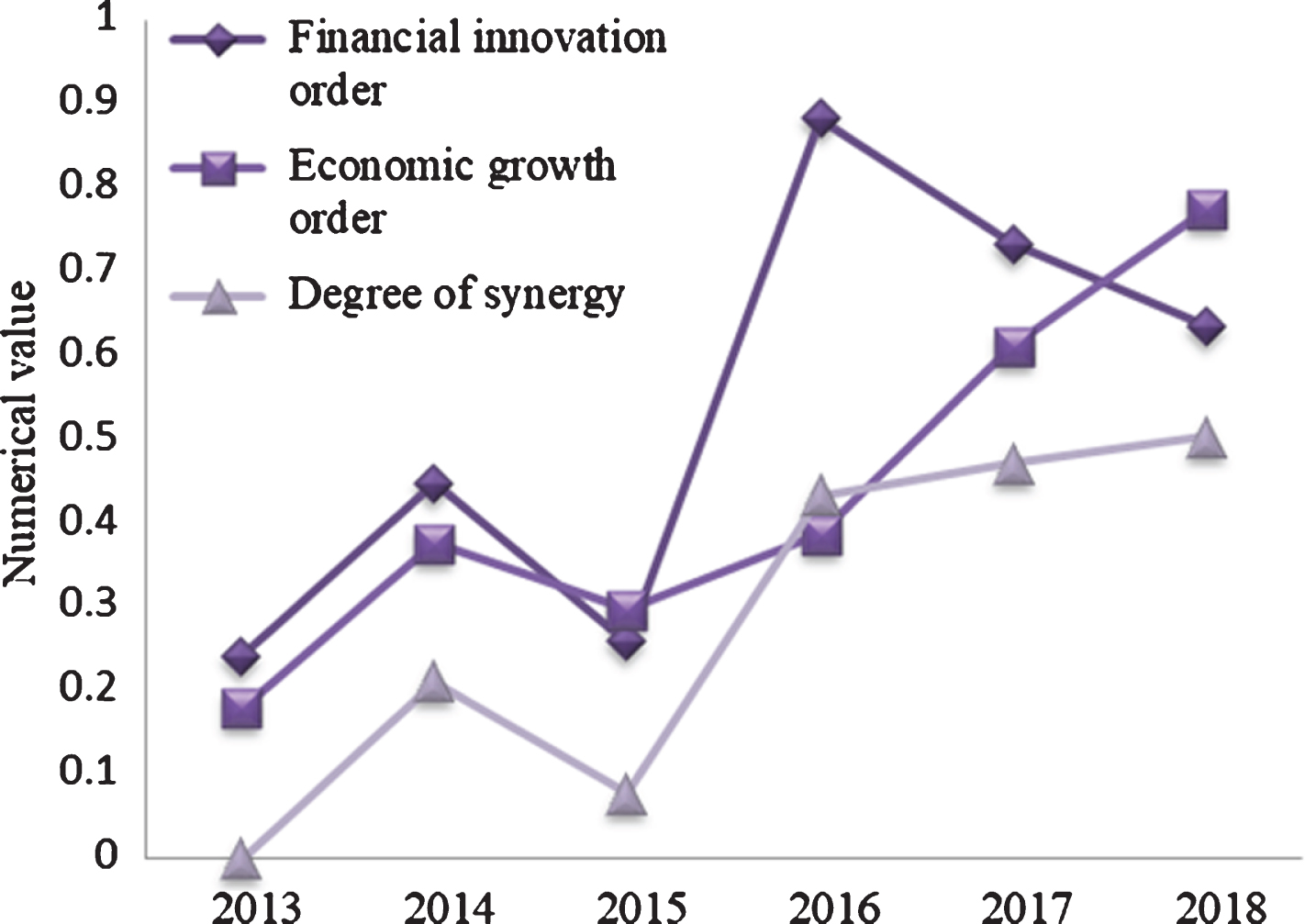
Degree of order and degree of synergy between logistic financial innovation and economic growth during 2013–2018.
Degree of order and system synergy of subsystems during 2012–2017, 2013–2018
After dimensionless processing of the original index data, we calculate the multiple correlation coefficients and weights of all indicators of the Internet financial development according to the formula (1 ∼ 5), and the regional economic development is expressed by GDP per capita. The results are shown in Table 2. On this basis, we use the formula (6) to calculate the comprehensive development index of the Shaanxi Internet financial and regional economic development system in the years of 2008∼2016. The results are shown in Table 3.
Complex correlation coefficient and weight calculation results
In order to facilitate the analysis of the growth trend and evolution characteristics of the comprehensive development index of Internet Finance and regional economic development, we draw the sequence diagram of industrial comprehensive development index based on the data in Table 4.
The integrated development index
(1) establish access mechanism for small and medium-sized enterprises
Small and medium-sized enterprises have poor production and operation stability, low awareness of credit risk, and weak ability to resist risk, which makes it difficult for small and medium-sized enterprises to obtain loans in the traditional financing mode. In the supply chain financial financing mode, although SMEs rely on the credit of core enterprises and the strength of the whole supply chain to reduce the credit risk, these financing weaknesses of SMEs themselves have not been fundamentally cured. There is an urgent need for banks to establish a credit risk assessment system for SMEs based on supply chain financing. Through the analysis of this paper, we can see that there is a very significant difference between the credit risk assessment of small and medium-sized enterprises in the supply chain financial business and the traditional credit risk assessment. The traditional credit risk assessment model only evaluates the balance sheet of small and medium-sized enterprises, while the supply chain financial credit risk assessment pays more attention to the development potential of small and medium-sized enterprises and their business status in the whole supply chain. Therefore, commercial banks should combine the characteristics of supply chain finance, according to the historical transaction data of enterprises and analyze the source of the credit risk of supply chain finance, establish the access mechanism of small and medium-sized enterprises, and use more accurate and objective measurement risk model to evaluate the credit status of small and medium-sized enterprises accurately and fairly.
(2) Track and evaluate the operation of core enterprises
When commercial banks choose the core enterprises participating in supply chain finance, they should evaluate the risk of different core enterprises according to different financing modes. For example, in receivables financing, we should pay more attention to the solvency and credit record of core enterprises, and take this as the core to evaluate the credit risk of enterprises. Commercial banks should analyze the operation and previous transactions of core enterprises, and make scientific evaluation, especially in the field investigation of the enterprise’s sales, equipment management, human resource development, quality control, cost control, technology development, user satisfaction and delivery agreement. The risk management department of commercial banks can use this information to monitor the risk level of core enterprises in real time. Once it is found that the pre-determined value exceeds the pre-determined value, the pre-determined value should be set by the commercial banks according to the actual situation and the past transaction situation, and risk early warning should be carried out.
(3). Improve the internal control of supply chain financial business
Supply chain finance is a complex system with multi-channel and multi link, and its credit risk has the characteristics of sudden. Therefore, for the occurrence of emergencies, commercial banks must have sufficient preparation, and establish the corresponding emergency system and early warning system. At the same time, if we want to establish a set of early warning evaluation index system, we must send out early warning signals for the indexes that deviate from the normal level and exceed a certain critical value. For the sudden and destructive events, the corresponding countermeasures and workflow should be set in advance. In order to avoid the serious consequences of the emergency to the supply chain finance, when the early warning system makes a warning, the emergency system should deal with the emergency in time.
Commercial banks should attach great importance to the monitoring of post loan credit risk to prevent the supply chain financial credit risk. Banks can not realize the direct control of funds after lending. Therefore, after the credit business with customers, banks often can understand the actual situation of financing enterprises more comprehensively and deeply. Banks play a passive role in the game with financing enterprises in the supply chain. The change of status and information asymmetry increase the difficulty of post loan management. At the same time, due to the long loan payback period and many uncertain factors in the supply chain financing business, in order to avoid, eliminate or control the risk or avoid the worst consequences, commercial banks must find and deal with the corresponding risks in time, and take other remedial measures such as adjusting the loan limit.
Conclusion
The evaluation of supply chain financial credit risk is of great significance to the steady development of supply chain financial business in China. Supply chain financial business is a new profit growth point, which provides an effective way for commercial banks to expand profit space, adjust profit structure and improve competitiveness. With the help of powerful core enterprises to provide credit guarantee for small and medium-sized enterprises, banks carry out the supply chain financial business. They not only increase their business income, but also establish a stable relationship with small and medium-sized enterprises, which provides a guarantee for long-term cooperation in the future. Through the effective evaluation of supply chain financial credit risk, banks can effectively reduce the risk, improve the credit level of enterprises, expand the scope of credit enterprises, so as to achieve the purpose of controlling risk and increasing profits. Therefore, it is of great significance to establish an appropriate index system and evaluation model to study the supply chain financial credit risk.
Footnotes
Acknowledgments
This paper was supported by (1) Research on the Poverty Return of preventive resettlement, National Social Science Fund of China (Grant No.17CRK007); (2)Research on Risk of Poverty Return in the Process of aid, Jiangsu University Philosophy and Social Science Research Fund (Grant No.2017JB0254); (3) Young Scholars Support Project in NUFE (Grant No.HZJXW18001).