



Abstract
In order to overcome the problems of invulnerability and low communication efficiency when analyzing network communication instability with current methods, this paper proposes a modeling method of network communication instability based on K-means algorithm. The network element nodes are generated by clustering idea, and the initial communication topology is constructed. K-means algorithm is used to optimize the initial communication model, build a comprehensive mathematical model of network communication, and solve the model to realize the optimization of communication model. The network efficiency function is used to further quantify the network invulnerability, and the function is used to find the most vulnerable nodes in the network, and strengthen them to achieve efficient control of network invulnerability. The experimental results show that the model has strong invulnerability, up to 99.9%, high communication efficiency and coverage, and the maximum communication delay is only 0.35 s. It is a feasible network communication model.
Introduction
The construction of network communication topology model is based on the simulation of actual communication network. It is a key means to study communication network. Because of the diversity and complexity of communication network, it will affect the overall stability of the simulation of network topology model [1–3]. It is necessary to use the model which can reflect the real network communication as an abstraction of the real network communication environment to get the correct results. When building the network communication model, it is necessary to study and design the network communication model which can be applied in the case of a special node failure or manual intervention, so that the network communication model can reflect the actual application situation as far as possible [4–6], in order to provide the necessary support for the network, to provide services safely and economically, and to ensure the rational allocation of resources and data.
Reference [7] proposes a research method of network communication instability based on topic model. According to labeling an implicit attribute, namely activity, for each node in the network, a communication simulation method based on topic model is proposed. In the process, the real mail network data set is taken as the object, and the proposed method is implemented to simulate the overall characteristics of the original network and the individual user’s operating behavior pattern. In addition, due to the limitation of privacy schemes and access strategies, it is very difficult for most researchers to collect large amounts of real communication network data in a short time. Many related research work is limited by the lack of test data. For this problem, the existing communication data stream can be used to obtain massive simulation data by this algorithm, but the invulnerability of this method is poor. Reference [8] proposes the research method of network communication instability based on waveguide technology. For the problem of path loss in traditional network magnetic induction communication, a magnetic induction communication model based on waveguide technology is proposed. Using waveguide technology, i.e. using a set of rated number of magnetic coupling elements, the rated number of passive relay coils is introduced into the transceiver and receiver coils at equal distances, and the matching capacitance of each resonant coil should be greater than 10 pF. The ideal distance between the relay coils should be defined as 0.7 m. By means of electric resonance, the path loss of communication channel can be reduced, but the communication efficiency of this method is lower. Reference [9] proposes a method of research on network communication instability based on OPNET. This method considers hybrid critical network as a relatively new communication mode, which can satisfy various requirements of non-real-time and real-time services. In order to analyze the performance of the network, a method of simulation modeling is proposed to simulate the communication mode in OPNET network. Based on the open system interconnection model, the network node and process model are designed and constructed through hierarchical modeling. This model takes into account the characteristics of event triggering and time triggering message display, and realizes the flexible configuration of simulation by designing scheduling algorithm and fault-tolerant mode, but the communication delay of this method is high.
In order to solve the problems existing in the above methods, a network communication instability model based on K-means algorithm is proposed to study the network communication instability. The specific scheme of this method is as follows: The initial communication model is established, which lays the foundation for the subsequent model optimization and analysis; The objective function is constructed based on K-means algorithm, and the communication model topology is optimized to improve the accuracy of network communication instability research. The vulnerability of the communication topology model is optimized to improve the invulnerability of the modified communication model. Experimental verification and result analysis.
Through the above scheme, the research of network communication instability with high invulnerability and efficiency is realized.
Modeling of network communication instability based on K-means algorithm
Construction of initial communication model
The process of building the initial communication model is as follows:
Step 1: Assuming that the original element node is {x(1), x(2), … , x(n) } and these nodes are disordered without any markers.
Step 2: K random nodes
Step 3: Calculate the time distances between all the original nodes and the initial random element nodes, and then arrange the nearest nodes to each random node according to the calculation results. The formula is:
Step 4: Get the average distance of all the original nodes closest to the found node:
Step 5:
The network element nodes in the communication model are generated by clustering to form the initial communication topology.
Construction of objective function and model optimization based on K-means algorithm
K-means algorithm
The basic idea of K-means algorithm is: firstly, the center of clustering is determined, and then the average value of each clustering set data is weakened based on the center. Then, all factors in communication network are judged by the minimum distance, and the unstable factors are analyzed under the condition of convergence of the objective function.
Because network communication is easy to be disturbed, it is necessary to analyze the unstable factors in network communication. Using K-means algorithm to construct the objective function and optimize the model can improve the efficiency of network communication and reduce the delay of network communication.
Construction of objective function and model optimization
By optimizing the initial communication model generated by 2.1, the network communication topology can be regarded as a constrained and multi-objective non-linear optimization problem, which makes use of the combination of nodes and links to achieve optimal network loss or reliability.
(1) Mathematical model and solution of network communication
The objective function of network communication model is:
Network invulnerability: the objective function is divided into topological invulnerability and service invulnerability. TSIFL, which maximizes the connectivity of CPU-based chains, is regarded as the objective function. The expression is as follows:
Where, MRIF represents the number of CPUE chains actually contained in the communication network, LCTi represents the overall connectivity of thei-th CPUE chain, MTi represents the number of information transmission chains contained in thei-th CPUE chain, and NLj represents the length of the j-th information transmission chain of Article J.
The invulnerability of communication service uses the invulnerability measure of the maximum network service, that is, the network service transmission performance is regarded as the objective function, expressed as:
Where, ϑi (G) represents the transmission rate of the simulated network traffic under the type i anomaly, aj represents the traffic transmitted by the j-th original data source, bi,k represents the total traffic received by the k-th final data sink under the type i anomaly, and λ represents the variation coefficient of the data volume.
Network communication performance: for the communication model, due to the limited communication performance of some nodes or parts, the communication performance of the whole network will be degraded, resulting in serious waste of data resources, increase of delay and damage of information value [10–12]. To sum up, improving network communication performance is one of the main objective functions of network communication instability modeling.
When some links in the network produce random anomalies, the quantitative correlation between the maximum link median B* and the overall network capacity Cnet can be expressed as:
In the formula, d* represents the initial link bandwidth corresponding to the maximum link median, n represents the number of network nodes, and
Network cost: the cost of network communication includes the cost of building all communication relay nodes and communication links [13, 14]. The expression is as follows:
Where, ATT,uv represents the existence or absence of direct links between the u-th and the v-th communication nodes, ATC,ui represents the existence or absence of links between the u-th and the i-th detection nodes, ATP,uj, ATU,uk, ATE,ul are variables in the communication network, costT,u represents the total construction cost of the u-th communication node, and costTT,uv represents the total cost of the constructed link between the u-th and the v-th communication node. Cost(TC, ui) represents the cost of the link between the u-th communication node and the i-th detection node, and costTP,uj, costTU,uk, costTE,ul represents the variables in the communication network.
The constraints of network communication model construction are as follows:
Node capacity constraints: In the process of building a communication model, after the network topology changes, the load of the node does not exceed its own capacity, that is to say:
Where, Cap(vi) represents the overall capacity of node i during its operation, and Capmax (vi) represents the upper limit of the overall capacity of node i during its operation.
Link capacity constraints: in the process of constructing communication topology, it is necessary that the link load is less than its bandwidth after the network topology changes [15, 16]. There are:
Where, Cap (ei) represents the overall capacity of link i during its operation, and Capmax (ei) represents the upper limit of the overall capacity of link i during its operation.
Connectivity constraints of network structure: in general, connectivity constraints refer to the need for at least one connection path between any two end users to improve communication coverage [17, 18]. There are:
Where, d (vi, vj) ≤ n - 1 represents the shortest path between two nodes, and n represents the number of nodes.
According to the above objective functions and constraints, the objectives of the communication model include improving the topology and service invulnerability, improving the communication performance and reducing the network operating costs. The comprehensive mathematical model of communication is constructed as follows:
Based on the above analysis and calculation, the solution structure of the designed communication topology is shown in Fig. 1.
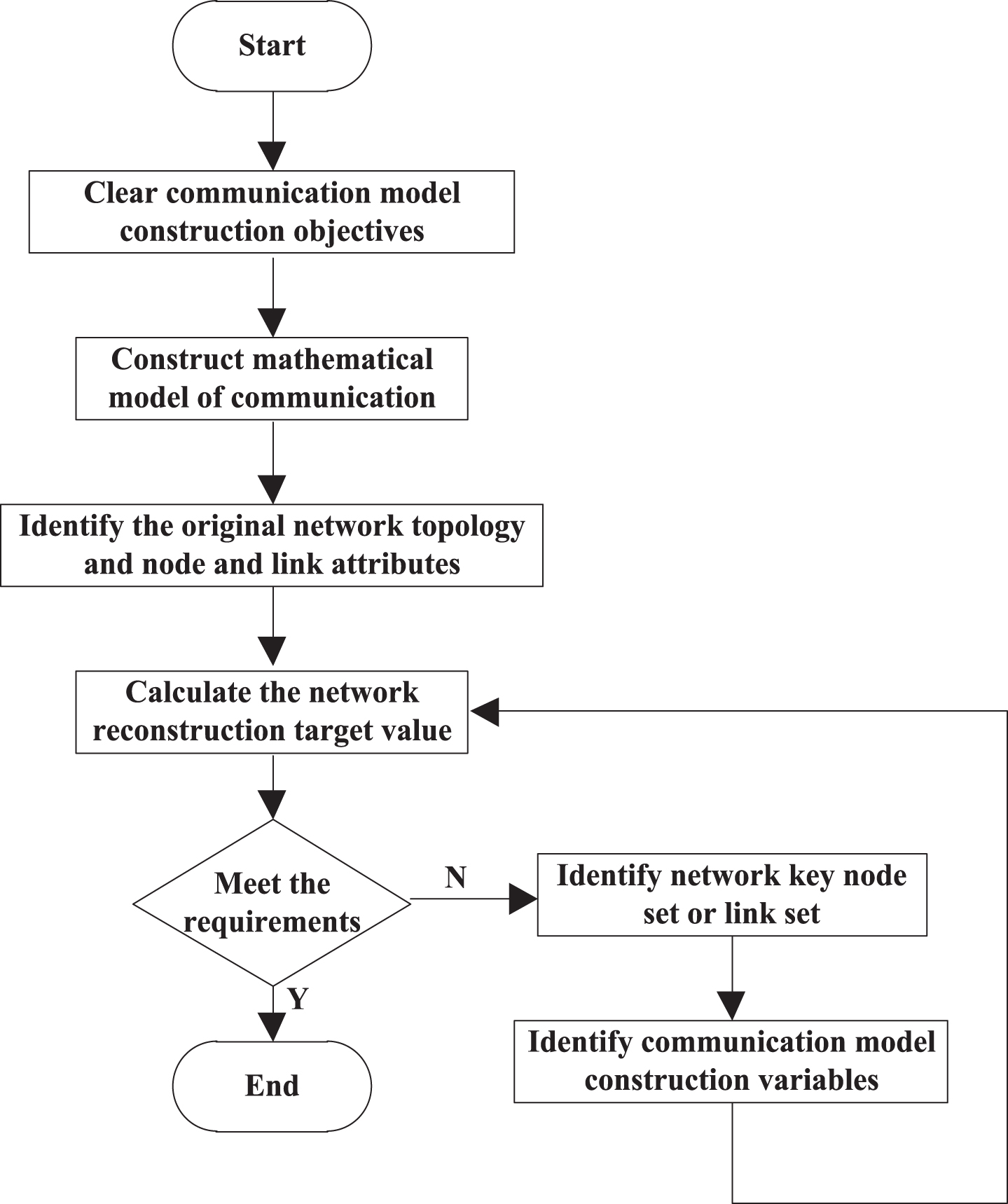
Communication topology solution.
(2) Determine the target weight of communication topology
Step 1: Determine the target of communication model and the performance indicator factors that affect each target.
Step 2: Design and build a hierarchical target system, as shown in Fig. 2.
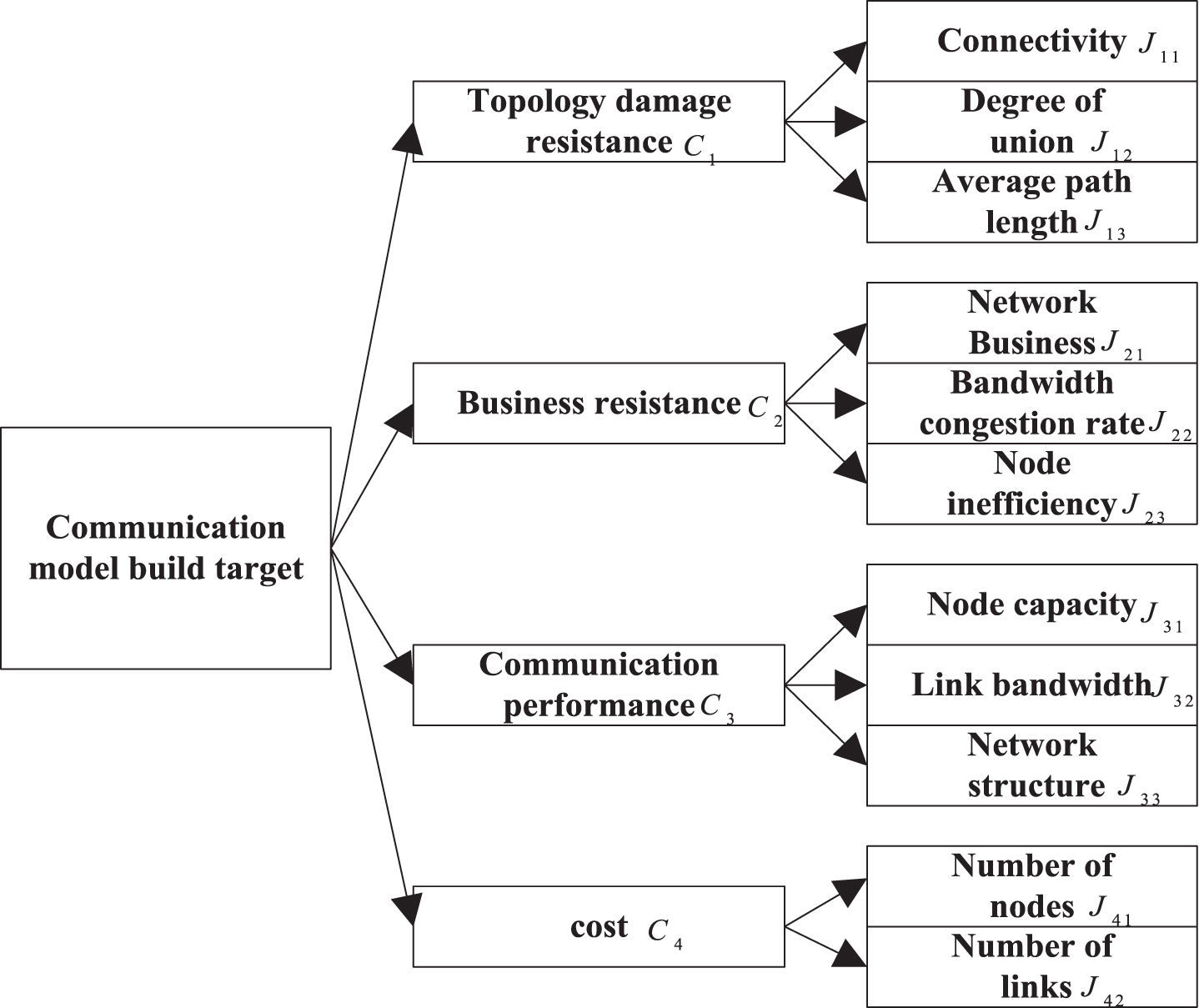
Hierarchical sketch of the target system.
Step 3: Design the networked target system, as shown in Fig. 3.
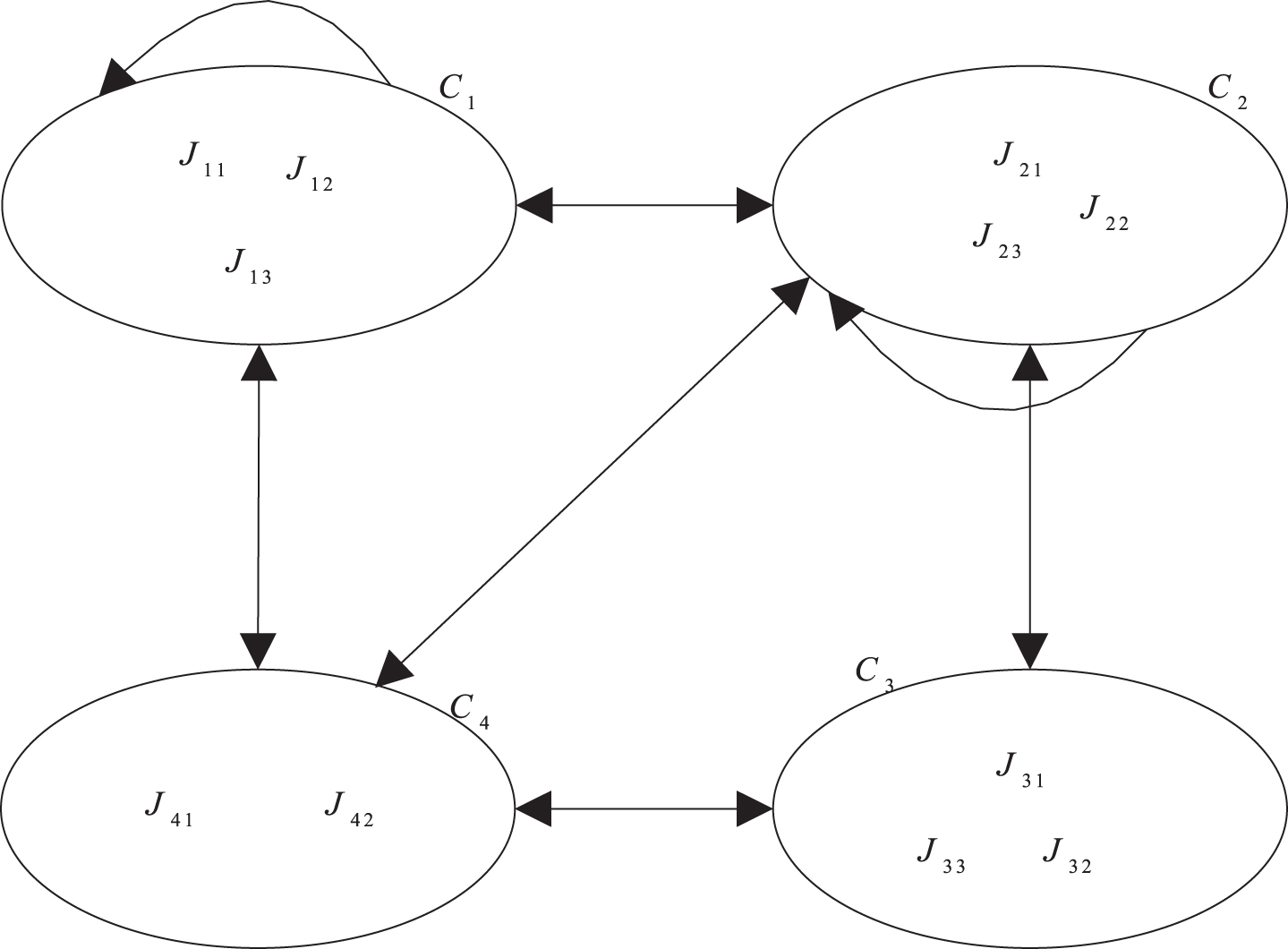
Schematic diagram of networked target system.
Step 4: Take each target as a criterion, analyze the impact of other targets through two-way comparison, and construct ANP model based on cloud matrix. In the process, the expert judgment information is described by intervals, that is to say, the contrast matrix of pairs of intervals is formed. In the above, the element form of the interval paired comparison matrix defined by experts can be described as
Step 5: Compute cloud power:
Where,
Step 6: Calculate the limit cloud matrix to get the target weight:
In the formula,
(3) Topology construction of communication model
This part is divided into two parts: the measurement of the importance of nodes and links, and the construction of communication model topology.
In the process of measuring the importance of nodes and links, the current researchers usually do not consider the end user when constructing the communication model. They will abstract it directly into a simple graph or a weighted graph for analysis, for the communication model without considering the user, as shown in Fig. 4. In fact, however, this abstraction is a very simplified process. Setting Fig. 5 is the graph structure of each communication node in Fig. 4, which considers the type and number of end users and other related information. Then the importance degree analysis process of each communication node is as follows: evaluating the importance degree of nodes through the intermediary number, then the shortest link in the process of calculating the intermediary number of nodes is not between two communication nodes. The shortest distance path is the shortest distance path between two end users, and other user nodes need not be considered in the calculation process. Assuming that the shortest distance path between nodes U1 and E4 is calculated, the overall structure of the network needs to be considered, as shown in Fig. 5. Then, the importance of nodes is evaluated by degree, and then the degree of communication nodes is the addition of the degree of their own class and the degree of heterogeneity. Table 1 shows the intrinsic and heterogeneous degrees of each communication node in the network in Fig. 6. The node T1 is analyzed as an example. In the previous simple graph model, the T1 degree is 3. If the user is considered, the T1 degree is 8.
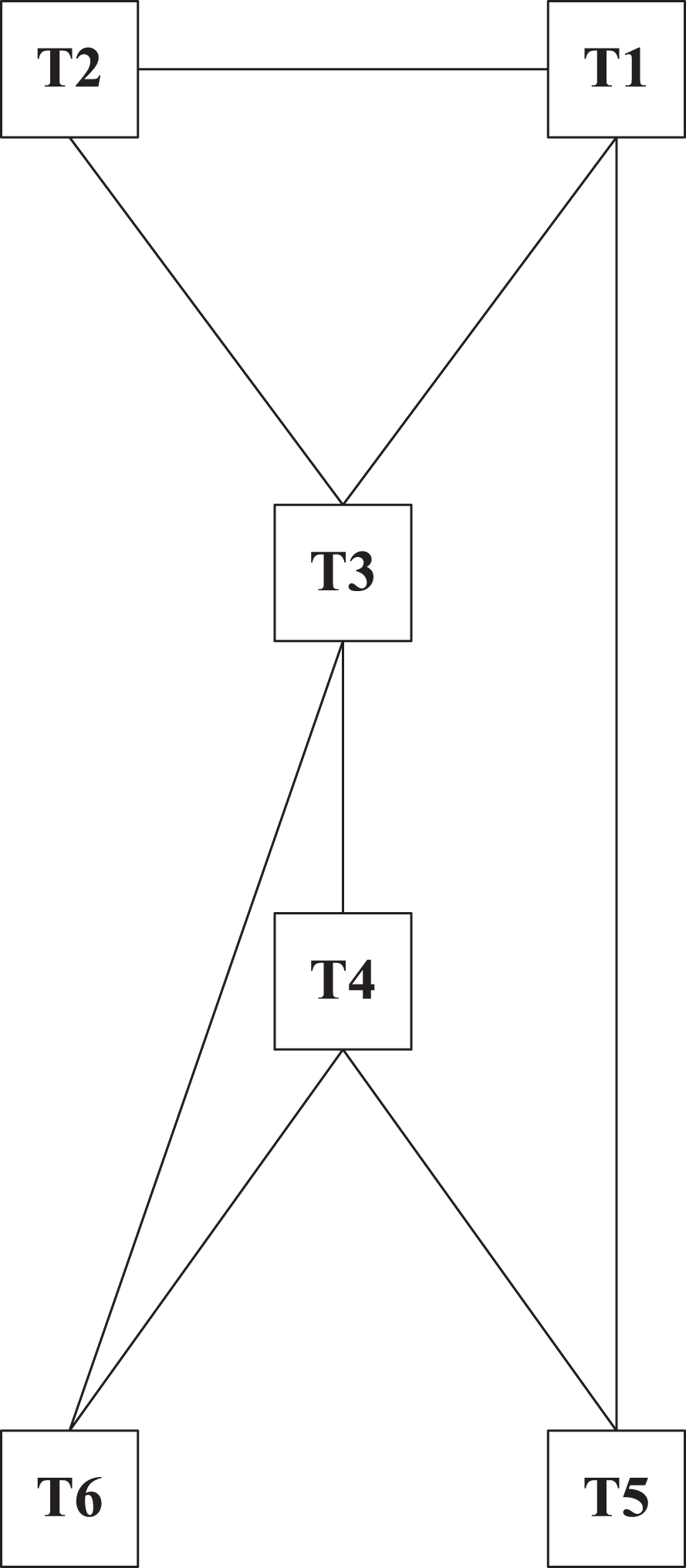
Communication model without considering the user.

Communication model between two end users.
Classification and heterogeneity degree of nodes in communication model

The communication model by considering the user.
In Fig. 6, T stands for relay, C for collection, P for processing, U for use, E for effect.
According to the above contents, a communication model considering the importance of nodes and links is constructed as follows:
Scheme 1: The links connected by several important nodes are deleted, and several links between their adjacent nodes are added, in order to achieve the purpose that the load of important nodes can be alleviated. The dotted link in Fig. 7 (b) describes the links that can be added in Fig. 7 (a), where the solid link describes the links that can be deleted, and Fig. 7 (c) is a communication model structure.
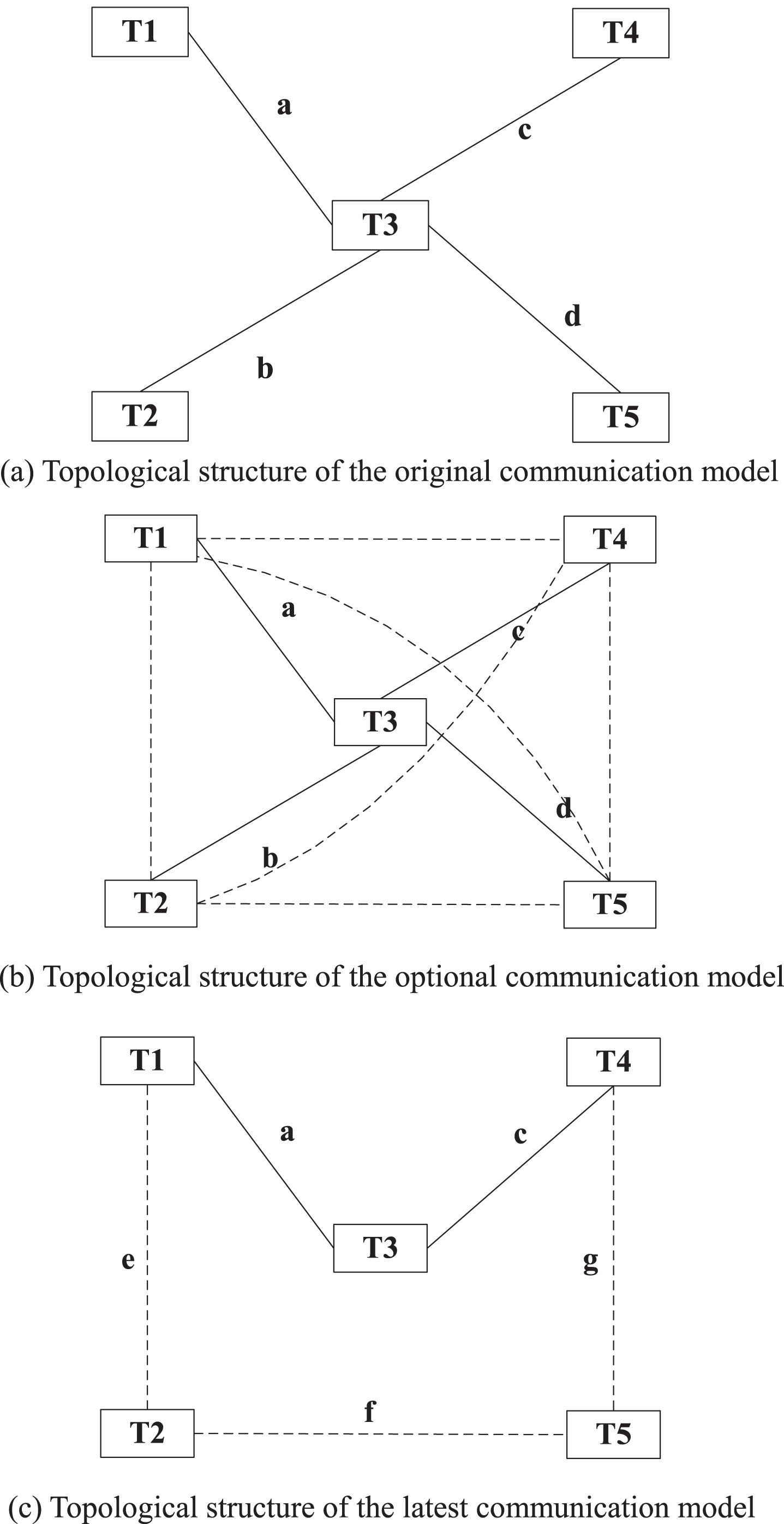
A schematic diagram of the topological transformation of the communication model considering the important nodes.
Scheme 2: Similarly, in order to alleviate the load of important links, the communication model considering important links is constructed as shown in Fig. 8.

A schematic diagram of the topological transformation of the communication model considering the important links.
Because vulnerability is one of the most important factors of communication instability, considering this problem, based on the above network communication model, vulnerability is further analyzed and optimized.
Assuming that the network is attacked by the outside world or invalidated by its own factors, the communication will certainly be affected [19–21]. Quantitative indicators are used to evaluate the impact of a node failure on the network in the constructed communication model topology. The indicator is defined as the network efficiency function E (G). E (G) can directly find the most vulnerable node in the network and strengthen it. The expression E (G) is:
In the formula,
For networks, vulnerabilities can be analyzed as follows:
Step 1: Obtain each node degree in the network, and arrange the results in order from big to small.
Step 2: Select the node with the greatest degree and delete the links connected with the node from the network to get the remaining network.
Step 3: Use formula (11) to calculate the transmission efficiency of the remaining network.
According to the sequence of the results after removing the nodes, the node with the least efficiency is defined as the most vulnerable node in the network topology. By strengthening the results obtained, an efficient control of communication model instability can be achieved.
In order to verify the validity of network communication instability modeling based on K-means algorithm, an experiment is carried out. The experimental platform is built on matlab. The experimental data defines 150 nodes in each category of the network, including 22 wireless communication nodes, 105 wired communication nodes, 8 information processing nodes and 15 detection nodes.
The overall experimental scheme is as follows: with invulnerability (validated by both internal faults and external attacks), communication delay and communication coverage as experimental comparison indicators, this method is compared with literature [7], literature [8], literature [9]. The higher the invulnerability and communication coverage, the lower the communication delay, the better the overall performance.
Comparison of Invulnerability
Analysis of the experimental results of Fig. 9 shows that the method presented in this paper has a higher anti-destructive performance than other literature comparison methods. Under internal faults, the anti-destructive ability of this method can reach 98.9%, while that of reference [7], reference [8], and reference [9] are 92% and 91% respectively. Under external attack, the invulnerability of this method is 99.9%, while that of reference [7], reference [8], and reference [9] is 91.5%, 90.3% and 88.6%, respectively. In both cases, the invulnerability of this method is higher than that of the three methods, which fully illustrates the high performance of this method.
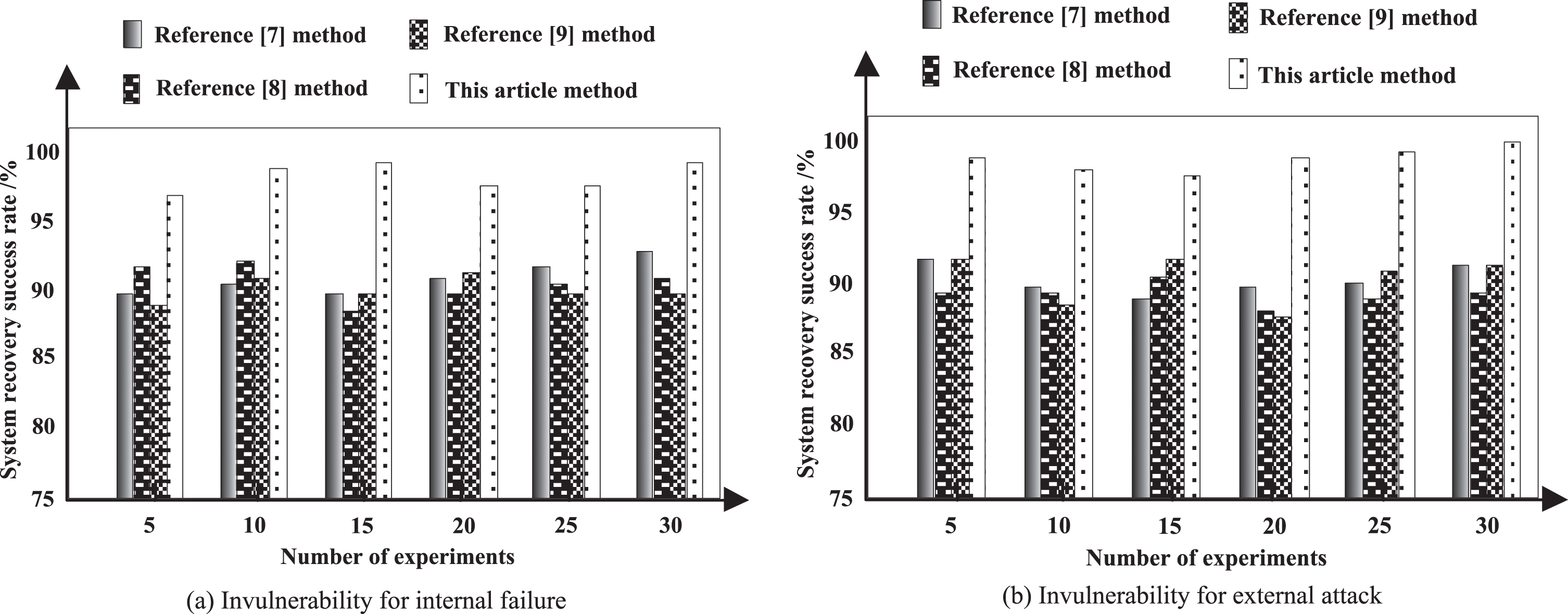
Comparison of invulnerability of different research methods.
As can be seen from Fig. 10, with the increase of the number of nodes, the communication delay of the four methods has been improved, but the communication delay of the method in this paper rises slightly. When the number of communication nodes increases by 120, the communication delay time of the method in this paper is only 0.35 s, while that of reference [7], reference [8], and reference [9]. The communication delay time is 0.75 s, 0.88 s and 0.99 s respectively. The validity of this method is fully proved. This is because this paper uses K-means algorithm to determine the target weight of network communication topology structure, so as to reduce the influence of unstable factors on network communication.
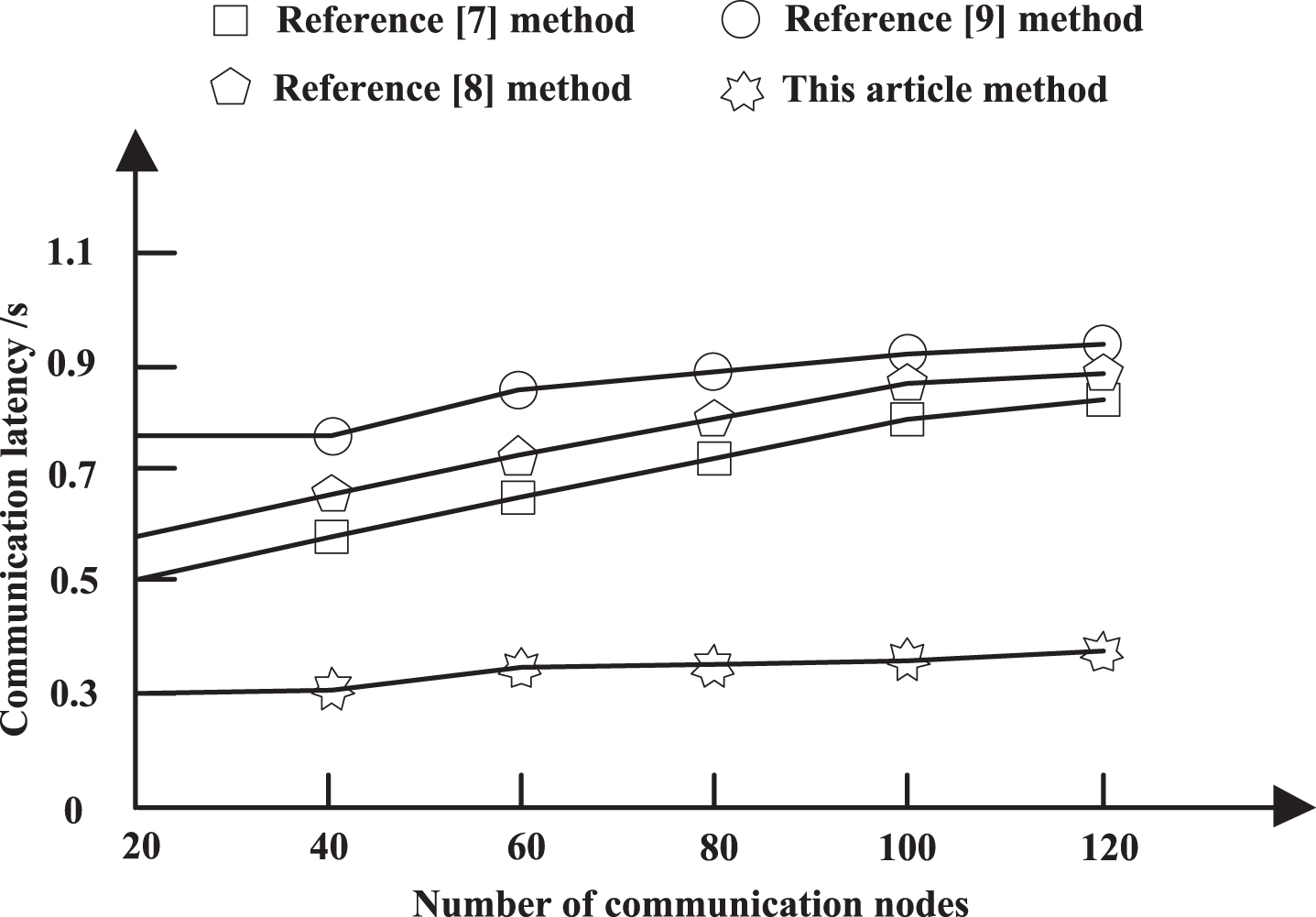
Comparison of communication delays of different research methods.
By analyzing the Fig. 11, the network coverage of the proposed method is higher than that of the method in references. In the process of research and analysis, this paper takes network survivability and network communication performance as objective functions and network structure connectivity as constraints to construct a comprehensive communication mathematical model, which effectively improves the invulnerability and communication capability of the established communication model, and improves network coverage with reliable network structure connectivity. The most vulnerable nodes in the network are found and strengthened by using the network efficiency function indicator, which further enhances the network survivability and communication stability.
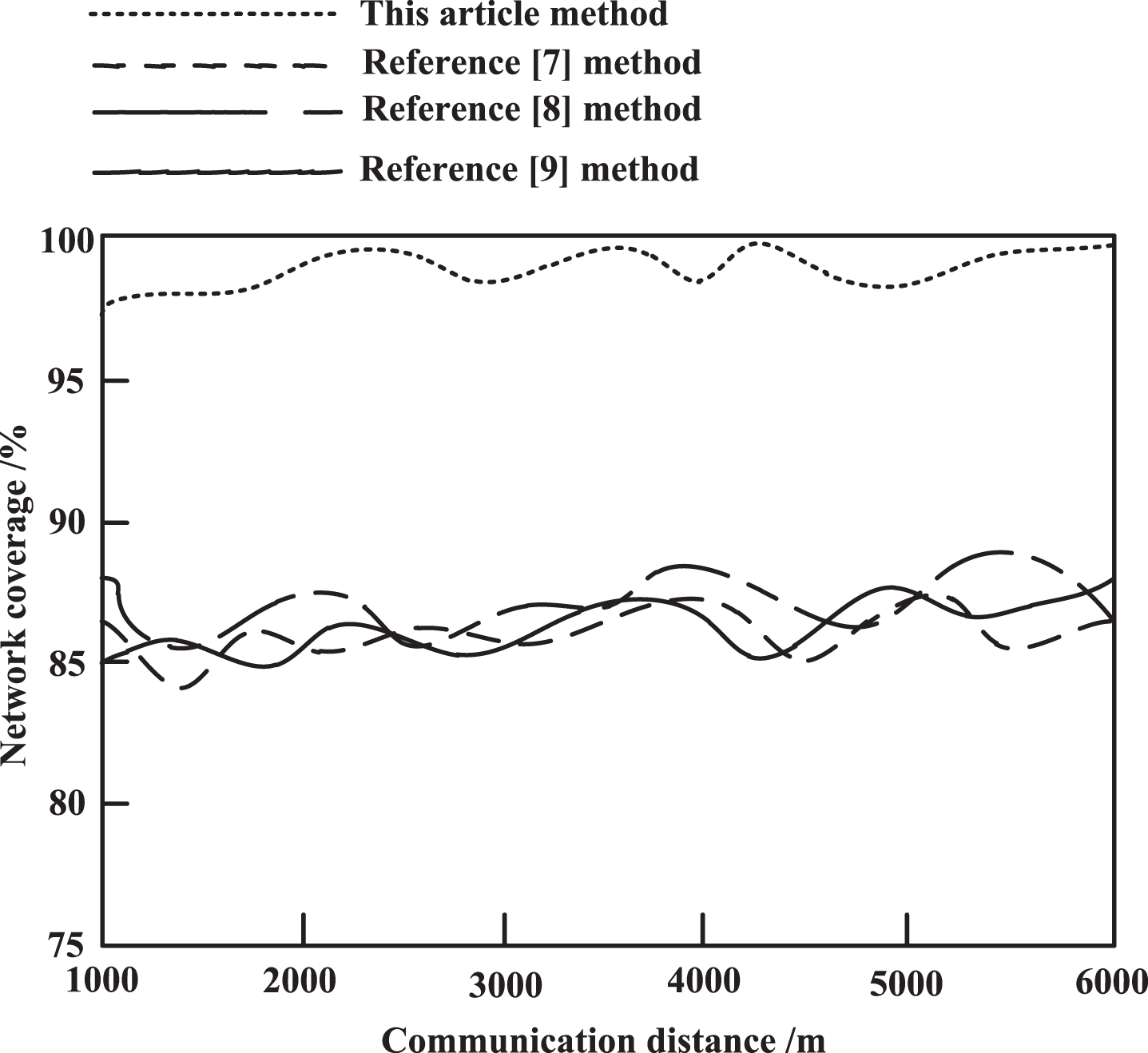
Comparison of network coverage of different research methods.
Network communication has the characteristics of instability and complexity, so it is necessary to study it. The invulnerability and communication efficiency of traditional network communication instability research methods need to be further improved. Therefore, this paper proposes a modeling method of network communication instability based on K-means algorithm. The following conclusions are proved theoretically and experimentally. This method has good invulnerability and low communication delay in the study of network communication instability. Specifically, compared with the method based on thematic model, the proposed method has better invulnerability, the maximum invulnerability can reach 99.9%. Compared with the method based on waveguide technology, the communication delay is greatly reduced, and the maximum communication delay is only 0.35 s. Therefore, the research method based on K-means algorithm proposed in this paper can better meet the needs of network communication instability research. In future research, communication delay should be further reduced to ensure the effectiveness of network communication.
Footnotes
Acknowledgments
This work was supported by Jilin Provincial Science and Technology Department Foundation under grant no.20190601040FG, and Jilin Provincial Education Department Foundation under grant no. JJKH20190799KJ.