



Abstract
Multi-criteria decision making (MCDM) is a discipline in which several contradictory criteria are evaluated in a decision making process. There are many MCDM techniques described in the literature, and important considerations have been made in this area because the hesitant evaluations of decision makers, regarding both the criteria and the alternatives, have to be taken into consideration. This study focuses on the MCDM problem using axiomatic design (AD), which is one of the "state of the art" and efficient MCDM techniques related to hesitant evaluations, which are defined as hesitant fuzzy linguistic term sets (HFLTS). In this study, AD is used throughout a methodology in which hesitancy is taken into account in the assessments of the decision makers. System and design ranges are determined in light of the hesitant evaluations of the field experts, and alternatives are listed in the case of both the unweighted and weighted fuzzy environments.
Keywords
Introduction
Multi-criteria decision making (MCDM) involves making an optimal choice that provides the highest degree of fitness among the alternatives characterized in terms of specific properties, and is a common task in our daily lives. MCDM methods are designed to identify preferred alternatives, to classify these alternatives into a small number of categories, and/or to rank them in subjective order of preference.
In classical MCDM, the evaluations of alternatives are well known. However, owing to the inherent uncertainties of human preferences and objects that are blurred and ambiguous, the properties used in decision-making problems are not always expressed in terms of real numbers, and it is more appropriate to employ fuzzy values for these expressions.
Nevertheless, the results obtained when decision-makers cannot make a clear decision about the superiority of alternatives and criteria, may not be trustable. Decision makers may hesitate while deciding between different criteria or alternatives and may need better expressions to express their knowledge. For these reasons, the hesitant fuzzy linguistic term set (HFLTS) is at the forefront. HFLTS describes the situations that permit the membership of an element of a given set having a few different values, which is a useful way to describe and deal with uncertain information in the MCDM process. Therefore, the use of hesitant fuzzy assessments enable the decision makers’ judgments to be more reliable and informative in the decision making process [40]. HFLTS has been used in the literature frequently in recent years, Wang et. al [35] reviewed the developments related to this subject. Dong et al. [8], Xu et al. [38], Tüysüz and Şimşek [33], Liang et al. [24], Xu et al. [37], Donget al. [7], Liao et al. [25], Li et al. [22], Wu et al. [36], Zhou et al. [43], Xu et al. [39], Li et al. [23] and Yuan et al. [42] are also some of the most recent studies.
Axiomatic design (AD) is one of the commonly used techniques of MCDM. The technique and its principles have improved rapidly over the recent years. Kulak et al. [21] presented a literature study in 2010 related to the applications of AD principles from the past 20 years. In recent studies, many AD applications are seen in different areas, such as; project selection [14], ergonomic evaluation [26], knowledge services [5], personnel selection [18], machine scheduling [19], location selection [3], production design and improvement [4, 34], failure modes analysis [29], maintenance strategy selection [30], supplier selection [2, 6], industrial robot [15], robot arm [1], and material handling equipment selection [16].
In AD, two major axioms are used: independence axiom and information axiom. The independence axiom points out that the independence of functional requirements, which are defined as the minimum number of independent requirements that illustrate the design aims, should always be protected. The information axiom states that, amongst designs that satisfy the independence axiom, the best design is the one that has the minimum information content, where the information content determines the design with the highest probability of success. A multi-criteria information axiom is based on the designs, systems and common ranges, which enable definition of the lower and upper bounds of design targets and the distribution function of the system performance. This provides an important advantage as it does not force the decision maker to define a single numerical design target [12].
The decision problem considered in this study is the selection of the most appropriate ultrasound (US) device at the Department of Pain Medicine in a university hospital in Ankara, Turkey. In this department, interventional pain management procedures and operations are performed on the patients. The university hospital analyzed here is regarded as one of the biggest hospitals in its region, and the department has an average of 150 patient visits per day. The majority of these patients are admitted with complaints such pain due to cancer, back pain, and headache, which may negatively affect their living standards and may cause serious loss to the workforce in the society. Because of such discomforts, interventional pain treatment is administered to 70-80 patients per week. The US is an imaging technology that is often used to diagnose unexplained pain, swelling, and infection. It is also used to provide imaging guidance to needle biopsies or to view and evaluate conditions related to blood flow. Furthermore, the popularity of US devices is increasing as they can be used in outpatient clinic conditions as well as in bedside applications and, have enable synchronous observation of the tissues in the treated area together with the needles and medicines used during the procedure, which consequently decreases side effects, and prevents both the patient and the physician from being exposed to radiation. The use of US devices is of great importance as the areas that these procedures are applied require a high degree of precaution.
In this study, AD is used for selecting the best US device among various alternatives. Throughout this method, system properties of the alternatives are determined and an attempt is made to minimize the information contents calculated according to the relation between the design and the system properties. With this approach, it is possible to make highly objective evaluations related to the proximity of the current properties of the alternatives to those of the desired characteristics, allowing the decision makers to use more flexible data using ranges instead of single values. Although this approach has become very popular in recent years, to the best of the authors’ knowledge, no application of AD with HFLTS has been found in the literature. In this study, AD is used in a methodology in which hesitancy is taken into account in the assessments of the decision makers. In the proposed method, system ranges and design ranges are determined in the same manner as those of AD applications, but in light of the hesitant evaluations of the field experts. Alternatives are first listed regardless of the weights of the criteria, and then, considering the priorities of these factors, the alternatives are sorted using the criteria weights, which are again determined according to the hesitant evaluations. Finally, the two results are compared and, related observations and analyses are given.
The remainder of the paper is organized as follows; Section 2 introduces some of the basic concepts of AD and HFLTS, briefly. Section 3 presents the application of the proposed algorithm in the decision problem of ultrasound device selection. Finally, Section 4 offers conclusions and recommendations for future studies.
Preliminaries
This section introduces the basic ideas and definitions about AD and HFLTS. In essence, this section is divided into four parts: (1) AD, (2) Fuzzy AD, (3) Weighted fuzzy AD and (4) HFLTS.
Axiomatic Design (AD)
The AD is a design method proposed by Suh [31] to establish a scientific technique to improve design activities, by providing a theoretical foundation grounded on logical and rational thought processes and tools [32]. Some of the most important aspects of AD principles are that they allow researchers to not only determine the best alternative or choice from a certain set of criteria but also to choose the best suitable alternative for the decision makers [13].
In any design situation, the probability of success is determined by information; it is given by what the designer wishes to achieve in terms of tolerance (i.e. design range) and what the system can deliver (i.e. system range). Information is expressed by I
i
information content and it is related to the actualization probability of given functional requirements (FR). For a given FR, I
i
value is calculated as follows:
Design range, system range, common range and probability density function (p.d.f.) of a functional requirement (FR)
For an FR with normal probability density function, p
i
value is calculated as follows:
MCDM techniques in the literature are generally available when the data are specific, while fuzzy multi-criteria AD approach is available if the data are not definitive. Real numbers are used to express the exact specified data, however, when the data are not specific and are expressed by linguistic variables instead of numerical values, this data must be transformed into a numeric form depending on a certain rule base. The fuzzy set theory is an important tool that can be used at this stage.
In AD, the system and design ranges of the functional requirements can not cannot always be expressed by certain intervals. Above or below a certain value can be approximated and these values can be represented by triangular or trapezoidal fuzzy numbers. In the case of a fuzzy AD, when the range values are given linguistically, the triangular or trapezoidal fuzzy membership functions are used when the probability density function is specified. Therefore, the common area is the intersection area between the fuzzy areas of the system and design ranges. Thus, the information content is calculated by Equation 4:
In subsection 1, the weights of the criteria are expected to be equal. However, this is not a realistic approach for real-life applications. In case each criterion has a specific weight value (w
j
), in addition to the previously defined equations, the following one is used to calculate the information content and this approach is named as the weighted axiomatic design [20].
In this study, hesitant fuzzy linguistic term sets (HFLTS), which were originally proposed by Rodríguez et al. [27], are used. Rodríguez et al. [27] introduced the concept of HFLTS to provide a linguistic and computational basis to increase the richness of elicitation based on the fuzzy linguistic approach and the use of context-free grammar using comparative terms. They proposed a single-criterion hesitant linguistic group decision-making model to achieve the aims in their related work.
Before the AD-HFLTS integrated methodology is presented, some basic concepts related to HFLTS are given. In this study, linguistic term sets, which are proposed by Yavuz et al. [41], are used together with the context-free grammar G
H
of Rodríguez et al. [27]. Assuming S = {s0, …, s
g
} be a linguistic term set, the elements of G
H
= {V
N
, V
T
, I, P} are defined as follows:
= {〈primary term〉, 〈composite term〉, 〈unary relation〉, 〈binary relation〉, 〈conjunction〉} = {lower than, greater than, between, at least, at most, and, s0, s1, …, s
g
} ∈V
N
= {I : : = 〈primary term〉 | 〈composite term〉 〈composite term〉 : : = 〈unary relation〉 〈primary term〉 | 〈binary relation〉 〈primary term〉 〈conjunction〉 〈primary term〉 〈primary term〉 : : = s0|s1| … |s
g
〈unary relation〉 : : = lower than | greater than | at least | at most 〈binary relation〉 : : = between 〈conjunction〉 : : = and }. (s
i
)] = {s
i
|S
i
∈ S} (at most s
i
)] = {s
j
|s
j
∈ S and s
j
≤ s
i
} (lower than s
i
)] = {s
j
|s
j
∈ S and s
j
< s
i
} (at least s
i
)] = {s
j
|s
j
∈ S and s
j
≥ s
i
} (greater than s
i
)] = {s
j
|s
j
∈ S and s
j
> s
i
} (between s
i
and s
j
)] = {s
k
|s
k
∈ S and s
i
≤ s
k
≤ s
j
}
Assuming that E
GH
is a function that converts linguistic expressions into HFLTS, linguistic expressions are converted into HFLTSs as follows [27]:
The envelope of an HFLTS, env (H
S
), is a linguistic interval whose limits are obtained by its maximum value and minimum value:
In this study, a fuzzy AD-HFLTS integrated approach is used for device selection. In the proposed solution, in accordance with the AD methodology, design and system ranges related to US device selection are determined first. From these determined ranges, information contents are calculated using the common ranges for each alternative, and the alternatives are listed on the basis of these contents.
Expert opinions are inevitable during this work. Rodríguez et al. [28] stated that in order the use of hesitant information to be useful for real world decision problems, any decision-making problem including hesitant fuzzy information should state what causes the doubt or the hesitancy in the problem framework. In this study, hesitancy arises due to the ambivalent evaluations of experts focusing on the selection of a specific device. As mentioned in previous sections, HFLTS is used in these evaluations, since there may be instability in the opinions of the experts, and HFLTS can help ensure consistency and increase the clarity of expert opinions.
Throughout the proposed method, the basic steps of AD are followed. However, as the effect of hesitancy is taken into account, the following steps are applied while determining the design and system ranges of alternatives.
Step 1. Gather the performance scores for alternatives with respect to the criteria using the context-free grammar of Rodríguez et al. [27]. Step 2. Transfer the evaluations into intervals using the transformation function E
G
H
Step 3. Calculate the pessimistic and optimistic preference relations (P- and P+) using 2-tuple operations.
In the first method, assuming that all the criteria are of equal importance, weights are not taken into account, whereas in the second one, decision makers’ hesitant evaluations are used to obtain criteria weights that are calculated using the above-mentioned steps for the criteria and sub-criteria, and then normalizing the midpoints of the intervals.
Application of Fuzzy AD - HFLTS Integrated Approach
The department requires a US device that is low-cost, high quality, easy to use, and has satisfactory technical properties. After a real-world decision-making investigation with a group of field experts, composed of a purchasing department director (PD), two radiology physicians (RP ♯1 and ♯2), and two pain medicine physicians (PP ♯1 and ♯2), a consensus on the definitions of the criteria, alternatives, and the functional requirements is achieved.
The decision making criteria used for selection of the most appropriate US device are determined as purchase cost, after-sales cost, image quality, data management, system properties, a variety of probes, ease of operation, and ease of mobility. These decision-making criteria are determined to capture important aspects of US device selection for pain medicine operations. These eight criteria are categorized into three main groups (i.e., cost, quality, and usability) as can be seen from Fig. 2. Throughout this study, experts from different fields are consulted, even though it is unlikely that physicians will have precise quantitative “cost” data; for example, it is not possible for the purchaser to have a definite opinion of “usability”. In order to prevent the loss of information related to the evaluation of qualitative criteria, fuzzy logic must be employed throughout the solution procedure.
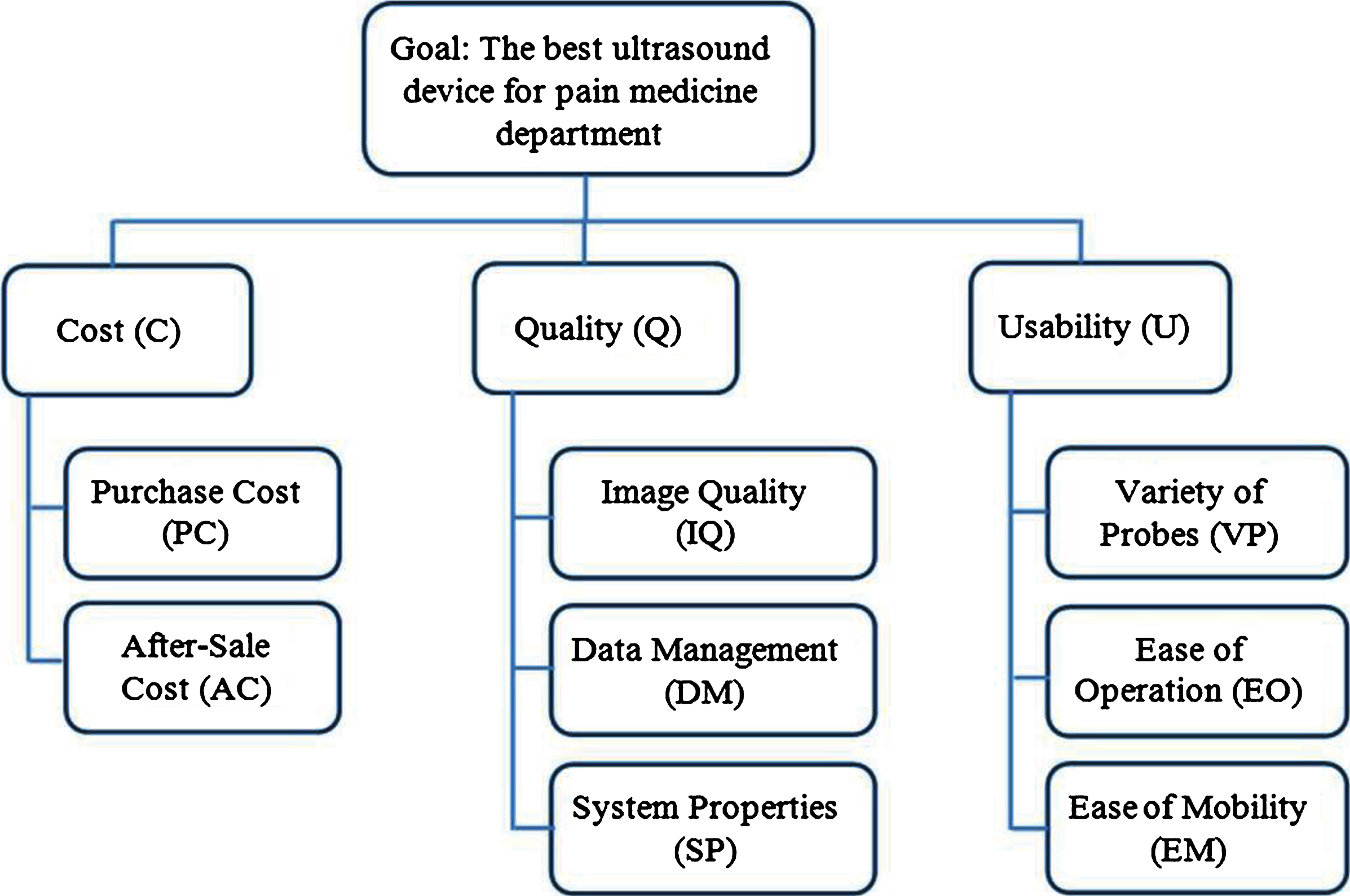
Hierarchical organization of the decision-making criteria
Taking a closer look at these criteria, “purchase cost” is probably the most easy-to-understand among all the others. “After-sale cost”, needs to be paid attention to as it may generate a considerable amount of money in case of need. As can be noticed by a careful reader, these two criteria can be defined by scalar representations. However, as physicians may not have exact knowledge of “cost” values, yet a coherent view is desired in this study, related data that are obtained from the field experts are used as linguistic values.
The first one among the quality related criteria is “image quality”, which is an important issue allowing experts to see the needle and anatomy in every patient, even in the obese. This avoids improper needle placementand increases confidence. “Data management” includes the documentation and connectivity possibilities. “System properties” define the specific properties of the device, including the frame rate, which is defined as the speed of frames generated by the device and effects the quality of image, screen properties, the technology used in the screen, the usability of the touchscreen and the screen size of the device, the number of digital channels that corresponds to the processing power that may cause poor image quality in case of low number of channels, etc.
The third group is related to the “usability” of the device by the experts. The first criterion is the “variety of probes”, which is important in terms of the differentiation of the applications. Different types of US probes have different properties, such as maximum display depth, which is related to image structures deep in the body and is important especially in obese patients and for deep tissues, and a feature for supporting high frequency probes, which helps to obtain better quality images in superficial tissues. This differentiation can cause significant differences during the operations and can be an important reason for preference. In the context of “ease of operation”, ergonomic design for ease of use in challenging environments and configurable presets including the device’s ability to obtain more ideal images for each operation using the already adjusted settings, quick opening-closing, auto-optimization, delivering contrast resolution, optimized spectral modes, automatic adjustments of the auto-depth according to the corresponding frequency, and focal zone position, for clarity throughout the near and far field are included. These properties make the system easy to use without many adjustments, which helps the expert focus on the patient rather than a complicated control panel and provide timely and effective pain blocking. “Ease of mobility” is mostly related to the portability and the weight of the device. This property is beneficial in facilitating access to patients in different clinics or operating rooms, whereas lighter devices are preferred for bedside procedures.
Alternatives of the study are also determined together with the field experts. Five different devices commonly used in many different pain centers have been considered as alternatives for evaluation. As the brands of these alternatives cannot be given due to ethical and legal obligations, they are named as Alternatives 1 to 5 throughout the solution procedure.
While constructing the design and system ranges with respect to the features of the devices, decision-makers are required to perform their evaluations using the semantics and syntax of the linguistic term set S1.
The scale for the linguistic terms
The design ranges for selecting the best US device, showing the FRs that should be satisfied by an ultrasound device, are defined according to the opinions and experience of the experts. Performance scores with respect to the criteria are given in Table 2.
Linguistic evaluations of experts with respect to the design range
Then these evaluations are converted into intervals using the transformation function E G H . The obtained envelops are presented in Table 3.
Obtained envelops for HFLTS with respect to the design range
Assigning the scale in Table 1 to the linguistic terms, P- and P+ values are calculated. For example, the pessimistic and optimistic values for “purchase cost” (PC) are calculated as follows:
Design ranges
Face-to-face interviews are conducted with the relevant field experts about the selection of US device for the department and five US device alternatives are determined. System ranges for alternative US devices are identified according to the opinions and experiences of the experts again. Performance scores are gathered from the experts and transferred into intervals. Obtained system range values with respect to the alternative devices are given in Table 5.
System ranges
Arriving at the last step of the solution procedure, information contents for all of the alternatives are calculated and presented in Table 6. According to these results, Alternative 1, having the minimum information content, emerges as the most appropriate alternative.
Information contents for alternatives
When the criteria used in the decision making phase are not equal in importance and the significance levels are different from each other, weighted fuzzy AD is preferred as an approach to use. In this approach, first, weights of the criteria are determined.
As is mentioned by Dong et al. [11], there are several approaches to obtain the attribute weights that can be classified into three categories: the subjective approach, the objective approach and the integrated approach, in which the decision maker is assumed to be honest, and aims to obtain “best” attribute weights to get a ranking of alternatives. In this study, the weights are obtained by asking the decision makers to make pairwise comparisons for criteria and sub-criteria. The semantics and syntax of the linguistic term set S2 are defined in the same manner as in Yavuz et al. [41] together with the hesitant linguistic term sets that are previously defined.
Field experts’ evaluations of the main criteria with respect to the goal are converted to envelops for HFLTS using the same manner in the previous section and related pessimistic and optimistic collective preferences are obtained and given in Table 7. Criteria weights are obtained by normalizing the midpoints of these intervals. These values are given in Table 8, representing the relative importance of each of the main criteria.
Pessimistic and optimistic collective preferences
Linguistic intervals and weights
Criteria and sub-criteria weights
In a similar fashion, same steps are repeated for all of the 8 sub-criteria with respect to each of the three main criteria and the criteria and sub-criteria weights given in Table 9 are obtained.
After determining the criteria weights, information contents for the criteria are calculated using Equation 5 and the results are given in Table 10.
Weighted information contents for alternatives
From the results in Table 10, Alternative 3, which has the minimum sum of the information content value, is determined as the best alternative. The results obtained with fuzzy AD and weighted fuzzy AD are summarized in Table 11. When the results from these tables are examined, it is seen that the ranking has changed. Based on this result, it can be said that, considering the weights of the criteria has an important and correcting effect on the result.
Results obtained by Fuzzy AD and Weighted Fuzzy AD
Taking a closer look at the data in Tables 6 and 10, it is possible to obtain secondary rankings of alternatives to be made on a criteria basis. Using such an examination, for example, according to the results obtained with fuzzy AD, although Alternative 3 comes into prominence in the “cost” and “usability” criteria, Alternative 1 is chosen to have the first priority in the overall evaluation. In addition to this, Alternative 5 is eliminated and ranked last, as it is not included in the design range for the “usability” criterion, irrespective of the other criteria. Similarly, looking at the results obtained with weighted fuzzy AD, Alternatives 4 and 2 have the smallest information content values in the “cost” and “quality” criteria, respectively. However, Alternative 3 has first priority in the overall evaluation.
When the ranking results are evaluated together with the experts; it is declared that systematic, logical, and consistent results have been achieved. These evaluations make it possible to see the effectiveness of AD HFLTS better.
This study focuses on the MCDM problems arising in our daily lives. In order to solve such problems, one needs the opinions of experts working in related areas. Furthermore, because of the fact that these experts may hesitate in deciding among different criteria or alternatives and may need better ways to express their knowledge, the opportunity to use HFLTS is proposed throughout their evaluations. As it may be better to choose the best suitable alternative instead of determining the best alternative to be chosen from a certain set of criteria, AD is used throughout the solution procedure.
First, the decision-making criteria are determined together with the field experts. Then the system and design ranges are composed in light of the hesitant evaluations. Following the steps of AD, the information for all of the alternatives are calculated and are listed regardless of the weights of the criteria. Then, the experts are asked to evaluate the criteria and related weights are obtained. In the second solution, the alternatives are sorted using these criteria weights.
The fact that the method used in the study is based on the difference between the system and the design ranges reveals an important difference between it and other MCDM techniques. On the basis of the results obtained from the sample problem, it can be seen that, when using AD, an alternative with a better ranking sequence for several criteria might be lower in the overall evaluation. Owing to this important feature of the method, there occurs a difference between the rankings obtained on the basis of the criteria and the final results obtained in both of the cases where the weights are taken into consideration or not. It is concluded that the final results are systematic, logical, and consistent when the calculated rankings are interpreted in consultation with the field experts. From this judgment, the effectiveness of the integrated method is once more visible.
Rodríguez et al. [28] stated the importance of the identification of real world decision situations in which the hesitancy produces uncertainty. As is mentioned before, obtained rankings are found to be better accepted than the solutions obtained with other type of information modeling by the field experts. Regarding the necessity of being more creative than simple and straight-away extensions of previous models for using hesitant information [28]; to the best of the authors’ knowledge, this is the first study to use fuzzy AD together with HFLTS and to apply this procedure to multi-criteria comparisons of a medical imaging system at a university hospital. Further research can be performed in different sectors as well. Besides, regarding to the recent progress in HFLTSs; strategic weight manipulation [11], dynamically changing sets of attributes and/or alternatives [10] can also be integrated into the solution approach that is proposed in this study.