



Abstract
Interval valued fuzzy c-means (IVFCM) clustering algorithm is one of effective clustering algorithms. When applied to image segmentation, IVFCM includes three problems as follows: (1) It is sensitive to the initial values of algorithm and may easily fall into the local optimal. (2) The algorithm is sensitive to the image noise and cannot obtain the satisfying performance on images corrupted by noise. (3) It always performs image segmentation under one objective function, therefore it cannot meet multiple practical needs. In order to address these problems, a multi-objective interval valued fuzzy clustering algorithm is proposed in this paper. This method constructs two novel interval valued fuzzy fitness functions which utilize the non-local spatial information of the image. Then a new mutation operator combining the interval valued fuzzy information of image is designed. Furthermore, an effective interval valued fuzzy cluster validity index using the non-local spatial information of image is presented to select a single solution from the non-dominated solution set. Experimental results show that the proposed method behaves well in noisy image segmentation.
Keywords
Introduction
Image segmentation, the key step from image processing to image analysis, is a technology and process that divides images into specific and unique regions and extracts the target of interest [1]. Existing image segmentation methods are mainly divided into the following categories: clustering algorithms [2–4], thresholding techniques [5], region-based approaches [6] and combination of some presented approaches [7]. Since 1998, researchers have been improving the existing image segmentation methods and applying some new theories and methods of other disciplines to image segmentation.
Among clustering algorithms, fuzzy c-means (FCM) clustering algorithm [8] is widely used for image segmentation and has been applied to various areas. However, for FCM and other fuzzy clustering algorithms, the fuzzy membership design includes various uncertainties (e.g., fuzzifier, prototypes, distance measure, etc.). To manage the uncertainty associated with the fuzzifier m, the fuzzy set is extended to an interval type-2 fuzzy set using two fuzzifiers m1 and m2 which creates a footprint of uncertainty for the fuzzifier m. Then the interval type-2 fuzzy set is incorporated into FCM to present interval type-2 fuzzy c-means (IT2FCM) approach [9]. In order to process the uncertainty of prototypes, a modified interval valued fuzzy c-means (IVFCM) clustering method was used in dealing with the interval-valued data in [10]. For the uncertainties of distance measure, D’Urso et al. [11] proposed to employ a robust metric based on the exponential distance in the framework of the fuzzy c-medoids clustering mode. However, when applied to image segmentation, FCM, IT2FCM and IVFCM methods encounter two problems. The first issue is that they are sensitive to the initial values of algorithms and easily fall into the local optimums. To solve the problem, Wang et al. [12] presented a global fuzzy c-means clustering algorithm (GFCM) which obtains better clustering results through a deterministic global search procedure. Furthermore, evolutionary algorithms such as genetic algorithm (GA) [13], simulated annealing (SA) [14], ant colony optimization (ACO) [15], and particle swam optimization (PSO) [16] have been successfully applied in fuzzy clustering methods. For example, a novel fuzzy clustering algorithm based on particle swarm optimization was proposed in [17] which achieves global optimized results and owns rapid convergence speed. The second problem is that FCM, IT2FCM and IVFCM algorithms are sensitive to image noise owing to the fact that these methods do not take the spatial information of images into consideration. In order to address this issue, many researchers introduced the image spatial information into the objective functions of fuzzy clustering methods [18–21]. For FCM, Ahmed et al. [18] modified the objective function of FCM by incorporating a local spatial neighborhood term and proposed FCM algorithm with spatial information (FCM_S). To reduce the computational complexity, Chen and Zhang [19] evaluated the neighbor of each pixel in a pre-filtering step before performing the FCM clustering. They denoted the methods using the neighborhood mean values and median values of the pixel by FCM_S1 and FCM_S2, respectively. In [20], a weighted image patch-based FCM (WIPFCM) algorithm was proposed by using image patches to replace pixels and constructing a weighting scheme to calculate the weights of pixels in each image patch. For images heavily contaminated by noise, the local spatial information cannot obtain satisfying segmentation performance. Therefore, Zhao et al. [21] introduced the non-local spatial information derived from a large image domain of the pixel to construct the spatial constraint term and proposed a fuzzy c-means clustering algorithm with non-local spatial information (FCM_NLS). For IT2FCM, Qiu et al. [22] proposed a modified interval type-2 FCM clustering algorithm which utilized two fuzzifiers and a spatial constraint on the membership functions of IT2FCM to remove image noise.
Various algorithms like FCM, IT2FCM, FCM_S, FCM_NLS, WIPFCM, etc. have been used for the purpose of image segmentation, but most of them use a single objective function to be optimized, which is not equally applicable to all kinds of data sets and cannot meet diverse segmentation needs. To solve this problem, researchers proposed many multi-objective clustering approaches [23, 29] which optimize multiple validity measures simultaneously. In [23], two cluster validity measures, J m [24] and Xie-Beni (XB) [25] indexes were optimized at the same time. However, there is a problem that these two validity measures are not completely independent to each other, which may not obtain the good Pareto-optimal solutions. Based on this work, Mukhopadhyay et al. [26] utilized three cluster validity measures including J m , XB, and PBM [27] as the objective functions. The number of clusters in these methods mentioned above was specified in advance. For the method in [28], it used a variable string length coded strategy to encode cluster centers, so that the number of clusters could be automatically evolved. In addition, two objective functions, global fuzzy compactness and fuzzy separation, were optimized simultaneously and a validity index I [29] was used to obtain a single solution from the final non-dominated solution set.
When applied to image segmentation, interval valued fuzzy clustering algorithms suffer from high sensitivity to noise and initial values. To overcome these shortcomings and obtain satisfactory segmentation performance by optimizing multiple clustering criteria simultaneously, in this paper, we propose a multi-objective interval valued fuzzy clustering algorithm (MIFCA) for image segmentation. In this algorithm, the non-local spatial information derived from the image has been introduced into two completely independent interval valued fuzzy fitness functions viz., global interval valued fuzzy compactness function and interval valued fuzzy separation function, which are optimized simultaneously. Moreover, to overcome premature convergence and maintain the diversity of the population, we design a novel interval valued fuzzy mutation operator utilizing the vagueness and uncertainty of the image. In the final generation, a Pareto-optimal non-dominated set of solutions is produced and it is necessary to choose a single solution from thenon-dominated set. So, an interval valued fuzzy cluster validity index incorporating the non-local spatial information derived from the image is used to select a particular solution. In the experiments, we compared our algorithm with seven other methods, viz. FCM, FCM_S1, IT2FCM, IVFCM, IFCM [30], MOVGA [28] and MSFCA [31] on a synthetic image, some Berkeley segmentation images and MR images contaminated by noise. The experimental results show that MIFCA behaves well in noisy images segmentation.
The remainder of the paper is organized as follows. In Section 2, we present the IVFCM clustering algorithm. Our proposed MIFCA method is described in Section 3. In Section 4, experimental results are presented. Finally, some concluding remarks and discussions are drawn in Section 5.
Interval valued fuzzy c-means clustering algorithm
The IVFCM clustering algorithm is a suitable extension of the standard FCM algorithm. It performs a fuzzy partition and a prototype for each cluster by optimizing the following objective function based on a suitable squared Euclidean distance between vectors of intervals:
Chromosome representation and population initialization
In MIFCA, each chromosome is made up of several interval real numbers which represent the cluster centers. For example, the pixel x
k
can be expressed as
If chromosome i encodes the centers of C i clusters in d-dimensional space, then its length l i is 2 × C i × d, where C i = max {2, rand () % C*}, rand() is used to produce a random integer and C* is the upper limit of the cluster number. Therefore, the number of clusters will change from 2 to C*. For example, the chromosome i encoding three cluster centers in two-dimensional space is represented in Fig. 1. Each center is considered to be indivisible.

Chromosome representation.
In MIFCA, an interval valued fuzzy separation function S
I
and a global interval valued fuzzy compactness function with non-local spatial information C
IN
are constructed as two fitness functions to be optimized simultaneously. Before calculating these two fitness functions, the cluster centers V = {v1, v2, ⋯ , v
C
} encoded in the chromosome should be firstly decoded. The fuzzy membership function between
Then the global interval valued fuzzy compactness function C
IN
is computed as Equation (9).
Another fitness function is the interval valued fuzzy separation function S
I
which is computed by Equation (10).
In MIFCA, crowded binary tournament selection method [33] is used to generate the mating pool of chromosomes. The conventional binary tournament method along with a crowded comparison technique is used in this method.
When applying the Laplace crossover operator [34] for crossover, the cluster centers are considered to be indivisible, i.e., the crossover points can only lie in between two cluster centers. Suppose that p
c
is the crossover probability, and the Laplace crossover operation works between two parent chromosomes. If
In the genetic algorithm, the mutation operator can generate new chromosomes and increase the diversity of the population. The design of the mutation operator mainly involves two aspects: the first aspect is the determination of the mutation location, and the second aspect is the determination of the gene value. For the traditional mutation operator, the mutation location is generally set as a single-valued data. The determination of the gene value is generally using a random number to guide the mutation or replace the original gene value. However, these traditional mutation operators do notmake full use of the interval valued fuzzy information of the image to guide the mutation operation, so that the performance of traditional genetic algorithms is not perfect. In order to solve this problem, we modify the traditional Poisson mutation operator [35] and propose an interval valued fuzzy Poisson mutation operator that uses the degree of hesitation to guide the mutation. If the ith cluster center
As we know, in order to maintain a better spread of non-dominated solutions from the parent and child populations, the elitism operation is used to propagate the non-dominated solutions among the parent and child populations to the next generation.
Optimal solution interval valued fuzzy cluster validity index using the non-local spatial information
To choose a particular solution from the set of non-dominated solutions produced by the final generation, an interval valued fuzzy cluster validity index is constructed by using the non-local spatial information and is defined as Equation (15).
In this section, the procedure of the proposed method is presented as follows:
Experimental results and analysis
To evaluate the performance of the proposed algorithm, we compare MIFCA with seven existing algorithms, namely FCM, FCM_S1, IT2FCM, IFCM [30], IVFCM [10], MOVGA [28] and MSFCA [31], and apply these methods on synthetic images, real images and MR images in this section. Moreover, the clustering accuracy (CA) [36] is adopted to evaluate the performance of algorithms. In these methods, MOVGA, MSFCA and MIFCA can automatically evolve the number of clusters. The other algorithms are performed under different number of clusters ranging from 2 to C*, where C* is the maximum cluster number.
For all the algorithms, the fuzziness index m is set to 2. For FCM, FCM_S1, IT2FCM, IFCM and IVFCM, the maximum iteration number T of and the stopping threshold ɛ are set to 100 and 10–5, respectively. According to the experimental analysis in [21], the search window size r × r, the patch size s × s and the filter degree parameter h for non-local spatial information are set to 21×21, 7×7, and 30 for MSFCA and MIFCA. For FCM_S1, MSFCA and MIFCA, the spatial constrained parameter β controlling the penalty effect of the spatial constraint term in the objective function is set to 6 [37]. For MOVGA, MSFCA and MIFCA, the number of generationG and the population size P are set to 100 and 50according to the experimental analysis in [23]. The crossover probability p c and the mutation probability p m are set to 0.9 and 0.1 for MOVGA, MSFCA and MIFCA.
Experiments on synthetic images
In this section, a synthetic image of size 256×256 is used to test the efficiency and robustness of all the comparative algorithms. Gaussian and Salt & Pepper (S&P) noise are added to this image, respectively. Figure 2 shows the segmentation results of all the algorithms on the Gaussian noisy image. FCM, IFCM, IT2FCM, IVFCM and MOVGA cannot overcome the sensitivity to noise due to not considering any spatial information. FCM_S1 improves the segmentation result to some extent due to the introduction of local spatial information. However, there are some wrongly classified pixels in the segmentation result. MSFCA and MIFCA can remove the most noise and obtain the better performance and obtain the same CA value. Figure 3 presents the segmentation results of all the algorithms on the S&P noisy image. It is clearly illustrated in Fig. 3(b-h) that FCM, FCM_S1, IFCM, IT2FCM, IVFCM, MOVGA and MSFCA are all influenced by the S&P noise, which indicates that these methods lack enough robustness to the noise. Figure 3(i) shows that the proposed MIFCA obtains better segmentation result than other algorithms.

Segmentation results on the synthetic image corrupted by the Gaussian noise (0, 0.01). (a) noisy image, (b) FCM (CA = 0.9565), (c) FCM_S1 (CA = 0.9985), (d) IFCM (CA = 0.9557), (e) IT2FCM (CA = 0.9536), (f) IVFCM (CA = 0.9553), (g) MOVGA (CA = 0.9549), (h) MSFCA (CA = 0.9999), (i) MIFCA (CA = 0.9999).
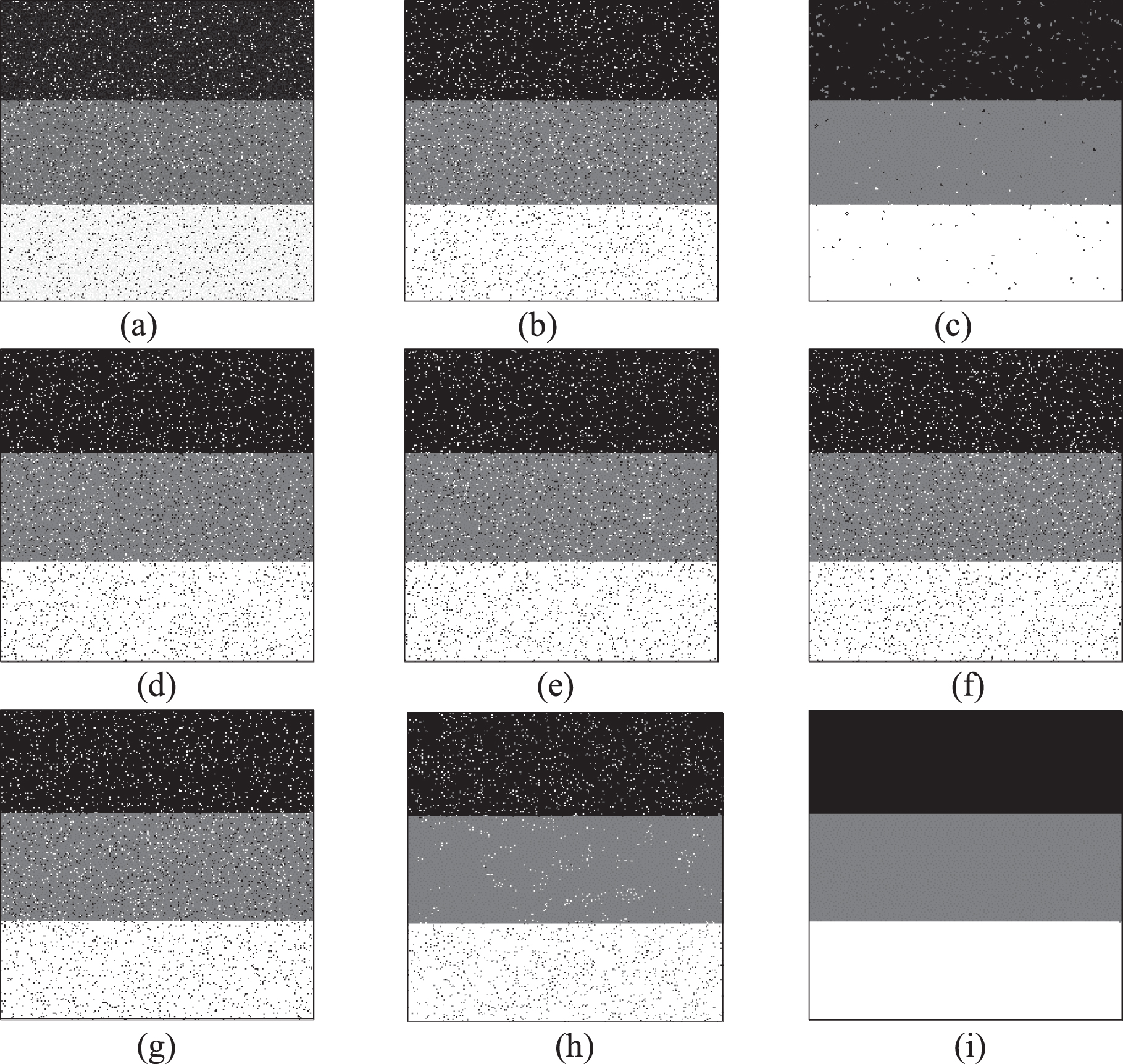
Segmentation results on the synthetic image corrupted by the S&P noise (0.1). (a) noisy image, (b) FCM (CA = 0.9324), (c) FCM_S1 (CA = 0.9871), (d) IFCM (CA = 0.9328), (e) IT2FCM (CA = 0.9324), (f) IVFCM (CA = 0.9321), (g) MOVGA (CA = 0.9339), (h) MSFCA (CA = 0.9619), (i) MIFCA (CA = 0.9999).
To prove the performance of the proposed algorithm, FCM, FCM_S1, IFCM, IT2FCM, IVFCM, MOVGA, MSFCA and MIFCA algorithms are evaluated on seven real images selected from the Berkeley Segmentation Dataset [38]. Table 1 gives the CA values of eight algorithms on these seven images corrupted by Gaussian and S&P noise with different levels, respectively. It is clearly illustrated that the proposed MIFCA obtains the higher segmentation accuracy than other algorithms and presents more robust to different noise.
Comparison of these eight methods on Berkeley images corrupted by Gaussian noise and S&P noise
Comparison of these eight methods on Berkeley images corrupted by Gaussian noise and S&P noise
In order to visually compare the performance, the segmentation results of all methods on images #3096 and #101027 are presented in this section. The original images and their benchmarks are shown in Fig. 4. The segmentation results of these two images are shown in Figs. 5–8. It can be seen from the results that FCM, FCM_S1, IFCM, IT2FCM, IVFCM and MOVGA lack enough robustness to the noise in images. Although MSFCA can obtain the betterperformance, its segmentation results still contain noise. It is clear that MIFCA provides excellent segmentation results for these images.

Original images and their benchmarks. (a) original image of #3096, (b) original image of #101027, (c) benchmark image of #3096, (d) benchmark image of #101027.
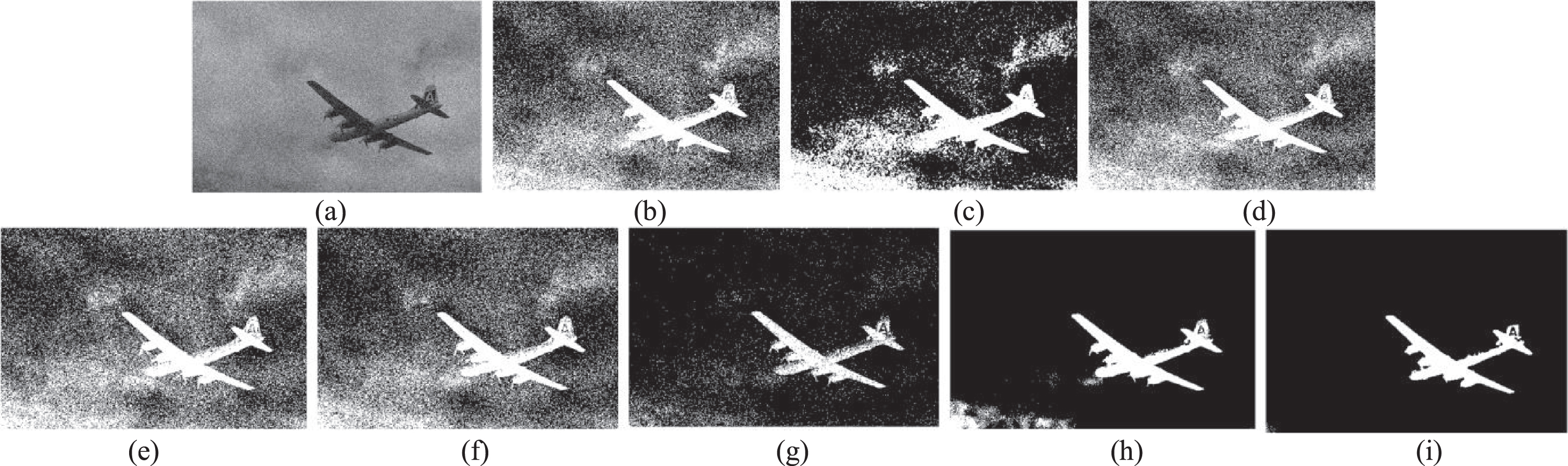
Segmentation results on the image #3096 corrupted by the Gaussian noise (0, 0.01). (a) noisy image, (b) FCM, (c) FCM_S1, (d) IFCM, (e) IT2FCM, (f) IVFCM, (g) MOVGA, (h) MSFCA, (i) MIFCA.
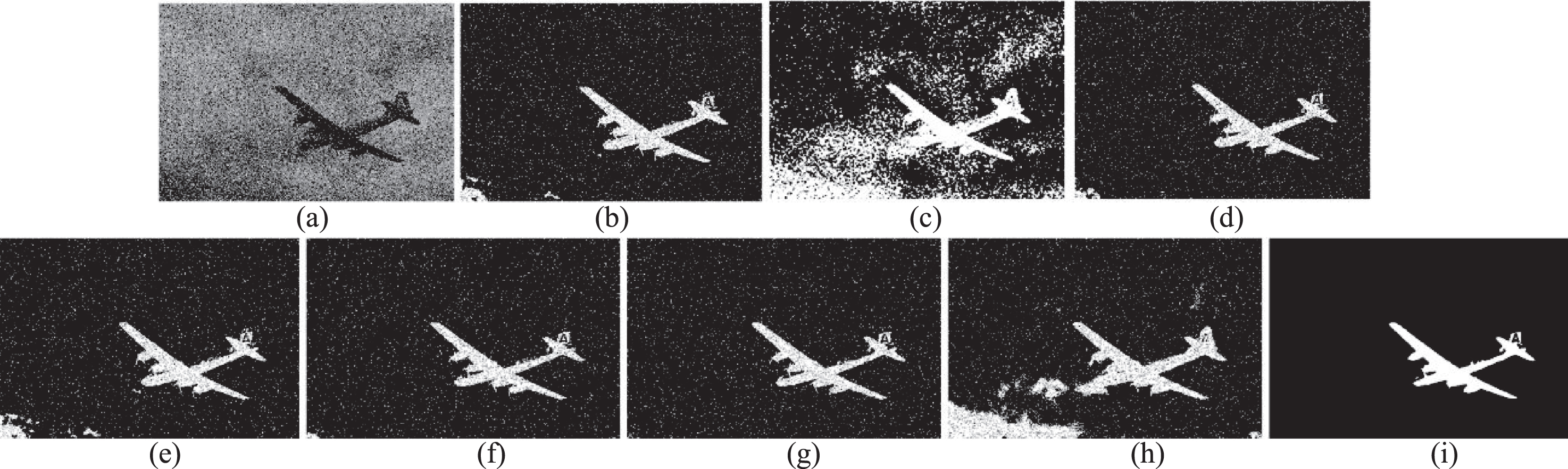
Segmentation results on the image #3096 corrupted by the S&P noise (0.1). (a) noisy image, (b) FCM, (c) FCM_S1, (d) IFCM, (e) IT2FCM, (f) IVFCM, (g) MOVGA, (h) MSFCA, (i) MIFCA.
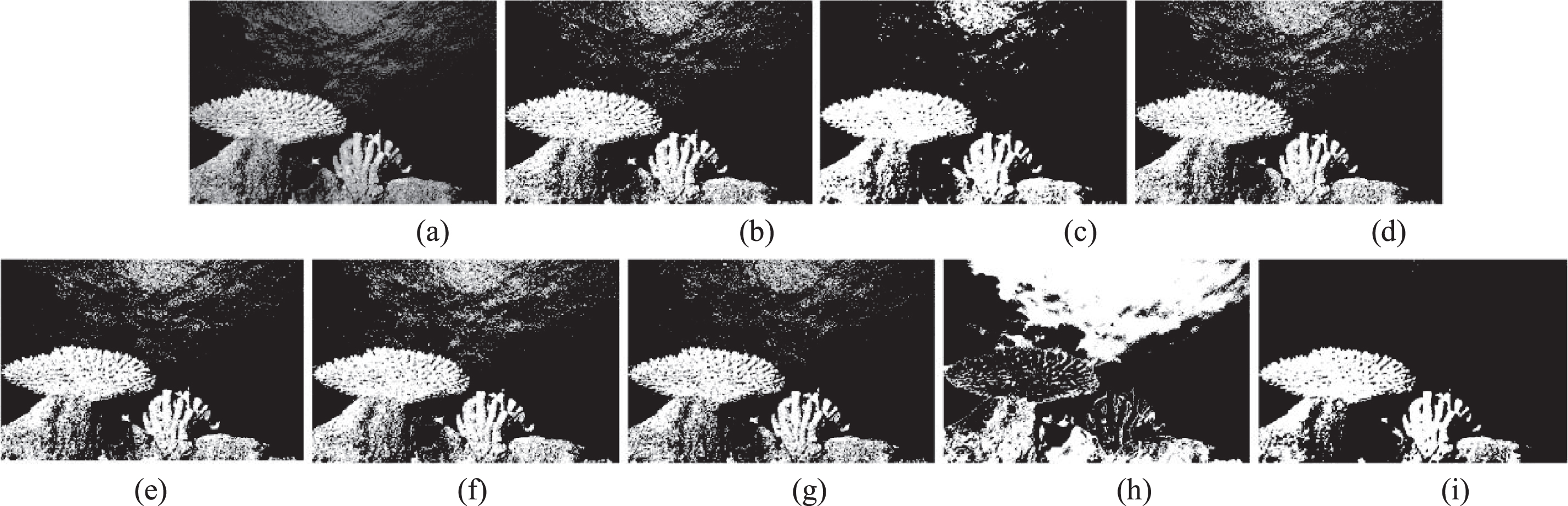
Segmentation results on the image #101027 corrupted by the Gaussian noise (0, 0.025). (a) noisy image, (b) FCM, (c) FCM_S1, (d) IFCM, (e) IT2FCM, (f) IVFCM, (g) MOVGA, (h) MSFCA, (i) MIFCA.
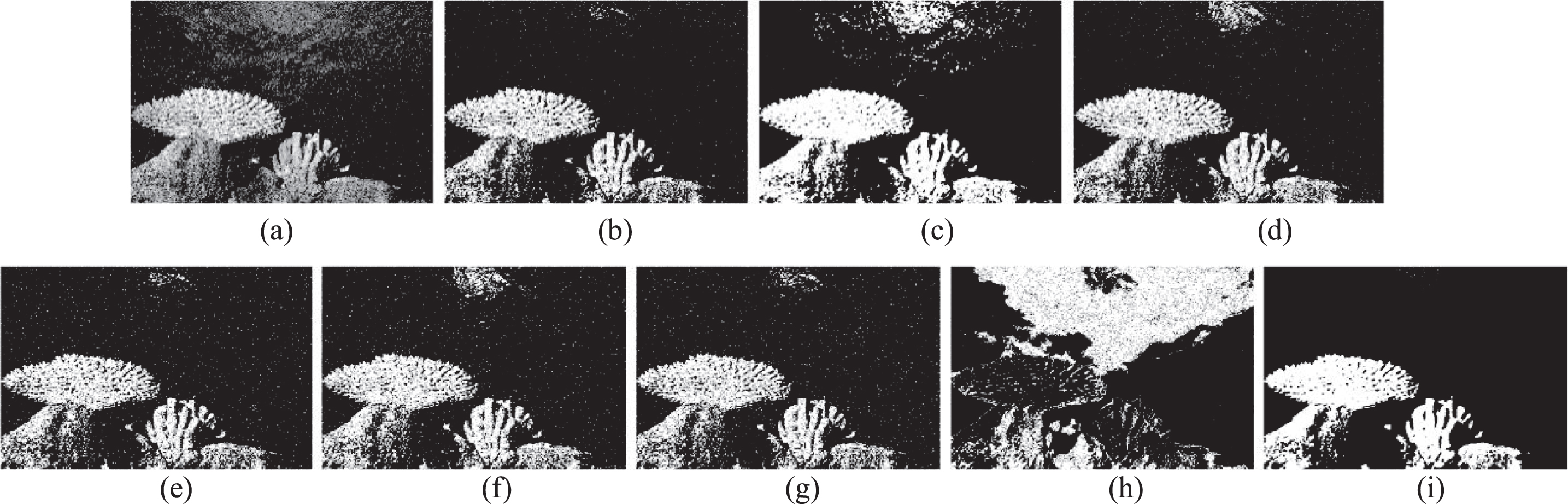
Segmentation results on the image #101027 corrupted by the S&P noise (0.1). (a) noisy image, (b) FCM, (c) FCM_S1, (d) IFCM, (e) IT2FCM, (f) IVFCM, (g) MOVGA, (h) MSFCA, (i) MIFCA.
Image segmentation plays a key role in medical image processing and analysis. To demonstrate the superiority of MIFCA, twenty brain MR images are selected from the Internet Brain Segmentation Repository (IBSR) [39] and their corresponding CA results of all methods are presented in Table 2. Except for the slice 20 of 7-8 and the slice 19 of 11-3, MIFCA obtains the highest CA values among all comparison methods. Moreover, the segmentation results of two brain images of different people (1–24 and 6–10) are selected to show the visual segmentation performance and shown in Figs. 9 and 10. Due to the number of clusters given in advance, the results of FCM, FCM_S1, IT2FCM, IFCM and IVFCM can be accepted. MOVGA obtains the incorrect number of clusters on slice 40 of 1–24. Moreover, MSFCA classifies the white matter region and gray matter region into one class on slice 12 of 6–10. For all the images, the proposed MIFCA can evolve the correct cluster number and obtain the best performance in the edge details of images.
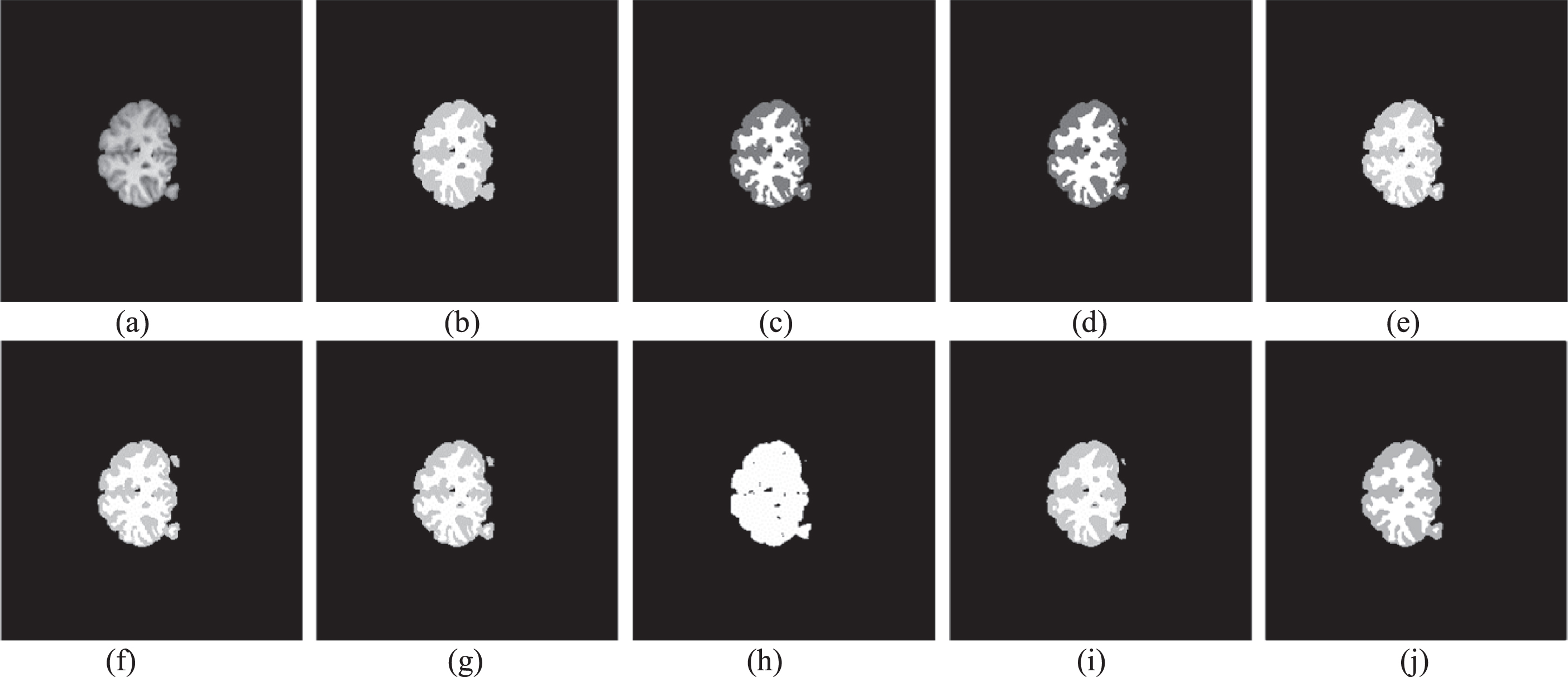
Segmentation results on the slice 40 of 1–24. (a) original image, (b) benchmark image, (c) FCM, (d) FCM_S1, (e) IFCM, (f) IT2FCM, (g) IVFCM, (h) MOVGA, (i) MSFCA, (j) MIFCA.

Segmentation results on the slice 12 of 6–10. (a) original image, (b) benchmark image, (c) FCM, (d) FCM_S1, (e) IFCM, (f) IT2FCM, (g) IVFCM, (h) MOVGA, (i) MSFCA, (j) MIFCA.
Comparison of these eight methods on brain images
In this article, we have proposed a multi-objective interval valued fuzzy clustering algorithm (MIFCA) to solve problems of fuzzy clustering. In order to increase the resistance to noise, MIFCA introduces the non-local spatial information derived from the image into the interval valued fuzzy fitness functions to be optimized. Moreover, interval valued fuzzy information is introduced into the new mutation operator to increase the efficiency of mutation. In order to select a solution from the non-dominated solution set, an effective interval valued fuzzy cluster validity index is constructed by utilize the non-local spatial information and the interval fuzzy information.
The construction of interval valued fuzzy sets for the image is the key procedure in the proposed method. How to construct the more robust interval valued fuzzy sets is a meaningful research. Moreover, we will discuss the construction of fitness functions incorporating the spatial information in our future work.
Footnotes
Acknowledgments
This work is supported by the National Natural Science Foundation of China (Grant Nos. 61571361, 61671377, 61202153, and 61102095), New Star Team of Xi’an University of Posts & Telecommunications (xyt2016-01), the Fundamental Research Funds for the Central Universities (Grant No. GK201903092).