



Abstract
Employee performance evaluations are one type of decision-making process that is embedded with uncertainty and ambiguity before concluding the final index. After reviewing different approaches to achieving such target, this paper introduces the implementation of fuzzification mechanism termed as “Fuzzimetric Sets” as a method of defining the minimum and maximum tolerance possibilities within pre-defined fuzzy sets. Decision-making evaluation process would be dependent on the inferred minimum to maximum defuzzified differences (spectrum). Based on this concept, a prototype was built to measure the employee performance level allowing much more flexibility when taking a decision under uncertainty. This application was termed as “Fuzzimetric Employee Evaluation System” (FEES). Comparative study of FEES was done by comparing the results of the work of another researcher investigated the same field of Fuzzy-employee-evaluation.
Introduction
As Sustainability of any business is highly dependent on human resources as well as the effective management of these resources. Employee performance measurements are needed in this case by managers running the organization to meet the organizational objectives and enhance employee performance. Such measurements can be the basis of a successful appraisal process and can lead to better employee motivation. Many researchers have previously looked into the benefits of effective performance appraisal techniques. For example, Klein et al. [1] proposed an appraisal model adapted from the theory of open systems. Toppo et al. [2] studied the evolution of appraisal systems with typical criticism of these systems. The problem with Performance Appraisal (PA) meetings in companies is that the employee and often manager(s) conclude that the output of the meeting determines the rate of employee salary increase. This is an incorrect perspective of PA where the focus should be the skill development to become a more effective employee and to recognize the weaknesses in employee performance compared to available resources. Using technology to build systems based on fuzzy logic can enhance the performance management process. Obviously, such systems should be flexible enough to be configurable as desired by an individual company where the company might have different objectives to be aligned with employee performance. Making such systems configurable as per company strategies and goals as well as available to the public for employee usage can motivate employees to clarify the link between the goals and how to achieve them. Employees can then work to achieve those goals, and they may use such systems to experiment with “what-if” scenarios on how to perform better in any specific period of time. Some of the rating factors can be automated by the system, as well. For example, lateness or absence can be easily automated, and such attribute values can be automatically inserted without human intervention, hence reducing the possibility of biases by performance evaluators.
Moreover, as it is important to have executive support for an effective system. Appraisals should be documented on all corporate levels, not only the lower operational layer. In this sense, such a system can be linked to a strategic management summary report. Few researchers attempted to develop a performance management infrastructure using fuzzy logic. For example, Yeh et al. [3] developed a multi-criteria fuzzy analysis approach to measure the performance of public transport systems where multiple criteria and multi-decision alternatives are involved. Beheshti et al. [4] developed a generic decision-making model with illustrated implementation for employee performance appraisals.
Non-fuzzy quantitative techniques can be utilized in some cases; however, most employee evaluation decision-making processes are subjective in nature, and the element of “fuzziness” is inevitable when measuring employee performance. A fuzzy inference model can help where employee performance is measured in the same pre-defined manner using the rated performance as input.
Hence, this paper introduces the use of fuzzy logic to infer the final employee performance level based on various vague input variables. Fuzzy logic for employee performance has been researched before by Ahmed et al. [5] in which 20 different attributes were identified as inputs to the fuzzy inference system. One output is the index representing the employee evaluation result. A hypothetical example was used to illustrate the mechanism of the fuzzy system when measuring employee performance. After describing the proposed Fuzzimetric sets and the adopted modular approach, a prototyped application was developed and data comparison between the proposed technique with that of Ahmad et al. [5]. It should be noted that Ahmad et al. [5] study was based on MATLAB implementation which is built on the principle of Mamdani-Sugeno fuzzy logic. Accordingly, this paper implicitly studies a comparative analysis of the proposed system as opposed to the Mamdani-Sugeuno mechanism. The results show more flexibility in decision making when using the proposed application which is termed in this paper as “Fuzzimetric Employee Evaluation System” (FEES). Unlike Mamdani-Sugeno mechanism, this flexibility stems from the fact that Fuzzimetric sets allows defining multiple alternatives (minimum and maximum) for each set and hence producing a possible spectrum as a defuzzified output of the proposed system.
Hence, Fuzzimetric sets can be viewed as one type of multisets where the minimum and maximum “sets” can be defined to generate a spectrum of the solution. As it can be an analogy to multisets principles, then the generalization of similar principles of Atanassov’s Intuitionistic fuzzy sets [6] as well as Torra’s Hesitant fuzzy sets [7] can also be utilized as similar models of decision making under uncertainty. The full consideration of Intuitionistic and hesitant fuzzy sets to model the uncertainty of employee evaluation is beyond the scope of this paper but it will be highlighted as part of the future research section. The next section of this paper will review the evolution of “Fuzzimetric sets” inclusive of the reasoning need for the proposal as well as the view of the possible use of fuzzimetric sets as part of type-2 and hesitant fuzzy sets. Section 3 discusses the fuzzy inference using the modular structure which is used as part of the proposed Fuzzimetric Employee Evaluation System (FEES). In Section 4, details of FEES with the modular structure as opposed to Ahmad’s et al. [5] is presented with a discussion of comparative results of the study. Lastly, the conclusion (Section 5) highlights the lessons learned from this study as well as the futuristic view of the possible implementation of other techniques like Hesitant fuzzy sets in modeling similar problems of uncertainty.
Evolution of the concept of fuzzimetric sets
Trigonometric-based fuzzy sets using fuzzimetric arcs
Most decision-making processes in management fields can be “fuzzy” in nature. Fuzzy logic is a theory initially proposed by Zadeh [8] that can address uncertainty when making a decision. Fuzzy logic is based on an extension of set theory where a member can have gradual membership in a specific set instead of an abrupt membership of either zero or unity membership as in traditional set theory. This principle can be extended to define sets in the universe of discourse and can be defined as P0 (Positive Zero), PS (Positive Small), PM (Positive Medium) and PB (Positive Big). Assuming a sinusoidal function, these representations can be defined in an analogy to trigonometric functions with an exception of taking the absolute values only. Hence, the definition of “Fuzzimetric Arcs” KOUATLI [9] with the different defined fuzzy variables (P0, PS, PM, and PB) is presented. Figure 1 shows a representation of these trigonometric-based fuzzimetric sets. Hence, accordingly, the following formulae are formal initial definitions of these four fuzzimetric sets.
(a) Positive Fuzzimetric Arc. (b) Spread of different fuzzy variables on the Universe of discourse.
Although defined with the trigonometric principle, these fuzzy sets do not have to be sinusoidal in shape, they can be triangular, trapezoidal, etc. The system researcher decides the definition of the fuzzy set shape where the most suitable shape is applicable to the specific application.
More details of fuzzy sets and the use of this concept for decision-making processes in a manufacturing environment can be found in Kouatli [10], where a robotic example was taken as a vehicle for a step-by-step explanation of inference using fuzzy sets. Adaptation of these fuzzimetric sets to the desired fuzzy set shape can be handled via two different operators: Mutation and Crossover as will be explained in the next two sub-sections.
After defining the initial fuzzy set shape using Fuzzimetric Arcs, then selection of the required fuzzy set shape can be defined using formula (5) (assuming μ is set to 1 in case the value is greater than 1.
Where the fuzzy variable is any of PO, PS, PM or PB. The T parameter is the shape alternation factor (Mutation factor) with the most active range of 0≤ T ≤270°.
Hence any fuzzy set shape other than sinusoidal (e.g. Triangular, Trapezoidal) can be achieved by implementing this formula to mutate the initially defined fuzzy sets based on Fuzzimetric Arcs. Accordingly, Equations 1–4 can be mutated using the following formulae:
Figure 2 shows an example of a mutated form of PS and PM by setting the mutation factor to the appropriate value. For example, a value of 90 would result in Triangular fuzzy sets, and a value of 60 would result in a trapezoidal form while values above 90 would result in a set with the highest membership less than one. The most significant active range of mutation factor T would be between 0<T<270.
TPS= 90, TPM= 60.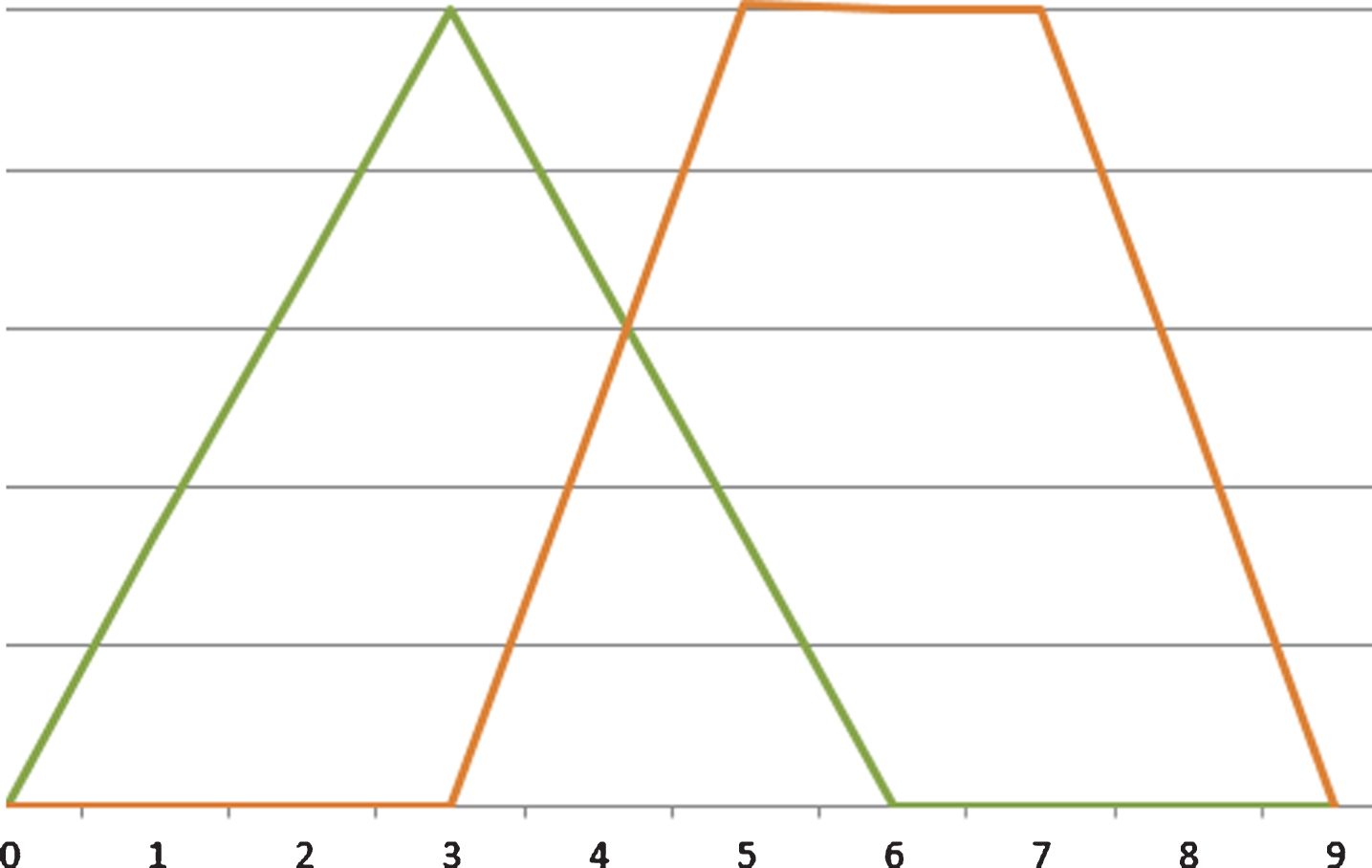
Mutation factor T described in the previous subsection can be used in part of the fuzzy set instead of the whole fuzzy set. Splitting the fuzzy set into two halves, each of which uses a different value of mutation factor “T” would generate a cross-over of these two halves by mutating them individually. Equations 6–9 can be implemented for each of the halves independently to achieve a variety (flexibility) of different fuzzy set shapes. This can be simply accomplished by changing the left and right parts of the mutation factors “T” for each set. Centroid of the fuzzy set can accordingly be shifted from left to right as desired by altering mutation factors. Optimization of the most suitable “T” value would also be possible by training the data to identify the best value of “T” in a specific situation. In some cases, optimization can replace rule-set tweaking for best performance as the fuzzy system can be tweaked by altering the centroid of the set instead of altering the rules of the system. Figure 3 shows an example of two sets PS and PM mutated with crossover wherein part (a) shows PS with minimum effective centroid and a closer to the high-end PM tolerance. While in Part (b) shows the Maximum effective possibility of PS centroid and an arbitrary value of PM centroid closer to the minimum value.
Example of mutated and crossed-over fuzzimetric sets.
After decades of fuzzy-type-1 development with successful applications, Fuzzy Type-2 sets emerged in many industrial fields to enhance the “Fuzziness” ability to address uncertainty in systems. The only apparent issue with the Fuzzy Type-1 approach proposed by Zadeh [8] was that the definition of the fuzzy sets was not “fuzzy.” Although fuzzy sets addressed system uncertainty, discretization of the fuzzy sets themselves was not fuzzy; however, a certain specified membership value for each member in the fuzzy variable existed. To rectify this issue, Zadeh [11] proposed type-2 fuzzy sets defined as fuzzy sets with membership grades of type-1 fuzzy sets in the range of [0, 1]. Type-2 fuzzy sets are obviously much more advanced in terms of the fuzzy system performance and flexibility where uncertainty in system variables is high. The applications of Type-2 fuzzy sets were limited due to the complexity of designing such a system. Hence, fuzzy set type-2 applications were not as popular as type-1 fuzzy sets. To avoid complexity, Coupland et al. [12] for example, proposed computational geometry representations for type-2 fuzzy sets, which reduce calculation complexity by a special type of discretization method. Liu [13] also studied the latest proposal of fuzzy type-2 representation where an α-plane representation of type-2 fuzzy sets used for centroid computation was proposed to reduce computational complexity. Zhao et al. [14] studied the axiomatic definitions of general type-2 fuzzy similarity and inclusion measures based on type-2 fuzzy sets where two new general type-2 fuzzy similarity and inclusions were proposed and discussed. Although it is not the objective of this paper to discuss the implementation of “Fuzzimetric sets” as a mechanism to represent type-2 fuzzy sets, this paper shows the flexibility of Fuzzimetric sets as the output represented by a spectrum rather than one specific defuzzified value. This facility is valid only by introducing the mutation and crossover operations using the mutation factors as explained in previous sub-sections. Hence, Fuzzimetric Sets can bridge the gap between the “un-fuzzified” type-1 fuzzy sets and the type-2 fuzzy sets.
How can fuzzimetric sets be viewed?
As it can be seen from the previous review of “Fuzzimetric sets”, the key features would be 1) the fact that it is based on trigonometric functions rather than piecewise arithmetic functions and 2) the crossover and mutation operations of fuzzimetric set allows changes in the shape of fuzzy set which can be used as part of optimization by manipulating the mutation factor “T” (described in equation 5). These features allow flexibility on how fuzzimetric sets can be viewed (and used).
Fuzzimetric sets use as traditional type-1 fuzzy sets
Fuzzimetric Arcs main intention was to achieve a systematic approach of discretization of the universe into fuzzy sets and a mechanism for defining the desired fuzzy set shape [9]. Rather than an arbitrary definition of fuzzy sets, a systematic approach by using a trigonometric based fuzzy set (Sine wave) which can also be mutated to triangular or trapezoidal fuzzy sets as described in the previous section. Mutation factor “T” (in equation 5) can be used for the desired shape of the fuzzy set which also allows a maximum value of membership to be less than unity. This can be useful as an analogy to the alpha cut in arithmetic based fuzzy sets.
Fuzzimetric sets use as type-2 fuzzy sets
In response to the rectification of the traditional type-1 where the fuzzy set itself “is not fuzzy”, mutation and crossover operators of fuzzimetric sets can be utilized to accommodate this concept. This can be conducted by allowing a controlled upper and lower limit for each fuzzy set where the fuzzy set membership values are allowed to float randomly between these upper and lower limits in the vertical direction as well as the ability to specify the level of interval to change the fuzzy set horizontally allowing a change of centroid from left to right and accordingly, the numerical decision (weighted average) level would change. Full details can be found in [15].
Fuzzimetric sets use in Intuitionistic fuzzy sets (IFS)
In parallel to the development of Type-2 fuzzy sets, Intuitionistic Fuzzy Sets (IFS) started to emerge when it was first introduced by Atanassov [6] as a more generalized extension of Zadeh’s original “Fuzzy sets”, however, unlike fuzzy sets, the members of IFS have levels of membership and non-membership values where the addition of these membership values would be less than or equal to 1. This was the emergent of what is termed as “multisets” implementation towards solving the uncertainty problems using fuzzy sets. The mathematical notation can be defined as:
Where
μA (x), v (x): X → [0, 1] are the degree of membership and non-membership in A respectively & where 0 ≤ μA (x) + v (x) ≤1.
Instead of defining two sets of membership and non-membership, fuzzimetric sets can be designed to define two sets (multisets), the first would be the minimum tolerance of acceptability and the other set would be the maximum tolerance of acceptability which can be defined using the crossover and mutation operators on ‘Fuzzimetric sets”. In doing so, a spectrum of acceptability can be generated.
Based on the definition of IFS, the hesitation margin can be measured as:
In such cases, Hesitant fuzzy sets do not only measure the uncertainty level but can be utilized to measure more linguistic terms like “Similarity”, “Hesitation”, “Domination” … etc. definitions of these terms are usually dependent on the distance measurement between boundaries of sets. Hesitant fuzzy sets were first introduced by Torra [7] and heavily researched by Dong et al. [16, 17], Xu et al. [18–20], Wu et al. [21] and Li et al. [22, 23] as part of dealing with linguistic uncertainty in group decision support systems. The application described in this paper can be viewed as an automated decision-making system using fuzzimetric sets to deal with uncertainty, but it can also be viewed as group decision-making problem under uncertainty and hence such studies can be relevant in this case where the hesitation distance needs to be measured. Moreover the consensus model of hesitation can also be beneficial when concluding the final output as described in [24, 25]. Hesitation consensus model was also utilized in social network group decision systems [26, 27] where hesitation measure of “social distance” used in such analytics. In a similar manner to IFS, Fuzzimetric sets can help towards defining the hesitation boundaries by specifying minimum and maximum tolerances of each predefined boundaries set in the universe of discourse.
After the initial introduction by Zadeh [8, 28] and the theory of fuzzy logic, Mamdani [29] utilized the theory to build an inference system based on fuzzy logic to control a steam engine using linguistic control rules in a form of “If A AND B then C.” The objective was to simulate an experienced human operator controlling such tasks where the system input was the fuzzified value of the crisp input and the output of the system was also a fuzzy set. Sugeno [30] used a similar technique to Mamdani with the main difference in the output where the final output was de-fuzzified to a crisp value using an averaging technique. Looking at the fuzzy set shapes in Figs. 2–4, the de-fuzzification of any fuzzy set is represented by the centroid in that area of the fuzzy sets, which is the averaging mechanism as proposed by Sugeno. A similar technique with a modular approach was proposed by KOUATLI [9, 10] with an example of a robotic manipulator controlling tasks. The first adaptation of the fuzzy set membership was proposed by Sugeno to achieve the desired results of the system. Sugeno proposed the same type of rules as Mamdani, with few exceptions that the input and output of each rule can also be a function instead of a value. Moreover, the weight of each rule can be measured using the “AND” operator to conclude the strength of each rule. This technique (Mamdani-Sugeno) was also used as the main mechanism of the fuzzy inference system in MATLAB. Hence, the Mamdani-Sugeno methodology was utilized in most fuzzy applications where the initial applications were in process control areas. However, process control is one type of decision-making process, so the same technique was utilized in management science and other industrial fields where decisions have to be made under uncertainty. For example, WANG et al. [31] applied fuzzy set concepts to the design of learning methods by proposing the maximum information gain to manage linguistic information.
Hence, Fuzzy system heuristics are built as rule-sets describing the system model. Rules are usually in the form of (IF A THEN B) where A and B are fuzzy variables. For a single input, single output (SISO) system, this would be straightforward, and fuzzy inferences could be conducted on the fuzzy variables representing the input and output, respectively. Most real-world problems are in the form of a multivariable structure composed of multi-input, multi-output (MIMO) systems. In this case, problems may arise in achieving complete and consistent construction of all possibilities relevant to the output of the system. Rules, in this case, are of the form (IF A1 & A2. & A
n
THEN B1 & B2 &. B
n
). This situation results in additional complexity in knowledge discovery and accurate heuristic modeling of the system. Special algorithms are necessary in this case to tune the system as well as to detect and remove irrelevant rules. For example, Gegove [32] studied rule compression and selection with the goal of maintaining completeness and consistency of the system. Instead of rule compression, a simplified modular structure was also proposed by KOUATLI [10, 34] where the fuzzy system can be defined as three main components. The fuzzification component is the knowledge component; the inference/de-fuzzification component is another component, and the input/output relationships are defined by creating sub-rule-sets that describe the relationship between one of the inputs and one of the outputs (Fig. 4).
Modular fuzzy logic approach.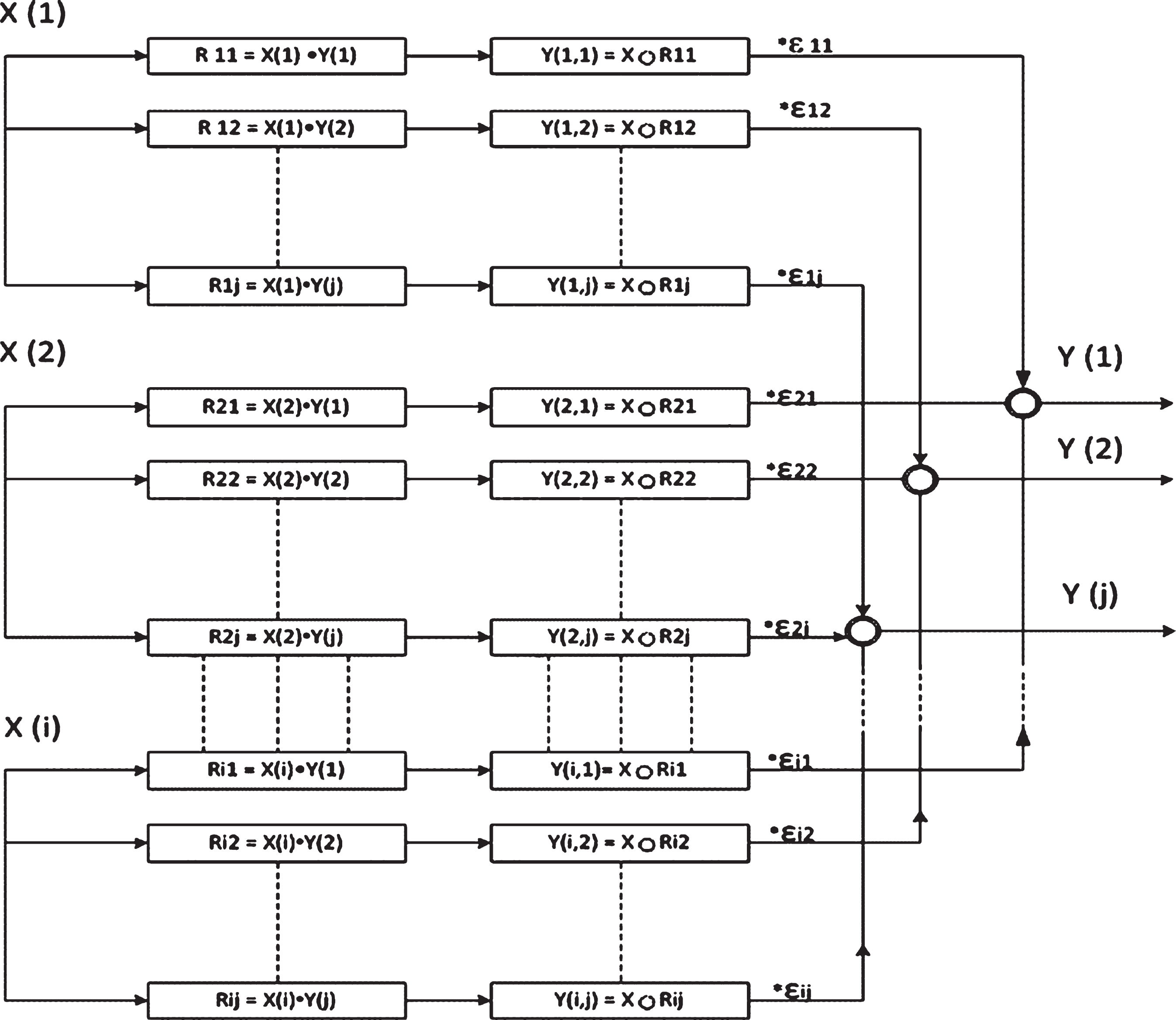
Many researchers adopted the modular approach principle when inferring the output of fuzzy systems. For example, Carrera et al. [35] proposed the use of modular fuzzy inference structure to conclude a decision in a supply chain environment where there is a need to optimize the right cost at the right time with the best quality from the right supplier. Lima et al. [36] present a supplier selection decision method based on fuzzy inference modeling of human reasoning which is advantageous when compared to approaches that combine fuzzy set theory with multi-criteria decision-making methods. Amindoust et al. [37] used a fuzzy inference mechanism to conclude the sustainability criteria for a given set of suppliers. Ling-Zhong et al. [38] used a modular approach for fuzzy inference to handle the impreciseness and uncertainty found in storing the image selection process. An example of the combination of intelligent techniques such as fuzzy logic and genetic algorithms can be seen in Melin et al. [39] as a genetic optimization approach of modular neural-fuzzy integration. Their methodology was applied to human recognition problems where the proposed algorithm was able to adjust the number of membership function/rules as well as the variation on the fuzzy set type of logic (type-1 or type-2).
In a similar hybrid type of intelligent techniques and to avoid the complexity of MIMO systems generated by maintaining complete and consistent rules, KOUATLI [33] proposed a modular approach by studying the biological structure of genes and chromosomes where each gene represents one rule connecting any one of the inputs with anyone with the outputs. Based on this, a chromosome can be defined in terms of pre-fixed number of rules representing the four fuzzy variables (P0, PS, PM, and PB). These chromosomes can then be constructed using “Input Importance Factor”, ɛ. The value of ɛ can be either normalized by the knowledge and intuition of the domain expert or can be deduced using the AHP technique proposed by Saaty [40, 41]. Based on this technique, Kouatli [42] also proposed to use this technique into the implementation area of a Fuzzy Taxi Scheduling System (FTSS) and discussing the theory in the form of a Student Advising System to predict student GPAs (Kouatli [43]). After comparing the proposed technique with the methodology of Mamdani-Sugeno, this paper describes another implementation of this Fuzzimetric sets with the use of a modular structure to measure the KPI of employee performance in organizations. Accordingly, this paper also proposes a customized application for decision making to determine the KPI of employee performance in a commercial environment. The proposed system is termed as the “Fuzzimetric Employee Evaluation System” (FEES).
Re-generation of hypothetical data reported by Ahmad et al. [5]
Re-generation of hypothetical data reported by Ahmad et al. [5]
Flexibility of 4 measurement levels
Hence, the output of the proposed prototype of FEES is in a form of a spectrum of possible outputs rather than a fixed discretized output. This conclusion leads to the following definition:
DS is the de-fuzzified output range using two different membership functions ranging the centroid of the set from a minimum to maximum possible values.
Comparison results of the FEES of the 5 main employees versus Ahmad et al data (2013)
Comparison results of the FEES of the 5 main employees versus Ahmad et al data (2013)
The variability options presented in Table 3 are needed because the performance measurement is dependent on the type of tasks or positions expected from the employee. For example, assume employee E5 (from Table 2) is simply a helpdesk operator, then leadership (score = 3/10) is not a necessary skill for his position, and it is not fair to measure performance based on this criterion. Conversely, planning capability = 0.3/1 and time management = 0.3/1 are necessary skills. To effectively measure the performance of an employee, the position type is matched to the expectations of that position before accurate measurement. Obviously, some contradictions can be noticed in this example (E5) where high dependability was observed (0.7/1) but low ethics were shown (2/10). Data from Ahmad et al. [5] was used, causing this contradiction that is not the true reflection of employee performance measurements. Additionally, some duplication in the criteria exists; for example, adaptability and versatility reflect the same performance measurement. Additionally, there was a typo in the data presented in Table 1 in Employee E4 where the score for quality of work was 900 while the maximum value should be 600 according to Ahmad et al. A similar typo exists in employee 5 where the score was 700. Hence, the proposed solution was considered out of 900 instead of 600, as shown in Fig. 5.
Snapshot of FEES menu with an example of employee KPI measurement.
Irrespective of the accuracy of the sampled data regenerated from Ahmed et al. [5], to effectively evaluate an employee, a template of expected high and low performance for each criterion has to be specified. Then, the employee will be evaluated based on the comparison of tasks requested according to a specific position template. Examples include 1st line support Template, 2nd line support Template, Analyst Template, and Team leader Template.
Instead of constructing templates in this paper, FEES provides multiple options to choose from when making a decision about employee performance. For example, if a manager noticed that the low-performance scores in some criteria are not relevant to a specific employee position, the manager may choose between the results of minimum or maximum Tolerance (MinTLS) and MaxTLS) with the ability to adjust these options (up or down). The adjustment is dependent on if the employee score was a minimum on both the expected and unexpected high criteria according to the position template or if the score is a maximum on these criteria or any combination of these two options, as seen in Table 3. Hence, by looking at Table 1 and the FEES results in Table 3, the flexibility and adaptability can be provided to a manager to choose the appropriate result for a specific employee in a specific position.
The output generated from Table 3 can be reproduced graphically, as shown in Fig. 6. The FEES output generates a range of possible solutions as defined in this paper as the De-fuzzified Spectrum (DS) starting from the Minimum Tolerance with Low Score (MinTLS) to the Maximum Tolerance of High Score (MaxTHS). Figure 6 shows that the Ahmad et al. [5] solution for most of the measured employees falls within the defined DS, with an exception of data for Employee 3 that falls outside this range and indicates that it either a typo error when entering the data (as opposed to the reported data) or a typo error when reporting the output.
Flexibility in decision-making using FEES. Employee 3 (E3) must be a mistake as the other E values are within the proposed solution range.
Difference between De-fuzzified outputs of Ahmad et al. (2013) and the proposed modular approach with Fuzzimetric sets
Employee performance evaluations is based on criteria combination of structured and non-structured fuzzy decision-making processes. This is due to the number of determinants, where some can be measured easily using simple mathematics (example: number of absences). The other determinants are fuzzy in nature, such as leadership performance, where there is no mathematical formula used to measure such an evaluation. In addition to this complexity, the nature of the position held by an individual may dictate which determinant should be weighed more than others. For example, leadership skills are not important for the 1st line support in a cloud-computing environment; discipline and commitment are more important for such a position.
Employee evaluation solution in such scenarios can be manifested by introducing fuzzy inference with a modular approach in a form of a decision support system for employee evaluation. The system proposed and built in this paper is the Fuzzy Employee Evaluation System (FEES). A comparative analysis between the proposed system and Mamdani-Sugeno inference system (MATLAB), manifested by the study of Ahmad et al. [5], has been conducted. By re-generating the same exercise conducted by Ahmad et al. [5], it was proven that Mamdani — Sugeno solution is only a subset of possible solutions produced by the proposed decision support system. The proposed FEES approach utilizes a Maximum and minimum definitions for each one of the proposed four fuzzimetric sets with a modular structure of rules to generate a De-fuzzified Spectrum (DS) of outputs. Hence, an appraisal manager can then rely on the spectrum with the association of employee position to decide on the appropriate output value of the spectrum.
When comparing the proposed technique with the technique tested by Ahmad et al. [5] using MATLAB, their solution was within the De-fuzzified-spectrum defined. However, one data point (E3) was outside spectrum, indicating that this specific dataset contained an error because all other datasets fall within the De-fuzzified Spectrum outputs.
One of the main objectives of this paper was to compare the MATLAB fuzzy inference using the Mamdani-Sugeno mechanism to the Fuzzimetric modular approach for fuzzy inference. The fuzzification process used a different modular approach, so all “fuzzy” parameters were kept in a similar manner to maintain consistency in comparison. Hence, not all adaptabilities and flexibilities are utilized in the final version of the FEES prototype. Further research is required to accurately conclude the determinants and how much they relate to a specific position type. Then, after identifying all position types in the organization, FEES can be modified to evaluate employees based on relevant determinants of their position types. Weighing factors such as the Input Importance Factor ɛ should then be evaluated based on a specific position template.
Future research
As discussed in the conclusion section FEES can be viewed as a constructed system to be used by a single appraisal manager. However, the fact that the system is composed of 20 parameters, some of which can be calculated automatically and others are inserted by different evaluators, then FEES can also be viewed as a group decision-making problem with a level of hesitation per each input. This hesitation stems from the following reasons:
The human nature of uncertainty When evaluating parameters, some of which are dependent on the type of the position held. This is where the multiset principle is valid where hesitant sets might need to be redefined per parameter as necessary to accommodate the type of position held by the employee. The use of hesitant fuzzy sets can be utilized to change the most appropriate weighted scale per position type. Accordingly, linguistic definitions might also have to be redefined per position type. The work of [18, 44] would be an appropriate mechanism to accommodate such hesitation. Employee evaluations problem can be seen as a multiple attribute group decision-making problem in some sense. This is due to the possibility of multiple evaluators involved in the evaluation with different consensus model when making decisions. Hence fuzziness within a group [16, 18] can be subjected to different levels of hesitations when contributing to the evaluation of an employee. Possible Interactive and automatic feedback mechanisms can be utilized to achieve a solution with consistency and consensus levels [20, 27]. The linguistic terminology used by different evaluators. In this sense “computing with words” can be useful to more accurately interpret the linguistic term to an appropriate numerical value. An extension of the hesitant fuzzy set developed by [19, 44], termed as hesitant fuzzy linguistic term sets (HFLTSs) can help towards developing the next version of FEES.