



Abstract
Wireless Sensor Network comprises several sensor nodes which communicate with each other for data forwarding. The node senses, computes, and transfers the data to the so-called base station. The applications of WSNs include nuclear power plants, environmental monitoring, disaster surveillance, agricultural control and security. The lifespan is an essential constraint in the design part of routing in a sensor network environment. The main purpose is to minimize the consumption of energy in data sharing (transmission and reception) and extend the network lifespan using the Cluster Optimized Routing Protocol (CORP). This work improves upon the existing model by selecting the near optimal cluster head for data transmission till the data reaches the sink. The proposed system may decrease energy consumption in data forwarding and perhaps prolong the lifespan of the node. By this approach, we tend to increase the energy efficiency and enhance the network’s lifetime. The results of the analysis and simulation indicate the performance of the proposed system is far better than the currently used comparative protocols.
Introduction
Sensor nodes are small sized devices or modules that detect events and/or changes in their environment such as temperature, pressure, moisture, humidity, chemical concentration, sound wave, light intensity, etc. These devices are proficient enough to receive, process and transmit the units of data. Communication takes place with their neighbor nodes and then the sink. A few applications like military surveillance, ocean monitoring, volcano detection need a real-time report for further progression. So the sensor network is an unavoidable field of academic research. Usually, the nodes are thrown in hazardous areas where human beings can’t reach. Therefore, all the sensor nodes are constrained by power, high and low frequency, processing capabilities, storage capacity and estimated computational competences. The routing protocols help to route the data and also minimizes the energy consumption of the node[1, 2]. One of the most common and efficient used approaches is clustering. In cluster-based WSN, the neighbor nodes create a cluster as well as choose a cluster head (CH) for the conveyance of data. The nodes transmit the received information to the CH, enabling intra-cluster communication to occur via the CH till the data reaches the sink. The clusters provide the collection of nodes and hence, more nodes are added to the cluster to improve its performance. The efficiency, reliability and speed of the network can be achieved through clustering. Network performances improve as the load is spread across multiple nodes.
Flooding is a technique where the incoming packet is sent to all the outgoing links [3].The disadvantage of flooding is the generation of duplicate packets in the network. The Sensor region is deluged with dozens of incomplete requests. This mechanism works without the need of the routing algorithm. It provides all the access routes that reach the terminal end; simultaneously, there is a chance of duplication count. Selective Flooding is also successfully used as it sends the data that follows a single right direction. In Direct Diffusion the sink sends a request, and it reaches the node which saves the path back to the sink [4, 5]. The data available at a node are sent back to the sink through a specific path. Directed diffusion consists of distinct elements such as interest propagation and gradient setup. An interest propagation consists of a query which cites what is essential at the user end. Each request consists of a task with the prescribed description which is sustained by the network for archiving the data. The data can take place as a phase, which gives a precise depiction of the changes in the network region. The direct diffusion contains attribute values paired data. A protocol named Sensor Protocols for Information via Negotiation (SPIN) is used for spreading the information in a wireless network region [6]. SPIN is an adaptive routing protocol that describes the data for negotiation using high-level naming and eliminates data traversal in the network. This technique assures that data redundancy does not take place in the network. It also accesses the node at the current energy level and protocol is adopted. SPIN is energy efficient and quick when compared with flooding. The elongation of a sensor node’s lifetime is crucial in WSN. A prolonged lifetime can be achieved by decreasing the energy consumption during data processing and transmission. Thus, with the help of proposed system, the energy consumed during the data transmission has been reduced by selecting optimized CH for each cluster and efficient relay node for data transmission to the base station (BS). The load was balanced throughout the network which tend to increase the number of iterations and minimize consumed energy. Thus, the design of energy efficient routing protocol helps to enhance the network’s performance and lifespan.
This research paper is customized as follows: The related works of the system is described in section 2. Sections 3 and 4 display the network and energy consumption model respectively. Section 5 describes the CORP protocol. The results of the simulation and discussion are given in section 6. Finally in section 7, the conclusion is discussed.
Related works
The traditional protocol, Low-Energy Adaptive Clustering Hierarchy (LEACH) selects CHs at random and establishes the cluster structure. The improvement in LEACH with the central control method is termed as LEACH – Centralized (LEACH-C). The initial selection of the CH is done based on random probability and the CH advertises the neighbor nodes to join as a cluster member [7, 8]. The cluster members transmit the data with the energy to the CH using Time-division multiple access (TDMA) and turns to sleep mode if time still exits. Since LEACH-C is a single-hop communication system, the CHs transit the fused data to the sink directly and from the second round BS computes the energy level of the nodes. The set of nodes having the energy above the average are taken as CH and this information is broadcast to the entire network. When the nodes ID matches with the broadcast ID, that node is assigned as the CH throughout the period of that round. LEACH-C provides equal distribution of energy consumption between the available nodes, which is considered to be the major advantage over LEACH.
The goal of the Hierarchical and Energy Optimized Clustering (HEOC) protocol lies in energy conservation and overhead control when the data is transmitted from the available source to the sink through hierarchical clustering [9, 10]. The clusters get organized as per the density of the node present in the environment. The node characterized with highest degree is considered as the CH for that round. The degree of the node is calculated depending on the proximity and transit range. The nodes forward the data to the CH with the adaptive transmission power depending on the strength of the signal received from the CH. This capability varies with each node adding to energy conservation. The CH aggregates the data and maintains the record of the node with the highest residual energy within the cluster. On the next iteration, the recorded node is exclusively chosen as the new CH and the same procedure is carried on for further iterations until the threshold value is reached. To prevent data from corruption and reduce energy loss in the intra cluster, the TDMA approach is used. The inter cluster communication deals with communication among the CHs to choose the most optimal CH which combines the data acquired from other CHs and dispatch it to the sink. The nodes that are excluded from the cluster communicate with the nearest node in a linear path to reach the closest CH. The Dijkstra’s approach helps in finding the shortest route to reach the BS. Thus, balancing the energy depletion across the network is done in each round.
The objective of the Threshold Sensitive Dynamic Cluster Head (TDCH) protocol is not only limited to energy conservation in data transmission but also to have a comparatively high packet reception ratio [11–13]. TDCH functions similar to the General Self-Organized Tree-Based Energy-Balance Routing Protocol (GSTEB) where the BS assigns the root CH as it contains the highest energy as well as floods the information to all the nodes. The nodes share the message with their neighbor nodes in the sensor region. The nodes which have the maximum residual energy are chosen as CH for the round. The source node communicates with the CHs using the soft threshold (Ts) which depends on small changes in the volume of the sensed data. The variance between the data set which is transmitted to the CH is very small. The communication between the CHs and the root CH is established by employing the hard threshold (Th) where the data is aggregated and sent to the BS. Thus, by employing a soft threshold (Ts) and hard threshold (Th) in intra-cluster and inter-cluster data transmission, respectively, the node’s lifetime can be increased by minimizing the energy dissipated in data transmission, so that it has a higher packet reception ratio.
The Heuristic Algorithm for Clustering Hierarchy (HACH) protocol is a clustering approach that performs the operation of the clustering mechanism with inactive nodes selecting the low energy nodes based on a stochastic process that should not affect the network coverage [14–16]. The maximum coverage effect is employed in the network to pick the inactive nodes for maintaining the coverage area. The sink computes the Euclidean distance between itself and the nodes. The computations are based on the coordinates and energy values received by the sink from all the nodes. BS floods the information about the selection of the CH in the network. If the node ID and the ID received by the node are the same, then that node will be the CH. The CH selection deals with a heuristic crossover approach that is spatially distributed in the sensory region; the selected CH has high energy.
Network model
The nodes are arranged randomly in a rectangular network region to audit the environment continuously. ‘N’ represents the total number of nodes, where N ={ n1, n2, … . . , nn }. Assumptions are carried out in the sensing region and nodes to design the CORP Protocol. These consist of a single Base Station which is placed above the sensing region. The nodes and BS take a firm position in the network region. At the initial levels the nodes have the same energy, thus the uniformity is maintained in the network. The BS interacts with the CH after the acknowledgement. The transmission power is adjusted depending on the length of distance of the Acceptor.
Figure 1 shows the architecture of the CORP. In each and every routine, the system employs a dynamic CH selection and dynamic relay node selection. The communication is based on the near optimal path approach.

System Architecture of CORP.
The energy needed for data transmission is dependent on transmission circuitry and the length of the data being transmitted. Similarly, even the energy required for receiving is dependent on the same factors. The energy needed to transmit a unit of data is:
The energy required to receive a unit of data is
Where, E ele (l) is the energy consumption per bit of transceiver circuitry. Depending on the transmission range, freespace (d2) or multipath (d4) propagation is used. E amp (l, d) is the amplification energy of the data with distance, d.
Cluster optimized routing protocol
The role of the CORP is to reduce the energy dissipation and overhead of CH while imparting the data from the source nodes to the sink through a cluster optimized protocol using BS as the control [17–23]. In this approach, the nodes are arranged randomly over a sensor field. The relay nodes are computed by BS and sent to all the CHs. The shortest path approach was employed to forward the data to BS.
The operation of the CORP consists of 3 phases, namely Formation of Cluster and Selection of CH Optimization in Relay using Ant colony approach Data Transmission and Forwarding
Formation of cluster and selection of cluster head
Initially, the tentative CHs are chosen by using the randomized approach. Using fuzzy logic, the fuzzy inference system uses the energy and distance between the node as an input parameter and fuzzy cost as an output parameter. The fuzzy cost is the computation of the euclidean distance and the residual energy. Each tentative CH broadcasts its fuzzy cost. If the other tentative CH has the minimum fuzzy cost within the competition radius, then the node will announce itself as the current_CH for the round to the members by broadcasting.
Where F
k
is the fuzzy cost of node k. d (k, q) is the euclidean distance between node k and node q. q is the previous CH of the cluster. E
k
is the residual energy of node k and α is a constant specifying the distribution of the cluster. As a result the CH is selected as,
Where CH x is the selected cluster head of clusterx. F p is the Fuzzy cost of node p calculated in Equation 1. Min () indicates the ‘minimum of’ operation. A cluster is the set of nodes. The selected CH broadcasts a signal indicating the selection result to all the neighboring nodes. On receiving the broadcast signal, the node switches on the transmitter and transfers the data with the required transmitting energy as per the strength of the broadcast signal obtained from the CH. If a node receives more than one broadcast signal, it sends the data to the CH whose broadcast signal strength is high (since the node is closer than the other). The CHs receive data from the source nodes using TDMA to avoid data loss and data corruption, thus reducing the energy consumption in the intra-cluster data transfer.
The energy consumed by the CH includes the energy of data reception, data fusion, and data transmission. The energy of data transmitted includes the length of the data and energy required for the transmitter circuitry in addition to the energy required for amplification to forward the data through free space propagation, if d < do. The consumption of energy in the cluster head (CH) for transmission of data is given as:
Similarly, the energy of data reception includes the length of the data and energy required for receiver circuitry. The energy consumption of the cluster member (CM) for data transmission is given as,
The total consumption of energy for the single cluster includes the consumption of energy for the cluster member of the cluster in intra cluster communication in addition to the consumed energy of the CH in the given cluster. The clusters’ total energy consumption is given by,
Substituting (3) and (4) in (5), we get,
Since ‘N’ represents the total number of nodes and ‘M’ indicates the sensor region in the network, the optimum number of clusters is identified using the equation,
The consumption of energy for the entire network is the product of consumption of energy for the single cluster and the optimal number of clusters, K
opt
in the sensor region. The total consumption of energy in the network is given by,
Threshold energy is the value of energy above which the node acts as the CH. When the node energy is lesser than the threshold, the node would not be a CH. Threshold energy measures the energy needed for accepting, aggregating and transmitting the data and is given by,
The synoptic arrangement of the proposed system is shown in Fig. 2. The synoptic overview displays the operations of the proposed system, starting from the initialization of the nodes, selection of CH and relay nodes, and ending with data transmission to BS using shortest path.
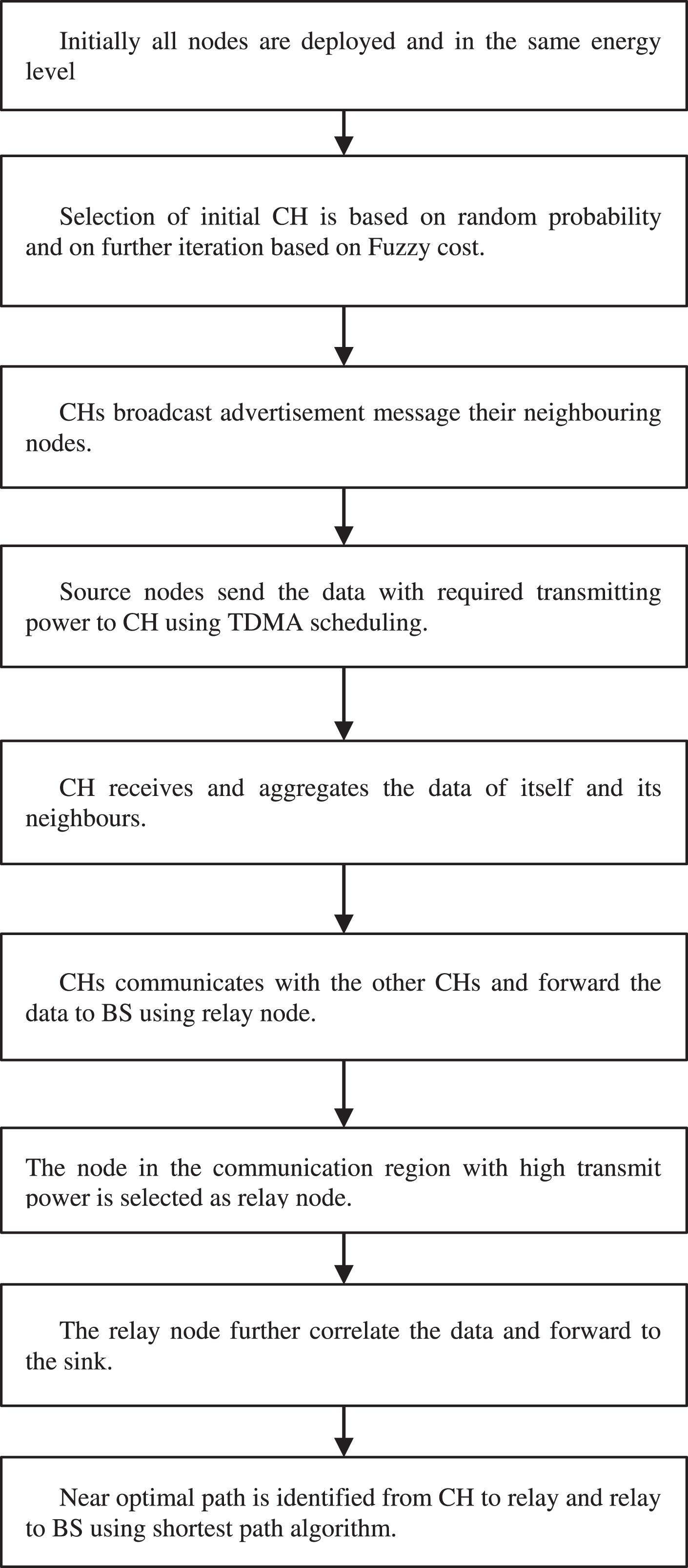
Synoptic overview of CORP.
The relay node in the communication region receives the data from the CH where it correlates and forwards the data to BS. The selection is a variation of Ant colony optimization in which the minimal path is found based on the pheromone left by the ants in the respective paths. In CORP, the relay node is selected based on the left- over pheromone (i.e., energy). The pheromone energy in the path from the CHs to the sink via the nodes in communication region is given by,
This phase focuses in routing the packets from each source node to the respective destination node. The source nodes pass the data further to their CH. This CH communicates with another CH to reach the relay node. Likewise, the relay node sends the data to the BS. The system employs the Bellman Ford approach in spotting the right route to transmit the data.
The residual energy, Re is identified for the CH and is represented as
Where D(CH,SINK) (t) is the near optimal path of the round for the data transmission towards the sink. The approach continues for each and every iteration to find the best path towards the sink.
The algorithm of the CORP is illustrated below: The sensor nodes are placed randomly over the region The nodes send the energy and its location data to BS Initially BS clusters the nodes and CHs are selected based on high degree For further iterations, eeF is calculated for each node by the BS Node p is selected as CH of that cluster if eeF(p) is minimized in the cluster The relay node is selected using optimization in Ei and Pi from the nodes in the communication region BS broadcasts the selection result to the nodes CH broadcasts an indication signal to the neighbor nodes Source nodes turn the transmitter with the required power based on the RSSI value received from the CHs Source nodes send data to their respective CHs using TDMA scheduling CHs receive and aggregate the data within their cluster CHs initiate the inter-cluster communication The shortest path to the relay node is found using the bellman-ford algorithm D(CH,sink) and Re are calculated by the BS CH sends data to the relay node via the shortest path Relay node correlates the entire data and transmits to the BS This process is repeated until all the nodes sense the data
The simulation was done using a Matlab simulator. The simulation results are projected in graph and shown in Figs. 3–8. For the simulation, about 500 sensor nodes are randomly deployed in a 500×500 m2 sensor region. The sensor nodes are initially powered with 0.5 J. The data size of the packet is set as 4000bits. The minimum threshold energy is set as 10-4 J. The energy consumption per bit Eele, free space propagation ɛfs and multipath propagation ɛmp are set as 50 nJ/bit, 10 pJ/bit/m2 and 0.0013 pJ/bit/m4 respectively. Also, the constants α, β, γ are set as 0.3333. The values of the simulation parameters for the given scheme are given in Table 1.
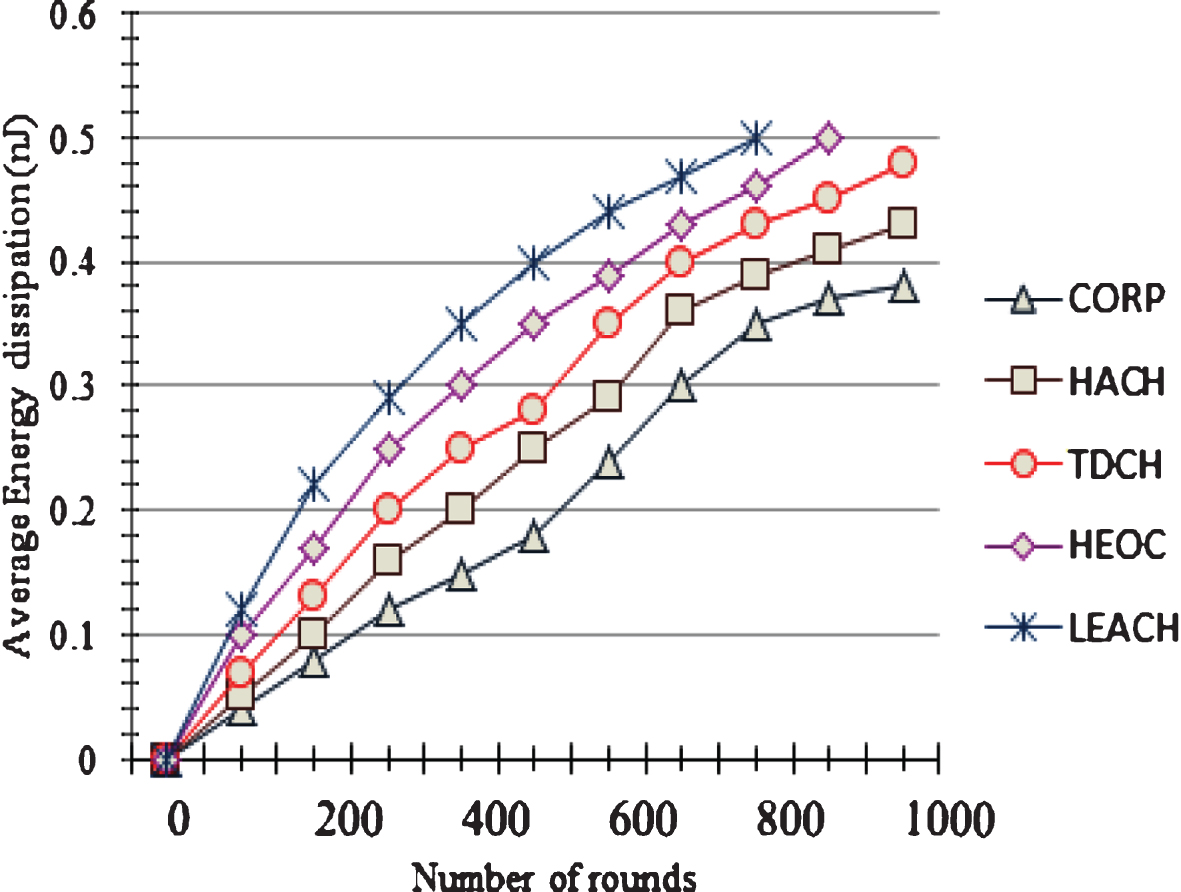
Comparison of average energy dissipation.

Existence of nodes under each round.

Number of rounds at first node dies.

Formation of Clusters under each round.
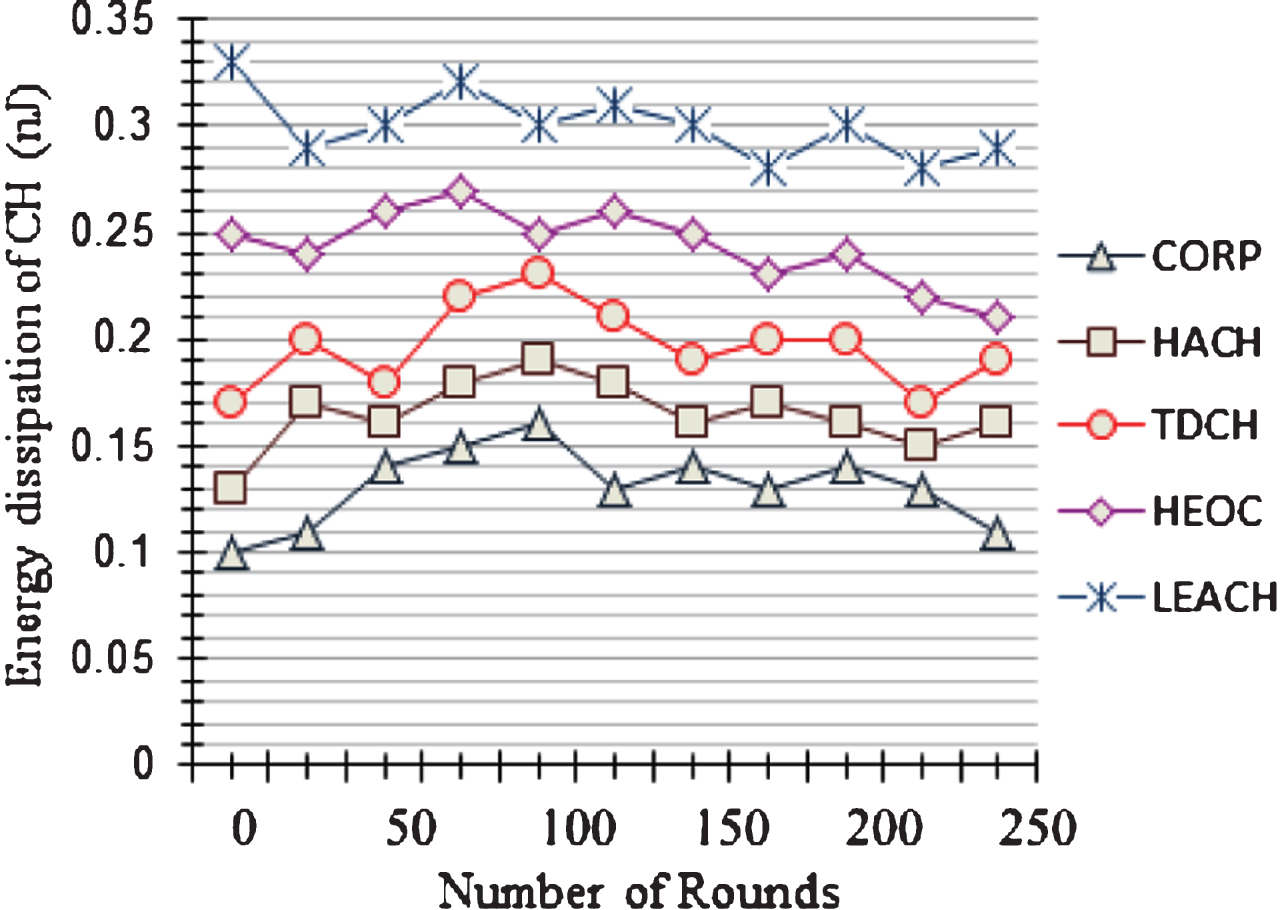
Energy dissipation of CH under each round.
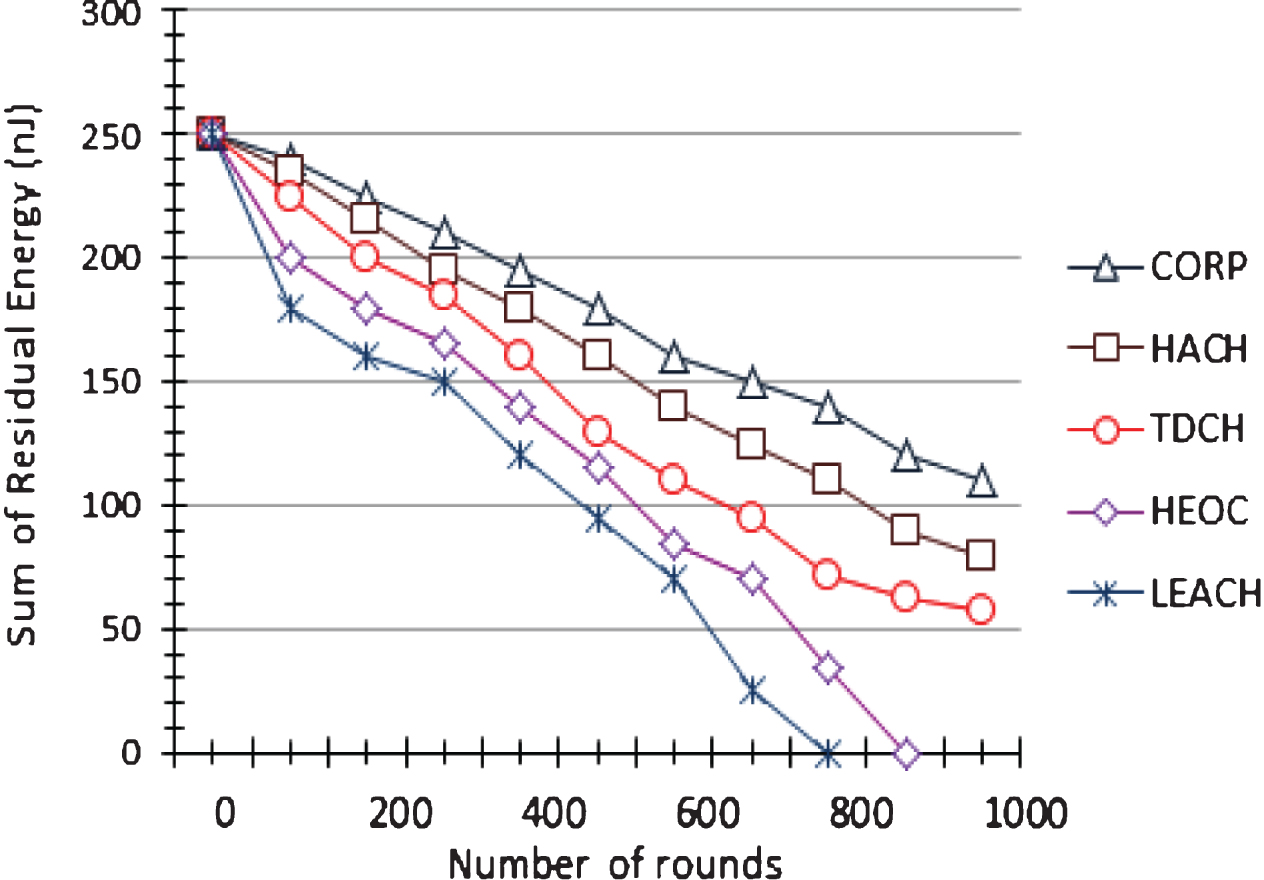
Sum of Residual Energy under each round.
Simulation parameters
The number of communication rounds increases when compared with the other protocols like LEACH, HEOC, TDCH and HACH. The network lifespan is proportional to the number of communication rounds. Figure 3 illustrates the average energy dissipation for all the nodes. The average dissipation energy at 1000 thousand rounds are 0.48 nJ, 0.43 nJ, 0.38 nJ for TDCH, HACH and CORP respectively, where as LEACH and HEOC dissipate 0.5 nJ at 800 and 900 rounds respectively.
In the proposed system, the number of live nodes is higher while comparing with LEACH, HEOC, TDCH and HACH protocols associated with the number of rounds. Figure 4 displays the number of alive nodes in each iteration. At 1000 thousand rounds, CORP, HACH and TDCH have 100, 50, 25 alive nodes respectively, where as in HEOC and LEACH all nodes are dead at 900 and 800 rounds respectively.
Figure 5 displays the death of the first node for each protocol. The first node dies at round 180, 290, 315, 405 and 510 for LEACH, HEOC, TDCH, HACH and CORP respectively.
Figure 6 and Table 2 plot the formation of clusters in the network in each round and improvement achieved by CORP. In the proposed system, the number of clusters increased when compared with the operations of protocols like LEACH, HEOC, TDCH and HACH. The parameter which we considered is the clusters formed at the end of 1000 rounds. A Total of 79, 89, 105, 135 and 145 clusters are formed by LEACH, HEOC, TDCH, HACH and CORP protocol respectively. This indicates that the proposed system CORP has an improved efficiency of 83.54%, 62.92%, 38.10% and 7.41% over LEACH, HEOC, TDCH and HACH protocols respectively.
Improvement achieved under each round during the formation of clusters by CORP
Figure 7 plots the dissipated energy of the CH with the existing protocol. The energy consumed by the CH in CORP is 0.11 nJ for 250 iterations which is less than that of the existing systems like LEACH, HEOC, TDCH and HACH protocols, which is 0.29 nJ, 0.21 nJ, 0.19 nJ and 0.16 nJ respectively.
Figure 8 and Table 3 plot the sum of residual energy during each round and improvement achieved by CORP. The sum of residual energy at 1000 rounds are 48 nJ, 80 nJ and 110 nJ for TDCH, HACH and CORP. This indicates that the proposed system CORP has an improved efficiency by 89.66% and 37.50% over TDCH and HACH protocols respectively.
Improvement achieved by CORP in the sum of Residual Energy under each round
From the projected graphs of the simulation results, it is concluded that CORP has a lower energy dissipation, an increase in the number of clusters and sum of residual energy consumed is low as compared with the preceded HEOC, TDCH, LEACH and HACH protocols, thus increasing the lifetime of the nodes. Thus, the proposed system distributes the energy evenly among all the nodes and further maximizes the number of transmission rounds and reduces the energy consumption.
According to the features of the problem, in this paper, the main ideology focuses in optimizing the energy of CHs in the network region with increased lifespan. The objective of the present research is to decrease the consumption of energy in the clustering region. According to the results of the study, it was observed that the CORP protocol surpasses the existing protocols. The protocol CORP minimizes the energy consumption. As we know, minimized energy consumption results in increased network lifetime. In this protocol, the concentration of nodes alive was increased and consequently, the dead nodes also decreased. CORP protocol intensifies the span of the nodes by selecting the CH depending on the energy and the distance between them. MATLAB is used to determine the simulation results. The results predict that CORP has exceeded the existing protocols in terms of residual energy and the energy dissipated by the CHs. The Simulation results obtained, maintain a stabilized distribution of energy among all nodes present in the sensor region which enhances the network’s lifespan. The nodes’ lifetime and data characteristics are compared with the help of the simulation results. The result can be modified and improvement is possible in the future work of cluster head selection.